Distributed DBMS © M. T. Özsu & P. Valduriez Ch.1/1
Outline
• Introduction
➡ What is a distributed DBMS
➡ Distributed DBMS Architecture
• Background
• Distributed Database Design
• Database Integration
• Semantic Data Control
• Distributed Query Processing
• Multidatabase query processing
• Distributed Transaction Management
• Data Replication
• Parallel Database Systems
• Distributed Object DBMS
• Peer-to-Peer Data Management
• Web Data Management
• Current Issues
Distributed DBMS © M. T. Özsu & P. Valduriez Ch.1/2
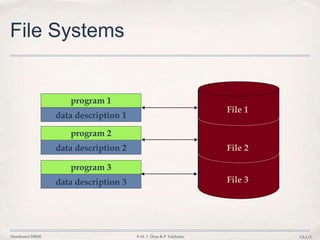
File Systems
program 1
data description 1
program 2
data description 2
program 3
data description 3
File 1
File 2
File 3
Distributed DBMS © M. T. Özsu & P. Valduriez Ch.1/3
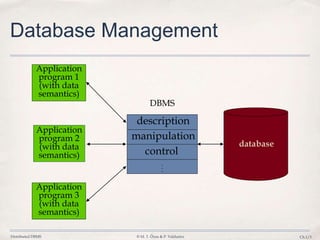
Database Management
database
DBMS
Application
program 1
(with data
semantics)
Application
program 2
(with data
semantics)
Application
program 3
(with data
semantics)
description
manipulation
control
Distributed DBMS © M. T. Özsu & P. Valduriez Ch.1/4
Motivation
Database
Technology
Computer
Networks
integration distribution
integration
integration ≠ centralization
Distributed
Database
Systems
Distributed DBMS © M. T. Özsu & P. Valduriez Ch.1/5
Distributed Computing
• A number of autonomous processing elements (not necessarily
homogeneous) that are interconnected by a computer network and that
cooperate in performing their assigned tasks.
• What is being distributed?
➡ Processing logic
➡ Function
➡ Data
➡ Control
Distributed DBMS © M. T. Özsu & P. Valduriez Ch.1/6
What is a Distributed Database
System?
A distributed database (DDB) is a collection of multiple, logically
interrelated databases distributed over a computer network.
A distributed database management system (D–DBMS) is the software
that manages the DDB and provides an access mechanism that makes this
distribution transparent to the users.
Distributed database system (DDBS) = DDB + D–DBMS
Distributed DBMS © M. T. Özsu & P. Valduriez Ch.1/7
What is not a DDBS?
• A timesharing computer system
• A loosely or tightly coupled multiprocessor system
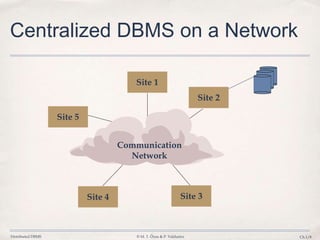
• A database system which resides at one of the nodes of a network of
computers - this is a centralized database on a network node
Distributed DBMS © M. T. Özsu & P. Valduriez Ch.1/8
Centralized DBMS on a Network
Site 5
Site 1
Site 2
Site 3Site 4
Communication
Network
Distributed DBMS © M. T. Özsu & P. Valduriez Ch.1/9
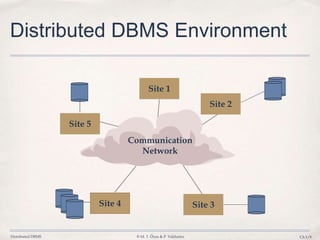
Distributed DBMS Environment
Site 5
Site 1
Site 2
Site 3Site 4
Communication
Network
Distributed DBMS © M. T. Özsu & P. Valduriez Ch.1/10
Implicit Assumptions
• Data stored at a number of sites  each site logically consists of a single
processor.
• Processors at different sites are interconnected by a computer network 
not a multiprocessor system
➡ Parallel database systems
• Distributed database is a database, not a collection of files  data logically
related as exhibited in the users’ access patterns
➡ Relational data model
• D-DBMS is a full-fledged DBMS
➡ Not remote file system, not a TP system
Distributed DBMS © M. T. Özsu & P. Valduriez Ch.1/11
Data Delivery Alternatives
• Delivery modes
➡ Pull-only
➡ Push-only
➡ Hybrid
• Frequency
➡ Periodic
➡ Conditional
➡ Ad-hoc or irregular
• Communication Methods
➡ Unicast
➡ One-to-many
• Note: not all combinations make sense
Distributed DBMS © M. T. Özsu & P. Valduriez Ch.1/12
Distributed DBMS Promises
Transparent management of distributed, fragmented, and replicated data
Improved reliability/availability through distributed transactions
Improved performance
Easier and more economical system expansion
Distributed DBMS © M. T. Özsu & P. Valduriez Ch.1/13
Transparency
• Transparency is the separation of the higher level semantics of a system
from the lower level implementation issues.
• Fundamental issue is to provide
data independence
in the distributed environment
➡ Network (distribution) transparency
➡ Replication transparency
➡ Fragmentation transparency
✦ horizontal fragmentation: selection
✦ vertical fragmentation: projection
✦ hybrid
Distributed DBMS © M. T. Özsu & P. Valduriez Ch.1/14
Example
Distributed DBMS © M. T. Özsu & P. Valduriez Ch.1/15
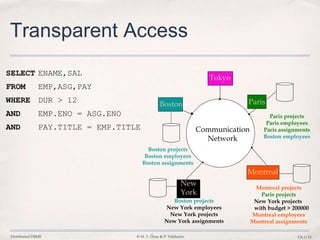
Transparent Access
SELECT ENAME,SAL
FROM EMP,ASG,PAY
WHERE DUR > 12
AND EMP.ENO = ASG.ENO
AND PAY.TITLE = EMP.TITLE
Paris projects
Paris employees
Paris assignments
Boston employees
Montreal projects
Paris projects
New York projects
with budget > 200000
Montreal employees
Montreal assignments
Boston
Communication
Network
Montreal
Paris
New
York
Boston projects
Boston employees
Boston assignments
Boston projects
New York employees
New York projects
New York assignments
Tokyo
Distributed DBMS © M. T. Özsu & P. Valduriez Ch.1/16
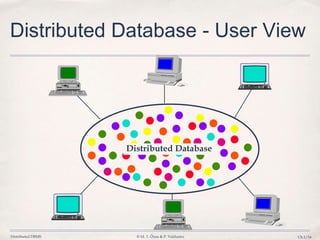
Distributed Database - User View
Distributed Database
Distributed DBMS © M. T. Özsu & P. Valduriez Ch.1/17
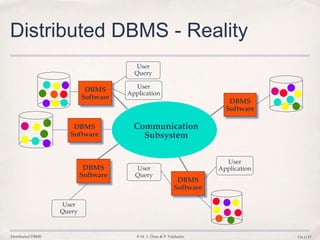
Distributed DBMS - Reality
Communication
Subsystem
DBMS
Software
User
ApplicationUser
Query
DBMS
Software
DBMS
Software
DBMS
Software
User
Query
DBMS
Software
User
Query
User
Application
Distributed DBMS © M. T. Özsu & P. Valduriez Ch.1/18
Types of Transparency
• Data independence
• Network transparency (or distribution transparency)
➡ Location transparency
➡ Fragmentation transparency
• Replication transparency
• Fragmentation transparency
Distributed DBMS © M. T. Özsu & P. Valduriez Ch.1/19
Reliability Through Transactions
• Replicated components and data should make distributed DBMS more
reliable.
• Distributed transactions provide
➡ Concurrency transparency
➡ Failure atomicity
• Distributed transaction support requires implementation of
➡ Distributed concurrency control protocols
➡ Commit protocols
• Data replication
➡ Great for read-intensive workloads, problematic for updates
➡ Replication protocols
Distributed DBMS © M. T. Özsu & P. Valduriez Ch.1/20
Potentially Improved
Performance
• Proximity of data to its points of use
➡ Requires some support for fragmentation and replication
• Parallelism in execution
➡ Inter-query parallelism
➡ Intra-query parallelism
Distributed DBMS © M. T. Özsu & P. Valduriez Ch.1/21
Parallelism Requirements
• Have as much of the data required by each application at the site where the
application executes
➡ Full replication
• How about updates?
➡ Mutual consistency
➡ Freshness of copies
Distributed DBMS © M. T. Özsu & P. Valduriez Ch.1/22
System Expansion
• Issue is database scaling
• Emergence of microprocessor and workstation technologies
➡ Demise of Grosh's law
➡ Client-server model of computing
• Data communication cost vs telecommunication cost
Distributed DBMS © M. T. Özsu & P. Valduriez Ch.1/23
Distributed DBMS Issues
• Distributed Database Design
➡ How to distribute the database
➡ Replicated & non-replicated database distribution
➡ A related problem in directory management
• Query Processing
➡ Convert user transactions to data manipulation instructions
➡ Optimization problem
✦ min{cost = data transmission + local processing}
➡ General formulation is NP-hard
Distributed DBMS © M. T. Özsu & P. Valduriez Ch.1/24
Distributed DBMS Issues
• Concurrency Control
➡ Synchronization of concurrent accesses
➡ Consistency and isolation of transactions' effects
➡ Deadlock management
• Reliability
➡ How to make the system resilient to failures
➡ Atomicity and durability
Distributed DBMS © M. T. Özsu & P. Valduriez Ch.1/25
Directory
Management
Relationship Between Issues
Reliability
Deadlock
Management
Query
Processing
Concurrency
Control
Distribution
Design
Distributed DBMS © M. T. Özsu & P. Valduriez Ch.1/26
Related Issues
• Operating System Support
➡ Operating system with proper support for database operations
➡ Dichotomy between general purpose processing requirements and database
processing requirements
• Open Systems and Interoperability
➡ Distributed Multidatabase Systems
➡ More probable scenario
➡ Parallel issues
Distributed DBMS © M. T. Özsu & P. Valduriez Ch.1/27
Architecture
• Defines the structure of the system
➡ components identified
➡ functions of each component defined
➡ interrelationships and interactions between components defined
Distributed DBMS © M. T. Özsu & P. Valduriez Ch.1/28
ANSI/SPARC Architecture
External
Schema
Conceptual
Schema
Internal
Schema
Internal view
Users
External
view
Conceptual
view
External
view
External
view
Distributed DBMS © M. T. Özsu & P. Valduriez Ch.1/29
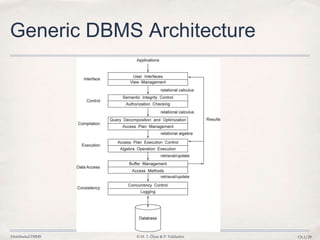
Generic DBMS Architecture
Distributed DBMS © M. T. Özsu & P. Valduriez Ch.1/30
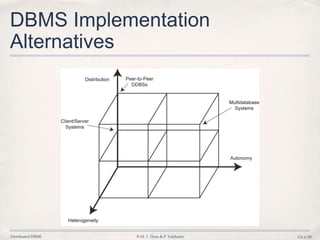
DBMS Implementation
Alternatives
Distributed DBMS © M. T. Özsu & P. Valduriez Ch.1/31
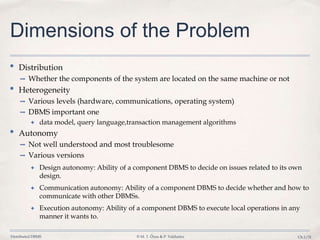
Dimensions of the Problem
• Distribution
➡ Whether the components of the system are located on the same machine or not
• Heterogeneity
➡ Various levels (hardware, communications, operating system)
➡ DBMS important one
✦ data model, query language,transaction management algorithms
• Autonomy
➡ Not well understood and most troublesome
➡ Various versions
✦ Design autonomy: Ability of a component DBMS to decide on issues related to its own
design.
✦ Communication autonomy: Ability of a component DBMS to decide whether and how to
communicate with other DBMSs.
✦ Execution autonomy: Ability of a component DBMS to execute local operations in any
manner it wants to.
Distributed DBMS © M. T. Özsu & P. Valduriez Ch.1/32
Client/Server Architecture
Distributed DBMS © M. T. Özsu & P. Valduriez Ch.1/33
Advantages of Client-Server
Architectures
• More efficient division of labor
• Horizontal and vertical scaling of resources
• Better price/performance on client machines
• Ability to use familiar tools on client machines
• Client access to remote data (via standards)
• Full DBMS functionality provided to client workstations
• Overall better system price/performance
Distributed DBMS © M. T. Özsu & P. Valduriez Ch.1/34
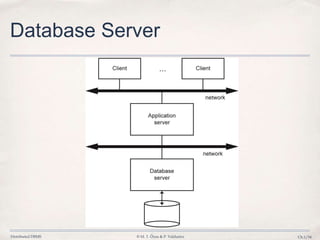
Database Server
Distributed DBMS © M. T. Özsu & P. Valduriez Ch.1/35
Distributed Database Servers
Distributed DBMS © M. T. Özsu & P. Valduriez Ch.1/36
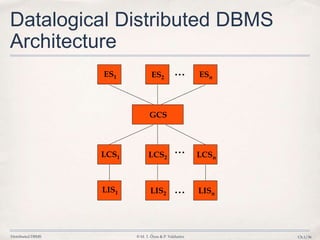
Datalogical Distributed DBMS
Architecture
...
...
...
ES1 ES2 ESn
GCS
LCS1 LCS2 LCSn
LIS1 LIS2 LISn
Distributed DBMS © M. T. Özsu & P. Valduriez Ch.1/37
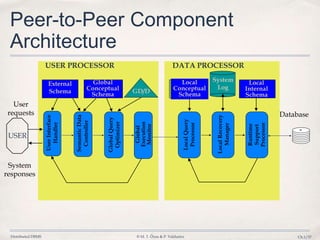
Peer-to-Peer Component
Architecture
Database
DATA PROCESSORUSER PROCESSOR
USER
User
requests
System
responses
External
Schema
UserInterface
Handler
Global
Conceptual
Schema
SemanticData
Controller
Global
Execution
Monitor
System
Log
LocalRecovery
Manager
Local
Internal
Schema
Runtime
Support
Processor
LocalQuery
Processor
Local
Conceptual
Schema
GlobalQuery
Optimizer
GD/D
Distributed DBMS © M. T. Özsu & P. Valduriez Ch.1/38
Datalogical Multi-DBMS
Architecture
...
GCS… …
GES1
LCS2 LCSn…
…LIS2 LISn
LES11 LES1n LESn1 LESnm
GES2 GESn
LIS1
LCS1
Distributed DBMS © M. T. Özsu & P. Valduriez Ch.1/39
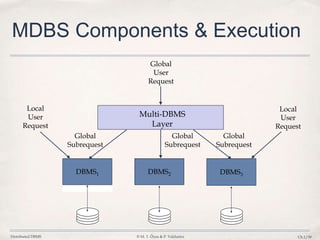
MDBS Components & Execution
Multi-DBMS
Layer
DBMS1 DBMS3DBMS2
Global
User
Request
Local
User
Request
Global
Subrequest
Global
Subrequest
Global
Subrequest
Local
User
Request
Distributed DBMS © M. T. Özsu & P. Valduriez Ch.1/40
Mediator/Wrapper Architecture

1 introduction

  • 1.
    Distributed DBMS ©M. T. Özsu & P. Valduriez Ch.1/1 Outline • Introduction ➡ What is a distributed DBMS ➡ Distributed DBMS Architecture • Background • Distributed Database Design • Database Integration • Semantic Data Control • Distributed Query Processing • Multidatabase query processing • Distributed Transaction Management • Data Replication • Parallel Database Systems • Distributed Object DBMS • Peer-to-Peer Data Management • Web Data Management • Current Issues
  • 2.
    Distributed DBMS ©M. T. Özsu & P. Valduriez Ch.1/2 File Systems program 1 data description 1 program 2 data description 2 program 3 data description 3 File 1 File 2 File 3
  • 3.
    Distributed DBMS ©M. T. Özsu & P. Valduriez Ch.1/3 Database Management database DBMS Application program 1 (with data semantics) Application program 2 (with data semantics) Application program 3 (with data semantics) description manipulation control
  • 4.
    Distributed DBMS ©M. T. Özsu & P. Valduriez Ch.1/4 Motivation Database Technology Computer Networks integration distribution integration integration ≠ centralization Distributed Database Systems
  • 5.
    Distributed DBMS ©M. T. Özsu & P. Valduriez Ch.1/5 Distributed Computing • A number of autonomous processing elements (not necessarily homogeneous) that are interconnected by a computer network and that cooperate in performing their assigned tasks. • What is being distributed? ➡ Processing logic ➡ Function ➡ Data ➡ Control
  • 6.
    Distributed DBMS ©M. T. Özsu & P. Valduriez Ch.1/6 What is a Distributed Database System? A distributed database (DDB) is a collection of multiple, logically interrelated databases distributed over a computer network. A distributed database management system (D–DBMS) is the software that manages the DDB and provides an access mechanism that makes this distribution transparent to the users. Distributed database system (DDBS) = DDB + D–DBMS
  • 7.
    Distributed DBMS ©M. T. Özsu & P. Valduriez Ch.1/7 What is not a DDBS? • A timesharing computer system • A loosely or tightly coupled multiprocessor system • A database system which resides at one of the nodes of a network of computers - this is a centralized database on a network node
  • 8.
    Distributed DBMS ©M. T. Özsu & P. Valduriez Ch.1/8 Centralized DBMS on a Network Site 5 Site 1 Site 2 Site 3Site 4 Communication Network
  • 9.
    Distributed DBMS ©M. T. Özsu & P. Valduriez Ch.1/9 Distributed DBMS Environment Site 5 Site 1 Site 2 Site 3Site 4 Communication Network
  • 10.
    Distributed DBMS ©M. T. Özsu & P. Valduriez Ch.1/10 Implicit Assumptions • Data stored at a number of sites  each site logically consists of a single processor. • Processors at different sites are interconnected by a computer network  not a multiprocessor system ➡ Parallel database systems • Distributed database is a database, not a collection of files  data logically related as exhibited in the users’ access patterns ➡ Relational data model • D-DBMS is a full-fledged DBMS ➡ Not remote file system, not a TP system
  • 11.
    Distributed DBMS ©M. T. Özsu & P. Valduriez Ch.1/11 Data Delivery Alternatives • Delivery modes ➡ Pull-only ➡ Push-only ➡ Hybrid • Frequency ➡ Periodic ➡ Conditional ➡ Ad-hoc or irregular • Communication Methods ➡ Unicast ➡ One-to-many • Note: not all combinations make sense
  • 12.
    Distributed DBMS ©M. T. Özsu & P. Valduriez Ch.1/12 Distributed DBMS Promises Transparent management of distributed, fragmented, and replicated data Improved reliability/availability through distributed transactions Improved performance Easier and more economical system expansion
  • 13.
    Distributed DBMS ©M. T. Özsu & P. Valduriez Ch.1/13 Transparency • Transparency is the separation of the higher level semantics of a system from the lower level implementation issues. • Fundamental issue is to provide data independence in the distributed environment ➡ Network (distribution) transparency ➡ Replication transparency ➡ Fragmentation transparency ✦ horizontal fragmentation: selection ✦ vertical fragmentation: projection ✦ hybrid
  • 14.
    Distributed DBMS ©M. T. Özsu & P. Valduriez Ch.1/14 Example
  • 15.
    Distributed DBMS ©M. T. Özsu & P. Valduriez Ch.1/15 Transparent Access SELECT ENAME,SAL FROM EMP,ASG,PAY WHERE DUR > 12 AND EMP.ENO = ASG.ENO AND PAY.TITLE = EMP.TITLE Paris projects Paris employees Paris assignments Boston employees Montreal projects Paris projects New York projects with budget > 200000 Montreal employees Montreal assignments Boston Communication Network Montreal Paris New York Boston projects Boston employees Boston assignments Boston projects New York employees New York projects New York assignments Tokyo
  • 16.
    Distributed DBMS ©M. T. Özsu & P. Valduriez Ch.1/16 Distributed Database - User View Distributed Database
  • 17.
    Distributed DBMS ©M. T. Özsu & P. Valduriez Ch.1/17 Distributed DBMS - Reality Communication Subsystem DBMS Software User ApplicationUser Query DBMS Software DBMS Software DBMS Software User Query DBMS Software User Query User Application
  • 18.
    Distributed DBMS ©M. T. Özsu & P. Valduriez Ch.1/18 Types of Transparency • Data independence • Network transparency (or distribution transparency) ➡ Location transparency ➡ Fragmentation transparency • Replication transparency • Fragmentation transparency
  • 19.
    Distributed DBMS ©M. T. Özsu & P. Valduriez Ch.1/19 Reliability Through Transactions • Replicated components and data should make distributed DBMS more reliable. • Distributed transactions provide ➡ Concurrency transparency ➡ Failure atomicity • Distributed transaction support requires implementation of ➡ Distributed concurrency control protocols ➡ Commit protocols • Data replication ➡ Great for read-intensive workloads, problematic for updates ➡ Replication protocols
  • 20.
    Distributed DBMS ©M. T. Özsu & P. Valduriez Ch.1/20 Potentially Improved Performance • Proximity of data to its points of use ➡ Requires some support for fragmentation and replication • Parallelism in execution ➡ Inter-query parallelism ➡ Intra-query parallelism
  • 21.
    Distributed DBMS ©M. T. Özsu & P. Valduriez Ch.1/21 Parallelism Requirements • Have as much of the data required by each application at the site where the application executes ➡ Full replication • How about updates? ➡ Mutual consistency ➡ Freshness of copies
  • 22.
    Distributed DBMS ©M. T. Özsu & P. Valduriez Ch.1/22 System Expansion • Issue is database scaling • Emergence of microprocessor and workstation technologies ➡ Demise of Grosh's law ➡ Client-server model of computing • Data communication cost vs telecommunication cost
  • 23.
    Distributed DBMS ©M. T. Özsu & P. Valduriez Ch.1/23 Distributed DBMS Issues • Distributed Database Design ➡ How to distribute the database ➡ Replicated & non-replicated database distribution ➡ A related problem in directory management • Query Processing ➡ Convert user transactions to data manipulation instructions ➡ Optimization problem ✦ min{cost = data transmission + local processing} ➡ General formulation is NP-hard
  • 24.
    Distributed DBMS ©M. T. Özsu & P. Valduriez Ch.1/24 Distributed DBMS Issues • Concurrency Control ➡ Synchronization of concurrent accesses ➡ Consistency and isolation of transactions' effects ➡ Deadlock management • Reliability ➡ How to make the system resilient to failures ➡ Atomicity and durability
  • 25.
    Distributed DBMS ©M. T. Özsu & P. Valduriez Ch.1/25 Directory Management Relationship Between Issues Reliability Deadlock Management Query Processing Concurrency Control Distribution Design
  • 26.
    Distributed DBMS ©M. T. Özsu & P. Valduriez Ch.1/26 Related Issues • Operating System Support ➡ Operating system with proper support for database operations ➡ Dichotomy between general purpose processing requirements and database processing requirements • Open Systems and Interoperability ➡ Distributed Multidatabase Systems ➡ More probable scenario ➡ Parallel issues
  • 27.
    Distributed DBMS ©M. T. Özsu & P. Valduriez Ch.1/27 Architecture • Defines the structure of the system ➡ components identified ➡ functions of each component defined ➡ interrelationships and interactions between components defined
  • 28.
    Distributed DBMS ©M. T. Özsu & P. Valduriez Ch.1/28 ANSI/SPARC Architecture External Schema Conceptual Schema Internal Schema Internal view Users External view Conceptual view External view External view
  • 29.
    Distributed DBMS ©M. T. Özsu & P. Valduriez Ch.1/29 Generic DBMS Architecture
  • 30.
    Distributed DBMS ©M. T. Özsu & P. Valduriez Ch.1/30 DBMS Implementation Alternatives
  • 31.
    Distributed DBMS ©M. T. Özsu & P. Valduriez Ch.1/31 Dimensions of the Problem • Distribution ➡ Whether the components of the system are located on the same machine or not • Heterogeneity ➡ Various levels (hardware, communications, operating system) ➡ DBMS important one ✦ data model, query language,transaction management algorithms • Autonomy ➡ Not well understood and most troublesome ➡ Various versions ✦ Design autonomy: Ability of a component DBMS to decide on issues related to its own design. ✦ Communication autonomy: Ability of a component DBMS to decide whether and how to communicate with other DBMSs. ✦ Execution autonomy: Ability of a component DBMS to execute local operations in any manner it wants to.
  • 32.
    Distributed DBMS ©M. T. Özsu & P. Valduriez Ch.1/32 Client/Server Architecture
  • 33.
    Distributed DBMS ©M. T. Özsu & P. Valduriez Ch.1/33 Advantages of Client-Server Architectures • More efficient division of labor • Horizontal and vertical scaling of resources • Better price/performance on client machines • Ability to use familiar tools on client machines • Client access to remote data (via standards) • Full DBMS functionality provided to client workstations • Overall better system price/performance
  • 34.
    Distributed DBMS ©M. T. Özsu & P. Valduriez Ch.1/34 Database Server
  • 35.
    Distributed DBMS ©M. T. Özsu & P. Valduriez Ch.1/35 Distributed Database Servers
  • 36.
    Distributed DBMS ©M. T. Özsu & P. Valduriez Ch.1/36 Datalogical Distributed DBMS Architecture ... ... ... ES1 ES2 ESn GCS LCS1 LCS2 LCSn LIS1 LIS2 LISn
  • 37.
    Distributed DBMS ©M. T. Özsu & P. Valduriez Ch.1/37 Peer-to-Peer Component Architecture Database DATA PROCESSORUSER PROCESSOR USER User requests System responses External Schema UserInterface Handler Global Conceptual Schema SemanticData Controller Global Execution Monitor System Log LocalRecovery Manager Local Internal Schema Runtime Support Processor LocalQuery Processor Local Conceptual Schema GlobalQuery Optimizer GD/D
  • 38.
    Distributed DBMS ©M. T. Özsu & P. Valduriez Ch.1/38 Datalogical Multi-DBMS Architecture ... GCS… … GES1 LCS2 LCSn… …LIS2 LISn LES11 LES1n LESn1 LESnm GES2 GESn LIS1 LCS1
  • 39.
    Distributed DBMS ©M. T. Özsu & P. Valduriez Ch.1/39 MDBS Components & Execution Multi-DBMS Layer DBMS1 DBMS3DBMS2 Global User Request Local User Request Global Subrequest Global Subrequest Global Subrequest Local User Request
  • 40.
    Distributed DBMS ©M. T. Özsu & P. Valduriez Ch.1/40 Mediator/Wrapper Architecture