UNIT IV : FAULT TOLERANCE AND
SECURITY
Fault Tolerance Services – Atomic Commit
Protocols – Concurrency Control In Distributed
Transaction – Distributed Deadlocks –
Transaction Recovery – Overview Of Security
Techniques – Access Control – Cryptography
Algorithms – Kerberos.
FAULT TOLERANCE SERVICES
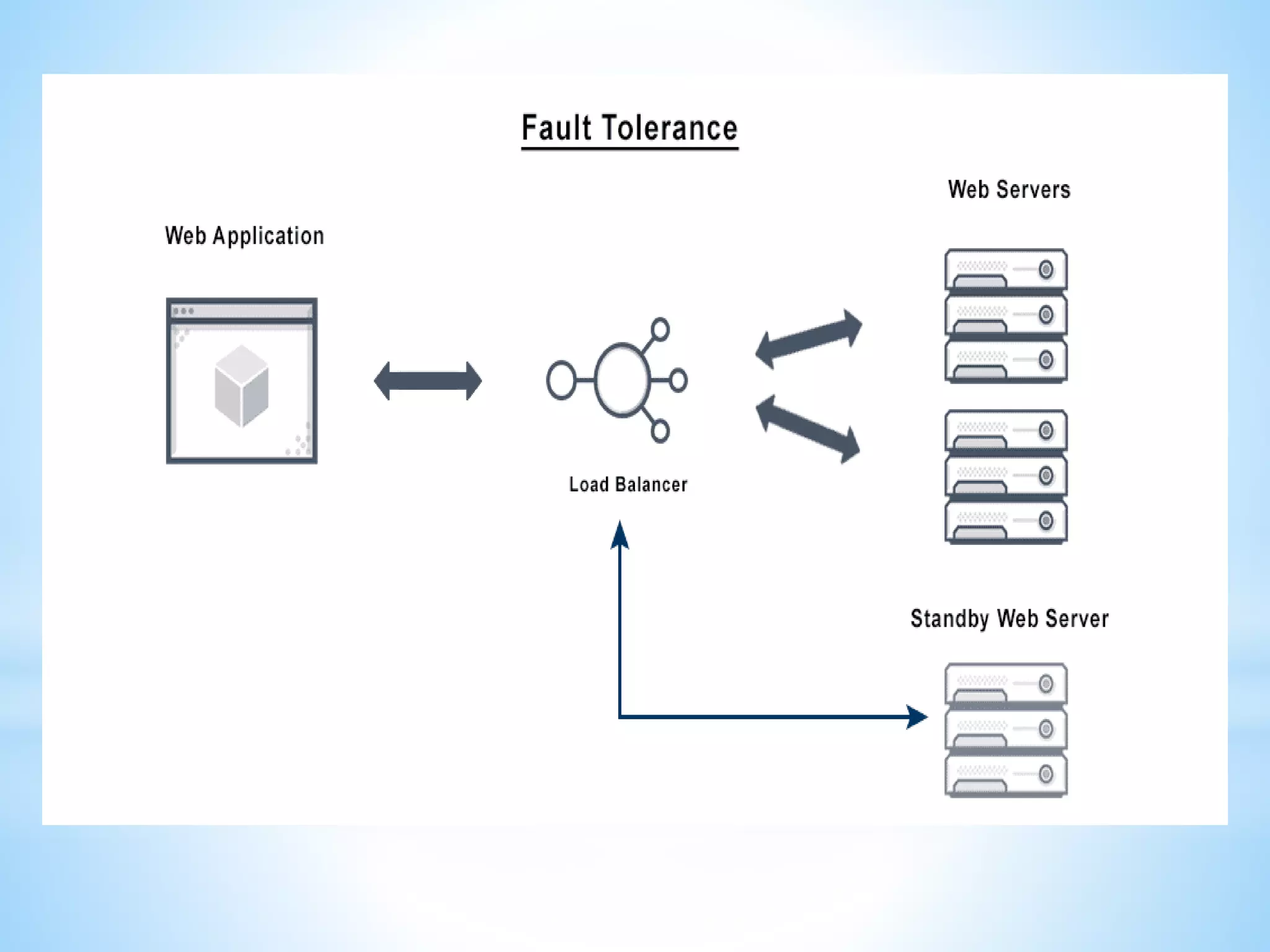
*Fault Tolerance simply means a system’s ability to
continue operating uninterrupted despite the failure of one
or more of its components.
*This is true whether it is a computer system, a cloud
cluster, a network, or something else.
*Fault Tolerant Services are obtained by using replication.
* By using multiple independent server’s replicas each
managing replicated data help in designing a service
which exhibit graceful degradation using partial failures
and improve overall server performance.
Fault Tolerance Services Models:
*There are two main fault tolerance service Model
*Passive (Primary – backup) Replication
*Active Replication
Passive (Primary – backup) Replication:
* In a passive model of replication for fault tolerance, there is at any
time a single primary replica manager and one or more secondary
replica managers.
i.e., “backups” or “slaves”.
* In the pure form of the model, frontend communicate only with the
primary replica manager to obtain the service.
*The primary replica manager executes the operation and sends copies of the
updated data to the backups.
*If the primary fails, one of the backup is promoted to act as the primary.
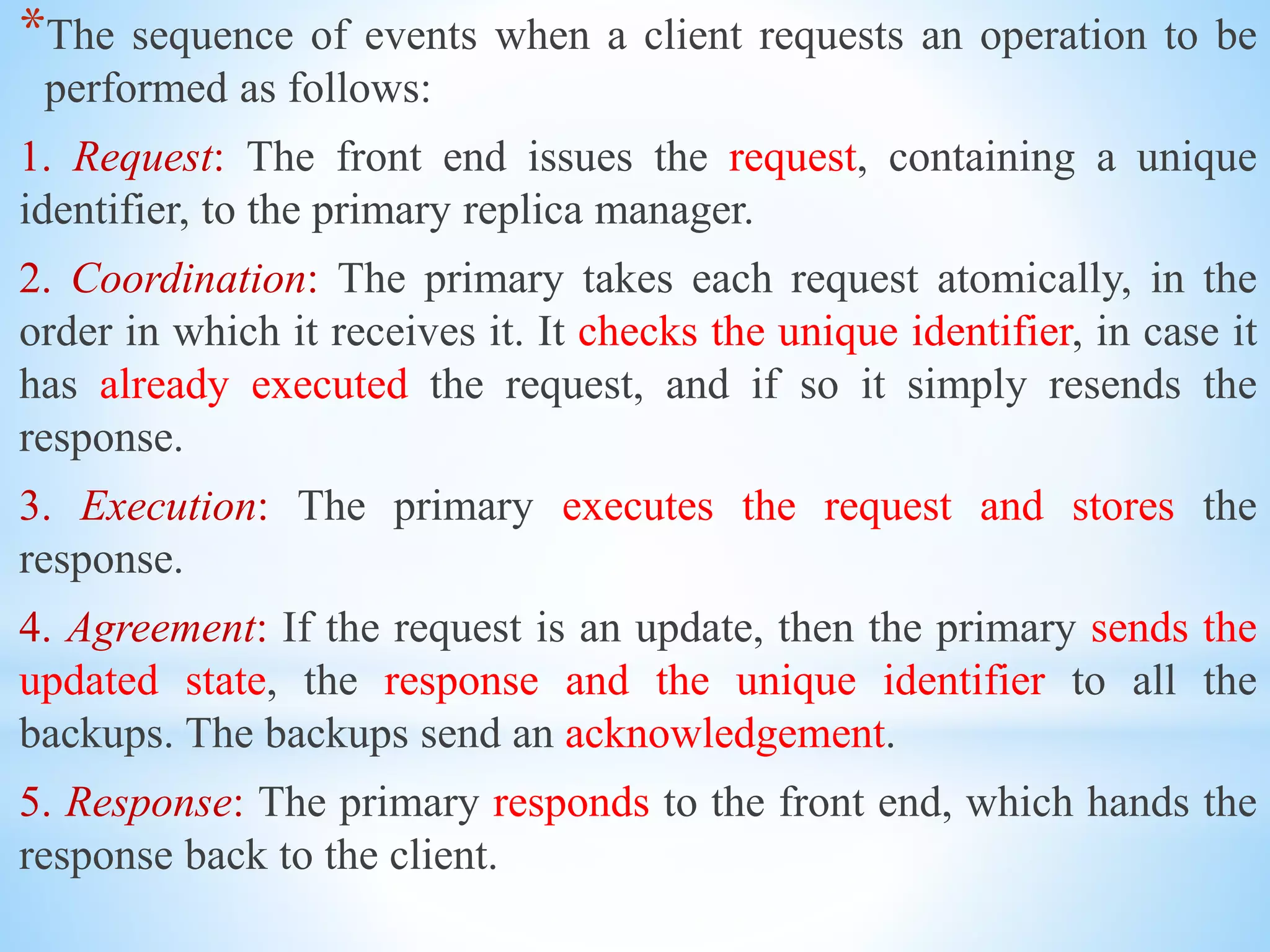
*The sequence of events when a client requests an operation to be
performed as follows:
1. Request: The front end issues the request, containing a unique
identifier, to the primary replica manager.
2. Coordination: The primary takes each request atomically, in the
order in which it receives it. It checks the unique identifier, in case it
has already executed the request, and if so it simply resends the
response.
3. Execution: The primary executes the request and stores the
response.
4. Agreement: If the request is an update, then the primary sends the
updated state, the response and the unique identifier to all the
backups. The backups send an acknowledgement.
5. Response: The primary responds to the front end, which hands the
response back to the client.
Active Replication:
*In the active model of replication for fault tolerance, the replica
managers are state machines that play equivalent roles and
organized as a group.
*Frontend multicast their request to the group of replica managers
and all the replica manager process the request independently but
identically and reply.
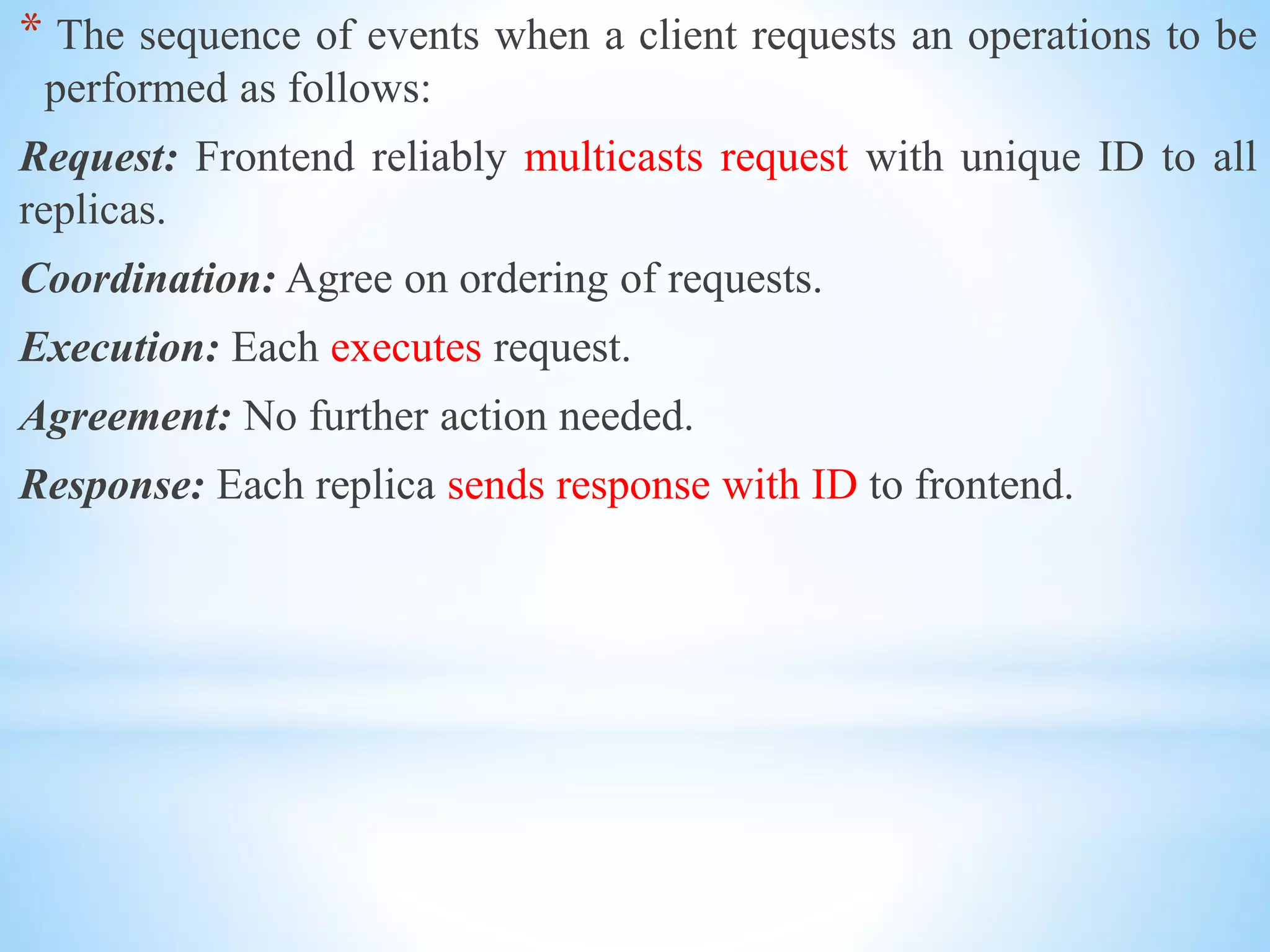
* The sequence of events when a client requests an operations to be
performed as follows:
Request: Frontend reliably multicasts request with unique ID to all
replicas.
Coordination: Agree on ordering of requests.
Execution: Each executes request.
Agreement: No further action needed.
Response: Each replica sends response with ID to frontend.
ATOMIC COMMIT PROTOCOL:
*An atomic commit protocol (ACP) is a distributed algorithm used
to ensure the atomicity property of transactions
in distributed database systems.
*Atomic Commit Protocol is a protocol used by database
manager to ensure that all the sub transactions are
consistently committed or aborted.
*In this each server applies local concurrency control to its
own objects which ensures the transaction is serialized
locally as well as serialize globally.
*When a distributed transaction comes to the end, either all
the servers commit the transaction or abort the transaction.
*There are two atomic commit protocol used in distributed database
system
*Two Phase Commit Protocol
*Three Phase Commit Protocol
Two Phase Commit Protocol :
*The two-phase commit protocol is designed to allow any
participant to abort its part of a transaction.
*Due to the requirement for atomicity, if one part of a
transaction is aborted, then the whole transaction must be aborted.
*In the first phase of the protocol, each participant votes for the
transaction to be committed or aborted.
*Once a participant has voted to commit a transaction, it is
not allowed to abort it.
*In the second phase of the protocol, every participant in the
transaction carries out the joint decision.
*If any one participant votes to abort, then the decision must be to
abort the transaction.
*If all the participants vote to commit, then the decision is to commit
the transaction.
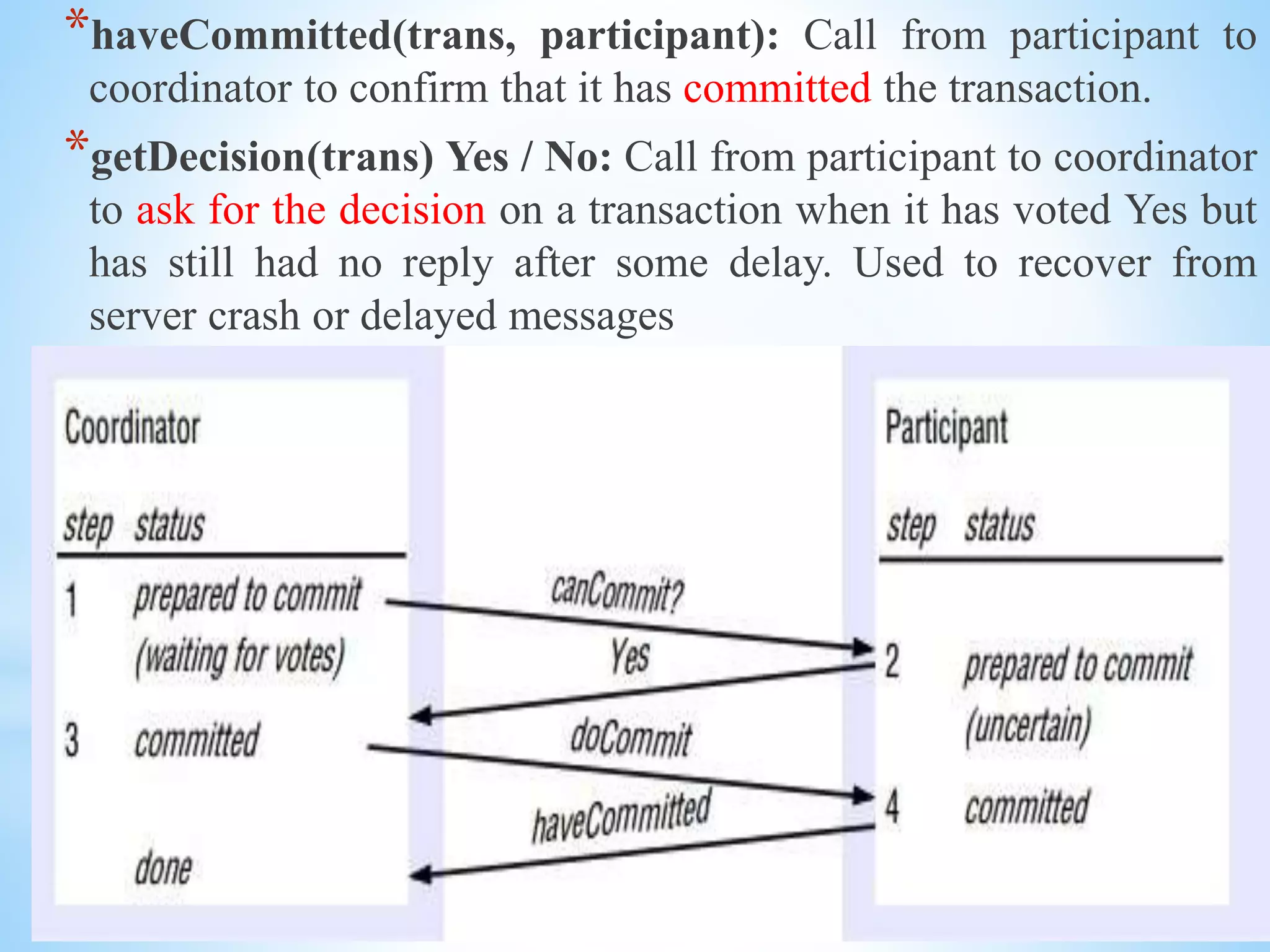
*The following are the operations in two phase commit protocol:
*canCommit?(trans)àYes / No: Call from coordinator to
participant to ask whether it can commit a transaction. Participant
replies with its vote.
*doCommit(trans):Call from coordinator to participant to tell
participant to commit its part of a transaction.
*doAbort(trans): Call from coordinator to participant to tell
participant to abort its part of a transaction.
*haveCommitted(trans, participant): Call from participant to
coordinator to confirm that it has committed the transaction.
*getDecision(trans) Yes / No: Call from participant to coordinator
to ask for the decision on a transaction when it has voted Yes but
has still had no reply after some delay. Used to recover from
server crash or delayed messages
Two phase commit for nested transactions
*The outermost transaction in a set of nested transactions is called
the top-level transaction.
*Transactions other than the top-level transaction are called sub-
transactions.
*The following are the operations are allowed:
*openSubTransaction(trans) subTrans: Opens a new
subtransaction whose parent is trans and returns a unique
subtransaction identifier.
*getStatus(trans) committed, aborted, provisional: Asks the
coordinator to report on the status of the transaction trans.
Returns values representing one of the following: committed,
aborted or provisional.
Flat Two phase commit protocol for
*In this approach, the coordinator of the top-level transaction
sends canCommit? messages to the coordinators of all of the
sub-transactions in the provisional commit list.
*During the commit protocol, the participants refer to the
transaction by its top-level TID.
*Each participant looks in its transaction list for any transaction
or sub-transaction matching that TID.
*A participant can commit descendants of the top-level
transaction unless they have aborted ancestors.
*When a participant receives a canCommit? request, it does the
following:
*If the participant has any provisionally committed transactions that
are descendants of the top-level transaction, trans, it:
*checks that they do not have aborted ancestors in the abortList, then
prepares to commit (by recording the transaction and its objects in
permanent storage);
*aborts those with aborted ancestors;
*sends a Yes vote to the coordinator.
*If the participant does not have a provisionally committed
descendent of the top level transaction, it must have failed since it
performed the sub- transaction and it sends a No vote to the
coordinator
Fundamentals of Concurrency control
*Concurrency is needed when multiple users want to access the same data at
the same time.
*Concurrency control (CC) ensures that correct results for parallel operations
are generated.
*CC provides rules, methods, design methodologies and theories to
maintain the consistency of components operating simultaneously
while interacting with the same object.
*All concurrency control protocols are based on serial equivalence
and are derived from rules of conflicting operations:
*Locks used to order transactions that access the same object
according to request order.
*Optimistic concurrency control allows transactions to proceed until
they are ready to commit, whereupon a check is made to see any
conflicting operation on objects.
*Timestamp ordering uses timestamps to order transactions that
access the same object according to their starting time.
Serial Equivalence:
*If these transactions are done one at a time in some order, then
the final result will be correct.
*If we do not want to sacrifice the concurrency, an interleaving of
the operations of transactions may lead to the same effect as if the
transactions had been performed one at a time in some order.
*We say it is a serially equivalent interleaving.
*The use of serial equivalence is a criterion for correct concurrent
execution to prevent lost updates and inconsistent retrievals.
Conflicting Operations:
*When we say a pair of operations conflicts we mean
that their combined effect depends on the order in
which they are executed. E.g. read and write
*There are three ways to ensure serializability:
*Locking
*Timestamp ordering
*Optimistic concurrency control
Process 1 Process 2 Conflict Reason
Read Read No -
Read Write Yes The result of these operations depend on
their order of execution.
Write Write Yes The result of these operations depend on
their order of execution.
DISTRIBUTED DEADLOCKS:
*A cycle in the global wait-for graph represents a distributed
deadlock.
*A deadlock that is detected but is not really a deadlock is
called a phantom deadlock.
*Two-phase locking prevents phantom deadlocks; autonomous
aborts may cause phantom deadlocks.
*Permanent blocking of a set of processes that either compete
for system resources or communicate with each other is
deadlock.
*No node has complete and up-to-date knowledge of the entire
distributed system. This is the cause of deadlocks.
Types of distributed deadlock:
*Resource deadlock: Set of deadlocked processes, where each
process waits for a resource held by another process (e.g., data
object in a database, I/O resource on a server)
*Communication deadlocks: Set of deadlocked processes, where
each process waits to receive messages (communication) from other
processes in the set.
Local and Global Wait for Graphs:
Edge Chasing:
*When a server notes that a transaction T starts waiting for another
transaction U, which is waiting to access a data item at another
server, it sends a probe containing (T → U) to the server of the data
item at which transaction U is blocked.
*Detection: receive probes and decide whether deadlock has
occurred and whether to forward the probes.
*When a server receives a probe (T → U) and finds the transaction
that U is waiting for, say V, is waiting for another data item
elsewhere, a probe (T → U → V) is forwarded.
*Detection: receive probes and decide whether deadlock has
occurred and whether to forward the probes.
*When a server receives a probe (T → U) and finds the transaction
that U is waiting for, say V, is waiting for another data item
elsewhere, a probe (T → U → V) is forwarded.
*Resolution: select a transaction in the cycle to abort.
Transaction priorities
*Every transaction involved in a deadlock cycle can cause deadlock
detection to be initiated.
*The effect of several transactions in a cycle initiating deadlock
detection is that detection may happen at several different servers in
the cycle, with the result that more than one transaction in the cycle
is aborted.
TRANSACTION RECOVERY
*Transactions may be performed effectively using distributed
transaction processing.
*However, there are instances in which a transaction may fail for a
variety of causes. System failure, hardware failure, network
error, inaccurate or invalid data, application problems, are all
probable causes.
*Transaction failures are impossible to avoid. These failures must be
handled by the distributed transaction system.
*When mistakes arise, one must be able to identify and correct them.
Transaction Recovery is the name for this procedure.
*In distributed databases, the most difficult procedure is recovery. It
is extremely difficult to recover a communication network system
that has failed.
*Let us consider the following scenario to analyze how transaction
fail may occur. Let suppose, we have two-person X and Y. X sends a
message to Y and expects a response, but Y is unable to receive it.
The following are some of the issues with this circumstance:
*The message was not sent due to a network problem.
*The communication sent by location B was not delivered to place A.
*Location B was destroyed.
*As a result, locating the source of a problem in a big
communication network is extremely challenging.
*One of the most famous methods of Transaction Recovery is the
“Two-Phase Commit Protocol”.
*The two-phase commit protocol contains two stages, as the name
implies.
*The first step is the PREPARE phase, in which the transaction’s
coordinator delivers a PREPARE message.
*The second step is the decision-making phase, in which the
coordinator sends a COMMIT message if all of the nodes can
complete the transaction, or an abort message if at least one
subordinate node cannot.
*Centralized 2PC, Linear 2PC, and Distributed 2PC are all ways
that may be used to perform the 2PC.
Centralized 2 PC:
*Contact in the Centralized 2PC is limited to the coordinator’s
process, and no communication between subordinates is permitted.
*The coordinator is in charge of sending the PREPARE message to
the subordinates, and once all of the subordinates’ votes have been
received and analyzed, the coordinator chooses whether to abort or
commit.
*There are two stages to this method:
*The First Phase: When a user desires to COMMIT a transaction
during this phase, the coordinator sends a PREPARE message to all
subordinates.
*When a subordinate gets the PREPARE message, it either records a
PREPARE log and sends a YES VOTE and enters the PREPARED
state if the subordinate is willing to COMMIT; or it creates an abort
record and sends a NO VOTE if the subordinate is not willing to
COMMIT.
*Second Phase: After the coordinator has reached a decision, it must
communicate that decision to the subordinates.
*If COMMIT is chosen, the coordinator enters the committing state
and sends a COMMIT message to all subordinates notifying them of
the choice.
*When the subordinates get the COMMIT message, they go into the
committing state and send the coordinator an acknowledge (ACK)
message.
*The transaction is completed when the coordinator gets the ACK
messages.
*If the coordinator, on the other hand, makes an ABORT decision, it
sends an ABORT message to all subordinates. In this case, the
coordinator does not need to send an ABORT message to the NO
VOTE subordinate(s).
Linear 2 PC:
*Subordinates in the linear 2PC, can communicate with one another. The
sites are numbered 1 to N, with site 1 being the coordinator.
*As a result, the PREPARE message is propagated in a sequential manner.
As a result, the transaction takes longer to complete than centralized or
dispersed approaches. Finally, it is node N that sends out the Global
COMMIT.
Distributed 2 PC:
*All of the nodes of a distributed 2PC interact with one another. Unlike
other 2PC techniques, this procedure does not require the second
phase.
*Furthermore, in order to know that each node has put in its vote, each
node must hold a list of all participating nodes.
*When the coordinator delivers a PREPARE message to all participating
nodes, the distributed 2PC gets started.
*When a participant receives the PREPARE message, it transmits his or
her vote to all other participants.
*As a result, each node keeps track of every transaction’s participants.
OVERVIEW OF SECURITY TECHNIQUES
Worst-case assumptions and design guidelines
*Interfaces are exposed- an attacker can send a message to any
interface.
*Networks are insecure.
*Limit the lifetime and scope of each secret- passwords and shared
secret keys should be time-limited
*Algorithms and program code are available to attackers - Secret
encryption algorithms are totally inadequate for today’s large-scale
network environments.
*Attackers may have access to large resources
*Minimize the trusted base - application programs should not be
trusted to protect data from their users.
Cryptography
*Encryption is the process of encoding a message in such a way as to
hide its contents.
*Modern cryptography includes several secure algorithms for
encrypting and decrypting messages. They are all based on the use
of secrets called keys.
*A cryptographic key is a parameter used in an encryption algorithm
in such a way that the encryption cannot be reversed without
knowledge of the key.
*There are two main classes of encryption algorithm in general
use.
*The first uses shared secret keys – the sender and the recipient must
share a knowledge of the key and it must not be revealed to anyone
else.
*The second class of encryption algorithms uses public/private key
pairs. Here the sender of a message uses a public key – one that has
already been published by the recipient – to encrypt the message.
*The recipient uses a corresponding private key to decrypt the
message. Although many principals may examine the public key,
only the recipient can decrypt the message, because they have the
private key.
Uses of cryptography:
Secrecy and integrity:
*Cryptography is used to maintain the secrecy and integrity of
information whenever it is exposed to potential attacks – for example,
during transmission across networks that are vulnerable to
eavesdropping and message tampering.
Scenario 1. Secret communication with a shared secret key:
*Alice wishes to send some information secretly to Bob. Alice and
Bob share a secret key KAB.
1. Alice uses KAB and an agreed encryption function E(KAB, M) to
encrypt and send any number of messages {Mi}KAB to Bob.
2. Bob decrypts the encrypted messages using the corresponding
decryption function D(KAB, M).
Authentication:
*Cryptography is used in support of mechanisms for authenticating
communication between pairs of principals.
*A principal who decrypts a message successfully using a particular key can
assume that the message is authentic if it contains a correct checksum.
ACCESS CONTROL
*Access control is a security technique that regulates who or what
can view or use resources in a computing environment.
*There are two types of access control: physical and logical.
*Physical access control limits access to campuses, buildings, rooms
and physical IT assets.
*Logical access control limits connections to computer networks,
system files and data.
*Access control systems perform
identification, authentication and authorization of users and entities
by evaluating required login credentials that can include passwords,
personal identification numbers (PINs), biometric scans, security
tokens or other authentication factors.
*Types of access control:
The main models of access control are the following:
*Mandatory access control (MAC). This is a security model in which
access rights are regulated by a central authority based on multiple levels
of security.
*Discretionary access control (DAC). This is an access control method in
which owners or administrators of the protected system, data or resource
set the policies defining who or what is authorized to access the resource.
*Role-based access control (RBAC). This is a widely used access control
mechanism that restricts access to computer resources based on
individuals or groups with defined business functions.
*Rule-based access control. This is a security model in which the system
administrator defines the rules that govern access to resource objects.
*Attribute-based access control (ABAC). This is a methodology that
manages access rights by evaluating a set of rules, policies and
relationships using the attributes of users, systems and environmental
conditions.
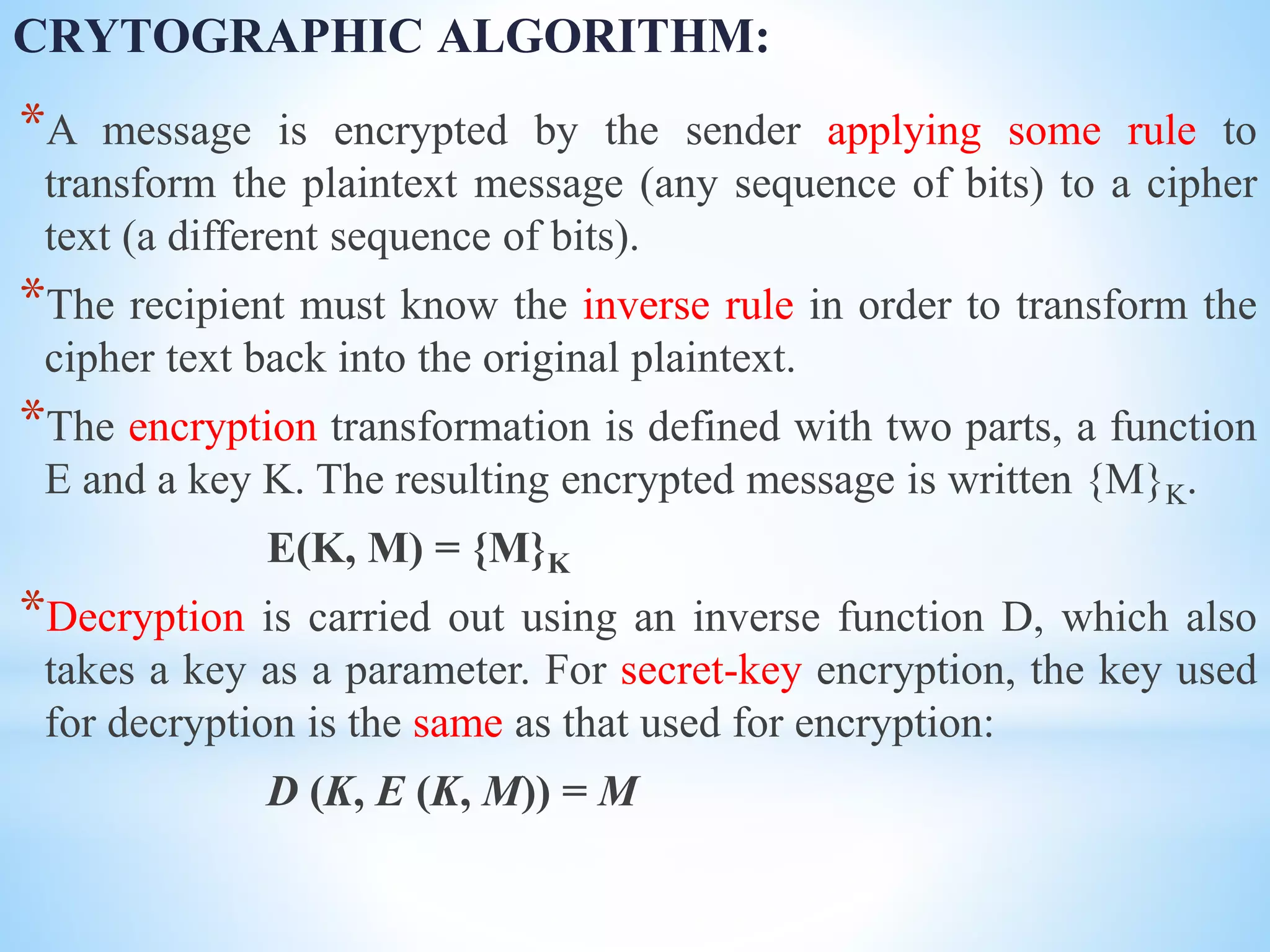
CRYTOGRAPHIC ALGORITHM:
*A message is encrypted by the sender applying some rule to
transform the plaintext message (any sequence of bits) to a cipher
text (a different sequence of bits).
*The recipient must know the inverse rule in order to transform the
cipher text back into the original plaintext.
*The encryption transformation is defined with two parts, a function
E and a key K. The resulting encrypted message is written {M}K.
E(K, M) = {M}K
*Decryption is carried out using an inverse function D, which also
takes a key as a parameter. For secret-key encryption, the key used
for decryption is the same as that used for encryption:
D (K, E (K, M)) = M
*Secret-key cryptography is often referred to as symmetric
cryptography, whereas public-key cryptography is referred to as
asymmetric because the keys used for encryption and decryption are
different.
Symmetric algorithms:
*If we remove the key parameter from consideration by defining
FK([M]) = E(K,M) , then it is a property of strong encryption
functions that FK([M]) is relatively easy to compute, whereas the
inverse, FK
–1([M]) , is so hard to compute that it is not feasible.
Such functions are known as one-way functions.
*The brute force approach is to run through all possible values of K,
computing E (K, M) until the result matches the value of {M}K that
is already known.
*If K has N bits then such an attack requires 2 N – 1 iterations on
average, and a maximum of 2N iterations, to find K. Hence the time
to crack K is exponential in the number of bits in K.
Asymmetric algorithms:
*When a public/private key pair is used, one-way functions are
exploited in another way.
*The feasibility of a public-key scheme was first proposed by Diffie
and Hellman [1976] as a cryptographic method that eliminates the
need for trust between the communicating parties.
Block ciphers:
*Most encryption algorithms operate on fixed-size blocks of data; 64
bits is a popular size for the blocks.
*A message is subdivided into blocks, the last block is padded to the
standard length if necessary and each block is encrypted
independently.
*The first block is available for transmission as soon as it has been
encrypted.
*Cipher block chaining:
*In cipher block chaining mode, each plaintext block is combined with the
preceding ciphertext block using the exclusive-or operation (XOR) before it
is encrypted.
*On decryption, the block is decrypted and then the preceding encrypted block
(which should have been stored for this purpose) is XOR-ed with it to obtain
the new plaintext block.
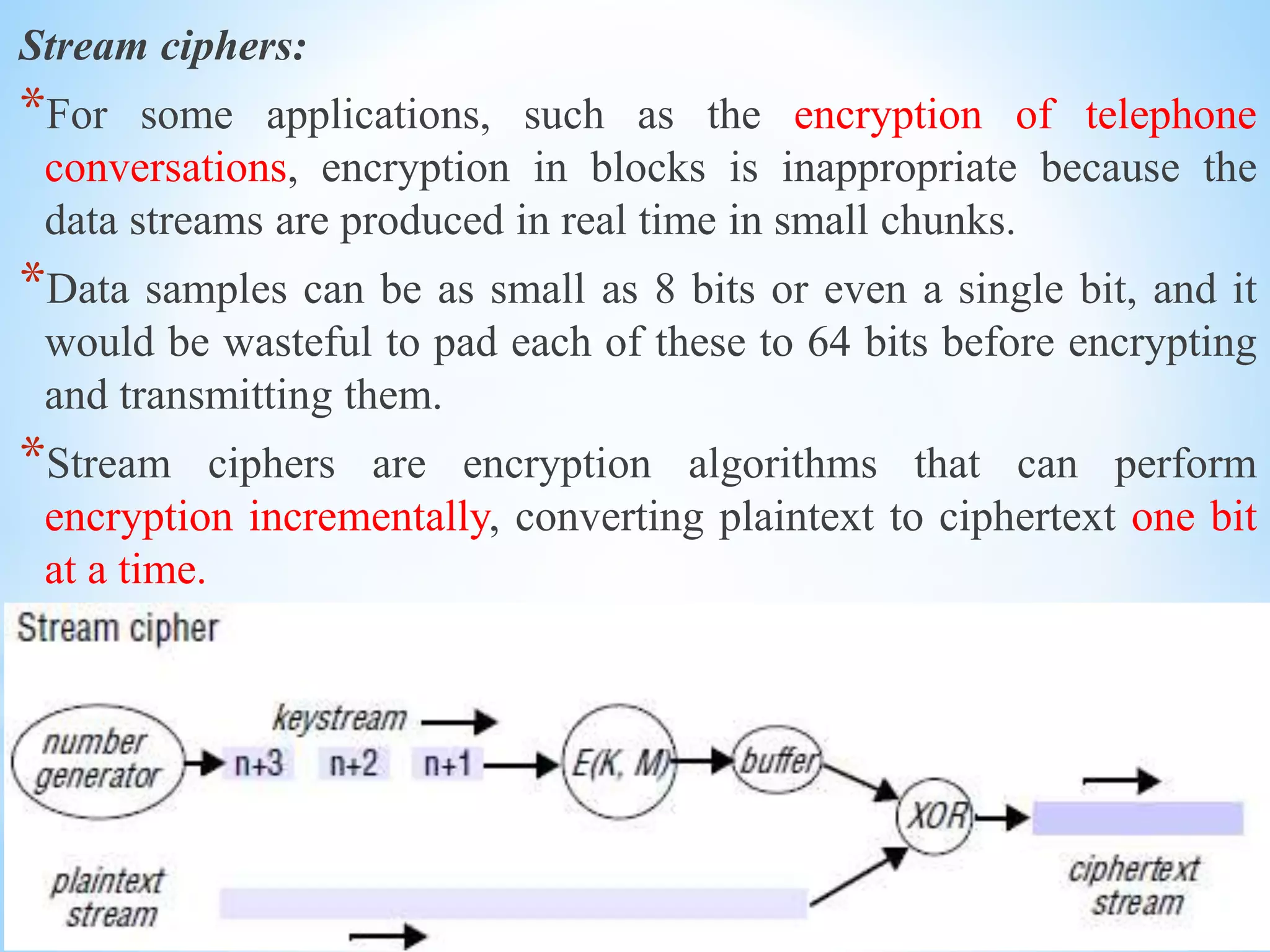
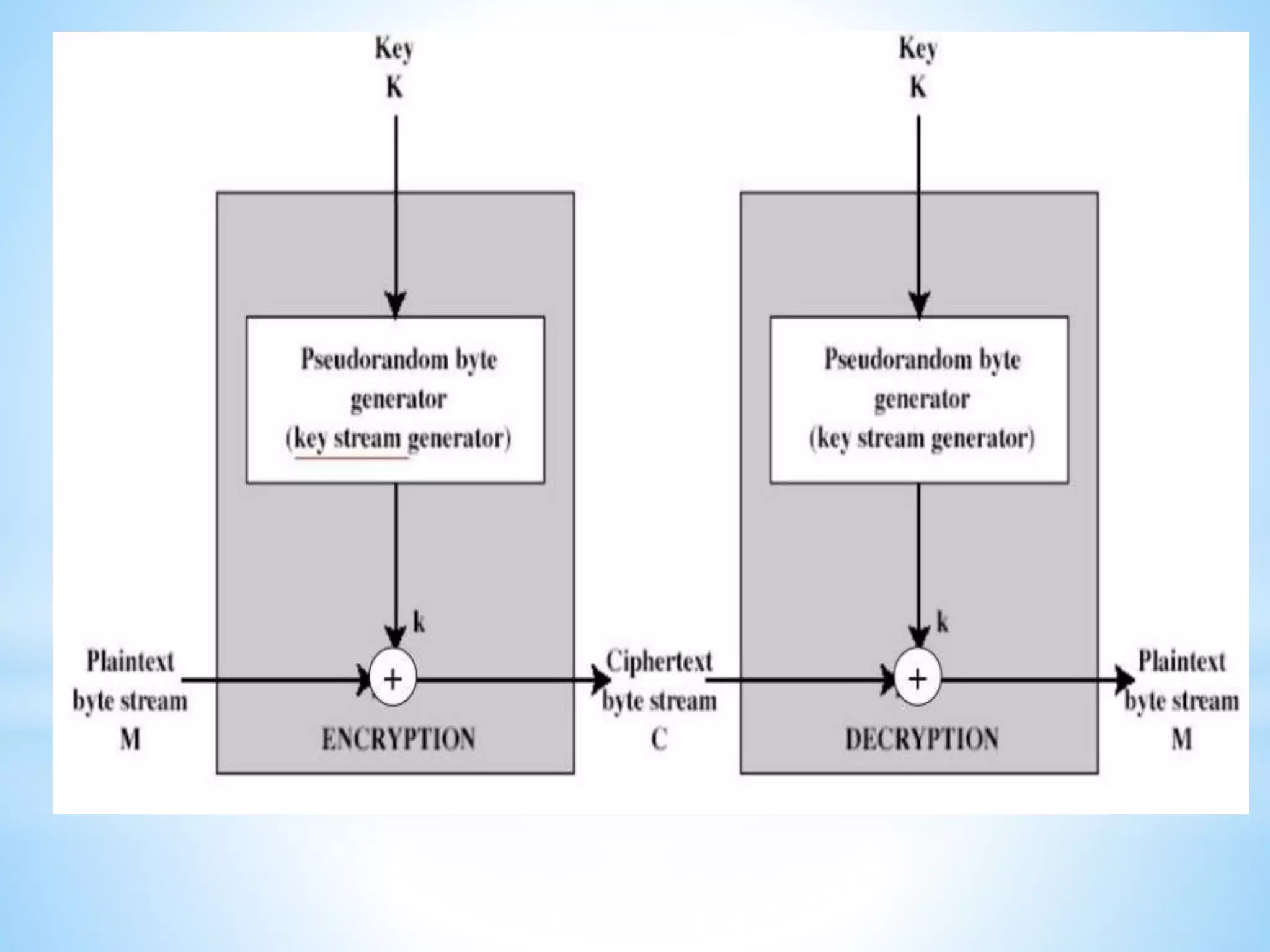
Stream ciphers:
*For some applications, such as the encryption of telephone
conversations, encryption in blocks is inappropriate because the
data streams are produced in real time in small chunks.
*Data samples can be as small as 8 bits or even a single bit, and it
would be wasteful to pad each of these to 64 bits before encrypting
and transmitting them.
*Stream ciphers are encryption algorithms that can perform
encryption incrementally, converting plaintext to ciphertext one bit
at a time.
Tiny Encryption Algorithm:
*The TEA algorithm uses rounds of integer addition, XOR (the ^ operator) and
bitwise logical shifts (<< and >>) to achieve diffusion and confusion of the
bit patterns in the plaintext.
*The plaintext is a 64-bit block represented as two 32-bit integers in the vector
text[]. The key is 128 bits long, represented as four 32-bit integers.
*The decryption function is the inverse of that for encryption.
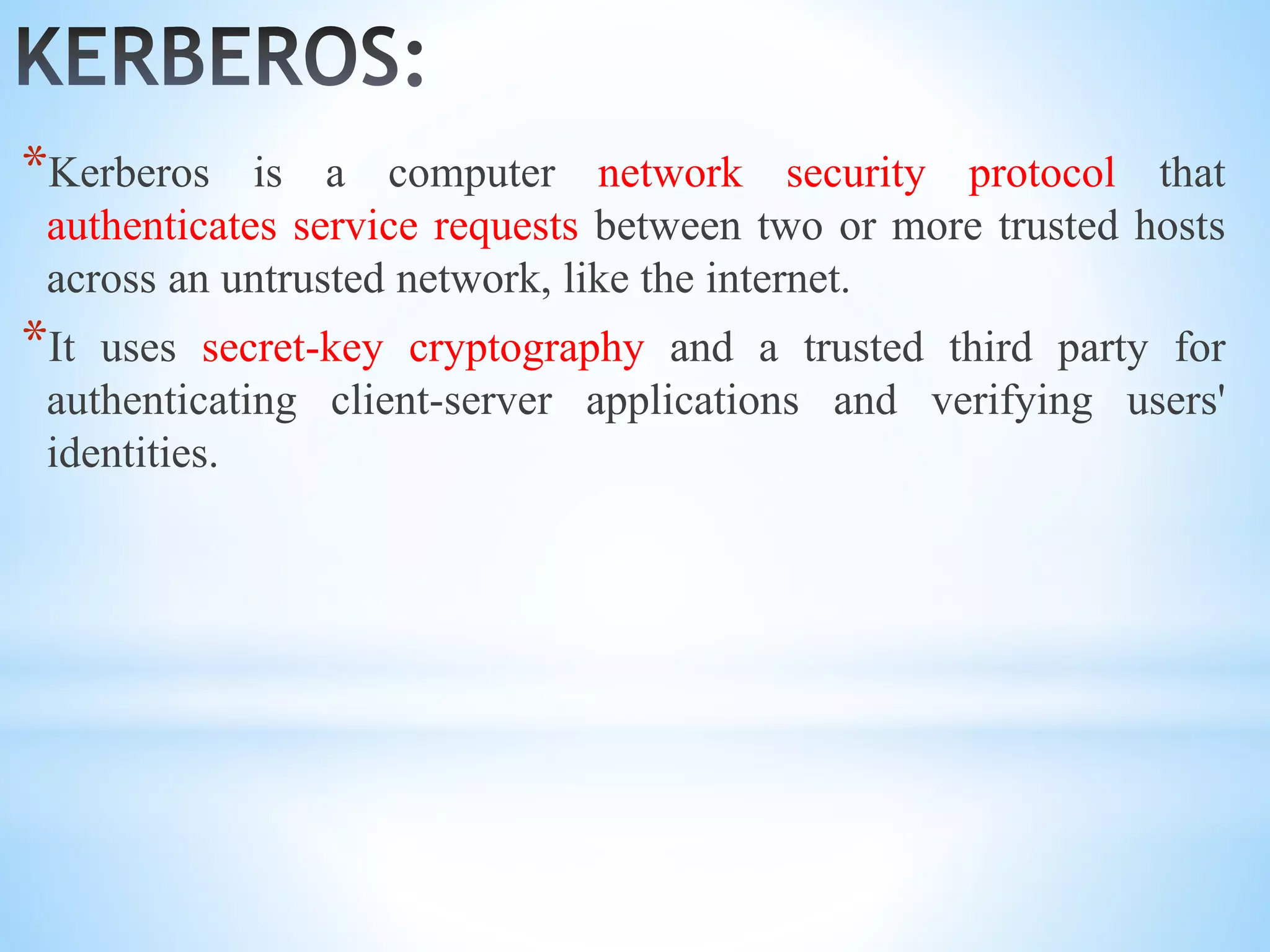
*Kerberos is a computer network security protocol that
authenticates service requests between two or more trusted hosts
across an untrusted network, like the internet.
*It uses secret-key cryptography and a trusted third party for
authenticating client-server applications and verifying users'
identities.
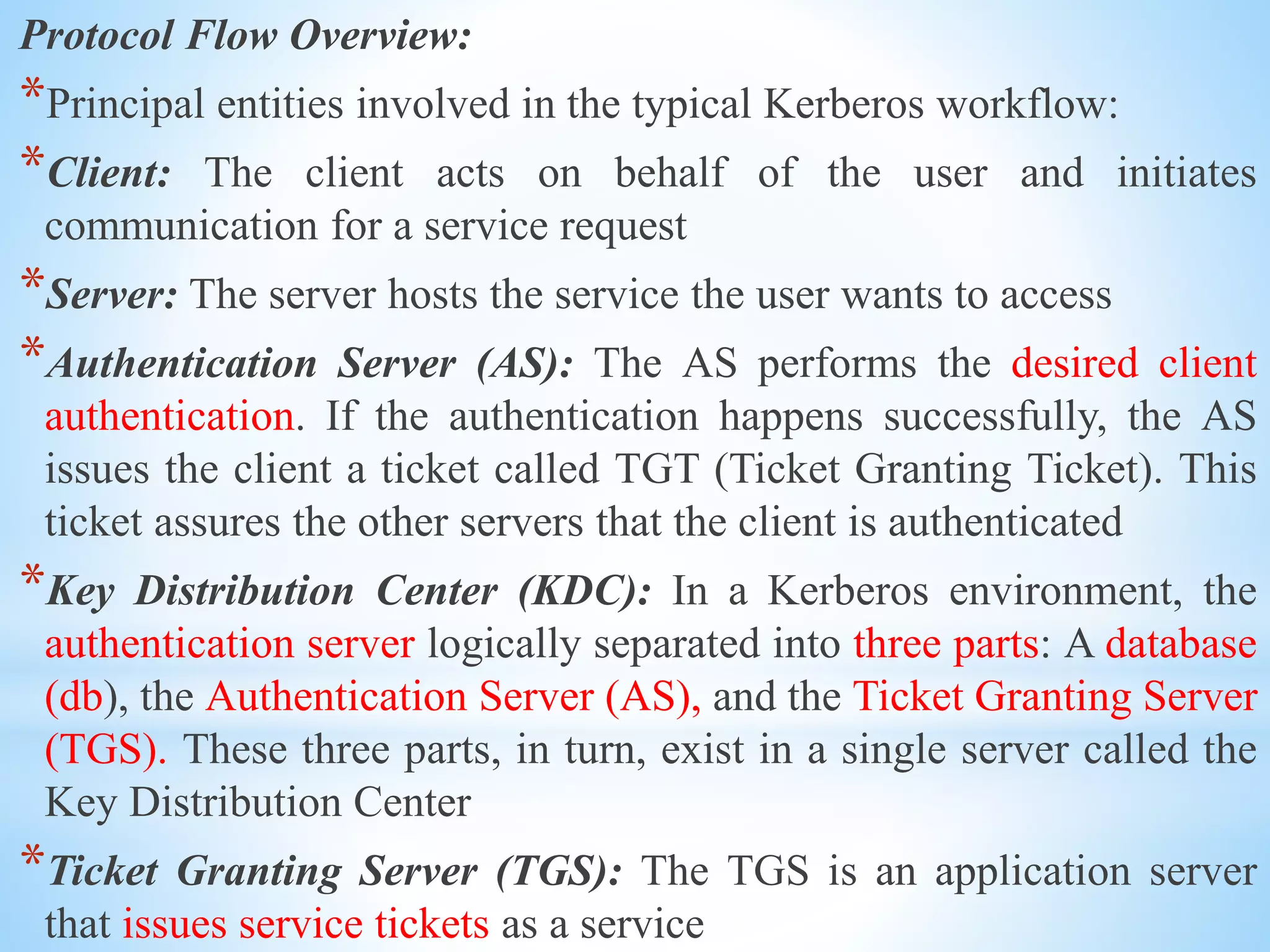
Protocol Flow Overview:
*Principal entities involved in the typical Kerberos workflow:
*Client: The client acts on behalf of the user and initiates
communication for a service request
*Server: The server hosts the service the user wants to access
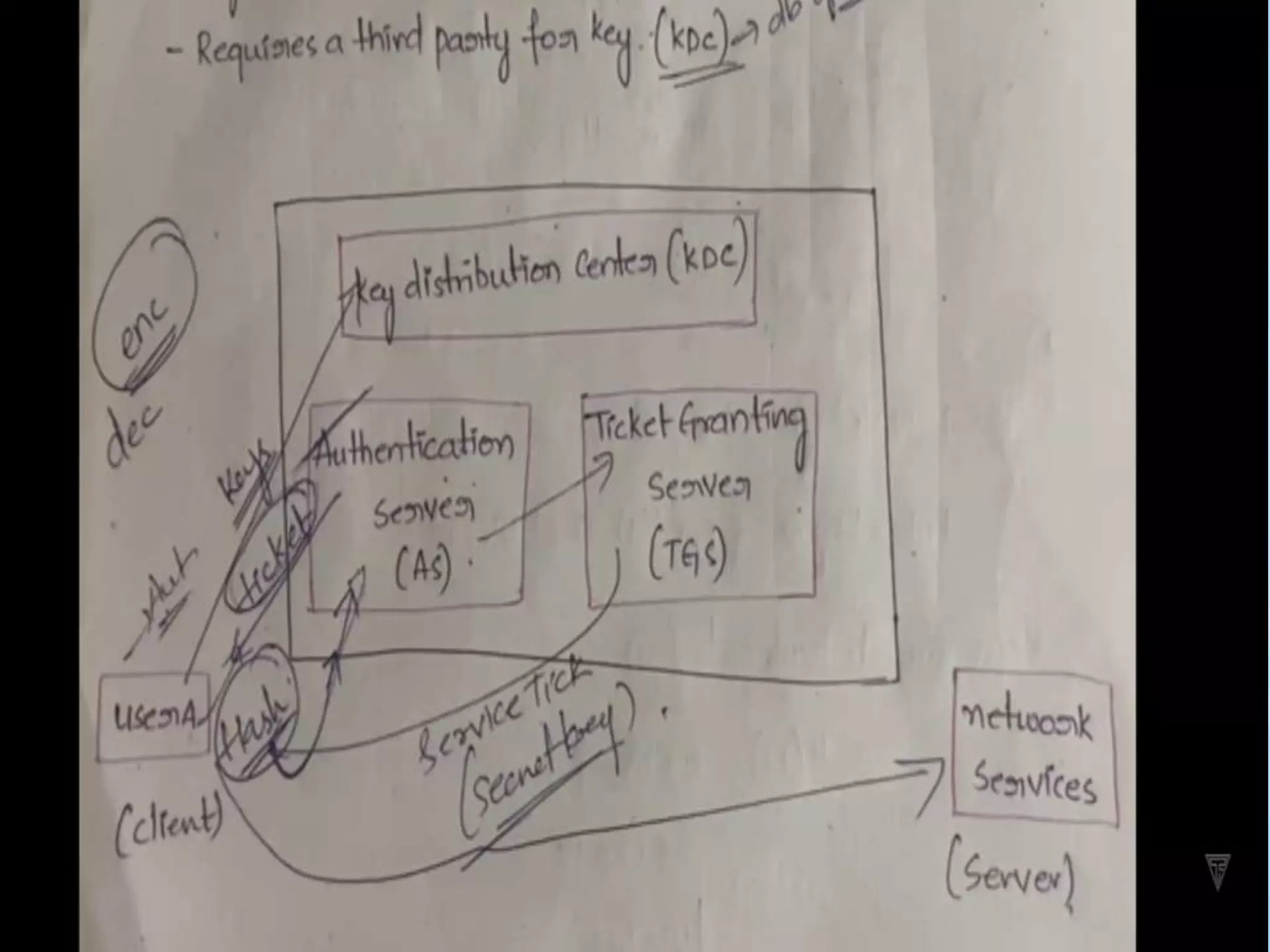
*Authentication Server (AS): The AS performs the desired client
authentication. If the authentication happens successfully, the AS
issues the client a ticket called TGT (Ticket Granting Ticket). This
ticket assures the other servers that the client is authenticated
*Key Distribution Center (KDC): In a Kerberos environment, the
authentication server logically separated into three parts: A database
(db), the Authentication Server (AS), and the Ticket Granting Server
(TGS). These three parts, in turn, exist in a single server called the
Key Distribution Center
*Ticket Granting Server (TGS): The TGS is an application server
that issues service tickets as a service
UNIT IV DIS.pptx

UNIT IV DIS.pptx

  • 1.
    UNIT IV :FAULT TOLERANCE AND SECURITY Fault Tolerance Services – Atomic Commit Protocols – Concurrency Control In Distributed Transaction – Distributed Deadlocks – Transaction Recovery – Overview Of Security Techniques – Access Control – Cryptography Algorithms – Kerberos.
  • 2.
    FAULT TOLERANCE SERVICES *FaultTolerance simply means a system’s ability to continue operating uninterrupted despite the failure of one or more of its components. *This is true whether it is a computer system, a cloud cluster, a network, or something else. *Fault Tolerant Services are obtained by using replication. * By using multiple independent server’s replicas each managing replicated data help in designing a service which exhibit graceful degradation using partial failures and improve overall server performance.
  • 4.
    Fault Tolerance ServicesModels: *There are two main fault tolerance service Model *Passive (Primary – backup) Replication *Active Replication Passive (Primary – backup) Replication: * In a passive model of replication for fault tolerance, there is at any time a single primary replica manager and one or more secondary replica managers. i.e., “backups” or “slaves”. * In the pure form of the model, frontend communicate only with the primary replica manager to obtain the service. *The primary replica manager executes the operation and sends copies of the updated data to the backups. *If the primary fails, one of the backup is promoted to act as the primary.
  • 5.
    *The sequence ofevents when a client requests an operation to be performed as follows: 1. Request: The front end issues the request, containing a unique identifier, to the primary replica manager. 2. Coordination: The primary takes each request atomically, in the order in which it receives it. It checks the unique identifier, in case it has already executed the request, and if so it simply resends the response. 3. Execution: The primary executes the request and stores the response. 4. Agreement: If the request is an update, then the primary sends the updated state, the response and the unique identifier to all the backups. The backups send an acknowledgement. 5. Response: The primary responds to the front end, which hands the response back to the client.
  • 7.
    Active Replication: *In theactive model of replication for fault tolerance, the replica managers are state machines that play equivalent roles and organized as a group. *Frontend multicast their request to the group of replica managers and all the replica manager process the request independently but identically and reply.
  • 8.
    * The sequenceof events when a client requests an operations to be performed as follows: Request: Frontend reliably multicasts request with unique ID to all replicas. Coordination: Agree on ordering of requests. Execution: Each executes request. Agreement: No further action needed. Response: Each replica sends response with ID to frontend.
  • 9.
    ATOMIC COMMIT PROTOCOL: *Anatomic commit protocol (ACP) is a distributed algorithm used to ensure the atomicity property of transactions in distributed database systems. *Atomic Commit Protocol is a protocol used by database manager to ensure that all the sub transactions are consistently committed or aborted. *In this each server applies local concurrency control to its own objects which ensures the transaction is serialized locally as well as serialize globally. *When a distributed transaction comes to the end, either all the servers commit the transaction or abort the transaction.
  • 10.
    *There are twoatomic commit protocol used in distributed database system *Two Phase Commit Protocol *Three Phase Commit Protocol Two Phase Commit Protocol : *The two-phase commit protocol is designed to allow any participant to abort its part of a transaction. *Due to the requirement for atomicity, if one part of a transaction is aborted, then the whole transaction must be aborted. *In the first phase of the protocol, each participant votes for the transaction to be committed or aborted. *Once a participant has voted to commit a transaction, it is not allowed to abort it.
  • 11.
    *In the secondphase of the protocol, every participant in the transaction carries out the joint decision. *If any one participant votes to abort, then the decision must be to abort the transaction. *If all the participants vote to commit, then the decision is to commit the transaction. *The following are the operations in two phase commit protocol: *canCommit?(trans)àYes / No: Call from coordinator to participant to ask whether it can commit a transaction. Participant replies with its vote. *doCommit(trans):Call from coordinator to participant to tell participant to commit its part of a transaction. *doAbort(trans): Call from coordinator to participant to tell participant to abort its part of a transaction.
  • 12.
    *haveCommitted(trans, participant): Callfrom participant to coordinator to confirm that it has committed the transaction. *getDecision(trans) Yes / No: Call from participant to coordinator to ask for the decision on a transaction when it has voted Yes but has still had no reply after some delay. Used to recover from server crash or delayed messages
  • 13.
    Two phase commitfor nested transactions *The outermost transaction in a set of nested transactions is called the top-level transaction. *Transactions other than the top-level transaction are called sub- transactions. *The following are the operations are allowed: *openSubTransaction(trans) subTrans: Opens a new subtransaction whose parent is trans and returns a unique subtransaction identifier. *getStatus(trans) committed, aborted, provisional: Asks the coordinator to report on the status of the transaction trans. Returns values representing one of the following: committed, aborted or provisional.
  • 14.
    Flat Two phasecommit protocol for *In this approach, the coordinator of the top-level transaction sends canCommit? messages to the coordinators of all of the sub-transactions in the provisional commit list. *During the commit protocol, the participants refer to the transaction by its top-level TID. *Each participant looks in its transaction list for any transaction or sub-transaction matching that TID. *A participant can commit descendants of the top-level transaction unless they have aborted ancestors.
  • 15.
    *When a participantreceives a canCommit? request, it does the following: *If the participant has any provisionally committed transactions that are descendants of the top-level transaction, trans, it: *checks that they do not have aborted ancestors in the abortList, then prepares to commit (by recording the transaction and its objects in permanent storage); *aborts those with aborted ancestors; *sends a Yes vote to the coordinator. *If the participant does not have a provisionally committed descendent of the top level transaction, it must have failed since it performed the sub- transaction and it sends a No vote to the coordinator
  • 16.
    Fundamentals of Concurrencycontrol *Concurrency is needed when multiple users want to access the same data at the same time. *Concurrency control (CC) ensures that correct results for parallel operations are generated. *CC provides rules, methods, design methodologies and theories to maintain the consistency of components operating simultaneously while interacting with the same object.
  • 17.
    *All concurrency controlprotocols are based on serial equivalence and are derived from rules of conflicting operations: *Locks used to order transactions that access the same object according to request order. *Optimistic concurrency control allows transactions to proceed until they are ready to commit, whereupon a check is made to see any conflicting operation on objects. *Timestamp ordering uses timestamps to order transactions that access the same object according to their starting time.
  • 18.
    Serial Equivalence: *If thesetransactions are done one at a time in some order, then the final result will be correct. *If we do not want to sacrifice the concurrency, an interleaving of the operations of transactions may lead to the same effect as if the transactions had been performed one at a time in some order. *We say it is a serially equivalent interleaving. *The use of serial equivalence is a criterion for correct concurrent execution to prevent lost updates and inconsistent retrievals.
  • 19.
    Conflicting Operations: *When wesay a pair of operations conflicts we mean that their combined effect depends on the order in which they are executed. E.g. read and write *There are three ways to ensure serializability: *Locking *Timestamp ordering *Optimistic concurrency control Process 1 Process 2 Conflict Reason Read Read No - Read Write Yes The result of these operations depend on their order of execution. Write Write Yes The result of these operations depend on their order of execution.
  • 20.
    DISTRIBUTED DEADLOCKS: *A cyclein the global wait-for graph represents a distributed deadlock. *A deadlock that is detected but is not really a deadlock is called a phantom deadlock. *Two-phase locking prevents phantom deadlocks; autonomous aborts may cause phantom deadlocks. *Permanent blocking of a set of processes that either compete for system resources or communicate with each other is deadlock. *No node has complete and up-to-date knowledge of the entire distributed system. This is the cause of deadlocks.
  • 22.
    Types of distributeddeadlock: *Resource deadlock: Set of deadlocked processes, where each process waits for a resource held by another process (e.g., data object in a database, I/O resource on a server) *Communication deadlocks: Set of deadlocked processes, where each process waits to receive messages (communication) from other processes in the set. Local and Global Wait for Graphs:
  • 23.
    Edge Chasing: *When aserver notes that a transaction T starts waiting for another transaction U, which is waiting to access a data item at another server, it sends a probe containing (T → U) to the server of the data item at which transaction U is blocked. *Detection: receive probes and decide whether deadlock has occurred and whether to forward the probes. *When a server receives a probe (T → U) and finds the transaction that U is waiting for, say V, is waiting for another data item elsewhere, a probe (T → U → V) is forwarded. *Detection: receive probes and decide whether deadlock has occurred and whether to forward the probes. *When a server receives a probe (T → U) and finds the transaction that U is waiting for, say V, is waiting for another data item elsewhere, a probe (T → U → V) is forwarded. *Resolution: select a transaction in the cycle to abort.
  • 24.
    Transaction priorities *Every transactioninvolved in a deadlock cycle can cause deadlock detection to be initiated. *The effect of several transactions in a cycle initiating deadlock detection is that detection may happen at several different servers in the cycle, with the result that more than one transaction in the cycle is aborted.
  • 25.
    TRANSACTION RECOVERY *Transactions maybe performed effectively using distributed transaction processing. *However, there are instances in which a transaction may fail for a variety of causes. System failure, hardware failure, network error, inaccurate or invalid data, application problems, are all probable causes. *Transaction failures are impossible to avoid. These failures must be handled by the distributed transaction system. *When mistakes arise, one must be able to identify and correct them. Transaction Recovery is the name for this procedure. *In distributed databases, the most difficult procedure is recovery. It is extremely difficult to recover a communication network system that has failed.
  • 26.
    *Let us considerthe following scenario to analyze how transaction fail may occur. Let suppose, we have two-person X and Y. X sends a message to Y and expects a response, but Y is unable to receive it. The following are some of the issues with this circumstance: *The message was not sent due to a network problem. *The communication sent by location B was not delivered to place A. *Location B was destroyed. *As a result, locating the source of a problem in a big communication network is extremely challenging.
  • 27.
    *One of themost famous methods of Transaction Recovery is the “Two-Phase Commit Protocol”. *The two-phase commit protocol contains two stages, as the name implies. *The first step is the PREPARE phase, in which the transaction’s coordinator delivers a PREPARE message. *The second step is the decision-making phase, in which the coordinator sends a COMMIT message if all of the nodes can complete the transaction, or an abort message if at least one subordinate node cannot. *Centralized 2PC, Linear 2PC, and Distributed 2PC are all ways that may be used to perform the 2PC.
  • 28.
    Centralized 2 PC: *Contactin the Centralized 2PC is limited to the coordinator’s process, and no communication between subordinates is permitted. *The coordinator is in charge of sending the PREPARE message to the subordinates, and once all of the subordinates’ votes have been received and analyzed, the coordinator chooses whether to abort or commit. *There are two stages to this method: *The First Phase: When a user desires to COMMIT a transaction during this phase, the coordinator sends a PREPARE message to all subordinates. *When a subordinate gets the PREPARE message, it either records a PREPARE log and sends a YES VOTE and enters the PREPARED state if the subordinate is willing to COMMIT; or it creates an abort record and sends a NO VOTE if the subordinate is not willing to COMMIT.
  • 29.
    *Second Phase: Afterthe coordinator has reached a decision, it must communicate that decision to the subordinates. *If COMMIT is chosen, the coordinator enters the committing state and sends a COMMIT message to all subordinates notifying them of the choice. *When the subordinates get the COMMIT message, they go into the committing state and send the coordinator an acknowledge (ACK) message. *The transaction is completed when the coordinator gets the ACK messages. *If the coordinator, on the other hand, makes an ABORT decision, it sends an ABORT message to all subordinates. In this case, the coordinator does not need to send an ABORT message to the NO VOTE subordinate(s).
  • 30.
    Linear 2 PC: *Subordinatesin the linear 2PC, can communicate with one another. The sites are numbered 1 to N, with site 1 being the coordinator. *As a result, the PREPARE message is propagated in a sequential manner. As a result, the transaction takes longer to complete than centralized or dispersed approaches. Finally, it is node N that sends out the Global COMMIT. Distributed 2 PC: *All of the nodes of a distributed 2PC interact with one another. Unlike other 2PC techniques, this procedure does not require the second phase. *Furthermore, in order to know that each node has put in its vote, each node must hold a list of all participating nodes. *When the coordinator delivers a PREPARE message to all participating nodes, the distributed 2PC gets started. *When a participant receives the PREPARE message, it transmits his or her vote to all other participants. *As a result, each node keeps track of every transaction’s participants.
  • 31.
    OVERVIEW OF SECURITYTECHNIQUES Worst-case assumptions and design guidelines *Interfaces are exposed- an attacker can send a message to any interface. *Networks are insecure. *Limit the lifetime and scope of each secret- passwords and shared secret keys should be time-limited *Algorithms and program code are available to attackers - Secret encryption algorithms are totally inadequate for today’s large-scale network environments. *Attackers may have access to large resources *Minimize the trusted base - application programs should not be trusted to protect data from their users.
  • 32.
    Cryptography *Encryption is theprocess of encoding a message in such a way as to hide its contents. *Modern cryptography includes several secure algorithms for encrypting and decrypting messages. They are all based on the use of secrets called keys. *A cryptographic key is a parameter used in an encryption algorithm in such a way that the encryption cannot be reversed without knowledge of the key. *There are two main classes of encryption algorithm in general use. *The first uses shared secret keys – the sender and the recipient must share a knowledge of the key and it must not be revealed to anyone else.
  • 33.
    *The second classof encryption algorithms uses public/private key pairs. Here the sender of a message uses a public key – one that has already been published by the recipient – to encrypt the message. *The recipient uses a corresponding private key to decrypt the message. Although many principals may examine the public key, only the recipient can decrypt the message, because they have the private key.
  • 34.
    Uses of cryptography: Secrecyand integrity: *Cryptography is used to maintain the secrecy and integrity of information whenever it is exposed to potential attacks – for example, during transmission across networks that are vulnerable to eavesdropping and message tampering. Scenario 1. Secret communication with a shared secret key: *Alice wishes to send some information secretly to Bob. Alice and Bob share a secret key KAB. 1. Alice uses KAB and an agreed encryption function E(KAB, M) to encrypt and send any number of messages {Mi}KAB to Bob. 2. Bob decrypts the encrypted messages using the corresponding decryption function D(KAB, M).
  • 35.
    Authentication: *Cryptography is usedin support of mechanisms for authenticating communication between pairs of principals. *A principal who decrypts a message successfully using a particular key can assume that the message is authentic if it contains a correct checksum.
  • 36.
    ACCESS CONTROL *Access controlis a security technique that regulates who or what can view or use resources in a computing environment. *There are two types of access control: physical and logical. *Physical access control limits access to campuses, buildings, rooms and physical IT assets. *Logical access control limits connections to computer networks, system files and data. *Access control systems perform identification, authentication and authorization of users and entities by evaluating required login credentials that can include passwords, personal identification numbers (PINs), biometric scans, security tokens or other authentication factors.
  • 37.
    *Types of accesscontrol: The main models of access control are the following: *Mandatory access control (MAC). This is a security model in which access rights are regulated by a central authority based on multiple levels of security. *Discretionary access control (DAC). This is an access control method in which owners or administrators of the protected system, data or resource set the policies defining who or what is authorized to access the resource. *Role-based access control (RBAC). This is a widely used access control mechanism that restricts access to computer resources based on individuals or groups with defined business functions. *Rule-based access control. This is a security model in which the system administrator defines the rules that govern access to resource objects. *Attribute-based access control (ABAC). This is a methodology that manages access rights by evaluating a set of rules, policies and relationships using the attributes of users, systems and environmental conditions.
  • 38.
    CRYTOGRAPHIC ALGORITHM: *A messageis encrypted by the sender applying some rule to transform the plaintext message (any sequence of bits) to a cipher text (a different sequence of bits). *The recipient must know the inverse rule in order to transform the cipher text back into the original plaintext. *The encryption transformation is defined with two parts, a function E and a key K. The resulting encrypted message is written {M}K. E(K, M) = {M}K *Decryption is carried out using an inverse function D, which also takes a key as a parameter. For secret-key encryption, the key used for decryption is the same as that used for encryption: D (K, E (K, M)) = M
  • 39.
    *Secret-key cryptography isoften referred to as symmetric cryptography, whereas public-key cryptography is referred to as asymmetric because the keys used for encryption and decryption are different. Symmetric algorithms: *If we remove the key parameter from consideration by defining FK([M]) = E(K,M) , then it is a property of strong encryption functions that FK([M]) is relatively easy to compute, whereas the inverse, FK –1([M]) , is so hard to compute that it is not feasible. Such functions are known as one-way functions. *The brute force approach is to run through all possible values of K, computing E (K, M) until the result matches the value of {M}K that is already known. *If K has N bits then such an attack requires 2 N – 1 iterations on average, and a maximum of 2N iterations, to find K. Hence the time to crack K is exponential in the number of bits in K.
  • 40.
    Asymmetric algorithms: *When apublic/private key pair is used, one-way functions are exploited in another way. *The feasibility of a public-key scheme was first proposed by Diffie and Hellman [1976] as a cryptographic method that eliminates the need for trust between the communicating parties. Block ciphers: *Most encryption algorithms operate on fixed-size blocks of data; 64 bits is a popular size for the blocks. *A message is subdivided into blocks, the last block is padded to the standard length if necessary and each block is encrypted independently. *The first block is available for transmission as soon as it has been encrypted.
  • 41.
    *Cipher block chaining: *Incipher block chaining mode, each plaintext block is combined with the preceding ciphertext block using the exclusive-or operation (XOR) before it is encrypted. *On decryption, the block is decrypted and then the preceding encrypted block (which should have been stored for this purpose) is XOR-ed with it to obtain the new plaintext block.
  • 42.
    Stream ciphers: *For someapplications, such as the encryption of telephone conversations, encryption in blocks is inappropriate because the data streams are produced in real time in small chunks. *Data samples can be as small as 8 bits or even a single bit, and it would be wasteful to pad each of these to 64 bits before encrypting and transmitting them. *Stream ciphers are encryption algorithms that can perform encryption incrementally, converting plaintext to ciphertext one bit at a time.
  • 44.
    Tiny Encryption Algorithm: *TheTEA algorithm uses rounds of integer addition, XOR (the ^ operator) and bitwise logical shifts (<< and >>) to achieve diffusion and confusion of the bit patterns in the plaintext. *The plaintext is a 64-bit block represented as two 32-bit integers in the vector text[]. The key is 128 bits long, represented as four 32-bit integers. *The decryption function is the inverse of that for encryption.
  • 45.
    *Kerberos is acomputer network security protocol that authenticates service requests between two or more trusted hosts across an untrusted network, like the internet. *It uses secret-key cryptography and a trusted third party for authenticating client-server applications and verifying users' identities.
  • 46.
    Protocol Flow Overview: *Principalentities involved in the typical Kerberos workflow: *Client: The client acts on behalf of the user and initiates communication for a service request *Server: The server hosts the service the user wants to access *Authentication Server (AS): The AS performs the desired client authentication. If the authentication happens successfully, the AS issues the client a ticket called TGT (Ticket Granting Ticket). This ticket assures the other servers that the client is authenticated *Key Distribution Center (KDC): In a Kerberos environment, the authentication server logically separated into three parts: A database (db), the Authentication Server (AS), and the Ticket Granting Server (TGS). These three parts, in turn, exist in a single server called the Key Distribution Center *Ticket Granting Server (TGS): The TGS is an application server that issues service tickets as a service