Hetauda School of
Management
Presented By: Presented
To:
Sujal Upadhyay Prakash Datta
Bhatta
Data Warehousing
1
Contents
 Introduction
 Benefits
 Challanges
2
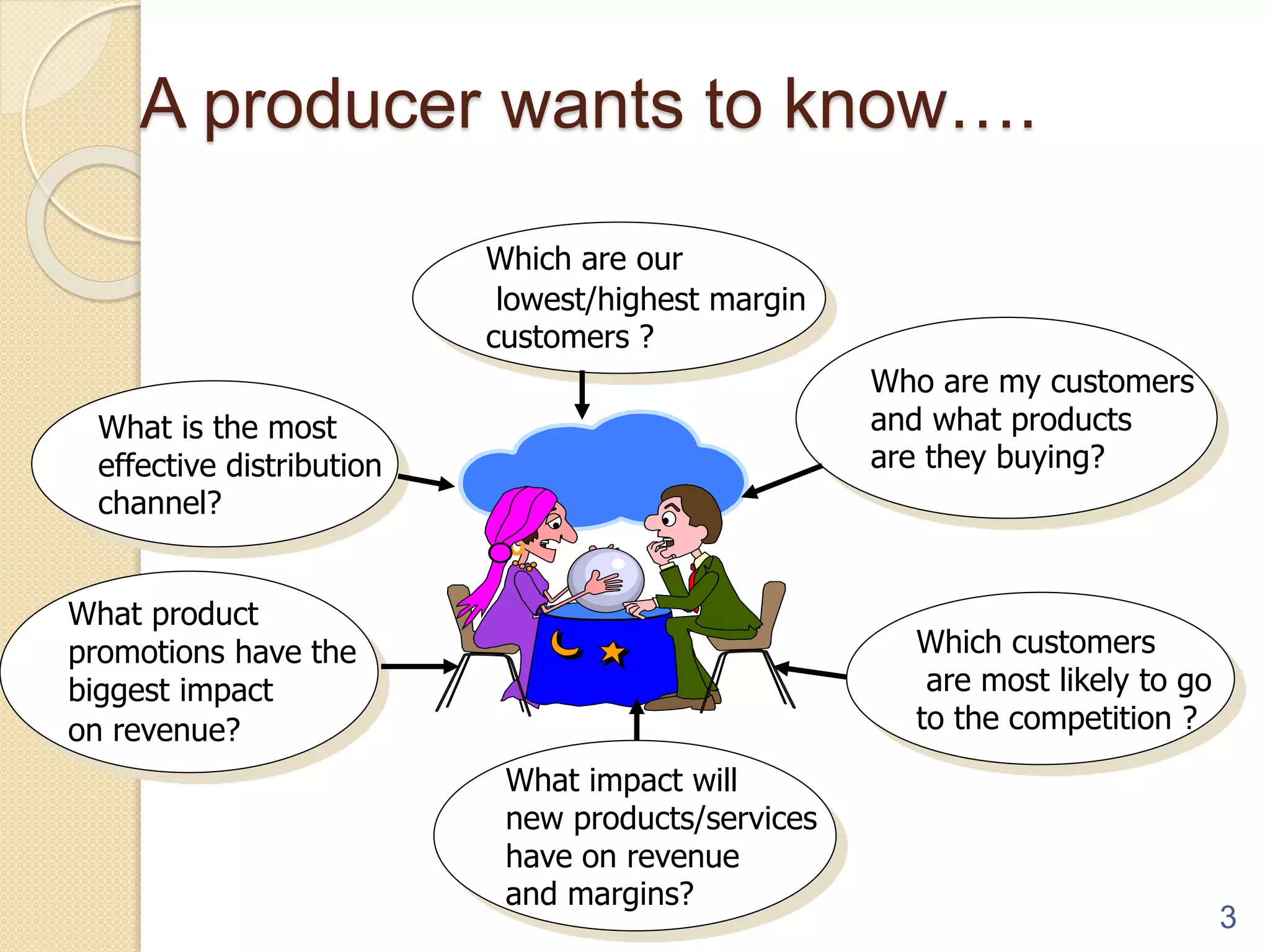
Which are our
lowest/highest margin
customers ?
Who are my customers
and what products
are they buying?
Which customers
are most likely to go
to the competition ?
What impact will
new products/services
have on revenue
and margins?
What product
promotions have the
biggest impact
on revenue?
What is the most
effective distribution
channel?
A producer wants to know….
3
What is a Data Warehouse?
A single, complete and
consistent store of data
obtained from a variety of
different sources made
available to end users in a
what they can understand
and use in a business
context.
4
What are the users saying...
• Summary data has a real
value to the organization
• Historical data holds the key
to understanding data over
time
• What-if capabilities are
required
5
What is Data Warehousing?
A process of transforming
data into information and
making it available to
users whenever they
require.
Data
Information
6
 It is used for data mining as well as
business decision making.
 Data mining is a process of extracting
data from data-warehouse as per the
requierment of user.
 A data warehouse consists of large
volume of data which are permanent.
7
We want to know ...
 Given a database of 100,000 names, which
persons are the least likely to default on their
credit cards?
 Which of my customers are likely to be the
most loyal?
 What was the position of the company 20
years ago?
Data Mining helps to extract these
informations.
8
Benefits
 A Data Warehouse Delivers Enhanced
Business Intelligence
 A Data Warehouse Saves Time
 A Data Warehouse Provides Historical
Intelligence
 Improved end-user access to a wide variety
of data
 Helps to know the status of any company or
organization
9
Challanges
 User expectation
 Data structuring
 High maintenance
 May be unaffordable for small
companies
 Requires high level of database
knowledge
10
References
 http://www.dwbiconcepts.com/dat
a-warehousing
 http://www.exforsys.com/tutorials/
data-warehousing
 http://www.wikipedia.com/
11
12
Data warehousing

Data warehousing

  • 1.
    Hetauda School of Management PresentedBy: Presented To: Sujal Upadhyay Prakash Datta Bhatta Data Warehousing 1
  • 2.
  • 3.
    Which are our lowest/highestmargin customers ? Who are my customers and what products are they buying? Which customers are most likely to go to the competition ? What impact will new products/services have on revenue and margins? What product promotions have the biggest impact on revenue? What is the most effective distribution channel? A producer wants to know…. 3
  • 4.
    What is aData Warehouse? A single, complete and consistent store of data obtained from a variety of different sources made available to end users in a what they can understand and use in a business context. 4
  • 5.
    What are theusers saying... • Summary data has a real value to the organization • Historical data holds the key to understanding data over time • What-if capabilities are required 5
  • 6.
    What is DataWarehousing? A process of transforming data into information and making it available to users whenever they require. Data Information 6
  • 7.
     It isused for data mining as well as business decision making.  Data mining is a process of extracting data from data-warehouse as per the requierment of user.  A data warehouse consists of large volume of data which are permanent. 7
  • 8.
    We want toknow ...  Given a database of 100,000 names, which persons are the least likely to default on their credit cards?  Which of my customers are likely to be the most loyal?  What was the position of the company 20 years ago? Data Mining helps to extract these informations. 8
  • 9.
    Benefits  A DataWarehouse Delivers Enhanced Business Intelligence  A Data Warehouse Saves Time  A Data Warehouse Provides Historical Intelligence  Improved end-user access to a wide variety of data  Helps to know the status of any company or organization 9
  • 10.
    Challanges  User expectation Data structuring  High maintenance  May be unaffordable for small companies  Requires high level of database knowledge 10
  • 11.
  • 12.