Data Warehouse: 11
Data Transformation
Prof Neeraj Bhargava
Vaibhav Khanna
Department of Computer Science
School of Engineering and Systems Sciences
Maharshi Dayanand Saraswati University Ajmer
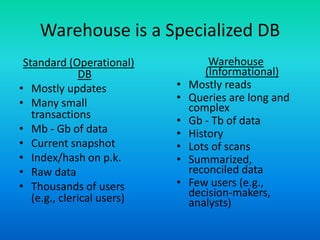
Warehouse is a Specialized DB
Standard (Operational)
DB
• Mostly updates
• Many small
transactions
• Mb - Gb of data
• Current snapshot
• Index/hash on p.k.
• Raw data
• Thousands of users
(e.g., clerical users)
Warehouse
(Informational)
• Mostly reads
• Queries are long and
complex
• Gb - Tb of data
• History
• Lots of scans
• Summarized,
reconciled data
• Few users (e.g.,
decision-makers,
analysts)
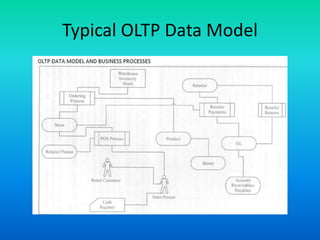
Typical OLTP Data Model
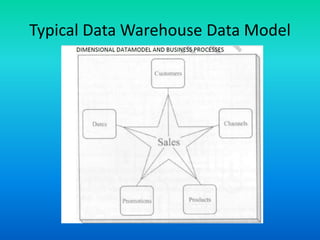
Typical Data Warehouse Data Model
Other Data Warehouse Changes
• New descriptive attributes
• New business activity attributes
• New classes of descriptive attributes
• Descriptive attributes become more refined
• Descriptive data are related to one another
• New source of data
The Reconciled Data Layer
• Typical operational data is:
– Transient
– Not historical
– Restricted in scope–not comprehensive
– Sometimes poor quality–inconsistencies and errors
• After ETL, data should be:
– Detailed–not summarized yet
– Historical–periodic
– Comprehensive–enterprise-wide perspective
– Timely–data should be current enough to assist decision-making
– Quality controlled–accurate with full integrity
Types of Data in DW
• Business Data - represents meaning
– Real-time data (ultimate source of all business data)
– Reconciled data
– Derived data
• Metadata - describes meaning
– Build-time metadata
– Control metadata
– Usage metadata
• Data as a product* - intrinsic meaning
– Produced and stored for its own intrinsic value
– e.g., the contents of a text-book
The ETL Process
• Capture/Extract
• Scrub or data cleansing
• Transform
• Load and Index
• ETL = Extract, transform, and load
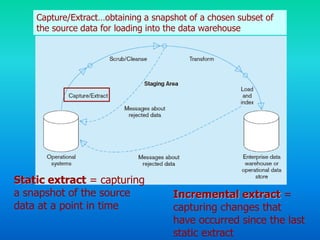
Capture/Extract…obtaining a snapshot of a chosen subset of
the source data for loading into the data warehouse
Static extract = capturing
a snapshot of the source
data at a point in time
Incremental extract =
capturing changes that
have occurred since the last
static extract
Thank You

Data warehouse 11 introduction to data transformation

  • 1.
    Data Warehouse: 11 DataTransformation Prof Neeraj Bhargava Vaibhav Khanna Department of Computer Science School of Engineering and Systems Sciences Maharshi Dayanand Saraswati University Ajmer
  • 2.
    Warehouse is aSpecialized DB Standard (Operational) DB • Mostly updates • Many small transactions • Mb - Gb of data • Current snapshot • Index/hash on p.k. • Raw data • Thousands of users (e.g., clerical users) Warehouse (Informational) • Mostly reads • Queries are long and complex • Gb - Tb of data • History • Lots of scans • Summarized, reconciled data • Few users (e.g., decision-makers, analysts)
  • 3.
  • 4.
  • 5.
    Other Data WarehouseChanges • New descriptive attributes • New business activity attributes • New classes of descriptive attributes • Descriptive attributes become more refined • Descriptive data are related to one another • New source of data
  • 6.
    The Reconciled DataLayer • Typical operational data is: – Transient – Not historical – Restricted in scope–not comprehensive – Sometimes poor quality–inconsistencies and errors • After ETL, data should be: – Detailed–not summarized yet – Historical–periodic – Comprehensive–enterprise-wide perspective – Timely–data should be current enough to assist decision-making – Quality controlled–accurate with full integrity
  • 7.
    Types of Datain DW • Business Data - represents meaning – Real-time data (ultimate source of all business data) – Reconciled data – Derived data • Metadata - describes meaning – Build-time metadata – Control metadata – Usage metadata • Data as a product* - intrinsic meaning – Produced and stored for its own intrinsic value – e.g., the contents of a text-book
  • 8.
    The ETL Process •Capture/Extract • Scrub or data cleansing • Transform • Load and Index • ETL = Extract, transform, and load
  • 9.
    Capture/Extract…obtaining a snapshotof a chosen subset of the source data for loading into the data warehouse Static extract = capturing a snapshot of the source data at a point in time Incremental extract = capturing changes that have occurred since the last static extract
  • 10.