 Introduction
 Warshall's algorithm
 Shortest path algorithm Floyd Warshall
Algorithm (modified warshall algorithm)
What is a Graph?
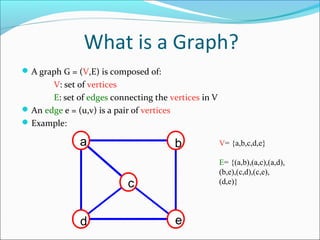
A graph G = (V,E) is composed of:
V: set of vertices
E: set of edges connecting the vertices in V
An edge e = (u,v) is a pair of vertices
Example:
a b
c
d e
V= {a,b,c,d,e}
E= {(a,b),(a,c),(a,d),
(b,e),(c,d),(c,e),
(d,e)}
0 0 0 1
1 0 1 1
1 0 0 1
0 0 1 0
A1 =
0 0 1 0
1 0 1 2
0 0 1 1
1 0 0 1
1 0 0 1
1 0 2 2
1 0 1 1
0 0 1 1
X
W
Y
Z
A2 = A3 =
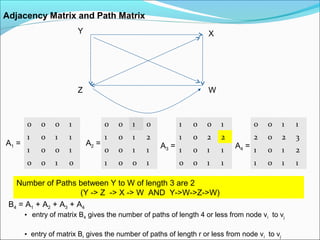
Adjacency Matrix and Path Matrix
A4 =
0 0 1 1
2 0 2 3
1 0 1 2
1 0 1 1
B4 = A1 + A2 + A3 + A4
• entry of matrix B4 gives the number of paths of length 4 or less from node vi to vj
• entry of matrix Br gives the number of paths of length r or less from node vi to vj
Number of Paths between Y to W of length 3 are 2
(Y -> Z -> X -> W AND Y->W->Z->W)
Warshall's algorithm
1. Repeat for I, J = 1, 2,…, M: [Initializes P.]
If A[I, J] = 0, then: Set P[I, J] := 0;
Else Set P[I, J] := 1.
[End of loop.]
1. Repeat Steps 3 and 4 for K = 1, 2,…, M: [Updates P.]
2. Repeat Step 4 for I = 1, 2,…, M:
3. Repeat J= 1, 2,…, M:
Set P[I, J] := P[I, J] OR (P[I, K] AND P[K, J] ).
[End of loop.]
[End of Step 3 loop.]
[End of step 2 loop.]
5. Exit
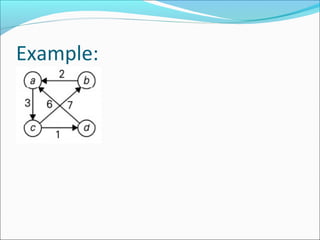
Example:
Floyd Warshall Algorithm
1. Repeat for I, J = 1, 2,…, M: [Initializes P.]
If A[I, J] = 0, then: Set P[I, J] := ∞;
Else Set P[I, J] := W(I, J).
[End of loop.]
1. Repeat Steps 3 and 4 for K = 1, 2,…, M: [Updates P.]
2. Repeat Step 4 for I = 1, 2,…, M:
3. Repeat J= 1, 2,…, M:
Set P[I, J] := MIN(P[I, J], (P[I, K]+P[K, J])).
[End of loop.]
[End of Step 3 loop.]
[End of step 2 loop.]
5. Exit
Example:
Thank You

Data Structure and Algorithms Graphs

  • 1.
     Introduction  Warshall'salgorithm  Shortest path algorithm Floyd Warshall Algorithm (modified warshall algorithm)
  • 2.
    What is aGraph? A graph G = (V,E) is composed of: V: set of vertices E: set of edges connecting the vertices in V An edge e = (u,v) is a pair of vertices Example: a b c d e V= {a,b,c,d,e} E= {(a,b),(a,c),(a,d), (b,e),(c,d),(c,e), (d,e)}
  • 3.
    0 0 01 1 0 1 1 1 0 0 1 0 0 1 0 A1 = 0 0 1 0 1 0 1 2 0 0 1 1 1 0 0 1 1 0 0 1 1 0 2 2 1 0 1 1 0 0 1 1 X W Y Z A2 = A3 = Adjacency Matrix and Path Matrix A4 = 0 0 1 1 2 0 2 3 1 0 1 2 1 0 1 1 B4 = A1 + A2 + A3 + A4 • entry of matrix B4 gives the number of paths of length 4 or less from node vi to vj • entry of matrix Br gives the number of paths of length r or less from node vi to vj Number of Paths between Y to W of length 3 are 2 (Y -> Z -> X -> W AND Y->W->Z->W)
  • 4.
    Warshall's algorithm 1. Repeatfor I, J = 1, 2,…, M: [Initializes P.] If A[I, J] = 0, then: Set P[I, J] := 0; Else Set P[I, J] := 1. [End of loop.] 1. Repeat Steps 3 and 4 for K = 1, 2,…, M: [Updates P.] 2. Repeat Step 4 for I = 1, 2,…, M: 3. Repeat J= 1, 2,…, M: Set P[I, J] := P[I, J] OR (P[I, K] AND P[K, J] ). [End of loop.] [End of Step 3 loop.] [End of step 2 loop.] 5. Exit
  • 5.
  • 6.
    Floyd Warshall Algorithm 1.Repeat for I, J = 1, 2,…, M: [Initializes P.] If A[I, J] = 0, then: Set P[I, J] := ∞; Else Set P[I, J] := W(I, J). [End of loop.] 1. Repeat Steps 3 and 4 for K = 1, 2,…, M: [Updates P.] 2. Repeat Step 4 for I = 1, 2,…, M: 3. Repeat J= 1, 2,…, M: Set P[I, J] := MIN(P[I, J], (P[I, K]+P[K, J])). [End of loop.] [End of Step 3 loop.] [End of step 2 loop.] 5. Exit
  • 7.
  • 8.