Application of Data Science in
Healthcare
Riya Khandelwal
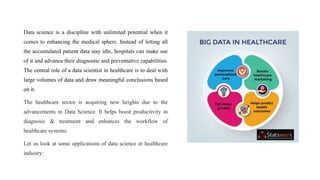
Data science is a discipline with unlimited potential when it
comes to enhancing the medical sphere. Instead of letting all
the accumulated patient data stay idle, hospitals can make use
of it and advance their diagnostic and preventative capabilities.
The central role of a data scientist in healthcare is to deal with
large volumes of data and draw meaningful conclusions based
on it.
The healthcare sector is acquiring new heights due to the
advancements in Data Science. It helps boost productivity in
diagnosis & treatment and enhances the workflow of
healthcare systems.
Let us look at some applications of data science in healthcare
industry:
Medical Image Analysis
Data Science helps in the recognition of scanned images to figure out the
defects in a human body to help doctors make an effective treatment strategy.
These medical image tests include X-rays, sonography, MRI, CT scans, and
many more. Proper analysis of the images of these tests helps gain valuable
insights for the doctors to provide the patients with better treatment.
Now, let us look at the three common algorithms used in medical image
analysis:
• Anomaly detection algorithm: This algorithm helps in identifying
conditions such as bone fracture and displacements.
• Image processing algorithm: The image processing algorithm helps in
analysing images and enhancing and denoising them.
• Descriptive image recognition algorithm: It visualizes and extracts data
from images, interprets it and makes use of it to form a bigger picture. For
example, merging the images of the brain scan and designating them
accordingly.
Predictive Analysis
In today’s world, information is one of the important factors in
healthcare analytics. Due to the lack of proper information about a
patient, the condition can get worse. Thus, information about the
patient must be collected efficiently.
This data can be anything from the patient’s blood pressure, body
temperature, or sugar level. After collecting the patient’s data, it is
analysed to search for patterns and correlations in it. This process
tries to identify the symptoms of a disease, the stages of the disease,
the extent of damage, and many more.
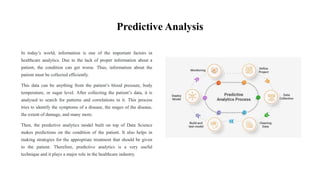
Then, the predictive analytics model built on top of Data Science
makes predictions on the condition of the patient. It also helps in
making strategies for the appropriate treatment that should be given
to the patient. Therefore, predictive analytics is a very useful
technique and it plays a major role in the healthcare industry.
Drug Research
As the world’s population is growing, there are many issues in the human
body emerging now and then. It has now become a challenge for medical
research institutes to find medicines or vaccines for diseases in a short
time. To find a formula for a medicine, the researchers have to understand
the characteristics of the causative agent, it may require millions of test
cases to do this. Then, after finding a formula, the researchers have to
perform further tests on the formula. To go through the data of the
millions of test cases mentioned above, earlier it required 10–12 years.
But, now, with the help of various applications of Data Science in
healthcare, it has become a much easier task. The data from millions of
test cases can be processed within months or maybe in weeks. It helps in
evaluating the efficiency of the drug through data analysis. Hence, a
successfully tested vaccine or medicine can be launched in less than a
year. This is all possible with the help of Data Science and Machine
Learning. Both have revolutionized the research and development sectors
of the medicinal drug industry.
Virtual Assistance
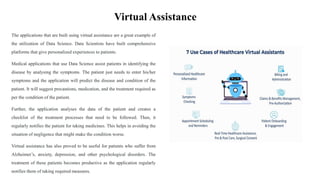
The applications that are built using virtual assistance are a great example of
the utilization of Data Science. Data Scientists have built comprehensive
platforms that give personalized experiences to patients.
Medical applications that use Data Science assist patients in identifying the
disease by analysing the symptoms. The patient just needs to enter his/her
symptoms and the application will predict the disease and condition of the
patient. It will suggest precautions, medication, and the treatment required as
per the condition of the patient.
Further, the application analyses the data of the patient and creates a
checklist of the treatment processes that need to be followed. Then, it
regularly notifies the patient for taking medicines. This helps in avoiding the
situation of negligence that might make the condition worse.
Virtual assistance has also proved to be useful for patients who suffer from
Alzheimer’s, anxiety, depression, and other psychological disorders. The
treatment of these patients becomes productive as the application regularly
notifies them of taking required measures.
Wearables
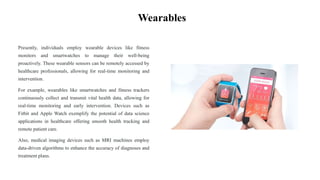
Presently, individuals employ wearable devices like fitness
monitors and smartwatches to manage their well-being
proactively. These wearable sensors can be remotely accessed by
healthcare professionals, allowing for real-time monitoring and
intervention.
For example, wearables like smartwatches and fitness trackers
continuously collect and transmit vital health data, allowing for
real-time monitoring and early intervention. Devices such as
Fitbit and Apple Watch exemplify the potential of data science
applications in healthcare offering smooth health tracking and
remote patient care.
Also, medical imaging devices such as MRI machines employ
data-driven algorithms to enhance the accuracy of diagnoses and
treatment plans.
The Road Ahead
In the future, we are likely to see even more use of artificial intelligence and
machine learning in healthcare. This will enable computers to learn from patient
data and make predictions about patient outcomes. This can make doctors make
even better decisions when it comes to diagnosing and treating patients.
In a nutshell, we can say that the data science shaping the future of healthcare
looks bright and we can expect to see many exciting developments in the coming
years that will improve the quality of care that patients receive.

Data science in healthcare.pptx

  • 1.
    Application of DataScience in Healthcare Riya Khandelwal
  • 2.
    Data science isa discipline with unlimited potential when it comes to enhancing the medical sphere. Instead of letting all the accumulated patient data stay idle, hospitals can make use of it and advance their diagnostic and preventative capabilities. The central role of a data scientist in healthcare is to deal with large volumes of data and draw meaningful conclusions based on it. The healthcare sector is acquiring new heights due to the advancements in Data Science. It helps boost productivity in diagnosis & treatment and enhances the workflow of healthcare systems. Let us look at some applications of data science in healthcare industry:
  • 3.
    Medical Image Analysis DataScience helps in the recognition of scanned images to figure out the defects in a human body to help doctors make an effective treatment strategy. These medical image tests include X-rays, sonography, MRI, CT scans, and many more. Proper analysis of the images of these tests helps gain valuable insights for the doctors to provide the patients with better treatment. Now, let us look at the three common algorithms used in medical image analysis: • Anomaly detection algorithm: This algorithm helps in identifying conditions such as bone fracture and displacements. • Image processing algorithm: The image processing algorithm helps in analysing images and enhancing and denoising them. • Descriptive image recognition algorithm: It visualizes and extracts data from images, interprets it and makes use of it to form a bigger picture. For example, merging the images of the brain scan and designating them accordingly.
  • 4.
    Predictive Analysis In today’sworld, information is one of the important factors in healthcare analytics. Due to the lack of proper information about a patient, the condition can get worse. Thus, information about the patient must be collected efficiently. This data can be anything from the patient’s blood pressure, body temperature, or sugar level. After collecting the patient’s data, it is analysed to search for patterns and correlations in it. This process tries to identify the symptoms of a disease, the stages of the disease, the extent of damage, and many more. Then, the predictive analytics model built on top of Data Science makes predictions on the condition of the patient. It also helps in making strategies for the appropriate treatment that should be given to the patient. Therefore, predictive analytics is a very useful technique and it plays a major role in the healthcare industry.
  • 5.
    Drug Research As theworld’s population is growing, there are many issues in the human body emerging now and then. It has now become a challenge for medical research institutes to find medicines or vaccines for diseases in a short time. To find a formula for a medicine, the researchers have to understand the characteristics of the causative agent, it may require millions of test cases to do this. Then, after finding a formula, the researchers have to perform further tests on the formula. To go through the data of the millions of test cases mentioned above, earlier it required 10–12 years. But, now, with the help of various applications of Data Science in healthcare, it has become a much easier task. The data from millions of test cases can be processed within months or maybe in weeks. It helps in evaluating the efficiency of the drug through data analysis. Hence, a successfully tested vaccine or medicine can be launched in less than a year. This is all possible with the help of Data Science and Machine Learning. Both have revolutionized the research and development sectors of the medicinal drug industry.
  • 6.
    Virtual Assistance The applicationsthat are built using virtual assistance are a great example of the utilization of Data Science. Data Scientists have built comprehensive platforms that give personalized experiences to patients. Medical applications that use Data Science assist patients in identifying the disease by analysing the symptoms. The patient just needs to enter his/her symptoms and the application will predict the disease and condition of the patient. It will suggest precautions, medication, and the treatment required as per the condition of the patient. Further, the application analyses the data of the patient and creates a checklist of the treatment processes that need to be followed. Then, it regularly notifies the patient for taking medicines. This helps in avoiding the situation of negligence that might make the condition worse. Virtual assistance has also proved to be useful for patients who suffer from Alzheimer’s, anxiety, depression, and other psychological disorders. The treatment of these patients becomes productive as the application regularly notifies them of taking required measures.
  • 7.
    Wearables Presently, individuals employwearable devices like fitness monitors and smartwatches to manage their well-being proactively. These wearable sensors can be remotely accessed by healthcare professionals, allowing for real-time monitoring and intervention. For example, wearables like smartwatches and fitness trackers continuously collect and transmit vital health data, allowing for real-time monitoring and early intervention. Devices such as Fitbit and Apple Watch exemplify the potential of data science applications in healthcare offering smooth health tracking and remote patient care. Also, medical imaging devices such as MRI machines employ data-driven algorithms to enhance the accuracy of diagnoses and treatment plans.
  • 8.
    The Road Ahead Inthe future, we are likely to see even more use of artificial intelligence and machine learning in healthcare. This will enable computers to learn from patient data and make predictions about patient outcomes. This can make doctors make even better decisions when it comes to diagnosing and treating patients. In a nutshell, we can say that the data science shaping the future of healthcare looks bright and we can expect to see many exciting developments in the coming years that will improve the quality of care that patients receive.