A Roadmap for
Optimizing Clinical
Decision Support
HEALTH CATALYST EDITORS
© 2020 Health Catalyst
Proprietary. Feel free to share but we would appreciate a Health Catalyst citation.
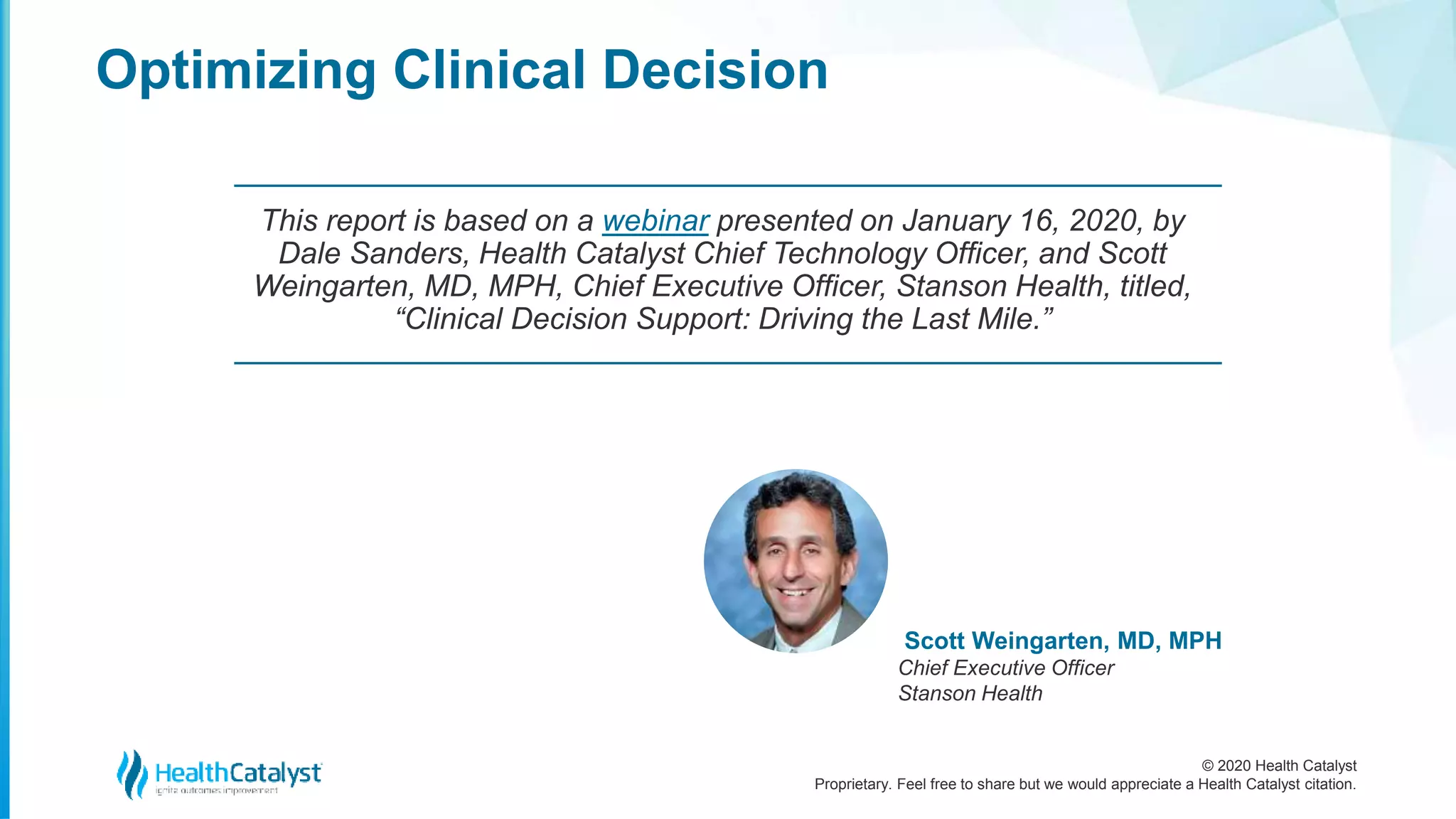
Scott Weingarten, MD, MPH
Chief Executive Officer
Stanson Health
This report is based on a webinar presented on January 16, 2020, by
Dale Sanders, Health Catalyst Chief Technology Officer, and Scott
Weingarten, MD, MPH, Chief Executive Officer, Stanson Health, titled,
“Clinical Decision Support: Driving the Last Mile.”
Optimizing Clinical Decision
© 2020 Health Catalyst
Proprietary. Feel free to share but we would appreciate a Health Catalyst citation.
Optimizing Clinical Decision
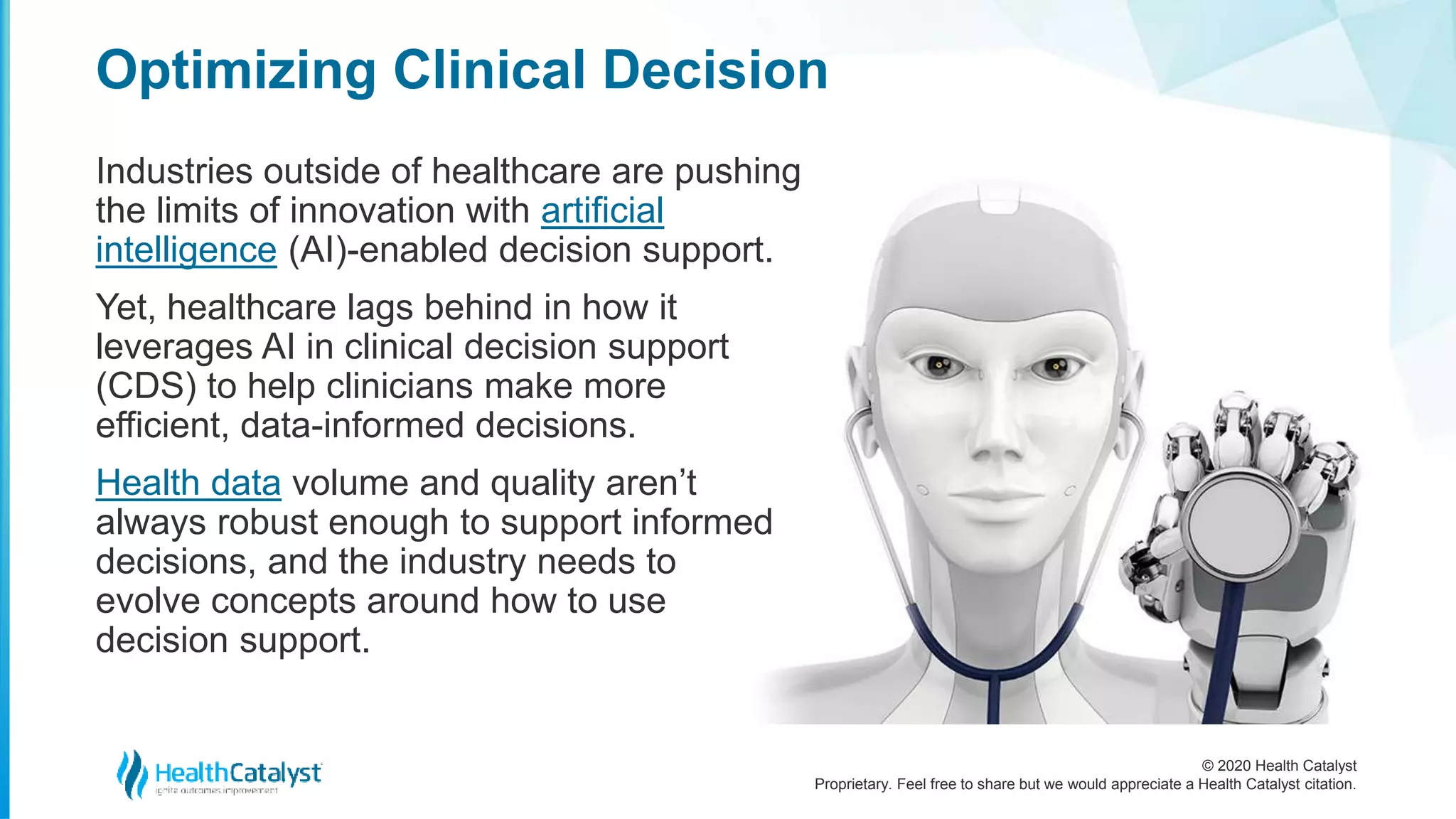
Industries outside of healthcare are pushing
the limits of innovation with artificial
intelligence (AI)-enabled decision support.
Yet, healthcare lags behind in how it
leverages AI in clinical decision support
(CDS) to help clinicians make more
efficient, data-informed decisions.
Health data volume and quality aren’t
always robust enough to support informed
decisions, and the industry needs to
evolve concepts around how to use
decision support.
© 2020 Health Catalyst
Proprietary. Feel free to share but we would appreciate a Health Catalyst citation.
Optimizing Clinical Decision
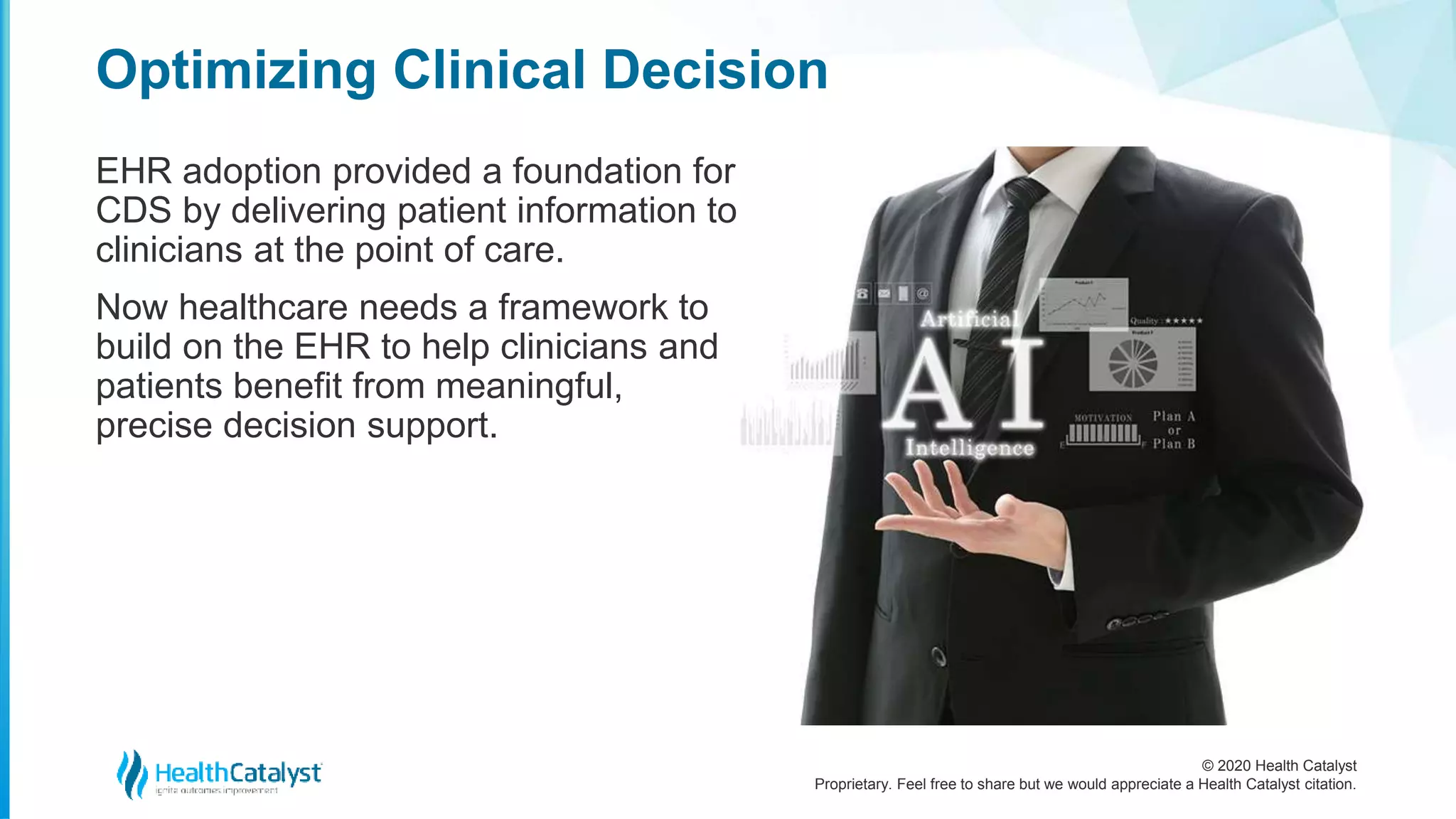
EHR adoption provided a foundation for
CDS by delivering patient information to
clinicians at the point of care.
Now healthcare needs a framework to
build on the EHR to help clinicians and
patients benefit from meaningful,
precise decision support.
© 2020 Health Catalyst
Proprietary. Feel free to share but we would appreciate a Health Catalyst citation.
Optimizing Clinical Decision
By looking to the automotive and aerospace
sectors, both highly digitized since the
1990s, as role models in innovation in
decision support, technically and culturally,
healthcare can create a pathway for CDS
that leverages available technology
(e.g., AI) in pursuit of improving outcomes
and lowering costs.
© 2020 Health Catalyst
Proprietary. Feel free to share but we would appreciate a Health Catalyst citation.
Optimizing Clinical Decision
Following the aerospace and automotive
arenas, healthcare can learn critical lessons
about improving its CDS capabilities:
1. Achieve Widespread Digitization
2. Build Data Volume and Scope
© 2020 Health Catalyst
Proprietary. Feel free to share but we would appreciate a Health Catalyst citation.
Optimizing Clinical Decision
#1: Achieve Widespread Digitization
Healthcare must digitize its assets and
operations for effective CDS.
Aerospace, for example, digitized the
aircraft, air traffic control, baggage
handling, ticketing, maintenance,
manufacturing.
Following suit, healthcare needs to
digitize patient registration, scheduling,
encounters, diagnosis, orders, billings,
and claims.
© 2020 Health Catalyst
Proprietary. Feel free to share but we would appreciate a Health Catalyst citation.
Optimizing Clinical Decision
#2: Build Data Volume and Scope
According to a paper from IEEE, simple
AI models and a lot of data trump more
elaborate models based on less data.
As the automotive industry demonstrates,
vehicle health monitoring relies on a data-
intense environment.
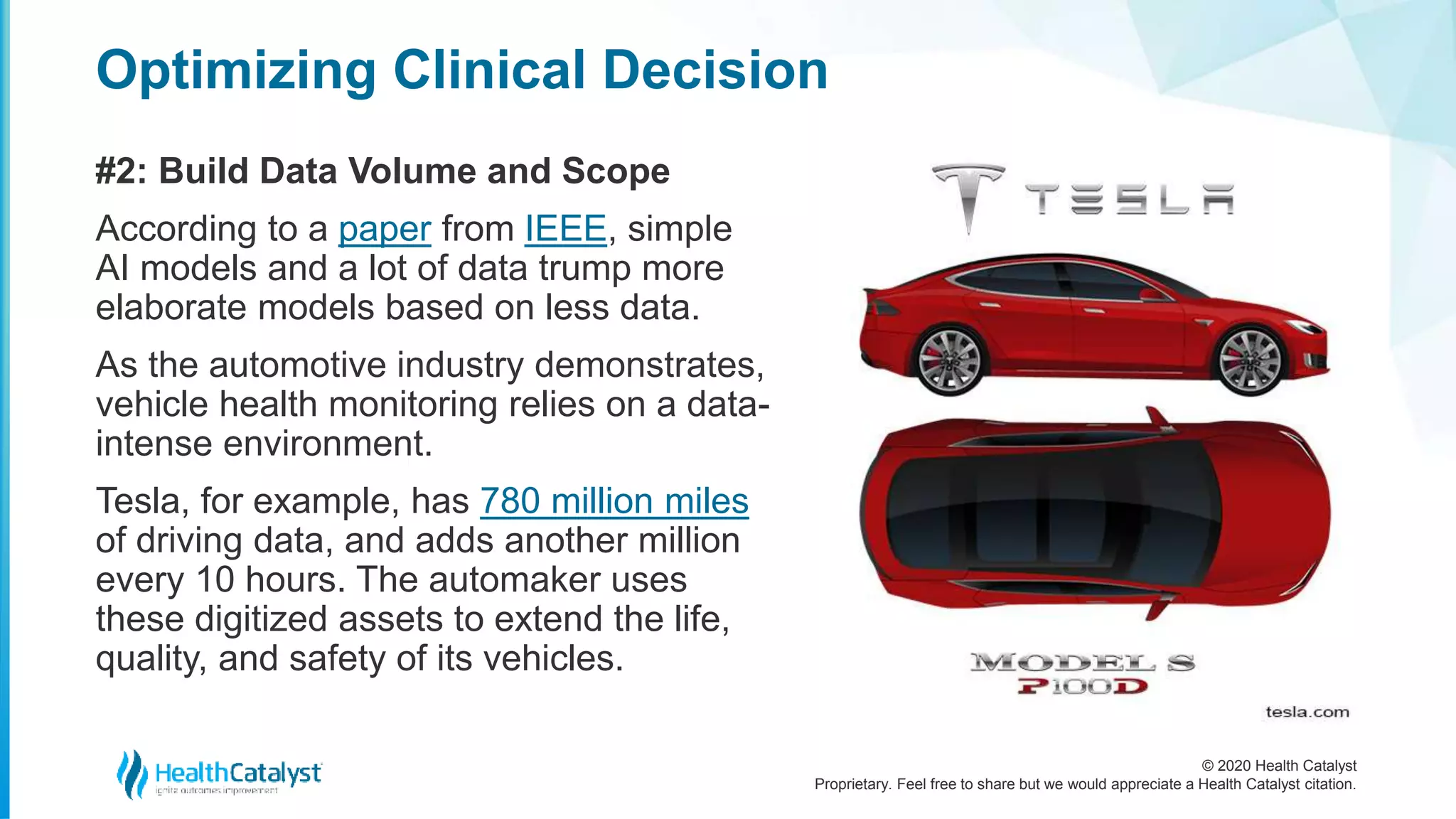
Tesla, for example, has 780 million miles
of driving data, and adds another million
every 10 hours. The automaker uses
these digitized assets to extend the life,
quality, and safety of its vehicles.
© 2020 Health Catalyst
Proprietary. Feel free to share but we would appreciate a Health Catalyst citation.
Optimizing Clinical Decision
#2: Build Data Volume and Scope
While healthcare big data volume is
projected to exceed data growth in other
sectors through 2025, effective CDS
demands better quality data.
To truly understand the patient at the
center of the human health data
ecosystem, healthcare must collect
socioeconomic, genomic, patient-reported
outcomes, claims data, and more.
© 2020 Health Catalyst
Proprietary. Feel free to share but we would appreciate a Health Catalyst citation.
Optimizing Clinical Decision
#2: Build Data Volume and Scope
Currently, the industry only collects data
on patients seeking care and no data on
patients not seeking care.
Putting all data categories on a timeline
for strategic data acquisition creates a
roadmap for the industry over the next
5 to 10 years to increase the precision
of understanding of patients.
© 2020 Health Catalyst
Proprietary. Feel free to share but we would appreciate a Health Catalyst citation.
Optimizing Clinical Decision
#2: Build Data Volume and Scope
Meanwhile, healthcare needs to ensure
the quality of its growing data volume.
Studies have highlighted concerns about
data quality, including poor disease
labeling in EHRs, discrepancies in
observed clinician behavior and EHR
documentation, and questionable
randomized clinical trials conclusions.
© 2020 Health Catalyst
Proprietary. Feel free to share but we would appreciate a Health Catalyst citation.
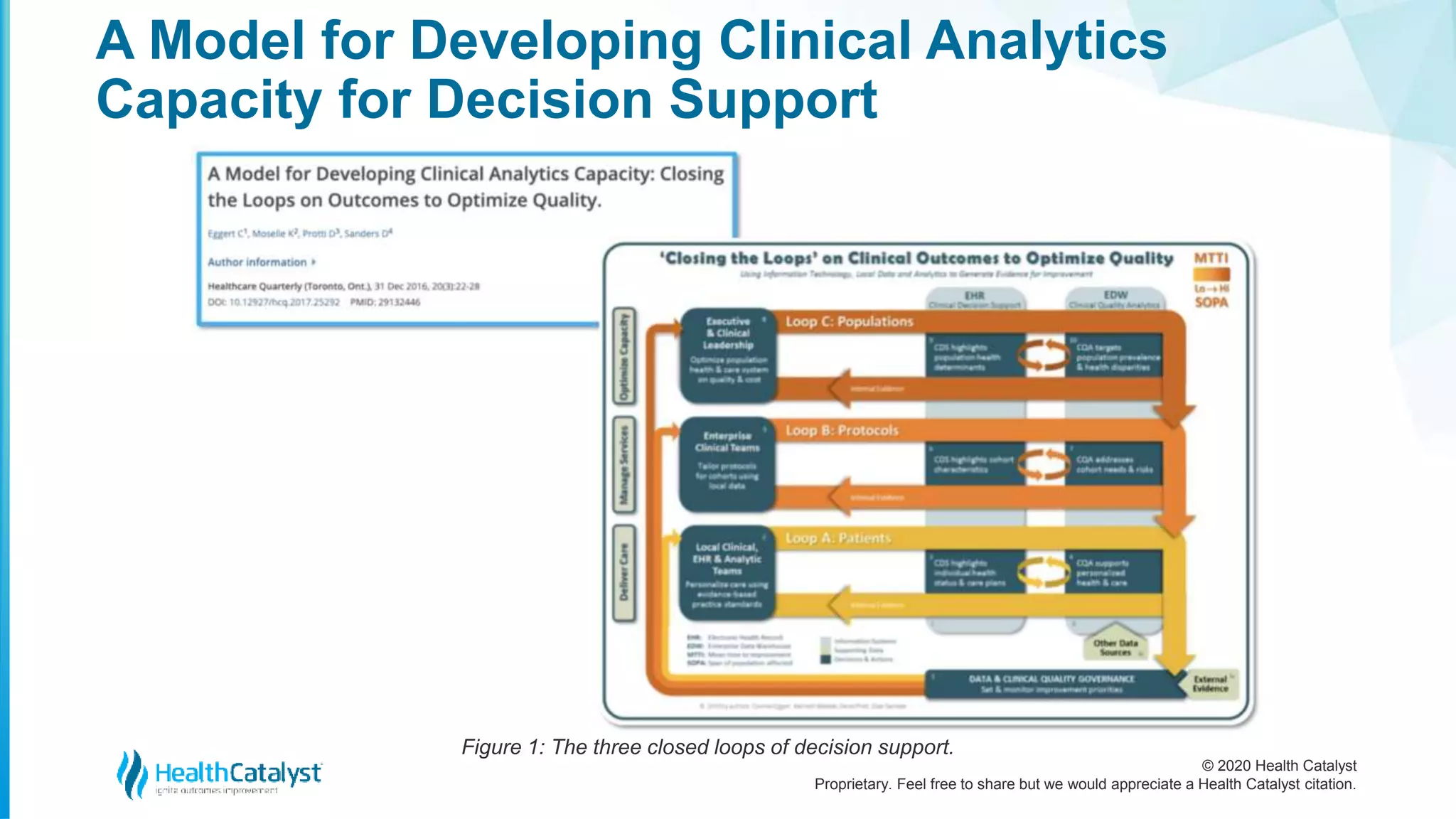
A Model for Developing Clinical Analytics
Capacity for Decision Support
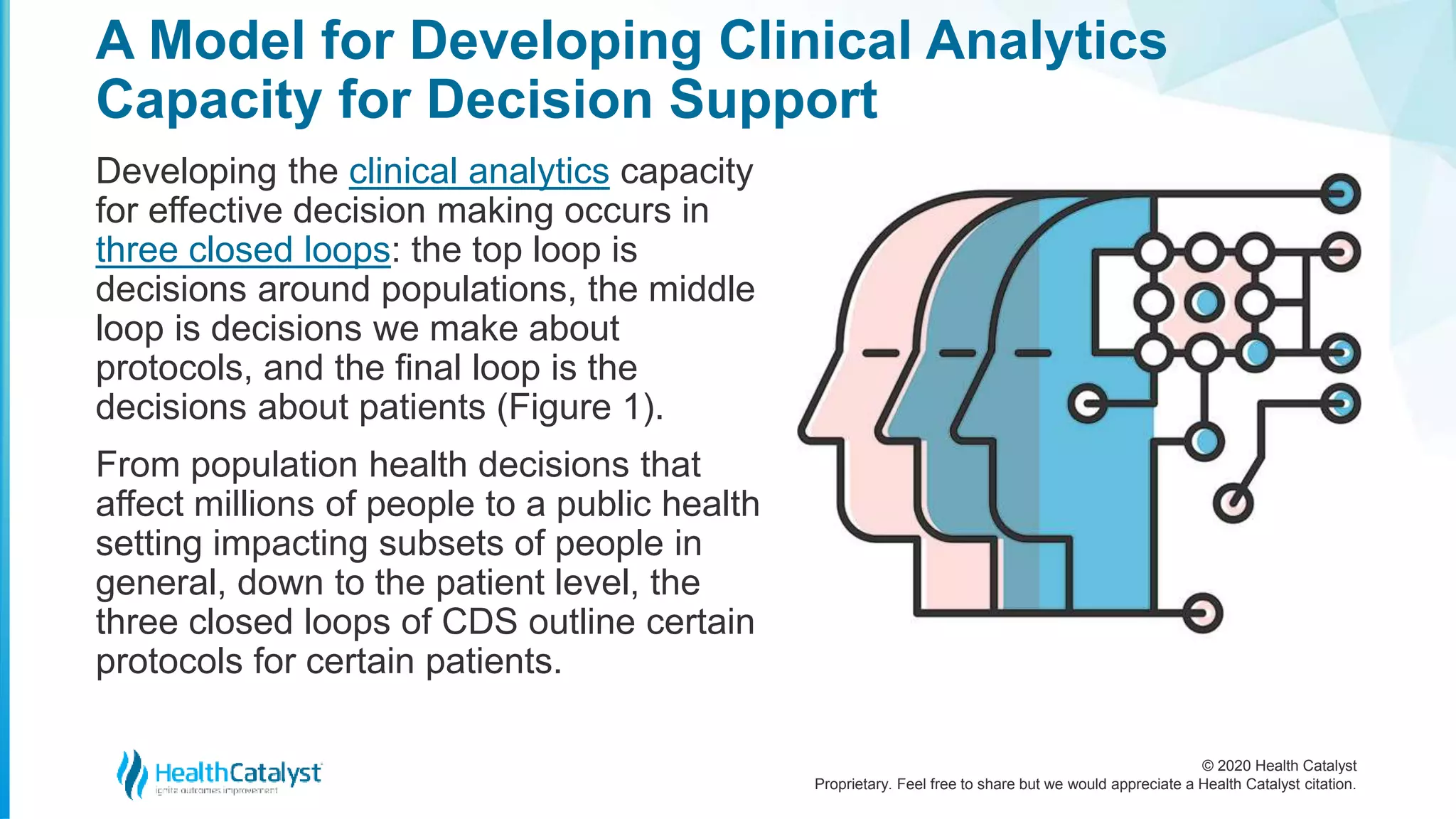
Developing the clinical analytics capacity
for effective decision making occurs in
three closed loops: the top loop is
decisions around populations, the middle
loop is decisions we make about
protocols, and the final loop is the
decisions about patients (Figure 1).
From population health decisions that
affect millions of people to a public health
setting impacting subsets of people in
general, down to the patient level, the
three closed loops of CDS outline certain
protocols for certain patients.
© 2020 Health Catalyst
Proprietary. Feel free to share but we would appreciate a Health Catalyst citation.
A Model for Developing Clinical Analytics
Capacity for Decision Support
Figure 1: The three closed loops of decision support.
© 2020 Health Catalyst
Proprietary. Feel free to share but we would appreciate a Health Catalyst citation.
Optimizing Clinical Decision Support:
Enabling Pattern Recognition with the Digital Twin
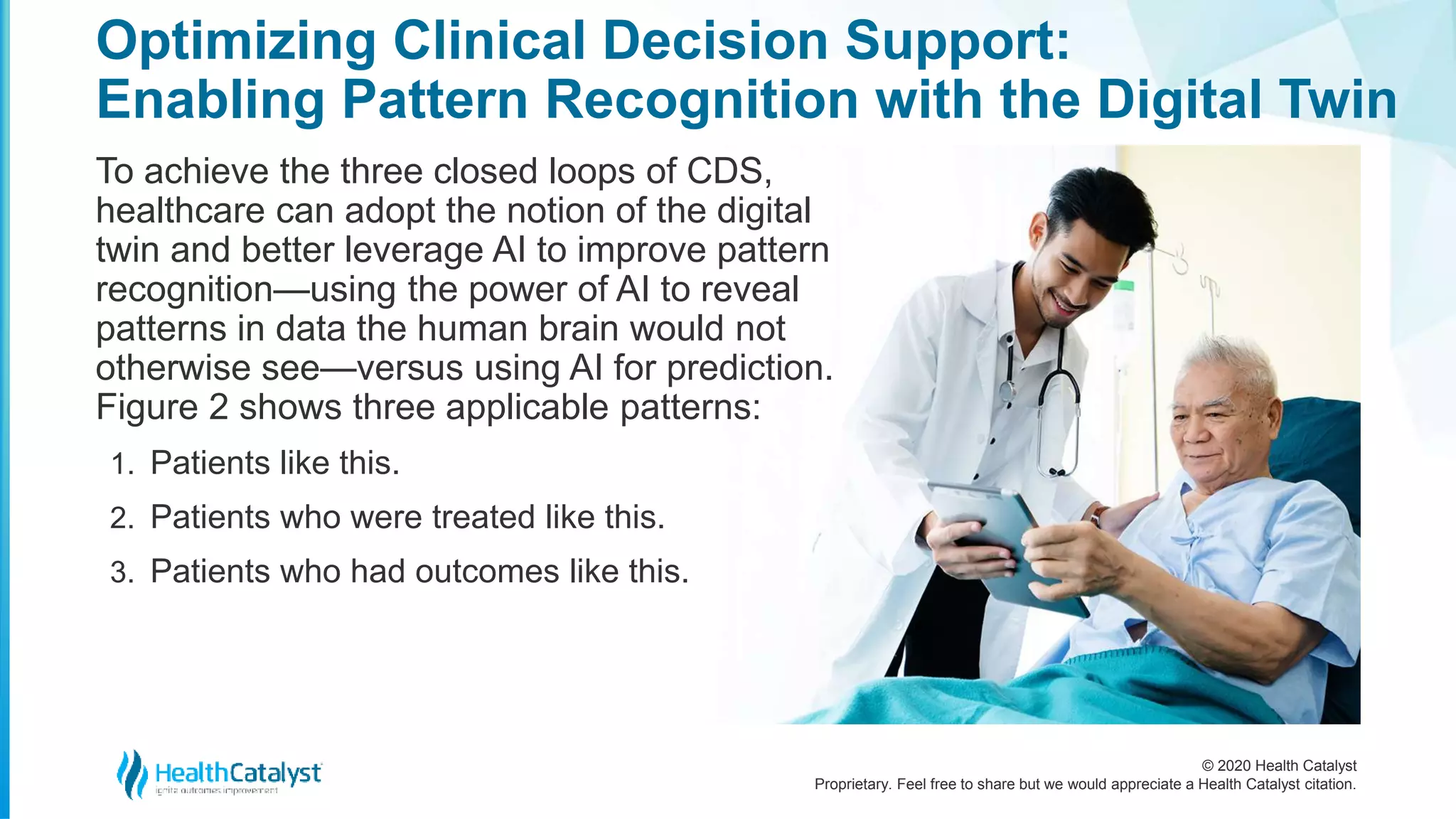
To achieve the three closed loops of CDS,
healthcare can adopt the notion of the digital
twin and better leverage AI to improve pattern
recognition—using the power of AI to reveal
patterns in data the human brain would not
otherwise see—versus using AI for prediction.
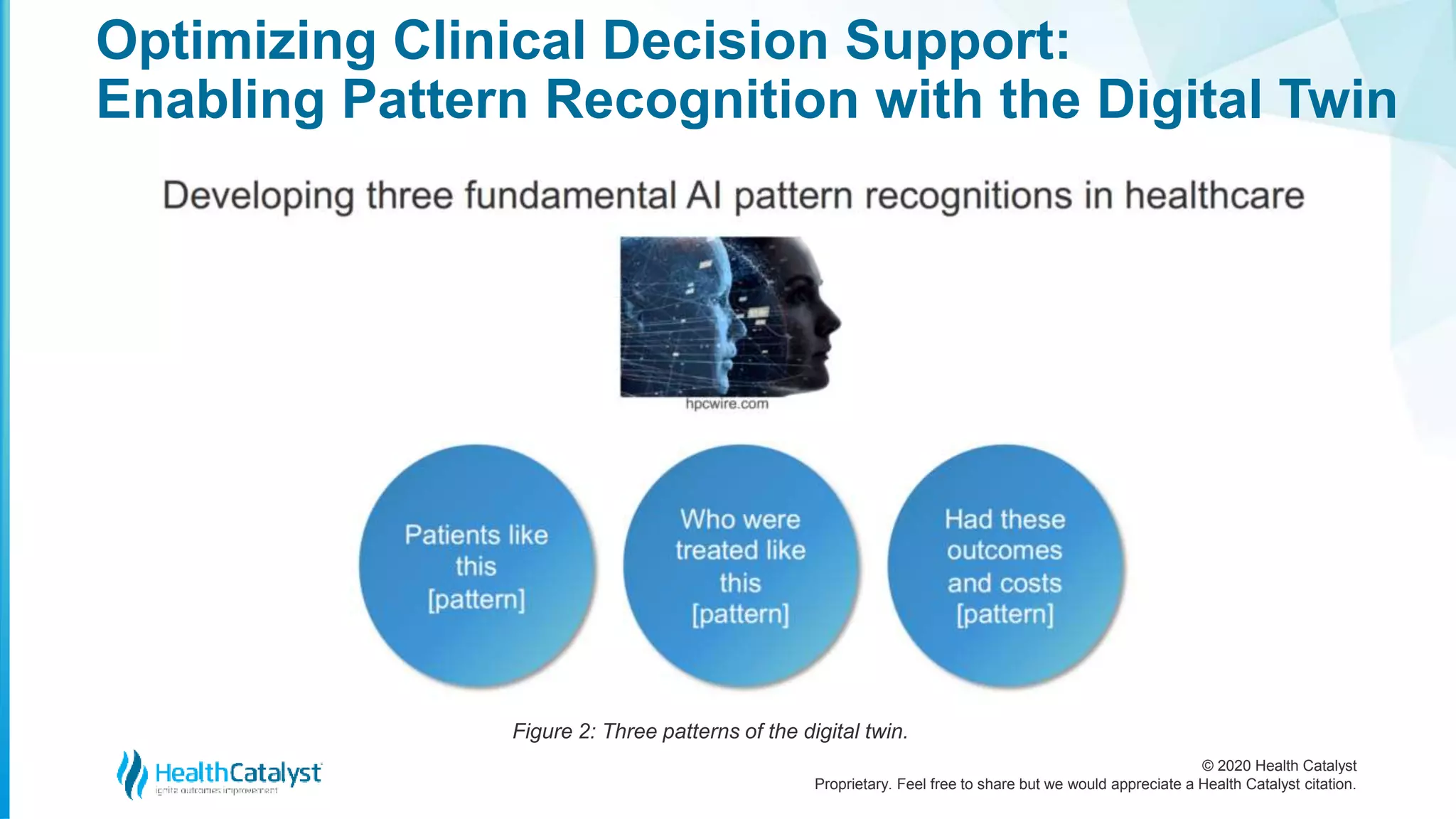
Figure 2 shows three applicable patterns:
1. Patients like this.
2. Patients who were treated like this.
3. Patients who had outcomes like this.
© 2020 Health Catalyst
Proprietary. Feel free to share but we would appreciate a Health Catalyst citation.
Optimizing Clinical Decision Support:
Enabling Pattern Recognition with the Digital Twin
Figure 2: Three patterns of the digital twin.
© 2020 Health Catalyst
Proprietary. Feel free to share but we would appreciate a Health Catalyst citation.
The Roadmap Bigger, Better Health Data
Borrowing from the progress of the automotive
and aerospace industries, health systems
clearly need to increase the data for every
member of their network.
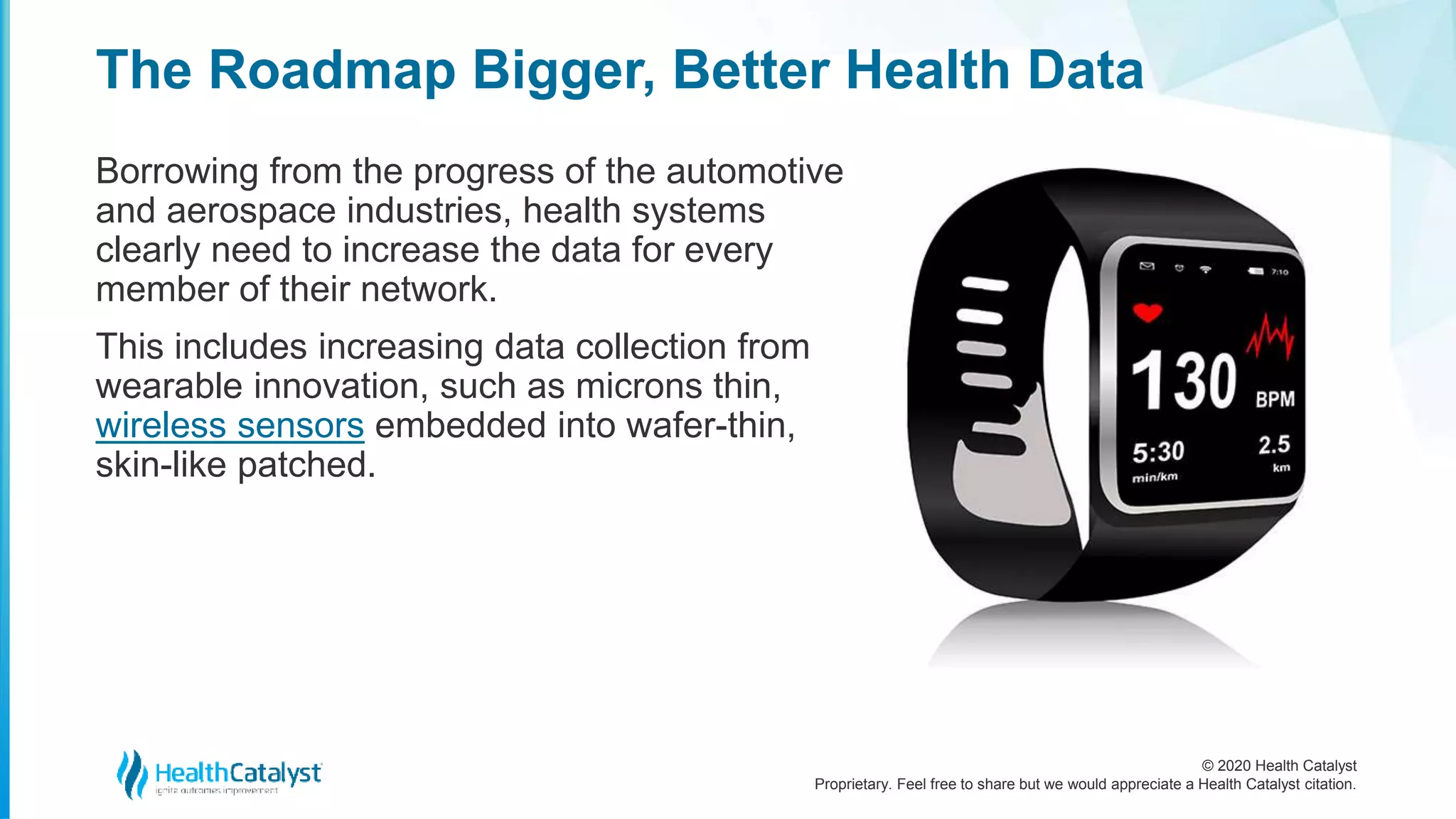
This includes increasing data collection from
wearable innovation, such as microns thin,
wireless sensors embedded into wafer-thin,
skin-like patched.
© 2020 Health Catalyst
Proprietary. Feel free to share but we would appreciate a Health Catalyst citation.
The Roadmap Bigger, Better Health Data
The need for and ability to collect more
health data will give way to a new type
of skillset—a “digititian,” who sits
between the patient and the physician
and the care team to develop digital
profiles of patient types.
© 2020 Health Catalyst
Proprietary. Feel free to share but we would appreciate a Health Catalyst citation.
The Roadmap Bigger, Better Health Data
For example, a patient with diabetes should
have a different digital profile than a patient
who’s undergone a spine surgery.
The digititian would define different patient
data profiles, then work with the patient and
the care team to collect and analyze data
and identify actions for the whole care team.
© 2020 Health Catalyst
Proprietary. Feel free to share but we would appreciate a Health Catalyst citation.
Healthcare Can Do Better
Following the roadmap to bigger, better
health data and improved CDS, healthcare
can better optimize bringing key insights
to practice.
According to the National Academy of
Medicine, there’s a 17-year gap between
the discovery of potentially lifesaving
information and its widespread translation
into practice.
Minimizing that gap needs to be an
industrywide priority.
© 2020 Health Catalyst
Proprietary. Feel free to share but we would appreciate a Health Catalyst citation.
Healthcare Can Do Better
In addition, a couple of studies in the New
England Journal of Medicine discovered that
patients are treated with care consistent with
the evidence only about 50 percent of the time.
Add to that equation studies in JAMA showing
about a third of all healthcare costs are waste,
and 10 percent of healthcare is overtreatment,
in which the harm exceeds the benefit.
Based on these findings, there’s ample
opportunity to improve.
© 2020 Health Catalyst
Proprietary. Feel free to share but we would appreciate a Health Catalyst citation.
How Clinical Decision Support Will Help
Healthcare Meet Today’s Digital Standards
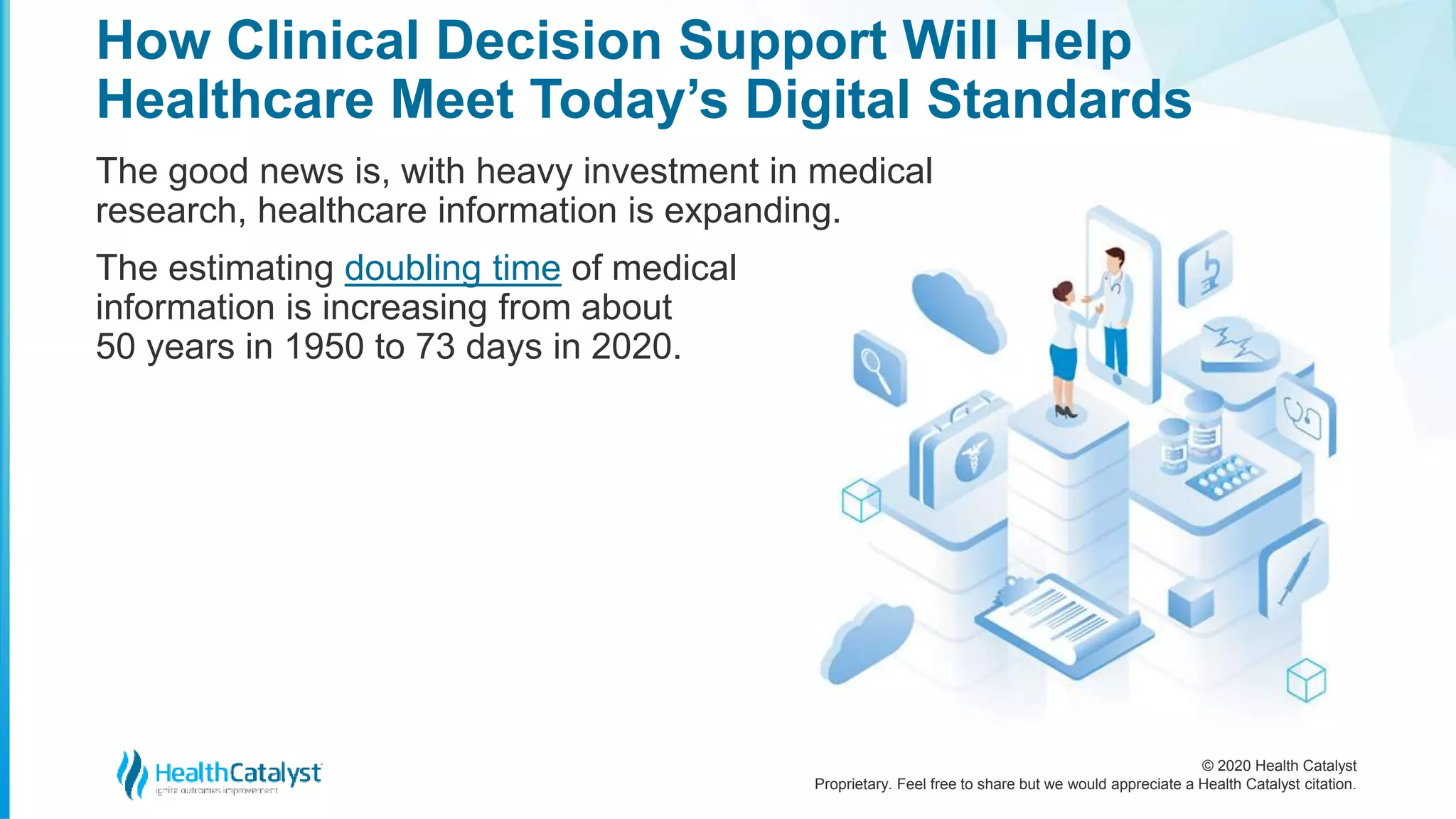
The good news is, with heavy investment in medical
research, healthcare information is expanding.
The estimating doubling time of medical
information is increasing from about
50 years in 1950 to 73 days in 2020.
© 2020 Health Catalyst
Proprietary. Feel free to share but we would appreciate a Health Catalyst citation.
How Clinical Decision Support Will Help
Healthcare Meet Today’s Digital Standards
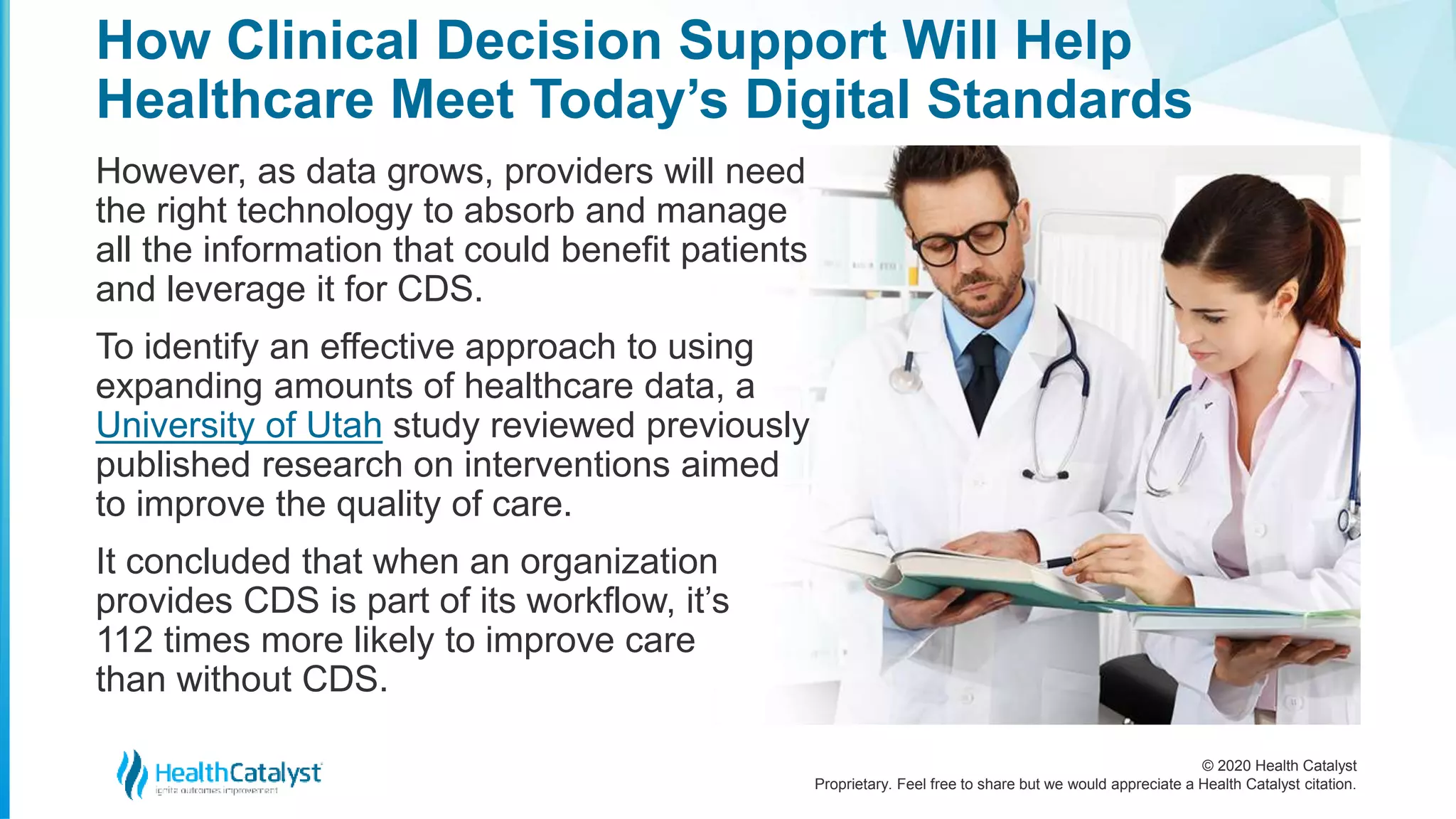
However, as data grows, providers will need
the right technology to absorb and manage
all the information that could benefit patients
and leverage it for CDS.
To identify an effective approach to using
expanding amounts of healthcare data, a
University of Utah study reviewed previously
published research on interventions aimed
to improve the quality of care.
It concluded that when an organization
provides CDS is part of its workflow, it’s
112 times more likely to improve care
than without CDS.
© 2020 Health Catalyst
Proprietary. Feel free to share but we would appreciate a Health Catalyst citation.
Optimized Clinical Decision Support Can
Improve Outcomes: Real-World Examples
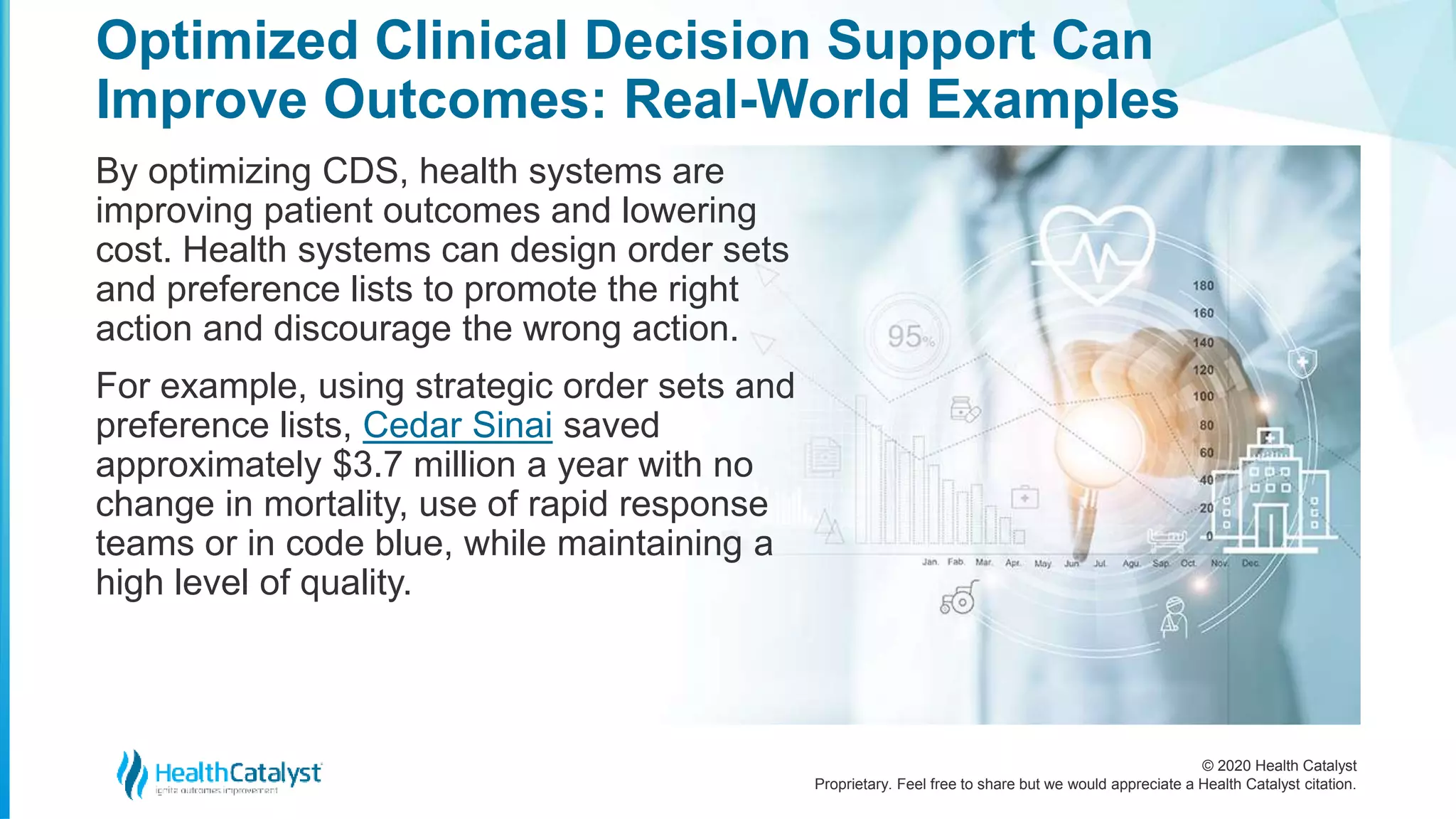
By optimizing CDS, health systems are
improving patient outcomes and lowering
cost. Health systems can design order sets
and preference lists to promote the right
action and discourage the wrong action.
For example, using strategic order sets and
preference lists, Cedar Sinai saved
approximately $3.7 million a year with no
change in mortality, use of rapid response
teams or in code blue, while maintaining a
high level of quality.
© 2020 Health Catalyst
Proprietary. Feel free to share but we would appreciate a Health Catalyst citation.
Optimized Clinical Decision Support Can
Improve Outcomes: Real-World Examples
Health systems can also implement CDS
to accelerate evidence or the translation
of evidence into practice.
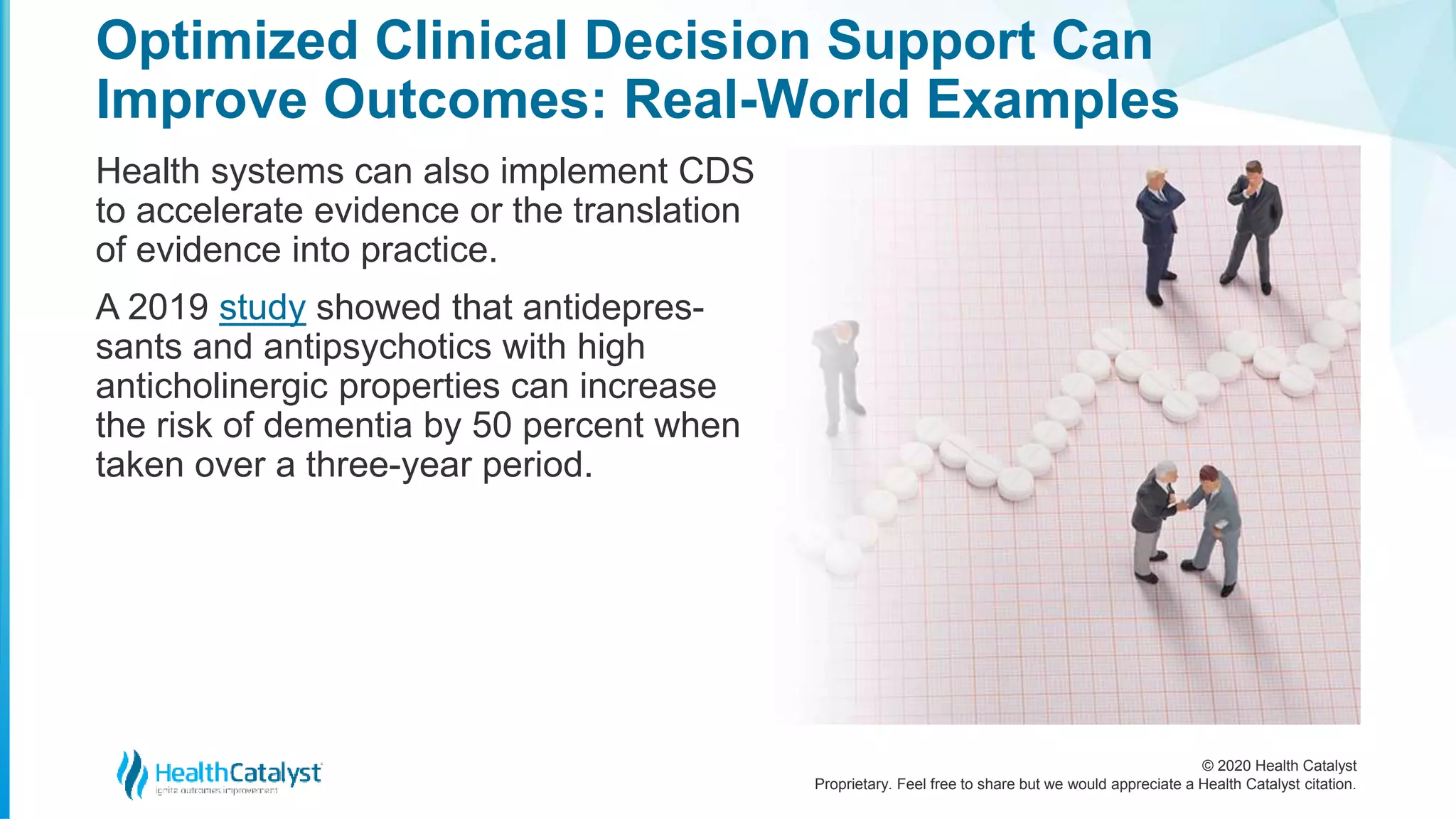
A 2019 study showed that antidepres-
sants and antipsychotics with high
anticholinergic properties can increase
the risk of dementia by 50 percent when
taken over a three-year period.
© 2020 Health Catalyst
Proprietary. Feel free to share but we would appreciate a Health Catalyst citation.
Optimized Clinical Decision Support Can
Improve Outcomes: Real-World Examples
Some of these antidepressants and antipsychotics
show up on order sets and preference lists, even
though antidepressants and antipsychotics exist
with fewer anticholinergic effects.
This leaves an opportunity to reduce preventable
dementia and improve the health of communities,
as well as the burden and morbidity associated
with dementia.
© 2020 Health Catalyst
Proprietary. Feel free to share but we would appreciate a Health Catalyst citation.
Innovation to Grow the Impact of Clinical
Decision Support
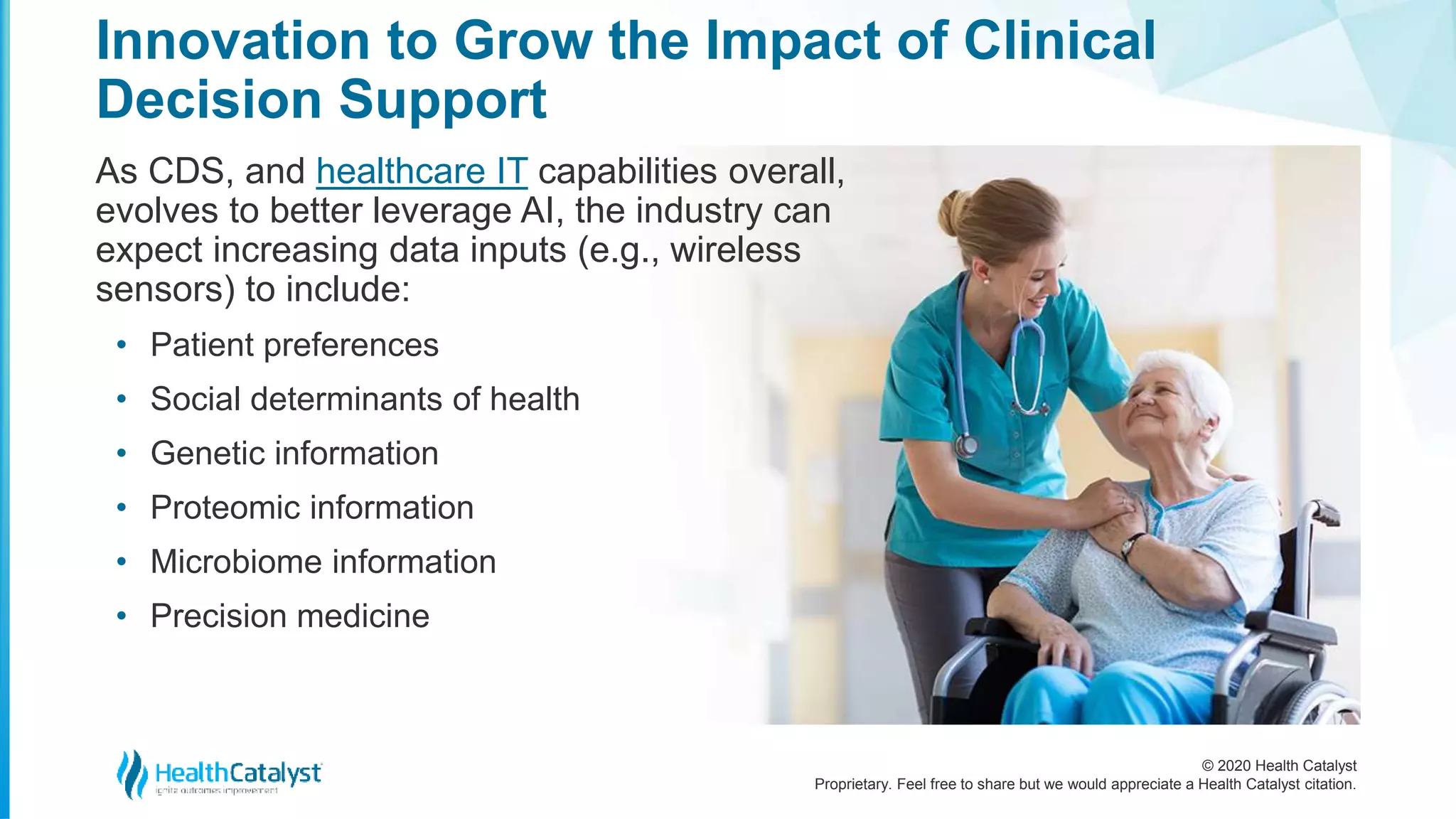
As CDS, and healthcare IT capabilities overall,
evolves to better leverage AI, the industry can
expect increasing data inputs (e.g., wireless
sensors) to include:
• Patient preferences
• Social determinants of health
• Genetic information
• Proteomic information
• Microbiome information
• Precision medicine
© 2020 Health Catalyst
Proprietary. Feel free to share but we would appreciate a Health Catalyst citation.
Innovation to Grow the Impact of Clinical
Decision Support
There’s also effort underway to make the
EHR more usable using voice recognition.
In addition, a number of companies are
working on ambient listening devices and
virtual assistants to listen to provider-patient
conversations, structure the information
and enable the information to guide to not
only the healthcare provider but also the
patient at home.
© 2020 Health Catalyst
Proprietary. Feel free to share but we would appreciate a Health Catalyst citation.
Decision-Support Role Models Set a
Two-Part Path for Improvement
If healthcare looks to the automotive and
aerospace industries for capable decision-
support role models, it can identify a
fundamental two-part for more capable
CDS: increased digitization and more
increased data volume and scope.
By building these two assets along with
better leveraging AI in data management
and decision making, healthcare can
achieve the CDS to positively impact
patients and the entire system of care
delivery.
© 2020 Health Catalyst
Proprietary. Feel free to share but we would appreciate a Health Catalyst citation.
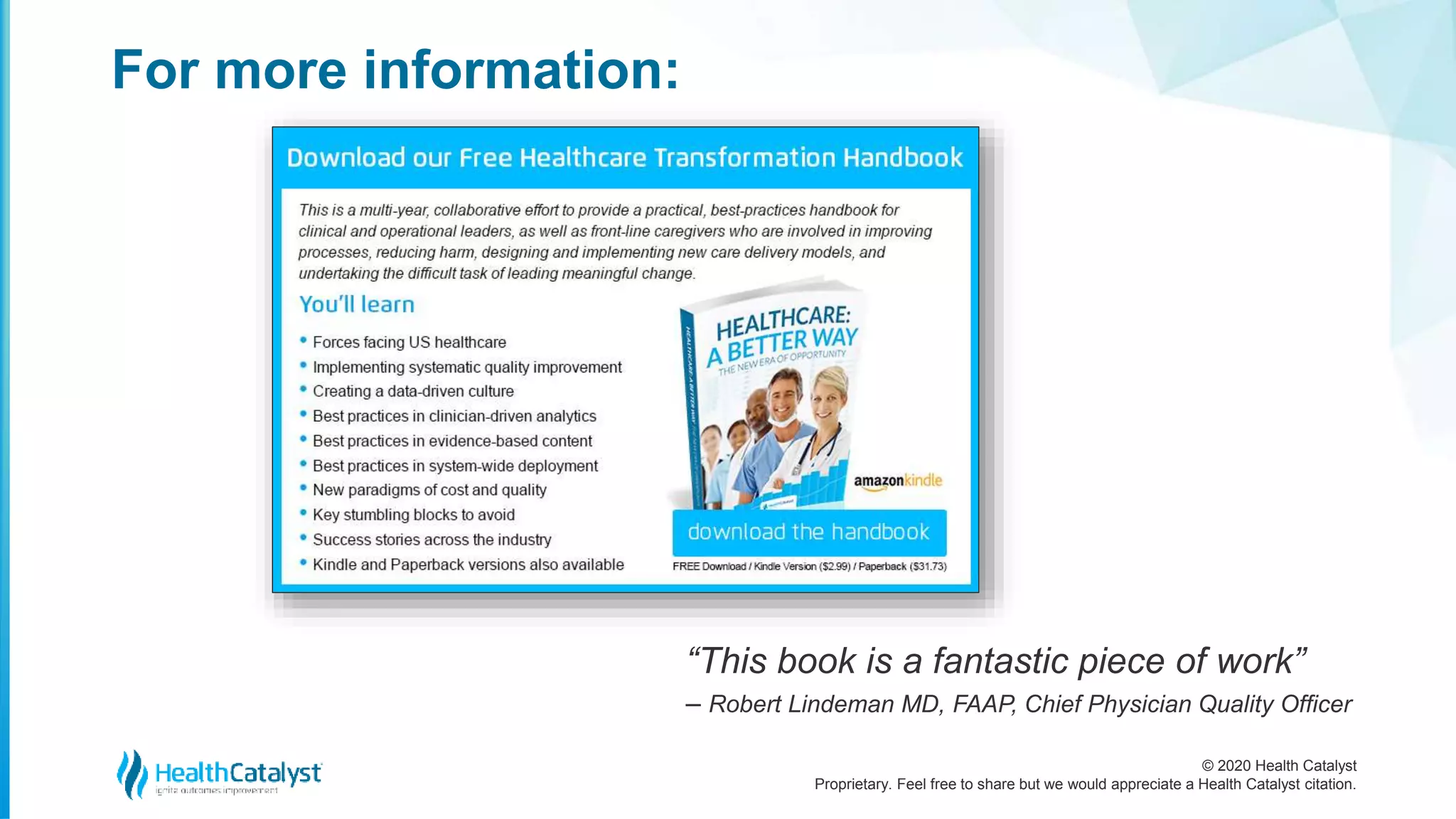
For more information:
“This book is a fantastic piece of work”
– Robert Lindeman MD, FAAP, Chief Physician Quality Officer
© 2020 Health Catalyst
Proprietary. Feel free to share but we would appreciate a Health Catalyst citation.
More about this topic
Link to original article for a more in-depth discussion.
A Roadmap for Optimizing Clinical Decision Support
Meaningful Machine Learning Visualizations for Clinical Users: A Framework
Valere Lemon, MBA, RN, Senior Subject Matter Expert; Alejo Jumat, User Experience Designer, Sr.
AI-Assisted Decision Making: Healthcare’s Next Frontier
Health Catalyst Editors
Health Catalyst® Introduces Closed-Loop Analytics™ Services
Tarah Neujahr Bryan, Senior VP, Marketing
Healthcare Data Literacy: A Must-Have for Becoming a Data-Driven Organization
Anna Kleckner, PhD, MPH, Business Consultant
Emergency Department Quality Improvement: Transforming the Delivery of Care
Health Catalyst Editors
© 2020 Health Catalyst
Proprietary. Feel free to share but we would appreciate a Health Catalyst citation.
Other Clinical Quality Improvement Resources
Click to read additional information at www.healthcatalyst.com
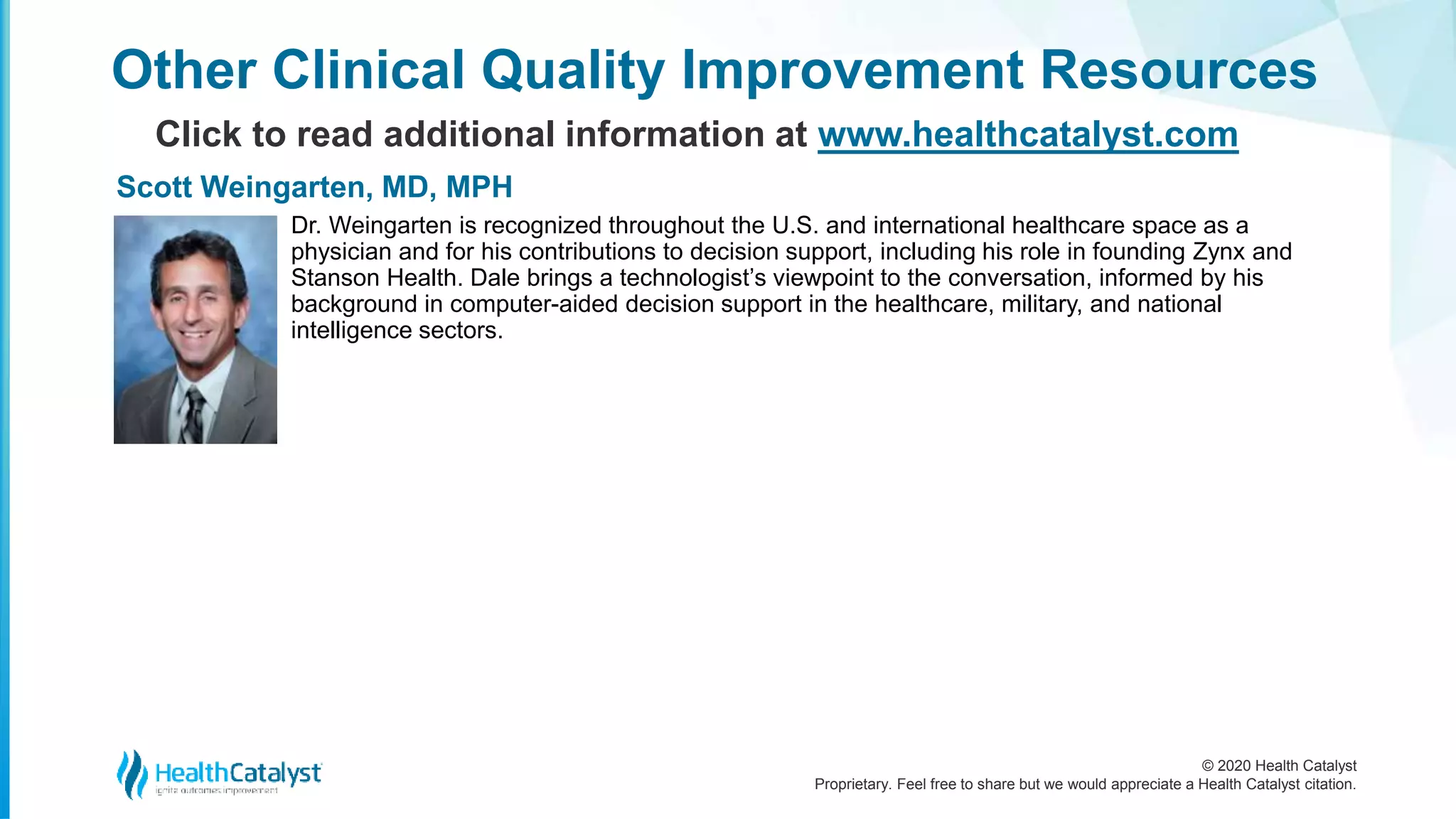
Dr. Weingarten is recognized throughout the U.S. and international healthcare space as a
physician and for his contributions to decision support, including his role in founding Zynx and
Stanson Health. Dale brings a technologist’s viewpoint to the conversation, informed by his
background in computer-aided decision support in the healthcare, military, and national
intelligence sectors.
Scott Weingarten, MD, MPH
© 2020 Health Catalyst
Proprietary. Feel free to share but we would appreciate a Health Catalyst citation.
Other Clinical Quality Improvement Resources
Click to read additional information at www.healthcatalyst.com
Health Catalyst is a mission-driven data warehousing, analytics and outcomes-improvement
company that helps healthcare organizations of all sizes improve clinical, financial, and operational
outcomes needed to improve population health and accountable care. Our proven enterprise data
warehouse (EDW) and analytics platform helps improve quality, add efficiency and lower costs in
support of more than 65 million patients for organizations ranging from the largest US health system
to forward-thinking physician practices.
Health Catalyst was recently named as the leader in the enterprise healthcare BI market in
improvement by KLAS, and has received numerous best-place-to work awards including Modern
Healthcare in 2013, 2014, and 2015, as well as other recognitions such as “Best Place to work for
Millenials, and a “Best Perks for Women.”

A Roadmap for Optimizing Clinical Decision Support

  • 1.
    A Roadmap for OptimizingClinical Decision Support HEALTH CATALYST EDITORS
  • 2.
    © 2020 HealthCatalyst Proprietary. Feel free to share but we would appreciate a Health Catalyst citation. Scott Weingarten, MD, MPH Chief Executive Officer Stanson Health This report is based on a webinar presented on January 16, 2020, by Dale Sanders, Health Catalyst Chief Technology Officer, and Scott Weingarten, MD, MPH, Chief Executive Officer, Stanson Health, titled, “Clinical Decision Support: Driving the Last Mile.” Optimizing Clinical Decision
  • 3.
    © 2020 HealthCatalyst Proprietary. Feel free to share but we would appreciate a Health Catalyst citation. Optimizing Clinical Decision Industries outside of healthcare are pushing the limits of innovation with artificial intelligence (AI)-enabled decision support. Yet, healthcare lags behind in how it leverages AI in clinical decision support (CDS) to help clinicians make more efficient, data-informed decisions. Health data volume and quality aren’t always robust enough to support informed decisions, and the industry needs to evolve concepts around how to use decision support.
  • 4.
    © 2020 HealthCatalyst Proprietary. Feel free to share but we would appreciate a Health Catalyst citation. Optimizing Clinical Decision EHR adoption provided a foundation for CDS by delivering patient information to clinicians at the point of care. Now healthcare needs a framework to build on the EHR to help clinicians and patients benefit from meaningful, precise decision support.
  • 5.
    © 2020 HealthCatalyst Proprietary. Feel free to share but we would appreciate a Health Catalyst citation. Optimizing Clinical Decision By looking to the automotive and aerospace sectors, both highly digitized since the 1990s, as role models in innovation in decision support, technically and culturally, healthcare can create a pathway for CDS that leverages available technology (e.g., AI) in pursuit of improving outcomes and lowering costs.
  • 6.
    © 2020 HealthCatalyst Proprietary. Feel free to share but we would appreciate a Health Catalyst citation. Optimizing Clinical Decision Following the aerospace and automotive arenas, healthcare can learn critical lessons about improving its CDS capabilities: 1. Achieve Widespread Digitization 2. Build Data Volume and Scope
  • 7.
    © 2020 HealthCatalyst Proprietary. Feel free to share but we would appreciate a Health Catalyst citation. Optimizing Clinical Decision #1: Achieve Widespread Digitization Healthcare must digitize its assets and operations for effective CDS. Aerospace, for example, digitized the aircraft, air traffic control, baggage handling, ticketing, maintenance, manufacturing. Following suit, healthcare needs to digitize patient registration, scheduling, encounters, diagnosis, orders, billings, and claims.
  • 8.
    © 2020 HealthCatalyst Proprietary. Feel free to share but we would appreciate a Health Catalyst citation. Optimizing Clinical Decision #2: Build Data Volume and Scope According to a paper from IEEE, simple AI models and a lot of data trump more elaborate models based on less data. As the automotive industry demonstrates, vehicle health monitoring relies on a data- intense environment. Tesla, for example, has 780 million miles of driving data, and adds another million every 10 hours. The automaker uses these digitized assets to extend the life, quality, and safety of its vehicles.
  • 9.
    © 2020 HealthCatalyst Proprietary. Feel free to share but we would appreciate a Health Catalyst citation. Optimizing Clinical Decision #2: Build Data Volume and Scope While healthcare big data volume is projected to exceed data growth in other sectors through 2025, effective CDS demands better quality data. To truly understand the patient at the center of the human health data ecosystem, healthcare must collect socioeconomic, genomic, patient-reported outcomes, claims data, and more.
  • 10.
    © 2020 HealthCatalyst Proprietary. Feel free to share but we would appreciate a Health Catalyst citation. Optimizing Clinical Decision #2: Build Data Volume and Scope Currently, the industry only collects data on patients seeking care and no data on patients not seeking care. Putting all data categories on a timeline for strategic data acquisition creates a roadmap for the industry over the next 5 to 10 years to increase the precision of understanding of patients.
  • 11.
    © 2020 HealthCatalyst Proprietary. Feel free to share but we would appreciate a Health Catalyst citation. Optimizing Clinical Decision #2: Build Data Volume and Scope Meanwhile, healthcare needs to ensure the quality of its growing data volume. Studies have highlighted concerns about data quality, including poor disease labeling in EHRs, discrepancies in observed clinician behavior and EHR documentation, and questionable randomized clinical trials conclusions.
  • 12.
    © 2020 HealthCatalyst Proprietary. Feel free to share but we would appreciate a Health Catalyst citation. A Model for Developing Clinical Analytics Capacity for Decision Support Developing the clinical analytics capacity for effective decision making occurs in three closed loops: the top loop is decisions around populations, the middle loop is decisions we make about protocols, and the final loop is the decisions about patients (Figure 1). From population health decisions that affect millions of people to a public health setting impacting subsets of people in general, down to the patient level, the three closed loops of CDS outline certain protocols for certain patients.
  • 13.
    © 2020 HealthCatalyst Proprietary. Feel free to share but we would appreciate a Health Catalyst citation. A Model for Developing Clinical Analytics Capacity for Decision Support Figure 1: The three closed loops of decision support.
  • 14.
    © 2020 HealthCatalyst Proprietary. Feel free to share but we would appreciate a Health Catalyst citation. Optimizing Clinical Decision Support: Enabling Pattern Recognition with the Digital Twin To achieve the three closed loops of CDS, healthcare can adopt the notion of the digital twin and better leverage AI to improve pattern recognition—using the power of AI to reveal patterns in data the human brain would not otherwise see—versus using AI for prediction. Figure 2 shows three applicable patterns: 1. Patients like this. 2. Patients who were treated like this. 3. Patients who had outcomes like this.
  • 15.
    © 2020 HealthCatalyst Proprietary. Feel free to share but we would appreciate a Health Catalyst citation. Optimizing Clinical Decision Support: Enabling Pattern Recognition with the Digital Twin Figure 2: Three patterns of the digital twin.
  • 16.
    © 2020 HealthCatalyst Proprietary. Feel free to share but we would appreciate a Health Catalyst citation. The Roadmap Bigger, Better Health Data Borrowing from the progress of the automotive and aerospace industries, health systems clearly need to increase the data for every member of their network. This includes increasing data collection from wearable innovation, such as microns thin, wireless sensors embedded into wafer-thin, skin-like patched.
  • 17.
    © 2020 HealthCatalyst Proprietary. Feel free to share but we would appreciate a Health Catalyst citation. The Roadmap Bigger, Better Health Data The need for and ability to collect more health data will give way to a new type of skillset—a “digititian,” who sits between the patient and the physician and the care team to develop digital profiles of patient types.
  • 18.
    © 2020 HealthCatalyst Proprietary. Feel free to share but we would appreciate a Health Catalyst citation. The Roadmap Bigger, Better Health Data For example, a patient with diabetes should have a different digital profile than a patient who’s undergone a spine surgery. The digititian would define different patient data profiles, then work with the patient and the care team to collect and analyze data and identify actions for the whole care team.
  • 19.
    © 2020 HealthCatalyst Proprietary. Feel free to share but we would appreciate a Health Catalyst citation. Healthcare Can Do Better Following the roadmap to bigger, better health data and improved CDS, healthcare can better optimize bringing key insights to practice. According to the National Academy of Medicine, there’s a 17-year gap between the discovery of potentially lifesaving information and its widespread translation into practice. Minimizing that gap needs to be an industrywide priority.
  • 20.
    © 2020 HealthCatalyst Proprietary. Feel free to share but we would appreciate a Health Catalyst citation. Healthcare Can Do Better In addition, a couple of studies in the New England Journal of Medicine discovered that patients are treated with care consistent with the evidence only about 50 percent of the time. Add to that equation studies in JAMA showing about a third of all healthcare costs are waste, and 10 percent of healthcare is overtreatment, in which the harm exceeds the benefit. Based on these findings, there’s ample opportunity to improve.
  • 21.
    © 2020 HealthCatalyst Proprietary. Feel free to share but we would appreciate a Health Catalyst citation. How Clinical Decision Support Will Help Healthcare Meet Today’s Digital Standards The good news is, with heavy investment in medical research, healthcare information is expanding. The estimating doubling time of medical information is increasing from about 50 years in 1950 to 73 days in 2020.
  • 22.
    © 2020 HealthCatalyst Proprietary. Feel free to share but we would appreciate a Health Catalyst citation. How Clinical Decision Support Will Help Healthcare Meet Today’s Digital Standards However, as data grows, providers will need the right technology to absorb and manage all the information that could benefit patients and leverage it for CDS. To identify an effective approach to using expanding amounts of healthcare data, a University of Utah study reviewed previously published research on interventions aimed to improve the quality of care. It concluded that when an organization provides CDS is part of its workflow, it’s 112 times more likely to improve care than without CDS.
  • 23.
    © 2020 HealthCatalyst Proprietary. Feel free to share but we would appreciate a Health Catalyst citation. Optimized Clinical Decision Support Can Improve Outcomes: Real-World Examples By optimizing CDS, health systems are improving patient outcomes and lowering cost. Health systems can design order sets and preference lists to promote the right action and discourage the wrong action. For example, using strategic order sets and preference lists, Cedar Sinai saved approximately $3.7 million a year with no change in mortality, use of rapid response teams or in code blue, while maintaining a high level of quality.
  • 24.
    © 2020 HealthCatalyst Proprietary. Feel free to share but we would appreciate a Health Catalyst citation. Optimized Clinical Decision Support Can Improve Outcomes: Real-World Examples Health systems can also implement CDS to accelerate evidence or the translation of evidence into practice. A 2019 study showed that antidepres- sants and antipsychotics with high anticholinergic properties can increase the risk of dementia by 50 percent when taken over a three-year period.
  • 25.
    © 2020 HealthCatalyst Proprietary. Feel free to share but we would appreciate a Health Catalyst citation. Optimized Clinical Decision Support Can Improve Outcomes: Real-World Examples Some of these antidepressants and antipsychotics show up on order sets and preference lists, even though antidepressants and antipsychotics exist with fewer anticholinergic effects. This leaves an opportunity to reduce preventable dementia and improve the health of communities, as well as the burden and morbidity associated with dementia.
  • 26.
    © 2020 HealthCatalyst Proprietary. Feel free to share but we would appreciate a Health Catalyst citation. Innovation to Grow the Impact of Clinical Decision Support As CDS, and healthcare IT capabilities overall, evolves to better leverage AI, the industry can expect increasing data inputs (e.g., wireless sensors) to include: • Patient preferences • Social determinants of health • Genetic information • Proteomic information • Microbiome information • Precision medicine
  • 27.
    © 2020 HealthCatalyst Proprietary. Feel free to share but we would appreciate a Health Catalyst citation. Innovation to Grow the Impact of Clinical Decision Support There’s also effort underway to make the EHR more usable using voice recognition. In addition, a number of companies are working on ambient listening devices and virtual assistants to listen to provider-patient conversations, structure the information and enable the information to guide to not only the healthcare provider but also the patient at home.
  • 28.
    © 2020 HealthCatalyst Proprietary. Feel free to share but we would appreciate a Health Catalyst citation. Decision-Support Role Models Set a Two-Part Path for Improvement If healthcare looks to the automotive and aerospace industries for capable decision- support role models, it can identify a fundamental two-part for more capable CDS: increased digitization and more increased data volume and scope. By building these two assets along with better leveraging AI in data management and decision making, healthcare can achieve the CDS to positively impact patients and the entire system of care delivery.
  • 29.
    © 2020 HealthCatalyst Proprietary. Feel free to share but we would appreciate a Health Catalyst citation. For more information: “This book is a fantastic piece of work” – Robert Lindeman MD, FAAP, Chief Physician Quality Officer
  • 30.
    © 2020 HealthCatalyst Proprietary. Feel free to share but we would appreciate a Health Catalyst citation. More about this topic Link to original article for a more in-depth discussion. A Roadmap for Optimizing Clinical Decision Support Meaningful Machine Learning Visualizations for Clinical Users: A Framework Valere Lemon, MBA, RN, Senior Subject Matter Expert; Alejo Jumat, User Experience Designer, Sr. AI-Assisted Decision Making: Healthcare’s Next Frontier Health Catalyst Editors Health Catalyst® Introduces Closed-Loop Analytics™ Services Tarah Neujahr Bryan, Senior VP, Marketing Healthcare Data Literacy: A Must-Have for Becoming a Data-Driven Organization Anna Kleckner, PhD, MPH, Business Consultant Emergency Department Quality Improvement: Transforming the Delivery of Care Health Catalyst Editors
  • 31.
    © 2020 HealthCatalyst Proprietary. Feel free to share but we would appreciate a Health Catalyst citation. Other Clinical Quality Improvement Resources Click to read additional information at www.healthcatalyst.com Dr. Weingarten is recognized throughout the U.S. and international healthcare space as a physician and for his contributions to decision support, including his role in founding Zynx and Stanson Health. Dale brings a technologist’s viewpoint to the conversation, informed by his background in computer-aided decision support in the healthcare, military, and national intelligence sectors. Scott Weingarten, MD, MPH
  • 32.
    © 2020 HealthCatalyst Proprietary. Feel free to share but we would appreciate a Health Catalyst citation. Other Clinical Quality Improvement Resources Click to read additional information at www.healthcatalyst.com Health Catalyst is a mission-driven data warehousing, analytics and outcomes-improvement company that helps healthcare organizations of all sizes improve clinical, financial, and operational outcomes needed to improve population health and accountable care. Our proven enterprise data warehouse (EDW) and analytics platform helps improve quality, add efficiency and lower costs in support of more than 65 million patients for organizations ranging from the largest US health system to forward-thinking physician practices. Health Catalyst was recently named as the leader in the enterprise healthcare BI market in improvement by KLAS, and has received numerous best-place-to work awards including Modern Healthcare in 2013, 2014, and 2015, as well as other recognitions such as “Best Place to work for Millenials, and a “Best Perks for Women.”