Application of Data Science
in Healthcare
Anurati Kulkarni 2MAECO 2237040
Big Data in Health
• Big data has been explored in many
different ways, from business to
transportation, which has made us aware
of how essential it is to daily life.
• It has changed the medical industry, and
has helped in structuring and mapping
large amounts of data to fundamentally
alter how even the most basic health
monitoring operations are carried out.
Educated Decision Making
• The competitive need for valuable
information in the health market is the
most significant of the many variables that
make data science essential to healthcare
today.
• Consumers may receive better-quality
healthcare with the aid of the correct data
collection procedures.
• To make educated decisions on the
health conditions of their patients,
everyone from doctors to health
Use In Pharma
• The foundation for drug synthesis
utilizing artificial intelligence is provided
by data science, which is its main
contribution to the pharmaceutical
sector.
• Compounds are created that address the
statistical association between the
attributes using mutation profiling and
patient metadata.
Diagnostics
• Applications of data science in healthcare
can facilitate and accelerate diagnosis.
• In addition to helping with early health
issue diagnosis, patient data analysis
also enables the creation of medical
heatmaps that show the demographic
trends in disease.
Predictive Analysis
• Data science predictive models correlate
and correlate every data point to symptoms,
routines, and diseases.
Helps to:
• Manage chronic diseases
• Monitor and analyze the demand for
pharmaceutical logistics
• Predict future patient crisis
• Deliver faster hospital data documentation
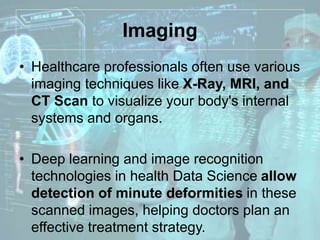
Imaging
• Healthcare professionals often use various
imaging techniques like X-Ray, MRI, and
CT Scan to visualize your body's internal
systems and organs.
• Deep learning and image recognition
technologies in health Data Science allow
detection of minute deformities in these
scanned images, helping doctors plan an
effective treatment strategy.
Conclusion
• The examples of data science in healthcare
above demonstrate how big data will soon
be the dominant force in the medical field.
• Naturally, such a large potential has
hazards, such as the lack of standardized
data and ineffective data management rules.
• Yet by establishing some norms for data
science applications in healthcare and trying
to improve the tools used for data analytics in
healthcare to make them as error-free as
possible, such difficulties can be solved.

Roll no.40 Class Presentation.pptx

  • 1.
    Application of DataScience in Healthcare Anurati Kulkarni 2MAECO 2237040
  • 2.
    Big Data inHealth • Big data has been explored in many different ways, from business to transportation, which has made us aware of how essential it is to daily life. • It has changed the medical industry, and has helped in structuring and mapping large amounts of data to fundamentally alter how even the most basic health monitoring operations are carried out.
  • 4.
    Educated Decision Making •The competitive need for valuable information in the health market is the most significant of the many variables that make data science essential to healthcare today. • Consumers may receive better-quality healthcare with the aid of the correct data collection procedures. • To make educated decisions on the health conditions of their patients, everyone from doctors to health
  • 5.
    Use In Pharma •The foundation for drug synthesis utilizing artificial intelligence is provided by data science, which is its main contribution to the pharmaceutical sector. • Compounds are created that address the statistical association between the attributes using mutation profiling and patient metadata.
  • 6.
    Diagnostics • Applications ofdata science in healthcare can facilitate and accelerate diagnosis. • In addition to helping with early health issue diagnosis, patient data analysis also enables the creation of medical heatmaps that show the demographic trends in disease.
  • 7.
    Predictive Analysis • Datascience predictive models correlate and correlate every data point to symptoms, routines, and diseases. Helps to: • Manage chronic diseases • Monitor and analyze the demand for pharmaceutical logistics • Predict future patient crisis • Deliver faster hospital data documentation
  • 8.
    Imaging • Healthcare professionalsoften use various imaging techniques like X-Ray, MRI, and CT Scan to visualize your body's internal systems and organs. • Deep learning and image recognition technologies in health Data Science allow detection of minute deformities in these scanned images, helping doctors plan an effective treatment strategy.
  • 9.
    Conclusion • The examplesof data science in healthcare above demonstrate how big data will soon be the dominant force in the medical field. • Naturally, such a large potential has hazards, such as the lack of standardized data and ineffective data management rules. • Yet by establishing some norms for data science applications in healthcare and trying to improve the tools used for data analytics in healthcare to make them as error-free as possible, such difficulties can be solved.