1
Data in the real world is dirty
incomplete: lacking attribute values, lacking certain attributes of
interest, or containing only aggregate data
e.g., occupation=― ‖
noisy: containing errors or outliers
e.g., Salary=―-10‖
inconsistent: containing discrepancies in codes or names
e.g., Age=―42‖ Birthday=―03/07/1997‖
e.g., Was rating ―1,2,3‖, now rating ―A, B, C‖
e.g., discrepancy between duplicate records

2
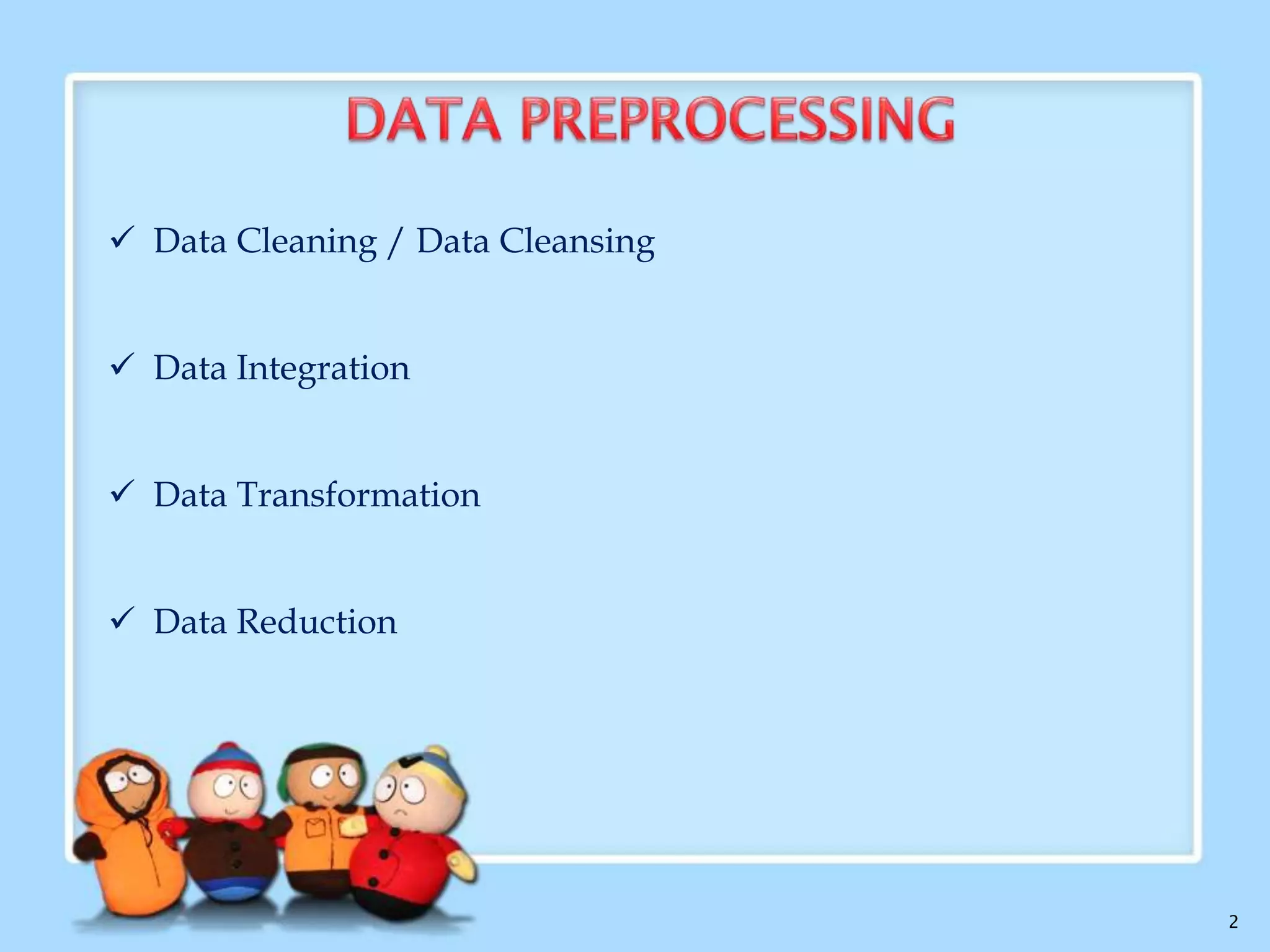
 Data Cleaning / Data Cleansing
Fill in missing values, smooth noisy data, identify or
remove outliers, and resolve inconsistencies

 Data Integration
Integration of multiple databases, data cubes, or files
 Data Transformation
Normalization and aggregation
 Data Reduction
Obtains reduced representation in volume but produces
the same or similar analytical results

3
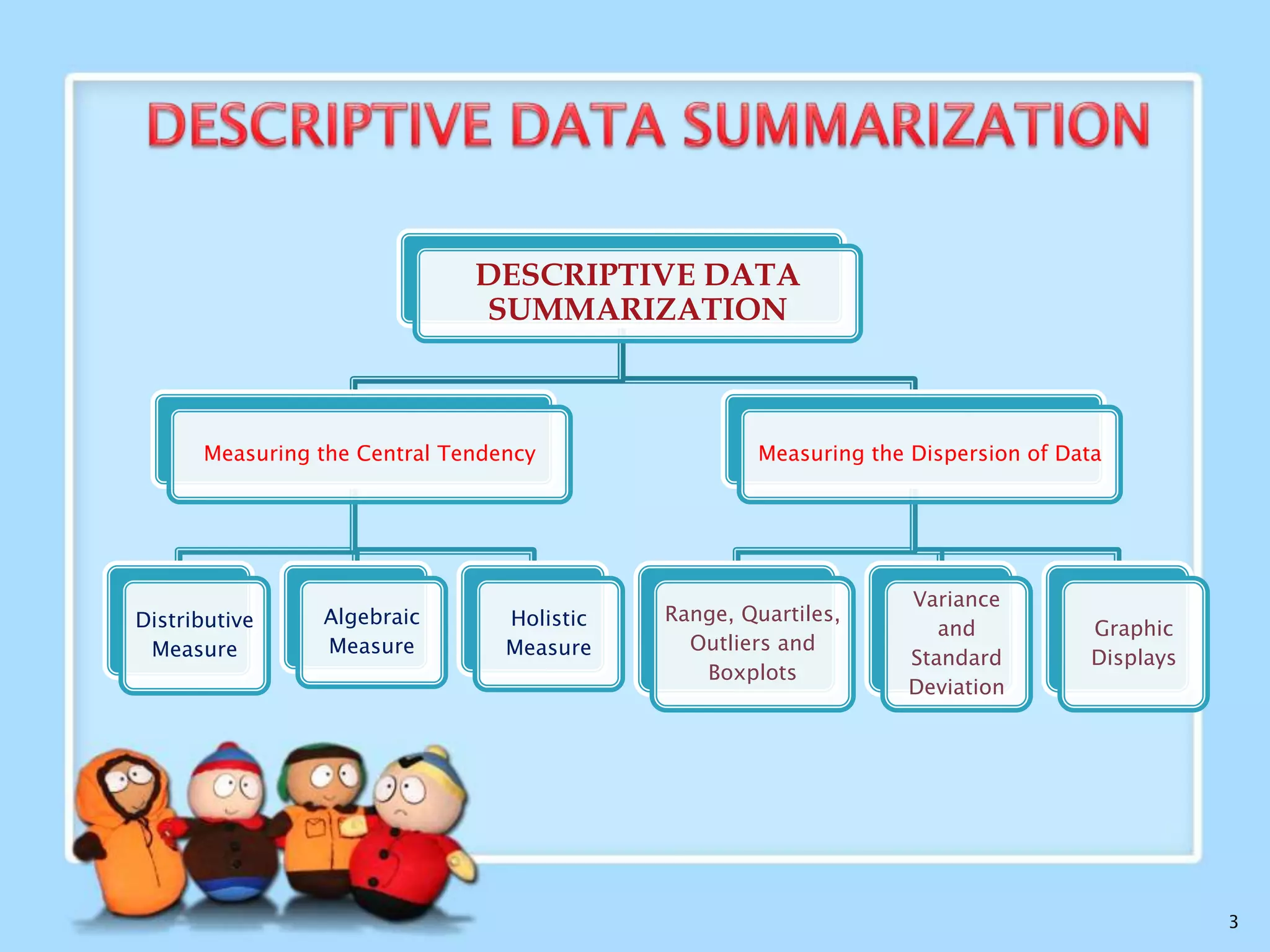
DESCRIPTIVE DATA
SUMMARIZATION

Measuring the Central Tendency

Distributive
Measure

Algebraic
Measure

Holistic
Measure

Measuring the Dispersion of Data

Range, Quartiles,
Outliers and
Boxplots

Variance
and
Standard
Deviation

Graphic
Displays

4
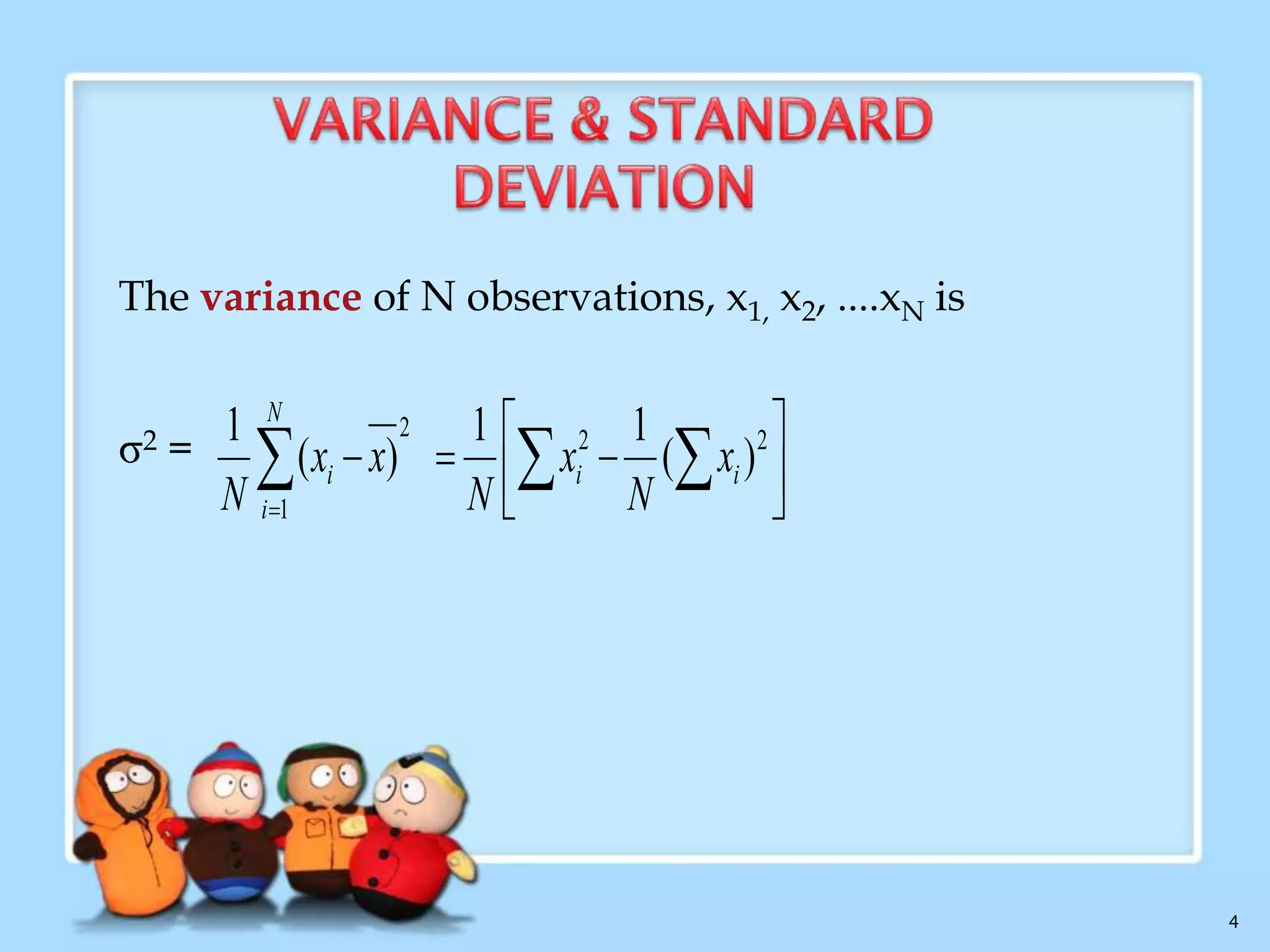
The variance of N observations, x1, x2, ....xN is

1
2 =
N

N

( xi x)
i1

2

1
N

2
i

x

1
( xi )2
N

5
Where

x

is the mean value of observations

The Standard deviation is 
The  of the observations is the square root of the

variance,  2

6
The basic properties of the standard deviation ,
  measures spread about the mean and should be used only
when the mean is chosen as the measure of center
  = 0 only when there is no spread, that is, when all
observations have the same value. Otherwise  > 0

7


Apart from the bar charts, pie charts and line graphs, there

are other popular types of graphs for the display of data
summaries and distributions.

Histograms

Quantile plots
q-q plots
Scatter plots
Curves
8
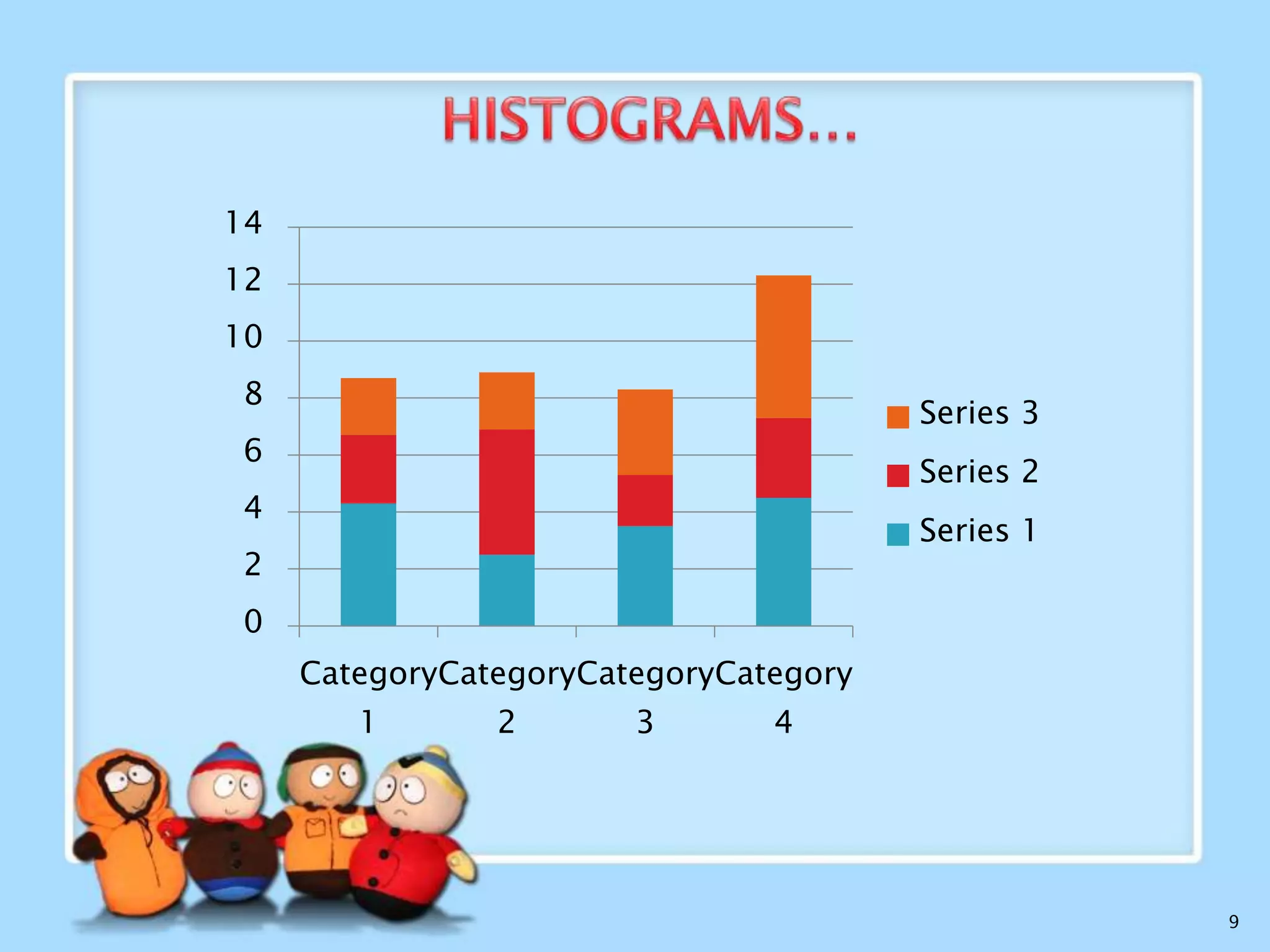
 Plotting histograms, or frequency histograms, is a graphical method
for summarizing the distribution of a given attribute.
 A histogram for an attribute A partitions into subsets or buckets.
 The width of each bucket is uniform
 Each bucket is represented by a rectangle
 The resulting graph is referred to as Bar chart

9
14
12
10
8
6
4
2
0

Series 3
Series 2

Series 1

10
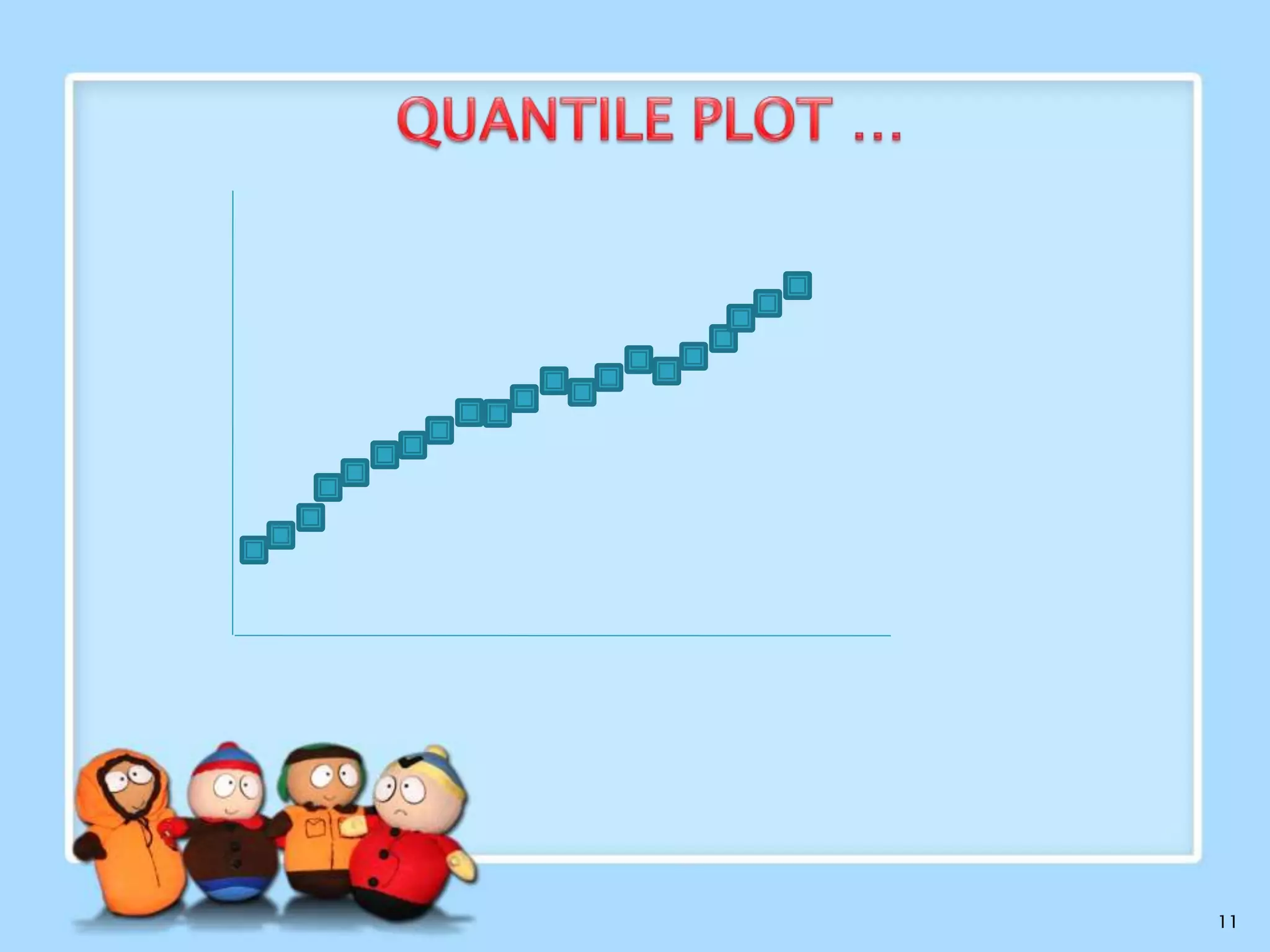
 It is a simple and effective way for a univariate data distribution
 First, it displays all of the data for the given attribute
 Second, it plots quantile information
 The mechanism is slightly differ from percentile computation
 fi = i – 0.5 / N

11
12
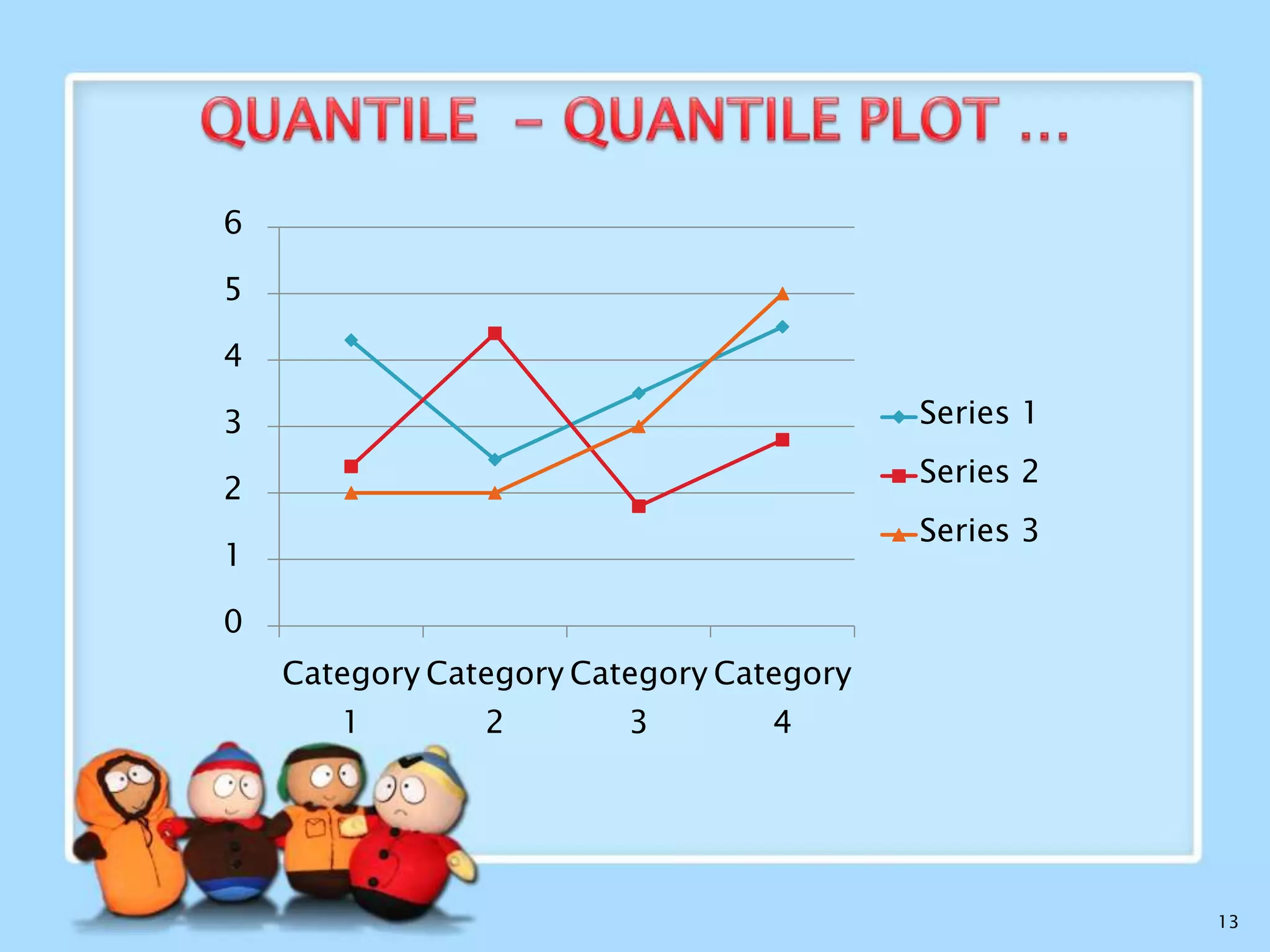
 A quantile-quantile plot, or q-q plot graphs the quantiles of one

variate distribution against the corresponding quantiles of another

 It is a powerful visualization tool that allows the user to view
whether there is a shift in going from one distribution to another.

13
6

5
4
3

Series 1

2

Series 2

1

Series 3

0
Category Category Category Category
1

2

3

4

14
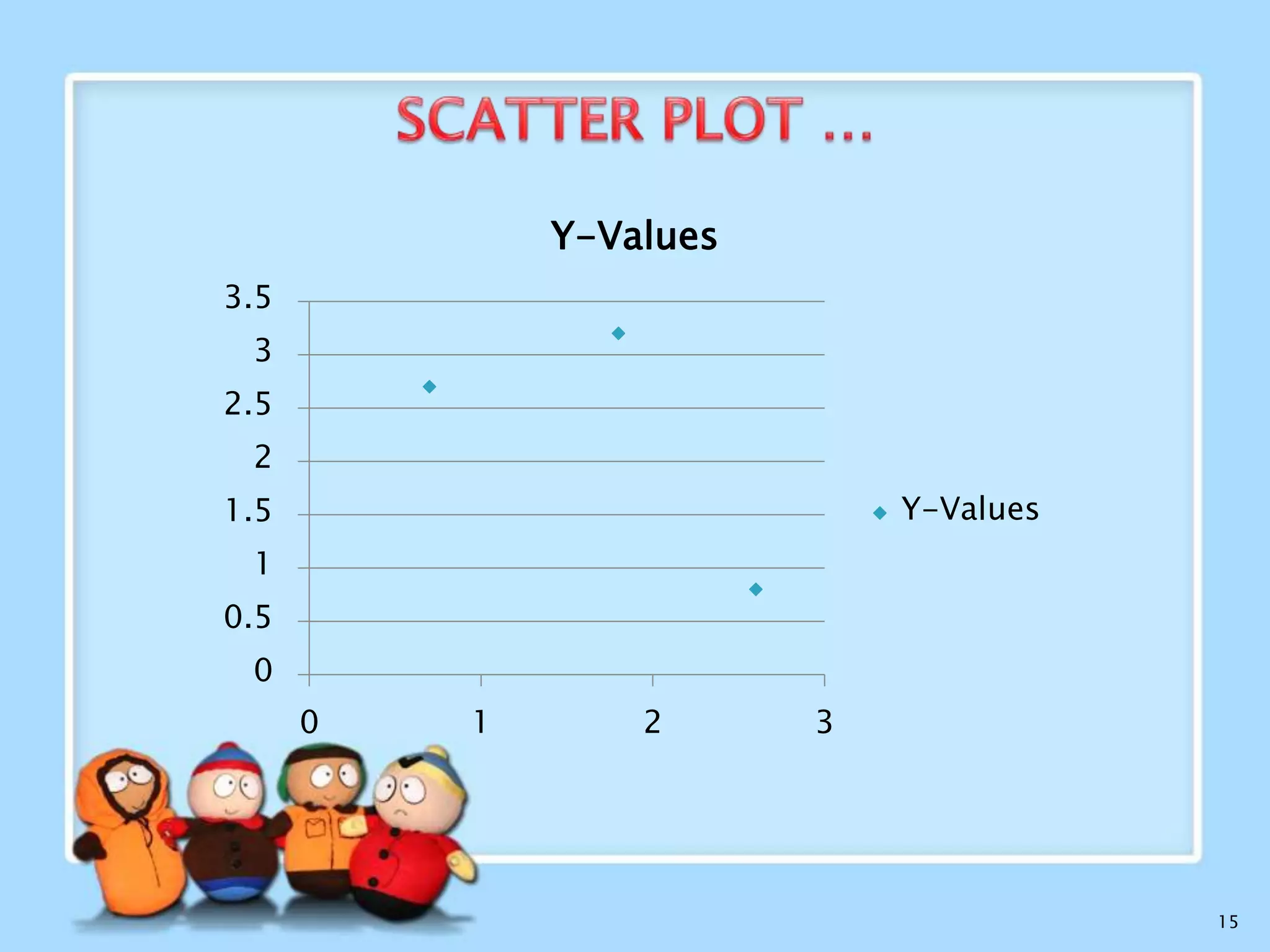
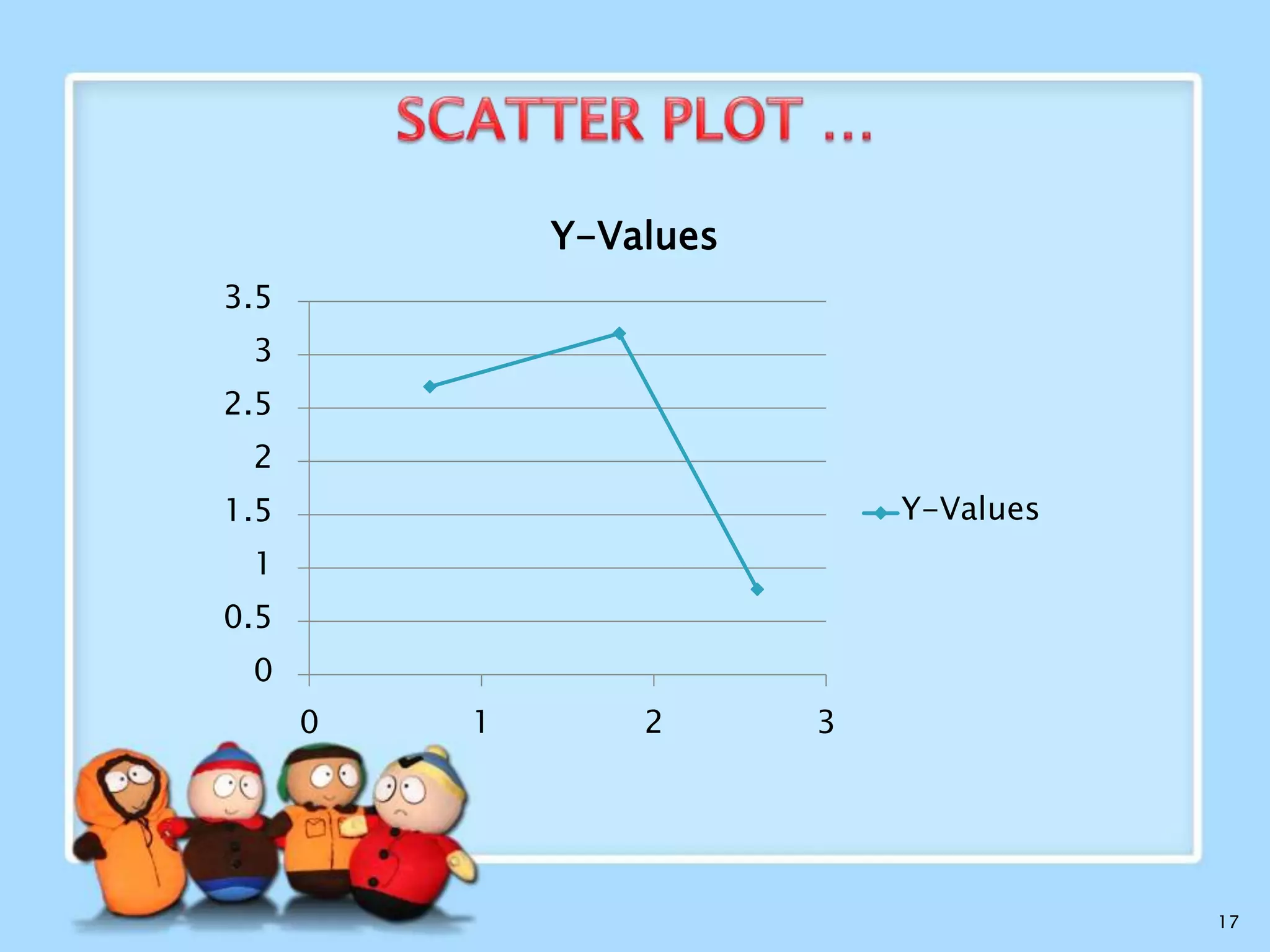
 A Scatter plot used for determining if there appears to be a

relationship, pattern, or trend between two numerical attributes
 To construct a scatter plot, each pair of values is treated as a pair of
coordinates in an algebraic sense and plotted as points in the plane
 Bivariate data to see clusters of points and outliers or correlation
relationships

15
Y-Values
3.5
3
2.5
2
1.5

Y-Values

1
0.5

0
0

1

2

3

16
Y-Values
3.5
3
2.5
2
1.5

Y-Values

1
0.5

0
0

1

2

3

17
Y-Values
3.5
3
2.5
2
1.5

Y-Values

1
0.5

0
0

1

2

3

18
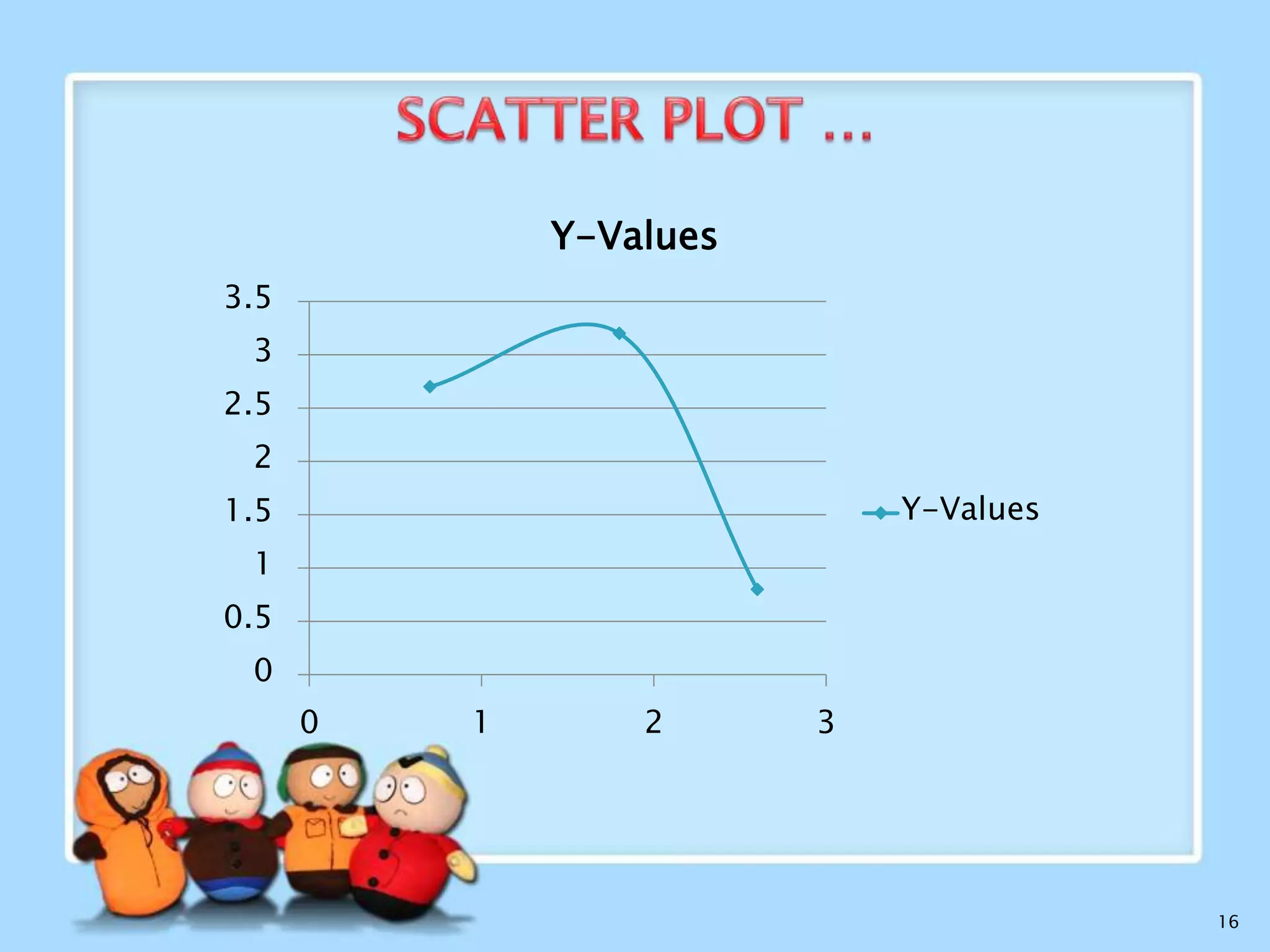
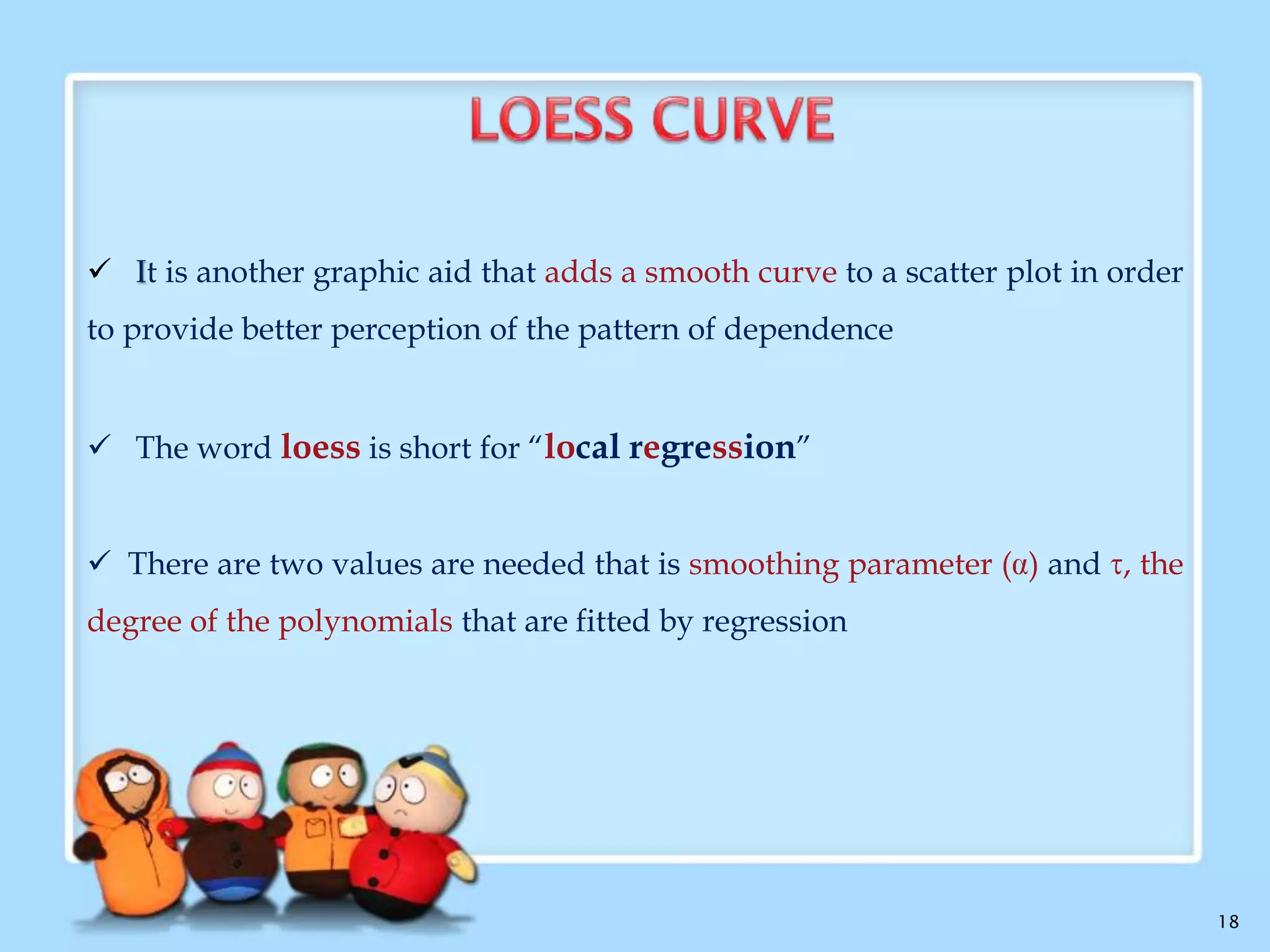
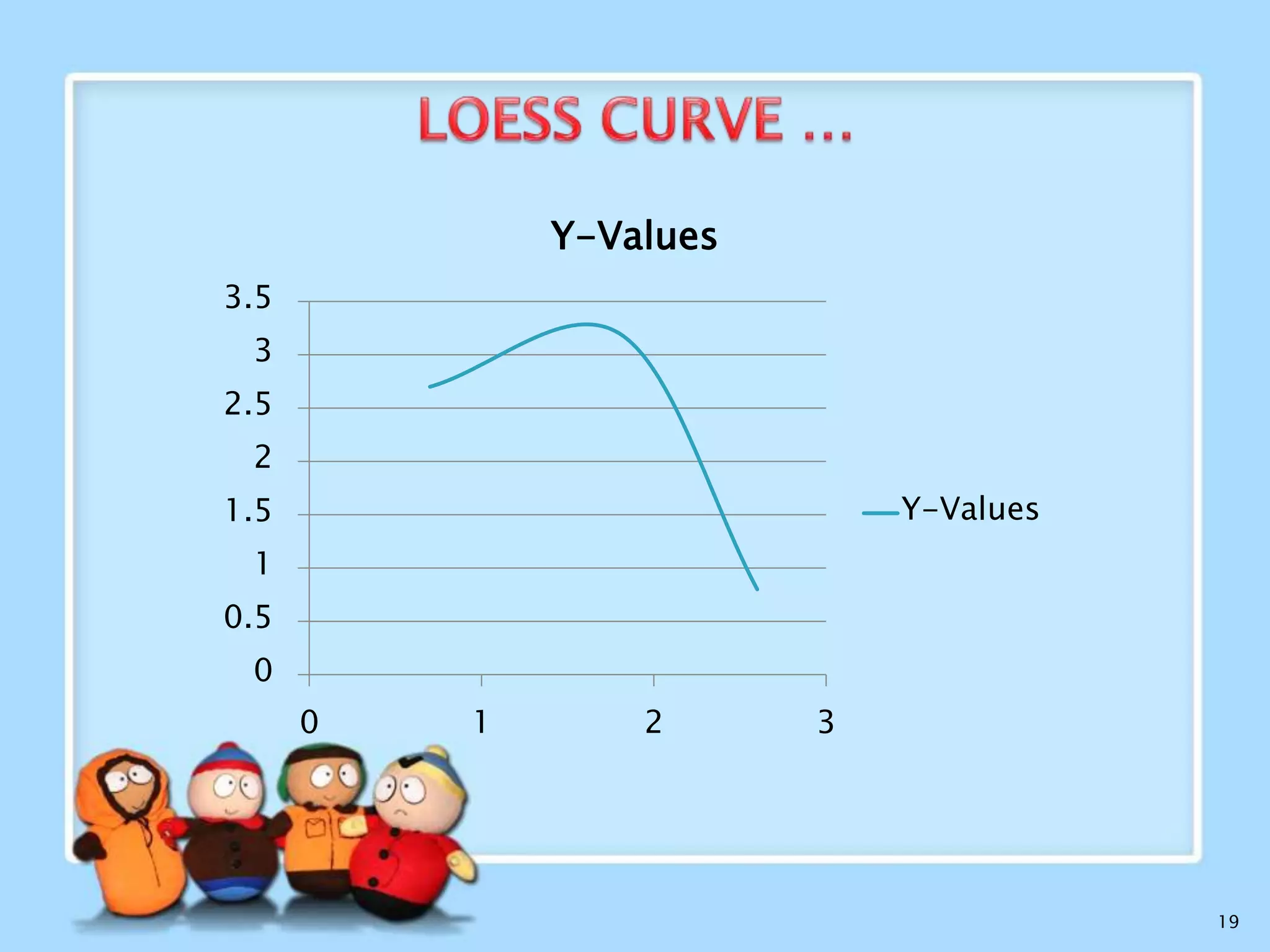
 It is another graphic aid that adds a smooth curve to a scatter plot in order

to provide better perception of the pattern of dependence
 The word loess is short for ―local regression‖

 There are two values are needed that is smoothing parameter () and , the
degree of the polynomials that are fitted by regression

19
Y-Values
3.5
3
2.5
2
1.5

Y-Values

1
0.5

0
0

1

2

3

20
 Descriptive data summaries provide valuable insight into the
overall behavior of our data
 By helping to identify noise and outliers, they are especially useful
for data cleaning

21
 Data Cleaning or Data Cleansing routines attempt to fill in missing
values,

smooth

out

noise

while

identifying

outliers,

and

correct

inconsistencies in the data.
 Handling missing values

 Data Smoothing techniques
 Data Cleaning as a process

22
Many tuples have no recorded value for several attributes
Methods:

1. Ignore the tuple :
This is usually done when the class label is missing
It is not very effective
2. Fill in the missing value manually:

It is time-consuming and may not be feasible in large data set
3. Use a global constant to fill in the missing value:
Replace all missing attribute values by the same constant

23
4. Use the attribute mean to fill in the missing value:
Use the mean value to replace the missing value for particular
attribute
5. Use the attribute mean for all samples belonging to the same class as the
given tuple:
if classifying customers according to credit_risk, replace the missing
value with the average income value for customers
6. Use the most probable value to fill in the missing value:
This may be determined with regression, inference-based tools using
a Bayesian formalism, or decision tree induction.

24
 Methods 3 to 6 bias the data. The filled-in value may not be correct

 Method 6 is a popular strategy to predict missing values
 By considering the other values of the other attributes in its estimation
of the missing value
 In some cases, a missing value may not imply an error in the data!
Ex: Phone number in some application form  NULL

25
 What is Noise?

 Noise is a random error or variance in a measured variable.
 Data Smoothing techniques:
Binning
Regression
Clustering

26
 Binning

first sort data and partition into (equal-frequency) bins then
one can smooth by bin means, smooth by bin median, smooth by bin
boundaries, etc.
 Regression
smooth by fitting the data into regression functions
 Clustering
detect and remove outliers

27
Combines data from multiple sources into a coherent store
 Schema integration:
Integrate metadata from different sources
 Entity identification problem:
Identify real world entities from multiple data sources,
e.g., Bill Clinton = William Clinton
 Detecting and resolving data value conflicts
For the same real world entity, attribute values from different
sources are different

28
Redundant data occur often when integration of multiple databases
Object identification: The same attribute or object may have

different names in different databases
Derivable data: One attribute may be a ―derived‖ attribute in
another table, e.g., annual revenue
Redundant attributes may be able to be detected by correlation analysis
Careful integration of the data from multiple sources may help
reduce/avoid redundancies and inconsistencies and improve mining
speed and quality

29
Smoothing: remove noise from data
Aggregation: summarization, data cube construction
Generalization: concept hierarchy climbing
Normalization: scaled to fall within a small, specified range
min-max normalization

z-score normalization
normalization by decimal scaling

30


Min-max normalization: to [new_minA, new_maxA]

v'

v minA
(new _ maxA new _ minA) new _ minA
maxA minA

◦ Ex. Let income range $12,000 to $98,000 normalized to [0.0, 1.0].
Then $73,000 is mapped to 73,600 12,000 (1.0 0) 0 0.716
98,000 12 ,000





Z-score normalization (μ: mean, σ: standard deviation):
v
A
v'
73,600 54 ,000
A
1.225
◦ Ex. Let μ = 54,000, σ = 16,000. Then
Normalization by decimal scaling

v
v'
10 j

16 ,000

Where j is the smallest integer such that Max(|ν’|) < 1

31
Why data reduction?
 A database/data warehouse may store terabytes of data
 Complex data analysis/mining may take a very long time to run on
the complete data set
Data reduction
Obtain a reduced representation of the data set that is much
smaller in volume but yet produce the same (or almost the same)
analytical results
Data reduction strategies
o Data cube aggregation:
o Dimensionality reduction — e.g., remove unimportant attributes
o Data Compression
o Numerosity reduction — e.g., fit data into models
o Discretization and concept hierarchy generation

32
 Data preparation or preprocessing is a big issue for both data
warehousing and data mining
 Discriptive data summarization is need for quality data preprocessing

 Data preparation includes,

 Data cleaning and data integration
 Data reduction and feature selection
 Discretization
 A lot a methods have been developed but data preprocessing still an active
area of research

33
34

Data mining

  • 1.
  • 2.
    Data in thereal world is dirty incomplete: lacking attribute values, lacking certain attributes of interest, or containing only aggregate data e.g., occupation=― ‖ noisy: containing errors or outliers e.g., Salary=―-10‖ inconsistent: containing discrepancies in codes or names e.g., Age=―42‖ Birthday=―03/07/1997‖ e.g., Was rating ―1,2,3‖, now rating ―A, B, C‖ e.g., discrepancy between duplicate records 2
  • 3.
     Data Cleaning/ Data Cleansing Fill in missing values, smooth noisy data, identify or remove outliers, and resolve inconsistencies  Data Integration Integration of multiple databases, data cubes, or files  Data Transformation Normalization and aggregation  Data Reduction Obtains reduced representation in volume but produces the same or similar analytical results 3
  • 4.
    DESCRIPTIVE DATA SUMMARIZATION Measuring theCentral Tendency Distributive Measure Algebraic Measure Holistic Measure Measuring the Dispersion of Data Range, Quartiles, Outliers and Boxplots Variance and Standard Deviation Graphic Displays 4
  • 5.
    The variance ofN observations, x1, x2, ....xN is 1 2 = N N ( xi x) i1 2 1 N 2 i x 1 ( xi )2 N 5
  • 6.
    Where x is the meanvalue of observations The Standard deviation is  The  of the observations is the square root of the variance,  2 6
  • 7.
    The basic propertiesof the standard deviation ,   measures spread about the mean and should be used only when the mean is chosen as the measure of center   = 0 only when there is no spread, that is, when all observations have the same value. Otherwise  > 0 7
  • 8.
     Apart from thebar charts, pie charts and line graphs, there are other popular types of graphs for the display of data summaries and distributions. Histograms Quantile plots q-q plots Scatter plots Curves 8
  • 9.
     Plotting histograms,or frequency histograms, is a graphical method for summarizing the distribution of a given attribute.  A histogram for an attribute A partitions into subsets or buckets.  The width of each bucket is uniform  Each bucket is represented by a rectangle  The resulting graph is referred to as Bar chart 9
  • 10.
  • 11.
     It isa simple and effective way for a univariate data distribution  First, it displays all of the data for the given attribute  Second, it plots quantile information  The mechanism is slightly differ from percentile computation  fi = i – 0.5 / N 11
  • 12.
  • 13.
     A quantile-quantileplot, or q-q plot graphs the quantiles of one variate distribution against the corresponding quantiles of another  It is a powerful visualization tool that allows the user to view whether there is a shift in going from one distribution to another. 13
  • 14.
    6 5 4 3 Series 1 2 Series 2 1 Series3 0 Category Category Category Category 1 2 3 4 14
  • 15.
     A Scatterplot used for determining if there appears to be a relationship, pattern, or trend between two numerical attributes  To construct a scatter plot, each pair of values is treated as a pair of coordinates in an algebraic sense and plotted as points in the plane  Bivariate data to see clusters of points and outliers or correlation relationships 15
  • 16.
  • 17.
  • 18.
  • 19.
     It isanother graphic aid that adds a smooth curve to a scatter plot in order to provide better perception of the pattern of dependence  The word loess is short for ―local regression‖  There are two values are needed that is smoothing parameter () and , the degree of the polynomials that are fitted by regression 19
  • 20.
  • 21.
     Descriptive datasummaries provide valuable insight into the overall behavior of our data  By helping to identify noise and outliers, they are especially useful for data cleaning 21
  • 22.
     Data Cleaningor Data Cleansing routines attempt to fill in missing values, smooth out noise while identifying outliers, and correct inconsistencies in the data.  Handling missing values  Data Smoothing techniques  Data Cleaning as a process 22
  • 23.
    Many tuples haveno recorded value for several attributes Methods: 1. Ignore the tuple : This is usually done when the class label is missing It is not very effective 2. Fill in the missing value manually: It is time-consuming and may not be feasible in large data set 3. Use a global constant to fill in the missing value: Replace all missing attribute values by the same constant 23
  • 24.
    4. Use theattribute mean to fill in the missing value: Use the mean value to replace the missing value for particular attribute 5. Use the attribute mean for all samples belonging to the same class as the given tuple: if classifying customers according to credit_risk, replace the missing value with the average income value for customers 6. Use the most probable value to fill in the missing value: This may be determined with regression, inference-based tools using a Bayesian formalism, or decision tree induction. 24
  • 25.
     Methods 3to 6 bias the data. The filled-in value may not be correct  Method 6 is a popular strategy to predict missing values  By considering the other values of the other attributes in its estimation of the missing value  In some cases, a missing value may not imply an error in the data! Ex: Phone number in some application form  NULL 25
  • 26.
     What isNoise?  Noise is a random error or variance in a measured variable.  Data Smoothing techniques: Binning Regression Clustering 26
  • 27.
     Binning first sortdata and partition into (equal-frequency) bins then one can smooth by bin means, smooth by bin median, smooth by bin boundaries, etc.  Regression smooth by fitting the data into regression functions  Clustering detect and remove outliers 27
  • 28.
    Combines data frommultiple sources into a coherent store  Schema integration: Integrate metadata from different sources  Entity identification problem: Identify real world entities from multiple data sources, e.g., Bill Clinton = William Clinton  Detecting and resolving data value conflicts For the same real world entity, attribute values from different sources are different 28
  • 29.
    Redundant data occuroften when integration of multiple databases Object identification: The same attribute or object may have different names in different databases Derivable data: One attribute may be a ―derived‖ attribute in another table, e.g., annual revenue Redundant attributes may be able to be detected by correlation analysis Careful integration of the data from multiple sources may help reduce/avoid redundancies and inconsistencies and improve mining speed and quality 29
  • 30.
    Smoothing: remove noisefrom data Aggregation: summarization, data cube construction Generalization: concept hierarchy climbing Normalization: scaled to fall within a small, specified range min-max normalization z-score normalization normalization by decimal scaling 30
  • 31.
     Min-max normalization: to[new_minA, new_maxA] v' v minA (new _ maxA new _ minA) new _ minA maxA minA ◦ Ex. Let income range $12,000 to $98,000 normalized to [0.0, 1.0]. Then $73,000 is mapped to 73,600 12,000 (1.0 0) 0 0.716 98,000 12 ,000   Z-score normalization (μ: mean, σ: standard deviation): v A v' 73,600 54 ,000 A 1.225 ◦ Ex. Let μ = 54,000, σ = 16,000. Then Normalization by decimal scaling v v' 10 j 16 ,000 Where j is the smallest integer such that Max(|ν’|) < 1 31
  • 32.
    Why data reduction? A database/data warehouse may store terabytes of data  Complex data analysis/mining may take a very long time to run on the complete data set Data reduction Obtain a reduced representation of the data set that is much smaller in volume but yet produce the same (or almost the same) analytical results Data reduction strategies o Data cube aggregation: o Dimensionality reduction — e.g., remove unimportant attributes o Data Compression o Numerosity reduction — e.g., fit data into models o Discretization and concept hierarchy generation 32
  • 33.
     Data preparationor preprocessing is a big issue for both data warehousing and data mining  Discriptive data summarization is need for quality data preprocessing  Data preparation includes,  Data cleaning and data integration  Data reduction and feature selection  Discretization  A lot a methods have been developed but data preprocessing still an active area of research 33
  • 34.