Data
Leadership
Stop Talking About Data and Start
Making an Impact!

Anthony J. Algmin
DATAVERSITY Webinar

October 22, 2019
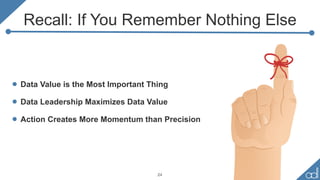
If You Remember Nothing Else
• Data Value is the Most Important Thing
• Data Leadership Maximizes Data Value
• Action Creates More Momentum than Precision
2
Agenda
• Data Leadership Introduction
• The Data Leadership Framework
• Data Leadership in Action
3
• Founder and CEO of Algmin Data Leadership, LLC
• Advisory firm helping organizations of all kinds
maximize their data impact
• Many years of data management and strategy
consulting
• Former CDO, with earlier roles as a technical data
architect and developer in the financial industry
• Thought Leadership
• DataLeadershipBook.com
• DATAVERSITY Online Training Courses
• Frequent Public Speaking Engagements
• Quarterly Column at TDAN.com
About Me
anthony@algmin.com
630-403-8348
algmin.com
4
Data Leadership Introduction
5
The Value of Data
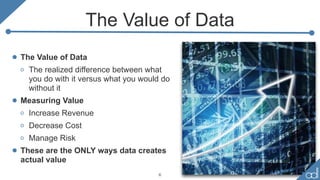
• The Value of Data
o The realized difference between what
you do with it versus what you would do
without it
• Measuring Value
o Increase Revenue
o Decrease Cost
o Manage Risk
• These are the ONLY ways data creates
actual value
6
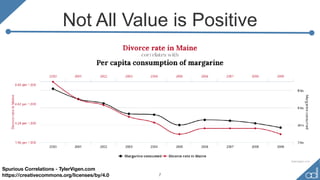
Not All Value is Positive
7
Spurious Correlations - TylerVigen.com
https://creativecommons.org/licenses/by/4.0
Data Leadership Foundations
• Data Value is the Most Important Thing
o This is what we are solving for
o We must do so actively
• Data Leadership Maximizes Data Value
o How our organizations take data inputs,
refine them, put them to use, and get better
at something
o It helps us achieve balance between the
business, technology, and data capabilities
we must harness to optimize our
organizations
8
Data Governance’s Role in Data Leadership
• Data Governance is everywhere—it
just may not be managed how we like
o By contrast, Data Leadership may not
exist anywhere we look
• Data Leadership is a complement to
Data Governance
• Data Governance is the steering, but
Data Leadership is the engine
o Steering is important unless, of course,
you aren’t moving at all
9
We Have Been Asking the Wrong Questions
• Wrong:
o What will you use this for?
o How will this help you?
o What do you need from this?
o What are your requirements?
• Instead ask:
o When we give you this, what will you do differently?
o How will this help us increase revenue, decrease
costs, or mitigate risks?
o What would you do instead if you did not have this?
10
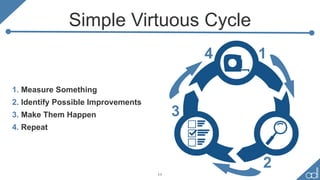
1. Measure Something
2. Identify Possible Improvements
3. Make Them Happen
4. Repeat
Simple Virtuous Cycle
11
1
2
3
4
The Data Leadership Framework
12
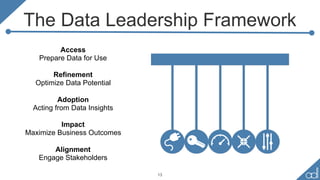
The Data Leadership Framework
13
Access
Prepare Data for Use
Refinement
Optimize Data Potential
Adoption
Acting from Data Insights
Impact
Maximize Business Outcomes
Alignment
Engage Stakeholders
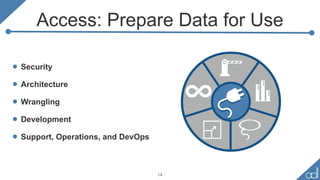
Access: Prepare Data for Use
• Security
• Architecture
• Wrangling
• Development
• Support, Operations, and DevOps
14
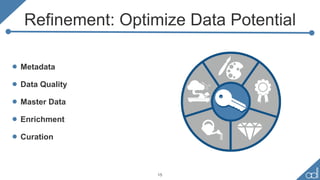
Refinement: Optimize Data Potential
• Metadata
• Data Quality
• Master Data
• Enrichment
• Curation
15
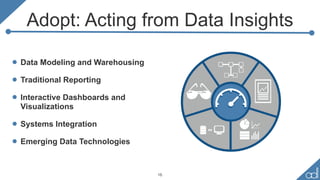
Adopt: Acting from Data Insights
• Data Modeling and Warehousing
• Traditional Reporting
• Interactive Dashboards and
Visualizations
• Systems Integration
• Emerging Data Technologies
16
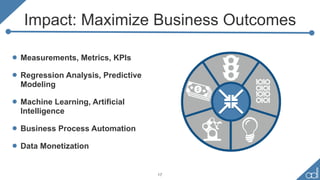
Impact: Maximize Business Outcomes
• Measurements, Metrics, KPIs
• Regression Analysis, Predictive
Modeling
• Machine Learning, Artificial
Intelligence
• Business Process Automation
• Data Monetization
17
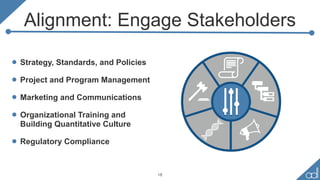
Alignment: Engage Stakeholders
• Strategy, Standards, and Policies
• Project and Program Management
• Marketing and Communications
• Organizational Training and
Building Quantitative Culture
• Regulatory Compliance
18
Data Leadership in Action
19
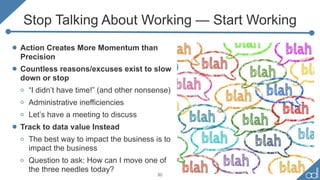
Stop Talking About Working — Start Working
• Action Creates More Momentum than
Precision
• Countless reasons/excuses exist to slow
down or stop
o “I didn’t have time!” (and other nonsense)
o Administrative inefficiencies
o Let’s have a meeting to discuss
• Track to data value Instead
o The best way to impact the business is to
impact the business
o Question to ask: How can I move one of
the three needles today?
20
Motivating Further Investment
• Start with Proof-of-Concept Level Commitment
o Small asks, prove viability
o A Data Catalog should be able to provide
positive value at any scale
• Ask: “What’s the Burning Platform?”
o Just “trying our doggone best to be better with
data” is a lousy foundation
o Something that will keep the business viable,
people out-of-jail, executives keeping their
cushy jobs—these are the kinds of motivators
to find
• Remember this General Rule:
o Reducing Costs < Increasing Revenue < Risk
Management
21
Developing a Business Case
• Recall Data Value
o Any successful business case is going to need it
• Know How Your Company Makes Investments
o Develop a pitch that will resonate
• Market and Sell It
o Good ideas fail all the time
o People are busy, distracted, and sometimes lazy
22
Building Quantitative Culture
• Engaging the Business
o If we build it…they won’t even notice
o If we build it badly…then we will get the wrong kind of
attention
o If others see their own likely success in using it…then
we have hope
• Data Value is All that Matters
o Throw away the catalog if it doesn’t foster Data Value
o If data is used without creating value, stop using the
data
• Encourage Change
o Without change, data is simply added costs23
Recall: If You Remember Nothing Else
• Data Value is the Most Important Thing
• Data Leadership Maximizes Data Value
• Action Creates More Momentum than Precision
24
Thank You for Attending Today
anthony@algmin.com
630-403-8348
algmin.com
Abstract
For any organization to be successful, whatever we do with data must connect to meaningful business
improvements—and those must be measured. If current data efforts lack results or accountability, then
Data Leadership is our answer.
But Data Leadership isn’t really about the data at all. What makes Data Leadership so powerful is its
ability to completely transform organizations. Going beyond traditional data management and
governance, Data Leadership builds momentum and delivers the change we’ve long known our
businesses need. Data Leadership helps us overcome the lingering data challenges our legacy
approaches never will.
This webinar will cover the key concepts of Data Leadership, and what anybody can do to start making a
bigger impact for their teams and businesses. Whether your role today is large or small, Data Leadership
will be essential to your future data success!
Key points include:
• What Data Value really is, and why creating it is the goal of everything we do with data
• Introduction to the Data Leadership Framework
• Why Data Leadership is fundamentally about balance
• How to immediately start making a Data Leadership impact in your organization!26
Data Leadership Framework
• Access: Preparing Data For Use
o Data Security
o Data Architecture
o Data Wrangling
o Development
o Support, Operations, DevOps
• Refinement: Optimize Data Potential
o Metadata
o Data Quality
o Master Data
o Enrichment
o Curation
• Adoption: Acting from Data Insights
o Data Modeling and Warehousing
o Traditional Reporting
o Interactive Dashboards and Visualizations
o Systems Integration
o Emerging Data Technologies
• Impact: Maximize Business Outcomes
o Measurements, Metrics, KPIs
o Regression Analysis and Predictive Modeling
o Machine Learning and Artificial Intelligence
o Business Process Automation
o Data Monetization
• Alignment: Engage Stakeholders
o Strategy, Standards, and Policies
o Project and Program Management
o Marketing and Communications
o Training and Building Quantitative Culture
o Regulatory Compliance
27

Data Leadership - Stop Talking About Data and Start Making an Impact!

  • 1.
    Data Leadership Stop Talking AboutData and Start Making an Impact! Anthony J. Algmin DATAVERSITY Webinar October 22, 2019
  • 2.
    If You RememberNothing Else • Data Value is the Most Important Thing • Data Leadership Maximizes Data Value • Action Creates More Momentum than Precision 2
  • 3.
    Agenda • Data LeadershipIntroduction • The Data Leadership Framework • Data Leadership in Action 3
  • 4.
    • Founder andCEO of Algmin Data Leadership, LLC • Advisory firm helping organizations of all kinds maximize their data impact • Many years of data management and strategy consulting • Former CDO, with earlier roles as a technical data architect and developer in the financial industry • Thought Leadership • DataLeadershipBook.com • DATAVERSITY Online Training Courses • Frequent Public Speaking Engagements • Quarterly Column at TDAN.com About Me anthony@algmin.com 630-403-8348 algmin.com 4
  • 5.
  • 6.
    The Value ofData • The Value of Data o The realized difference between what you do with it versus what you would do without it • Measuring Value o Increase Revenue o Decrease Cost o Manage Risk • These are the ONLY ways data creates actual value 6
  • 7.
    Not All Valueis Positive 7 Spurious Correlations - TylerVigen.com https://creativecommons.org/licenses/by/4.0
  • 8.
    Data Leadership Foundations •Data Value is the Most Important Thing o This is what we are solving for o We must do so actively • Data Leadership Maximizes Data Value o How our organizations take data inputs, refine them, put them to use, and get better at something o It helps us achieve balance between the business, technology, and data capabilities we must harness to optimize our organizations 8
  • 9.
    Data Governance’s Rolein Data Leadership • Data Governance is everywhere—it just may not be managed how we like o By contrast, Data Leadership may not exist anywhere we look • Data Leadership is a complement to Data Governance • Data Governance is the steering, but Data Leadership is the engine o Steering is important unless, of course, you aren’t moving at all 9
  • 10.
    We Have BeenAsking the Wrong Questions • Wrong: o What will you use this for? o How will this help you? o What do you need from this? o What are your requirements? • Instead ask: o When we give you this, what will you do differently? o How will this help us increase revenue, decrease costs, or mitigate risks? o What would you do instead if you did not have this? 10
  • 11.
    1. Measure Something 2.Identify Possible Improvements 3. Make Them Happen 4. Repeat Simple Virtuous Cycle 11 1 2 3 4
  • 12.
    The Data LeadershipFramework 12
  • 13.
    The Data LeadershipFramework 13 Access Prepare Data for Use Refinement Optimize Data Potential Adoption Acting from Data Insights Impact Maximize Business Outcomes Alignment Engage Stakeholders
  • 14.
    Access: Prepare Datafor Use • Security • Architecture • Wrangling • Development • Support, Operations, and DevOps 14
  • 15.
    Refinement: Optimize DataPotential • Metadata • Data Quality • Master Data • Enrichment • Curation 15
  • 16.
    Adopt: Acting fromData Insights • Data Modeling and Warehousing • Traditional Reporting • Interactive Dashboards and Visualizations • Systems Integration • Emerging Data Technologies 16
  • 17.
    Impact: Maximize BusinessOutcomes • Measurements, Metrics, KPIs • Regression Analysis, Predictive Modeling • Machine Learning, Artificial Intelligence • Business Process Automation • Data Monetization 17
  • 18.
    Alignment: Engage Stakeholders •Strategy, Standards, and Policies • Project and Program Management • Marketing and Communications • Organizational Training and Building Quantitative Culture • Regulatory Compliance 18
  • 19.
  • 20.
    Stop Talking AboutWorking — Start Working • Action Creates More Momentum than Precision • Countless reasons/excuses exist to slow down or stop o “I didn’t have time!” (and other nonsense) o Administrative inefficiencies o Let’s have a meeting to discuss • Track to data value Instead o The best way to impact the business is to impact the business o Question to ask: How can I move one of the three needles today? 20
  • 21.
    Motivating Further Investment •Start with Proof-of-Concept Level Commitment o Small asks, prove viability o A Data Catalog should be able to provide positive value at any scale • Ask: “What’s the Burning Platform?” o Just “trying our doggone best to be better with data” is a lousy foundation o Something that will keep the business viable, people out-of-jail, executives keeping their cushy jobs—these are the kinds of motivators to find • Remember this General Rule: o Reducing Costs < Increasing Revenue < Risk Management 21
  • 22.
    Developing a BusinessCase • Recall Data Value o Any successful business case is going to need it • Know How Your Company Makes Investments o Develop a pitch that will resonate • Market and Sell It o Good ideas fail all the time o People are busy, distracted, and sometimes lazy 22
  • 23.
    Building Quantitative Culture •Engaging the Business o If we build it…they won’t even notice o If we build it badly…then we will get the wrong kind of attention o If others see their own likely success in using it…then we have hope • Data Value is All that Matters o Throw away the catalog if it doesn’t foster Data Value o If data is used without creating value, stop using the data • Encourage Change o Without change, data is simply added costs23
  • 24.
    Recall: If YouRemember Nothing Else • Data Value is the Most Important Thing • Data Leadership Maximizes Data Value • Action Creates More Momentum than Precision 24
  • 25.
    Thank You forAttending Today anthony@algmin.com 630-403-8348 algmin.com
  • 26.
    Abstract For any organizationto be successful, whatever we do with data must connect to meaningful business improvements—and those must be measured. If current data efforts lack results or accountability, then Data Leadership is our answer. But Data Leadership isn’t really about the data at all. What makes Data Leadership so powerful is its ability to completely transform organizations. Going beyond traditional data management and governance, Data Leadership builds momentum and delivers the change we’ve long known our businesses need. Data Leadership helps us overcome the lingering data challenges our legacy approaches never will. This webinar will cover the key concepts of Data Leadership, and what anybody can do to start making a bigger impact for their teams and businesses. Whether your role today is large or small, Data Leadership will be essential to your future data success! Key points include: • What Data Value really is, and why creating it is the goal of everything we do with data • Introduction to the Data Leadership Framework • Why Data Leadership is fundamentally about balance • How to immediately start making a Data Leadership impact in your organization!26
  • 27.
    Data Leadership Framework •Access: Preparing Data For Use o Data Security o Data Architecture o Data Wrangling o Development o Support, Operations, DevOps • Refinement: Optimize Data Potential o Metadata o Data Quality o Master Data o Enrichment o Curation • Adoption: Acting from Data Insights o Data Modeling and Warehousing o Traditional Reporting o Interactive Dashboards and Visualizations o Systems Integration o Emerging Data Technologies • Impact: Maximize Business Outcomes o Measurements, Metrics, KPIs o Regression Analysis and Predictive Modeling o Machine Learning and Artificial Intelligence o Business Process Automation o Data Monetization • Alignment: Engage Stakeholders o Strategy, Standards, and Policies o Project and Program Management o Marketing and Communications o Training and Building Quantitative Culture o Regulatory Compliance 27