Data Literacy and Data
Virtualization
A Step-by-step Guide to Bolstering Your
Organizational Competencies
17th November, 2020
Speakers
Data Governance Practice Leader
at Sense Corp
Sr. Vice President and Chief Marketing
Officer at Denodo
10 Steps to Develop a Data
Literate Workforce
3
4
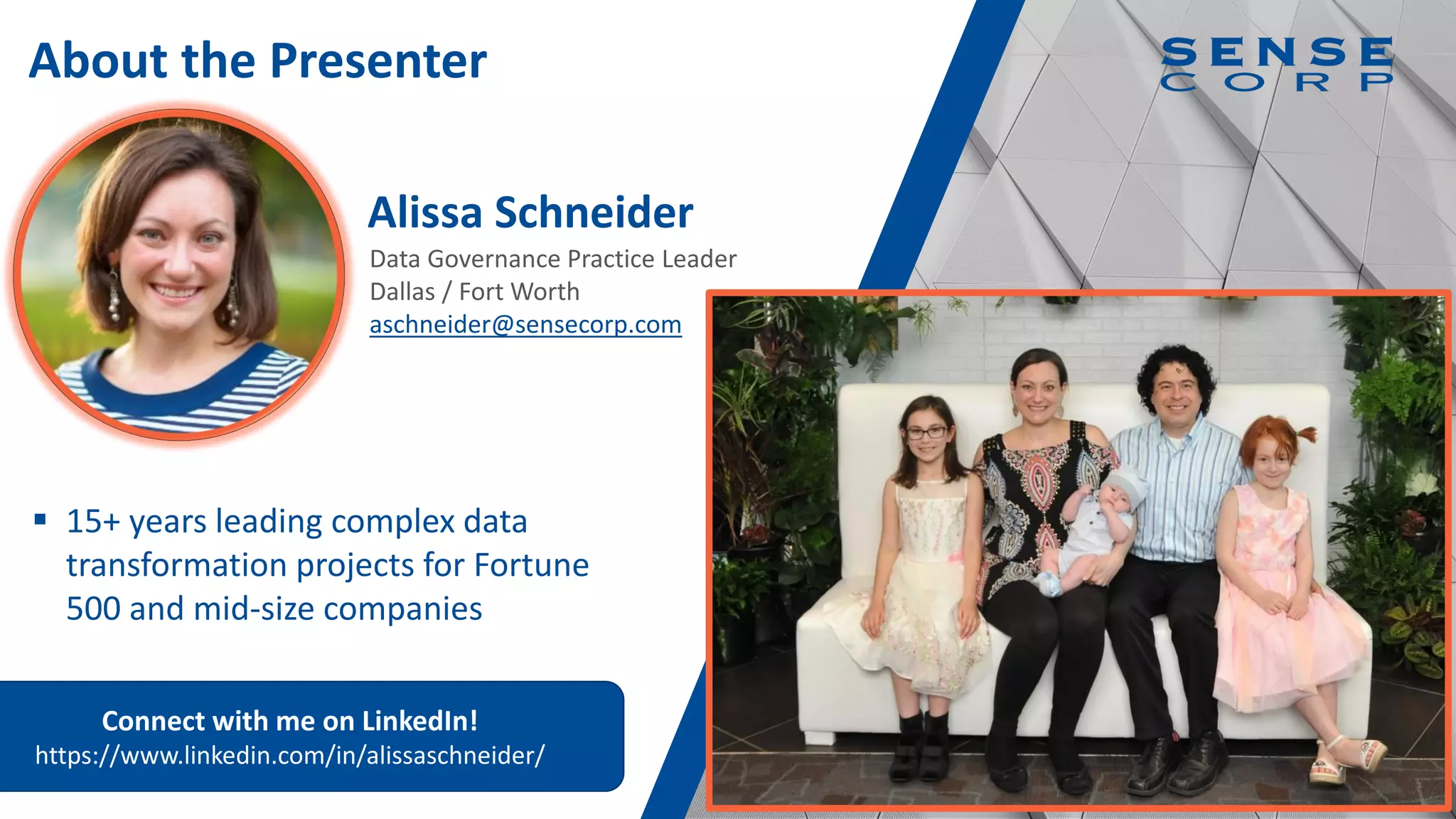
Data Governance Practice Leader
Dallas / Fort Worth
aschneider@sensecorp.com
Alissa Schneider
About the Presenter
▪ 15+ years leading complex data
transformation projects for Fortune
500 and mid-size companies
Connect with me on LinkedIn!
https://www.linkedin.com/in/alissaschneider/
5
• What is Data Literacy?
• Why is Data Literacy Important?
• 10 Steps to Develop and Foster a Data
Literate Workforce
• Q & A
AGENDA
6
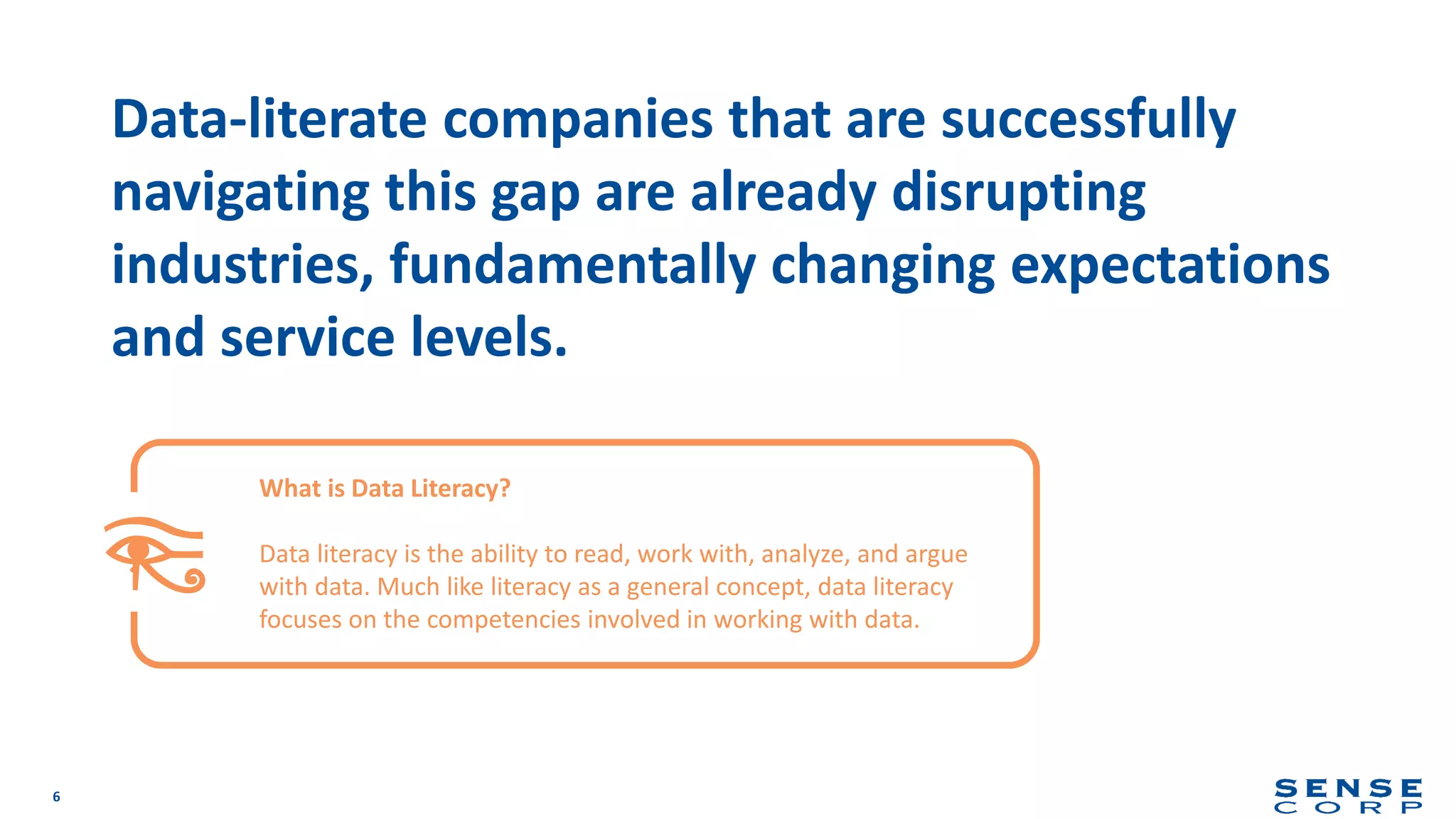
Data-literate companies that are successfully
navigating this gap are already disrupting
industries, fundamentally changing expectations
and service levels.
What is Data Literacy?
Data literacy is the ability to read, work with, analyze, and argue
with data. Much like literacy as a general concept, data literacy
focuses on the competencies involved in working with data.
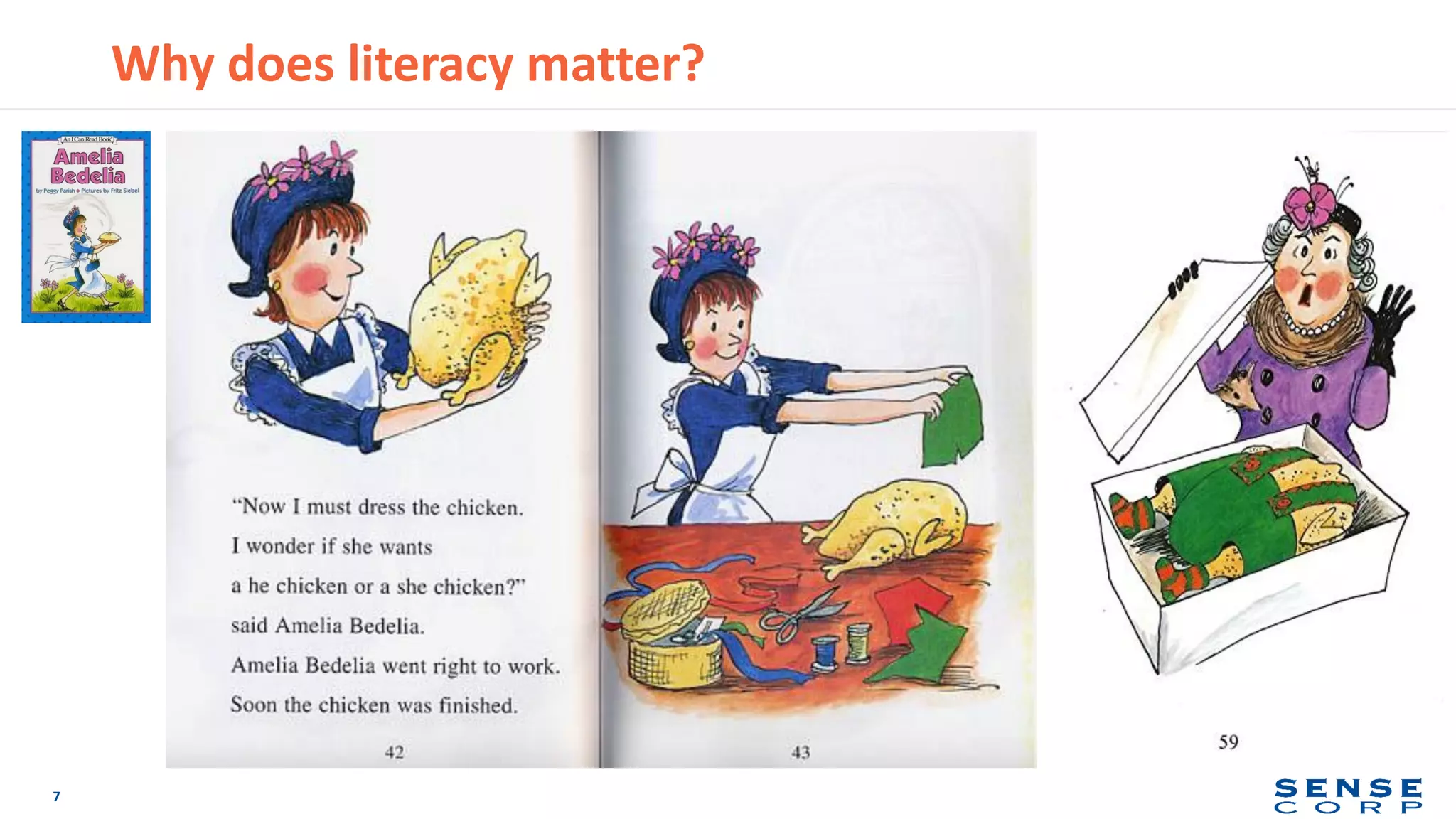
Why does literacy matter?
7
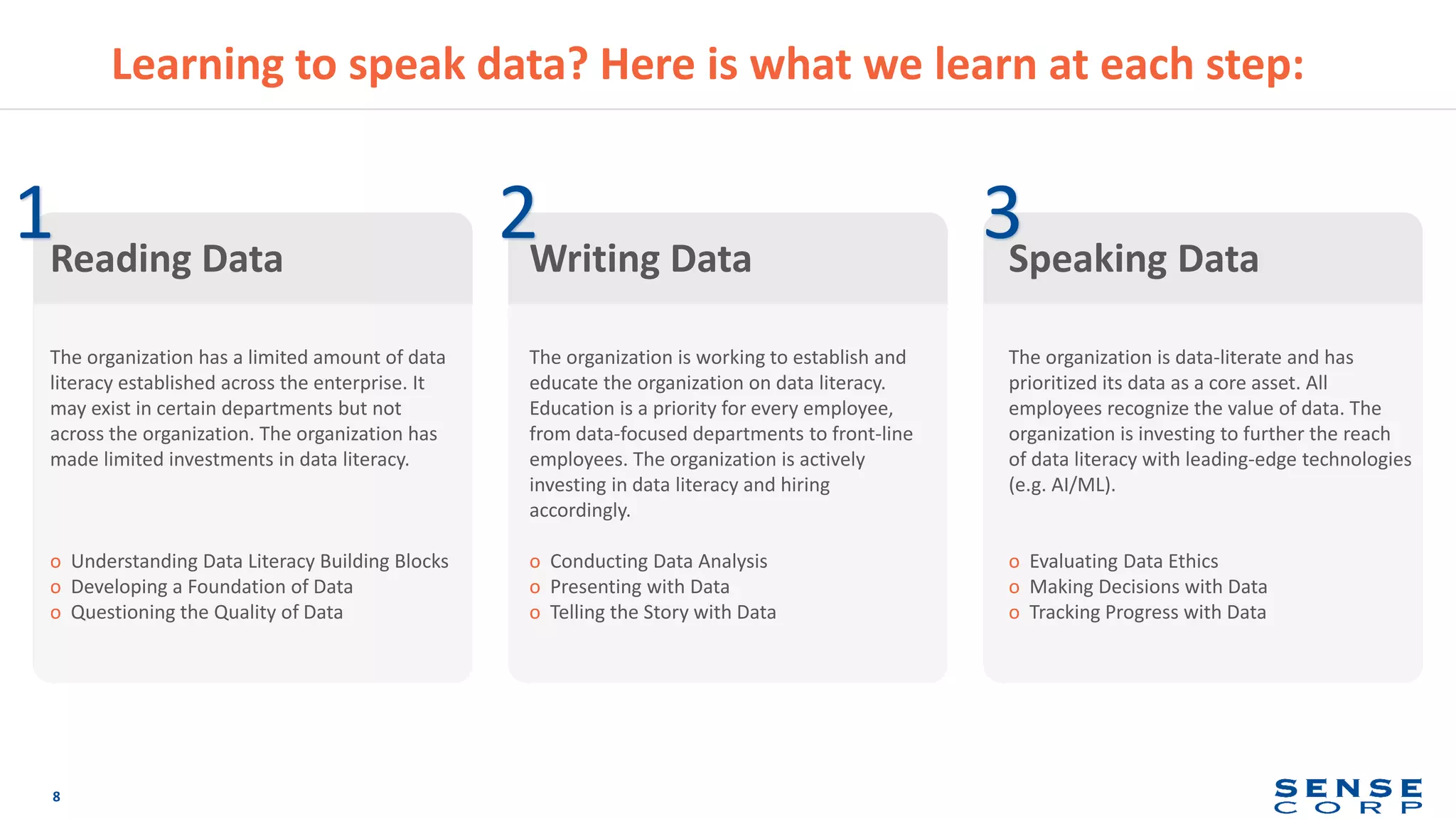
Learning to speak data? Here is what we learn at each step:
8
Reading Data
The organization has a limited amount of data
literacy established across the enterprise. It
may exist in certain departments but not
across the organization. The organization has
made limited investments in data literacy.
o Understanding Data Literacy Building Blocks
o Developing a Foundation of Data
o Questioning the Quality of Data
Writing Data
The organization is working to establish and
educate the organization on data literacy.
Education is a priority for every employee,
from data-focused departments to front-line
employees. The organization is actively
investing in data literacy and hiring
accordingly.
o Conducting Data Analysis
o Presenting with Data
o Telling the Story with Data
Speaking Data
The organization is data-literate and has
prioritized its data as a core asset. All
employees recognize the value of data. The
organization is investing to further the reach
of data literacy with leading-edge technologies
(e.g. AI/ML).
o Evaluating Data Ethics
o Making Decisions with Data
o Tracking Progress with Data
1 32
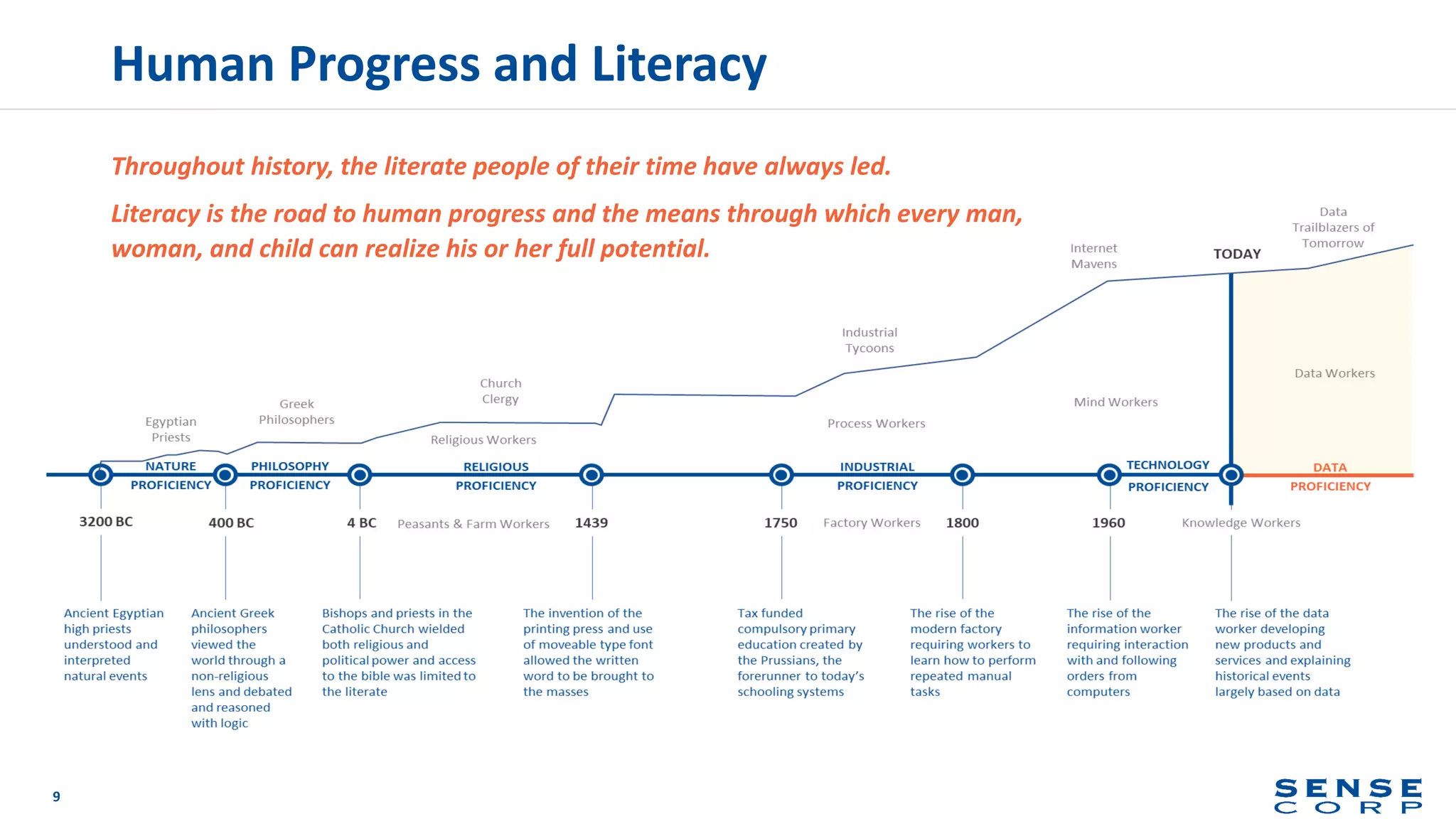
Human Progress and Literacy
9
Throughout history, the literate people of their time have always led.
Literacy is the road to human progress and the means through which every man,
woman, and child can realize his or her full potential.
Key Findings
10
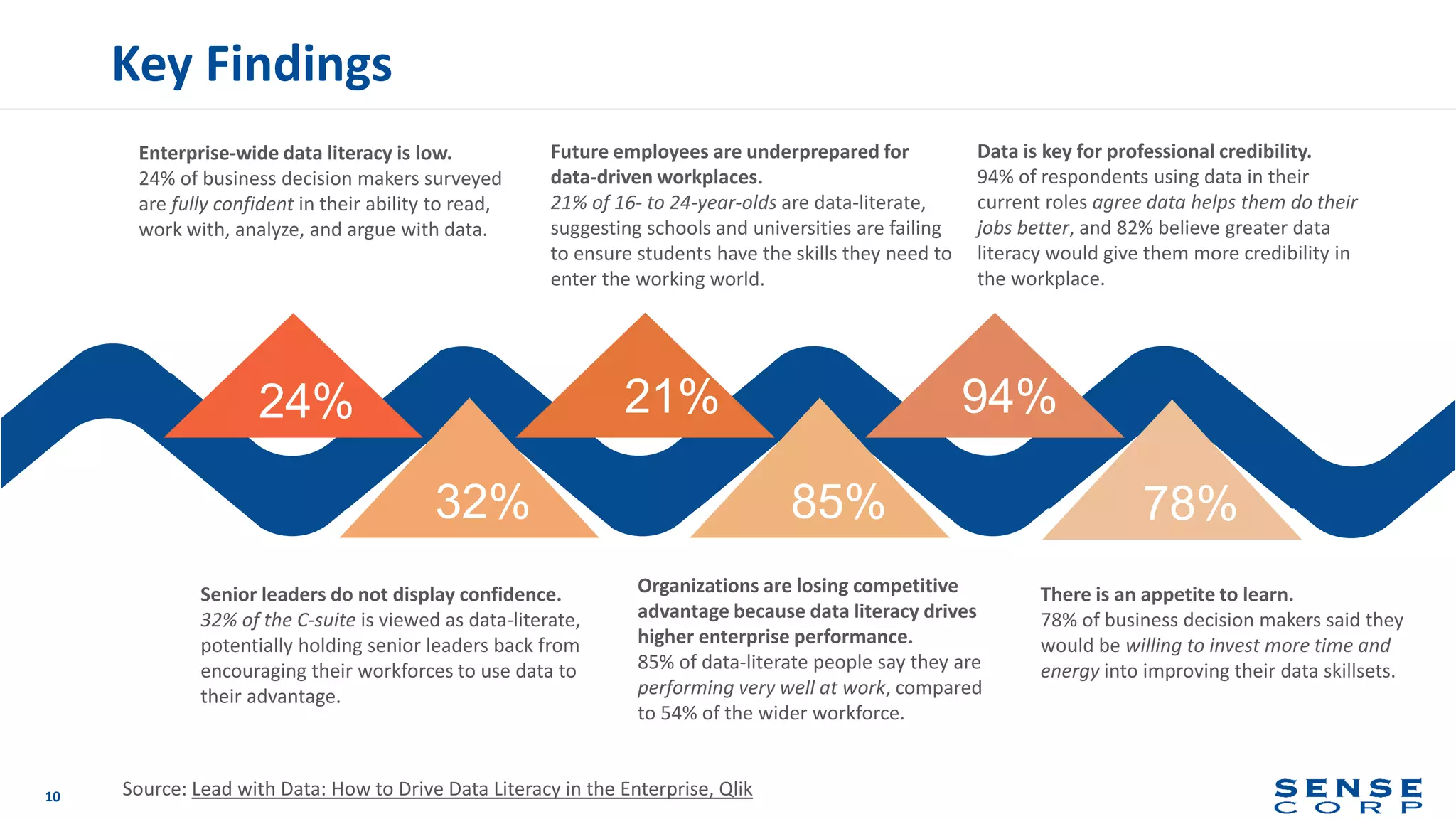
Enterprise-wide data literacy is low.
24% of business decision makers surveyed
are fully confident in their ability to read,
work with, analyze, and argue with data.
Future employees are underprepared for
data-driven workplaces.
21% of 16- to 24-year-olds are data-literate,
suggesting schools and universities are failing
to ensure students have the skills they need to
enter the working world.
Data is key for professional credibility.
94% of respondents using data in their
current roles agree data helps them do their
jobs better, and 82% believe greater data
literacy would give them more credibility in
the workplace.
Senior leaders do not display confidence.
32% of the C-suite is viewed as data-literate,
potentially holding senior leaders back from
encouraging their workforces to use data to
their advantage.
Organizations are losing competitive
advantage because data literacy drives
higher enterprise performance.
85% of data-literate people say they are
performing very well at work, compared
to 54% of the wider workforce.
There is an appetite to learn.
78% of business decision makers said they
would be willing to invest more time and
energy into improving their data skillsets.
Source: Lead with Data: How to Drive Data Literacy in the Enterprise, Qlik
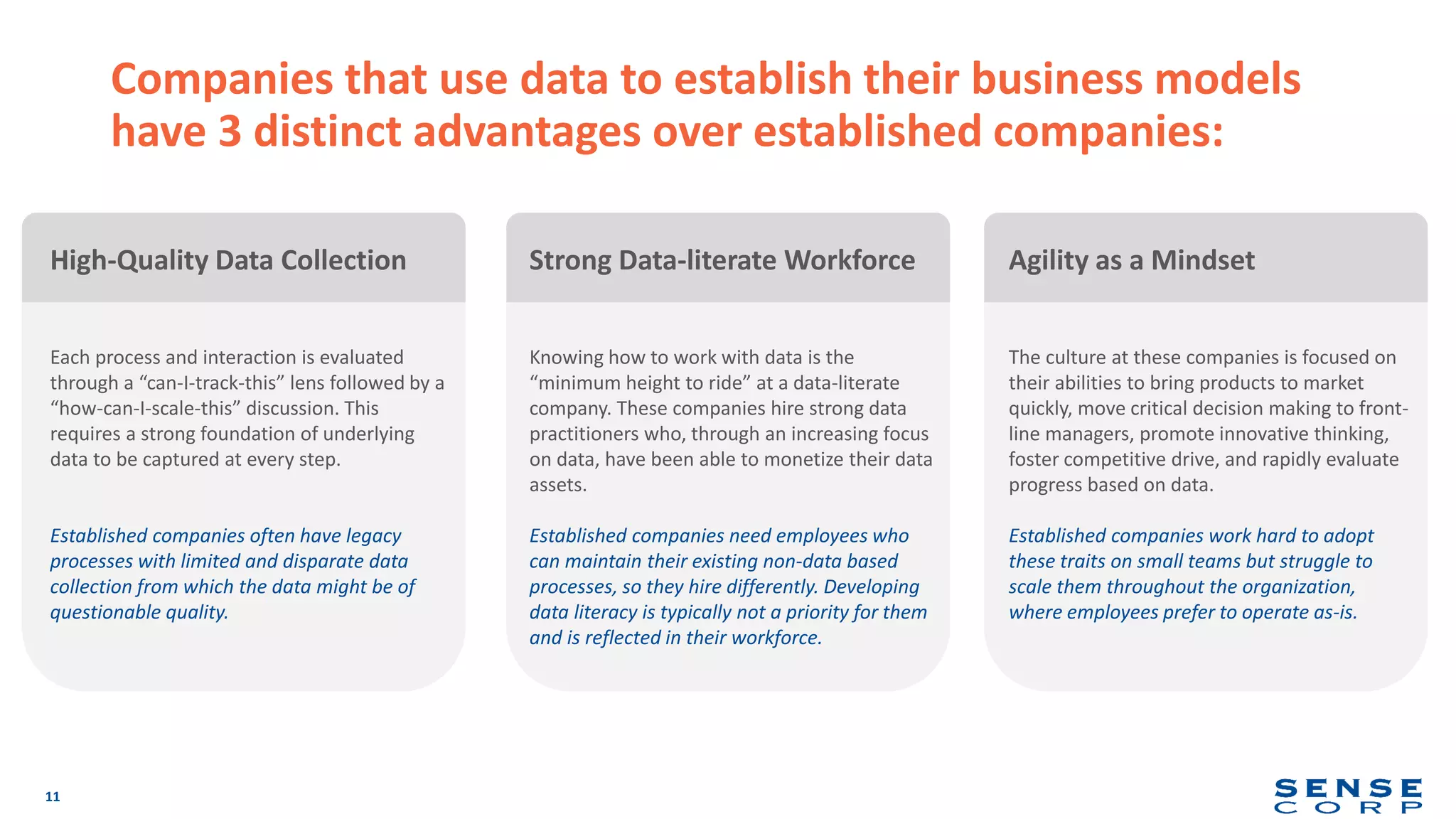
Companies that use data to establish their business models
have 3 distinct advantages over established companies:
11
High-Quality Data Collection
Each process and interaction is evaluated
through a “can-I-track-this” lens followed by a
“how-can-I-scale-this” discussion. This
requires a strong foundation of underlying
data to be captured at every step.
Established companies often have legacy
processes with limited and disparate data
collection from which the data might be of
questionable quality.
Strong Data-literate Workforce
Knowing how to work with data is the
“minimum height to ride” at a data-literate
company. These companies hire strong data
practitioners who, through an increasing focus
on data, have been able to monetize their data
assets.
Established companies need employees who
can maintain their existing non-data based
processes, so they hire differently. Developing
data literacy is typically not a priority for them
and is reflected in their workforce.
Agility as a Mindset
The culture at these companies is focused on
their abilities to bring products to market
quickly, move critical decision making to front-
line managers, promote innovative thinking,

foster competitive drive, and rapidly evaluate
progress based on data.
Established companies work hard to adopt
these traits on small teams but struggle to
scale them throughout the organization,
where employees prefer to operate as-is.
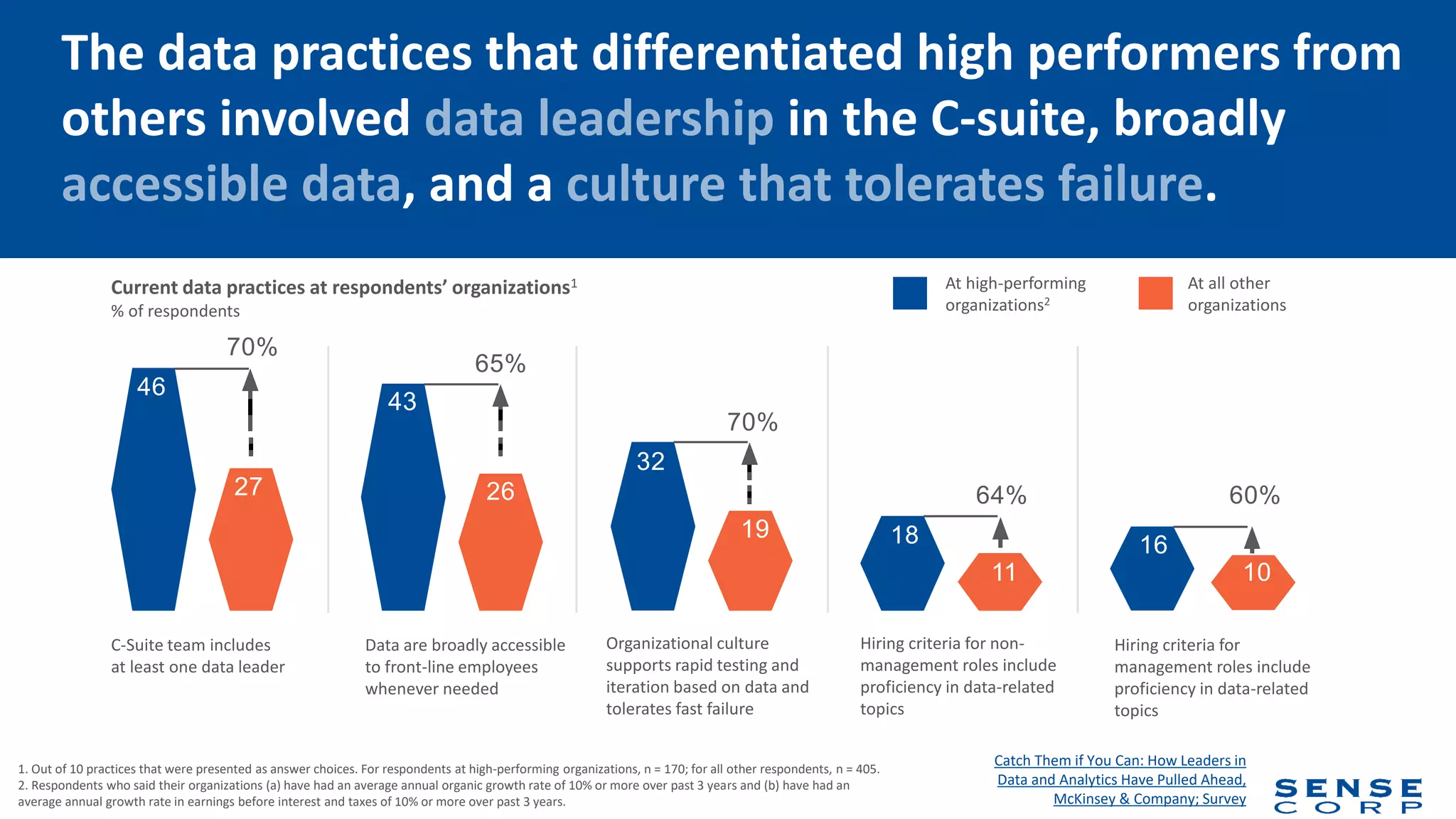
The data practices that differentiated high performers from
others involved data leadership in the C-suite, broadly
accessible data, and a culture that tolerates failure.
1. Out of 10 practices that were presented as answer choices. For respondents at high-performing organizations, n = 170; for all other respondents, n = 405.
2. Respondents who said their organizations (a) have had an average annual organic growth rate of 10% or more over past 3 years and (b) have had an
average annual growth rate in earnings before interest and taxes of 10% or more over past 3 years.
Current data practices at respondents’ organizations1
% of respondents
At all other
organizations
At high-performing
organizations2
C-Suite team includes
at least one data leader
Data are broadly accessible
to front-line employees
whenever needed
Organizational culture
supports rapid testing and
iteration based on data and
tolerates fast failure
Hiring criteria for non-
management roles include
proficiency in data-related
topics
Hiring criteria for
management roles include
proficiency in data-related
topics
Catch Them if You Can: How Leaders in
Data and Analytics Have Pulled Ahead,
McKinsey & Company; Survey
Established companies often feel like
prisoners to what made them
successful – their static processes and
hierarchical controls.
Meanwhile, the new kids in class are
faster, smarter, and better prepared to
succeed in a data-driven environment.
14
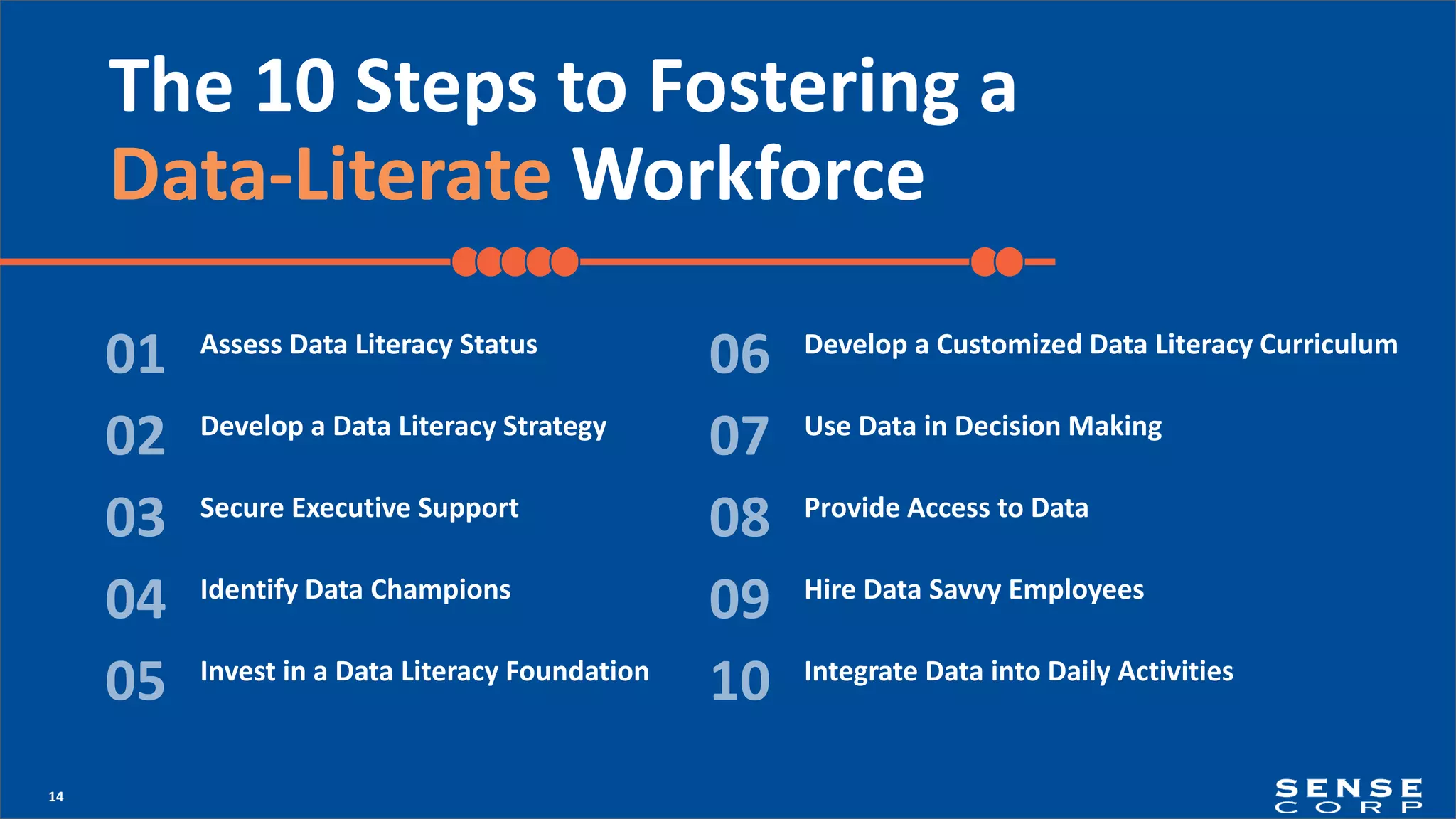
Assess Data Literacy Status
01
Develop a Data Literacy Strategy
02
Secure Executive Support
03
Identify Data Champions
04
Invest in a Data Literacy Foundation
05
Develop a Customized Data Literacy Curriculum
06
Use Data in Decision Making
07
Provide Access to Data
08
Hire Data Savvy Employees
09
Integrate Data into Daily Activities
10
The 10 Steps to Fostering a
Data-Literate Workforce
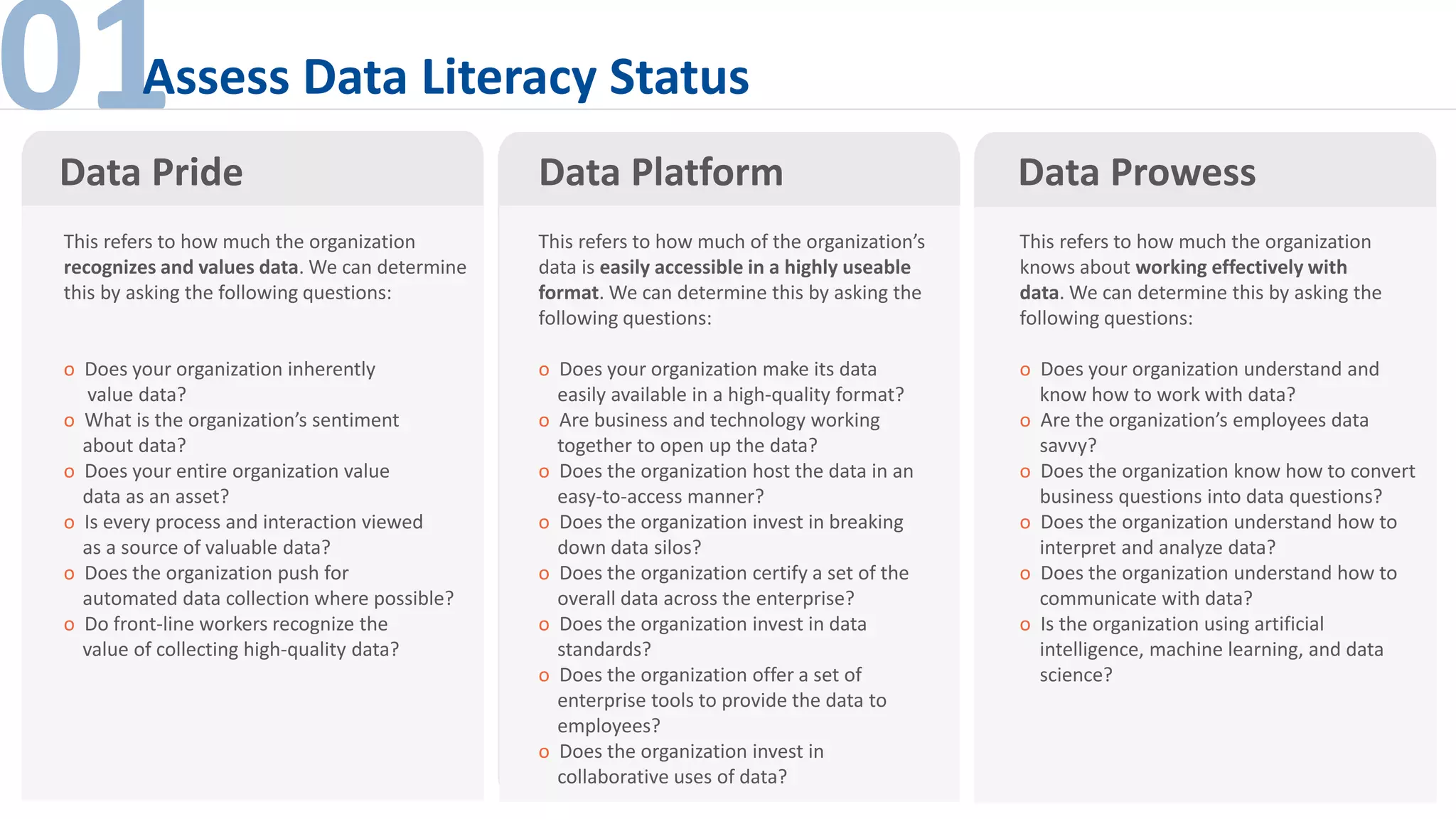
01Data Pride Data Platform Data Prowess
This refers to how much the organization
recognizes and values data. We can determine
this by asking the following questions:
o Does your organization inherently
value data?
o What is the organization’s sentiment
about data?
o Does your entire organization value
data as an asset?
o Is every process and interaction viewed
as a source of valuable data?
o Does the organization push for
automated data collection where possible?
o Do front-line workers recognize the
value of collecting high-quality data?
This refers to how much of the organization’s
data is easily accessible in a highly useable
format. We can determine this by asking the
following questions:
o Does your organization make its data
easily available in a high-quality format?
o Are business and technology working
together to open up the data?
o Does the organization host the data in an
easy-to-access manner?
o Does the organization invest in breaking
down data silos?
o Does the organization certify a set of the
overall data across the enterprise?
o Does the organization invest in data
standards?
o Does the organization offer a set of
enterprise tools to provide the data to
employees?
o Does the organization invest in
collaborative uses of data?
This refers to how much the organization
knows about working effectively with
data. We can determine this by asking the
following questions:
o Does your organization understand and
know how to work with data?
o Are the organization’s employees data
savvy?
o Does the organization know how to convert
business questions into data questions?
o Does the organization understand how to
interpret and analyze data?
o Does the organization understand how to
communicate with data?
o Is the organization using artificial
intelligence, machine learning, and data
science?
Assess Data Literacy Status
16
02Develop a Data Literacy Strategy
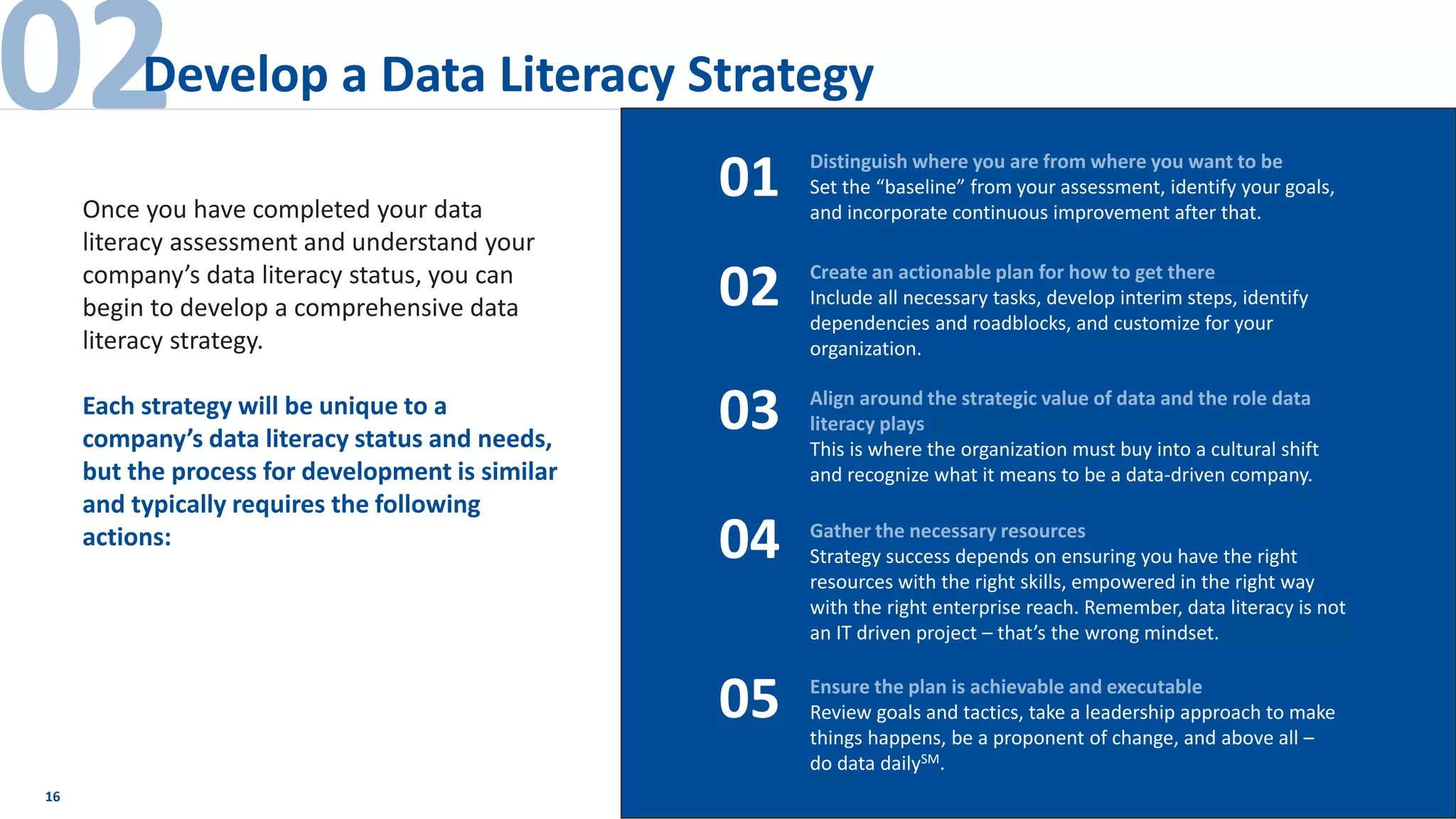
Distinguish where you are from where you want to be
Set the “baseline” from your assessment, identify your goals,
and incorporate continuous improvement after that.
01
02
03
04
05
Create an actionable plan for how to get there
Include all necessary tasks, develop interim steps, identify
dependencies and roadblocks, and customize for your
organization.
Align around the strategic value of data and the role data
literacy plays
This is where the organization must buy into a cultural shift
and recognize what it means to be a data-driven company.
Gather the necessary resources
Strategy success depends on ensuring you have the right
resources with the right skills, empowered in the right way
with the right enterprise reach. Remember, data literacy is not
an IT driven project – that’s the wrong mindset.
Ensure the plan is achievable and executable
Review goals and tactics, take a leadership approach to make
things happens, be a proponent of change, and above all –
do data dailySM.
Once you have completed your data
literacy assessment and understand your
company’s data literacy status, you can
begin to develop a comprehensive data
literacy strategy.
Each strategy will be unique to a
company’s data literacy status and needs,
but the process for development is similar
and typically requires the following
actions:
17
03
The Beauty of
Data Visualization
The Best Stats
You’ve Ever Seen
Why Everyone
Should Be Data
Literate
The Power in
Effective Data
Storytelling
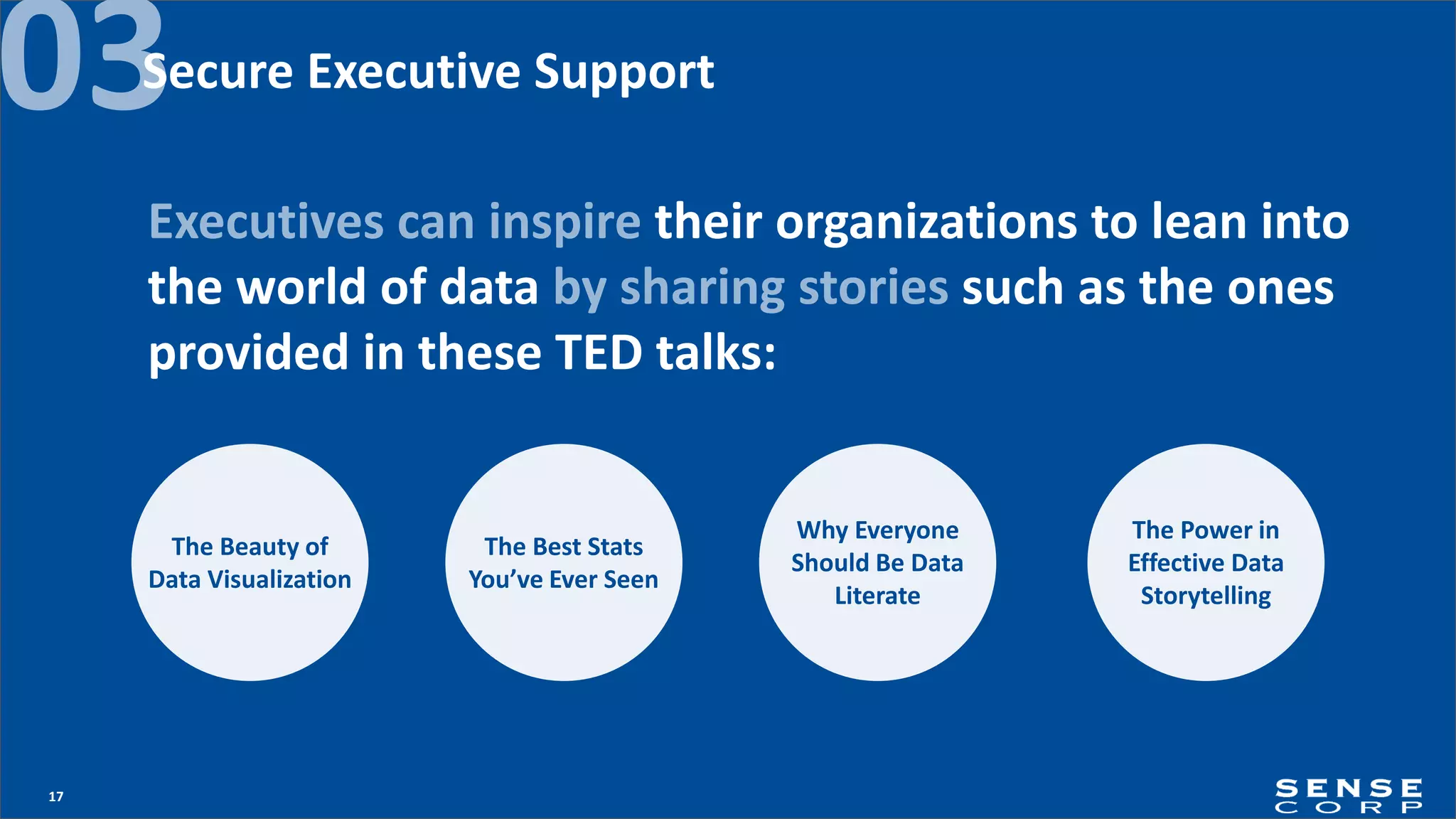
Executives can inspire their organizations to lean into
the world of data by sharing stories such as the ones
provided in these TED talks:
Secure Executive Support
18
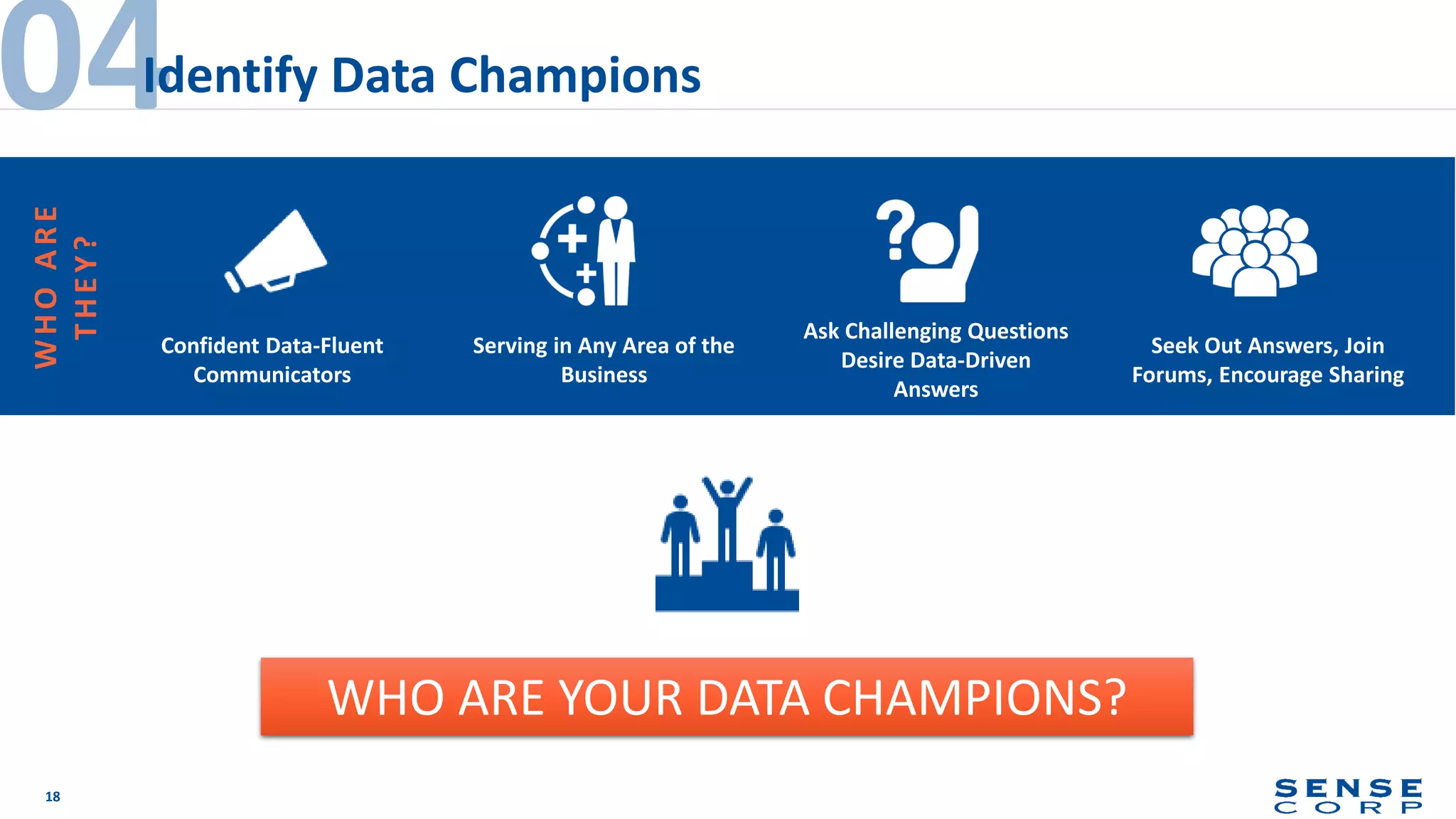
04Identify Data Champions
WHOARE
THEY?
Confident Data-Fluent
Communicators
Serving in Any Area of the
Business
Ask Challenging Questions
Desire Data-Driven
Answers
Seek Out Answers, Join
Forums, Encourage Sharing
WHO ARE YOUR DATA CHAMPIONS?
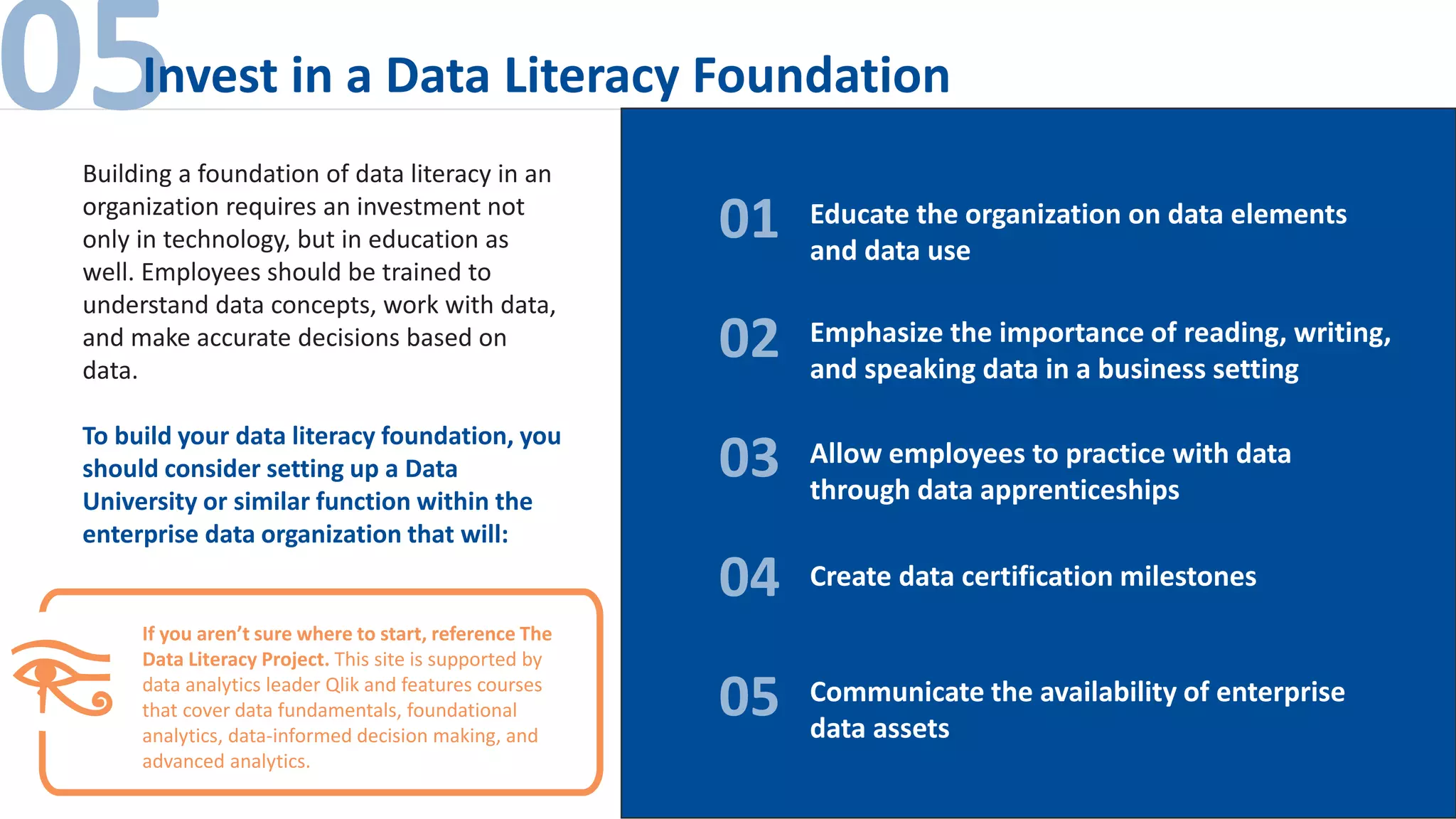
05Invest in a Data Literacy Foundation
Educate the organization on data elements
and data use
01
02
03
04
05
Emphasize the importance of reading, writing,
and speaking data in a business setting
Allow employees to practice with data
through data apprenticeships
Create data certification milestones
Communicate the availability of enterprise
data assets
If you aren’t sure where to start, reference The
Data Literacy Project. This site is supported by
data analytics leader Qlik and features courses
that cover data fundamentals, foundational
analytics, data-informed decision making, and
advanced analytics.
Building a foundation of data literacy in an
organization requires an investment not
only in technology, but in education as
well. Employees should be trained to
understand data concepts, work with data,
and make accurate decisions based on
data.
To build your data literacy foundation, you
should consider setting up a Data
University or similar function within the
enterprise data organization that will:
o Build and practice the data literacy concepts. Discuss different types of data,
how to differentiate them, and how to “speak” data in a business setting.
o Make the curriculum a mix of theoretical concept and practical application.
Challenge students to apply what they learn to their daily activities.
o Make it interesting. Incorporate games for competition or integrate storytelling
activities to discuss how people used data to drive business differently.
o Create a tailored experience. Customize the material for different audiences,
their roles, their learning styles, their needs, and the tools they use.
o Develop a mentoring program. Start a “buddy system” to help those who might
be struggling with data concepts.
o Tie coursework into career paths, performance reviews, and incentive structures.
This will ensure more widespread participation across the organization.
06Develop a Customized Data Literacy Curriculum
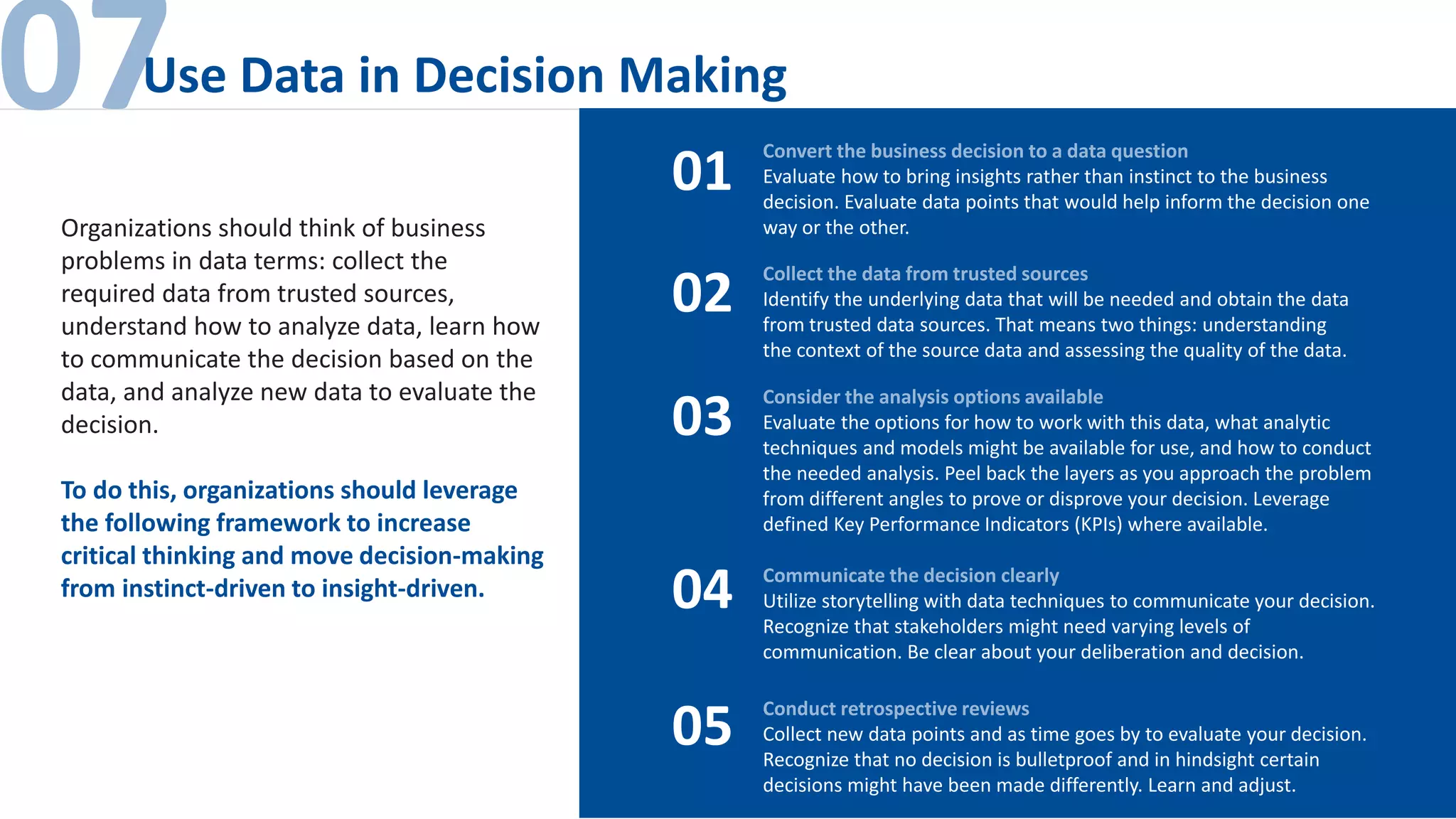
07Use Data in Decision Making
Convert the business decision to a data question
Evaluate how to bring insights rather than instinct to the business
decision. Evaluate data points that would help inform the decision one
way or the other.
01
02
03
04
05
Collect the data from trusted sources
Identify the underlying data that will be needed and obtain the data
from trusted data sources. That means two things: understanding
the context of the source data and assessing the quality of the data.
Consider the analysis options available
Evaluate the options for how to work with this data, what analytic
techniques and models might be available for use, and how to conduct
the needed analysis. Peel back the layers as you approach the problem
from different angles to prove or disprove your decision. Leverage
defined Key Performance Indicators (KPIs) where available.
Communicate the decision clearly
Utilize storytelling with data techniques to communicate your decision.
Recognize that stakeholders might need varying levels of
communication. Be clear about your deliberation and decision.
Conduct retrospective reviews
Collect new data points and as time goes by to evaluate your decision.
Recognize that no decision is bulletproof and in hindsight certain
decisions might have been made differently. Learn and adjust.
Organizations should think of business
problems in data terms: collect the
required data from trusted sources,
understand how to analyze data, learn how
to communicate the decision based on the
data, and analyze new data to evaluate the
decision.
To do this, organizations should leverage
the following framework to increase
critical thinking and move decision-making
from instinct-driven to insight-driven.
22
08
Big data governance requires special attention, as this
data may move from one setting to another. A
portion of this data might be used in a laboratory
before moving to a factory. The data will need
definitions and a defined process as it moves to the
factory setting and is used for production.
Provide Access to Data
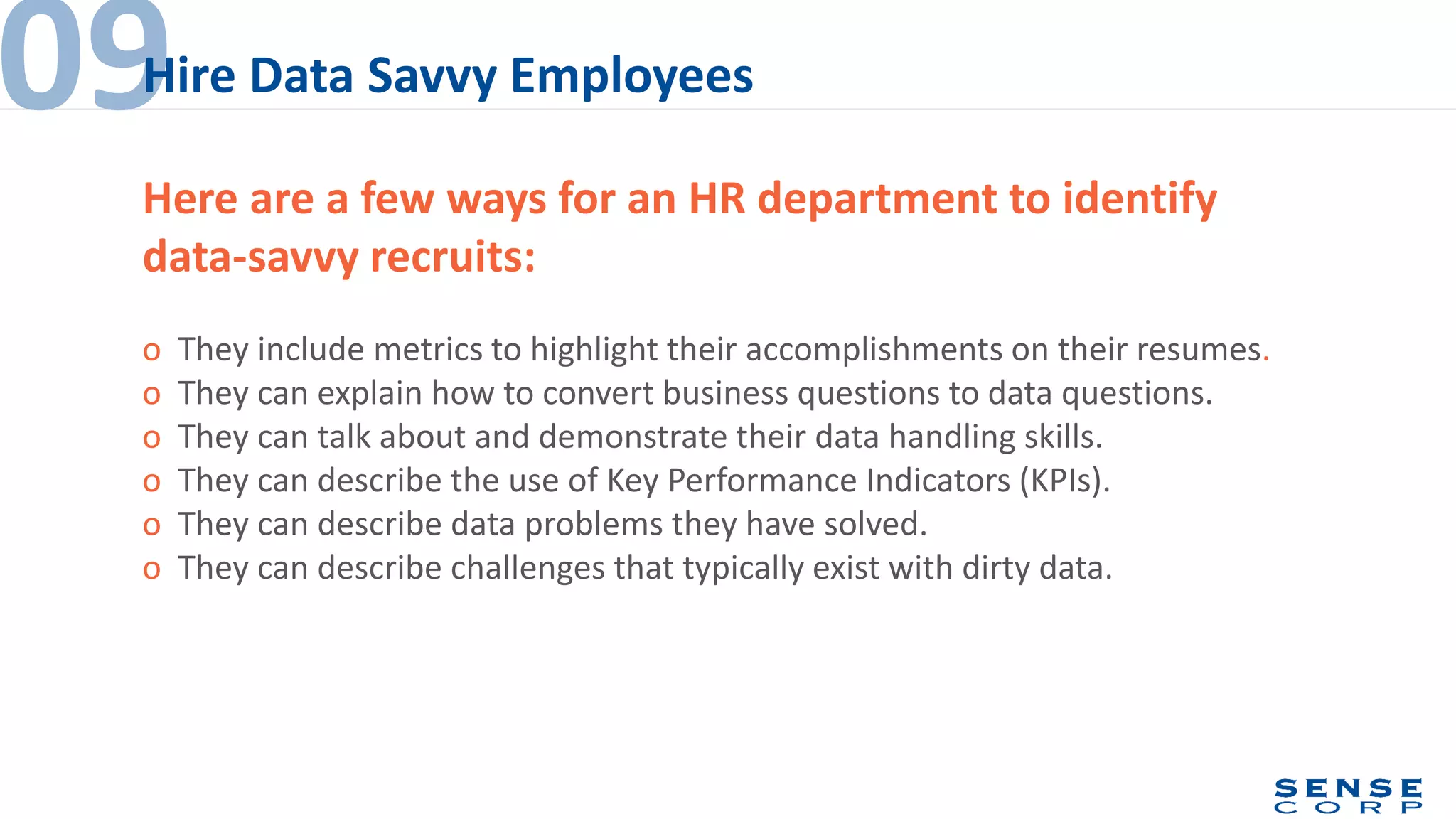
o They include metrics to highlight their accomplishments on their resumes.
o They can explain how to convert business questions to data questions.
o They can talk about and demonstrate their data handling skills.
o They can describe the use of Key Performance Indicators (KPIs).
o They can describe data problems they have solved.
o They can describe challenges that typically exist with dirty data.
09Hire Data Savvy Employees
Here are a few ways for an HR department to identify
data-savvy recruits:
24
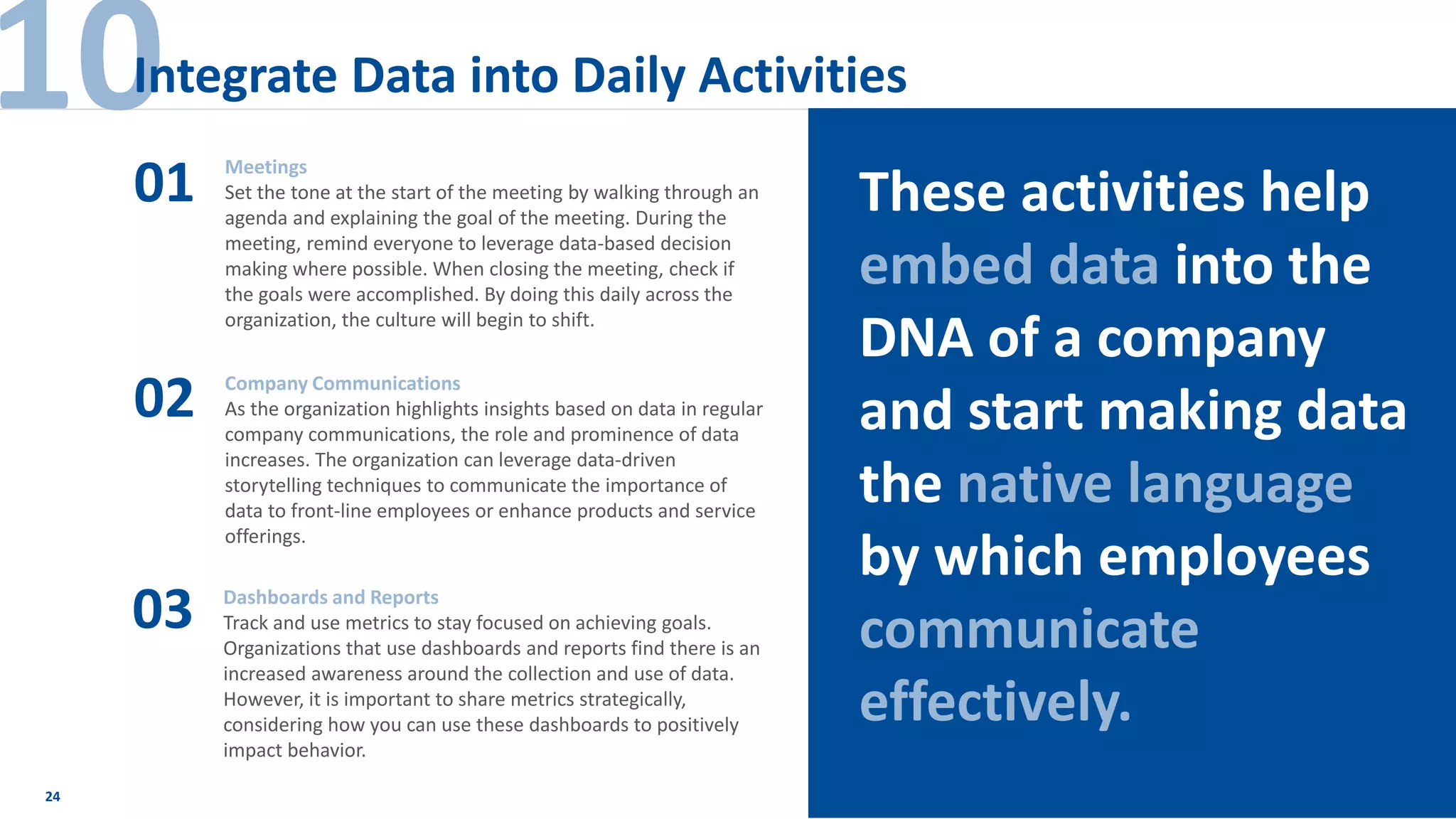
Meetings
Set the tone at the start of the meeting by walking through an
agenda and explaining the goal of the meeting. During the
meeting, remind everyone to leverage data-based decision
making where possible. When closing the meeting, check if
the goals were accomplished. By doing this daily across the
organization, the culture will begin to shift.
01
02
03
Company Communications
As the organization highlights insights based on data in regular
company communications, the role and prominence of data
increases. The organization can leverage data-driven
storytelling techniques to communicate the importance of
data to front-line employees or enhance products and service
offerings.
Dashboards and Reports
Track and use metrics to stay focused on achieving goals.
Organizations that use dashboards and reports find there is an
increased awareness around the collection and use of data.
However, it is important to share metrics strategically,
considering how you can use these dashboards to positively
impact behavior.
10Integrate Data into Daily Activities
These activities help
embed data into the
DNA of a company
and start making data
the native language
by which employees
communicate
effectively.
“Do Data Daily”
25
Assess Data Literacy Status
01
Develop a Data Literacy Strategy
02
Secure Executive Support
03
Identify Data Champions
04
Invest in a Data Literacy Foundation
05
Develop a Customized Data Literacy Curriculum
06
Use Data in Decision Making
07
Provide Access to Data
08
Hire Data Savvy Employees
09
Integrate Data into Daily Activities
10
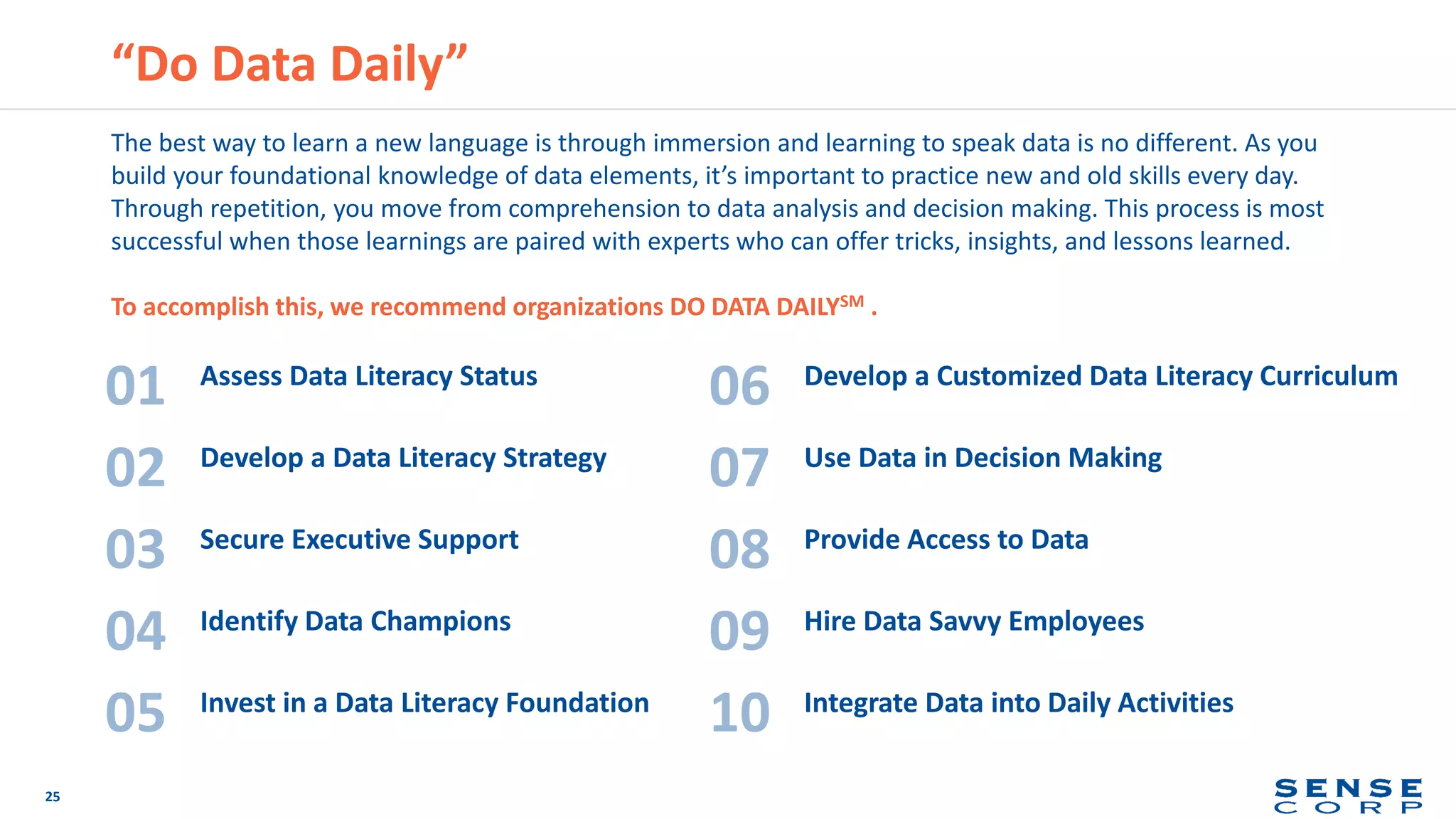
The best way to learn a new language is through immersion and learning to speak data is no different. As you
build your foundational knowledge of data elements, it’s important to practice new and old skills every day.
Through repetition, you move from comprehension to data analysis and decision making. This process is most
successful when those learnings are paired with experts who can offer tricks, insights, and lessons learned.
To accomplish this, we recommend organizations DO DATA DAILYSM .
Thanks For Joining Us
We hope you enjoyed the presentation.
If you’d like to learn more about how to develop and
foster a data-literate workforce,
download our eBook.
https://sensecorp.com/10_steps_to_data_literacy/
DOWNLOAD EBOOK
www.sensecorp.com | marketing@sensecorp.com
Connect with me on LinkedIn!
https://www.linkedin.com/in/alissaschneider/
Data Virtualization as a
Technology Enabler for
Data Literacy
Stop Collecting. Start Connecting.
Ravi Shankar
Sr. Vice President and Chief Marketing Officer
28
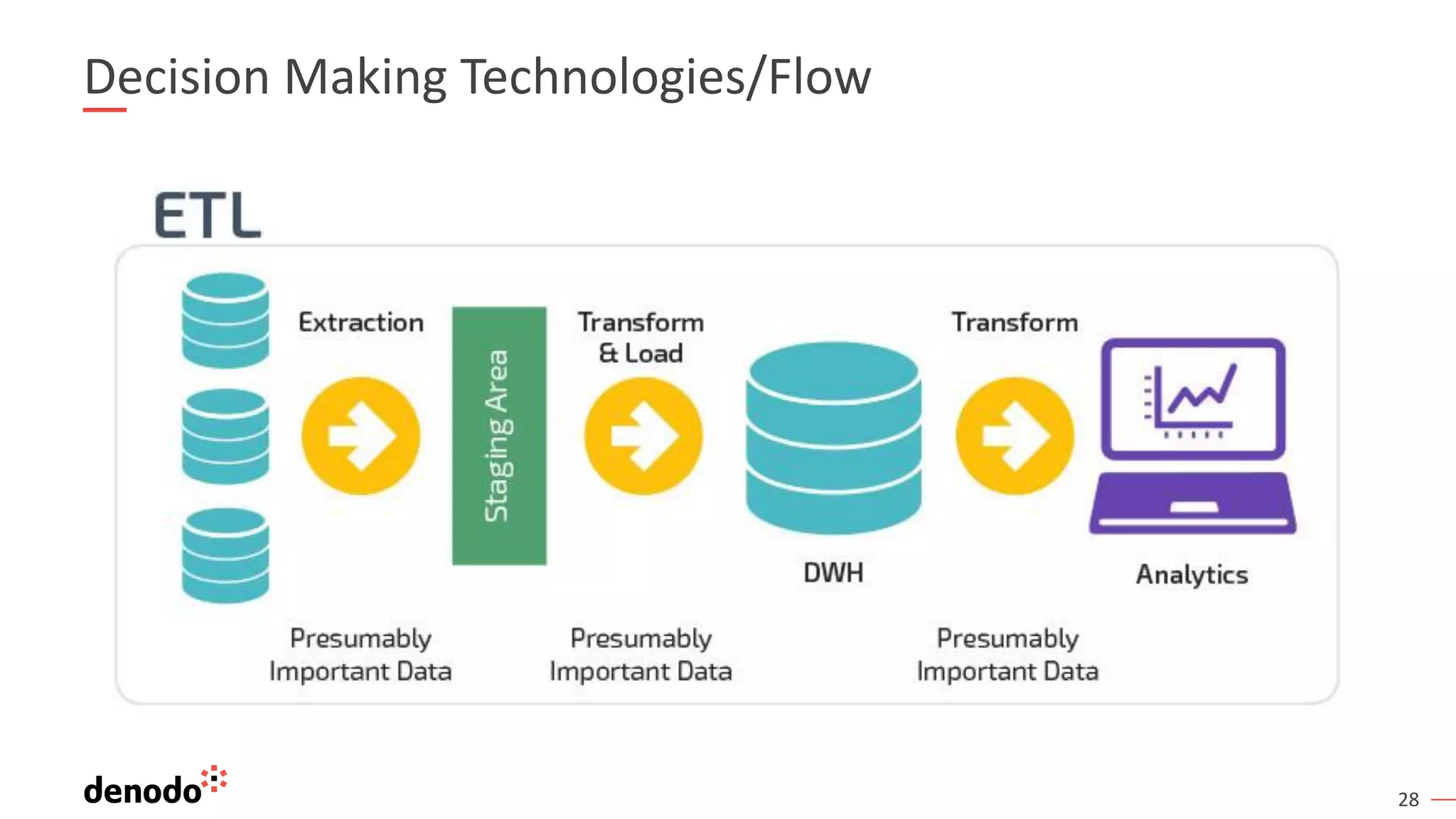
Decision Making Technologies/Flow
29
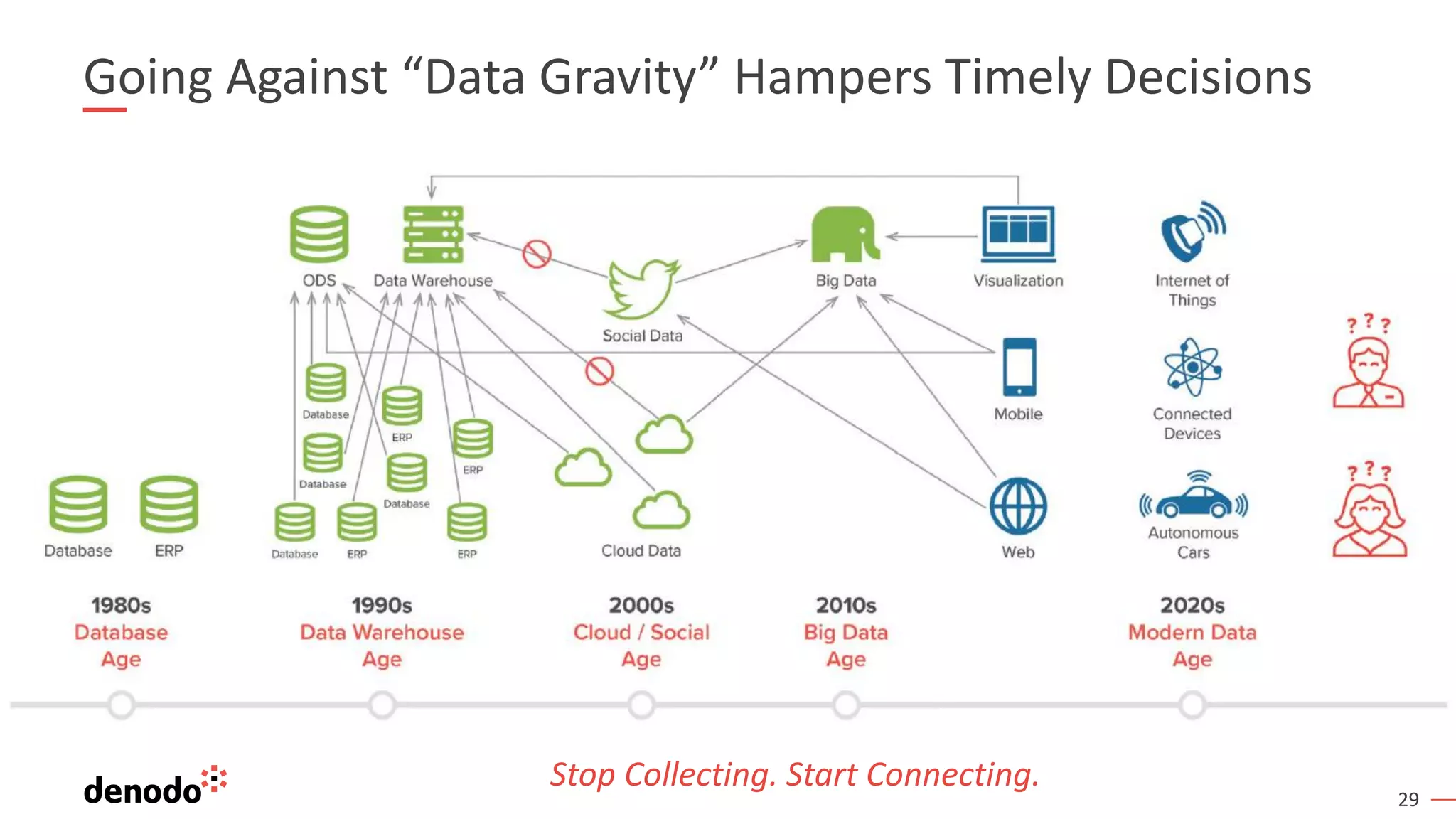
Going Against “Data Gravity” Hampers Timely Decisions
Stop Collecting. Start Connecting.
30
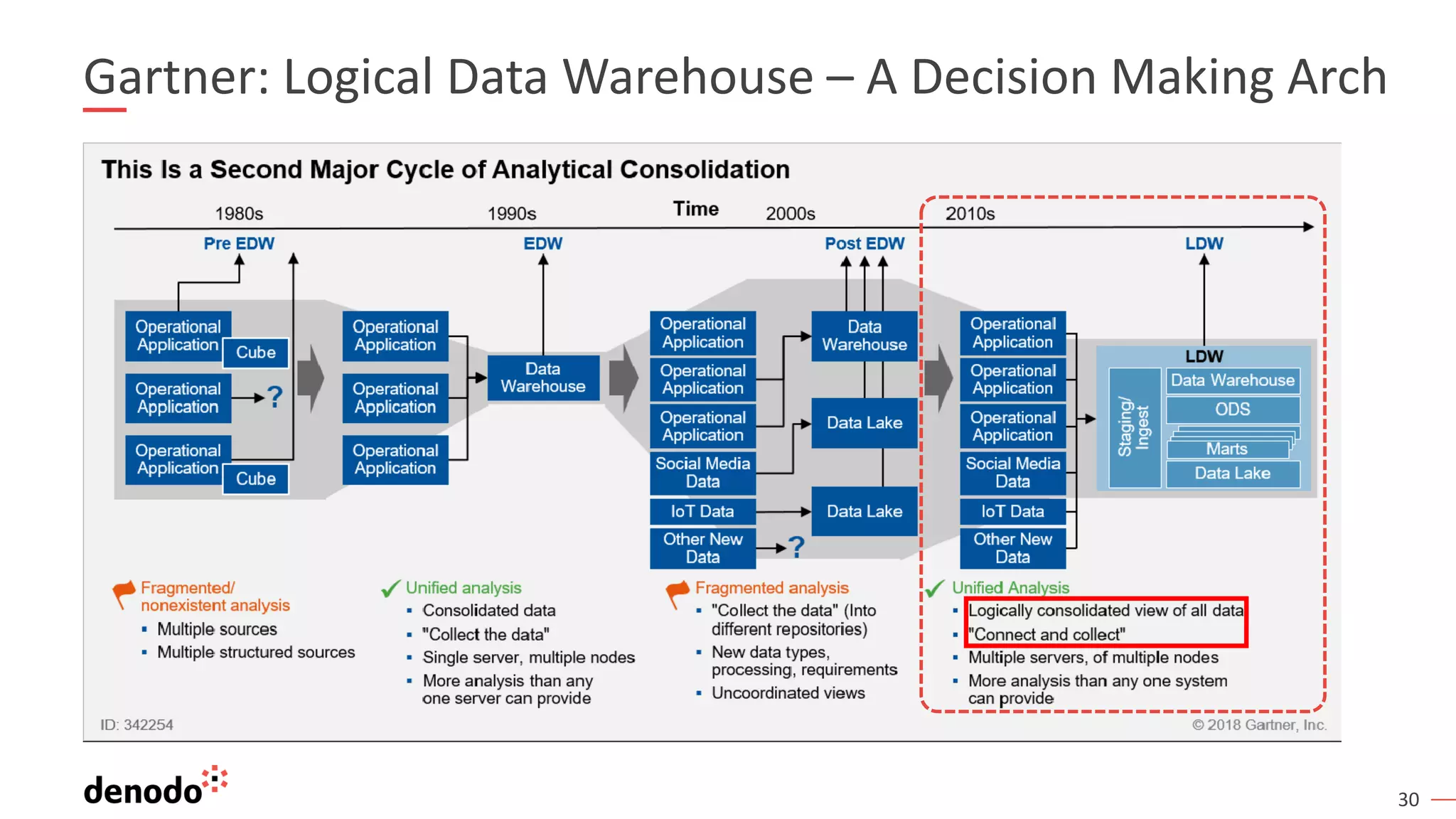
Gartner: Logical Data Warehouse – A Decision Making Arch
31
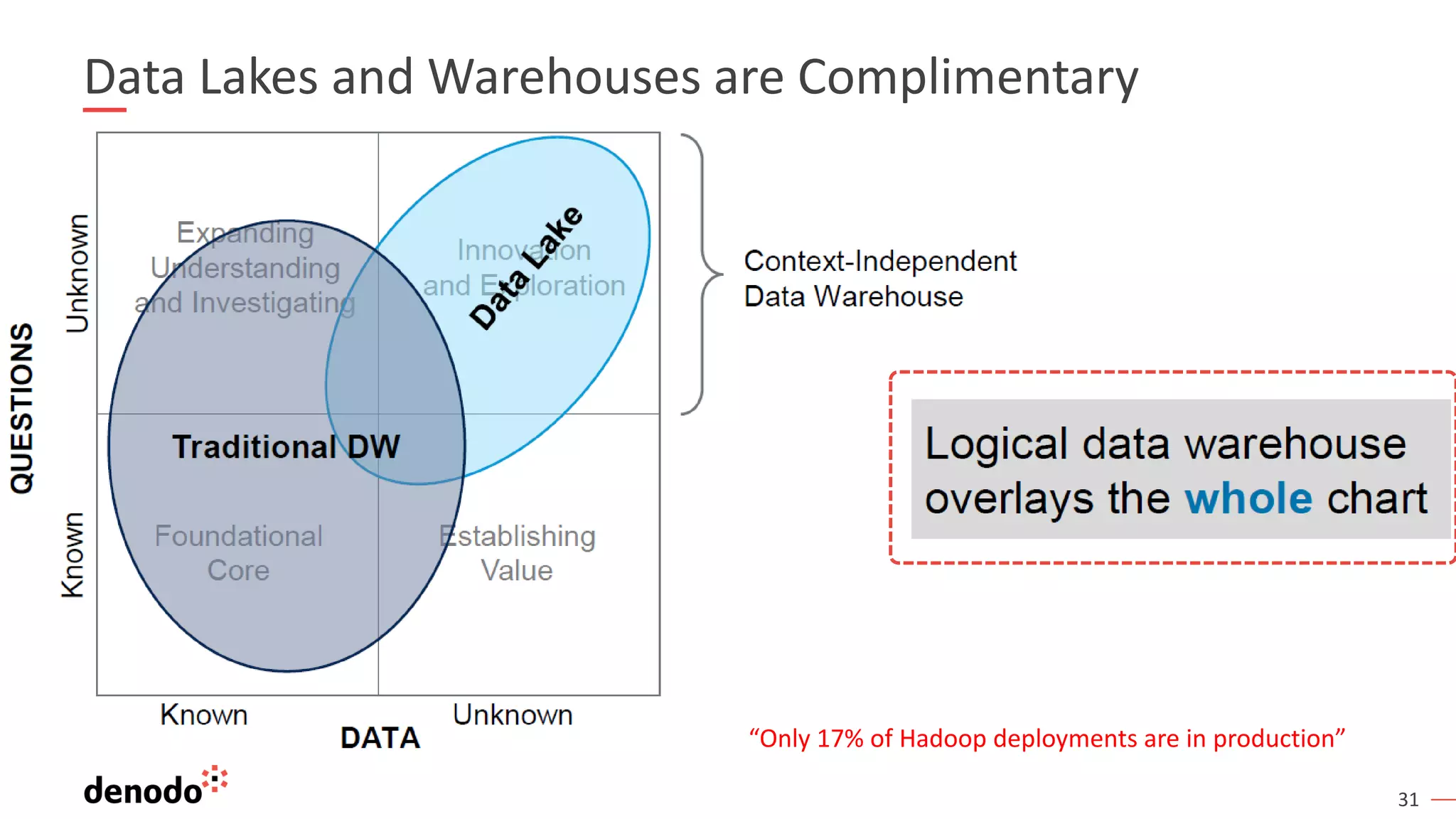
Data Lakes and Warehouses are Complimentary
“Only 17% of Hadoop deployments are in production”
32
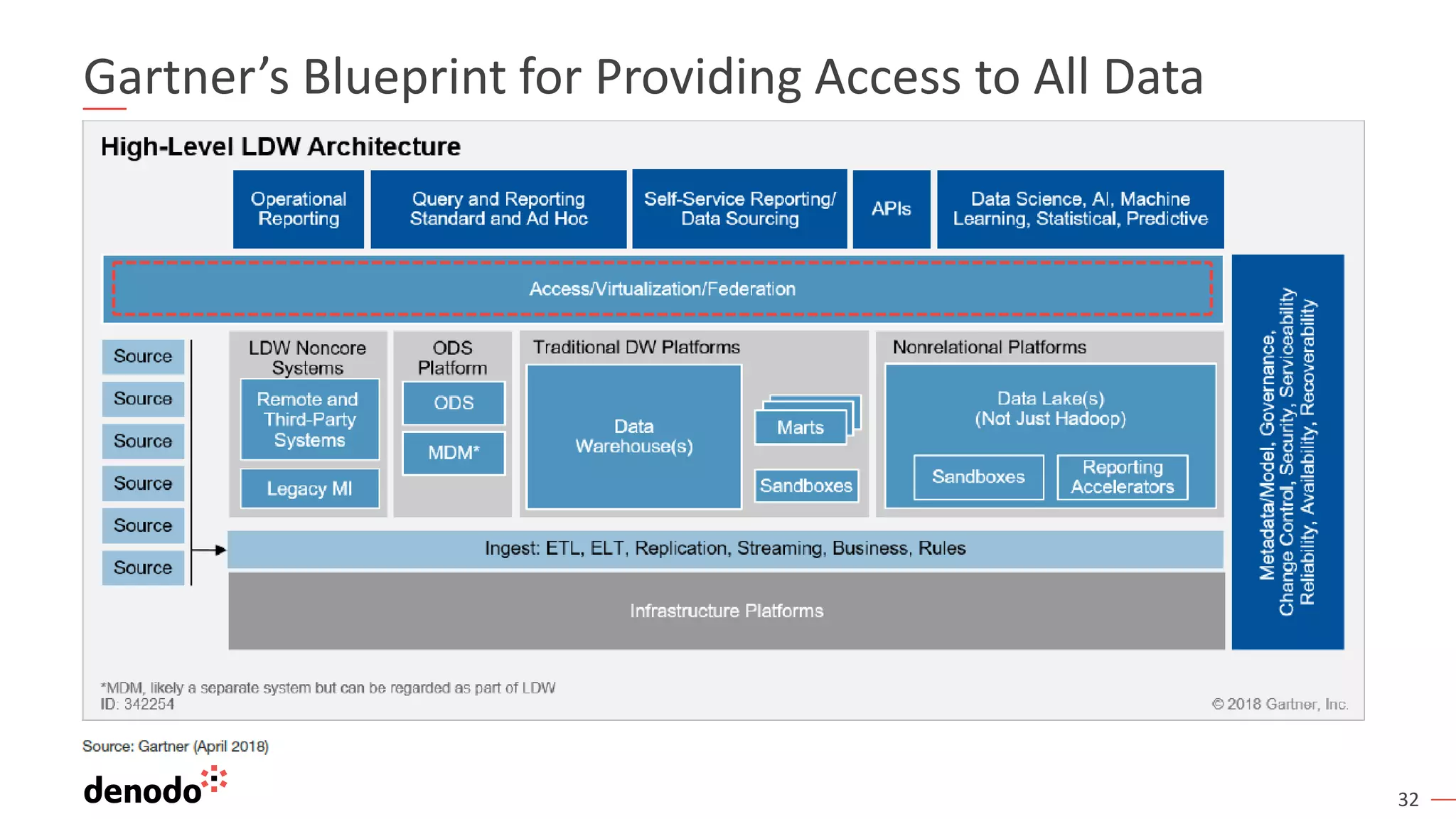
Gartner’s Blueprint for Providing Access to All Data
What is Data Virtualization?
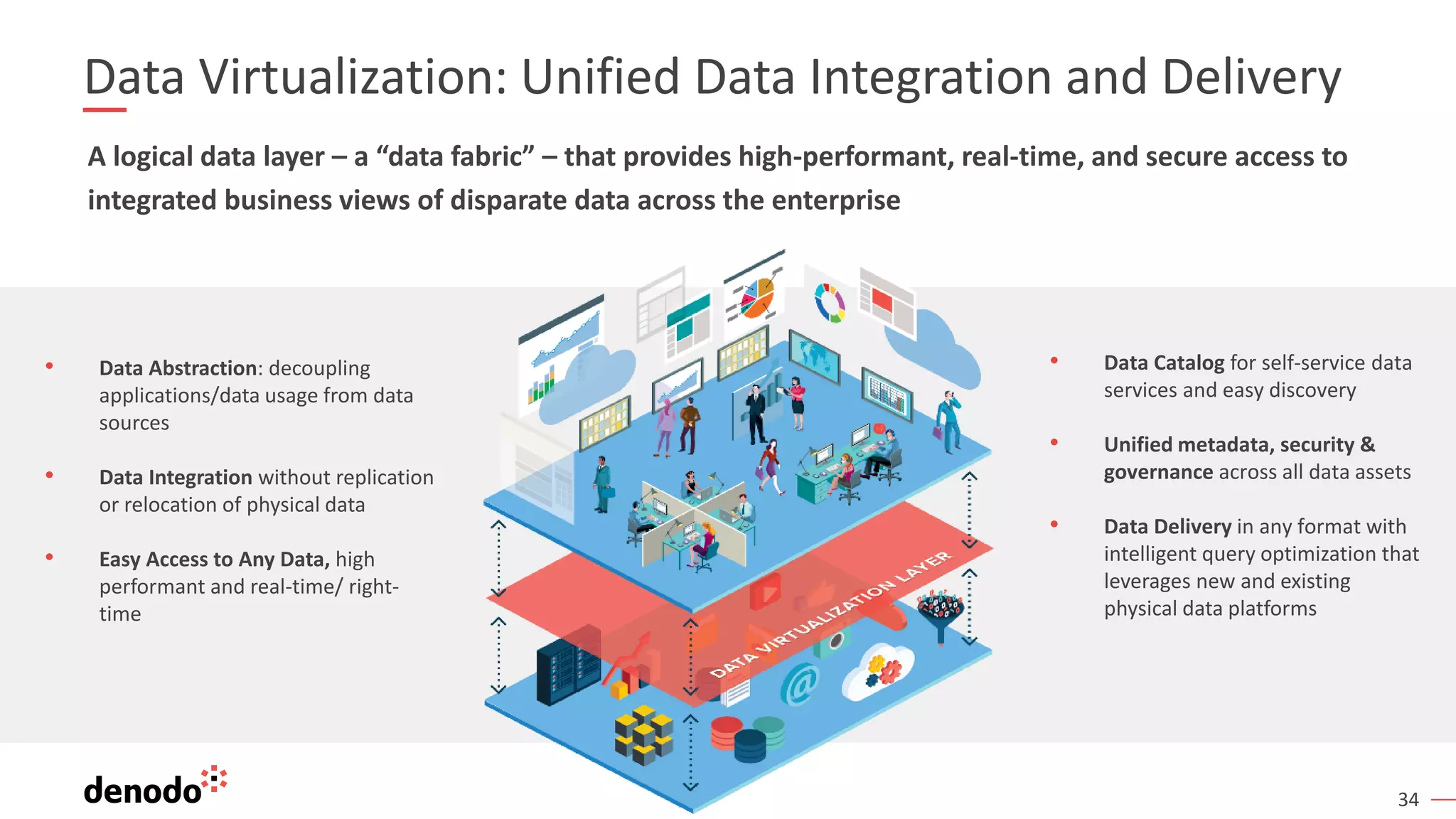
34
Data Virtualization: Unified Data Integration and Delivery
• Data Abstraction: decoupling
applications/data usage from data
sources
• Data Integration without replication
or relocation of physical data
• Easy Access to Any Data, high
performant and real-time/ right-
time
• Data Catalog for self-service data
services and easy discovery
• Unified metadata, security &
governance across all data assets
• Data Delivery in any format with
intelligent query optimization that
leverages new and existing
physical data platforms
A logical data layer – a “data fabric” – that provides high-performant, real-time, and secure access to
integrated business views of disparate data across the enterprise
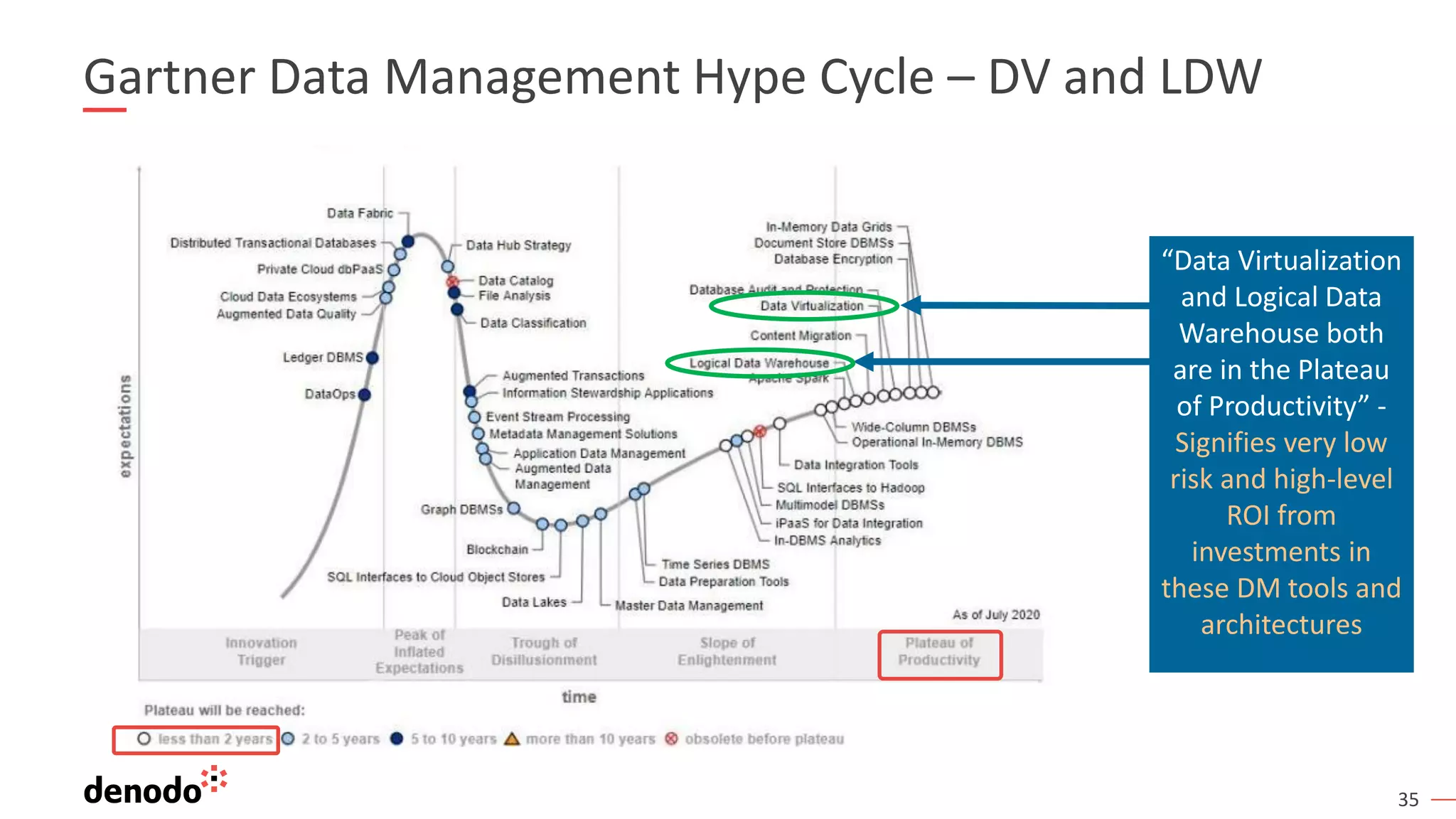
35
Gartner Data Management Hype Cycle – DV and LDW
“Data Virtualization
and Logical Data
Warehouse both
are in the Plateau
of Productivity” -
Signifies very low
risk and high-level
ROI from
investments in
these DM tools and
architectures
36
Source: Gartner Data Virtualization Market Guide, Dec 2018
Through 2022, 60% of all organizations will implement data
virtualization as one key delivery style in their data integration
architecture”
37
38
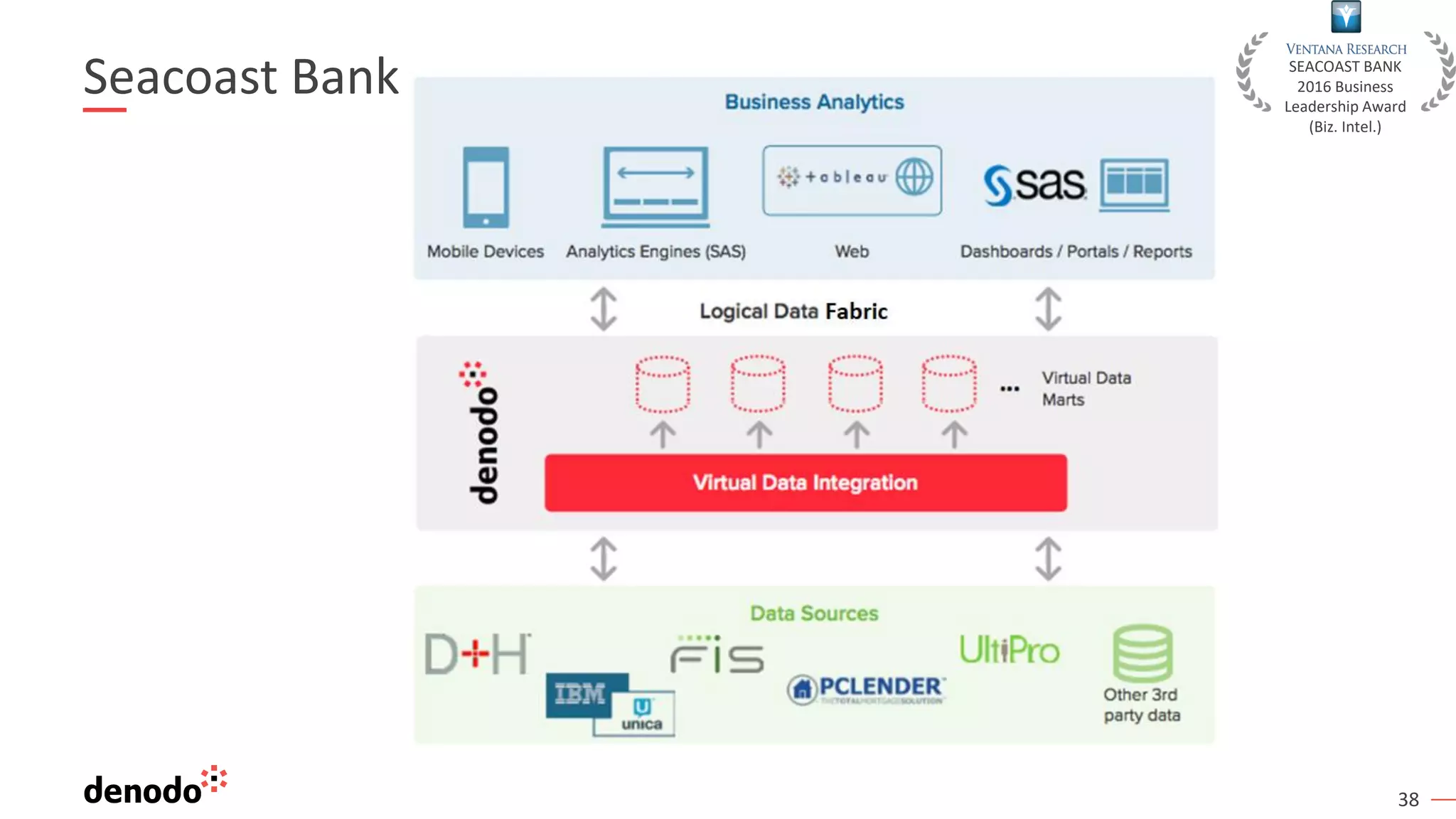
Seacoast Bank SEACOAST BANK
2016 Business
Leadership Award
(Biz. Intel.)
39
Q&A
#DenodoDataFest
You’re Invited: Join Sense Corp at Denodo DataFest
The Agile Data Management and Analytics Conference
Advancing Cloud, Analytics, and Data Science with Logical Data Fabric
Sense Corp is sponsoring Denodo DataFest!
See our very own Josh Rachner on a Panel covering:
“Cloud Data Integration: Hybrid/Multicloud Strategies”
Register Now: December 9-10: https://bit.ly/sensecorp
THANK YOU

Data Literacy and Data Virtualization: A Step-by-step Guide to Bolstering Your Organizational Competencies (US)

  • 1.
    Data Literacy andData Virtualization A Step-by-step Guide to Bolstering Your Organizational Competencies 17th November, 2020
  • 2.
    Speakers Data Governance PracticeLeader at Sense Corp Sr. Vice President and Chief Marketing Officer at Denodo
  • 3.
    10 Steps toDevelop a Data Literate Workforce 3
  • 4.
    4 Data Governance PracticeLeader Dallas / Fort Worth aschneider@sensecorp.com Alissa Schneider About the Presenter ▪ 15+ years leading complex data transformation projects for Fortune 500 and mid-size companies Connect with me on LinkedIn! https://www.linkedin.com/in/alissaschneider/
  • 5.
    5 • What isData Literacy? • Why is Data Literacy Important? • 10 Steps to Develop and Foster a Data Literate Workforce • Q & A AGENDA
  • 6.
    6 Data-literate companies thatare successfully navigating this gap are already disrupting industries, fundamentally changing expectations and service levels. What is Data Literacy? Data literacy is the ability to read, work with, analyze, and argue with data. Much like literacy as a general concept, data literacy focuses on the competencies involved in working with data.
  • 7.
  • 8.
    Learning to speakdata? Here is what we learn at each step: 8 Reading Data The organization has a limited amount of data literacy established across the enterprise. It may exist in certain departments but not across the organization. The organization has made limited investments in data literacy. o Understanding Data Literacy Building Blocks o Developing a Foundation of Data o Questioning the Quality of Data Writing Data The organization is working to establish and educate the organization on data literacy. Education is a priority for every employee, from data-focused departments to front-line employees. The organization is actively investing in data literacy and hiring accordingly. o Conducting Data Analysis o Presenting with Data o Telling the Story with Data Speaking Data The organization is data-literate and has prioritized its data as a core asset. All employees recognize the value of data. The organization is investing to further the reach of data literacy with leading-edge technologies (e.g. AI/ML). o Evaluating Data Ethics o Making Decisions with Data o Tracking Progress with Data 1 32
  • 9.
    Human Progress andLiteracy 9 Throughout history, the literate people of their time have always led. Literacy is the road to human progress and the means through which every man, woman, and child can realize his or her full potential.
  • 10.
    Key Findings 10 Enterprise-wide dataliteracy is low. 24% of business decision makers surveyed are fully confident in their ability to read, work with, analyze, and argue with data. Future employees are underprepared for data-driven workplaces. 21% of 16- to 24-year-olds are data-literate, suggesting schools and universities are failing to ensure students have the skills they need to enter the working world. Data is key for professional credibility. 94% of respondents using data in their current roles agree data helps them do their jobs better, and 82% believe greater data literacy would give them more credibility in the workplace. Senior leaders do not display confidence. 32% of the C-suite is viewed as data-literate, potentially holding senior leaders back from encouraging their workforces to use data to their advantage. Organizations are losing competitive advantage because data literacy drives higher enterprise performance. 85% of data-literate people say they are performing very well at work, compared to 54% of the wider workforce. There is an appetite to learn. 78% of business decision makers said they would be willing to invest more time and energy into improving their data skillsets. Source: Lead with Data: How to Drive Data Literacy in the Enterprise, Qlik
  • 11.
    Companies that usedata to establish their business models have 3 distinct advantages over established companies: 11 High-Quality Data Collection Each process and interaction is evaluated through a “can-I-track-this” lens followed by a “how-can-I-scale-this” discussion. This requires a strong foundation of underlying data to be captured at every step. Established companies often have legacy processes with limited and disparate data collection from which the data might be of questionable quality. Strong Data-literate Workforce Knowing how to work with data is the “minimum height to ride” at a data-literate company. These companies hire strong data practitioners who, through an increasing focus on data, have been able to monetize their data assets. Established companies need employees who can maintain their existing non-data based processes, so they hire differently. Developing data literacy is typically not a priority for them and is reflected in their workforce. Agility as a Mindset The culture at these companies is focused on their abilities to bring products to market quickly, move critical decision making to front- line managers, promote innovative thinking, foster competitive drive, and rapidly evaluate progress based on data. Established companies work hard to adopt these traits on small teams but struggle to scale them throughout the organization, where employees prefer to operate as-is.
  • 12.
    The data practicesthat differentiated high performers from others involved data leadership in the C-suite, broadly accessible data, and a culture that tolerates failure. 1. Out of 10 practices that were presented as answer choices. For respondents at high-performing organizations, n = 170; for all other respondents, n = 405. 2. Respondents who said their organizations (a) have had an average annual organic growth rate of 10% or more over past 3 years and (b) have had an average annual growth rate in earnings before interest and taxes of 10% or more over past 3 years. Current data practices at respondents’ organizations1 % of respondents At all other organizations At high-performing organizations2 C-Suite team includes at least one data leader Data are broadly accessible to front-line employees whenever needed Organizational culture supports rapid testing and iteration based on data and tolerates fast failure Hiring criteria for non- management roles include proficiency in data-related topics Hiring criteria for management roles include proficiency in data-related topics Catch Them if You Can: How Leaders in Data and Analytics Have Pulled Ahead, McKinsey & Company; Survey
  • 13.
    Established companies oftenfeel like prisoners to what made them successful – their static processes and hierarchical controls. Meanwhile, the new kids in class are faster, smarter, and better prepared to succeed in a data-driven environment.
  • 14.
    14 Assess Data LiteracyStatus 01 Develop a Data Literacy Strategy 02 Secure Executive Support 03 Identify Data Champions 04 Invest in a Data Literacy Foundation 05 Develop a Customized Data Literacy Curriculum 06 Use Data in Decision Making 07 Provide Access to Data 08 Hire Data Savvy Employees 09 Integrate Data into Daily Activities 10 The 10 Steps to Fostering a Data-Literate Workforce
  • 15.
    01Data Pride DataPlatform Data Prowess This refers to how much the organization recognizes and values data. We can determine this by asking the following questions: o Does your organization inherently value data? o What is the organization’s sentiment about data? o Does your entire organization value data as an asset? o Is every process and interaction viewed as a source of valuable data? o Does the organization push for automated data collection where possible? o Do front-line workers recognize the value of collecting high-quality data? This refers to how much of the organization’s data is easily accessible in a highly useable format. We can determine this by asking the following questions: o Does your organization make its data easily available in a high-quality format? o Are business and technology working together to open up the data? o Does the organization host the data in an easy-to-access manner? o Does the organization invest in breaking down data silos? o Does the organization certify a set of the overall data across the enterprise? o Does the organization invest in data standards? o Does the organization offer a set of enterprise tools to provide the data to employees? o Does the organization invest in collaborative uses of data? This refers to how much the organization knows about working effectively with data. We can determine this by asking the following questions: o Does your organization understand and know how to work with data? o Are the organization’s employees data savvy? o Does the organization know how to convert business questions into data questions? o Does the organization understand how to interpret and analyze data? o Does the organization understand how to communicate with data? o Is the organization using artificial intelligence, machine learning, and data science? Assess Data Literacy Status
  • 16.
    16 02Develop a DataLiteracy Strategy Distinguish where you are from where you want to be Set the “baseline” from your assessment, identify your goals, and incorporate continuous improvement after that. 01 02 03 04 05 Create an actionable plan for how to get there Include all necessary tasks, develop interim steps, identify dependencies and roadblocks, and customize for your organization. Align around the strategic value of data and the role data literacy plays This is where the organization must buy into a cultural shift and recognize what it means to be a data-driven company. Gather the necessary resources Strategy success depends on ensuring you have the right resources with the right skills, empowered in the right way with the right enterprise reach. Remember, data literacy is not an IT driven project – that’s the wrong mindset. Ensure the plan is achievable and executable Review goals and tactics, take a leadership approach to make things happens, be a proponent of change, and above all – do data dailySM. Once you have completed your data literacy assessment and understand your company’s data literacy status, you can begin to develop a comprehensive data literacy strategy. Each strategy will be unique to a company’s data literacy status and needs, but the process for development is similar and typically requires the following actions:
  • 17.
    17 03 The Beauty of DataVisualization The Best Stats You’ve Ever Seen Why Everyone Should Be Data Literate The Power in Effective Data Storytelling Executives can inspire their organizations to lean into the world of data by sharing stories such as the ones provided in these TED talks: Secure Executive Support
  • 18.
    18 04Identify Data Champions WHOARE THEY? ConfidentData-Fluent Communicators Serving in Any Area of the Business Ask Challenging Questions Desire Data-Driven Answers Seek Out Answers, Join Forums, Encourage Sharing WHO ARE YOUR DATA CHAMPIONS?
  • 19.
    05Invest in aData Literacy Foundation Educate the organization on data elements and data use 01 02 03 04 05 Emphasize the importance of reading, writing, and speaking data in a business setting Allow employees to practice with data through data apprenticeships Create data certification milestones Communicate the availability of enterprise data assets If you aren’t sure where to start, reference The Data Literacy Project. This site is supported by data analytics leader Qlik and features courses that cover data fundamentals, foundational analytics, data-informed decision making, and advanced analytics. Building a foundation of data literacy in an organization requires an investment not only in technology, but in education as well. Employees should be trained to understand data concepts, work with data, and make accurate decisions based on data. To build your data literacy foundation, you should consider setting up a Data University or similar function within the enterprise data organization that will:
  • 20.
    o Build andpractice the data literacy concepts. Discuss different types of data, how to differentiate them, and how to “speak” data in a business setting. o Make the curriculum a mix of theoretical concept and practical application. Challenge students to apply what they learn to their daily activities. o Make it interesting. Incorporate games for competition or integrate storytelling activities to discuss how people used data to drive business differently. o Create a tailored experience. Customize the material for different audiences, their roles, their learning styles, their needs, and the tools they use. o Develop a mentoring program. Start a “buddy system” to help those who might be struggling with data concepts. o Tie coursework into career paths, performance reviews, and incentive structures. This will ensure more widespread participation across the organization. 06Develop a Customized Data Literacy Curriculum
  • 21.
    07Use Data inDecision Making Convert the business decision to a data question Evaluate how to bring insights rather than instinct to the business decision. Evaluate data points that would help inform the decision one way or the other. 01 02 03 04 05 Collect the data from trusted sources Identify the underlying data that will be needed and obtain the data from trusted data sources. That means two things: understanding the context of the source data and assessing the quality of the data. Consider the analysis options available Evaluate the options for how to work with this data, what analytic techniques and models might be available for use, and how to conduct the needed analysis. Peel back the layers as you approach the problem from different angles to prove or disprove your decision. Leverage defined Key Performance Indicators (KPIs) where available. Communicate the decision clearly Utilize storytelling with data techniques to communicate your decision. Recognize that stakeholders might need varying levels of communication. Be clear about your deliberation and decision. Conduct retrospective reviews Collect new data points and as time goes by to evaluate your decision. Recognize that no decision is bulletproof and in hindsight certain decisions might have been made differently. Learn and adjust. Organizations should think of business problems in data terms: collect the required data from trusted sources, understand how to analyze data, learn how to communicate the decision based on the data, and analyze new data to evaluate the decision. To do this, organizations should leverage the following framework to increase critical thinking and move decision-making from instinct-driven to insight-driven.
  • 22.
    22 08 Big data governancerequires special attention, as this data may move from one setting to another. A portion of this data might be used in a laboratory before moving to a factory. The data will need definitions and a defined process as it moves to the factory setting and is used for production. Provide Access to Data
  • 23.
    o They includemetrics to highlight their accomplishments on their resumes. o They can explain how to convert business questions to data questions. o They can talk about and demonstrate their data handling skills. o They can describe the use of Key Performance Indicators (KPIs). o They can describe data problems they have solved. o They can describe challenges that typically exist with dirty data. 09Hire Data Savvy Employees Here are a few ways for an HR department to identify data-savvy recruits:
  • 24.
    24 Meetings Set the toneat the start of the meeting by walking through an agenda and explaining the goal of the meeting. During the meeting, remind everyone to leverage data-based decision making where possible. When closing the meeting, check if the goals were accomplished. By doing this daily across the organization, the culture will begin to shift. 01 02 03 Company Communications As the organization highlights insights based on data in regular company communications, the role and prominence of data increases. The organization can leverage data-driven storytelling techniques to communicate the importance of data to front-line employees or enhance products and service offerings. Dashboards and Reports Track and use metrics to stay focused on achieving goals. Organizations that use dashboards and reports find there is an increased awareness around the collection and use of data. However, it is important to share metrics strategically, considering how you can use these dashboards to positively impact behavior. 10Integrate Data into Daily Activities These activities help embed data into the DNA of a company and start making data the native language by which employees communicate effectively.
  • 25.
    “Do Data Daily” 25 AssessData Literacy Status 01 Develop a Data Literacy Strategy 02 Secure Executive Support 03 Identify Data Champions 04 Invest in a Data Literacy Foundation 05 Develop a Customized Data Literacy Curriculum 06 Use Data in Decision Making 07 Provide Access to Data 08 Hire Data Savvy Employees 09 Integrate Data into Daily Activities 10 The best way to learn a new language is through immersion and learning to speak data is no different. As you build your foundational knowledge of data elements, it’s important to practice new and old skills every day. Through repetition, you move from comprehension to data analysis and decision making. This process is most successful when those learnings are paired with experts who can offer tricks, insights, and lessons learned. To accomplish this, we recommend organizations DO DATA DAILYSM .
  • 26.
    Thanks For JoiningUs We hope you enjoyed the presentation. If you’d like to learn more about how to develop and foster a data-literate workforce, download our eBook. https://sensecorp.com/10_steps_to_data_literacy/ DOWNLOAD EBOOK www.sensecorp.com | marketing@sensecorp.com Connect with me on LinkedIn! https://www.linkedin.com/in/alissaschneider/
  • 27.
    Data Virtualization asa Technology Enabler for Data Literacy Stop Collecting. Start Connecting. Ravi Shankar Sr. Vice President and Chief Marketing Officer
  • 28.
  • 29.
    29 Going Against “DataGravity” Hampers Timely Decisions Stop Collecting. Start Connecting.
  • 30.
    30 Gartner: Logical DataWarehouse – A Decision Making Arch
  • 31.
    31 Data Lakes andWarehouses are Complimentary “Only 17% of Hadoop deployments are in production”
  • 32.
    32 Gartner’s Blueprint forProviding Access to All Data
  • 33.
    What is DataVirtualization?
  • 34.
    34 Data Virtualization: UnifiedData Integration and Delivery • Data Abstraction: decoupling applications/data usage from data sources • Data Integration without replication or relocation of physical data • Easy Access to Any Data, high performant and real-time/ right- time • Data Catalog for self-service data services and easy discovery • Unified metadata, security & governance across all data assets • Data Delivery in any format with intelligent query optimization that leverages new and existing physical data platforms A logical data layer – a “data fabric” – that provides high-performant, real-time, and secure access to integrated business views of disparate data across the enterprise
  • 35.
    35 Gartner Data ManagementHype Cycle – DV and LDW “Data Virtualization and Logical Data Warehouse both are in the Plateau of Productivity” - Signifies very low risk and high-level ROI from investments in these DM tools and architectures
  • 36.
    36 Source: Gartner DataVirtualization Market Guide, Dec 2018 Through 2022, 60% of all organizations will implement data virtualization as one key delivery style in their data integration architecture”
  • 37.
  • 38.
    38 Seacoast Bank SEACOASTBANK 2016 Business Leadership Award (Biz. Intel.)
  • 39.
  • 40.
  • 41.
    #DenodoDataFest You’re Invited: JoinSense Corp at Denodo DataFest The Agile Data Management and Analytics Conference Advancing Cloud, Analytics, and Data Science with Logical Data Fabric Sense Corp is sponsoring Denodo DataFest! See our very own Josh Rachner on a Panel covering: “Cloud Data Integration: Hybrid/Multicloud Strategies” Register Now: December 9-10: https://bit.ly/sensecorp
  • 42.