The First Step in Information Management
www.firstsanfranciscopartners.com
Produced by:
MONTHLY SERIES
Brought to you in partnership with:
Aug. 3, 2017
Big Data Analytics
Topics for Today’s Analytics Webinar
 New Directions & Trends in Big Data Analytics
− Implications of New Directions
 Differences in Big Data Analytics Architecture
 New Tools for Leveraging More Data Types
 Key Take-Aways
 Q&A
pg 2© 2017 First San Francisco Partners www.firstsanfranciscopartners.com
Polling Question
pg 3© 2017 First San Francisco Partners www.firstsanfranciscopartners.com
 What data types are you analyzing?
− Row and column
− Free-form text
− Geospatial
− Images
− Audio
− Video
− All of the above
www.firstsanfranciscopartners.com
New Directions & Trends in Big Data Analytics
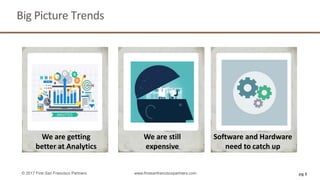
Big Picture Trends
pg 5© 2017 First San Francisco Partners www.firstsanfranciscopartners.com
We are getting
better at Analytics
We are still
expensive
Software and Hardware
need to catch up
Different Questions Being Asked of Data
 Evolving from what to when to why then how?
 Prescriptive and Predictive Analytics are more
commonly adopted
 Graph Analytics shows relationships across
multi-structured data (that are virtually
impossible to see with structured data)
pg 6© 2017 First San Francisco Partners www.firstsanfranciscopartners.com
Implications:
− Analytics are Everywhere
− Real-time (Analytics)
 Decreasing Latencies
Big Data is the New Normal
 Big Data has changed the way we view
technology and how we respond to
innovations
 “Big Data” vendors now supporting other
types of data; and vice versa
 Expanding Sources
 Open Data
 Algorithm Marketplaces
 Crowdsourcing
 Consideration of “dark data”
pg 7© 2017 First San Francisco Partners www.firstsanfranciscopartners.com
Implications:
− Expanding Sources drive re-evaluation
of data governance concerns
− Driving to self-service Data Preparation
and Data Catalogs that are truly
business created and managed
− Outsourcing: Do non-traditional data
activity, Outsource “Mode 2”
 Additional Concerns: IP protection,
Regulatory, Governance,
Accountability, etc.
Internet of Things (IoT)
 Key component of a digital business
 More data, more complexity and more automation
 Driving spin-off areas of investment like:
− IIOT – Industrial Internet of Things
− IoT Edge Analytics
− Mobile App Edge Analytics
− Event Stream Processing
 Shift to a services-based model, not capital-based
pg 8© 2017 First San Francisco Partners www.firstsanfranciscopartners.com
Implications:
− Will drive increased data integration requirements
− Data Privacy and Security is still a big concern as the potential amount of
sensitive data collected can be large
Artificial Intelligence (AI) is Everywhere
 Key component of digital business
 Success is based on the data
 Availability of data and computing
power has fueled AI growth
 Types:
− Machine Learning
− Deep Learning
− Natural Language Processing and
Generation, Conversational AI Platforms
− Computer Vision
pg 9© 2017 First San Francisco Partners www.firstsanfranciscopartners.com
“AI is the new
electricity.”
- Andrew Ng
Implications:
− Be aware of how your data is used
− Corroboration of Correlation
− IT organizations are leveraging AI to better manage
their operations and the growth of data
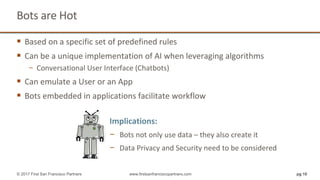
Bots are Hot
 Based on a specific set of predefined rules
 Can be a unique implementation of AI when leveraging algorithms
− Conversational User Interface (Chatbots)
 Can emulate a User or an App
 Bots embedded in applications facilitate workflow
pg 10© 2017 First San Francisco Partners www.firstsanfranciscopartners.com
Implications:
− Bots not only use data – they also create it
− Data Privacy and Security need to be considered
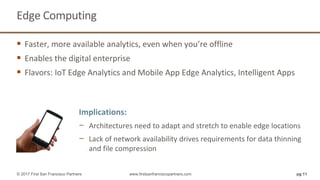
Edge Computing
 Faster, more available analytics, even when you’re offline
 Enables the digital enterprise
 Flavors: IoT Edge Analytics and Mobile App Edge Analytics, Intelligent Apps
pg 11© 2017 First San Francisco Partners www.firstsanfranciscopartners.com
Implications:
− Architectures need to adapt and stretch to enable edge locations
− Lack of network availability drives requirements for data thinning
and file compression
www.firstsanfranciscopartners.com
Differences in Big Data Analytics Architecture
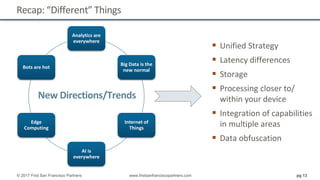
Recap: “Different” Things
pg 13© 2017 First San Francisco Partners www.firstsanfranciscopartners.com
Analytics are
everywhere
Big Data is the
new normal
Internet of
Things
AI is
everywhere
Edge
Computing
Bots are hot
 Unified Strategy
 Latency differences
 Storage
 Processing closer to/
within your device
 Integration of capabilities
in multiple areas
 Data obfuscation
New Directions/Trends
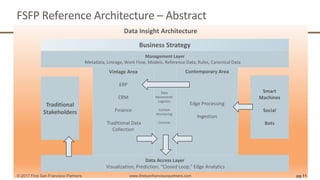
FSFP Reference Architecture – Abstract
Data Insight Architecture
pg 11© 2017 First San Francisco Partners www.firstsanfranciscopartners.com
1
Data
Movement/
Logistics
Context
Monitoring
Controls
Management Layer
Metadata, Lineage, Work Flow, Models, Reference Data, Rules, Canonical Data
Data Access Layer
Visualization, Prediction, “Closed Loop,” Edge Analytics
Vintage Area
ERP
CRM
Finance
Traditional Data
Collection
Contemporary Area
Edge Processing
Ingestion
Business Strategy
Smart
Machines
Social
Bots
Traditional
Stakeholders
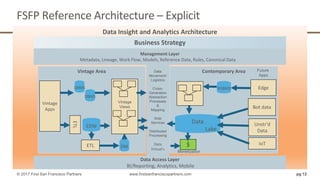
FSFP Reference Architecture – Explicit
Data Insight and Analytics Architecture
pg 12© 2017 First San Francisco Partners www.firstsanfranciscopartners.com
1
Data
movement /
logistics
Cross-
generation
Abstraction
Processes
&
Mapping
Vintage Area Contemporary Area
Business Strategy
Vintage
Views
DBMS
Future
Apps
Data
Movement/
Logistics
Cross-
Generation
Abstraction
Processes
&
Mapping
Web
Services
Distributed
Processing
Data
Virtual’n
$
Monetization
EDW
RDBMS
Bot data
Unstr’d
Data
Edge
Vintage
Apps
Management Layer
Metadata, Lineage, Work Flow, Models, Reference Data, Rules, Canonical Data
Data Access Layer
BI/Reporting, Analytics, Mobile
DBMS
ETL
ETL
Data
Lake
DM
IoT
www.firstsanfranciscopartners.com
New Tools for Leveraging More Data Types
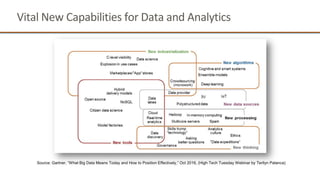
Vital New Capabilities for Data and Analytics
Source: Gartner, “What Big Data Means Today and How to Position Effectively,” Oct 2016, (High Tech Tuesday Webinar by Terilyn Palanca)
Key Take-Aways
 Analytics will be everywhere.
− Account for it in your architectures and your data
governance and management strategies.
 Take advantage of new technologies and service
providers to expand the use of sophisticated analytics.
 Recognize the skills gap that still exists across the Big
Data and AI spectrum and plan accordingly.
 Privacy will be increasingly important with computing
closer to the individual, including location data.
 “Data Freedom” will require insight enablers, not data
providers.
 Don’t rely on regulations to guide how you think you
should use your data.
pg 18© 2017 First San Francisco Partners www.firstsanfranciscopartners.com
Questions?
pg 19© 2017 First San Francisco Partners www.firstsanfranciscopartners.com
MONTHLY SERIES
Thank you for dialing in!
Please join us Thursday, Sep. 7 for the next webinar:
“Analytics, Business Intelligence and Data
Science: What's the Progression?”
Kelle O’Neal @kellezoneal
kelle@firstsanfranciscopartners.com

DI&A Webinar: Big Data Analytics

  • 1.
    The First Stepin Information Management www.firstsanfranciscopartners.com Produced by: MONTHLY SERIES Brought to you in partnership with: Aug. 3, 2017 Big Data Analytics
  • 2.
    Topics for Today’sAnalytics Webinar  New Directions & Trends in Big Data Analytics − Implications of New Directions  Differences in Big Data Analytics Architecture  New Tools for Leveraging More Data Types  Key Take-Aways  Q&A pg 2© 2017 First San Francisco Partners www.firstsanfranciscopartners.com
  • 3.
    Polling Question pg 3©2017 First San Francisco Partners www.firstsanfranciscopartners.com  What data types are you analyzing? − Row and column − Free-form text − Geospatial − Images − Audio − Video − All of the above
  • 4.
  • 5.
    Big Picture Trends pg5© 2017 First San Francisco Partners www.firstsanfranciscopartners.com We are getting better at Analytics We are still expensive Software and Hardware need to catch up
  • 6.
    Different Questions BeingAsked of Data  Evolving from what to when to why then how?  Prescriptive and Predictive Analytics are more commonly adopted  Graph Analytics shows relationships across multi-structured data (that are virtually impossible to see with structured data) pg 6© 2017 First San Francisco Partners www.firstsanfranciscopartners.com Implications: − Analytics are Everywhere − Real-time (Analytics)  Decreasing Latencies
  • 7.
    Big Data isthe New Normal  Big Data has changed the way we view technology and how we respond to innovations  “Big Data” vendors now supporting other types of data; and vice versa  Expanding Sources  Open Data  Algorithm Marketplaces  Crowdsourcing  Consideration of “dark data” pg 7© 2017 First San Francisco Partners www.firstsanfranciscopartners.com Implications: − Expanding Sources drive re-evaluation of data governance concerns − Driving to self-service Data Preparation and Data Catalogs that are truly business created and managed − Outsourcing: Do non-traditional data activity, Outsource “Mode 2”  Additional Concerns: IP protection, Regulatory, Governance, Accountability, etc.
  • 8.
    Internet of Things(IoT)  Key component of a digital business  More data, more complexity and more automation  Driving spin-off areas of investment like: − IIOT – Industrial Internet of Things − IoT Edge Analytics − Mobile App Edge Analytics − Event Stream Processing  Shift to a services-based model, not capital-based pg 8© 2017 First San Francisco Partners www.firstsanfranciscopartners.com Implications: − Will drive increased data integration requirements − Data Privacy and Security is still a big concern as the potential amount of sensitive data collected can be large
  • 9.
    Artificial Intelligence (AI)is Everywhere  Key component of digital business  Success is based on the data  Availability of data and computing power has fueled AI growth  Types: − Machine Learning − Deep Learning − Natural Language Processing and Generation, Conversational AI Platforms − Computer Vision pg 9© 2017 First San Francisco Partners www.firstsanfranciscopartners.com “AI is the new electricity.” - Andrew Ng Implications: − Be aware of how your data is used − Corroboration of Correlation − IT organizations are leveraging AI to better manage their operations and the growth of data
  • 10.
    Bots are Hot Based on a specific set of predefined rules  Can be a unique implementation of AI when leveraging algorithms − Conversational User Interface (Chatbots)  Can emulate a User or an App  Bots embedded in applications facilitate workflow pg 10© 2017 First San Francisco Partners www.firstsanfranciscopartners.com Implications: − Bots not only use data – they also create it − Data Privacy and Security need to be considered
  • 11.
    Edge Computing  Faster,more available analytics, even when you’re offline  Enables the digital enterprise  Flavors: IoT Edge Analytics and Mobile App Edge Analytics, Intelligent Apps pg 11© 2017 First San Francisco Partners www.firstsanfranciscopartners.com Implications: − Architectures need to adapt and stretch to enable edge locations − Lack of network availability drives requirements for data thinning and file compression
  • 12.
  • 13.
    Recap: “Different” Things pg13© 2017 First San Francisco Partners www.firstsanfranciscopartners.com Analytics are everywhere Big Data is the new normal Internet of Things AI is everywhere Edge Computing Bots are hot  Unified Strategy  Latency differences  Storage  Processing closer to/ within your device  Integration of capabilities in multiple areas  Data obfuscation New Directions/Trends
  • 14.
    FSFP Reference Architecture– Abstract Data Insight Architecture pg 11© 2017 First San Francisco Partners www.firstsanfranciscopartners.com 1 Data Movement/ Logistics Context Monitoring Controls Management Layer Metadata, Lineage, Work Flow, Models, Reference Data, Rules, Canonical Data Data Access Layer Visualization, Prediction, “Closed Loop,” Edge Analytics Vintage Area ERP CRM Finance Traditional Data Collection Contemporary Area Edge Processing Ingestion Business Strategy Smart Machines Social Bots Traditional Stakeholders
  • 15.
    FSFP Reference Architecture– Explicit Data Insight and Analytics Architecture pg 12© 2017 First San Francisco Partners www.firstsanfranciscopartners.com 1 Data movement / logistics Cross- generation Abstraction Processes & Mapping Vintage Area Contemporary Area Business Strategy Vintage Views DBMS Future Apps Data Movement/ Logistics Cross- Generation Abstraction Processes & Mapping Web Services Distributed Processing Data Virtual’n $ Monetization EDW RDBMS Bot data Unstr’d Data Edge Vintage Apps Management Layer Metadata, Lineage, Work Flow, Models, Reference Data, Rules, Canonical Data Data Access Layer BI/Reporting, Analytics, Mobile DBMS ETL ETL Data Lake DM IoT
  • 16.
  • 17.
    Vital New Capabilitiesfor Data and Analytics Source: Gartner, “What Big Data Means Today and How to Position Effectively,” Oct 2016, (High Tech Tuesday Webinar by Terilyn Palanca)
  • 18.
    Key Take-Aways  Analyticswill be everywhere. − Account for it in your architectures and your data governance and management strategies.  Take advantage of new technologies and service providers to expand the use of sophisticated analytics.  Recognize the skills gap that still exists across the Big Data and AI spectrum and plan accordingly.  Privacy will be increasingly important with computing closer to the individual, including location data.  “Data Freedom” will require insight enablers, not data providers.  Don’t rely on regulations to guide how you think you should use your data. pg 18© 2017 First San Francisco Partners www.firstsanfranciscopartners.com
  • 19.
    Questions? pg 19© 2017First San Francisco Partners www.firstsanfranciscopartners.com MONTHLY SERIES
  • 20.
    Thank you fordialing in! Please join us Thursday, Sep. 7 for the next webinar: “Analytics, Business Intelligence and Data Science: What's the Progression?” Kelle O’Neal @kellezoneal kelle@firstsanfranciscopartners.com