Building a Gigaword Corpus
Data Ingestion, Management, and Processing for NLP
Rebecca Bilbro
Data Intelligence 2017
● Me and my motivation
● Why make a custom corpus?
● Things likely to go wrong
○ Ingestion
○ Management
○ Loading
○ Preprocessing
○ Analysis
● Lessons we learned
● Open source tools we made
Rebecca Bilbro
Data Scientist
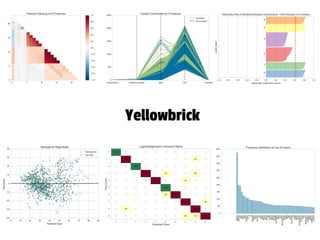
Yellowbrick
Natural language
processing
Everyone’s doing it
NLTK
So many great tools
The Natural Language Toolkit
import nltk
moby = nltk.text.Text(nltk.corpus.gutenberg.words('melville-moby_dick.txt'))
print(moby.similar("ahab"))
print(moby.common_contexts(["ahab", "starbuck"]))
print(moby.concordance("monstrous", 55, lines=10))
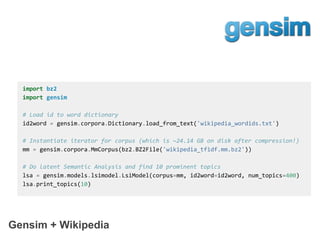
Gensim + Wikipedia
import bz2
import gensim
# Load id to word dictionary
id2word = gensim.corpora.Dictionary.load_from_text('wikipedia_wordids.txt')
# Instantiate iterator for corpus (which is ~24.14 GB on disk after compression!)
mm = gensim.corpora.MmCorpus(bz2.BZ2File('wikipedia_tfidf.mm.bz2'))
# Do latent Semantic Analysis and find 10 prominent topics
lsa = gensim.models.lsimodel.LsiModel(corpus=mm, id2word=id2word, num_topics=400)
lsa.print_topics(10)
Case Study:
Predicting Political Orientation
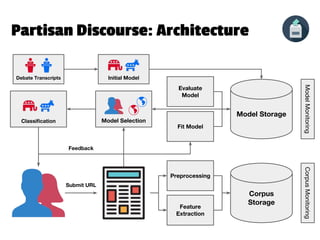
Partisan Discourse: Architecture
Initial ModelDebate Transcripts
Submit URL
Preprocessing
Feature
Extraction
Evaluate
Model
Fit Model
Model Storage
ModelMonitoring
Corpus
Storage
CorpusMonitoring
Classification
Feedback
Model Selection
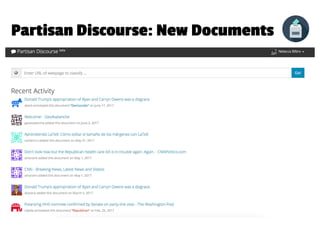
Partisan Discourse: New Documents
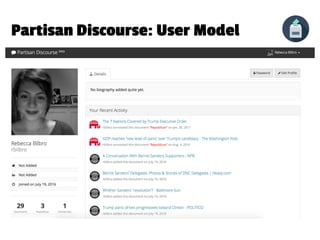
Partisan Discourse: User Model
A custom corpus
RSS
import os
import requests
import feedparser
feed = "http://feeds.washingtonpost.com/rss/national"
for entry in feedparser.parse(feed)['entries']:
r = requests.get(entry['link'])
path = entry['title'].lower().replace(" ", "-") + ".html"
with open(path, 'wb') as f:
f.write(r.content)
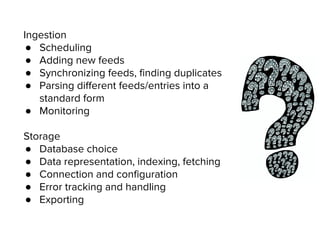
Ingestion
● Scheduling
● Adding new feeds
● Synchronizing feeds, finding duplicates
● Parsing different feeds/entries into a
standard form
● Monitoring
Storage
● Database choice
● Data representation, indexing, fetching
● Connection and configuration
● Error tracking and handling
● Exporting
And as the corpus began
to grow …
… new questions arose about costs
(storage, time) and surprising results
(videos?).
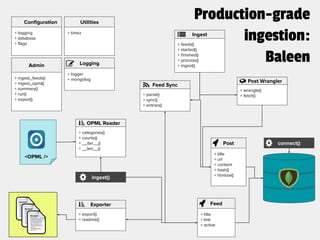
Post
+ title
+ url
+ content
+ hash()
+ htmlize()
Feed
+ title
+ link
+ active
OPML Reader
+ categories()
+ counts()
+ __iter__()
+ __len__()
ingest()
Configuration
+ logging
+ database
+ flags
Exporter
+ export()
+ readme()
Admin
+ ingest_feeds()
+ ingest_opml()
+ summary()
+ run()
+ export()
Utilities
+ timez
Logging
+ logger
+ mongolog
Ingest
+ feeds()
+ started()
+ finished()
+ process()
+ ingest()
Feed Sync
+ parse()
+ sync()
+ entries()
Post Wrangler
+ wrangle()
+ fetch()
connect()
<OPML />
Production-grade
ingestion:
Baleen
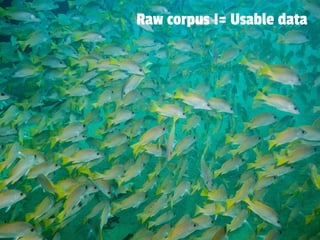
Raw corpus != Usable data
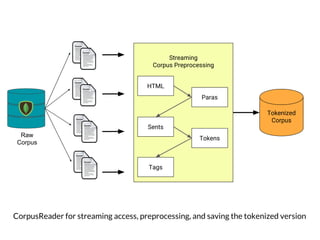
From each doc, extract html, identify paras/sents/words, tag with part-of-speech
Raw Corpus
HTML
corpus = [(‘How’, ’WRB’),
(‘long’, ‘RB’),
(‘will’, ‘MD’),
(‘this’, ‘DT’),
(‘go’, ‘VB’),
(‘on’, ‘IN’),
(‘?’, ‘.’),
...
]
Paras
Sents
Tokens
Tags
Streaming
Corpus Preprocessing
Tokenized
Corpus
CorpusReader for streaming access, preprocessing, and saving the tokenized version
HTML
Paras
Sents
Tokens
Tags
Raw
Corpus
Vectorization
...so many features
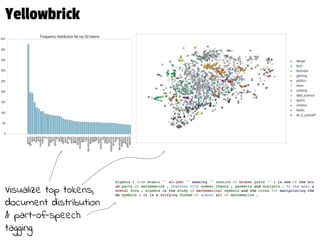
Visualize top tokens,
document distribution
& part-of-speech
tagging
Yellowbrick
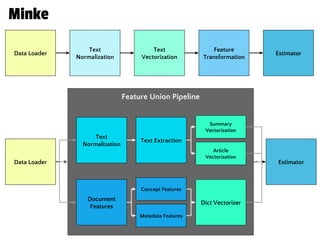
Data Loader
Text
Normalization
Text
Vectorization
Feature
Transformation
Estimator
Data Loader
Feature Union Pipeline
Estimator
Text
Normalization
Document
Features
Text Extraction
Summary
Vectorization
Article
Vectorization
Concept Features
Metadata Features
Dict Vectorizer
Minke
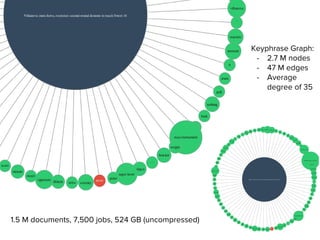
Dynamic graph
analysis
1.5 M documents, 7,500 jobs, 524 GB (uncompressed)
Keyphrase Graph:
- 2.7 M nodes
- 47 M edges
- Average
degree of 35
Lessons learned
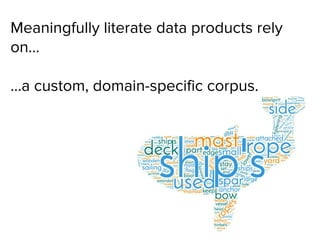
Meaningfully literate data products rely
on…
...a custom, domain-specific corpus.
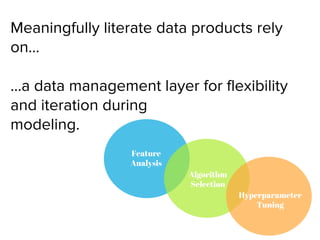
Meaningfully literate data products rely
on…
...a data management layer for flexibility
and iteration during
modeling.
Feature
Analysis
Algorithm
Selection
Hyperparameter
Tuning
corpus
├── citation.bib
├── feeds.json
├── LICENSE.md
├── manifest.json
├── README.md
└── books
├── 56d629e7c1808113ffb87eaf.html
├── 56d629e7c1808113ffb87eb3.html
└── 56d629ebc1808113ffb87ed0.html
└── business
├── 56d625d5c1808113ffb87730.html
├── 56d625d6c1808113ffb87736.html
└── 56d625ddc1808113ffb87752.html
└── cinema
├── 56d629b5c1808113ffb87d8f.html
├── 56d629b5c1808113ffb87d93.html
└── 56d629b6c1808113ffb87d9a.html
└── cooking
├── 56d62af2c1808113ffb880ec.html
├── 56d62af2c1808113ffb880ee.html
└── 56d62af2c1808113ffb880fa.html
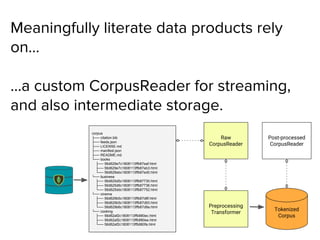
Preprocessing
Transformer
Raw
CorpusReader
Tokenized
Corpus
Post-processed
CorpusReader
Meaningfully literate data products rely
on…
...a custom CorpusReader for streaming,
and also intermediate storage.
Meaningfully literate data products rely
on…
...visual steering and
graph analysis for
interpretation.
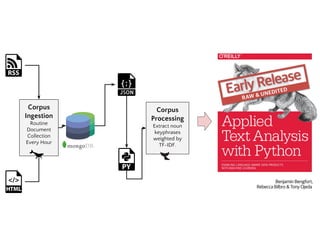
Corpus
Processing
Extract noun
keyphrases
weighted by
TF-IDF.
Corpus
Ingestion
Routine
Document
Collection
Every Hour
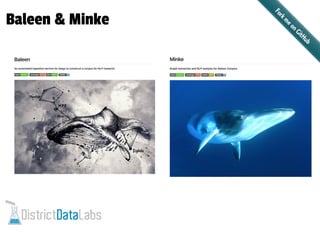
Baleen & Minke
Yellowbrick
Thank you!
Rebecca Bilbro
Twitter: twitter.com/rebeccabilbro
Github: github.com/rebeccabilbro
Email: rebecca.bilbro@bytecubed.com

Data Intelligence 2017 - Building a Gigaword Corpus

  • 1.
    Building a GigawordCorpus Data Ingestion, Management, and Processing for NLP Rebecca Bilbro Data Intelligence 2017
  • 2.
    ● Me andmy motivation ● Why make a custom corpus? ● Things likely to go wrong ○ Ingestion ○ Management ○ Loading ○ Preprocessing ○ Analysis ● Lessons we learned ● Open source tools we made
  • 3.
  • 4.
  • 6.
  • 7.
  • 8.
    The Natural LanguageToolkit import nltk moby = nltk.text.Text(nltk.corpus.gutenberg.words('melville-moby_dick.txt')) print(moby.similar("ahab")) print(moby.common_contexts(["ahab", "starbuck"])) print(moby.concordance("monstrous", 55, lines=10))
  • 9.
    Gensim + Wikipedia importbz2 import gensim # Load id to word dictionary id2word = gensim.corpora.Dictionary.load_from_text('wikipedia_wordids.txt') # Instantiate iterator for corpus (which is ~24.14 GB on disk after compression!) mm = gensim.corpora.MmCorpus(bz2.BZ2File('wikipedia_tfidf.mm.bz2')) # Do latent Semantic Analysis and find 10 prominent topics lsa = gensim.models.lsimodel.LsiModel(corpus=mm, id2word=id2word, num_topics=400) lsa.print_topics(10)
  • 10.
  • 11.
    Partisan Discourse: Architecture InitialModelDebate Transcripts Submit URL Preprocessing Feature Extraction Evaluate Model Fit Model Model Storage ModelMonitoring Corpus Storage CorpusMonitoring Classification Feedback Model Selection
  • 12.
  • 13.
  • 14.
  • 15.
    RSS import os import requests importfeedparser feed = "http://feeds.washingtonpost.com/rss/national" for entry in feedparser.parse(feed)['entries']: r = requests.get(entry['link']) path = entry['title'].lower().replace(" ", "-") + ".html" with open(path, 'wb') as f: f.write(r.content)
  • 16.
    Ingestion ● Scheduling ● Addingnew feeds ● Synchronizing feeds, finding duplicates ● Parsing different feeds/entries into a standard form ● Monitoring Storage ● Database choice ● Data representation, indexing, fetching ● Connection and configuration ● Error tracking and handling ● Exporting
  • 17.
    And as thecorpus began to grow … … new questions arose about costs (storage, time) and surprising results (videos?).
  • 18.
    Post + title + url +content + hash() + htmlize() Feed + title + link + active OPML Reader + categories() + counts() + __iter__() + __len__() ingest() Configuration + logging + database + flags Exporter + export() + readme() Admin + ingest_feeds() + ingest_opml() + summary() + run() + export() Utilities + timez Logging + logger + mongolog Ingest + feeds() + started() + finished() + process() + ingest() Feed Sync + parse() + sync() + entries() Post Wrangler + wrangle() + fetch() connect() <OPML /> Production-grade ingestion: Baleen
  • 19.
    Raw corpus !=Usable data
  • 20.
    From each doc,extract html, identify paras/sents/words, tag with part-of-speech Raw Corpus HTML corpus = [(‘How’, ’WRB’), (‘long’, ‘RB’), (‘will’, ‘MD’), (‘this’, ‘DT’), (‘go’, ‘VB’), (‘on’, ‘IN’), (‘?’, ‘.’), ... ] Paras Sents Tokens Tags
  • 21.
    Streaming Corpus Preprocessing Tokenized Corpus CorpusReader forstreaming access, preprocessing, and saving the tokenized version HTML Paras Sents Tokens Tags Raw Corpus
  • 22.
  • 23.
    Visualize top tokens, documentdistribution & part-of-speech tagging Yellowbrick
  • 24.
    Data Loader Text Normalization Text Vectorization Feature Transformation Estimator Data Loader FeatureUnion Pipeline Estimator Text Normalization Document Features Text Extraction Summary Vectorization Article Vectorization Concept Features Metadata Features Dict Vectorizer Minke
  • 25.
  • 26.
    1.5 M documents,7,500 jobs, 524 GB (uncompressed) Keyphrase Graph: - 2.7 M nodes - 47 M edges - Average degree of 35
  • 27.
  • 28.
    Meaningfully literate dataproducts rely on… ...a custom, domain-specific corpus.
  • 29.
    Meaningfully literate dataproducts rely on… ...a data management layer for flexibility and iteration during modeling. Feature Analysis Algorithm Selection Hyperparameter Tuning
  • 30.
    corpus ├── citation.bib ├── feeds.json ├──LICENSE.md ├── manifest.json ├── README.md └── books ├── 56d629e7c1808113ffb87eaf.html ├── 56d629e7c1808113ffb87eb3.html └── 56d629ebc1808113ffb87ed0.html └── business ├── 56d625d5c1808113ffb87730.html ├── 56d625d6c1808113ffb87736.html └── 56d625ddc1808113ffb87752.html └── cinema ├── 56d629b5c1808113ffb87d8f.html ├── 56d629b5c1808113ffb87d93.html └── 56d629b6c1808113ffb87d9a.html └── cooking ├── 56d62af2c1808113ffb880ec.html ├── 56d62af2c1808113ffb880ee.html └── 56d62af2c1808113ffb880fa.html Preprocessing Transformer Raw CorpusReader Tokenized Corpus Post-processed CorpusReader Meaningfully literate data products rely on… ...a custom CorpusReader for streaming, and also intermediate storage.
  • 31.
    Meaningfully literate dataproducts rely on… ...visual steering and graph analysis for interpretation.
  • 32.
  • 33.
  • 34.
  • 35.
    Thank you! Rebecca Bilbro Twitter:twitter.com/rebeccabilbro Github: github.com/rebeccabilbro Email: rebecca.bilbro@bytecubed.com