Data Driven Risk
Assessment
Hello!
I am Joe Crampton
VP Product at Resolver
@JoeCrampton
joe@resolver.com
Session Objective
Understand how data can be mapped to risk events to
drive improved assessment accuracy.
Why does this matter?
Every organization faces more risks than they have budget to
address. How do you choose which ones? Have you done
enough?
A Quick Review of Qualitative
Risk Assessment
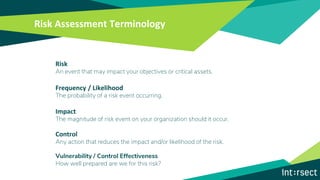
Risk Assessment Terminology
Frequency / Likelihood
The probability of a risk event occurring.
Impact
The magnitude of risk event on your organization should it occur.
Control
Any action that reduces the impact and/or likelihood of the risk.
Risk
An event that may impact your objectives or critical assets.
Vulnerability / Control Effectiveness
How well prepared are we for this risk?
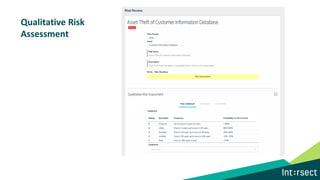
Qualitative Risk Assessment
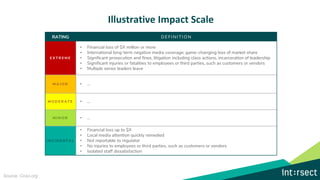
Illustrative Impact Scale
RATING DEFINI TI ON
E X T R E M E
• Financial loss of $X million or more
• International long-term negative media coverage; game-changing loss of market share
• Significant prosecution and fines, litigation including class actions, incarceration of leadership
• Significant injuries or fatalities to employees or third parties, such as customers or vendors
• Multiple senior leaders leave
M A J O R • …
M O D E R A T E • …
M I N O R • …
I N C I D E N T A L
• Financial loss up to $X
• Local media attention quickly remedied
• Not reportable to regulator
• No injuries to employees or third parties, such as customers or vendors
• Isolated staff dissatisfaction
Source: Coso.org
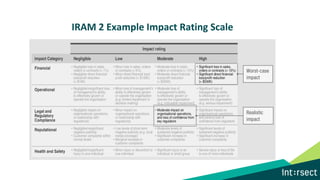
IRAM 2 Example Impact Rating Scale
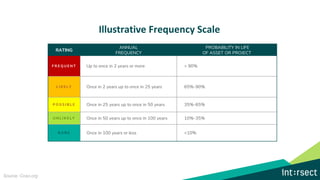
Illustrative Frequency Scale
RATING
ANNUAL
FREQUENCY
PROBABILITY IN LIFE
OF ASSET OR PROJECT
F R E Q U E N T Up to once in 2 years or more > 90%
L I K E L Y Once in 2 years up to once in 25 years 65%-90%
P O S S I B L E Once in 25 years up to once in 50 years 35%-65%
U N L I K E L Y Once in 50 years up to once in 100 years 10%-35%
R A R E Once in 100 years or less <10%
Source: Coso.org
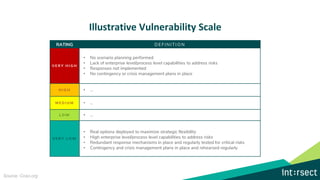
Illustrative Vulnerability Scale
RATING DEFINI TI O N
V E R Y H I G H
• No scenario planning performed
• Lack of enterprise level/process level capabilities to address risks
• Responses not implemented
• No contingency or crisis management plans in place
H I G H • …
M E D I U M • …
L O W • …
V E R Y L O W
• Real options deployed to maximize strategic flexibility
• High enterprise level/process level capabilities to address risks
• Redundant response mechanisms in place and regularly tested for critical risks
• Contingency and crisis management plans in place and rehearsed regularly
Source: Coso.org
An example scenario
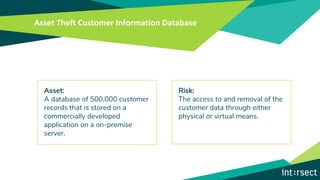
Asset Theft Customer Information Database
Asset:
A database of 500,000 customer
records that is stored on a
commercially developed
application on a on-premise
server.
Risk:
The access to and removal of the
customer data through either
physical or virtual means.
Qualitative Risk
Assessment
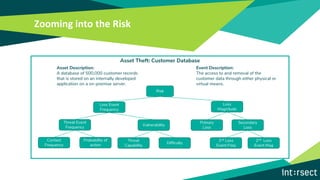
Zooming into the Risk
Asset Theft: Customer Database
Risk
Loss Event
Frequency
Loss
Magnitude
Asset Description:
A database of 500,000 customer records
that is stored on an internally developed
application on a on-premise server.
Event Description:
The access to and removal of the
customer data through either physical or
virtual means.
Threat Event
Frequency
Vulnerability
Contact
Frequency
Probability of
action
Difficulty
Threat
Capability
Primary
Loss
Secondary
Loss
2nd Loss
Event Freq
2nd Loss
Event Mag
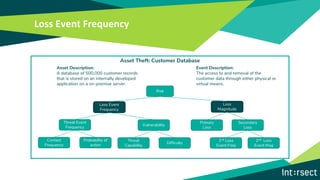
Loss Event Frequency
Asset Theft: Customer Database
Risk
Loss Event
Frequency
Loss
Magnitude
Threat Event
Frequency
Vulnerability
Contact
Frequency
Probability of
action
Difficulty
Threat
Capability
Primary
Loss
Secondary
Loss
2nd Loss
Event Freq
2nd Loss
Event Mag
Asset Description:
A database of 500,000 customer records
that is stored on an internally developed
application on a on-premise server.
Event Description:
The access to and removal of the
customer data through either physical or
virtual means.
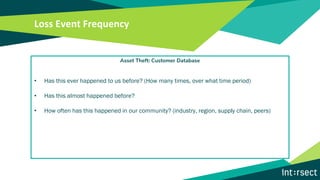
Loss Event Frequency
Asset Theft: Customer Database
• Has this ever happened to us before? (How many times, over what time period)
• Has this almost happened before?
• How often has this happened in our community? (industry, region, supply chain, peers)
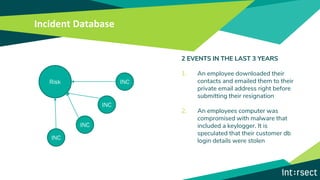
Incident Database
2 EVENTS IN THE LAST 3 YEARS
1. An employee downloaded their
contacts and emailed them to their
private email address right before
submitting their resignation
2. An employees computer was
compromised with malware that
included a keylogger. It is
speculated that their customer db
login details were stolen
INC
INC
INC
INC
Risk
Core Demo
with Incidents Tied to Risks
If we have this data
we can estimate it directly.
If not, we need to go deeper.
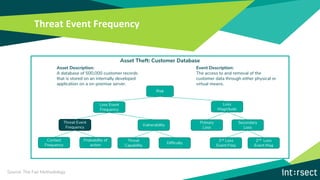
Threat Event Frequency
Asset Theft: Customer Database
Risk
Loss Event
Frequency
Loss
Magnitude
Threat Event
Frequency
Vulnerability
Contact
Frequency
Probability of
action
Difficulty
Threat
Capability
Primary
Loss
Secondary
Loss
2nd Loss
Event Freq
2nd Loss
Event Mag
Source: The Fair Methodology
Asset Description:
A database of 500,000 customer records
that is stored on an internally developed
application on a on-premise server.
Event Description:
The access to and removal of the
customer data through either physical or
virtual means.
Threat vs. Loss
Threat vs Loss
THREAT LOSS
Threat vs Loss
THREAT LOSS
Threat vs Loss
THREAT LOSS
Threat vs Loss
THREAT LOSS
Threat Event Frequency
Asset Theft: Customer Database
• What threats have the potential of triggering this loss event?
• What is the threat community? (Who or what can perpetrate this threat)?
• How likely is that actor to act? (Probability of Action)
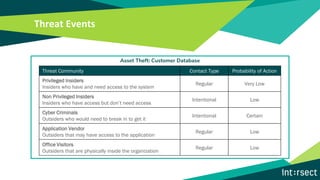
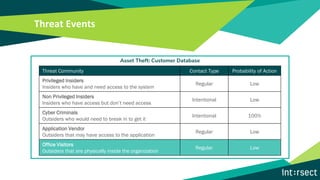
Threat Events
Asset Theft: Customer Database
Threat Community Contact Type Probability of Action
Privileged Insiders
Insiders who have and need access to the system
Regular Very Low
Non Privileged Insiders
Insiders who have access but don’t need access
Intentional Low
Cyber Criminals
Outsiders who would need to break in to get it
Intentional Certain
Application Vendor
Outsiders that may have access to the application
Regular Low
Office Visitors
Outsiders that are physically inside the organization
Regular Low
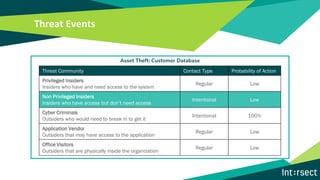
Threat Events
Asset Theft: Customer Database
Threat Community Contact Type Probability of Action
Privileged Insiders
Insiders who have and need access to the system
Regular Low
Non Privileged Insiders
Insiders who have access but don’t need access
Intentional Low
Cyber Criminals
Outsiders who would need to break in to get it
Intentional 100%
Application Vendor
Outsiders that may have access to the application
Regular Low
Office Visitors
Outsiders that are physically inside the organization
Regular Low
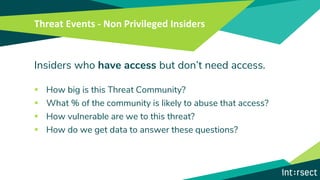
Threat Events - Non Privileged Insiders
Insiders who have access but don’t need access.
▪ How big is this Threat Community?
▪ What % of the community is likely to abuse that access?
▪ How vulnerable are we to this threat?
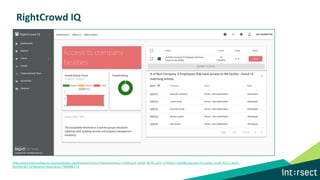
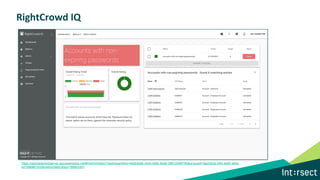
▪ How do we get data to answer these questions?
Core Demo
with RightCrowd IQ
RightCrowd IQ
https://reporiademo2server.azurewebsites.net/#/metricHistory?dashboardKey=7b06cac6-3e08-4070-a2f2-e7f43b113fe9&uniqueId=21cae8ac-eee8-4272-8a91-
00c64e367165&metricHistoryKey=788886274
RightCrowd IQ
https://reporiademo2server.azurewebsites.net/#/metricHistory?dashboardKey=0edb2e9b-c6c6-408c-8ba8-388120d4f78b&uniqueId=9a2cfb2e-bfbf-4a95-a89e-
e279968812c2&metricHistoryKey=788903301
Threat Events
Asset Theft: Customer Database
Threat Community Contact Type Probability of Action
Privileged Insiders
Insiders who have and need access to the system
Regular Low
Non Privileged Insiders
Insiders who have access but don’t need access
Intentional Low
Cyber Criminals
Outsiders who would need to break in to get it
Intentional 100%
Application Vendor
Outsiders that may have access to the application
Regular Low
Office Visitors
Outsiders that are physically inside the organization
Regular Low
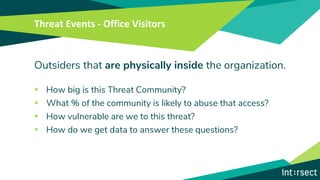
Threat Events - Office Visitors
Outsiders that are physically inside the organization.
▪ How big is this Threat Community?
▪ What % of the community is likely to abuse that access?
▪ How vulnerable are we to this threat?
▪ How do we get data to answer these questions?
Vendor Assessments
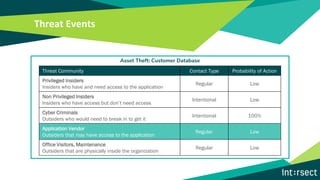
Threat Events
Asset Theft: Customer Database
Threat Community Contact Type Probability of Action
Privileged Insiders
Insiders who have and need access to the application
Regular Low
Non Privileged Insiders
Insiders who have access but don’t need access
Intentional Low
Cyber Criminals
Outsiders who would need to break in to get it
Intentional 100%
Application Vendor
Outsiders that may have access to the application
Regular Low
Office Visitors, Maintenance
Outsiders that are physically inside the organization
Regular Low
Threat Events - Application Vendor
Outsiders that may have access to the application
▪ How big is this Threat Community?
▪ What % of the community is likely to abuse that access?
▪ How vulnerable are we to this threat?
▪ How do we get data to answer these questions?
Site Risk Assessment
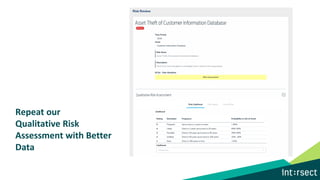
Repeat our
Qualitative Risk
Assessment with Better
Data
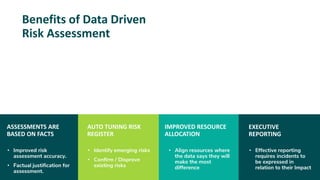
Benefits of Data Driven
Risk Assessment
ASSESSMENTS ARE
BASED ON FACTS
• Improved risk
assessment accuracy.
• Factual justification for
assessment.
AUTO TUNING RISK
REGISTER
• Identify emerging risks
• Confirm / Disprove
existing risks
IMPROVED RESOURCE
ALLOCATION
• Align resources where
the data says they will
make the most
difference
EXECUTIVE
REPORTING
• Effective reporting
requires incidents to
be expressed in
relation to their Impact
Thanks!
Any questions?
@JoeCrampton
joe@resolver.com

Data Driven Risk Assessment

  • 1.
  • 3.
    Hello! I am JoeCrampton VP Product at Resolver @JoeCrampton joe@resolver.com
  • 4.
    Session Objective Understand howdata can be mapped to risk events to drive improved assessment accuracy. Why does this matter? Every organization faces more risks than they have budget to address. How do you choose which ones? Have you done enough?
  • 5.
    A Quick Reviewof Qualitative Risk Assessment
  • 6.
    Risk Assessment Terminology Frequency/ Likelihood The probability of a risk event occurring. Impact The magnitude of risk event on your organization should it occur. Control Any action that reduces the impact and/or likelihood of the risk. Risk An event that may impact your objectives or critical assets. Vulnerability / Control Effectiveness How well prepared are we for this risk?
  • 7.
  • 8.
    Illustrative Impact Scale RATINGDEFINI TI ON E X T R E M E • Financial loss of $X million or more • International long-term negative media coverage; game-changing loss of market share • Significant prosecution and fines, litigation including class actions, incarceration of leadership • Significant injuries or fatalities to employees or third parties, such as customers or vendors • Multiple senior leaders leave M A J O R • … M O D E R A T E • … M I N O R • … I N C I D E N T A L • Financial loss up to $X • Local media attention quickly remedied • Not reportable to regulator • No injuries to employees or third parties, such as customers or vendors • Isolated staff dissatisfaction Source: Coso.org
  • 9.
    IRAM 2 ExampleImpact Rating Scale
  • 10.
    Illustrative Frequency Scale RATING ANNUAL FREQUENCY PROBABILITYIN LIFE OF ASSET OR PROJECT F R E Q U E N T Up to once in 2 years or more > 90% L I K E L Y Once in 2 years up to once in 25 years 65%-90% P O S S I B L E Once in 25 years up to once in 50 years 35%-65% U N L I K E L Y Once in 50 years up to once in 100 years 10%-35% R A R E Once in 100 years or less <10% Source: Coso.org
  • 11.
    Illustrative Vulnerability Scale RATINGDEFINI TI O N V E R Y H I G H • No scenario planning performed • Lack of enterprise level/process level capabilities to address risks • Responses not implemented • No contingency or crisis management plans in place H I G H • … M E D I U M • … L O W • … V E R Y L O W • Real options deployed to maximize strategic flexibility • High enterprise level/process level capabilities to address risks • Redundant response mechanisms in place and regularly tested for critical risks • Contingency and crisis management plans in place and rehearsed regularly Source: Coso.org
  • 12.
  • 13.
    Asset Theft CustomerInformation Database Asset: A database of 500,000 customer records that is stored on a commercially developed application on a on-premise server. Risk: The access to and removal of the customer data through either physical or virtual means.
  • 14.
  • 15.
    Zooming into theRisk Asset Theft: Customer Database Risk Loss Event Frequency Loss Magnitude Asset Description: A database of 500,000 customer records that is stored on an internally developed application on a on-premise server. Event Description: The access to and removal of the customer data through either physical or virtual means. Threat Event Frequency Vulnerability Contact Frequency Probability of action Difficulty Threat Capability Primary Loss Secondary Loss 2nd Loss Event Freq 2nd Loss Event Mag
  • 16.
    Loss Event Frequency AssetTheft: Customer Database Risk Loss Event Frequency Loss Magnitude Threat Event Frequency Vulnerability Contact Frequency Probability of action Difficulty Threat Capability Primary Loss Secondary Loss 2nd Loss Event Freq 2nd Loss Event Mag Asset Description: A database of 500,000 customer records that is stored on an internally developed application on a on-premise server. Event Description: The access to and removal of the customer data through either physical or virtual means.
  • 17.
    Loss Event Frequency AssetTheft: Customer Database • Has this ever happened to us before? (How many times, over what time period) • Has this almost happened before? • How often has this happened in our community? (industry, region, supply chain, peers)
  • 18.
    Incident Database 2 EVENTSIN THE LAST 3 YEARS 1. An employee downloaded their contacts and emailed them to their private email address right before submitting their resignation 2. An employees computer was compromised with malware that included a keylogger. It is speculated that their customer db login details were stolen INC INC INC INC Risk
  • 19.
  • 20.
    If we havethis data we can estimate it directly. If not, we need to go deeper.
  • 21.
    Threat Event Frequency AssetTheft: Customer Database Risk Loss Event Frequency Loss Magnitude Threat Event Frequency Vulnerability Contact Frequency Probability of action Difficulty Threat Capability Primary Loss Secondary Loss 2nd Loss Event Freq 2nd Loss Event Mag Source: The Fair Methodology Asset Description: A database of 500,000 customer records that is stored on an internally developed application on a on-premise server. Event Description: The access to and removal of the customer data through either physical or virtual means.
  • 22.
  • 23.
  • 24.
  • 25.
  • 26.
  • 27.
    Threat Event Frequency AssetTheft: Customer Database • What threats have the potential of triggering this loss event? • What is the threat community? (Who or what can perpetrate this threat)? • How likely is that actor to act? (Probability of Action)
  • 28.
    Threat Events Asset Theft:Customer Database Threat Community Contact Type Probability of Action Privileged Insiders Insiders who have and need access to the system Regular Very Low Non Privileged Insiders Insiders who have access but don’t need access Intentional Low Cyber Criminals Outsiders who would need to break in to get it Intentional Certain Application Vendor Outsiders that may have access to the application Regular Low Office Visitors Outsiders that are physically inside the organization Regular Low
  • 29.
    Threat Events Asset Theft:Customer Database Threat Community Contact Type Probability of Action Privileged Insiders Insiders who have and need access to the system Regular Low Non Privileged Insiders Insiders who have access but don’t need access Intentional Low Cyber Criminals Outsiders who would need to break in to get it Intentional 100% Application Vendor Outsiders that may have access to the application Regular Low Office Visitors Outsiders that are physically inside the organization Regular Low
  • 30.
    Threat Events -Non Privileged Insiders Insiders who have access but don’t need access. ▪ How big is this Threat Community? ▪ What % of the community is likely to abuse that access? ▪ How vulnerable are we to this threat? ▪ How do we get data to answer these questions?
  • 31.
  • 32.
  • 33.
  • 34.
    Threat Events Asset Theft:Customer Database Threat Community Contact Type Probability of Action Privileged Insiders Insiders who have and need access to the system Regular Low Non Privileged Insiders Insiders who have access but don’t need access Intentional Low Cyber Criminals Outsiders who would need to break in to get it Intentional 100% Application Vendor Outsiders that may have access to the application Regular Low Office Visitors Outsiders that are physically inside the organization Regular Low
  • 35.
    Threat Events -Office Visitors Outsiders that are physically inside the organization. ▪ How big is this Threat Community? ▪ What % of the community is likely to abuse that access? ▪ How vulnerable are we to this threat? ▪ How do we get data to answer these questions?
  • 36.
  • 37.
    Threat Events Asset Theft:Customer Database Threat Community Contact Type Probability of Action Privileged Insiders Insiders who have and need access to the application Regular Low Non Privileged Insiders Insiders who have access but don’t need access Intentional Low Cyber Criminals Outsiders who would need to break in to get it Intentional 100% Application Vendor Outsiders that may have access to the application Regular Low Office Visitors, Maintenance Outsiders that are physically inside the organization Regular Low
  • 38.
    Threat Events -Application Vendor Outsiders that may have access to the application ▪ How big is this Threat Community? ▪ What % of the community is likely to abuse that access? ▪ How vulnerable are we to this threat? ▪ How do we get data to answer these questions?
  • 39.
  • 40.
  • 41.
    Benefits of DataDriven Risk Assessment ASSESSMENTS ARE BASED ON FACTS • Improved risk assessment accuracy. • Factual justification for assessment. AUTO TUNING RISK REGISTER • Identify emerging risks • Confirm / Disprove existing risks IMPROVED RESOURCE ALLOCATION • Align resources where the data says they will make the most difference EXECUTIVE REPORTING • Effective reporting requires incidents to be expressed in relation to their Impact
  • 42.