TIER STANDARDS IN DATA
CENTER, ARE YOU SURE ABOUT
THEIR DIFFERENCES?
B Y : V A I S H N A V I K U L K A R N I
E S D S S O F T W A R E S O L U T I O N S P V T. L T D .
INTRODUCTION
• We are already steering towards change with digital
evolution all over and with this we can be
manipulated easily with number of services all over
claiming to be best.
• Tier level certifications for Datacenters are one
such thing. Basically Tier defines the levels of
availability of data from the DC to the requested
location.
• Availability is defined by the level of tiers, higher is
better.
• Tier standards falls under TIA and
Uptime institute LLC.
• The goal of Tier standards is
nothing but the standardized
approaches for defining uptime
and data security of the data
centers
But What is difference between these
Tier levels?
INTRODUCTION
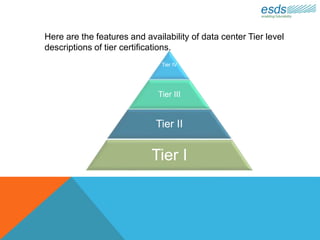
Here are the features and availability of data center Tier level
descriptions of tier certifications.
Tier IV
Tier III
Tier II
Tier I
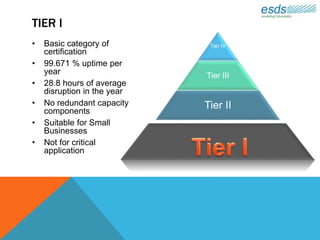
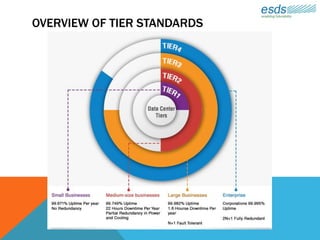
TIER I
• Basic category of
certification
• 99.671 % uptime per
year
• 28.8 hours of average
disruption in the year
• No redundant capacity
components
• Suitable for Small
Businesses
• Not for critical
application
Tier IV
Tier III
Tier II
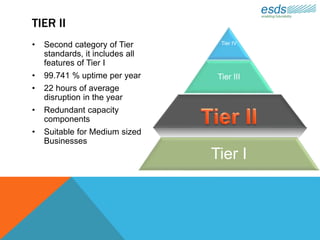
TIER II
• Second category of Tier
standards, it includes all
features of Tier I
• 99.741 % uptime per year
• 22 hours of average
disruption in the year
• Redundant capacity
components
• Suitable for Medium sized
Businesses
Tier IV
Tier III
Tier I
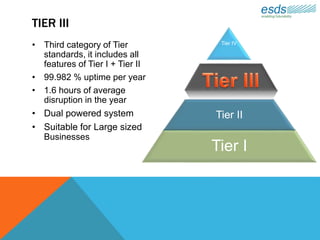
TIER III
• Third category of Tier
standards, it includes all
features of Tier I + Tier II
• 99.982 % uptime per year
• 1.6 hours of average
disruption in the year
• Dual powered system
• Suitable for Large sized
Businesses
Tier IV
Tier I
Tier II
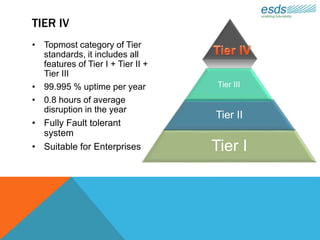
TIER IV
• Topmost category of Tier
standards, it includes all
features of Tier I + Tier II +
Tier III
• 99.995 % uptime per year
• 0.8 hours of average
disruption in the year
• Fully Fault tolerant
system
• Suitable for Enterprises Tier I
Tier II
Tier III
MYTHS ABOUT TIER III
• DC providing 99.982% does not necessarily
means Tier III certified Data center
• Tier III has no single points-of-failure
• Fault tolerance of Tier III is higher than Tier
II
• A Tier rating is aggregate (Tier III.5, Tier
III+)
• Tier mandate location, security and
operations
WHEN CAN BE RIGHT TIME TO CHOOSE TIER III?
• When the data to be stored is sensitive and
requires secure hosting.
• Need of mission critical businesses or high priority
operations that are proportionally related with
financial aspects and may lead to losses if there
are disruptions in power.
TIER III OR TIER IV ?
• This is one of the common confusion, this makes
providers a reason to present their services as
best.
• Tier III and IV are not just data center centric but
they are complete infrastructure centric.
• Logically speaking tier IV is the best of all but it’s
not at all logical always to invest heavy costs in it
when we have a reasonable option available.
• Tier III provides with maximum required features in
lower costs
OVERVIEW OF TIER STANDARDS
CONCLUSION
• Maximum the tier level minimum the downtime is the basic theory behind.
Complexities, performance, CAPEX and OPEX increase with each tier level.
• Depending on the business size, budgets and requirement, it is logical to
choose suitable certified Data Center.
• In case of any further doubts feel free to contact relationship@esds.co.in
SOURCE
Read complete
information on
https://goo.gl/42Md1l
We would be glad to hear from
you about your views !
!
Contact us @ www.esds.co.in
Connect with us:

Tier standards in data center, are you sure about their differences?

  • 1.
    TIER STANDARDS INDATA CENTER, ARE YOU SURE ABOUT THEIR DIFFERENCES? B Y : V A I S H N A V I K U L K A R N I E S D S S O F T W A R E S O L U T I O N S P V T. L T D .
  • 2.
    INTRODUCTION • We arealready steering towards change with digital evolution all over and with this we can be manipulated easily with number of services all over claiming to be best. • Tier level certifications for Datacenters are one such thing. Basically Tier defines the levels of availability of data from the DC to the requested location. • Availability is defined by the level of tiers, higher is better.
  • 3.
    • Tier standardsfalls under TIA and Uptime institute LLC. • The goal of Tier standards is nothing but the standardized approaches for defining uptime and data security of the data centers But What is difference between these Tier levels? INTRODUCTION
  • 4.
    Here are thefeatures and availability of data center Tier level descriptions of tier certifications. Tier IV Tier III Tier II Tier I
  • 5.
    TIER I • Basiccategory of certification • 99.671 % uptime per year • 28.8 hours of average disruption in the year • No redundant capacity components • Suitable for Small Businesses • Not for critical application Tier IV Tier III Tier II
  • 6.
    TIER II • Secondcategory of Tier standards, it includes all features of Tier I • 99.741 % uptime per year • 22 hours of average disruption in the year • Redundant capacity components • Suitable for Medium sized Businesses Tier IV Tier III Tier I
  • 7.
    TIER III • Thirdcategory of Tier standards, it includes all features of Tier I + Tier II • 99.982 % uptime per year • 1.6 hours of average disruption in the year • Dual powered system • Suitable for Large sized Businesses Tier IV Tier I Tier II
  • 8.
    TIER IV • Topmostcategory of Tier standards, it includes all features of Tier I + Tier II + Tier III • 99.995 % uptime per year • 0.8 hours of average disruption in the year • Fully Fault tolerant system • Suitable for Enterprises Tier I Tier II Tier III
  • 9.
    MYTHS ABOUT TIERIII • DC providing 99.982% does not necessarily means Tier III certified Data center • Tier III has no single points-of-failure • Fault tolerance of Tier III is higher than Tier II • A Tier rating is aggregate (Tier III.5, Tier III+) • Tier mandate location, security and operations
  • 10.
    WHEN CAN BERIGHT TIME TO CHOOSE TIER III? • When the data to be stored is sensitive and requires secure hosting. • Need of mission critical businesses or high priority operations that are proportionally related with financial aspects and may lead to losses if there are disruptions in power.
  • 11.
    TIER III ORTIER IV ? • This is one of the common confusion, this makes providers a reason to present their services as best. • Tier III and IV are not just data center centric but they are complete infrastructure centric. • Logically speaking tier IV is the best of all but it’s not at all logical always to invest heavy costs in it when we have a reasonable option available. • Tier III provides with maximum required features in lower costs
  • 12.
  • 13.
    CONCLUSION • Maximum thetier level minimum the downtime is the basic theory behind. Complexities, performance, CAPEX and OPEX increase with each tier level. • Depending on the business size, budgets and requirement, it is logical to choose suitable certified Data Center. • In case of any further doubts feel free to contact relationship@esds.co.in
  • 14.
    SOURCE Read complete information on https://goo.gl/42Md1l Wewould be glad to hear from you about your views ! !
  • 15.
    Contact us @www.esds.co.in Connect with us: