1© Copyright 2016 EMC Corporation. All rights reserved.
DATA CENTER EFFICIENCY
STEFANO PORTELLI
ITALY TRASFORMATION CONSULTING LEAD
EMC COMPUTER SYSTEMS ITALIA S.P.A.
STEFANO.PORTELLI@EMC.COM
WWW.LINKEDIN.COM/IN/STEXXE
2© Copyright 2016 EMC Corporation. All rights reserved.
Agenda
 Data Center Overview
– What are we talking about?
 Data Center Classification
– What should we know?
 Data Center Preparation
– What should we do?
3© Copyright 2016 EMC Corporation. All rights reserved.
Data Center Overview
What are we talking about?
5© Copyright 2016 EMC Corporation. All rights reserved.
Data Center Overview
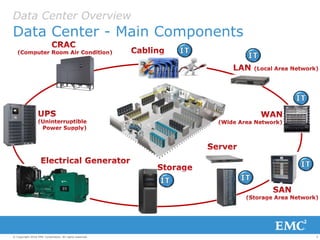
Data Center - Main Components
6© Copyright 2016 EMC Corporation. All rights reserved.
Data Center Overview
Data Center – Energy Metrics
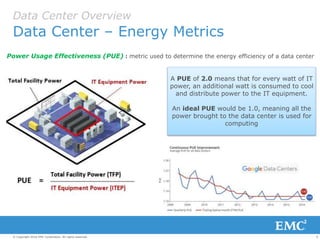
Power Usage Effectiveness (PUE) : metric used to determine the energy efficiency of a data center
A PUE of 2.0 means that for every watt of IT
power, an additional watt is consumed to cool
and distribute power to the IT equipment.
An ideal PUE would be 1.0, meaning all the
power brought to the data center is used for
computing
7© Copyright 2016 EMC Corporation. All rights reserved.
Data Center Overview
Data Center - Consumption
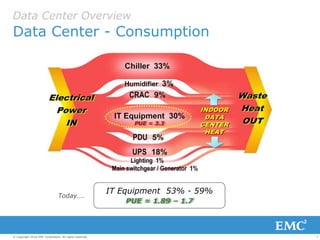
PUE = 3.3
IT Equipment 53% - 59%
PUE = 1.89 – 1.7
Today….
8© Copyright 2016 EMC Corporation. All rights reserved.
Data Center Overview
Data Center - Strategies
Many companies have identified strategic locations for their data center in order to take
advantage from the environmental characteristics to cool its data center or to produce energy
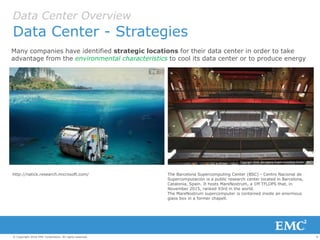
The Barcelona Supercomputing Center (BSC) - Centro Nacional de
Supercomputación is a public research center located in Barcelona,
Catalonia, Spain. It hosts MareNostrum, a 1M TFLOPS that, in
November 2015, ranked 93rd in the world.
The MareNostrum supercomputer is contained inside an enormous
glass box in a former chapell.
http://natick.research.microsoft.com/
9© Copyright 2016 EMC Corporation. All rights reserved.
Data Center Overview
Data Center - Strategies
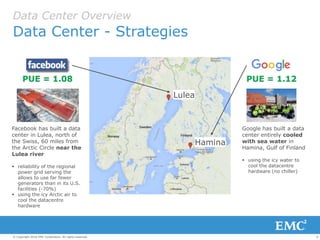
Lulea
Hamina
PUE = 1.12PUE = 1.08
Google has built a data
center entirely cooled
with sea water in
Hamina, Gulf of Finland
 using the icy water to
cool the datacentre
hardware (no chiller)
Facebook has built a data
center in Lulea, north of
the Swiss, 60 miles from
the Arctic Circle near the
Lulea river
 reliability of the regional
power grid serving the
allows to use far fewer
generators than in its U.S.
facilities (-70%)
 using the icy Arctic air to
cool the datacentre
hardware
10© Copyright 2016 EMC Corporation. All rights reserved.
Data Center Overview
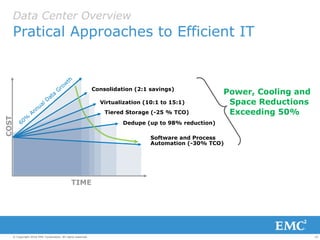
Pratical Approaches to Efficient IT
Consolidation (2:1 savings)
Tiered Storage (-25 % TCO)
Dedupe (up to 98% reduction)
Software and Process
Automation (-30% TCO)
COST
TIME
Power, Cooling and
Space Reductions
Exceeding 50%
Virtualization (10:1 to 15:1)
11© Copyright 2016 EMC Corporation. All rights reserved.
Data Center Classification
What should we know?
12© Copyright 2016 EMC Corporation. All rights reserved.
Data Center Classification
Uptime Institute
 Uptime Institute created the standard Tier Classification System
as a means to effectively evaluate data center infrastructure in
terms of a business’ requirements for system availability.
 The Tier Classification System provides the data center industry with
a consistent method to compare typically unique, customized
facilities based on expected site infrastructure performance, or
uptime.
 Furthermore, Tiers enables companies to align their data center
infrastructure investment with business goals specific to growth
and technology strategies.
13© Copyright 2016 EMC Corporation. All rights reserved.
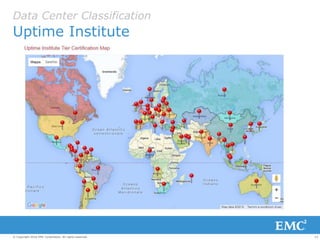
Data Center Classification
Uptime Institute
14© Copyright 2016 EMC Corporation. All rights reserved.
Data Center Classification
Data Center - Tiering
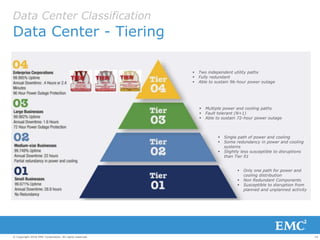
 Only one path for power and
cooling distribution
 Non Redundant Components
 Susceptible to disruption from
planned and unplanned activity
 Single path of power and cooling
 Some redundancy in power and cooling
systems
 Slightly less susceptible to disruptions
than Tier 01
 Multiple power and cooling paths
 Fault tolerant (N+1)
 Able to sustain 72-hour power outage
 Two independent utility paths
 Fully redundant
 Able to sustain 96-hour power outage
15© Copyright 2016 EMC Corporation. All rights reserved.
Data Center Classification
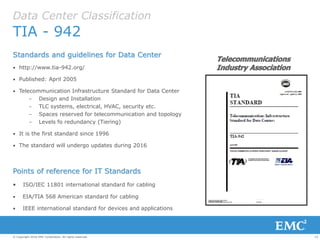
TIA - 942
Standards and guidelines for Data Center
• http://www.tia-942.org/
• Published: April 2005
• Telecommunication Infrastructure Standard for Data Center
– Design and Installation
– TLC systems, electrical, HVAC, security etc.
– Spaces reserved for telecommunication and topology
– Levels fo redundancy (Tiering)
• It is the first standard since 1996
• The standard will undergo updates during 2016
Points of reference for IT Standards
• ISO/IEC 11801 international standard for cabling
• EIA/TIA 568 American standard for cabling
• IEEE international standard for devices and applications
16© Copyright 2016 EMC Corporation. All rights reserved.
Data Center Preparation
What should we do?
17© Copyright 2016 EMC Corporation. All rights reserved.
Data Center Preparation
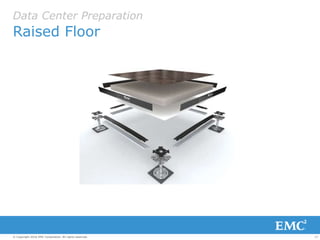
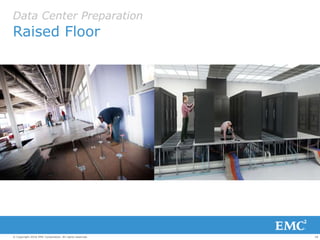
Raised Floor
18© Copyright 2016 EMC Corporation. All rights reserved.
Data Center Preparation
Raised Floor
19© Copyright 2016 EMC Corporation. All rights reserved.
Data Center Preparation
Raised Floor
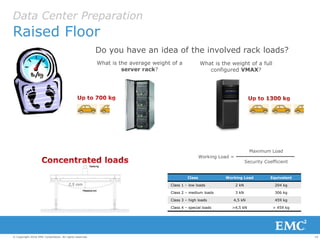
Do you have an idea of the involved rack loads?
What is the average weight of a
server rack?
What is the weight of a full
configured VMAX?
2,5 mm
Class Working Load Equivalent
Class 1 – low loads 2 kN 204 kg
Class 2 – medium loads 3 kN 306 kg
Class 3 – high loads 4,5 kN 459 kg
Class 4 – special loads >4,5 kN > 459 kg
Working Load =
Maximum Load
Security Coefficient
20© Copyright 2016 EMC Corporation. All rights reserved.
Data Center Preparation
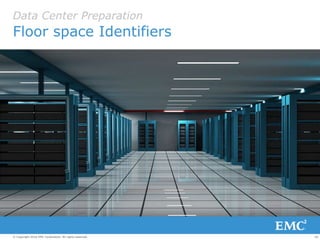
Floor space Identifiers
21© Copyright 2016 EMC Corporation. All rights reserved.
Data Center Preparation
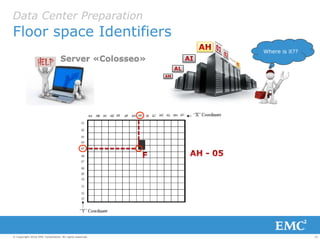
Floor space Identifiers
Where is it??
Server «Colosseo»
22© Copyright 2016 EMC Corporation. All rights reserved.
Data Center Preparation
Floor space Identifiers
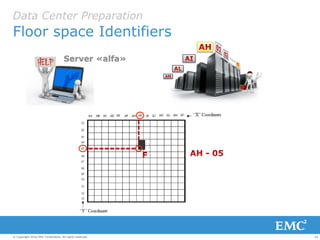
Server «alfa»
23© Copyright 2016 EMC Corporation. All rights reserved.
Data Center Preparation
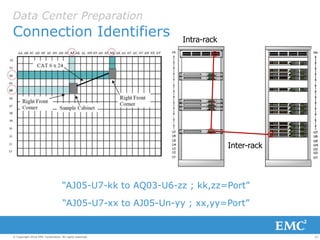
Connection Identifiers Intra-rack
Inter-rack
“AJ05-U7-kk to AQ03-U6-zz ; kk,zz=Port”
“AJ05-U7-xx to AJ05-Un-yy ; xx,yy=Port”
24© Copyright 2016 EMC Corporation. All rights reserved.
Data Center Preparation
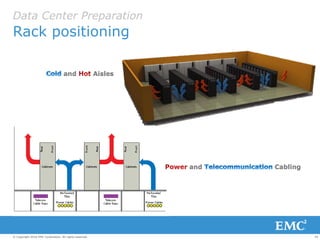
Rack positioning
and Aisles
and Cabling
25© Copyright 2016 EMC Corporation. All rights reserved.
Data Center Preparation
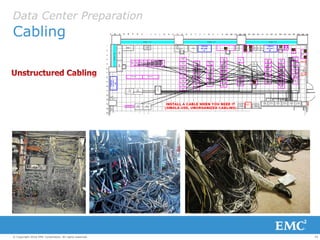
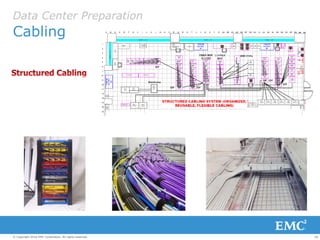
Cabling
26© Copyright 2016 EMC Corporation. All rights reserved.
Data Center Preparation
Cabling
27© Copyright 2016 EMC Corporation. All rights reserved.
Data Center Preparation
Cabling
28© Copyright 2016 EMC Corporation. All rights reserved.
Data Center Preparation
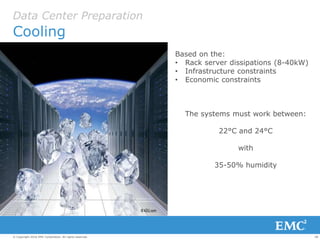
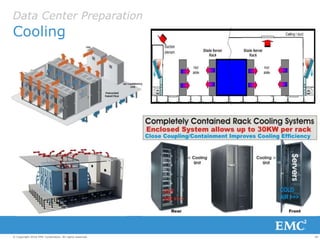
Cooling
Based on the:
• Rack server dissipations (8-40kW)
• Infrastructure constraints
• Economic constraints
The systems must work between:
22°C and 24°C
with
35-50% humidity
29© Copyright 2016 EMC Corporation. All rights reserved.
Data Center Preparation
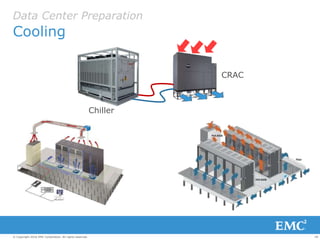
Cooling
Chiller
CRAC
30© Copyright 2016 EMC Corporation. All rights reserved.
Data Center Preparation
Cooling
31© Copyright 2016 EMC Corporation. All rights reserved.
Data Center Preparation
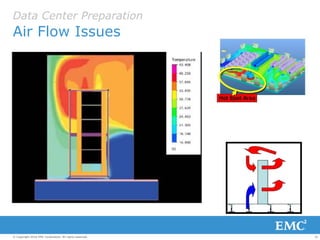
Air Flow Issues
32© Copyright 2016 EMC Corporation. All rights reserved.
Data Center Preparation
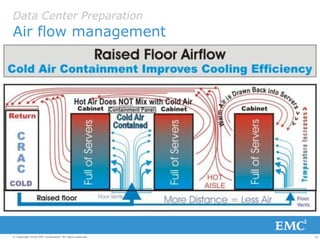
Air flow management
33© Copyright 2016 EMC Corporation. All rights reserved.
Data Center Preparation
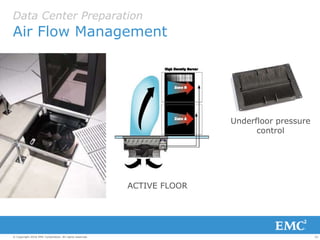
Air Flow Management
ACTIVE FLOOR
Underfloor pressure
control
34© Copyright 2016 EMC Corporation. All rights reserved.

Data Center Efficiency Workshop 2016

  • 1.
    1© Copyright 2016EMC Corporation. All rights reserved. DATA CENTER EFFICIENCY STEFANO PORTELLI ITALY TRASFORMATION CONSULTING LEAD EMC COMPUTER SYSTEMS ITALIA S.P.A. STEFANO.PORTELLI@EMC.COM WWW.LINKEDIN.COM/IN/STEXXE
  • 2.
    2© Copyright 2016EMC Corporation. All rights reserved. Agenda  Data Center Overview – What are we talking about?  Data Center Classification – What should we know?  Data Center Preparation – What should we do?
  • 3.
    3© Copyright 2016EMC Corporation. All rights reserved. Data Center Overview What are we talking about?
  • 4.
    5© Copyright 2016EMC Corporation. All rights reserved. Data Center Overview Data Center - Main Components
  • 5.
    6© Copyright 2016EMC Corporation. All rights reserved. Data Center Overview Data Center – Energy Metrics Power Usage Effectiveness (PUE) : metric used to determine the energy efficiency of a data center A PUE of 2.0 means that for every watt of IT power, an additional watt is consumed to cool and distribute power to the IT equipment. An ideal PUE would be 1.0, meaning all the power brought to the data center is used for computing
  • 6.
    7© Copyright 2016EMC Corporation. All rights reserved. Data Center Overview Data Center - Consumption PUE = 3.3 IT Equipment 53% - 59% PUE = 1.89 – 1.7 Today….
  • 7.
    8© Copyright 2016EMC Corporation. All rights reserved. Data Center Overview Data Center - Strategies Many companies have identified strategic locations for their data center in order to take advantage from the environmental characteristics to cool its data center or to produce energy The Barcelona Supercomputing Center (BSC) - Centro Nacional de Supercomputación is a public research center located in Barcelona, Catalonia, Spain. It hosts MareNostrum, a 1M TFLOPS that, in November 2015, ranked 93rd in the world. The MareNostrum supercomputer is contained inside an enormous glass box in a former chapell. http://natick.research.microsoft.com/
  • 8.
    9© Copyright 2016EMC Corporation. All rights reserved. Data Center Overview Data Center - Strategies Lulea Hamina PUE = 1.12PUE = 1.08 Google has built a data center entirely cooled with sea water in Hamina, Gulf of Finland  using the icy water to cool the datacentre hardware (no chiller) Facebook has built a data center in Lulea, north of the Swiss, 60 miles from the Arctic Circle near the Lulea river  reliability of the regional power grid serving the allows to use far fewer generators than in its U.S. facilities (-70%)  using the icy Arctic air to cool the datacentre hardware
  • 9.
    10© Copyright 2016EMC Corporation. All rights reserved. Data Center Overview Pratical Approaches to Efficient IT Consolidation (2:1 savings) Tiered Storage (-25 % TCO) Dedupe (up to 98% reduction) Software and Process Automation (-30% TCO) COST TIME Power, Cooling and Space Reductions Exceeding 50% Virtualization (10:1 to 15:1)
  • 10.
    11© Copyright 2016EMC Corporation. All rights reserved. Data Center Classification What should we know?
  • 11.
    12© Copyright 2016EMC Corporation. All rights reserved. Data Center Classification Uptime Institute  Uptime Institute created the standard Tier Classification System as a means to effectively evaluate data center infrastructure in terms of a business’ requirements for system availability.  The Tier Classification System provides the data center industry with a consistent method to compare typically unique, customized facilities based on expected site infrastructure performance, or uptime.  Furthermore, Tiers enables companies to align their data center infrastructure investment with business goals specific to growth and technology strategies.
  • 12.
    13© Copyright 2016EMC Corporation. All rights reserved. Data Center Classification Uptime Institute
  • 13.
    14© Copyright 2016EMC Corporation. All rights reserved. Data Center Classification Data Center - Tiering  Only one path for power and cooling distribution  Non Redundant Components  Susceptible to disruption from planned and unplanned activity  Single path of power and cooling  Some redundancy in power and cooling systems  Slightly less susceptible to disruptions than Tier 01  Multiple power and cooling paths  Fault tolerant (N+1)  Able to sustain 72-hour power outage  Two independent utility paths  Fully redundant  Able to sustain 96-hour power outage
  • 14.
    15© Copyright 2016EMC Corporation. All rights reserved. Data Center Classification TIA - 942 Standards and guidelines for Data Center • http://www.tia-942.org/ • Published: April 2005 • Telecommunication Infrastructure Standard for Data Center – Design and Installation – TLC systems, electrical, HVAC, security etc. – Spaces reserved for telecommunication and topology – Levels fo redundancy (Tiering) • It is the first standard since 1996 • The standard will undergo updates during 2016 Points of reference for IT Standards • ISO/IEC 11801 international standard for cabling • EIA/TIA 568 American standard for cabling • IEEE international standard for devices and applications
  • 15.
    16© Copyright 2016EMC Corporation. All rights reserved. Data Center Preparation What should we do?
  • 16.
    17© Copyright 2016EMC Corporation. All rights reserved. Data Center Preparation Raised Floor
  • 17.
    18© Copyright 2016EMC Corporation. All rights reserved. Data Center Preparation Raised Floor
  • 18.
    19© Copyright 2016EMC Corporation. All rights reserved. Data Center Preparation Raised Floor Do you have an idea of the involved rack loads? What is the average weight of a server rack? What is the weight of a full configured VMAX? 2,5 mm Class Working Load Equivalent Class 1 – low loads 2 kN 204 kg Class 2 – medium loads 3 kN 306 kg Class 3 – high loads 4,5 kN 459 kg Class 4 – special loads >4,5 kN > 459 kg Working Load = Maximum Load Security Coefficient
  • 19.
    20© Copyright 2016EMC Corporation. All rights reserved. Data Center Preparation Floor space Identifiers
  • 20.
    21© Copyright 2016EMC Corporation. All rights reserved. Data Center Preparation Floor space Identifiers Where is it?? Server «Colosseo»
  • 21.
    22© Copyright 2016EMC Corporation. All rights reserved. Data Center Preparation Floor space Identifiers Server «alfa»
  • 22.
    23© Copyright 2016EMC Corporation. All rights reserved. Data Center Preparation Connection Identifiers Intra-rack Inter-rack “AJ05-U7-kk to AQ03-U6-zz ; kk,zz=Port” “AJ05-U7-xx to AJ05-Un-yy ; xx,yy=Port”
  • 23.
    24© Copyright 2016EMC Corporation. All rights reserved. Data Center Preparation Rack positioning and Aisles and Cabling
  • 24.
    25© Copyright 2016EMC Corporation. All rights reserved. Data Center Preparation Cabling
  • 25.
    26© Copyright 2016EMC Corporation. All rights reserved. Data Center Preparation Cabling
  • 26.
    27© Copyright 2016EMC Corporation. All rights reserved. Data Center Preparation Cabling
  • 27.
    28© Copyright 2016EMC Corporation. All rights reserved. Data Center Preparation Cooling Based on the: • Rack server dissipations (8-40kW) • Infrastructure constraints • Economic constraints The systems must work between: 22°C and 24°C with 35-50% humidity
  • 28.
    29© Copyright 2016EMC Corporation. All rights reserved. Data Center Preparation Cooling Chiller CRAC
  • 29.
    30© Copyright 2016EMC Corporation. All rights reserved. Data Center Preparation Cooling
  • 30.
    31© Copyright 2016EMC Corporation. All rights reserved. Data Center Preparation Air Flow Issues
  • 31.
    32© Copyright 2016EMC Corporation. All rights reserved. Data Center Preparation Air flow management
  • 32.
    33© Copyright 2016EMC Corporation. All rights reserved. Data Center Preparation Air Flow Management ACTIVE FLOOR Underfloor pressure control
  • 33.
    34© Copyright 2016EMC Corporation. All rights reserved.

Editor's Notes

  • #8 CRAC – computer room air conditioning PDU – Power distribution unit UPS – Uninterruptible power supply
  • #18 I pannelli della pavimentazione (60x60, 120X60, 60X40 cm) sono realizzati secondo tre livelli: la finitura superficiale, l'anima interna e il rivestimento inferiore. Il piano di calpestio realizza la componente estetica di finitura, capace di offrire la stessa resa visiva di un pavimento tradizionale grazie ai più svariati materiali (laminato, PVC, gomma, linoleum, moquette, parquet, gres porcellanato, marmi e graniti naturali). L'anima del pannello è l’insieme dei materiali strutturali (conglomerato ligneo ad alta densità o solfato di calcio) disposto sotto lo strato di rivestimento superficiale, mentre la parte inferiore è la faccia nascosta del pannello, con la funzione di migliorare le caratteristiche meccaniche e la protezione dall’umidità (laminato plastico, alluminio, carta melaminica, lamiera o acciaio zincato).
  • #20 La normativa europea di riferimento del settore pavimenti sopraelevati è la EN 12825 che si riferisce al parametro univoco del “Carico Massimo di Sicurezza” (vicinissimo, dal punto vista tecnico, al carico di rottura). Questo carico è inteso come il carico massimo concentrato al quale un sistema di pavimenti sopraelevati può resistere sul suo punto più debole, per una durata massima di 5 minuti, senza collassare. Per comprendere meglio il metodo di misurazione è utile chiarire alcune definizioni: Il carico massimo è carico al momento del cedimento dell’elemento durante lo specifico procedimento di prova. Il carico massimo è talvolta chiamato carico di rottura. Il coefficiente di sicurezza è il fattore per il quale è diviso il carico massimo per determinare il carico di esercizio. Carico di esercizio è il carico ottenuto dividendo il carico massimo per il fattore di sicurezza. Il carico di esercizio è talvolta chiamato carico di progetto o carico nominale.  Il carico massimo concentrato diviso per il coefficiente di sicurezza previsto dallo Stato membro in ambito nazionale determina quindi il “carico di esercizio”. Ad esempio, un carico massimo di sicurezza 9 kN sarà classificato in Italia, in Germania e in Francia, dove il coefficiente di sicurezza è 2, esprimerà un carico di esercizio di  9 / 2 = 4,5 kN. In Inghilterra, invece, dove il coefficiente di sicurezza è 3 il “carico di esercizio”  sarà di 9 / 3 = 3 kN. La vigente normativa europea in materia di resistenza meccanica EN 12825 non prevede prove di carico uniformemente distribuito. Questo carico viene ancora oggi espresso poiché, per consuetudine, nel settore edilizio ci si riferisce con lo stesso parametro alla portata dei solai. I pavimenti sopraelevati presentano normalmente, al carico distribuito, una resistenza superiore a quella del solaio o soletta su cui poggiano; per questo motivo tale criterio di giudizio non viene osservato dalle attuali norme che si riferiscono al settore dei pavimenti flottanti.