
August 24-27, 2020
30519_DCW20
datacenterworld.com
Cooling Optimization 101: A
Beginner's Guide to Data Center
Cooling
Lars Strong, P.E.
Senior Engineer and Company Science
Officer
Upsite Technologies
datacenterworld.com
Speaker Background
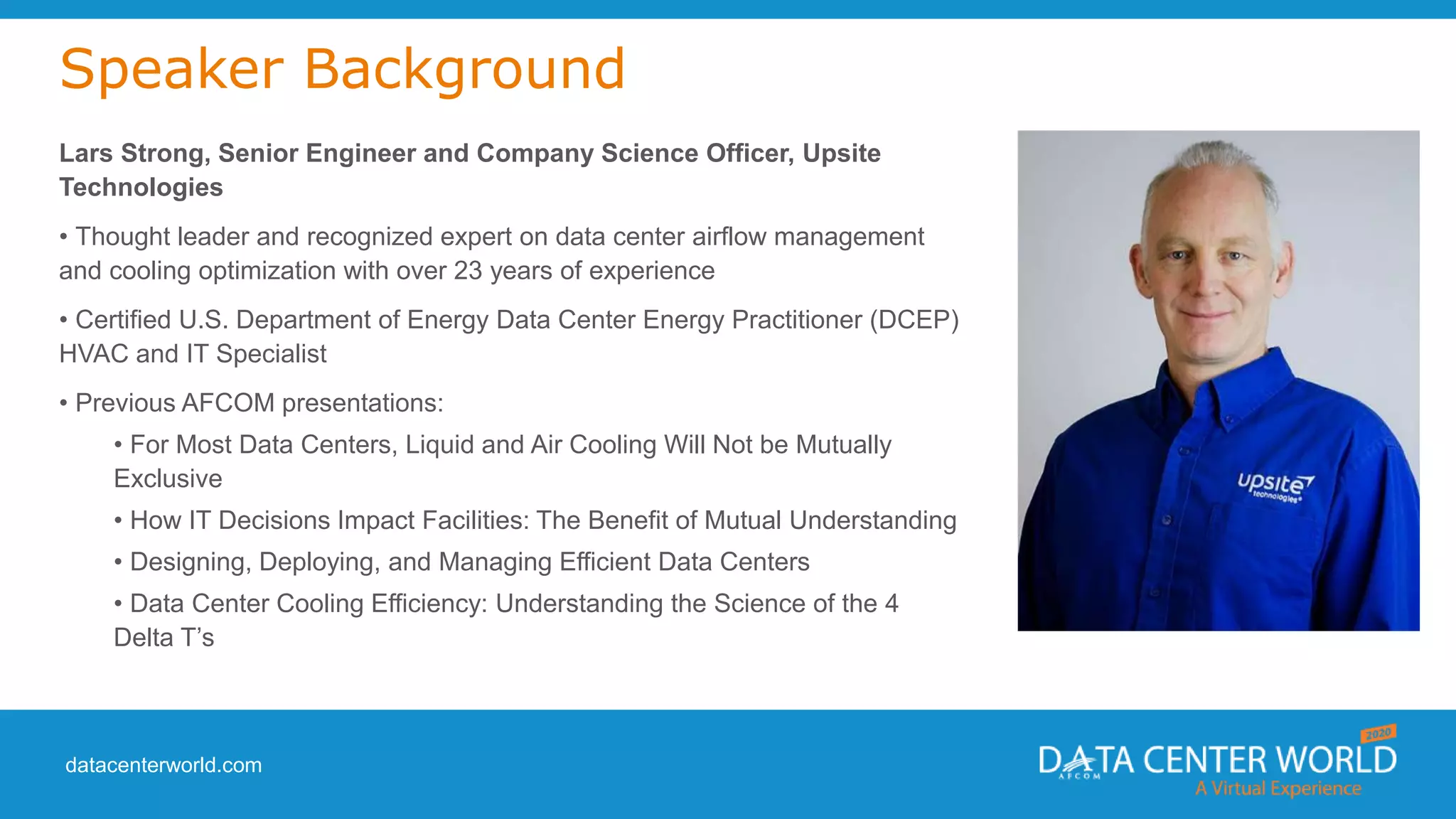
Lars Strong, Senior Engineer and Company Science Officer, Upsite
Technologies
• Thought leader and recognized expert on data center airflow management
and cooling optimization with over 23 years of experience
• Certified U.S. Department of Energy Data Center Energy Practitioner (DCEP)
HVAC and IT Specialist
• Previous AFCOM presentations:
• For Most Data Centers, Liquid and Air Cooling Will Not be Mutually
Exclusive
• How IT Decisions Impact Facilities: The Benefit of Mutual Understanding
• Designing, Deploying, and Managing Efficient Data Centers
• Data Center Cooling Efficiency: Understanding the Science of the 4
Delta T’s
datacenterworld.com
Agenda
• The Significance of Airflow Management Related to Cooling Optimization
• ASHRAE Guidelines
• Relationship to PUE
• Bypass Airflow and Exhaust Air Recirculation
• The Four Delta T’s
• The 4 R’s of Airflow Management™
• Best Practices
• The Importance of Cooling Optimization
• How Cooling Optimization Works
• Questions
datacenterworld.com
The Significance of
Airflow Management
Related to Cooling
Optimization
datacenterworld.com
“Power In, Heat Out Always” – Ken Brill
• Every kW of power consumed by any equipment in a computer room becomes a kilowatt of heat that needs to
be removed
• Therefore, the total power being demanded by IT equipment (i.e. total UPS output load) provides a good
indication of the cooling capacity required
datacenterworld.com
The Goal of Airflow Management and Cooling
Optimization
• Provide appropriate IT equipment intake air conditions and redundant cooling capacity, with the lowest
possible flow rate of conditioned air at the warmest possible temperature
datacenterworld.com
What is Airflow Management?
• In a standard data center environment that is cooled by air, airflow management is simply the process of
managing the flow of air through the room
• Specifically, managing the flow of conditioned or cooled air to the intakes of IT equipment and the flow of
exhaust air back to the cooling units
• There are many configurations for IT equipment layout and cooling system designs, in all cases airflow
management is simply preventing the hot and cold airstreams from mixing
• On its own, improving airflow management can reduce IT equipment intake air temperatures which improves
IT equipment reliability
• It also enables the adjustment of cooling controls and set points to reduce operating costs, improve cooling
capacity, and defer capital expenditure
datacenterworld.com
Ideal Hot and Cold Aisle Configuration (With Good Airflow
Management)
datacenterworld.com
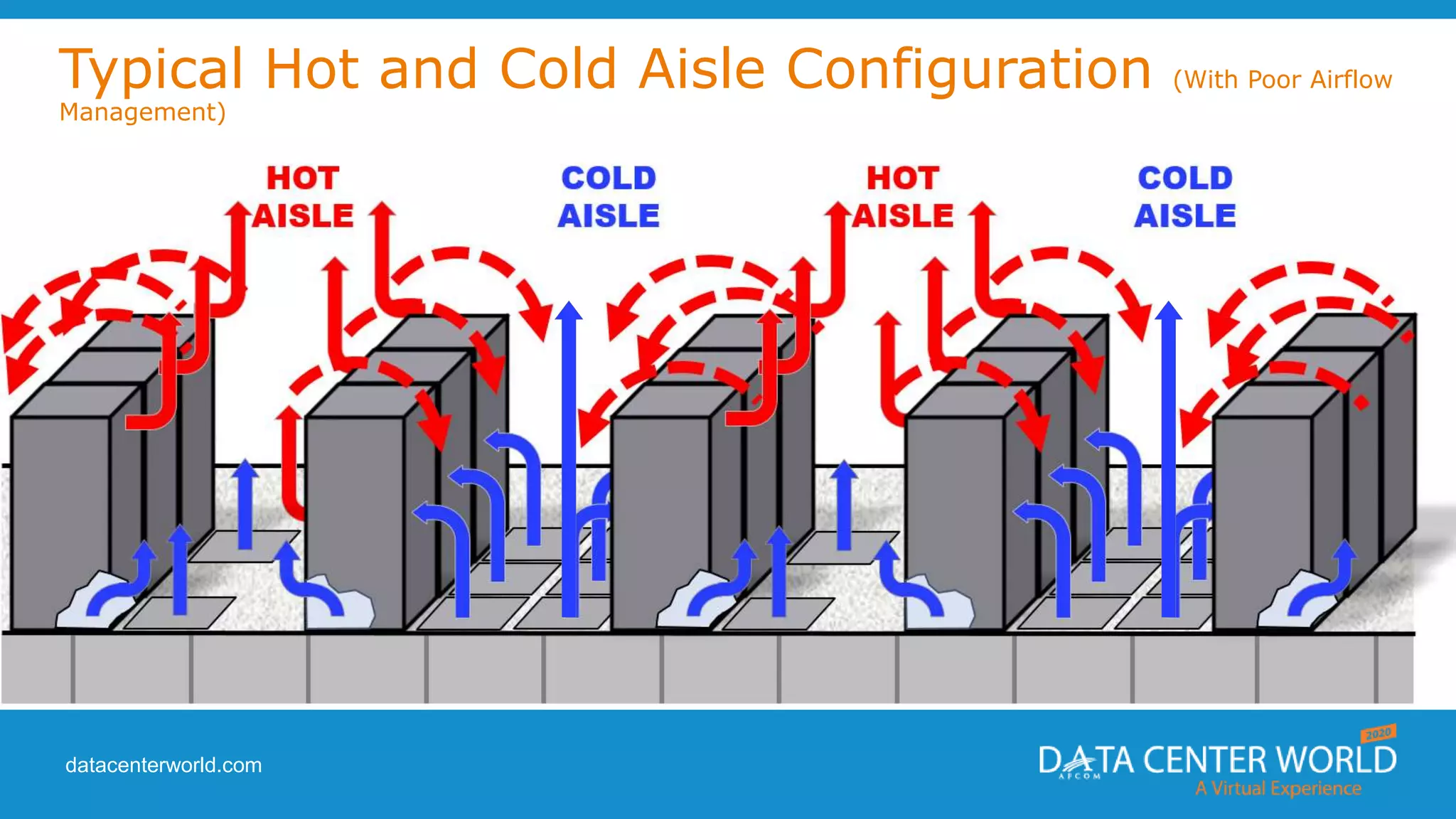
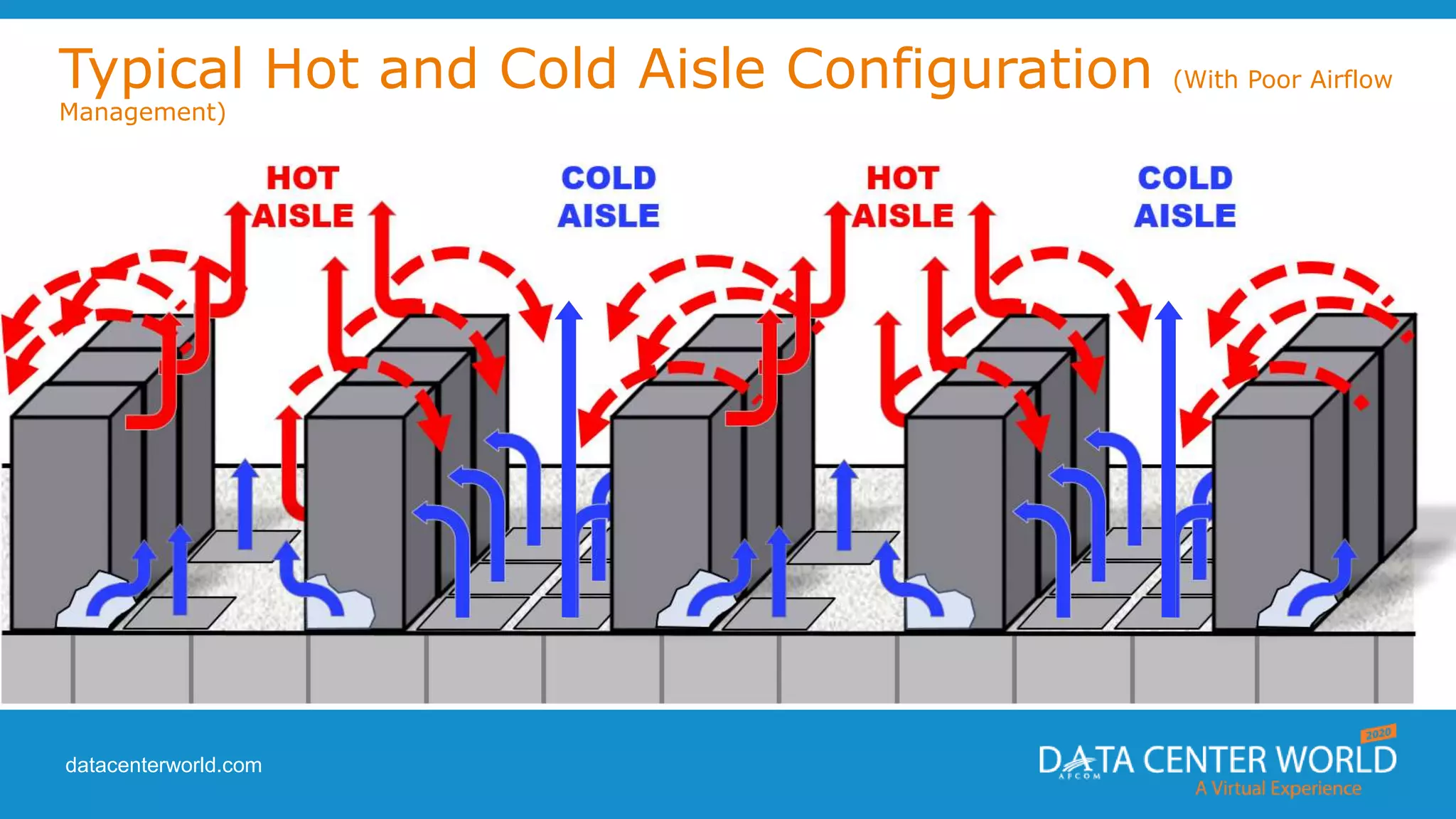
Typical Hot and Cold Aisle Configuration (With Poor Airflow
Management)
datacenterworld.com
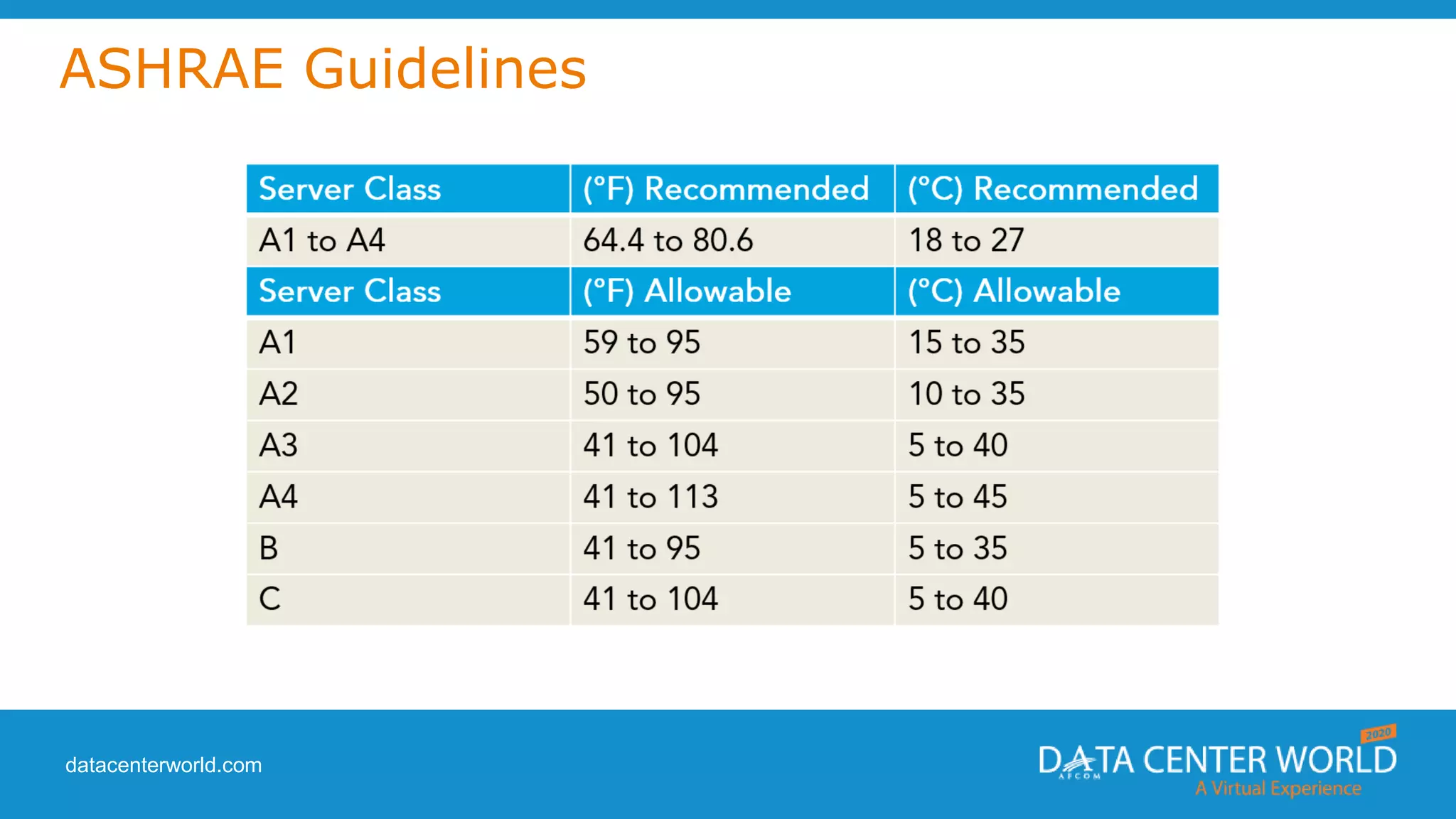
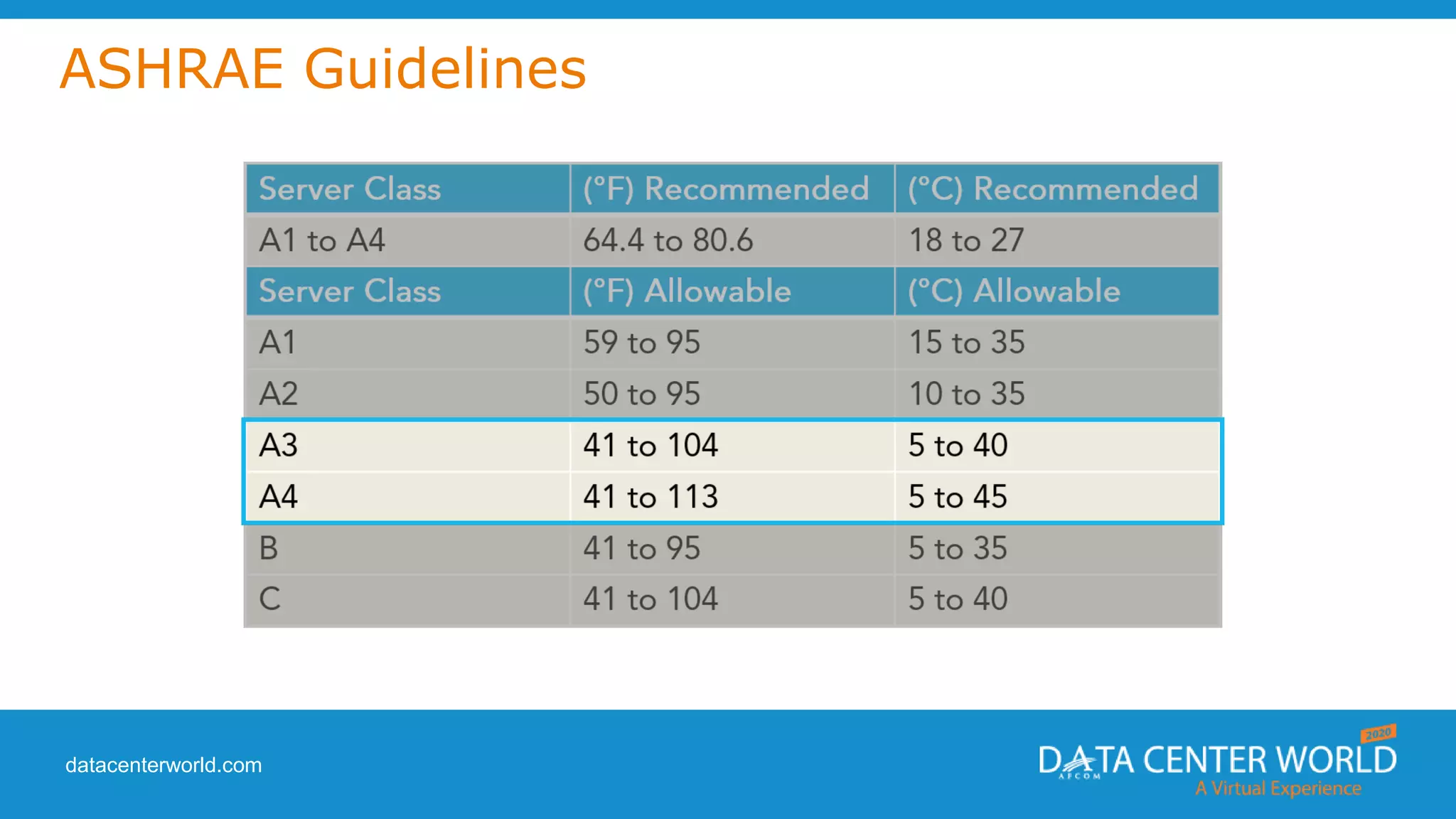
ASHRAE Guidelines
datacenterworld.com
ASHRAE Guidelines
datacenterworld.com
Typical Hot and Cold Aisle Configuration (With Poor Airflow
Management)
datacenterworld.com
How Airflow Management Relates to PUE
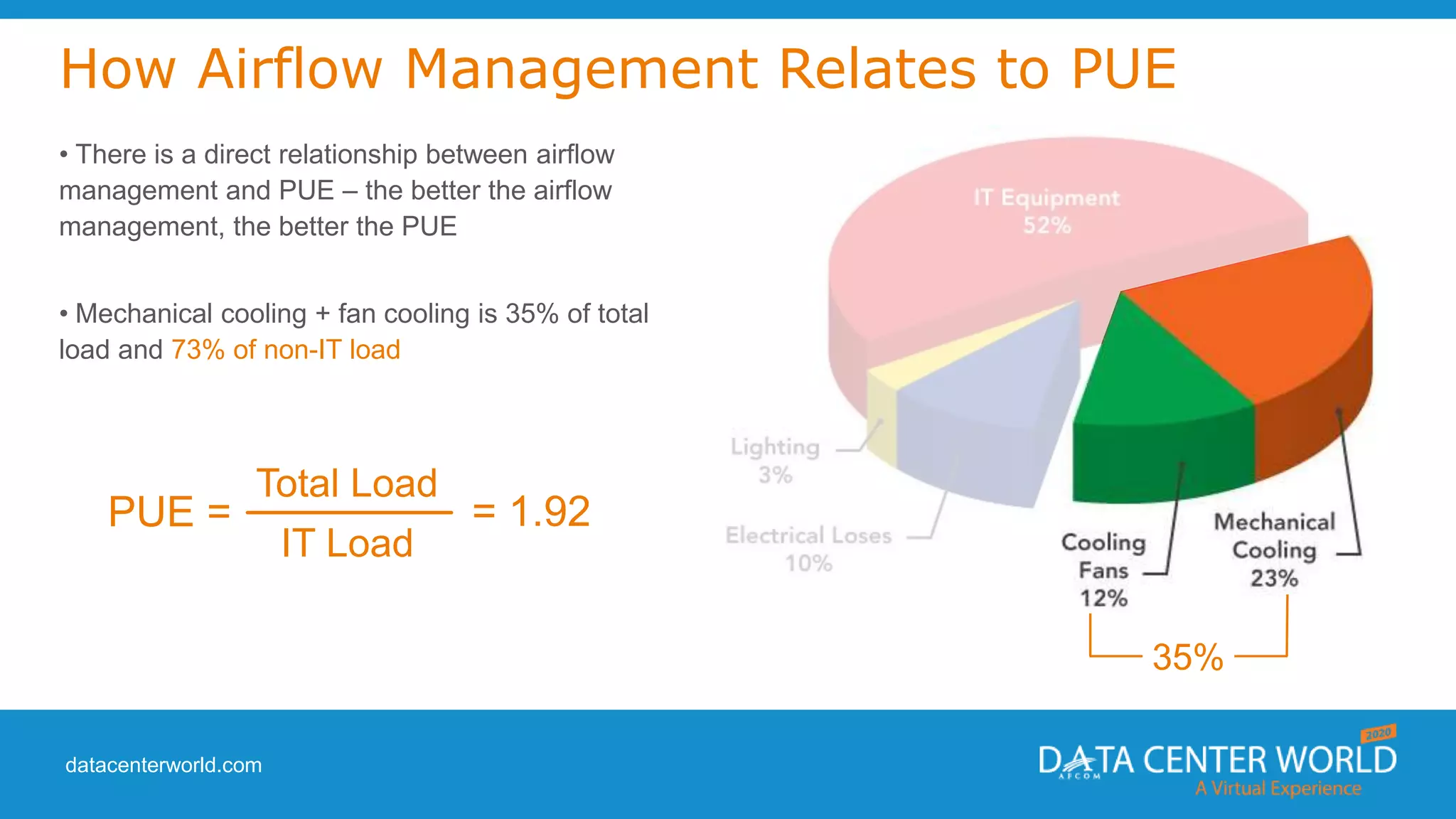
• There is a direct relationship between airflow
management and PUE – the better the airflow
management, the better the PUE
• Mechanical cooling + fan cooling is 35% of total
load and 73% of non-IT load
Total Load
IT Load
PUE = = 1.92
datacenterworld.com
How Airflow Management Relates to PUE
• There is a direct relationship between airflow
management and PUE – the better the airflow
management, the better the PUE
• Mechanical cooling + fan cooling is 35% of total
load and 73% of non-IT load
Total Load
IT Load
PUE = = 1.92
35%
datacenterworld.com
Bypass Airflow
• Bypass airflow is any conditioned air from a cooling unit that does not pass through IT equipment before
returning to the cooling unit
• The total volumetric flow rate of conditioned air through cooling units is independent of the volumetric flow rate
of air through IT equipment
• Bypass airflow (cfm) = Total cooling flow (cfm) – Total IT equipment demand flow (cfm)
datacenterworld.com
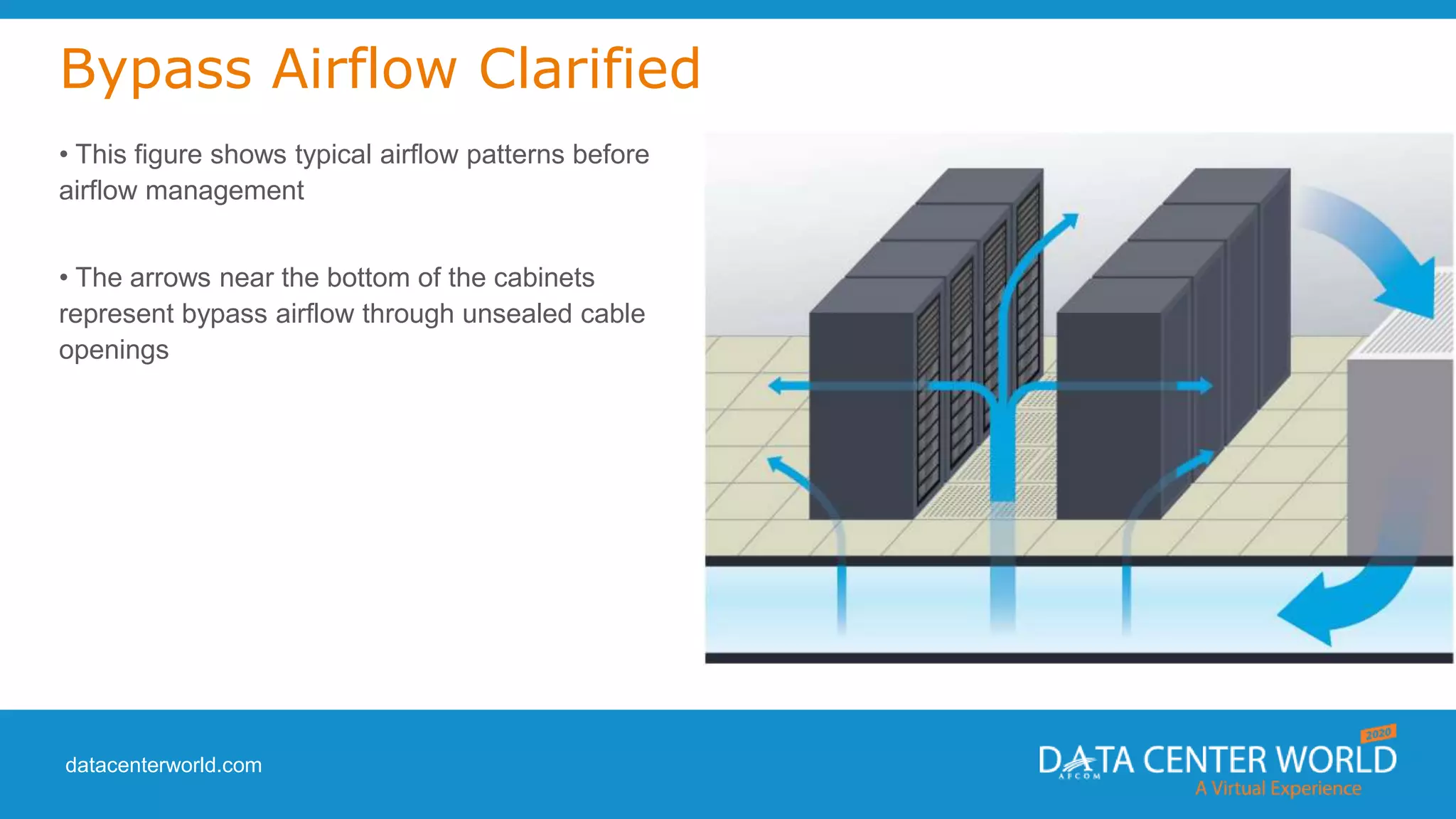
Bypass Airflow Clarified
• This figure shows typical airflow patterns before
airflow management
• The arrows near the bottom of the cabinets
represent bypass airflow through unsealed cable
openings
datacenterworld.com
Exhaust Air Recirculation
• Exhaust air recirculation is any air that passes through IT equipment more than once before returning to a
cooling unit
• This is when warm exhaust air mixes with the cold supply air and raises the intake temperatures possibly
causing hot spots and reducing IT equipment reliability
• Exhaust air recirculation limits the reduction of fan speed and the raising of supply temperatures during cooling
optimization efforts
datacenterworld.com
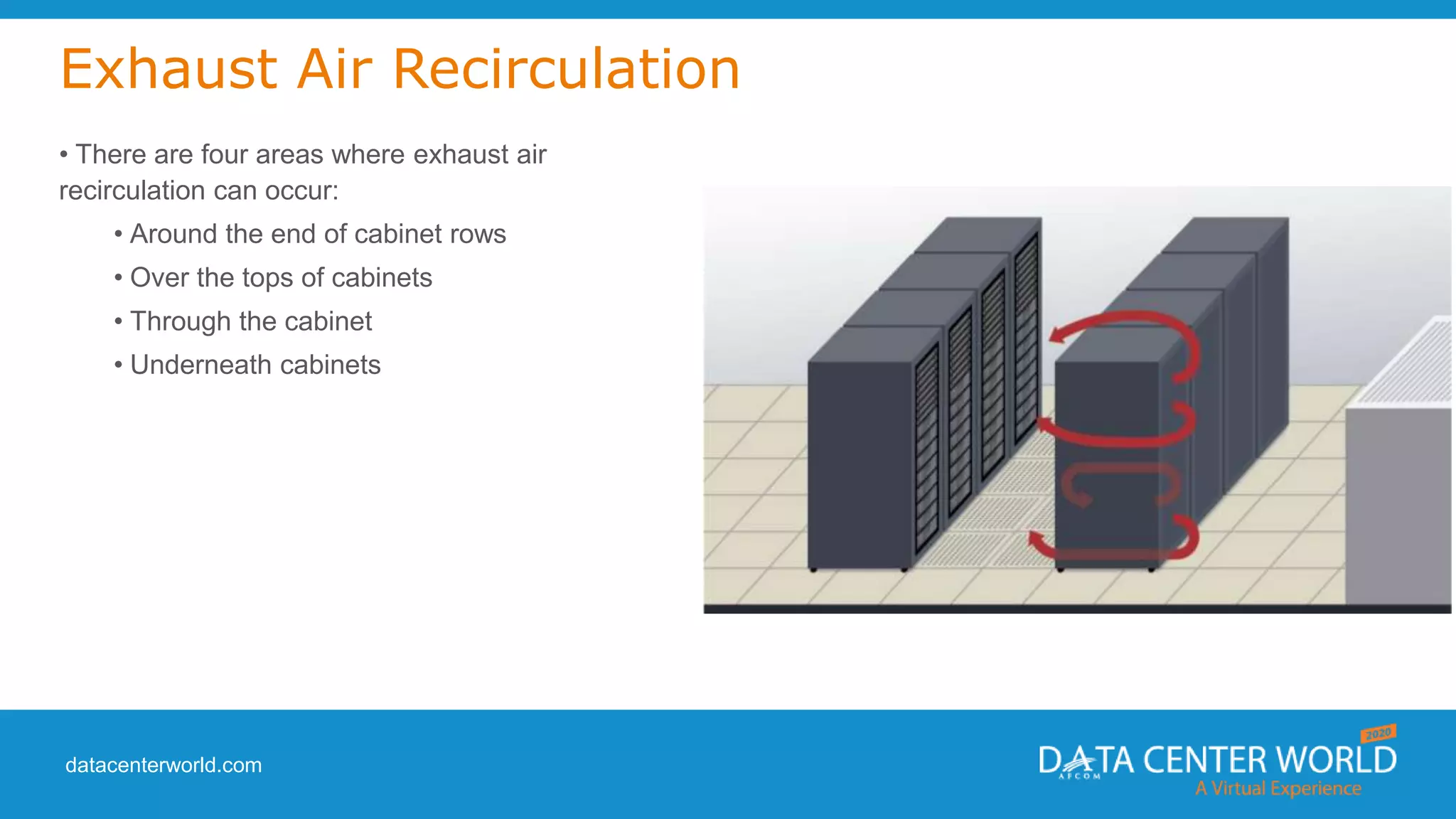
Exhaust Air Recirculation
• There are four areas where exhaust air
recirculation can occur:
• Around the end of cabinet rows
• Over the tops of cabinets
• Through the cabinet
• Underneath cabinets
datacenterworld.com
The Four Delta T’s (ΔT)
• Delta T (ΔT) = Change in temperature
• There are four different ΔT’s which contribute to the health of the data center
• Two of these temperature differentials are well known, however there are two additional ΔT’s that are not well
known and rarely considered, yet they are crucial to improving airflow management and reducing energy
consumption
datacenterworld.com
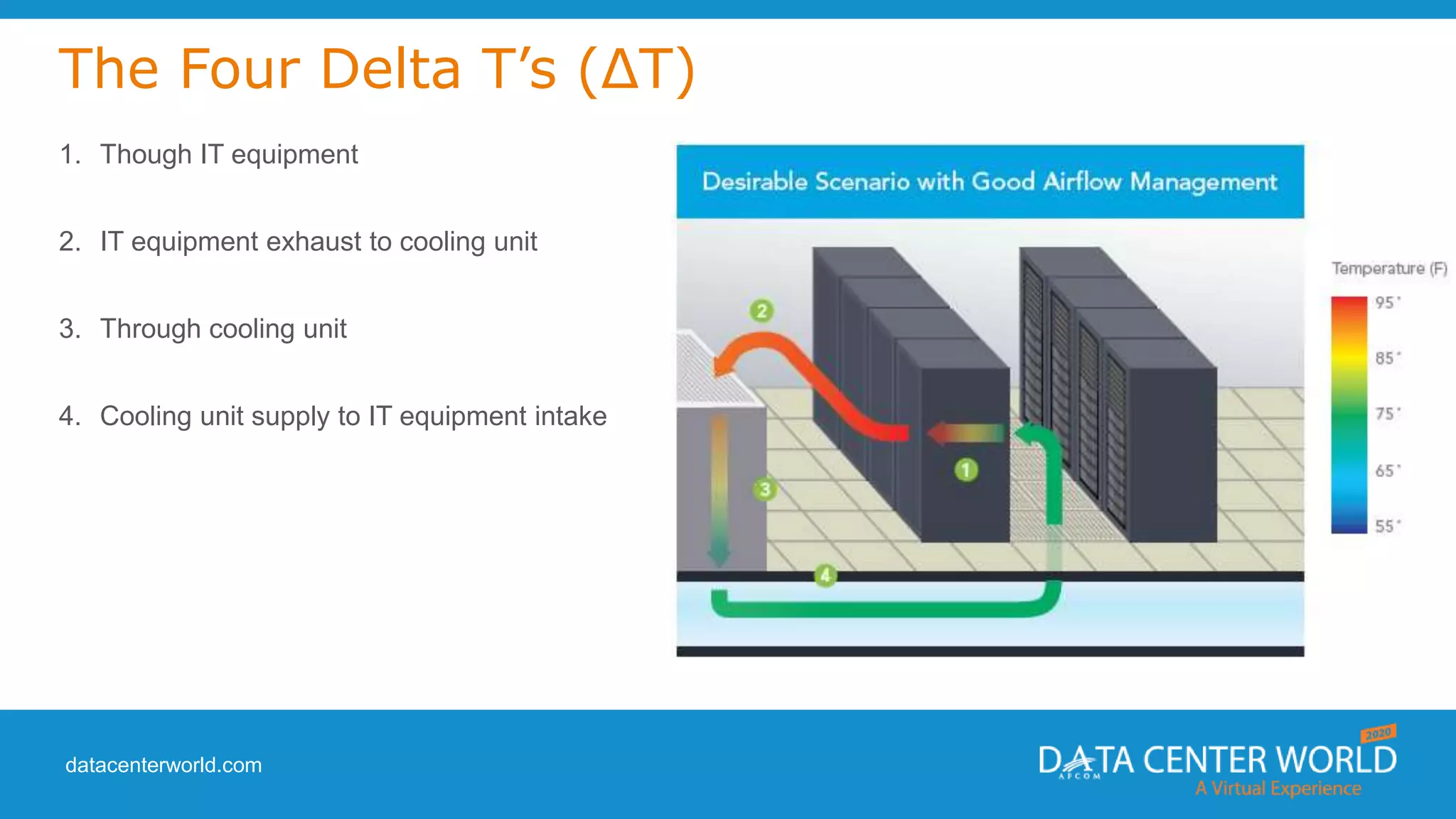
The Four Delta T’s (ΔT)
1. Though IT equipment
2. IT equipment exhaust to cooling unit
3. Through cooling unit
4. Cooling unit supply to IT equipment intake
datacenterworld.com
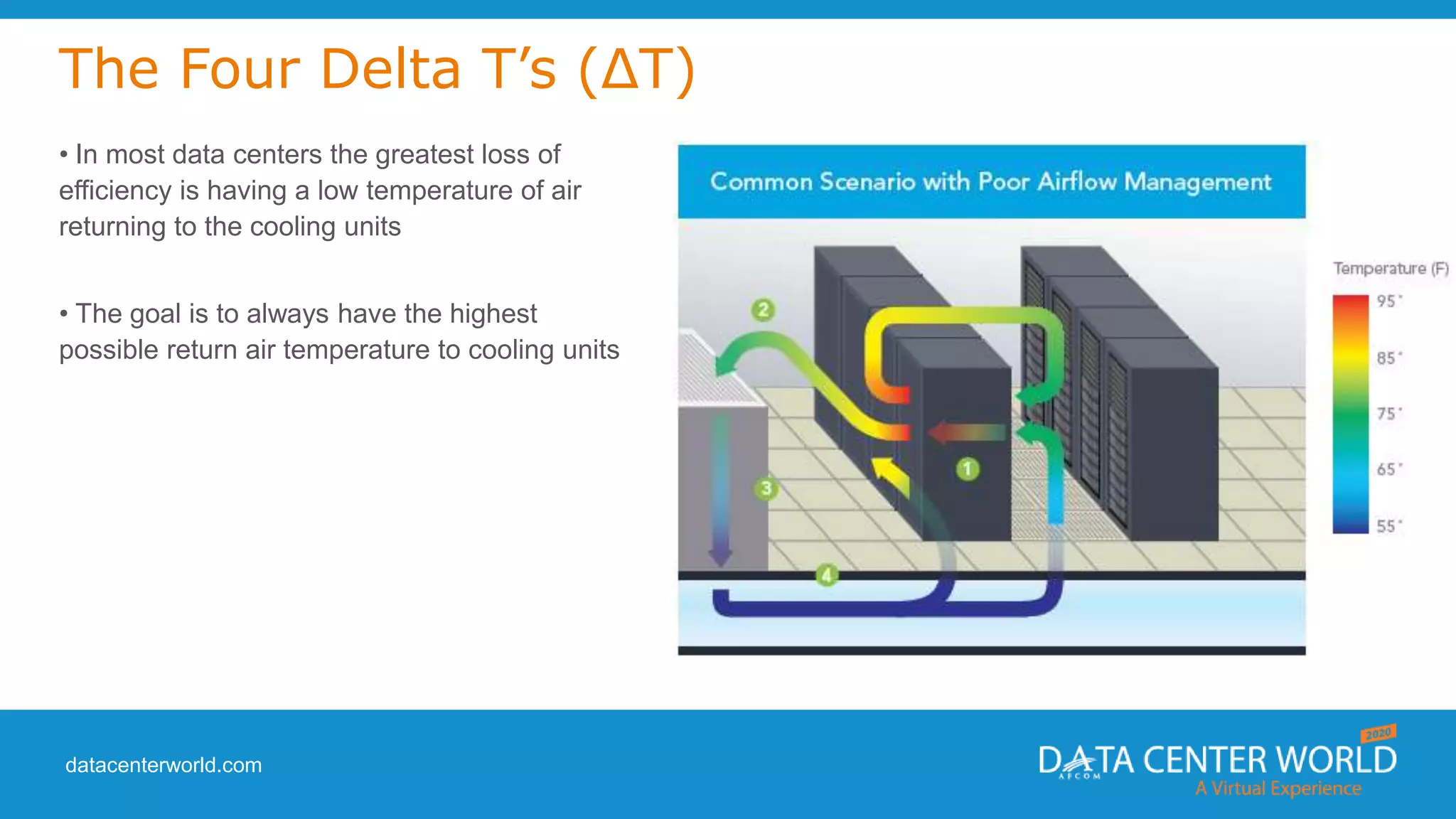
The Four Delta T’s (ΔT)
• In most data centers the greatest loss of
efficiency is having a low temperature of air
returning to the cooling units
• The goal is to always have the highest
possible return air temperature to cooling units
datacenterworld.com
The 4 R’s of Airflow
Management™
datacenterworld.com
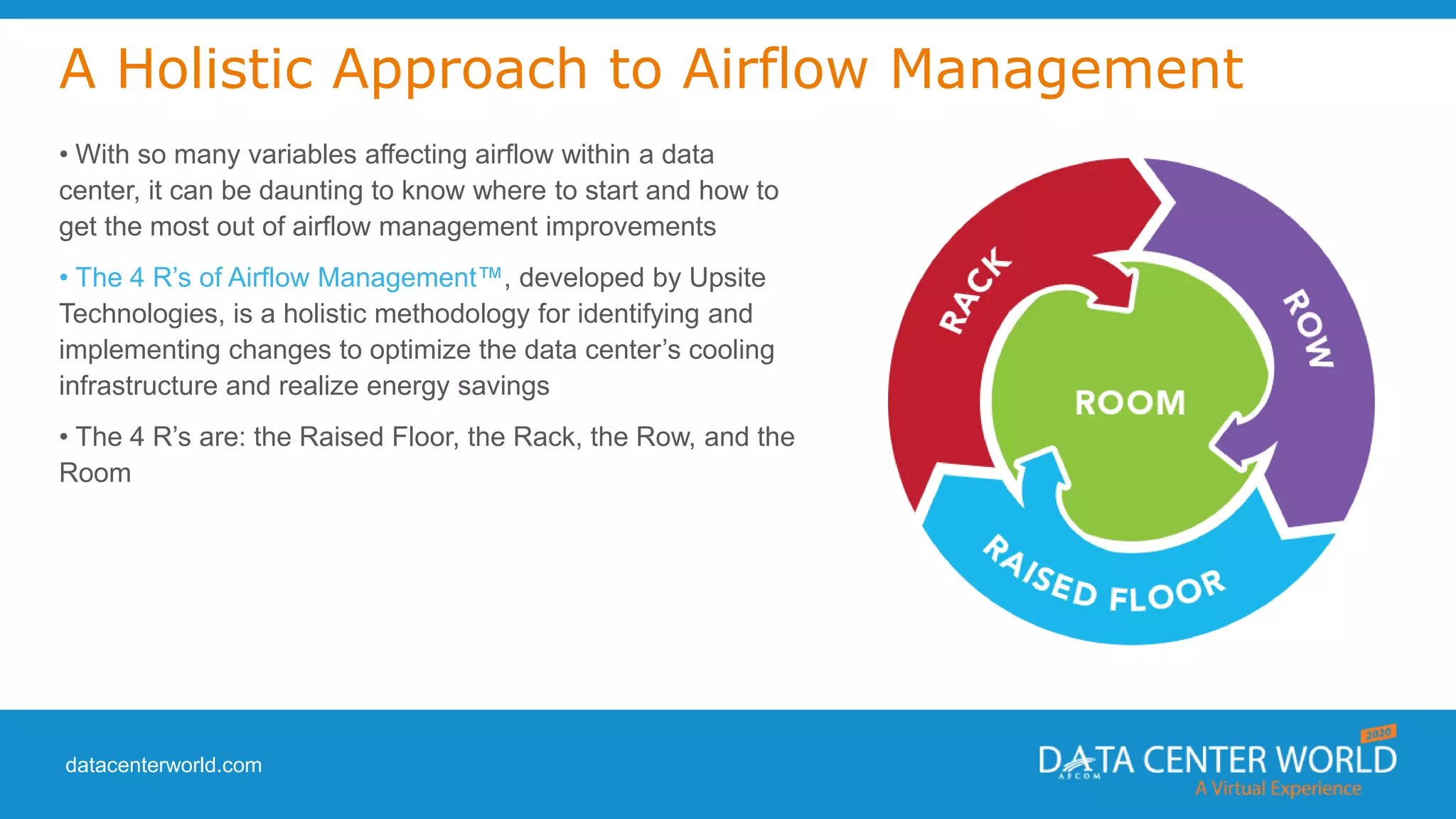
A Holistic Approach to Airflow Management
• With so many variables affecting airflow within a data
center, it can be daunting to know where to start and how to
get the most out of airflow management improvements
• The 4 R’s of Airflow Management™, developed by Upsite
Technologies, is a holistic methodology for identifying and
implementing changes to optimize the data center’s cooling
infrastructure and realize energy savings
• The 4 R’s are: the Raised Floor, the Rack, the Row, and the
Room
datacenterworld.com
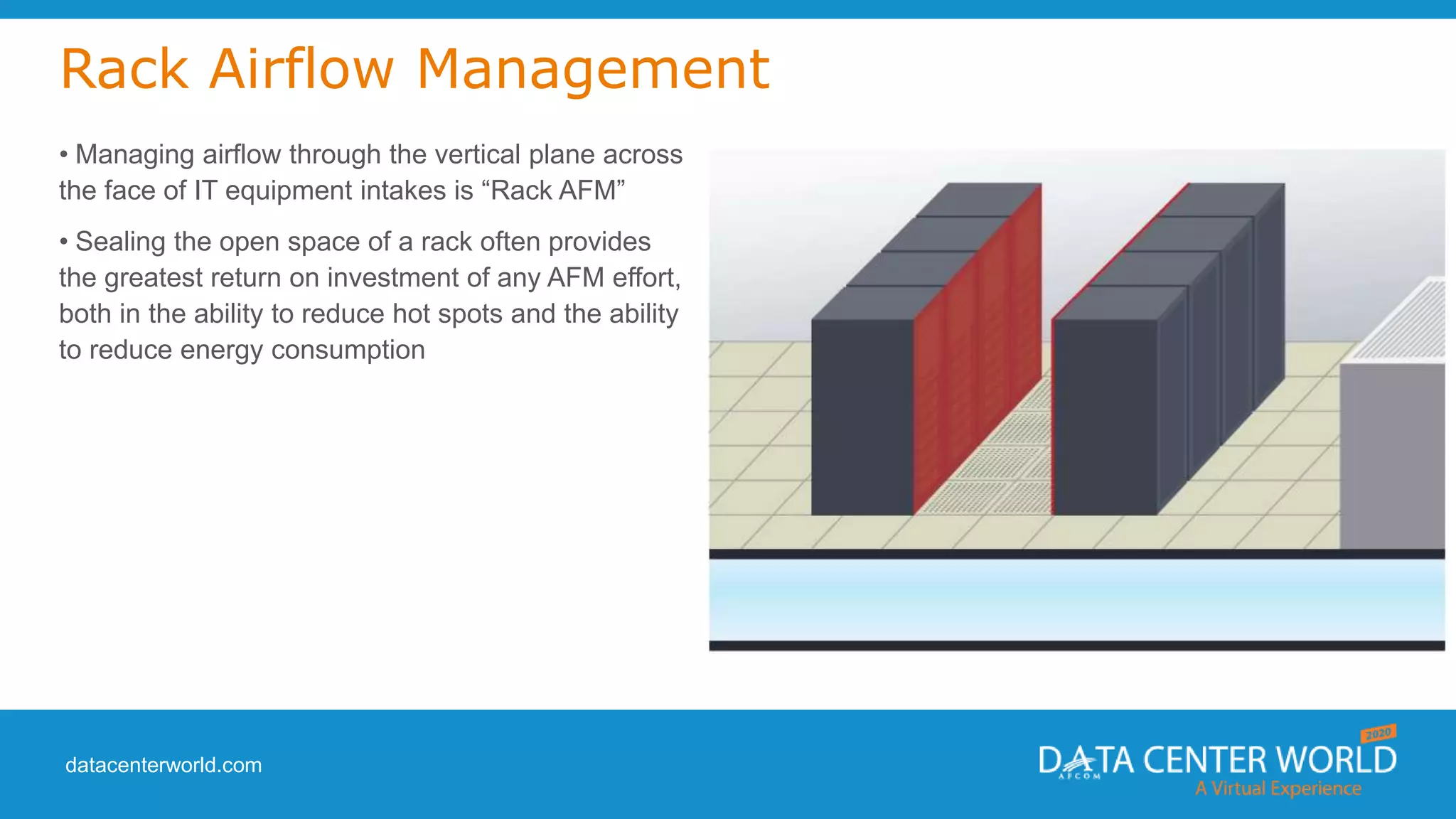
Rack Airflow Management
• Managing airflow through the vertical plane across
the face of IT equipment intakes is “Rack AFM”
• Sealing the open space of a rack often provides
the greatest return on investment of any AFM effort,
both in the ability to reduce hot spots and the ability
to reduce energy consumption
datacenterworld.com
Rack Airflow Management Best Practices
• Install blanking panels in every open U space
• Seal the space between mounting rails and sides of cabinets
• Identify IT equipment mounted to the back rails, commonly switches, that do not have ducted inlets to the face
of the cold aisle and fix with passive cooling channels
• Identify IT equipment facing backwards, inlet facing hot aisle and exhaust blowing into the cold aisle, and
rotate equipment if possible
datacenterworld.com
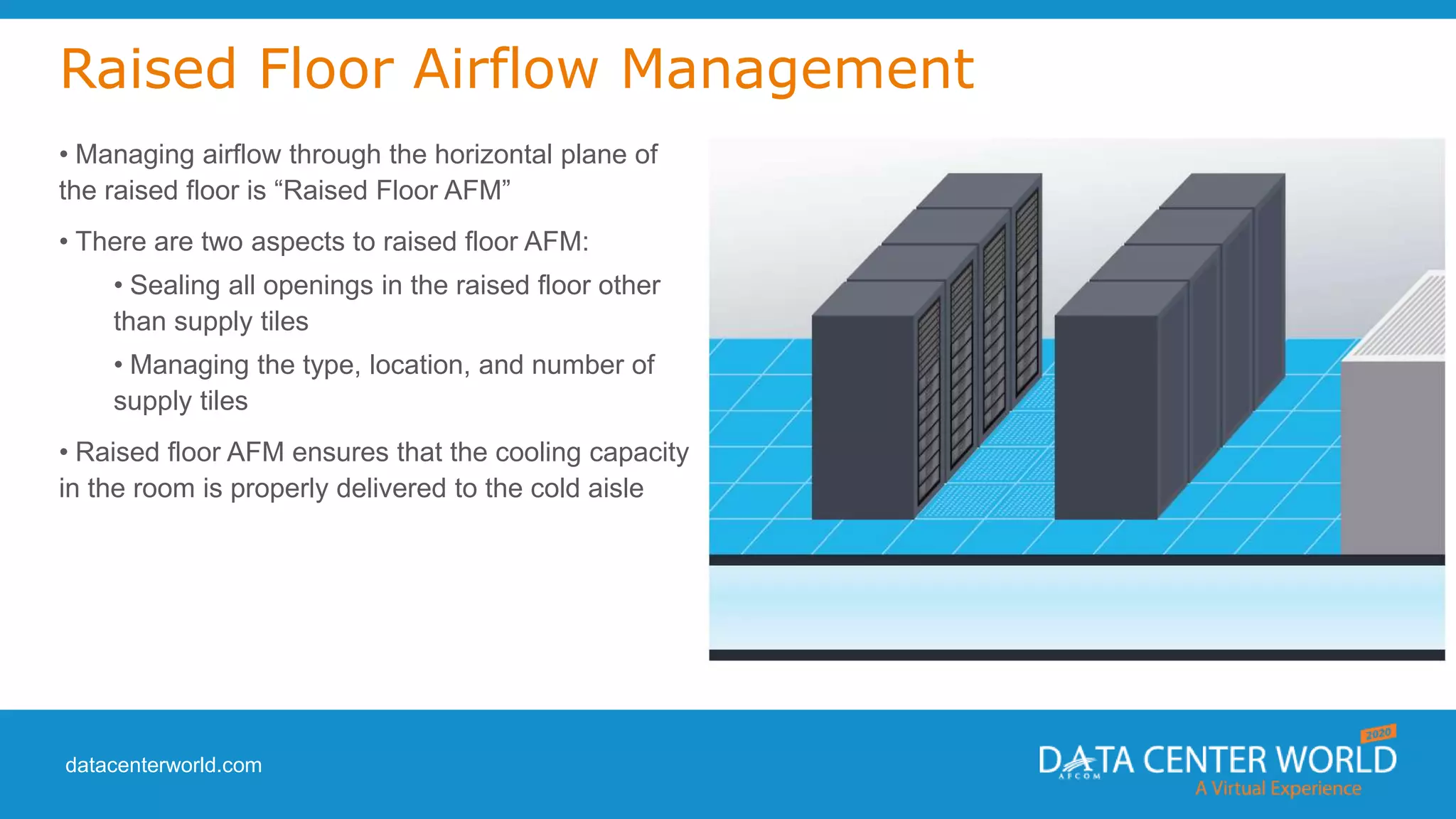
Raised Floor Airflow Management
• Managing airflow through the horizontal plane of
the raised floor is “Raised Floor AFM”
• There are two aspects to raised floor AFM:
• Sealing all openings in the raised floor other
than supply tiles
• Managing the type, location, and number of
supply tiles
• Raised floor AFM ensures that the cooling capacity
in the room is properly delivered to the cold aisle
datacenterworld.com
Raised Floor Airflow Management Best Practices
• Seal cable openings with brush grommets
• Seal openings around the perimeter of the room
• Seal openings in the perimeter walls below the raised floor or around partitions
• Make sure all supply tiles are properly located in front of IT equipment and remove any tiles that are not
supplying cooling air to IT equipment
• Ensure supply tiles are the appropriate size in terms of % open area
datacenterworld.com
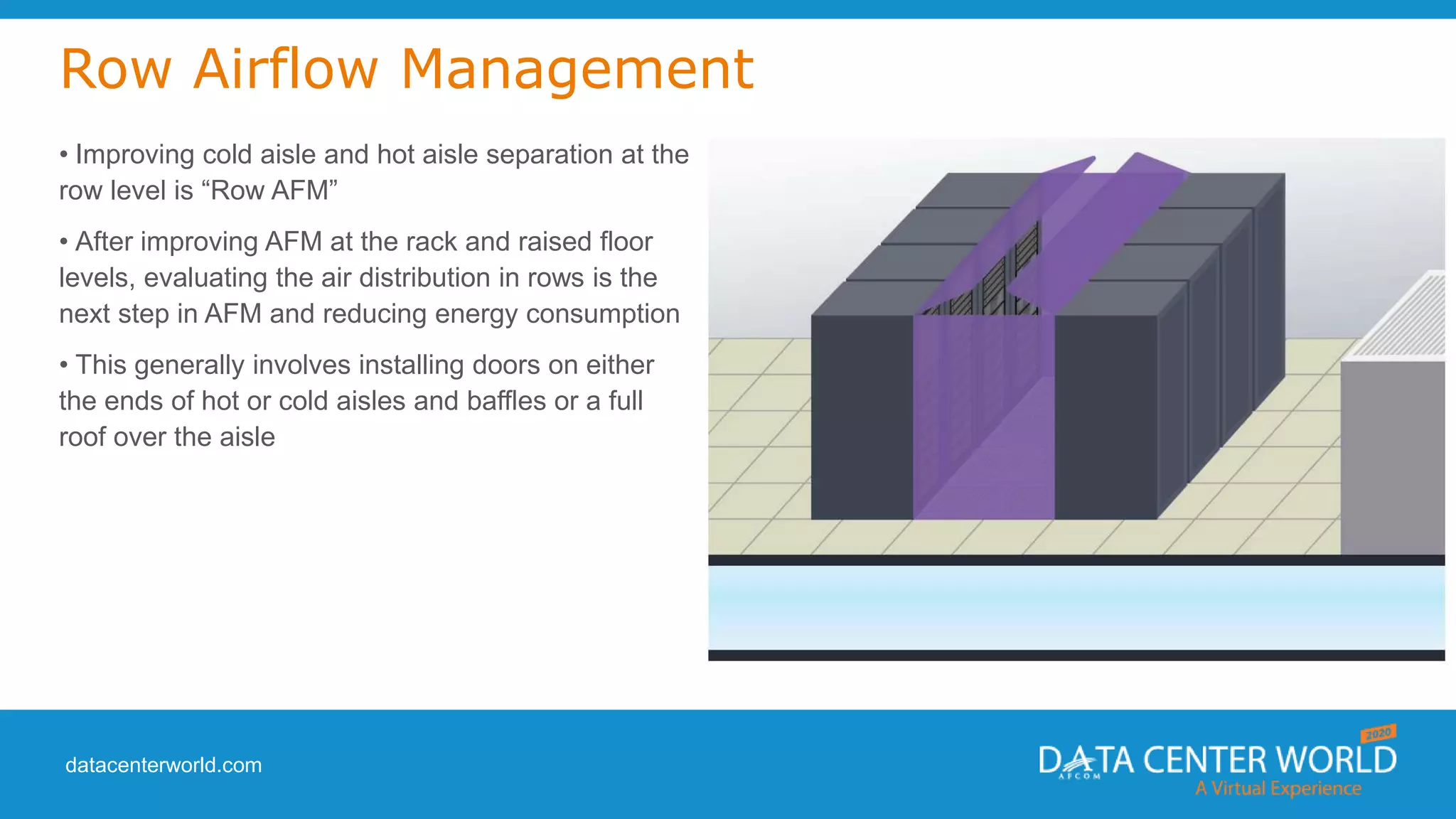
Row Airflow Management
• Improving cold aisle and hot aisle separation at the
row level is “Row AFM”
• After improving AFM at the rack and raised floor
levels, evaluating the air distribution in rows is the
next step in AFM and reducing energy consumption
• This generally involves installing doors on either
the ends of hot or cold aisles and baffles or a full
roof over the aisle
datacenterworld.com
Row Airflow Management Best Practices
• Block open spaces underneath racks to prevent air flowing under the cabinets
• Seal spaces in cabinet rows where there are missing cabinets or gaps between cabinets
• Install aisle end doors on either the hot or cold aisles
• Install top-of-rack containment (partial or full) on either the hot or cold aisles
datacenterworld.com
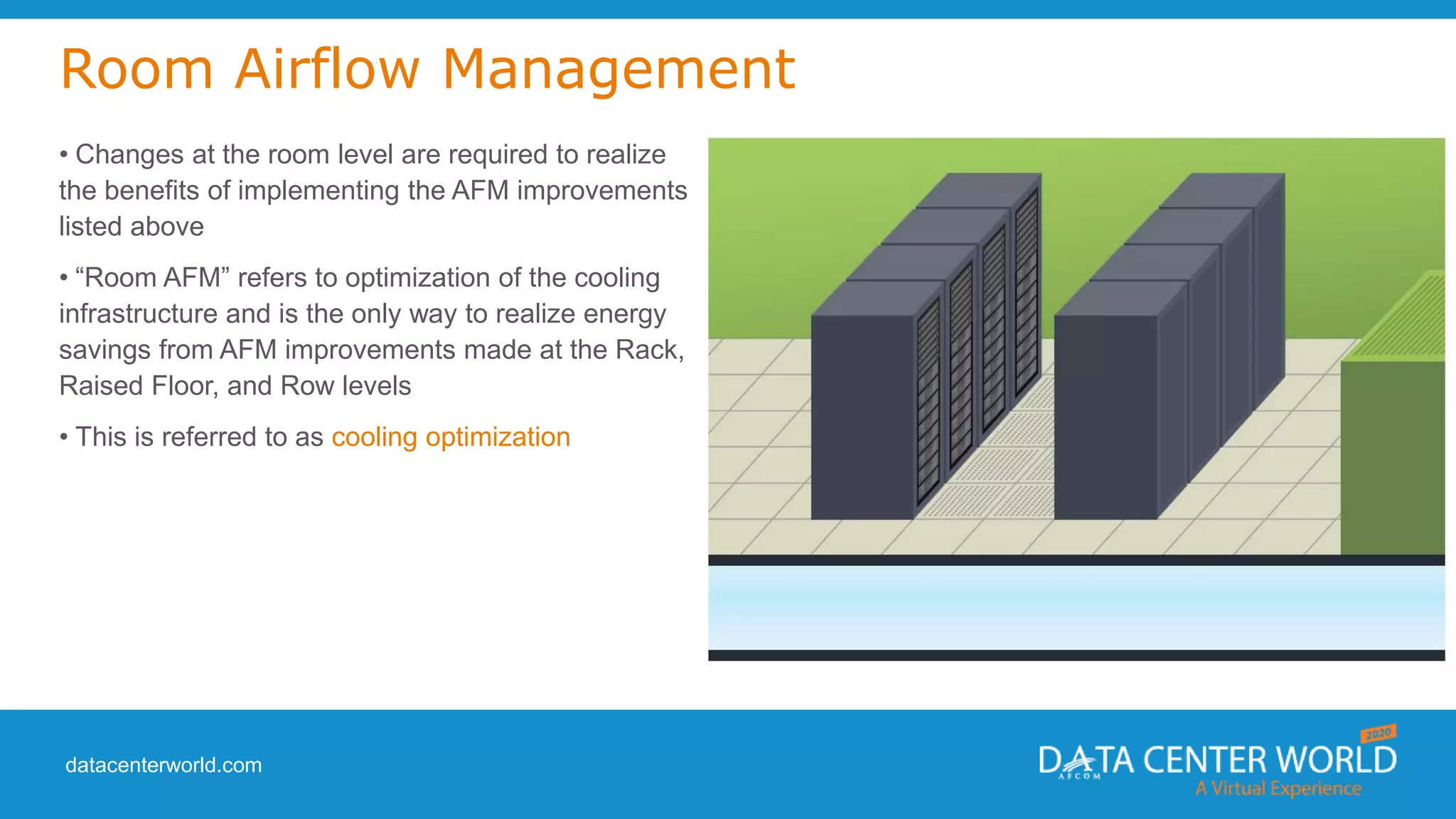
Room Airflow Management
• Changes at the room level are required to realize
the benefits of implementing the AFM improvements
listed above
• “Room AFM” refers to optimization of the cooling
infrastructure and is the only way to realize energy
savings from AFM improvements made at the Rack,
Raised Floor, and Row levels
• This is referred to as cooling optimization
datacenterworld.com
Room Airflow Management Best Practices
• Raising cooling unit air temperature set points as high as possible without exceeding the maximum allowable
IT equipment intake air temperature
• Reduce fan speeds for units with variable frequency drives (VFD) as much as possible without exceeding the
maximum allowable IT equipment intake air temperature
• Expand the allowable relative humidity (Rh) band to prevent cooling units from fighting each other, and the
energy consumption required for humidification
• Turn off excess cooling units when possible
datacenterworld.com
The Importance of
Cooling Optimization
datacenterworld.com
What is Cooling Optimization?
• Cooling optimization is the process of making adjustments to the cooling system controls to improve energy
efficiency resulting in reduced operating costs, improve cooling capacity, improve IT equipment reliability, and
defer capital expenditure
• Cooling optimization is often an iterative process of making adjustments to controls, allowing the system to
equalize, and then making additional adjustments, and so on
• Each time additional airflow management improvements are implemented, or significant IT equipment
changes occur, there are opportunities for refining the cooling optimization
datacenterworld.com
Why is Cooling Optimization Important?
• After any significant airflow management improvement or IT load installation or removal, there’s an opportunity
to evaluate room level controls to ensure efficient operation and sufficient redundant capacity
• Without cooling optimization, every airflow management improvement that has been made is an expense
• Cooling optimization is the only way to achieve a return on investment from airflow management
improvements
• Efficiency can not be purchased, it has to be managed
datacenterworld.com
How Cooling Optimization Works
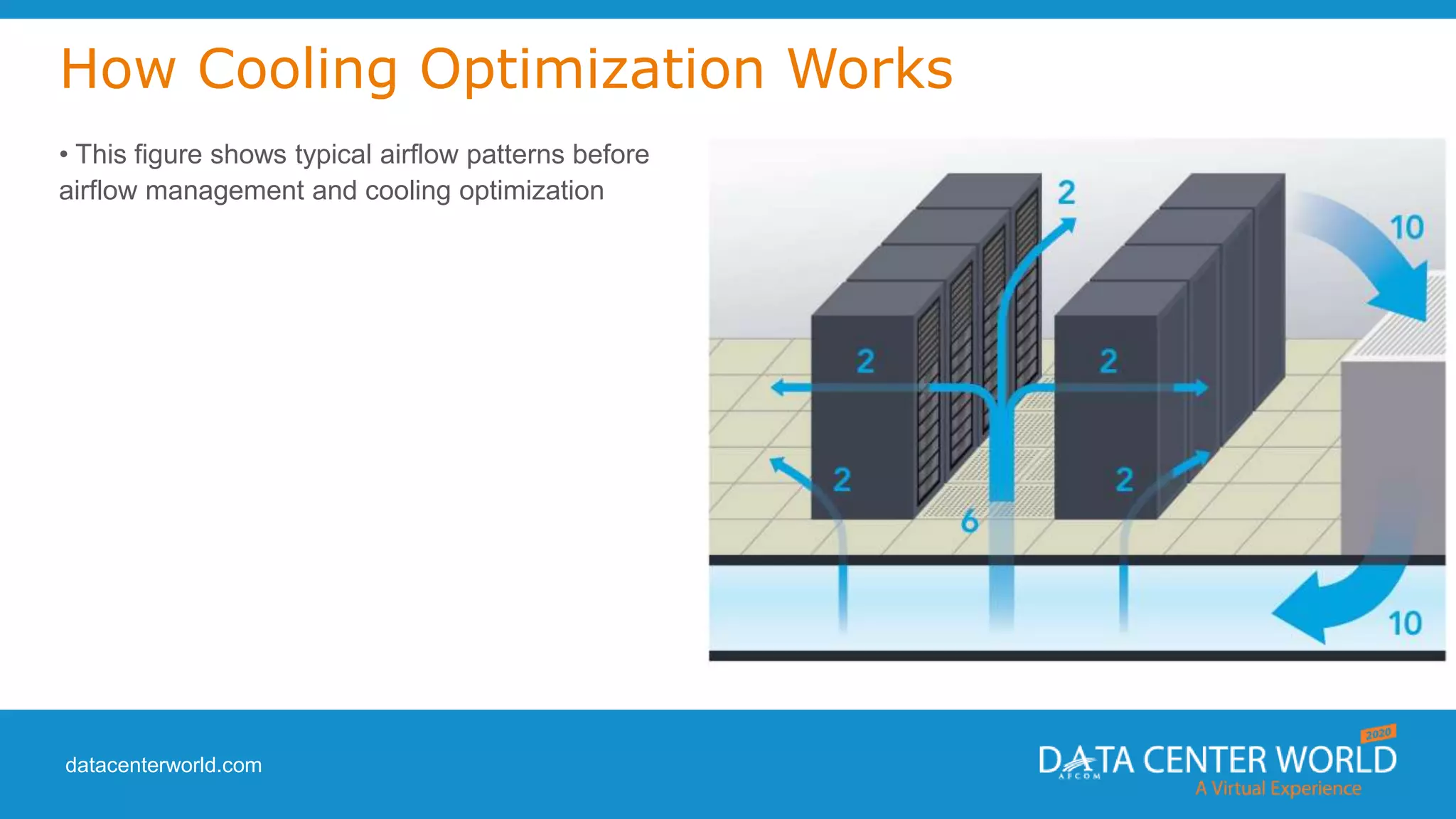
• This figure shows typical airflow patterns before
airflow management and cooling optimization
datacenterworld.com
How Cooling Optimization Works
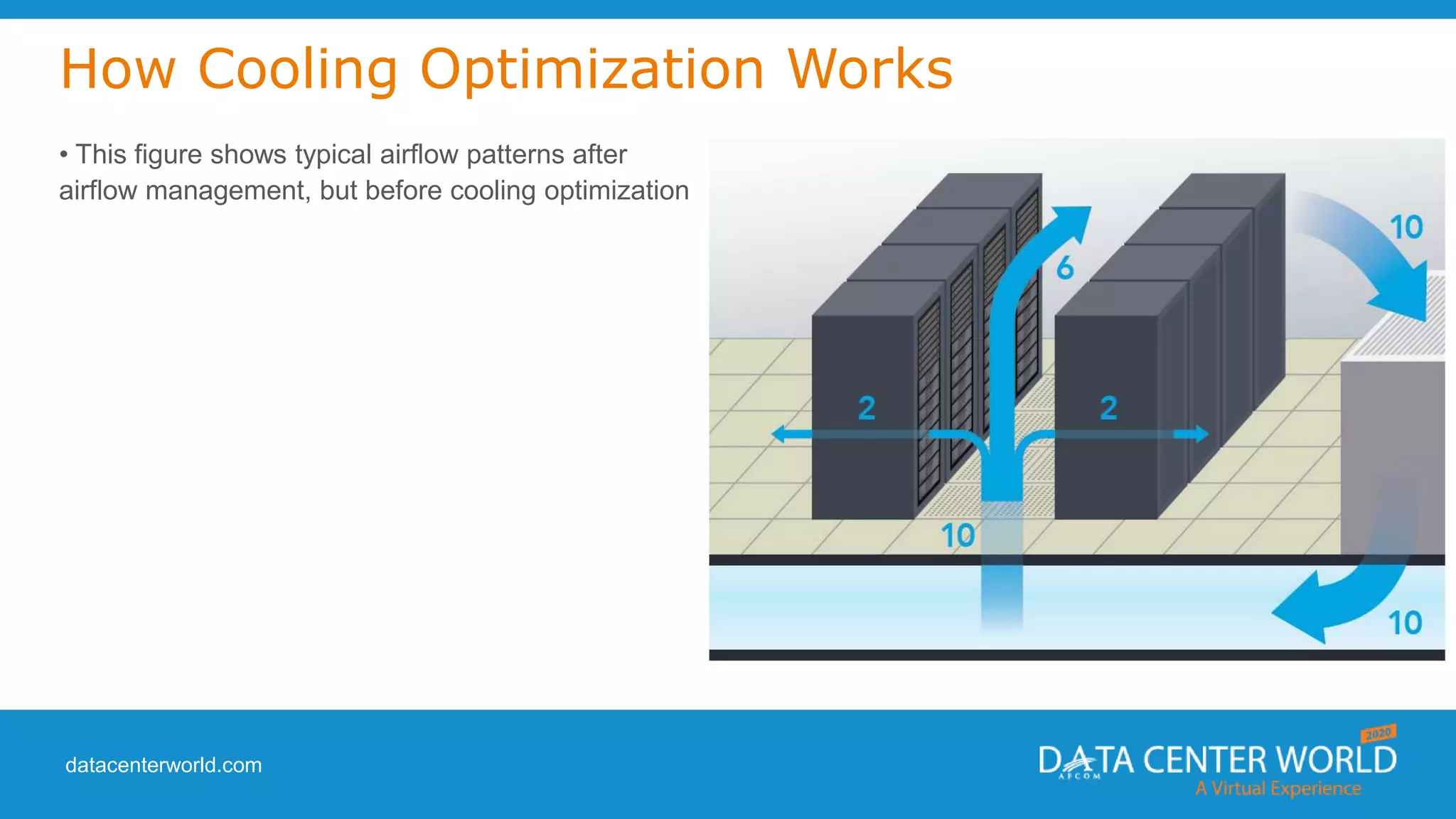
• This figure shows typical airflow patterns after
airflow management, but before cooling optimization
datacenterworld.com
How Cooling Optimization Works
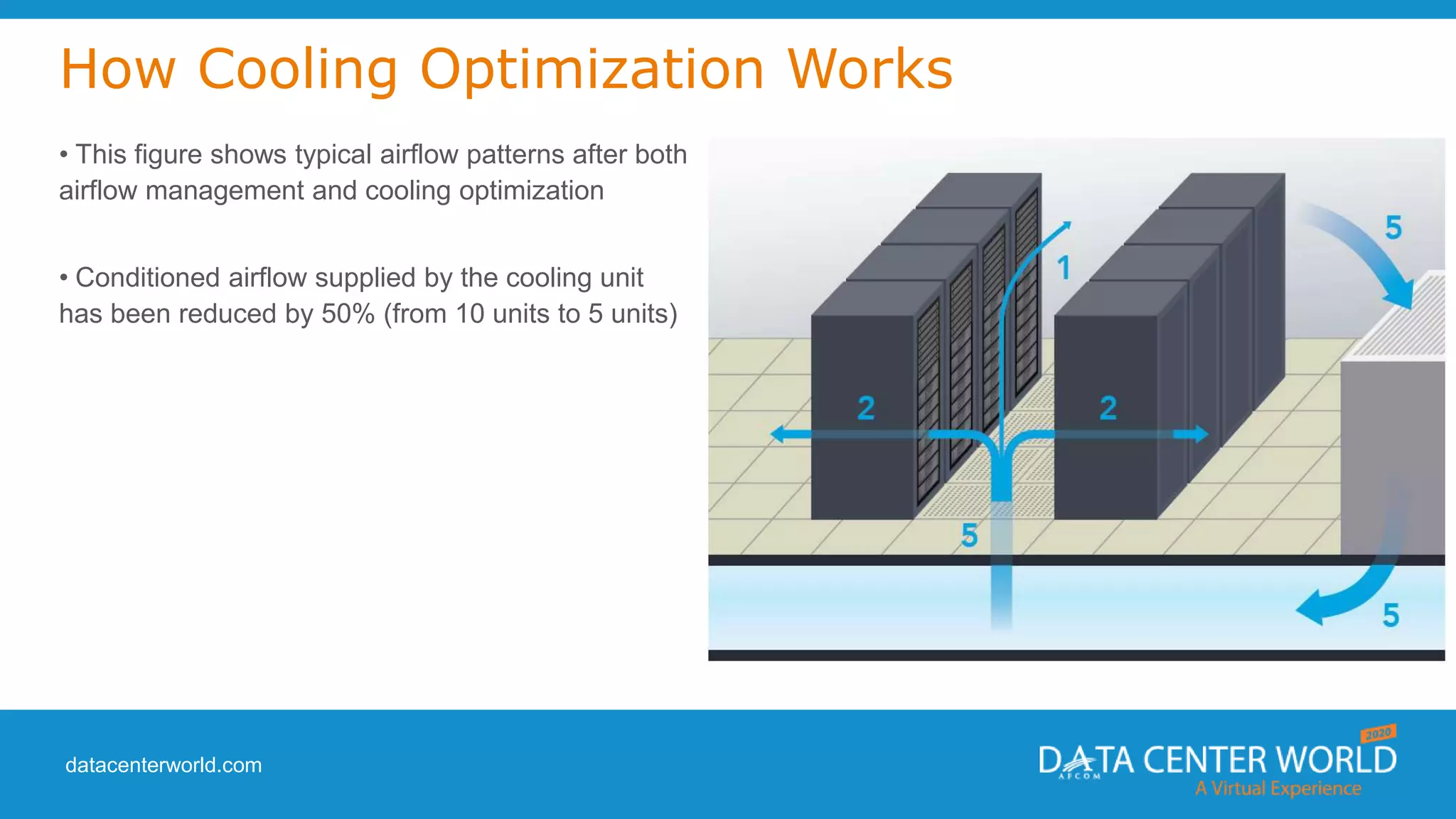
• This figure shows typical airflow patterns after both
airflow management and cooling optimization
• Conditioned airflow supplied by the cooling unit
has been reduced by 50% (from 10 units to 5 units)
datacenterworld.com
Key Takeaways
• Airflow management can have a profound impact on a data center’s cooling strategy
• Improvements at the Rack, Raised Floor, and Row levels are necessary steps to improving IT equipment inlet
temperatures, but alone do not save you and money
• Improving IT equipment inlet temperatures enables the opportunity to optimize the cooling infrastructure
• Cooling optimization is the only way to improve cooling efficiency and reap the financial benefits
• Airflow management and cooling optimization is an iterative process that must be managed
datacenterworld.com
Benefits of Airflow Management and Cooling
Optimization
• Improved efficiency, resulting in reduced operating costs and increased cooling capacity
• Improved IT equipment reliability
• Reduced infrastructure maintenance cost
• Increased available free cooling hours
• Ability to increase chilled water temperature which results in improved chiller efficiency (this can be
substantial)
• For colocation facilities, an increase in the number of customers and/or amount of power that can be sold per
suite
• Deferred capital expenditure, from additional cooling units all the way up to a new data center build
datacenterworld.com
Questions?
Lars Strong
Upsite Technologies
lds@upsite.com
505.798.0208
Facebook LinkedInTwitter
InstagramYouTube Upsite Blog

Cooling Optimization 101: A Beginner's Guide to Data Center Cooling

  • 1.
  • 2.
    datacenterworld.com Cooling Optimization 101:A Beginner's Guide to Data Center Cooling Lars Strong, P.E. Senior Engineer and Company Science Officer Upsite Technologies
  • 3.
    datacenterworld.com Speaker Background Lars Strong,Senior Engineer and Company Science Officer, Upsite Technologies • Thought leader and recognized expert on data center airflow management and cooling optimization with over 23 years of experience • Certified U.S. Department of Energy Data Center Energy Practitioner (DCEP) HVAC and IT Specialist • Previous AFCOM presentations: • For Most Data Centers, Liquid and Air Cooling Will Not be Mutually Exclusive • How IT Decisions Impact Facilities: The Benefit of Mutual Understanding • Designing, Deploying, and Managing Efficient Data Centers • Data Center Cooling Efficiency: Understanding the Science of the 4 Delta T’s
  • 4.
    datacenterworld.com Agenda • The Significanceof Airflow Management Related to Cooling Optimization • ASHRAE Guidelines • Relationship to PUE • Bypass Airflow and Exhaust Air Recirculation • The Four Delta T’s • The 4 R’s of Airflow Management™ • Best Practices • The Importance of Cooling Optimization • How Cooling Optimization Works • Questions
  • 5.
    datacenterworld.com The Significance of AirflowManagement Related to Cooling Optimization
  • 6.
    datacenterworld.com “Power In, HeatOut Always” – Ken Brill • Every kW of power consumed by any equipment in a computer room becomes a kilowatt of heat that needs to be removed • Therefore, the total power being demanded by IT equipment (i.e. total UPS output load) provides a good indication of the cooling capacity required
  • 7.
    datacenterworld.com The Goal ofAirflow Management and Cooling Optimization • Provide appropriate IT equipment intake air conditions and redundant cooling capacity, with the lowest possible flow rate of conditioned air at the warmest possible temperature
  • 8.
    datacenterworld.com What is AirflowManagement? • In a standard data center environment that is cooled by air, airflow management is simply the process of managing the flow of air through the room • Specifically, managing the flow of conditioned or cooled air to the intakes of IT equipment and the flow of exhaust air back to the cooling units • There are many configurations for IT equipment layout and cooling system designs, in all cases airflow management is simply preventing the hot and cold airstreams from mixing • On its own, improving airflow management can reduce IT equipment intake air temperatures which improves IT equipment reliability • It also enables the adjustment of cooling controls and set points to reduce operating costs, improve cooling capacity, and defer capital expenditure
  • 9.
    datacenterworld.com Ideal Hot andCold Aisle Configuration (With Good Airflow Management)
  • 10.
    datacenterworld.com Typical Hot andCold Aisle Configuration (With Poor Airflow Management)
  • 11.
  • 12.
  • 13.
    datacenterworld.com Typical Hot andCold Aisle Configuration (With Poor Airflow Management)
  • 14.
    datacenterworld.com How Airflow ManagementRelates to PUE • There is a direct relationship between airflow management and PUE – the better the airflow management, the better the PUE • Mechanical cooling + fan cooling is 35% of total load and 73% of non-IT load Total Load IT Load PUE = = 1.92
  • 15.
    datacenterworld.com How Airflow ManagementRelates to PUE • There is a direct relationship between airflow management and PUE – the better the airflow management, the better the PUE • Mechanical cooling + fan cooling is 35% of total load and 73% of non-IT load Total Load IT Load PUE = = 1.92 35%
  • 16.
    datacenterworld.com Bypass Airflow • Bypassairflow is any conditioned air from a cooling unit that does not pass through IT equipment before returning to the cooling unit • The total volumetric flow rate of conditioned air through cooling units is independent of the volumetric flow rate of air through IT equipment • Bypass airflow (cfm) = Total cooling flow (cfm) – Total IT equipment demand flow (cfm)
  • 17.
    datacenterworld.com Bypass Airflow Clarified •This figure shows typical airflow patterns before airflow management • The arrows near the bottom of the cabinets represent bypass airflow through unsealed cable openings
  • 18.
    datacenterworld.com Exhaust Air Recirculation •Exhaust air recirculation is any air that passes through IT equipment more than once before returning to a cooling unit • This is when warm exhaust air mixes with the cold supply air and raises the intake temperatures possibly causing hot spots and reducing IT equipment reliability • Exhaust air recirculation limits the reduction of fan speed and the raising of supply temperatures during cooling optimization efforts
  • 19.
    datacenterworld.com Exhaust Air Recirculation •There are four areas where exhaust air recirculation can occur: • Around the end of cabinet rows • Over the tops of cabinets • Through the cabinet • Underneath cabinets
  • 20.
    datacenterworld.com The Four DeltaT’s (ΔT) • Delta T (ΔT) = Change in temperature • There are four different ΔT’s which contribute to the health of the data center • Two of these temperature differentials are well known, however there are two additional ΔT’s that are not well known and rarely considered, yet they are crucial to improving airflow management and reducing energy consumption
  • 21.
    datacenterworld.com The Four DeltaT’s (ΔT) 1. Though IT equipment 2. IT equipment exhaust to cooling unit 3. Through cooling unit 4. Cooling unit supply to IT equipment intake
  • 22.
    datacenterworld.com The Four DeltaT’s (ΔT) • In most data centers the greatest loss of efficiency is having a low temperature of air returning to the cooling units • The goal is to always have the highest possible return air temperature to cooling units
  • 23.
    datacenterworld.com The 4 R’sof Airflow Management™
  • 24.
    datacenterworld.com A Holistic Approachto Airflow Management • With so many variables affecting airflow within a data center, it can be daunting to know where to start and how to get the most out of airflow management improvements • The 4 R’s of Airflow Management™, developed by Upsite Technologies, is a holistic methodology for identifying and implementing changes to optimize the data center’s cooling infrastructure and realize energy savings • The 4 R’s are: the Raised Floor, the Rack, the Row, and the Room
  • 25.
    datacenterworld.com Rack Airflow Management •Managing airflow through the vertical plane across the face of IT equipment intakes is “Rack AFM” • Sealing the open space of a rack often provides the greatest return on investment of any AFM effort, both in the ability to reduce hot spots and the ability to reduce energy consumption
  • 26.
    datacenterworld.com Rack Airflow ManagementBest Practices • Install blanking panels in every open U space • Seal the space between mounting rails and sides of cabinets • Identify IT equipment mounted to the back rails, commonly switches, that do not have ducted inlets to the face of the cold aisle and fix with passive cooling channels • Identify IT equipment facing backwards, inlet facing hot aisle and exhaust blowing into the cold aisle, and rotate equipment if possible
  • 27.
    datacenterworld.com Raised Floor AirflowManagement • Managing airflow through the horizontal plane of the raised floor is “Raised Floor AFM” • There are two aspects to raised floor AFM: • Sealing all openings in the raised floor other than supply tiles • Managing the type, location, and number of supply tiles • Raised floor AFM ensures that the cooling capacity in the room is properly delivered to the cold aisle
  • 28.
    datacenterworld.com Raised Floor AirflowManagement Best Practices • Seal cable openings with brush grommets • Seal openings around the perimeter of the room • Seal openings in the perimeter walls below the raised floor or around partitions • Make sure all supply tiles are properly located in front of IT equipment and remove any tiles that are not supplying cooling air to IT equipment • Ensure supply tiles are the appropriate size in terms of % open area
  • 29.
    datacenterworld.com Row Airflow Management •Improving cold aisle and hot aisle separation at the row level is “Row AFM” • After improving AFM at the rack and raised floor levels, evaluating the air distribution in rows is the next step in AFM and reducing energy consumption • This generally involves installing doors on either the ends of hot or cold aisles and baffles or a full roof over the aisle
  • 30.
    datacenterworld.com Row Airflow ManagementBest Practices • Block open spaces underneath racks to prevent air flowing under the cabinets • Seal spaces in cabinet rows where there are missing cabinets or gaps between cabinets • Install aisle end doors on either the hot or cold aisles • Install top-of-rack containment (partial or full) on either the hot or cold aisles
  • 31.
    datacenterworld.com Room Airflow Management •Changes at the room level are required to realize the benefits of implementing the AFM improvements listed above • “Room AFM” refers to optimization of the cooling infrastructure and is the only way to realize energy savings from AFM improvements made at the Rack, Raised Floor, and Row levels • This is referred to as cooling optimization
  • 32.
    datacenterworld.com Room Airflow ManagementBest Practices • Raising cooling unit air temperature set points as high as possible without exceeding the maximum allowable IT equipment intake air temperature • Reduce fan speeds for units with variable frequency drives (VFD) as much as possible without exceeding the maximum allowable IT equipment intake air temperature • Expand the allowable relative humidity (Rh) band to prevent cooling units from fighting each other, and the energy consumption required for humidification • Turn off excess cooling units when possible
  • 33.
  • 34.
    datacenterworld.com What is CoolingOptimization? • Cooling optimization is the process of making adjustments to the cooling system controls to improve energy efficiency resulting in reduced operating costs, improve cooling capacity, improve IT equipment reliability, and defer capital expenditure • Cooling optimization is often an iterative process of making adjustments to controls, allowing the system to equalize, and then making additional adjustments, and so on • Each time additional airflow management improvements are implemented, or significant IT equipment changes occur, there are opportunities for refining the cooling optimization
  • 35.
    datacenterworld.com Why is CoolingOptimization Important? • After any significant airflow management improvement or IT load installation or removal, there’s an opportunity to evaluate room level controls to ensure efficient operation and sufficient redundant capacity • Without cooling optimization, every airflow management improvement that has been made is an expense • Cooling optimization is the only way to achieve a return on investment from airflow management improvements • Efficiency can not be purchased, it has to be managed
  • 36.
    datacenterworld.com How Cooling OptimizationWorks • This figure shows typical airflow patterns before airflow management and cooling optimization
  • 37.
    datacenterworld.com How Cooling OptimizationWorks • This figure shows typical airflow patterns after airflow management, but before cooling optimization
  • 38.
    datacenterworld.com How Cooling OptimizationWorks • This figure shows typical airflow patterns after both airflow management and cooling optimization • Conditioned airflow supplied by the cooling unit has been reduced by 50% (from 10 units to 5 units)
  • 39.
    datacenterworld.com Key Takeaways • Airflowmanagement can have a profound impact on a data center’s cooling strategy • Improvements at the Rack, Raised Floor, and Row levels are necessary steps to improving IT equipment inlet temperatures, but alone do not save you and money • Improving IT equipment inlet temperatures enables the opportunity to optimize the cooling infrastructure • Cooling optimization is the only way to improve cooling efficiency and reap the financial benefits • Airflow management and cooling optimization is an iterative process that must be managed
  • 40.
    datacenterworld.com Benefits of AirflowManagement and Cooling Optimization • Improved efficiency, resulting in reduced operating costs and increased cooling capacity • Improved IT equipment reliability • Reduced infrastructure maintenance cost • Increased available free cooling hours • Ability to increase chilled water temperature which results in improved chiller efficiency (this can be substantial) • For colocation facilities, an increase in the number of customers and/or amount of power that can be sold per suite • Deferred capital expenditure, from additional cooling units all the way up to a new data center build
  • 41.

Editor's Notes

  • #13 Even though A3 and A4 have higher allowable intake temperatures, ASHRAE still recommends 64.4 to 80.6