OpeningKeynote–
2020andBeyond:EnterpriseDataCentreTrendsand
Prediction
Barry Lewington – Head of Data Centre Service Practice
6th December 2016
2© PTS Consulting 2016
SettingtheScene
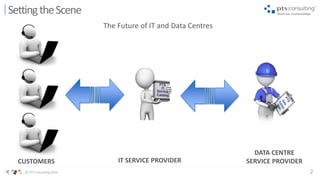
The Future of IT and Data Centres
CUSTOMERS IT SERVICE PROVIDER
DATA CENTRE
SERVICE PROVIDER
3© PTS Consulting 2016
TheChallenges
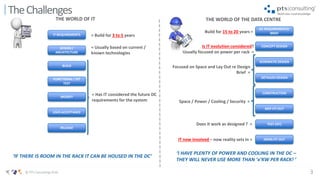
THE WORLD OF IT THE WORLD OF THE DATA CENTRE
DC REQUIREMENTS/
BRIEFBuild for 15 to 20 years =
IT REQUIREMENTS = Build for 3 to 5 years
CONCEPT DESIGNIs IT evolution considered?
Usually focused on power per rack =
SCHEMATIC DESIGN
DETAILED DESIGN
Focused on Space and Lay Out re Design
Brief =
DESIGN /
ARCHITECTURE
= Usually based on current /
known technologies
CONSTRUCTION
MEP FIT OUT
Space / Power / Cooling / Security =
TEST (IST)Does it work as designed ? =
BUILD
FUNCTIONAL / SIT
TEST
MODIFY
USER ACCEPTANCE
RELEASE
= Has IT considered the future DC
requirements for the system
INFRA FIT OUTIT now involved – now reality sets in =
‘IF THERE IS ROOM IN THE RACK IT CAN BE HOUSED IN THE DC’
‘I HAVE PLENTY OF POWER AND COOLING IN THE DC –
THEY WILL NEVER USE MORE THAN ‘x’KW PER RACK! ’
4© PTS Consulting 2016
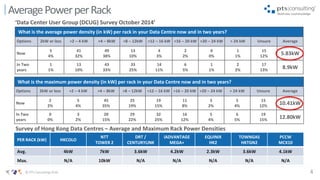
What is the maximum power density (in kW) per rack in your Data Centre now and in two years?
Options 2kW or less >2 – 4 kW >4 – 8kW >8 – 12kW >12 – 16 kW >16 – 20 kW >20 – 24 kW > 24 kW Unsure Average
Now
2
2%
5
4%
45
35%
25
19%
19
15%
11
8%
3
2%
5
4%
15
12%
10.41kW
In Two
years
0
0%
3
2%
20
15%
29
22%
32
25%
16
12%
5
4%
6
5%
19
15%
12.80kW
What is the average power density (in kW) per rack in your Data Centre now and in two years?
Options 2kW or less >2 – 4 kW >4 – 8kW >8 – 12kW >12 – 16 kW >16 – 20 kW >20 – 24 kW > 24 kW Unsure Average
Now
5
4%
41
32%
49
38%
13
10%
4
3%
2
2%
0
0%
1
1%
15
12%
5.83kW
In Two
years
1
1%
13
10%
43
33%
33
25%
14
11%
6
5%
1
1%
2
2%
17
13%
8.9kW
AveragePowerperRack
PER RACK (kW) HKCOLO
NTT
TOWER 2
DRT /
CENTURYLINK
iADVANTAGE
MEGA+
EQUINIX
HK2
TOWNGAS
HKTGN2
PCCW
MCX10
Avg. 4kW 7kW 3.6kW 4.2kW 2.3kW 3.6kW 4.1kW
Max. N/A 10kW N/A N/A N/A N/A N/A
‘Data Center User Group (DCUG) Survey October 2014’
Survey of Hong Kong Data Centres – Average and Maximum Rack Power Densities
5© PTS Consulting 2016
HowdoesIT&DCseetheFuture
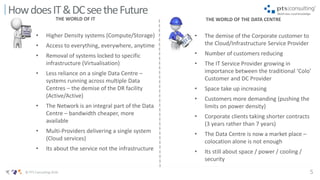
THE WORLD OF IT THE WORLD OF THE DATA CENTRE
• Higher Density systems (Compute/Storage)
• Access to everything, everywhere, anytime
• Removal of systems locked to specific
infrastructure (Virtualisation)
• Less reliance on a single Data Centre –
systems running across multiple Data
Centres – the demise of the DR facility
(Active/Active)
• The Network is an integral part of the Data
Centre – bandwidth cheaper, more
available
• Multi-Providers delivering a single system
(Cloud services)
• Its about the service not the infrastructure
• The demise of the Corporate customer to
the Cloud/Infrastructure Service Provider
• Number of customers reducing
• The IT Service Provider growing in
importance between the traditional ‘Colo’
Customer and DC Provider
• Space take up increasing
• Customers more demanding (pushing the
limits on power density)
• Corporate clients taking shorter contracts
(3 years rather than 7 years)
• The Data Centre is now a market place –
colocation alone is not enough
• Its still about space / power / cooling /
security
6© PTS Consulting 2016
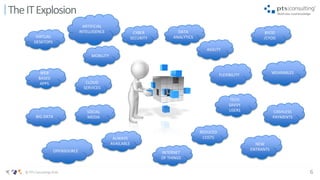
TheITExplosion
MOBILITY
CLOUD
SERVICES
CYBER
SECURITY
AGILITY
FLEXIBILITY
REDUCED
COSTS
INTERNET
OF THINGS
ALWAYS
AVAILABLE
SOCIAL
MEDIA
TECH
SAVVY
USERS
DATA
ANALYTICSVIRTUAL
DESKTOPS
WEB
BASED
APPS
BIG DATA
BYOD
/CYOD
WEARABLES
CASHLESS
PAYMENTS
OPENSOURCE
NEW
ENTRANTS
ARTIFICIAL
INTELLIGENCE
7© PTS Consulting 2016
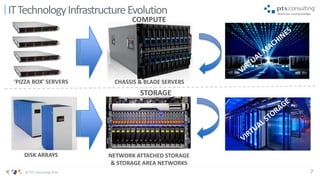
ITTechnologyInfrastructureEvolution
COMPUTE
STORAGE
‘PIZZA BOX’ SERVERS CHASSIS & BLADE SERVERS
DISK ARRAYS NETWORK ATTACHED STORAGE
& STORAGE AREA NETWORKS
8© PTS Consulting 2016
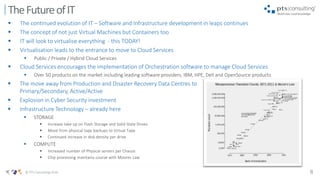
 The continued evolution of IT – Software and Infrastructure development in leaps continues
 The concept of not just Virtual Machines but Containers too
 IT will look to virtualise everything - this TODAY!
 Virtualisation leads to the entrance to move to Cloud Services
 Public / Private / Hybrid Cloud Services
 Cloud Services encourages the implementation of Orchestration software to manage Cloud Services
 Over 50 products on the market including leading software providers, IBM, HPE, Dell and OpenSource products
TheFutureofIT
 The move away from Production and Disaster Recovery Data Centres to
Primary/Secondary, Active/Active
 Explosion in Cyber Security investment
 Infrastructure Technology – already here
 STORAGE
 Increase take up on Flash Storage and Solid State Drives
 Move from physical tape backups to Virtual Tape
 Continued increase in disk density per drive
 COMPUTE
 Increased number of Physical servers per Chassis
 Chip processing maintains course with Moores Law
9© PTS Consulting 2016
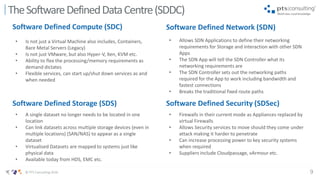
TheSoftwareDefinedDataCentre(SDDC)
Software Defined Compute (SDC) Software Defined Network (SDN)
Software Defined Storage (SDS) Software Defined Security (SDSec)
• Is not just a Virtual Machine also includes, Containers,
Bare Metal Servers (Legacy)
• Is not just VMware, but also Hyper-V, Xen, KVM etc.
• Ability to flex the processing/memory requirements as
demand dictates
• Flexible services, can start up/shut down services as and
when needed
• A single dataset no longer needs to be located in one
location
• Can link datasets across multiple storage devices (even in
multiple locations) (SAN/NAS) to appear as a single
dataset
• Virtualised Datasets are mapped to systems just like
physical data
• Available today from HDS, EMC etc.
• Firewalls in their current mode as Appliances replaced by
virtual Firewalls
• Allows Security services to move should they come under
attack making it harder to penetrate
• Can increase processing power to key security systems
when required
• Suppliers include Cloudpassage, vArmour etc.
• Allows SDN Applications to define their networking
requirements for Storage and interaction with other SDN
Apps
• The SDN App will tell the SDN Controller what its
networking requirements are
• The SDN Controller sets out the networking paths
required for the App to work including bandwidth and
fastest connections
• Breaks the traditional fixed route paths
10© PTS Consulting 2016
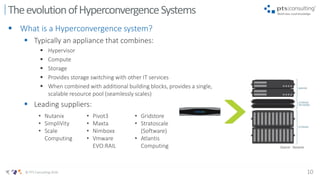
TheevolutionofHyperconvergenceSystems
• Nutanix
• SimpliVity
• Scale
Computing
• Pivot3
• Maxta
• Nimboxx
• Vmware
EVO:RAIL
• Gridstore
• Stratoscale
(Software)
• Atlantis
Computing Source - Nutanix
 What is a Hyperconvergence system?
 Typically an appliance that combines:
 Hypervisor
 Compute
 Storage
 Provides storage switching with other IT services
 When combined with additional building blocks, provides a single,
scalable resource pool (seamlessly scales)
 Leading suppliers:
11© PTS Consulting 2016
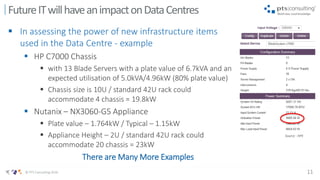
 In assessing the power of new infrastructure items
used in the Data Centre - example
 HP C7000 Chassis
 with 13 Blade Servers with a plate value of 6.7kVA and an
expected utilisation of 5.0kVA/4.96kW (80% plate value)
 Chassis size is 10U / standard 42U rack could
accommodate 4 chassis = 19.8kW
 Nutanix – NX3060-G5 Appliance
 Plate value – 1.764kW / Typical – 1.15kW
 Appliance Height – 2U / standard 42U rack could
accommodate 20 chassis = 23kW
There are Many More Examples
FutureITwillhaveanimpactonDataCentres
Source - HPE
12© PTS Consulting 2016
 The trend for IT is higher density – 10kW/20kW/30kW……. 60kW
 New Data Centres being built with an average rack density of 5kW – 7kW
 Traditional cooling methods in Data Centres become generally ineffective
when average rack utilisation hits 10kW
 Specific cooling is required to effectively dissipate the concentrated heat
areas
 Air is not the most effective medium for cooling
 Bringing fluid cooling back as close to the heat source is required
 New products now available to address the issue of high density cooling
TheChallengeAheadforITandDataCentreOperators
13© PTS Consulting 2016
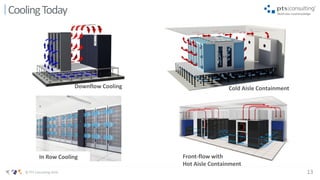
CoolingToday
Downflow Cooling Cold Aisle Containment
Front-flow with
Hot Aisle Containment
In Row Cooling
14© PTS Consulting 2016
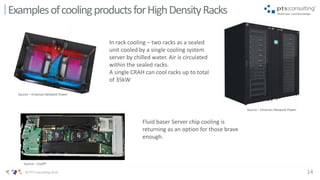
ExamplesofcoolingproductsforHighDensityRacks
In rack cooling – two racks as a sealed
unit cooled by a single cooling system
server by chilled water. Air is circulated
within the sealed racks.
A single CRAH can cool racks up to total
of 35kW
Source – Emerson Network Power
Fluid baser Server chip cooling is
returning as an option for those brave
enough.
Source – CoolIT
Source – Emerson Network Power
15© PTS Consulting 2016
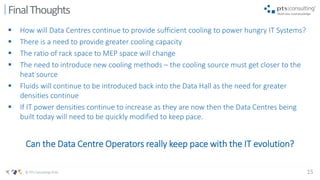
 How will Data Centres continue to provide sufficient cooling to power hungry IT Systems?
 There is a need to provide greater cooling capacity
 The ratio of rack space to MEP space will change
 The need to introduce new cooling methods – the cooling source must get closer to the
heat source
 Fluids will continue to be introduced back into the Data Hall as the need for greater
densities continue
 If IT power densities continue to increase as they are now then the Data Centres being
built today will need to be quickly modified to keep pace.
Can the Data Centre Operators really keep pace with the IT evolution?
FinalThoughts
PTS Consulting (HK) Ltd.
29/f, WingOn Centre, 111, Connaught Road Central, Sheung Wan. Hong Kong.
www.ptsconsulting.com
Questions

MIG 5th Data Centre Summit 2016 PTS Presentation v1

  • 1.
  • 2.
    2© PTS Consulting2016 SettingtheScene The Future of IT and Data Centres CUSTOMERS IT SERVICE PROVIDER DATA CENTRE SERVICE PROVIDER
  • 3.
    3© PTS Consulting2016 TheChallenges THE WORLD OF IT THE WORLD OF THE DATA CENTRE DC REQUIREMENTS/ BRIEFBuild for 15 to 20 years = IT REQUIREMENTS = Build for 3 to 5 years CONCEPT DESIGNIs IT evolution considered? Usually focused on power per rack = SCHEMATIC DESIGN DETAILED DESIGN Focused on Space and Lay Out re Design Brief = DESIGN / ARCHITECTURE = Usually based on current / known technologies CONSTRUCTION MEP FIT OUT Space / Power / Cooling / Security = TEST (IST)Does it work as designed ? = BUILD FUNCTIONAL / SIT TEST MODIFY USER ACCEPTANCE RELEASE = Has IT considered the future DC requirements for the system INFRA FIT OUTIT now involved – now reality sets in = ‘IF THERE IS ROOM IN THE RACK IT CAN BE HOUSED IN THE DC’ ‘I HAVE PLENTY OF POWER AND COOLING IN THE DC – THEY WILL NEVER USE MORE THAN ‘x’KW PER RACK! ’
  • 4.
    4© PTS Consulting2016 What is the maximum power density (in kW) per rack in your Data Centre now and in two years? Options 2kW or less >2 – 4 kW >4 – 8kW >8 – 12kW >12 – 16 kW >16 – 20 kW >20 – 24 kW > 24 kW Unsure Average Now 2 2% 5 4% 45 35% 25 19% 19 15% 11 8% 3 2% 5 4% 15 12% 10.41kW In Two years 0 0% 3 2% 20 15% 29 22% 32 25% 16 12% 5 4% 6 5% 19 15% 12.80kW What is the average power density (in kW) per rack in your Data Centre now and in two years? Options 2kW or less >2 – 4 kW >4 – 8kW >8 – 12kW >12 – 16 kW >16 – 20 kW >20 – 24 kW > 24 kW Unsure Average Now 5 4% 41 32% 49 38% 13 10% 4 3% 2 2% 0 0% 1 1% 15 12% 5.83kW In Two years 1 1% 13 10% 43 33% 33 25% 14 11% 6 5% 1 1% 2 2% 17 13% 8.9kW AveragePowerperRack PER RACK (kW) HKCOLO NTT TOWER 2 DRT / CENTURYLINK iADVANTAGE MEGA+ EQUINIX HK2 TOWNGAS HKTGN2 PCCW MCX10 Avg. 4kW 7kW 3.6kW 4.2kW 2.3kW 3.6kW 4.1kW Max. N/A 10kW N/A N/A N/A N/A N/A ‘Data Center User Group (DCUG) Survey October 2014’ Survey of Hong Kong Data Centres – Average and Maximum Rack Power Densities
  • 5.
    5© PTS Consulting2016 HowdoesIT&DCseetheFuture THE WORLD OF IT THE WORLD OF THE DATA CENTRE • Higher Density systems (Compute/Storage) • Access to everything, everywhere, anytime • Removal of systems locked to specific infrastructure (Virtualisation) • Less reliance on a single Data Centre – systems running across multiple Data Centres – the demise of the DR facility (Active/Active) • The Network is an integral part of the Data Centre – bandwidth cheaper, more available • Multi-Providers delivering a single system (Cloud services) • Its about the service not the infrastructure • The demise of the Corporate customer to the Cloud/Infrastructure Service Provider • Number of customers reducing • The IT Service Provider growing in importance between the traditional ‘Colo’ Customer and DC Provider • Space take up increasing • Customers more demanding (pushing the limits on power density) • Corporate clients taking shorter contracts (3 years rather than 7 years) • The Data Centre is now a market place – colocation alone is not enough • Its still about space / power / cooling / security
  • 6.
    6© PTS Consulting2016 TheITExplosion MOBILITY CLOUD SERVICES CYBER SECURITY AGILITY FLEXIBILITY REDUCED COSTS INTERNET OF THINGS ALWAYS AVAILABLE SOCIAL MEDIA TECH SAVVY USERS DATA ANALYTICSVIRTUAL DESKTOPS WEB BASED APPS BIG DATA BYOD /CYOD WEARABLES CASHLESS PAYMENTS OPENSOURCE NEW ENTRANTS ARTIFICIAL INTELLIGENCE
  • 7.
    7© PTS Consulting2016 ITTechnologyInfrastructureEvolution COMPUTE STORAGE ‘PIZZA BOX’ SERVERS CHASSIS & BLADE SERVERS DISK ARRAYS NETWORK ATTACHED STORAGE & STORAGE AREA NETWORKS
  • 8.
    8© PTS Consulting2016  The continued evolution of IT – Software and Infrastructure development in leaps continues  The concept of not just Virtual Machines but Containers too  IT will look to virtualise everything - this TODAY!  Virtualisation leads to the entrance to move to Cloud Services  Public / Private / Hybrid Cloud Services  Cloud Services encourages the implementation of Orchestration software to manage Cloud Services  Over 50 products on the market including leading software providers, IBM, HPE, Dell and OpenSource products TheFutureofIT  The move away from Production and Disaster Recovery Data Centres to Primary/Secondary, Active/Active  Explosion in Cyber Security investment  Infrastructure Technology – already here  STORAGE  Increase take up on Flash Storage and Solid State Drives  Move from physical tape backups to Virtual Tape  Continued increase in disk density per drive  COMPUTE  Increased number of Physical servers per Chassis  Chip processing maintains course with Moores Law
  • 9.
    9© PTS Consulting2016 TheSoftwareDefinedDataCentre(SDDC) Software Defined Compute (SDC) Software Defined Network (SDN) Software Defined Storage (SDS) Software Defined Security (SDSec) • Is not just a Virtual Machine also includes, Containers, Bare Metal Servers (Legacy) • Is not just VMware, but also Hyper-V, Xen, KVM etc. • Ability to flex the processing/memory requirements as demand dictates • Flexible services, can start up/shut down services as and when needed • A single dataset no longer needs to be located in one location • Can link datasets across multiple storage devices (even in multiple locations) (SAN/NAS) to appear as a single dataset • Virtualised Datasets are mapped to systems just like physical data • Available today from HDS, EMC etc. • Firewalls in their current mode as Appliances replaced by virtual Firewalls • Allows Security services to move should they come under attack making it harder to penetrate • Can increase processing power to key security systems when required • Suppliers include Cloudpassage, vArmour etc. • Allows SDN Applications to define their networking requirements for Storage and interaction with other SDN Apps • The SDN App will tell the SDN Controller what its networking requirements are • The SDN Controller sets out the networking paths required for the App to work including bandwidth and fastest connections • Breaks the traditional fixed route paths
  • 10.
    10© PTS Consulting2016 TheevolutionofHyperconvergenceSystems • Nutanix • SimpliVity • Scale Computing • Pivot3 • Maxta • Nimboxx • Vmware EVO:RAIL • Gridstore • Stratoscale (Software) • Atlantis Computing Source - Nutanix  What is a Hyperconvergence system?  Typically an appliance that combines:  Hypervisor  Compute  Storage  Provides storage switching with other IT services  When combined with additional building blocks, provides a single, scalable resource pool (seamlessly scales)  Leading suppliers:
  • 11.
    11© PTS Consulting2016  In assessing the power of new infrastructure items used in the Data Centre - example  HP C7000 Chassis  with 13 Blade Servers with a plate value of 6.7kVA and an expected utilisation of 5.0kVA/4.96kW (80% plate value)  Chassis size is 10U / standard 42U rack could accommodate 4 chassis = 19.8kW  Nutanix – NX3060-G5 Appliance  Plate value – 1.764kW / Typical – 1.15kW  Appliance Height – 2U / standard 42U rack could accommodate 20 chassis = 23kW There are Many More Examples FutureITwillhaveanimpactonDataCentres Source - HPE
  • 12.
    12© PTS Consulting2016  The trend for IT is higher density – 10kW/20kW/30kW……. 60kW  New Data Centres being built with an average rack density of 5kW – 7kW  Traditional cooling methods in Data Centres become generally ineffective when average rack utilisation hits 10kW  Specific cooling is required to effectively dissipate the concentrated heat areas  Air is not the most effective medium for cooling  Bringing fluid cooling back as close to the heat source is required  New products now available to address the issue of high density cooling TheChallengeAheadforITandDataCentreOperators
  • 13.
    13© PTS Consulting2016 CoolingToday Downflow Cooling Cold Aisle Containment Front-flow with Hot Aisle Containment In Row Cooling
  • 14.
    14© PTS Consulting2016 ExamplesofcoolingproductsforHighDensityRacks In rack cooling – two racks as a sealed unit cooled by a single cooling system server by chilled water. Air is circulated within the sealed racks. A single CRAH can cool racks up to total of 35kW Source – Emerson Network Power Fluid baser Server chip cooling is returning as an option for those brave enough. Source – CoolIT Source – Emerson Network Power
  • 15.
    15© PTS Consulting2016  How will Data Centres continue to provide sufficient cooling to power hungry IT Systems?  There is a need to provide greater cooling capacity  The ratio of rack space to MEP space will change  The need to introduce new cooling methods – the cooling source must get closer to the heat source  Fluids will continue to be introduced back into the Data Hall as the need for greater densities continue  If IT power densities continue to increase as they are now then the Data Centres being built today will need to be quickly modified to keep pace. Can the Data Centre Operators really keep pace with the IT evolution? FinalThoughts
  • 16.
    PTS Consulting (HK)Ltd. 29/f, WingOn Centre, 111, Connaught Road Central, Sheung Wan. Hong Kong. www.ptsconsulting.com Questions