Usage Statistics and Beyond
Workshop “Usage Statistics and Beyond”
22-23 April 2013, Berlin
Ulrich Herb | u.herb@sulb.uni-saarland.de
Workshop “Usage Statistics and Beyond” | Usage Statistics and Beyond | 22-23 April 2013 | Ulrich Herb
Impact
„The ‚impact factor‘ is the most commonly used assessment aid for
deciding which journals should receive a scholarly submission or
attention from research readership. It is also an often misunderstood
tool.“
Dong et al. 2005
Workshop “Usage Statistics and Beyond” | Usage Statistics and Beyond | 22-23 April 2013 | Ulrich Herb
When & Why
• Initial meeting of the later project partners, June 2006
• All of the participating institutions were progressive members of the
German Initiative for Networked Information (Deutsche Initiative für
Netzwerkinformation DINI) and interested in promoting Open Access
• Main obstacle: Little reputation and impact of Open Access
infrastructures (repositories, journals)
Workshop “Usage Statistics and Beyond” | Usage Statistics and Beyond | 22-23 April 2013 | Ulrich Herb
Alternative Impact
• Neither repositories nor most Open Access journals were covered by
citations databases (scopus, web of science)
• Document usage as an alternative model for assessing the impact of
scientific publications
Workshop “Usage Statistics and Beyond” | Usage Statistics and Beyond | 22-23 April 2013 | Ulrich Herb
Citations vs. Usage
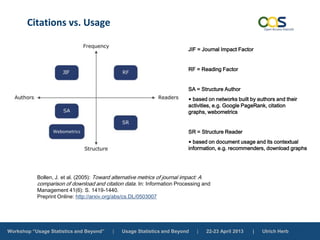
JIF = Journal Impact Factor
RF = Reading Factor
SA = Structure Author
• based on networks built by authors and their
activities, e.g. Google PageRank, citation
graphs, webometrics
SR = Structure Reader
• based on document usage and its contextual
information, e.g. recommenders, download graphs
Bollen, J. et al. (2005): Toward alternative metrics of journal impact: A
comparison of download and citation data. In: Information Processing and
Management 41(6): S. 1419-1440.
Preprint Online: http://arxiv.org/abs/cs.DL/0503007
Workshop “Usage Statistics and Beyond” | Usage Statistics and Beyond | 22-23 April 2013 | Ulrich Herb
Citations vs. Usage
Citation based measures
Author-centred
Delayed measurement: at first in the following generation of
publications
Impact of a separate object is mostly not described
Usage based measures
Reader-centred
Measuring: on-the-fly and consecutive
Impact of a separate object can be described
Automated measurement is possible
Workshop “Usage Statistics and Beyond” | Usage Statistics and Beyond | 22-23 April 2013 | Ulrich Herb
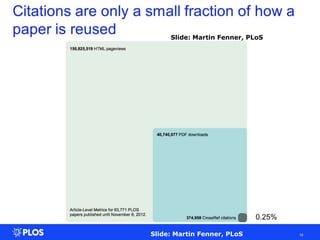
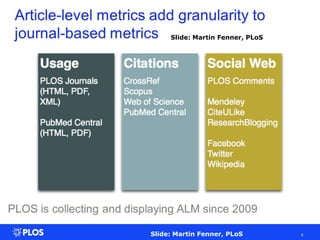
UlSlide: Martin Fenner, PLoS
Slide: Martin Fenner, PLoS
Workshop “Usage Statistics and Beyond” | Usage Statistics and Beyond | 22-23 April 2013 | Ulrich Herb
Standards?
„An important issue, however, was the lack of standards on how to
produce and report the usage data in a way that could be compared“
Baker et al. 2008
Workshop “Usage Statistics and Beyond” | Usage Statistics and Beyond | 22-23 April 2013 | Ulrich Herb
Standards
http://www.projectcounter.org
http://logec.repec.org/
http://www.ifabc.org/
Workshop “Usage Statistics and Beyond” | Usage Statistics and Beyond | 22-23 April 2013 | Ulrich Herb
Surveys on usage data and standards
• Two online surveys conducted by Saarland University and State
Library on the behalf of OAS
• 32 experts on the realm of usage statistics were selected and invited
to take part in the surveys
• Survey I focused on an evaluation of the standards COUNTER, LogEc,
IFABC:
8 respondents, 25%
• Survey II focused on functionalities and features based on usage
information
9 respondents, 28%
• Participation rate was very low, but not uncommonly low for expert
surveys
Workshop “Usage Statistics and Beyond” | Usage Statistics and Beyond | 22-23 April 2013 | Ulrich Herb
Standards as seen by the community…
The ideal standard was expected to be
• comparable and widely accepted
The experts mostly ignored
• financial issues
• legal issues as privacy
Workshop “Usage Statistics and Beyond” | Usage Statistics and Beyond | 22-23 April 2013 | Ulrich Herb
Standards as seen by the community…
Results
COUNTER was considered
• the most appropriate standard
• „globally recognized“
But nevertheless
• LogEc was considered more useful than COUNTER regarding the
definition of double click intervals and robot identification
• experts expressed the need for article level statistics
Workshop “Usage Statistics and Beyond” | Usage Statistics and Beyond | 22-23 April 2013 | Ulrich Herb
Standards as seen by the community…
Results
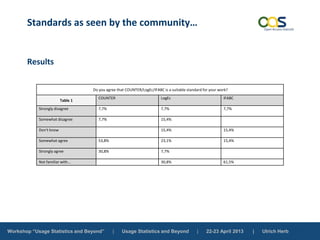
Do you agree that COUNTER/LogEc/IFABC is a suitable standard for your work?
Table 1
COUNTER LogEc IFABC
Strongly disagree 7,7% 7,7% 7,7%
Somewhat disagree 7,7% 15,4%
Don't know 15,4% 15,4%
Somewhat agree 53,8% 23,1% 15,4%
Strongly agree 30,8% 7,7%
Not familiar with... 30,8% 61,5%
Workshop “Usage Statistics and Beyond” | Usage Statistics and Beyond | 22-23 April 2013 | Ulrich Herb
Standards as seen by the community…
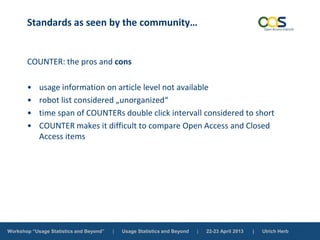
COUNTER: the pros and cons
• usage information on article level not available
• robot list considered „unorganized“
• time span of COUNTERs double click intervall considered to short
• COUNTER makes it difficult to compare Open Access and Closed
Access items
Workshop “Usage Statistics and Beyond” | Usage Statistics and Beyond | 22-23 April 2013 | Ulrich Herb
Standards as seen by the community…
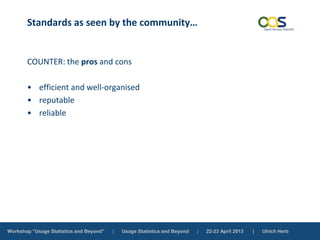
COUNTER: the pros and cons
• efficient and well-organised
• reputable
• reliable
Workshop “Usage Statistics and Beyond” | Usage Statistics and Beyond | 22-23 April 2013 | Ulrich Herb
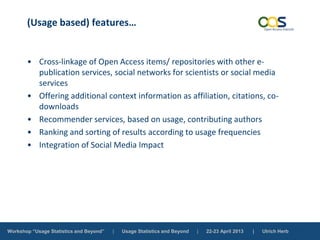
(Usage based) features…
• Cross-linkage of Open Access items/ repositories with other e-
publication services, social networks for scientists or social media
services
• Offering additional context information as affiliation, citations, co-
downloads
• Recommender services, based on usage, contributing authors
• Ranking and sorting of results according to usage frequencies
• Integration of Social Media Impact
Workshop “Usage Statistics and Beyond” | Usage Statistics and Beyond | 22-23 April 2013 | Ulrich Herb
UlSlide: Martin Fenner, PLoS
Slide: Martin Fenner, PLoS
Workshop “Usage Statistics and Beyond” | Usage Statistics and Beyond | 22-23 April 2013 | Ulrich Herb
Many thanks for your attention.
Questions?
E-Mail: u.herb@sulb.uni-saarland.de
Website: http://www.dini.de/projekte/oa-statistik/english/
License:

Usage Statistics and Beyond

  • 1.
    Usage Statistics andBeyond Workshop “Usage Statistics and Beyond” 22-23 April 2013, Berlin Ulrich Herb | u.herb@sulb.uni-saarland.de
  • 2.
    Workshop “Usage Statisticsand Beyond” | Usage Statistics and Beyond | 22-23 April 2013 | Ulrich Herb Impact „The ‚impact factor‘ is the most commonly used assessment aid for deciding which journals should receive a scholarly submission or attention from research readership. It is also an often misunderstood tool.“ Dong et al. 2005
  • 3.
    Workshop “Usage Statisticsand Beyond” | Usage Statistics and Beyond | 22-23 April 2013 | Ulrich Herb When & Why • Initial meeting of the later project partners, June 2006 • All of the participating institutions were progressive members of the German Initiative for Networked Information (Deutsche Initiative für Netzwerkinformation DINI) and interested in promoting Open Access • Main obstacle: Little reputation and impact of Open Access infrastructures (repositories, journals)
  • 4.
    Workshop “Usage Statisticsand Beyond” | Usage Statistics and Beyond | 22-23 April 2013 | Ulrich Herb Alternative Impact • Neither repositories nor most Open Access journals were covered by citations databases (scopus, web of science) • Document usage as an alternative model for assessing the impact of scientific publications
  • 5.
    Workshop “Usage Statisticsand Beyond” | Usage Statistics and Beyond | 22-23 April 2013 | Ulrich Herb Citations vs. Usage JIF = Journal Impact Factor RF = Reading Factor SA = Structure Author • based on networks built by authors and their activities, e.g. Google PageRank, citation graphs, webometrics SR = Structure Reader • based on document usage and its contextual information, e.g. recommenders, download graphs Bollen, J. et al. (2005): Toward alternative metrics of journal impact: A comparison of download and citation data. In: Information Processing and Management 41(6): S. 1419-1440. Preprint Online: http://arxiv.org/abs/cs.DL/0503007
  • 6.
    Workshop “Usage Statisticsand Beyond” | Usage Statistics and Beyond | 22-23 April 2013 | Ulrich Herb Citations vs. Usage Citation based measures Author-centred Delayed measurement: at first in the following generation of publications Impact of a separate object is mostly not described Usage based measures Reader-centred Measuring: on-the-fly and consecutive Impact of a separate object can be described Automated measurement is possible
  • 7.
    Workshop “Usage Statisticsand Beyond” | Usage Statistics and Beyond | 22-23 April 2013 | Ulrich Herb UlSlide: Martin Fenner, PLoS Slide: Martin Fenner, PLoS
  • 8.
    Workshop “Usage Statisticsand Beyond” | Usage Statistics and Beyond | 22-23 April 2013 | Ulrich Herb Standards? „An important issue, however, was the lack of standards on how to produce and report the usage data in a way that could be compared“ Baker et al. 2008
  • 9.
    Workshop “Usage Statisticsand Beyond” | Usage Statistics and Beyond | 22-23 April 2013 | Ulrich Herb Standards http://www.projectcounter.org http://logec.repec.org/ http://www.ifabc.org/
  • 10.
    Workshop “Usage Statisticsand Beyond” | Usage Statistics and Beyond | 22-23 April 2013 | Ulrich Herb Surveys on usage data and standards • Two online surveys conducted by Saarland University and State Library on the behalf of OAS • 32 experts on the realm of usage statistics were selected and invited to take part in the surveys • Survey I focused on an evaluation of the standards COUNTER, LogEc, IFABC: 8 respondents, 25% • Survey II focused on functionalities and features based on usage information 9 respondents, 28% • Participation rate was very low, but not uncommonly low for expert surveys
  • 11.
    Workshop “Usage Statisticsand Beyond” | Usage Statistics and Beyond | 22-23 April 2013 | Ulrich Herb Standards as seen by the community… The ideal standard was expected to be • comparable and widely accepted The experts mostly ignored • financial issues • legal issues as privacy
  • 12.
    Workshop “Usage Statisticsand Beyond” | Usage Statistics and Beyond | 22-23 April 2013 | Ulrich Herb Standards as seen by the community… Results COUNTER was considered • the most appropriate standard • „globally recognized“ But nevertheless • LogEc was considered more useful than COUNTER regarding the definition of double click intervals and robot identification • experts expressed the need for article level statistics
  • 13.
    Workshop “Usage Statisticsand Beyond” | Usage Statistics and Beyond | 22-23 April 2013 | Ulrich Herb Standards as seen by the community… Results Do you agree that COUNTER/LogEc/IFABC is a suitable standard for your work? Table 1 COUNTER LogEc IFABC Strongly disagree 7,7% 7,7% 7,7% Somewhat disagree 7,7% 15,4% Don't know 15,4% 15,4% Somewhat agree 53,8% 23,1% 15,4% Strongly agree 30,8% 7,7% Not familiar with... 30,8% 61,5%
  • 14.
    Workshop “Usage Statisticsand Beyond” | Usage Statistics and Beyond | 22-23 April 2013 | Ulrich Herb Standards as seen by the community… COUNTER: the pros and cons • usage information on article level not available • robot list considered „unorganized“ • time span of COUNTERs double click intervall considered to short • COUNTER makes it difficult to compare Open Access and Closed Access items
  • 15.
    Workshop “Usage Statisticsand Beyond” | Usage Statistics and Beyond | 22-23 April 2013 | Ulrich Herb Standards as seen by the community… COUNTER: the pros and cons • efficient and well-organised • reputable • reliable
  • 16.
    Workshop “Usage Statisticsand Beyond” | Usage Statistics and Beyond | 22-23 April 2013 | Ulrich Herb (Usage based) features… • Cross-linkage of Open Access items/ repositories with other e- publication services, social networks for scientists or social media services • Offering additional context information as affiliation, citations, co- downloads • Recommender services, based on usage, contributing authors • Ranking and sorting of results according to usage frequencies • Integration of Social Media Impact
  • 17.
    Workshop “Usage Statisticsand Beyond” | Usage Statistics and Beyond | 22-23 April 2013 | Ulrich Herb UlSlide: Martin Fenner, PLoS Slide: Martin Fenner, PLoS
  • 18.
    Workshop “Usage Statisticsand Beyond” | Usage Statistics and Beyond | 22-23 April 2013 | Ulrich Herb Many thanks for your attention. Questions? E-Mail: u.herb@sulb.uni-saarland.de Website: http://www.dini.de/projekte/oa-statistik/english/ License: