MAKING THE GRADE
WHEN APPLYING
FOR AID
…AND GETTING AN
        „ A‟ IN THE
     PROCESS!!
THE INFORMATION CONTAINED IN THIS PRESENTATION IS CURRENT AT THIS TIME
FOR STUDENTS ENTERING COLLEGE IN FALL 2011 BUT IS SUBJECT TO CHANGE.


                      Presented By: DeeDee Barnes Bruns
 2010/2011
                      Executive Director of New Student Programs
Financial Aid Doesn‟t Have to be
SCARY!!
Today, you will…
   learn about timelines & deadlines
   learn some “lingo” & acronyms
   learn what is reasonable to expect
    from colleges & what the colleges
    will be expecting of YOU!
   learn how to stay organized &
    informed & prepared to meet deadlines
                       AND
    You will discover that you have
    LOTS of resources for
    information,                        i.e. high
    school guidance counselors, university
    financial aid & admission professionals, and
    on-line resources     (too many to count!)
Where do I start???
1. Start with the colleges!!
   Request scholarship/financial aid info
      or download from their website
2. Look for Local Area Resources:
   Civic organizations
   Service Clubs
3. Employers (students and parents)
   System-wide scholarships/credit unions
4. Special Interest Funds
   Obscure & (usually) very specific.
   Most have very early application deadlines
   Best info source for these? FREE websites!
Please DON‟T Pay for scholarship search services!
Closely examine every
possibility!
   National Service - The Corporation for National
    Service offers a number of funding opportunities in
    exchange for community service. Learn more at
    www.cns.gov
   The Student‟s Employer
        Competitive scholarships
        Book funds
        Career experience
            (summer and PT during school)
   Special Interest Funds
        Obscure & (usually) very specific
        VERY early application deadlines
        Best info source for these?
            FREE web sources!!! D

Don‟t pay for scholarship search services
WHERE to L                                 K for
info…
   FastWeb Scholarship Search
       www.fastweb.com
   ACT (great website for parents!)
       www.act.org
   Peterson’s / NASFAA
       www.collegequest.com
   The College Board
    (good checklists can be found here!)
      www.college.board.com
   The Student Guide
    (a FREE federal guidebook often available at your HS)
What about the PACT plan?

http://www.treasury.state.al.us/Content/Pact_intr
o.htm

Colleges do not
have any control
over this program!
Colleges only receive
and distribute funds as
they are sent from PACT.
529 plan? Roth IRA? How do I
know?
  Saving money for college is an important family
  goal.   There are multiple tax-deferred savings
  plans available, including 529 plans, Roth IRA‟s,
  etc.         Each has different perimeters, and
     one option           may work better than
    another option for              your family‟s
                particular situation.


     For a table explaining the similarities and
 differences in the most common college-savings
                    plans, go to:
How and when do I apply for
government-funded resources?
You MUST complete and submit the FAFSA
  (Free Application for Federal Student Aid) to be
  considered for government-funded aid of ANY kind!
 Complete the FAFSA as soon as possible after Jan. 1st
  of the student‟s senior year in high school (not before).
  The results of the FAFSA determine your eligibility for
  ALL federal aid.
Federal Aid Programs include:
   PELL Grants
     Most families do not qualify for PELL grants. Must
     have a very low family contribution. Please don’t be
     discouraged                       if you do not qualify for this
     program! Many families do not.
    Current minimum PELL grant is $555; maximum is $5550
   SEOG Grants
     Supplemental grant, with priority given to students who have
…and also these Government-
 Funded “Self Help” Options
 Work      Study Jobs
    Federal Work Study – Based on “demonstrated need”
     (salary is paid from 75% government sources & 25%
     university)
 Loan      Options               Current Interest rate
  Perkins Student Loan           (5% - reserved for neediest
   families)
  Stafford Student Loan         (4.5% - subsidized-need based)
  Stafford Student Loan         (6.8% - unsubsidized-not need
   based)
                          AND/OR
    PLUS (Parents Loan)
         (7.9% interest and parents
What Does the FAFSA actually
DO?


  When you complete the Free Application for
 Federal Student Aid (FAFSA) at www.fafsa.gov
 the answers enable the federal government to
 calculate how much of your family‟s financial
  resources should be available to pay for the
           cost of college expenses.
  The FAFSA refers to this calculated number as
   your “EFC” or “Expected Family Contribution”
 Colleges then use that EFC to determine
 your “demonstrated need” for federal aid
  such as PELL grants, work-study, etc.
So..how is my “need”
  calculated?
COST of the college/university equals…
  Direct Costs
  (defined costs of tuition, required fees, & room and board,
  if living on campus)
+ Indirect Costs (estimate for books, travel, expenses)

Minus EFC (Expected Family Contribution -
                   taken from results of FAFSA)


Equals DEMONSTRATED NEED
     for federal aid
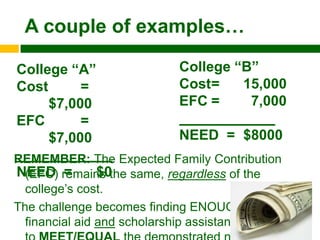
A couple of examples…

College “A”              College “B”
Cost      =              Cost=    15,000
     $7,000              EFC =     7,000
EFC       =
     $7,000              NEED = $8000
REMEMBER: The Expected Family Contribution
NEED remains the same, regardless of the
  (EFC) =       $0
  college’s cost.
The challenge becomes finding ENOUGH
  financial aid and scholarship assistance
Parents of Juniors…
Curious to know your projected
EFC??
The Federal Government has a form you can
 complete that gives you an
 “early estimate” of
 your EFC based on
 the current year’s
 income and assets.
 This will help you
 make projections
 for NEXT year.
 Go to… www.fafsa4caster.ed.gov
Steps to take…WHAT and WHEN?

   Determine ADMISSION requirements
    and what it takes to be admitted to
    various colleges and universities of interest.
   Determine SCHOLARSHIP requirements
    and what it takes to be considered for one.
    NOTE: Not every college/university offers
    academic scholarships, and those that do vary
    widely as to what they consider to be
    “outstanding scholarship” for their school.
     For example, if the AVERAGE ACT score for a college
    is a 28, then a score of 27 (though 90% nationally) is
    going to be BELOW average at THAT school and
    probably                  will not be scholarship eligible.
And when you are a senior…

   Apply for admission and gain acceptance.
         Different dates for different schools. USUALLY must be accepted to
          a college by December 1 of the senior year in high school
          to be considered for academic $$$. Know the deadlines!
          Deadlines are usually on college websites.

   Complete any college-specific forms
         Varies from school to school
         Read websites and brochures thoroughly!

   Complete the FAFSA
         ASAP after January 1 of student‟s Senior year in HS
         Available on-line at www.fafsa.gov
         Make photocopies/download a hardcopy

     Observe all required “respond by” deadlines!
Competitive Schools and/or
Competitive Scholarships =
Interviews and Essays…
   Many scholarships require an essay or interview.
    Do’s and Don’ts; PLEASE no MDI/DDI…
   Occasionally, admission will be
    influenced by the quality of an
    interview and/or essay.
BUT…
  the quality of an interview or an
  essay will nearly ALWAYS affect
  scholarship amounts
Practicing for scholarship interviews
  and perfecting an essay can make
  thousands of dollars of difference!
You‟ve got homework to do!!

   Request scholarship info from colleges
   Make a “COLLEGE CALENDAR”
   Apply early and well before deadlines
   Make a file for each college you apply to
   Make photocopies/hardcopies for files
   Log info sent/phone calls made
   Make a list of key contact people w/
    phone numbers and e-mail addresses
   Utilize final decision “etiquette”
Know Your Rights …
 AND Know Your Responsibilities!
       www.nacacnet.org/MemberPortal/AboutNACAC/Policies/
                           then scroll to
             “Students Rights and Responsibilities”
QUESTIONS???

Fa workshop-presented-in-10-11

  • 1.
    MAKING THE GRADE WHENAPPLYING FOR AID …AND GETTING AN „ A‟ IN THE PROCESS!! THE INFORMATION CONTAINED IN THIS PRESENTATION IS CURRENT AT THIS TIME FOR STUDENTS ENTERING COLLEGE IN FALL 2011 BUT IS SUBJECT TO CHANGE. Presented By: DeeDee Barnes Bruns 2010/2011 Executive Director of New Student Programs
  • 2.
    Financial Aid Doesn‟tHave to be SCARY!! Today, you will…  learn about timelines & deadlines  learn some “lingo” & acronyms  learn what is reasonable to expect from colleges & what the colleges will be expecting of YOU!  learn how to stay organized & informed & prepared to meet deadlines AND You will discover that you have LOTS of resources for information, i.e. high school guidance counselors, university financial aid & admission professionals, and on-line resources (too many to count!)
  • 3.
    Where do Istart??? 1. Start with the colleges!! Request scholarship/financial aid info or download from their website 2. Look for Local Area Resources: Civic organizations Service Clubs 3. Employers (students and parents) System-wide scholarships/credit unions 4. Special Interest Funds Obscure & (usually) very specific. Most have very early application deadlines Best info source for these? FREE websites! Please DON‟T Pay for scholarship search services!
  • 4.
    Closely examine every possibility!  National Service - The Corporation for National Service offers a number of funding opportunities in exchange for community service. Learn more at www.cns.gov  The Student‟s Employer Competitive scholarships Book funds Career experience (summer and PT during school)  Special Interest Funds Obscure & (usually) very specific VERY early application deadlines Best info source for these? FREE web sources!!! D Don‟t pay for scholarship search services
  • 5.
    WHERE to L K for info…  FastWeb Scholarship Search www.fastweb.com  ACT (great website for parents!) www.act.org  Peterson’s / NASFAA www.collegequest.com  The College Board (good checklists can be found here!) www.college.board.com  The Student Guide (a FREE federal guidebook often available at your HS)
  • 6.
    What about thePACT plan? http://www.treasury.state.al.us/Content/Pact_intr o.htm Colleges do not have any control over this program! Colleges only receive and distribute funds as they are sent from PACT.
  • 7.
    529 plan? RothIRA? How do I know? Saving money for college is an important family goal. There are multiple tax-deferred savings plans available, including 529 plans, Roth IRA‟s, etc. Each has different perimeters, and one option may work better than another option for your family‟s particular situation. For a table explaining the similarities and differences in the most common college-savings plans, go to:
  • 8.
    How and whendo I apply for government-funded resources? You MUST complete and submit the FAFSA (Free Application for Federal Student Aid) to be considered for government-funded aid of ANY kind! Complete the FAFSA as soon as possible after Jan. 1st of the student‟s senior year in high school (not before). The results of the FAFSA determine your eligibility for ALL federal aid. Federal Aid Programs include:  PELL Grants Most families do not qualify for PELL grants. Must have a very low family contribution. Please don’t be discouraged if you do not qualify for this program! Many families do not. Current minimum PELL grant is $555; maximum is $5550  SEOG Grants Supplemental grant, with priority given to students who have
  • 9.
    …and also theseGovernment- Funded “Self Help” Options  Work Study Jobs  Federal Work Study – Based on “demonstrated need” (salary is paid from 75% government sources & 25% university)  Loan Options Current Interest rate  Perkins Student Loan (5% - reserved for neediest families)  Stafford Student Loan (4.5% - subsidized-need based)  Stafford Student Loan (6.8% - unsubsidized-not need based) AND/OR  PLUS (Parents Loan)  (7.9% interest and parents
  • 10.
    What Does theFAFSA actually DO? When you complete the Free Application for Federal Student Aid (FAFSA) at www.fafsa.gov the answers enable the federal government to calculate how much of your family‟s financial resources should be available to pay for the cost of college expenses. The FAFSA refers to this calculated number as your “EFC” or “Expected Family Contribution” Colleges then use that EFC to determine your “demonstrated need” for federal aid such as PELL grants, work-study, etc.
  • 11.
    So..how is my“need” calculated? COST of the college/university equals… Direct Costs (defined costs of tuition, required fees, & room and board, if living on campus) + Indirect Costs (estimate for books, travel, expenses) Minus EFC (Expected Family Contribution - taken from results of FAFSA) Equals DEMONSTRATED NEED for federal aid
  • 12.
    A couple ofexamples… College “A” College “B” Cost = Cost= 15,000 $7,000 EFC = 7,000 EFC = $7,000 NEED = $8000 REMEMBER: The Expected Family Contribution NEED remains the same, regardless of the (EFC) = $0 college’s cost. The challenge becomes finding ENOUGH financial aid and scholarship assistance
  • 13.
    Parents of Juniors… Curiousto know your projected EFC?? The Federal Government has a form you can complete that gives you an “early estimate” of your EFC based on the current year’s income and assets. This will help you make projections for NEXT year. Go to… www.fafsa4caster.ed.gov
  • 14.
    Steps to take…WHATand WHEN?  Determine ADMISSION requirements and what it takes to be admitted to various colleges and universities of interest.  Determine SCHOLARSHIP requirements and what it takes to be considered for one. NOTE: Not every college/university offers academic scholarships, and those that do vary widely as to what they consider to be “outstanding scholarship” for their school. For example, if the AVERAGE ACT score for a college is a 28, then a score of 27 (though 90% nationally) is going to be BELOW average at THAT school and probably will not be scholarship eligible.
  • 15.
    And when youare a senior…  Apply for admission and gain acceptance.  Different dates for different schools. USUALLY must be accepted to a college by December 1 of the senior year in high school to be considered for academic $$$. Know the deadlines! Deadlines are usually on college websites.  Complete any college-specific forms  Varies from school to school  Read websites and brochures thoroughly!  Complete the FAFSA  ASAP after January 1 of student‟s Senior year in HS  Available on-line at www.fafsa.gov  Make photocopies/download a hardcopy Observe all required “respond by” deadlines!
  • 16.
    Competitive Schools and/or CompetitiveScholarships = Interviews and Essays…  Many scholarships require an essay or interview. Do’s and Don’ts; PLEASE no MDI/DDI…  Occasionally, admission will be influenced by the quality of an interview and/or essay. BUT… the quality of an interview or an essay will nearly ALWAYS affect scholarship amounts Practicing for scholarship interviews and perfecting an essay can make thousands of dollars of difference!
  • 17.
    You‟ve got homeworkto do!!  Request scholarship info from colleges  Make a “COLLEGE CALENDAR”  Apply early and well before deadlines  Make a file for each college you apply to  Make photocopies/hardcopies for files  Log info sent/phone calls made  Make a list of key contact people w/ phone numbers and e-mail addresses  Utilize final decision “etiquette” Know Your Rights … AND Know Your Responsibilities! www.nacacnet.org/MemberPortal/AboutNACAC/Policies/ then scroll to “Students Rights and Responsibilities”
  • 18.