HARMFUL PRACTICES -
CHILD MARRIAGE AND
FEMALE GENITAL
MUTILATION ARE
INTERNATIONALLY
RECOGNIZED HUMAN
RIGHTS VIOLATIONS
EDUCATE
GIRLS
You educate women, you educate
the nation. Women's contribution
to education changes countries,
and this, in turn, changes the
world. Girls who have received an
education most often change the
prospect of early marriage for the
possibility of a productive, healthy
life. They learn to make important
decisions for themselves, become
aware of their rights and defend
themselves and their point of view
The material wealth of girls is
becoming higher. The child
mortality rate is declining.
The maternal mortality rate
is declining. The number of
child marriages is decreasing.
The prevalence of malicious
practices is decreasing. More
first-class female specialists
are coming to various
industries. The national
growth rate is increasing.
Society is becoming more
sophisticated and advanced
We need to make education more
accessible. Build more educational
institutions that operate on a pro
bono basis: free schools,
gymnasiums, and colleges. Of course,
it is necessary to make higher
education more accessible: grants,
scholarships, special educational
programs aimed at third world
countries. It is worth taking care of
the qualifications of teachers,
because in developing countries it
often leaves much to be desire
GENDER STEREOTYPES - THE
RELATIVELY FIXED AND
OVERGENERALIZED ATTITUDES
AND BEHAVIOURS THAT ARE
CONSIDERED NORMAL AND
APPROPRIATE FOR A PERSON IN A
PARTICULAR CULTURE BASED
ON HIS OR HER BIOLOGICAL SEX
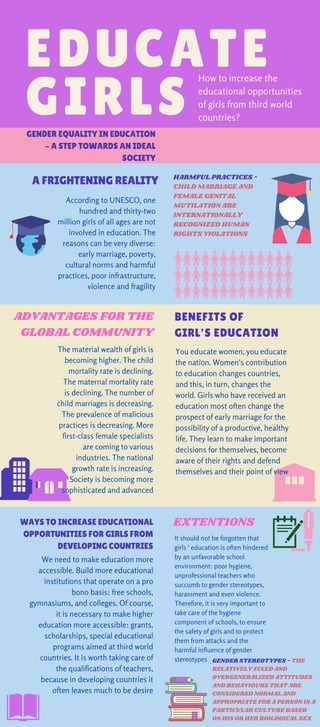
A FRIGHTENING REALITY
According to UNESCO, one
hundred and thirty-two
million girls of all ages are not
involved in education. The
reasons can be very diverse:
early marriage, poverty,
cultural norms and harmful
practices, poor infrastructure,
violence and fragility
BENEFITS OF
GIRL'S EDUCATION
ADVANTAGES FOR THE
GLOBAL COMMUNITY
WAYS TO INCREASE EDUCATIONAL
OPPORTUNITIES FOR GIRLS FROM
DEVELOPING COUNTRIES
It should not be forgotten that
girls ' education is often hindered
by an unfavorable school
environment: poor hygiene,
unprofessional teachers who
succumb to gender stereotypes,
harassment and even violence.
Therefore, it is very important to
take care of the hygiene
component of schools, to ensure
the safety of girls and to protect
them from attacks and the
harmful influence of gender
stereotypes
EXTENTIONS
How to increase the
educational opportunities
of girls from third world
countries?
GENDER EQUALITY IN EDUCATION
- A STEP TOWARDS AN IDEAL
SOCIETY
References
1) “Girls' Education.” UNICEF, 19 Jan.
2020, www.unicef.org/education/girls-
education.
2) “Improving Girls' Education in
Developing Countries: Creating a Better
Future, One Life at a Time.” Central Asia
Institute, 14 Sept. 2020,
centralasiainstitute.org/improving-girls-
education-in-developing-countries/.
3) “Girls' Education.” World Bank,
www.worldbank.org/en/topic/girlseducat
ion#4.
4) Versluys, Eline, and GPE Secretariat.
“28 Million Girls without Access to
Education.” Global Partnership for
Education, 23 Oct. 2017,
www.globalpartnership.org/blog/28-
million-girls-without-access-education.
5) Subrahmanian, Ramya. “Gender
Equality in Education: Definitions and
Measurements.” International Journal of
Educational Development, Pergamon, 22
June 2005,
www.sciencedirect.com/science/article/a
bs/pii/S0738059305000349.
6) “Education and Gender Equality.”
UNESCO, 13 Jan. 2020,
en.unesco.org/themes/education-and-
gender-equality.

Educate girls infographic

  • 1.
    HARMFUL PRACTICES - CHILDMARRIAGE AND FEMALE GENITAL MUTILATION ARE INTERNATIONALLY RECOGNIZED HUMAN RIGHTS VIOLATIONS EDUCATE GIRLS You educate women, you educate the nation. Women's contribution to education changes countries, and this, in turn, changes the world. Girls who have received an education most often change the prospect of early marriage for the possibility of a productive, healthy life. They learn to make important decisions for themselves, become aware of their rights and defend themselves and their point of view The material wealth of girls is becoming higher. The child mortality rate is declining. The maternal mortality rate is declining. The number of child marriages is decreasing. The prevalence of malicious practices is decreasing. More first-class female specialists are coming to various industries. The national growth rate is increasing. Society is becoming more sophisticated and advanced We need to make education more accessible. Build more educational institutions that operate on a pro bono basis: free schools, gymnasiums, and colleges. Of course, it is necessary to make higher education more accessible: grants, scholarships, special educational programs aimed at third world countries. It is worth taking care of the qualifications of teachers, because in developing countries it often leaves much to be desire GENDER STEREOTYPES - THE RELATIVELY FIXED AND OVERGENERALIZED ATTITUDES AND BEHAVIOURS THAT ARE CONSIDERED NORMAL AND APPROPRIATE FOR A PERSON IN A PARTICULAR CULTURE BASED ON HIS OR HER BIOLOGICAL SEX A FRIGHTENING REALITY According to UNESCO, one hundred and thirty-two million girls of all ages are not involved in education. The reasons can be very diverse: early marriage, poverty, cultural norms and harmful practices, poor infrastructure, violence and fragility BENEFITS OF GIRL'S EDUCATION ADVANTAGES FOR THE GLOBAL COMMUNITY WAYS TO INCREASE EDUCATIONAL OPPORTUNITIES FOR GIRLS FROM DEVELOPING COUNTRIES It should not be forgotten that girls ' education is often hindered by an unfavorable school environment: poor hygiene, unprofessional teachers who succumb to gender stereotypes, harassment and even violence. Therefore, it is very important to take care of the hygiene component of schools, to ensure the safety of girls and to protect them from attacks and the harmful influence of gender stereotypes EXTENTIONS How to increase the educational opportunities of girls from third world countries? GENDER EQUALITY IN EDUCATION - A STEP TOWARDS AN IDEAL SOCIETY
  • 2.
    References 1) “Girls' Education.”UNICEF, 19 Jan. 2020, www.unicef.org/education/girls- education. 2) “Improving Girls' Education in Developing Countries: Creating a Better Future, One Life at a Time.” Central Asia Institute, 14 Sept. 2020, centralasiainstitute.org/improving-girls- education-in-developing-countries/. 3) “Girls' Education.” World Bank, www.worldbank.org/en/topic/girlseducat ion#4. 4) Versluys, Eline, and GPE Secretariat. “28 Million Girls without Access to Education.” Global Partnership for Education, 23 Oct. 2017, www.globalpartnership.org/blog/28- million-girls-without-access-education. 5) Subrahmanian, Ramya. “Gender Equality in Education: Definitions and Measurements.” International Journal of Educational Development, Pergamon, 22 June 2005, www.sciencedirect.com/science/article/a bs/pii/S0738059305000349. 6) “Education and Gender Equality.” UNESCO, 13 Jan. 2020, en.unesco.org/themes/education-and- gender-equality.