SHAPE SHIFTING
Adam Corlett, Dave Finch & Matt Whittaker
November 2015
@resfoundation @mattwhittakerRF #SR2015
1
The changing role of the state
during fiscal consolidation
2
THE SHRINKING STATE
Government spending in an era of fiscal
consolidation
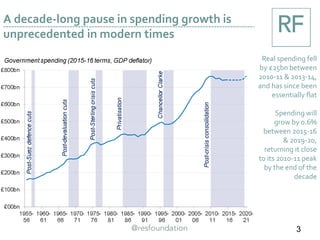
A decade-long pause in spending growth is
unprecedented in modern times
Real spending fell
by £25bn between
2010-11 & 2013-14,
and has since been
essentially flat
Spending will
grow by 0.6%
between 2015-16
& 2019-20,
returning it close
to its 2010-11 peak
by the end of the
decade
3
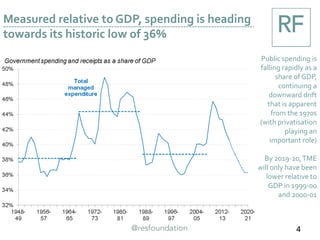
Measured relative to GDP, spending is heading
towards its historic low of 36%
Public spending is
falling rapidly as a
share of GDP,
continuing a
downward drift
that is apparent
from the 1970s
(with privatisation
playing an
important role)
By 2019-20,TME
will only have been
lower relative to
GDP in 1999-00
and 2000-01
4
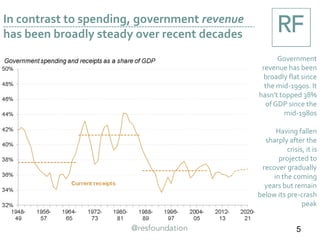
In contrast to spending, government revenue
has been broadly steady over recent decades
Government
revenue has been
broadly flat since
the mid-1990s. It
hasn’t topped 38%
of GDP since the
mid-1980s
Having fallen
sharply after the
crisis, it is
projected to
recover gradually
in the coming
years but remain
below its pre-crash
peak
5
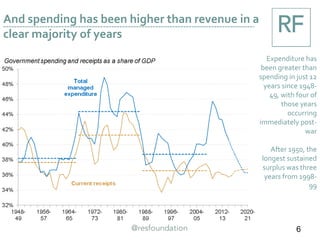
And spending has been higher than revenue in a
clear majority of years
Revenue has been
greater than
spending in just 12
years since 1948-
49, with four of
those years
occurring
immediately post-
war
After 1950, the
longest sustained
surplus was three
years from 1998-
99
6
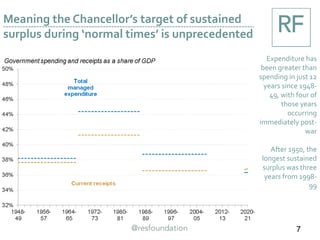
Meaning the Chancellor’s target of sustained
surplus during ‘normal times’ is unprecedented
Revenue has been
greater than
spending in just 12
years since 1948-
49, with four of
those years
occurring
immediately post-
war
After 1950, the
longest sustained
surplus was three
years from 1998-
99
7
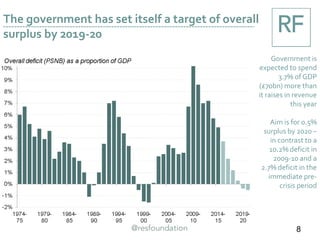
The government has set itself a target of overall
surplus by 2019-20
Government is
expected to spend
3.7% of GDP
(£70bn) more than
it raises in revenue
this year
Aim is for 0.5%
surplus by 2020 –
in contrast to a
10.2% deficit in
2009-10 and a
2.7% deficit in the
immediate pre-
crisis period
8
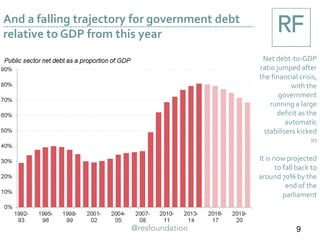
And a falling trajectory for government debt
relative to GDP from this year
Net debt-to-GDP
ratio jumped after
the financial crisis,
with the
government
running a large
deficit as the
automatic
stabilisers kicked
in
It is now projected
to fall back to
around 70% by the
end of the
parliament
9
These trajectories are underpinned by two key
articles of faith
10
1) We need a budget surplus during normal economic
times
– In theory we could run a small deficit without increasing
debt, but the Chancellor wants to go further
– The strongest argument for this position is that we
need more fiscal headroom in readiness for the next
downturn (a point made by the Chancellor yesterday)
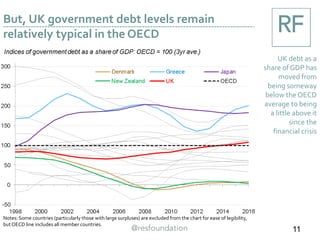
But, UK government debt levels remain
relatively typical in the OECD
UK debt as a
share of GDP has
moved from
being someway
below the OECD
average to being
a little above it
since the
financial crisis
11
Notes: Some countries (particularly those with large surpluses) are excluded from the chart for ease of legibility,
butOECD line includes all member countries.
These trajectories are underpinned by two key
articles of faith
12
2)The heavy lifting on the deficit has to be done by
spending
– Government revenue has tended to hover between
36% and 38% of GDP over the last 30 years
– The government has been explicit in its desire to focus
on spending cuts rather than tax rises
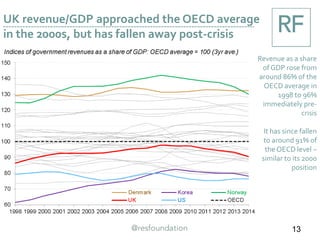
UK revenue/GDP approached the OECD average
in the 2000s, but has fallen away post-crisis
Revenue as a share
of GDP rose from
around 86% of the
OECD average in
1998 to 96%
immediately pre-
crisis
It has since fallen
to around 91% of
theOECD level –
similar to its 2000
position
13
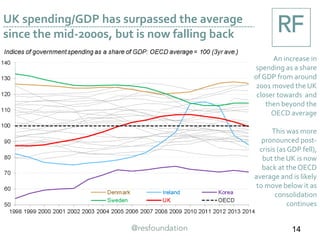
UK spending/GDP has surpassed the average
since the mid-2000s, but is now falling back
An increase in
spending as a share
of GDP from around
2001 moved the UK
closer towards and
then beyond the
OECD average
This was more
pronounced post-
crisis (as GDP fell),
but the UK is now
back at theOECD
average and is likely
to move below it as
consolidation
continues
14
While shrinking overall, the shape of what the
state does is affected by a series of choices
15
Spending is broadly split between departments (DEL)
and welfare (AME)
– AME (which includes debt interest) is less directly
controllable, but welfare cuts clearly affect this
Within overall DEL and AME envelopes, choices are
made about which services and groups to protect
– DEL protection for health, schools, aid and defence
– Welfare protection for pensioner benefits
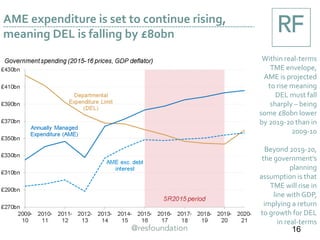
AME expenditure is set to continue rising,
meaning DEL is falling by £80bn
Within real-terms
TME envelope,
AME is projected
to rise meaning
DEL must fall
sharply – being
some £80bn lower
by 2019-20 than in
2009-10
Beyond 2019-20,
the government’s
planning
assumption is that
TME will rise in
line with GDP,
implying a return
to growth for DEL
in real-terms
16
17
THE NEW
PUBLIC SERVICES MIX
The split of consolidation across
resource, capital and departments
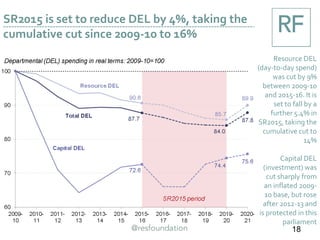
SR2015 is set to reduce DEL by 4%, taking the
cumulative cut since 2009-10 to 16%
Resource DEL
(day-to-day spend)
was cut by 9%
between 2009-10
and 2015-16. It is
set to fall by a
further 5.4% in
SR2015, taking the
cumulative cut to
14%
Capital DEL
(investment) was
cut sharply from
an inflated 2009-
10 base, but rose
after 2012-13 and
is protected in this
parliament
18
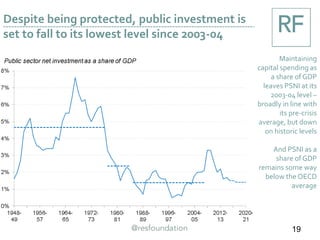
Despite being protected, public investment is
set to fall to its lowest level since 2003-04
Maintaining
capital spending as
a share of GDP
leaves PSNI at its
2003-04 level –
broadly in line with
its pre-crisis
average, but down
on historic levels
And PSNI as a
share of GDP
remains some way
below the OECD
average
19
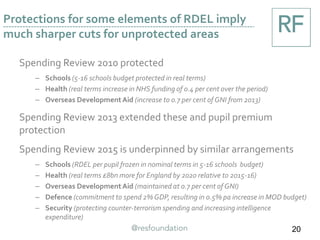
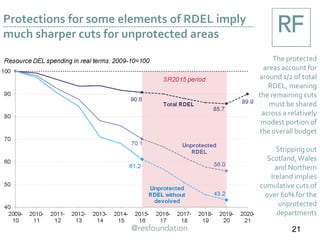
Protections for some elements of RDEL imply
much sharper cuts for unprotected areas
20
Spending Review 2010 protected
– Schools (5-16 schools budget protected in real terms)
– Health (real terms increase in NHS funding of 0.4 per cent over the period)
– Overseas DevelopmentAid (increase to 0.7 per cent of GNI from 2013)
Spending Review 2013 extended these and pupil premium
protection
Spending Review 2015 is underpinned by similar arrangements
– Schools (RDEL per pupil frozen in nominal terms in 5-16 schools budget)
– Health (real terms £8bn more for England by 2020 relative to 2015-16)
– Overseas DevelopmentAid (maintained at 0.7 per cent of GNI)
– Defence (commitment to spend 2%GDP, resulting in 0.5% pa increase in MOD budget)
– Security (protecting counter-terrorism spending and increasing intelligence
expenditure)
Protections for some elements of RDEL imply
much sharper cuts for unprotected areas
The protected
areas account for
around 1/2 of total
RDEL, meaning
the remaining cuts
must be shared
across a relatively
modest portion of
the overall budget
Stripping out
Scotland, Wales
and Northern
Ireland implies
cumulative cuts of
over 60% for the
unprotected
departments
21
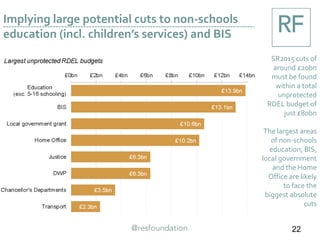
Implying large potential cuts to non-schools
education (incl. children’s services) and BIS
SR2015 cuts of
around £20bn
must be found
within a total
unprotected
RDEL budget of
just £80bn
The largest areas
of non-schools
education, BIS,
local government
and the Home
Office are likely
to face the
biggest absolute
cuts
22
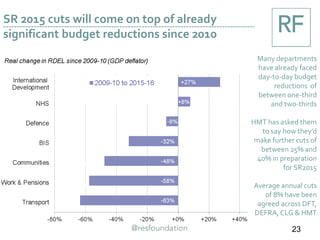
SR 2015 cuts will come on top of already
significant budget reductions since 2010
Many departments
have already faced
day-to-day budget
reductions of
between one-third
and two-thirds
HMT has asked them
to say how they’d
make further cuts of
between 25% and
40% in preparation
for SR2015
Average annual cuts
of 8% have been
agreed across DFT,
DEFRA,CLG & HMT
23
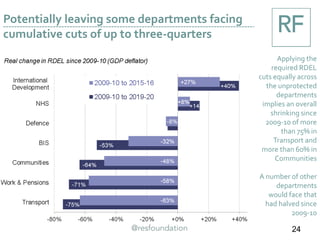
Potentially leaving some departments facing
cumulative cuts of up to three-quarters
Applying the
required RDEL
cuts equally across
the unprotected
departments
implies an overall
shrinking since
2009-10 of more
than 75% in
Transport and
more than 60% in
Communities
A number of other
departments
would face
budgets that had
halved since 2009-
10
24
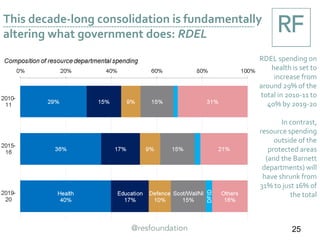
This decade-long consolidation is fundamentally
altering what government does: RDEL
RDEL spending on
health is set to
increase from
around 29% of the
total in 2010-11 to
40% by 2019-20
In contrast,
resource spending
outside of the
protected areas
(and the Barnett
departments) will
have shrunk from
31% to just 16% of
the total
25
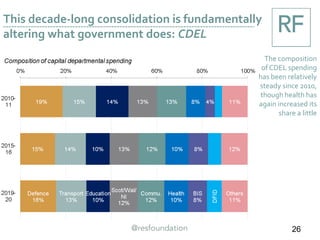
This decade-long consolidation is fundamentally
altering what government does: CDEL
The composition
of CDEL spending
has been relatively
steady since 2010,
though health has
again increased its
share a little
26
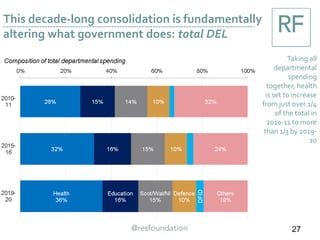
This decade-long consolidation is fundamentally
altering what government does: total DEL
Taking all
departmental
spending
together, health
is set to increase
from just over 1/4
of the total in
2010-11 to more
than 1/3 by 2019-
20
27
28
WELL FAIR?
The changing distribution of household
welfare during consolidation
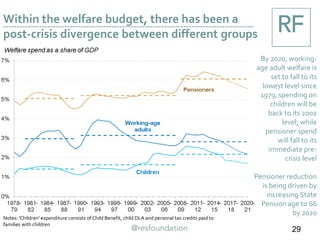
Within the welfare budget, there has been a
post-crisis divergence between different groups
29
By 2020, working-
age adult welfare is
set to fall to its
lowest level since
1979; spending on
children will be
back to its 2002
level; while
pensioner spend
will fall to its
immediate pre-
crisis level
Pensioner reduction
is being driven by
increasing State
Pension age to 66
by 2020
Notes: 'Children' expenditure consists of Child Benefit, child DLA and personal tax credits paid to
families with children
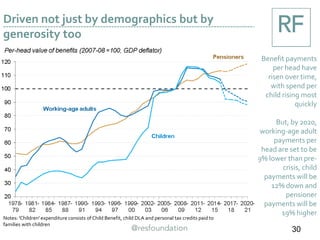
Driven not just by demographics but by
generosity too
Benefit payments
per head have
risen over time,
with spend per
child rising most
quickly
But, by 2020,
working-age adult
payments per
head are set to be
9% lower than pre-
crisis, child
payments will be
12% down and
pensioner
payments will be
19% higher
30
Notes: 'Children' expenditure consists of Child Benefit, child DLA and personal tax credits paid to
families with children
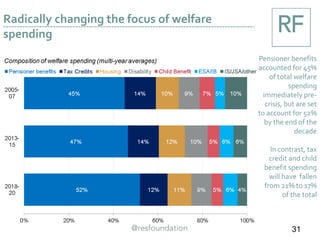
Radically changing the focus of welfare
spending
Pensioner benefits
accounted for 45%
of total welfare
spending
immediately pre-
crisis, but are set
to account for 52%
by the end of the
decade
In contrast, tax
credit and child
benefit spending
will have fallen
from 21% to 17%
of the total
31
Notes: Pensioner benefits excludes Housing Benefit and Disability benefit (PIP, DLA,.AA)
32
THE STATE OF
THINGS TO COME
Assessing how the role of the state has
shifted in recent years
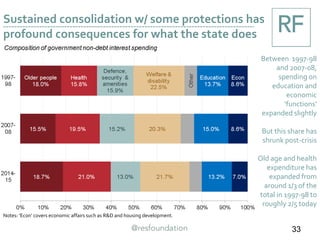
Sustained consolidation w/ some protections has
profound consequences for what the state does
Between 1997-98
and 2007-08,
spending on
education and
economic
‘functions’
expanded slightly
But this share has
shrunk post-crisis
Old age and health
expenditure has
expanded from
around 1/3 of the
total in 1997-98 to
roughly 2/5 today
33
Notes: ‘Econ’ covers economic affairs such as R&D and housing development.
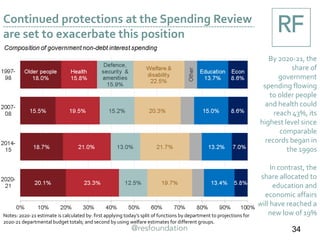
Continued protections at the Spending Review
are set to exacerbate this position
By 2020-21, the
share of
government
spending flowing
to older people
and health could
reach 43%, its
highest level since
comparable
records began in
the 1990s
In contrast, the
share allocated to
education and
economic affairs
will have reached a
new low of 19%
34
Notes: 2020-21 estimate is calculated by: first applying today’s split of functions by department to projections for
2020-21 departmental budget totals; and second by using welfare estimates for different groups.
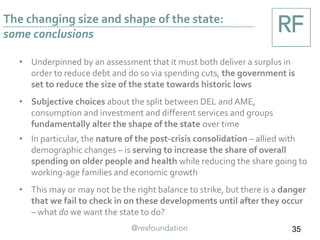
The changing size and shape of the state:
some conclusions
35
• Underpinned by an assessment that it must both deliver a surplus in
order to reduce debt and do so via spending cuts, the government is
set to reduce the size of the state towards historic lows
• Subjective choices about the split between DEL and AME,
consumption and investment and different services and groups
fundamentally alter the shape of the state over time
• In particular, the nature of the post-crisis consolidation – allied with
demographic changes – is serving to increase the share of overall
spending on older people and health while reducing the share going to
working-age families and economic growth
• This may or may not be the right balance to strike, but there is a danger
that we fail to check in on these developments until after they occur
– what do we want the state to do?

Size and shape slides final

  • 1.
    SHAPE SHIFTING Adam Corlett,Dave Finch & Matt Whittaker November 2015 @resfoundation @mattwhittakerRF #SR2015 1 The changing role of the state during fiscal consolidation
  • 2.
    2 THE SHRINKING STATE Governmentspending in an era of fiscal consolidation
  • 3.
    A decade-long pausein spending growth is unprecedented in modern times Real spending fell by £25bn between 2010-11 & 2013-14, and has since been essentially flat Spending will grow by 0.6% between 2015-16 & 2019-20, returning it close to its 2010-11 peak by the end of the decade 3
  • 4.
    Measured relative toGDP, spending is heading towards its historic low of 36% Public spending is falling rapidly as a share of GDP, continuing a downward drift that is apparent from the 1970s (with privatisation playing an important role) By 2019-20,TME will only have been lower relative to GDP in 1999-00 and 2000-01 4
  • 5.
    In contrast tospending, government revenue has been broadly steady over recent decades Government revenue has been broadly flat since the mid-1990s. It hasn’t topped 38% of GDP since the mid-1980s Having fallen sharply after the crisis, it is projected to recover gradually in the coming years but remain below its pre-crash peak 5
  • 6.
    And spending hasbeen higher than revenue in a clear majority of years Revenue has been greater than spending in just 12 years since 1948- 49, with four of those years occurring immediately post- war After 1950, the longest sustained surplus was three years from 1998- 99 6
  • 7.
    Meaning the Chancellor’starget of sustained surplus during ‘normal times’ is unprecedented Revenue has been greater than spending in just 12 years since 1948- 49, with four of those years occurring immediately post- war After 1950, the longest sustained surplus was three years from 1998- 99 7
  • 8.
    The government hasset itself a target of overall surplus by 2019-20 Government is expected to spend 3.7% of GDP (£70bn) more than it raises in revenue this year Aim is for 0.5% surplus by 2020 – in contrast to a 10.2% deficit in 2009-10 and a 2.7% deficit in the immediate pre- crisis period 8
  • 9.
    And a fallingtrajectory for government debt relative to GDP from this year Net debt-to-GDP ratio jumped after the financial crisis, with the government running a large deficit as the automatic stabilisers kicked in It is now projected to fall back to around 70% by the end of the parliament 9
  • 10.
    These trajectories areunderpinned by two key articles of faith 10 1) We need a budget surplus during normal economic times – In theory we could run a small deficit without increasing debt, but the Chancellor wants to go further – The strongest argument for this position is that we need more fiscal headroom in readiness for the next downturn (a point made by the Chancellor yesterday)
  • 11.
    But, UK governmentdebt levels remain relatively typical in the OECD UK debt as a share of GDP has moved from being someway below the OECD average to being a little above it since the financial crisis 11 Notes: Some countries (particularly those with large surpluses) are excluded from the chart for ease of legibility, butOECD line includes all member countries.
  • 12.
    These trajectories areunderpinned by two key articles of faith 12 2)The heavy lifting on the deficit has to be done by spending – Government revenue has tended to hover between 36% and 38% of GDP over the last 30 years – The government has been explicit in its desire to focus on spending cuts rather than tax rises
  • 13.
    UK revenue/GDP approachedthe OECD average in the 2000s, but has fallen away post-crisis Revenue as a share of GDP rose from around 86% of the OECD average in 1998 to 96% immediately pre- crisis It has since fallen to around 91% of theOECD level – similar to its 2000 position 13
  • 14.
    UK spending/GDP hassurpassed the average since the mid-2000s, but is now falling back An increase in spending as a share of GDP from around 2001 moved the UK closer towards and then beyond the OECD average This was more pronounced post- crisis (as GDP fell), but the UK is now back at theOECD average and is likely to move below it as consolidation continues 14
  • 15.
    While shrinking overall,the shape of what the state does is affected by a series of choices 15 Spending is broadly split between departments (DEL) and welfare (AME) – AME (which includes debt interest) is less directly controllable, but welfare cuts clearly affect this Within overall DEL and AME envelopes, choices are made about which services and groups to protect – DEL protection for health, schools, aid and defence – Welfare protection for pensioner benefits
  • 16.
    AME expenditure isset to continue rising, meaning DEL is falling by £80bn Within real-terms TME envelope, AME is projected to rise meaning DEL must fall sharply – being some £80bn lower by 2019-20 than in 2009-10 Beyond 2019-20, the government’s planning assumption is that TME will rise in line with GDP, implying a return to growth for DEL in real-terms 16
  • 17.
    17 THE NEW PUBLIC SERVICESMIX The split of consolidation across resource, capital and departments
  • 18.
    SR2015 is setto reduce DEL by 4%, taking the cumulative cut since 2009-10 to 16% Resource DEL (day-to-day spend) was cut by 9% between 2009-10 and 2015-16. It is set to fall by a further 5.4% in SR2015, taking the cumulative cut to 14% Capital DEL (investment) was cut sharply from an inflated 2009- 10 base, but rose after 2012-13 and is protected in this parliament 18
  • 19.
    Despite being protected,public investment is set to fall to its lowest level since 2003-04 Maintaining capital spending as a share of GDP leaves PSNI at its 2003-04 level – broadly in line with its pre-crisis average, but down on historic levels And PSNI as a share of GDP remains some way below the OECD average 19
  • 20.
    Protections for someelements of RDEL imply much sharper cuts for unprotected areas 20 Spending Review 2010 protected – Schools (5-16 schools budget protected in real terms) – Health (real terms increase in NHS funding of 0.4 per cent over the period) – Overseas DevelopmentAid (increase to 0.7 per cent of GNI from 2013) Spending Review 2013 extended these and pupil premium protection Spending Review 2015 is underpinned by similar arrangements – Schools (RDEL per pupil frozen in nominal terms in 5-16 schools budget) – Health (real terms £8bn more for England by 2020 relative to 2015-16) – Overseas DevelopmentAid (maintained at 0.7 per cent of GNI) – Defence (commitment to spend 2%GDP, resulting in 0.5% pa increase in MOD budget) – Security (protecting counter-terrorism spending and increasing intelligence expenditure)
  • 21.
    Protections for someelements of RDEL imply much sharper cuts for unprotected areas The protected areas account for around 1/2 of total RDEL, meaning the remaining cuts must be shared across a relatively modest portion of the overall budget Stripping out Scotland, Wales and Northern Ireland implies cumulative cuts of over 60% for the unprotected departments 21
  • 22.
    Implying large potentialcuts to non-schools education (incl. children’s services) and BIS SR2015 cuts of around £20bn must be found within a total unprotected RDEL budget of just £80bn The largest areas of non-schools education, BIS, local government and the Home Office are likely to face the biggest absolute cuts 22
  • 23.
    SR 2015 cutswill come on top of already significant budget reductions since 2010 Many departments have already faced day-to-day budget reductions of between one-third and two-thirds HMT has asked them to say how they’d make further cuts of between 25% and 40% in preparation for SR2015 Average annual cuts of 8% have been agreed across DFT, DEFRA,CLG & HMT 23
  • 24.
    Potentially leaving somedepartments facing cumulative cuts of up to three-quarters Applying the required RDEL cuts equally across the unprotected departments implies an overall shrinking since 2009-10 of more than 75% in Transport and more than 60% in Communities A number of other departments would face budgets that had halved since 2009- 10 24
  • 25.
    This decade-long consolidationis fundamentally altering what government does: RDEL RDEL spending on health is set to increase from around 29% of the total in 2010-11 to 40% by 2019-20 In contrast, resource spending outside of the protected areas (and the Barnett departments) will have shrunk from 31% to just 16% of the total 25
  • 26.
    This decade-long consolidationis fundamentally altering what government does: CDEL The composition of CDEL spending has been relatively steady since 2010, though health has again increased its share a little 26
  • 27.
    This decade-long consolidationis fundamentally altering what government does: total DEL Taking all departmental spending together, health is set to increase from just over 1/4 of the total in 2010-11 to more than 1/3 by 2019- 20 27
  • 28.
    28 WELL FAIR? The changingdistribution of household welfare during consolidation
  • 29.
    Within the welfarebudget, there has been a post-crisis divergence between different groups 29 By 2020, working- age adult welfare is set to fall to its lowest level since 1979; spending on children will be back to its 2002 level; while pensioner spend will fall to its immediate pre- crisis level Pensioner reduction is being driven by increasing State Pension age to 66 by 2020 Notes: 'Children' expenditure consists of Child Benefit, child DLA and personal tax credits paid to families with children
  • 30.
    Driven not justby demographics but by generosity too Benefit payments per head have risen over time, with spend per child rising most quickly But, by 2020, working-age adult payments per head are set to be 9% lower than pre- crisis, child payments will be 12% down and pensioner payments will be 19% higher 30 Notes: 'Children' expenditure consists of Child Benefit, child DLA and personal tax credits paid to families with children
  • 31.
    Radically changing thefocus of welfare spending Pensioner benefits accounted for 45% of total welfare spending immediately pre- crisis, but are set to account for 52% by the end of the decade In contrast, tax credit and child benefit spending will have fallen from 21% to 17% of the total 31 Notes: Pensioner benefits excludes Housing Benefit and Disability benefit (PIP, DLA,.AA)
  • 32.
    32 THE STATE OF THINGSTO COME Assessing how the role of the state has shifted in recent years
  • 33.
    Sustained consolidation w/some protections has profound consequences for what the state does Between 1997-98 and 2007-08, spending on education and economic ‘functions’ expanded slightly But this share has shrunk post-crisis Old age and health expenditure has expanded from around 1/3 of the total in 1997-98 to roughly 2/5 today 33 Notes: ‘Econ’ covers economic affairs such as R&D and housing development.
  • 34.
    Continued protections atthe Spending Review are set to exacerbate this position By 2020-21, the share of government spending flowing to older people and health could reach 43%, its highest level since comparable records began in the 1990s In contrast, the share allocated to education and economic affairs will have reached a new low of 19% 34 Notes: 2020-21 estimate is calculated by: first applying today’s split of functions by department to projections for 2020-21 departmental budget totals; and second by using welfare estimates for different groups.
  • 35.
    The changing sizeand shape of the state: some conclusions 35 • Underpinned by an assessment that it must both deliver a surplus in order to reduce debt and do so via spending cuts, the government is set to reduce the size of the state towards historic lows • Subjective choices about the split between DEL and AME, consumption and investment and different services and groups fundamentally alter the shape of the state over time • In particular, the nature of the post-crisis consolidation – allied with demographic changes – is serving to increase the share of overall spending on older people and health while reducing the share going to working-age families and economic growth • This may or may not be the right balance to strike, but there is a danger that we fail to check in on these developments until after they occur – what do we want the state to do?