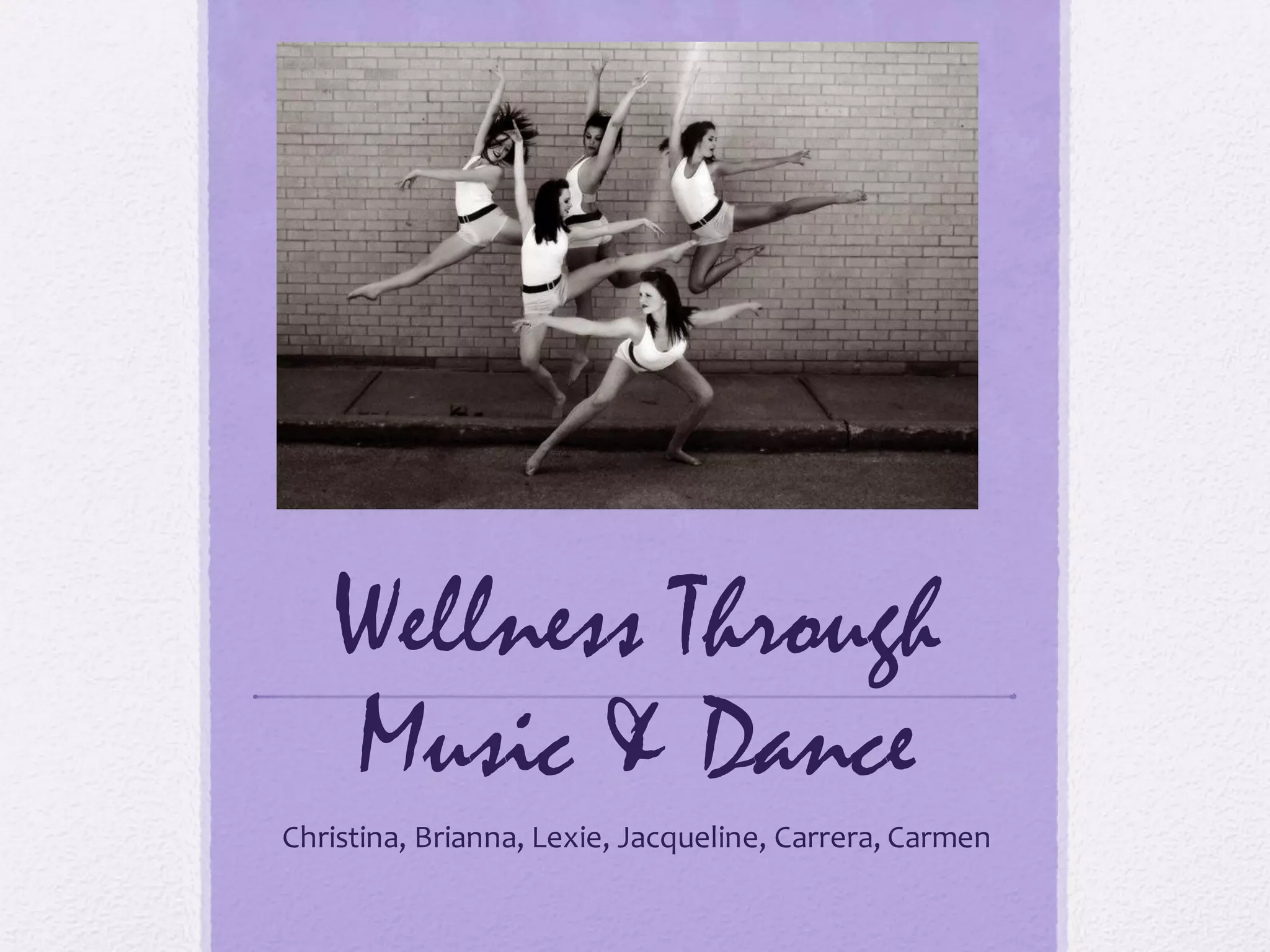
Wellness Through
Music & Dance
Christina, Brianna, Lexie, Jacqueline, Carrera, Carmen
WELCOME 
• Hello Everyone and welcome to our Wellness
Through Music & Dance program!
• Through assessments we determined that to
benefit your specific needs, free movement
activitieswould bring about a positive
outcome.
• First we will start of with a brief introduction
to our program through the use of models!
What is Depression?
• A medical condition with various emotional,
physical, behavioural and cognitive symptoms
Symptoms
• Sad
• Irritability
• Extreme tiredness
• Withdrawal
• Suicidal thoughts
If you ever Need a
Helping Hand
• www.depressionhurts.ca
• Suicide hotline 1-800-273-TALK (8255)
• Kids Help Phoneline 1-800-668-6868
• Facebook page - Depressed Teens
• Twitter page – CAMH , KidsHelpPhone
Why Dance?
• Exercise and dance is generally inexpensive
• Encourages a sense of health
• Encourages a sense of power over recovery
• During exercise the pituitary gland and the
hypothalamus release endorphins as
neurotransmitters which produce a feeling of
well-being
• Allows a means to socialize in a structured event
“Dancing is an excellent form of exercise because it not only burns calories and
builds muscles, but it also contributes to an overall sense of happiness”
Contd.
• Achieve new skills and accomplish goals, which
can be empowering
• Gets the mind away from depressive thought onto
other activities
• Encourages nonverbal exploration and expression
• Interaction between the mind and the body
• Releases endorphins into your blood stream
My teacher always said to us, “just dance and you’ll feel better.”
Therapeutic Recreation
Accountability Model
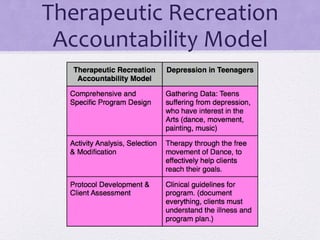
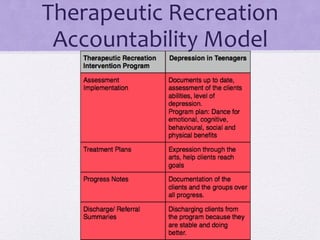
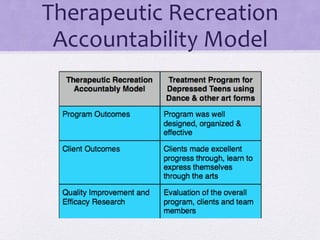
• Therapeutic Recreation Accountability Model(TRAM): Purpose,
Interventions and Outcomes
• Determines what is an effective therapeutic program, by examination of
previous programs/treatments used to provide the right outcomes for
the client.
• “The right services” must be delivered to produce the “right
outcomes”(Navar, 1991,p. 92)
• TRAM is being accountable for documenting what happens in the
programs and to the clients. If it is not documented it did not happen.
• Benefits can be seen through connections and relationships between
tasks
• Well-design program are nothingwith out proper evaluations and
assessments.
Therapeutic Recreation
Accountability Model
Therapeutic Recreation
Accountability Model
Therapeutic Recreation
Accountability Model
Leisure Ability Model
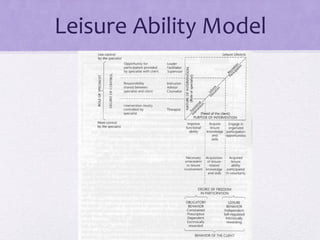
3 Stages
1. Functional Intervention
2. Leisure Education
3. Recreation Participation
Functional Intervention
• TR acts as a therapist
• Goal: Improve functional ability
• Client is dependent
Leisure Education
• TR acts as a counselor
• Goal: Acquire leisure knowledge and skills
• Us educating you on the program
Recreation Participation
• Our approach:
• TR becomes a leisure resource for the client
• Goal: Engage in organized participation
opportunities(Dance)
• Client is independent, and follows along
• Client has an overall happier outlook on life
Degree of Freedom
Obligatory Behavior
• Constrained, prescripted, dependent
• Following along with the dance steps
• Doing what one’s told (following the rules)
Contd.
Leisure Behavior
• Independent, self-regulated
• Adding ones own creativity to the movements
prescribed
• Finding the rhythm to the music
• Letting go and having fun
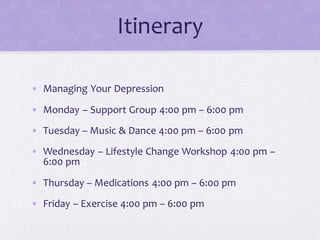
Itinerary
• Managing Your Depression
• Monday – Support Group 4:00 pm – 6:00 pm
• Tuesday – Music & Dance 4:00 pm – 6:00 pm
• Wednesday – Lifestyle Change Workshop 4:00 pm –
6:00 pm
• Thursday – Medications 4:00 pm – 6:00 pm
• Friday – Exercise 4:00 pm – 6:00 pm
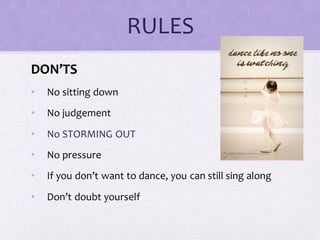
RULES
DON’TS
• No sitting down
• No judgement
• No STORMING OUT
• No pressure
• If you don’t want to dance, you can still sing along
• Don’t doubt yourself
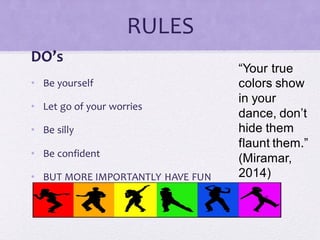
RULES
DO’s
• Be yourself
• Let go of your worries
• Be silly
• Be confident
• BUT MORE IMPORTANTLY HAVE FUN
“Your true
colors show
in your
dance, don’t
hide them
flaunt them.”
(Miramar,
2014)
EVERYBODY ON YOUR
FEET! 
Wellness Through Dance
Program
• Step touch (with clap, arms up/down, spiral arms
up/down)
• Jump Clap
• Fist pump
• Box step
• Grape vine (both ways, with clap)
• Open turn (both ways, with clap)
• Shake your hips
References
• Miramar, S. (2014).What are the rules of Dancing Retrieved from
http://wiki.answers.com/Q/What_are_the_rules_of_dancing?#slide
=1
• Levy, F. J., Fried, J. P., & Leventhal, F. (1995). Dance and other expressive
art therapies: when words are not enough. New York: Routledge.
• Walsh, L. (2009). Depression care across the lifespan. Chichester, U.K.:
Wiley-Blackwell.
• Hanson, R. (2014). How does dance affect the mind. Retrieved from
http://dance.lovetoknow.com/How_Does_Dancing_Affect_the_Mind
• Stumbo, Norma J., and Carol Ann Peterson. "Chapter 4: Therapeutic
Recreation Accountability Model." Therapeutic Recreation Program
Design:Principles and Procedures. Fifth ed. San Francisco, Calif. ;London:
Pearson/Benjamin-Cummings, 2009. 91-104. Print.

Dance Therapy Assignment (Brianna Jane Mainprize)

  • 1.
    Wellness Through Music &Dance Christina, Brianna, Lexie, Jacqueline, Carrera, Carmen
  • 2.
    WELCOME  • HelloEveryone and welcome to our Wellness Through Music & Dance program! • Through assessments we determined that to benefit your specific needs, free movement activitieswould bring about a positive outcome. • First we will start of with a brief introduction to our program through the use of models!
  • 3.
    What is Depression? •A medical condition with various emotional, physical, behavioural and cognitive symptoms
  • 4.
    Symptoms • Sad • Irritability •Extreme tiredness • Withdrawal • Suicidal thoughts
  • 5.
    If you everNeed a Helping Hand • www.depressionhurts.ca • Suicide hotline 1-800-273-TALK (8255) • Kids Help Phoneline 1-800-668-6868 • Facebook page - Depressed Teens • Twitter page – CAMH , KidsHelpPhone
  • 6.
    Why Dance? • Exerciseand dance is generally inexpensive • Encourages a sense of health • Encourages a sense of power over recovery • During exercise the pituitary gland and the hypothalamus release endorphins as neurotransmitters which produce a feeling of well-being • Allows a means to socialize in a structured event “Dancing is an excellent form of exercise because it not only burns calories and builds muscles, but it also contributes to an overall sense of happiness”
  • 7.
    Contd. • Achieve newskills and accomplish goals, which can be empowering • Gets the mind away from depressive thought onto other activities • Encourages nonverbal exploration and expression • Interaction between the mind and the body • Releases endorphins into your blood stream My teacher always said to us, “just dance and you’ll feel better.”
  • 8.
    Therapeutic Recreation Accountability Model •Therapeutic Recreation Accountability Model(TRAM): Purpose, Interventions and Outcomes • Determines what is an effective therapeutic program, by examination of previous programs/treatments used to provide the right outcomes for the client. • “The right services” must be delivered to produce the “right outcomes”(Navar, 1991,p. 92) • TRAM is being accountable for documenting what happens in the programs and to the clients. If it is not documented it did not happen. • Benefits can be seen through connections and relationships between tasks • Well-design program are nothingwith out proper evaluations and assessments.
  • 9.
  • 10.
  • 11.
  • 12.
  • 13.
    Leisure Ability Model 3Stages 1. Functional Intervention 2. Leisure Education 3. Recreation Participation
  • 14.
    Functional Intervention • TRacts as a therapist • Goal: Improve functional ability • Client is dependent
  • 15.
    Leisure Education • TRacts as a counselor • Goal: Acquire leisure knowledge and skills • Us educating you on the program
  • 16.
    Recreation Participation • Ourapproach: • TR becomes a leisure resource for the client • Goal: Engage in organized participation opportunities(Dance) • Client is independent, and follows along • Client has an overall happier outlook on life
  • 17.
    Degree of Freedom ObligatoryBehavior • Constrained, prescripted, dependent • Following along with the dance steps • Doing what one’s told (following the rules)
  • 18.
    Contd. Leisure Behavior • Independent,self-regulated • Adding ones own creativity to the movements prescribed • Finding the rhythm to the music • Letting go and having fun
  • 19.
    Itinerary • Managing YourDepression • Monday – Support Group 4:00 pm – 6:00 pm • Tuesday – Music & Dance 4:00 pm – 6:00 pm • Wednesday – Lifestyle Change Workshop 4:00 pm – 6:00 pm • Thursday – Medications 4:00 pm – 6:00 pm • Friday – Exercise 4:00 pm – 6:00 pm
  • 20.
    RULES DON’TS • No sittingdown • No judgement • No STORMING OUT • No pressure • If you don’t want to dance, you can still sing along • Don’t doubt yourself
  • 21.
    RULES DO’s • Be yourself •Let go of your worries • Be silly • Be confident • BUT MORE IMPORTANTLY HAVE FUN “Your true colors show in your dance, don’t hide them flaunt them.” (Miramar, 2014)
  • 22.
  • 23.
    Wellness Through Dance Program •Step touch (with clap, arms up/down, spiral arms up/down) • Jump Clap • Fist pump • Box step • Grape vine (both ways, with clap) • Open turn (both ways, with clap) • Shake your hips
  • 24.
    References • Miramar, S.(2014).What are the rules of Dancing Retrieved from http://wiki.answers.com/Q/What_are_the_rules_of_dancing?#slide =1 • Levy, F. J., Fried, J. P., & Leventhal, F. (1995). Dance and other expressive art therapies: when words are not enough. New York: Routledge. • Walsh, L. (2009). Depression care across the lifespan. Chichester, U.K.: Wiley-Blackwell. • Hanson, R. (2014). How does dance affect the mind. Retrieved from http://dance.lovetoknow.com/How_Does_Dancing_Affect_the_Mind • Stumbo, Norma J., and Carol Ann Peterson. "Chapter 4: Therapeutic Recreation Accountability Model." Therapeutic Recreation Program Design:Principles and Procedures. Fifth ed. San Francisco, Calif. ;London: Pearson/Benjamin-Cummings, 2009. 91-104. Print.