Dance LanguageOf
HoneyBees
DR. NIRBHAY SUDHIR PIMPLE
DEPARTMENT OF ZOOLOGY
ABASAHEB GARWARE COLLEGE, KARVE ROAD.
PUNE-4
Discovery -
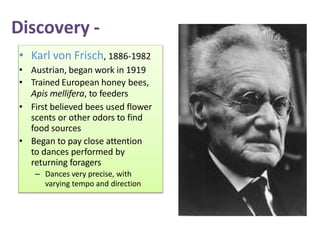
• Karl von Frisch, 1886-1982
• Austrian, began work in 1919
• Trained European honey bees,
Apis mellifera, to feeders
• First believed bees used flower
scents or other odors to find
food sources
• Began to pay close attention
to dances performed by
returning foragers
– Dances very precise, with
varying tempo and direction
Karl von Frisch described the dances
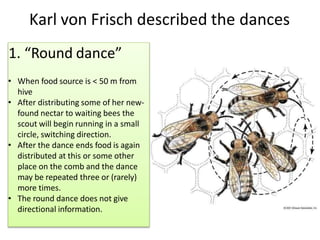
1. “Round dance”
• When food source is < 50 m from
hive
• After distributing some of her new-
found nectar to waiting bees the
scout will begin running in a small
circle, switching direction.
• After the dance ends food is again
distributed at this or some other
place on the comb and the dance
may be repeated three or (rarely)
more times.
• The round dance does not give
directional information.
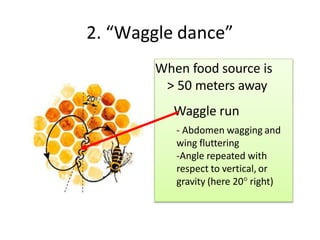
2. “Waggle dance”
When food source is
> 50 meters away
Waggle run
- Abdomen wagging and
wing fluttering
-Angle repeated with
respect to vertical, or
gravity (here 20° right)
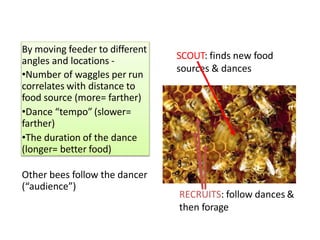
By moving feeder to different
angles and locations -
•Number of waggles per run
correlates with distance to
food source (more= farther)
•Dance “tempo” (slower=
farther)
•The duration of the dance
(longer= better food)
Other bees follow the dancer
(“audience”)
SCOUT: finds new food
sources & dances
RECRUITS: follow dances &
then forage
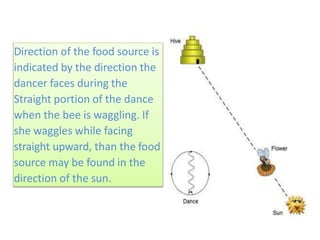
Direction of the food source is
indicated by the direction the
dancer faces during the
Straight portion of the dance
when the bee is waggling. If
she waggles while facing
straight upward, than the food
source may be found in the
direction of the sun.
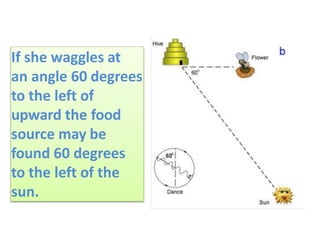
If she waggles at
an angle 60 degrees
to the left of
upward the food
source may be
found 60 degrees
to the left of the
sun.
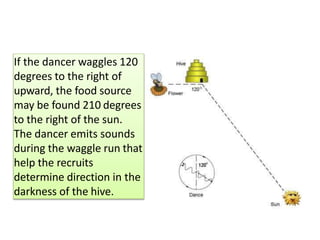
If the dancer waggles 120
degrees to the right of
upward, the food source
may be found 210 degrees
to the right of the sun.
The dancer emits sounds
during the waggle run that
help the recruits
determine direction in the
darkness of the hive.
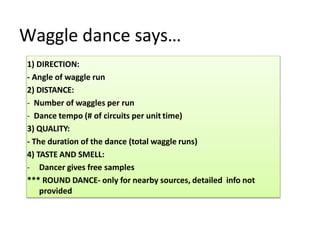
Waggle dance says…
1) DIRECTION:
- Angle of waggle run
2) DISTANCE:
- Number of waggles per run
- Dance tempo (# of circuits per unit time)
3) QUALITY:
- The duration of the dance (total waggle runs)
4) TASTE AND SMELL:
- Dancer gives free samples
*** ROUND DANCE- only for nearby sources, detailed info not
provided
THANK YOU

Dance language honeybee

  • 1.
    Dance LanguageOf HoneyBees DR. NIRBHAYSUDHIR PIMPLE DEPARTMENT OF ZOOLOGY ABASAHEB GARWARE COLLEGE, KARVE ROAD. PUNE-4
  • 2.
    Discovery - • Karlvon Frisch, 1886-1982 • Austrian, began work in 1919 • Trained European honey bees, Apis mellifera, to feeders • First believed bees used flower scents or other odors to find food sources • Began to pay close attention to dances performed by returning foragers – Dances very precise, with varying tempo and direction
  • 3.
    Karl von Frischdescribed the dances 1. “Round dance” • When food source is < 50 m from hive • After distributing some of her new- found nectar to waiting bees the scout will begin running in a small circle, switching direction. • After the dance ends food is again distributed at this or some other place on the comb and the dance may be repeated three or (rarely) more times. • The round dance does not give directional information.
  • 4.
    2. “Waggle dance” Whenfood source is > 50 meters away Waggle run - Abdomen wagging and wing fluttering -Angle repeated with respect to vertical, or gravity (here 20° right)
  • 5.
    By moving feederto different angles and locations - •Number of waggles per run correlates with distance to food source (more= farther) •Dance “tempo” (slower= farther) •The duration of the dance (longer= better food) Other bees follow the dancer (“audience”) SCOUT: finds new food sources & dances RECRUITS: follow dances & then forage
  • 6.
    Direction of thefood source is indicated by the direction the dancer faces during the Straight portion of the dance when the bee is waggling. If she waggles while facing straight upward, than the food source may be found in the direction of the sun.
  • 7.
    If she wagglesat an angle 60 degrees to the left of upward the food source may be found 60 degrees to the left of the sun.
  • 8.
    If the dancerwaggles 120 degrees to the right of upward, the food source may be found 210 degrees to the right of the sun. The dancer emits sounds during the waggle run that help the recruits determine direction in the darkness of the hive.
  • 9.
    Waggle dance says… 1)DIRECTION: - Angle of waggle run 2) DISTANCE: - Number of waggles per run - Dance tempo (# of circuits per unit time) 3) QUALITY: - The duration of the dance (total waggle runs) 4) TASTE AND SMELL: - Dancer gives free samples *** ROUND DANCE- only for nearby sources, detailed info not provided
  • 10.