Week 4
Queens, Hive Splitting and
Swarms

Dara K. Dimitrov
dkd4@waikato.ac.nz
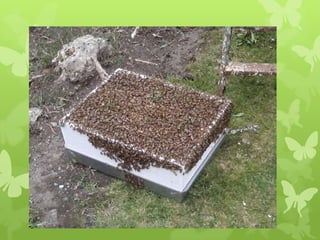
Swarms

 Can be an easy way to increase the number of hives you
have
 It is the natural way that bees replicate themselves
 It usually occurs in early spring to mid summer
 Happens in large active healthily hives (so if the hive is
weak – it won’t swarm)
 If you live in the city – swarming of your bees is a public
nuisance
Types of Swarms
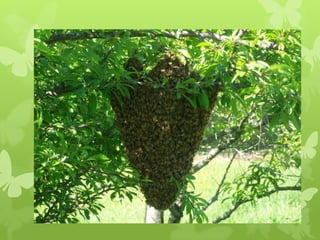
 Primary Swarms
 1st Swarm of the season

 Contains a Queen and can have up to 25,000 bees
 Sometimes this maybe the only swarm from a hive
 Sometimes maybe the original queen (she ceases laying
eggs, so abdomen reduces and allows her to fly)
Types of Swarms
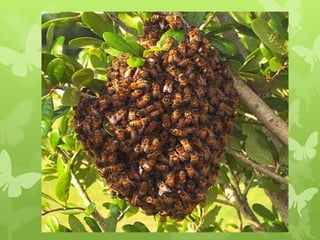
 Secondary Swarms (sometimes called after-swarms)
 Happen after the primary swarms (maybe only be a couple
a weeks after the primary one sometimes)

 Usually a virgin queen
Types of Swarms

 Absconding Swarms
 The whole hive leaves the box
 They are starving
 There is disease present
 Insects are attacking the hive (hive month or ants)

This is rare – but it does happen
More common – the hive will die out before vacating the hive
Catching the Swarm

 You need to consider 3 main points
 How long the bees have been sitting there
 Where exactly the swarm is located

 The size of the swarm
Catching the Swarm
 If the bees have not settled properly
 They will not go into your box easily
 They will probably move on very quickly

 If the bees have been there a couple of days
 They will move on very quickly to their new home
 The Scout bees will have located a new hive spot
 Even if you manage to catch them – they may leave
Location of the Swarm
 If the bees settle in a very high tree or some other
difficult spot – it will be very difficult to catch them
 Your success rate is very low

 Accessibility – can you reach them
 Do you need a ladder?
 How high????

 If the bees are in someone’s house wall, roof, inside part of
a building structure (which requires removal of the part of
the structure ----------CALL PEST CONTROL!

You must consider the safety aspect – and use
caution when grabbing the swarm
Size of the Swarm

 If it is a primary swarm –
 You may need a full size box
 10 frames

 If it is a secondary swarm
 Use a nuc box
 5 frames
Catching the Swarm

1. Suit up
2. Make sure you have all your wood ware ready
- put a couple of drawn frames in the hive box
- the bees have gorged on honey – so they don’t need
any honey frames
- Swarms are often used to repair damaged frames and
draw foundation
Catching the Swarm
 The bees will be clustering around the queen

 Shake the bees into a bucket
 If possible – put the hive box underneath the swarm
 Try disturb the bees as little as possible
 You might have to shake the bees off several times
before they will stay in the box
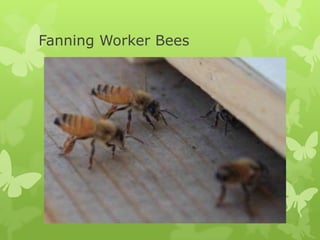
 You can tell that you have caught the queen because the
worker bees will ‘fan’
Fanning Worker Bees
Catching the Swarm
 Leave the lid off the swarm for the first 15-20 mins
 Then when the bees start fanning and the majority of
the bees are in the hive box
 Put the lid on BUT leave a gap for the bees to enter and
exit from
 The bees will use the regular entrance as well as the gap
on the top
 Leave the box on location until evening so that you
catch the entire hive before removing it
Emergency
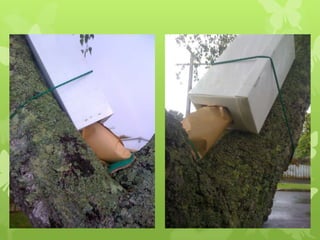
 You can put them into a cardboard box – use one that
closes
 You can use a bucket with a lid – slip the bucket under
the swarm and put the lid on the bucket (snip the
branch)
 Try to not to disturb the cluster – just quietly place the
box/bucket under the swarm – and shut it quickly
 You won’t get all the bees – but most of them & the
queen
Final thoughts on Swarms
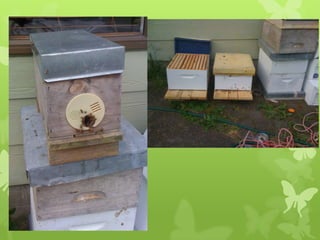
 You can use Bait hives to catch swarms when you are
not around – (nuc box with some drawn frames)
 If the swarm is a secondary – you are better off
jamming it on top of a weaker hive
 Greater number of bees === stronger hive, better cluster

 Disease can be transferred with Swarms
 If it is not your own hive swarm ----Play it safe and leave
the swarms separate from your own hives
 Keep an eye on the brood for signs of disease
Splitting Hives

 If you want to increase the number of producing hives
for either the current year or the following year
 It discourages swarming

 You can generate an income from the sale of nucs
Hive Splits and Time of the Year
 If you get the timing wrong – it will be a waste of time,
money and bees
 Generally mid spring (when numbers in the hives begin
to increase) and before the honey flow peaks
 There has to be adequate food in both splits for the both
hives to thrive (so you may have to feed them too)
 The general rule – the earlier and the stronger each split
is – the more successful you will be
How to Split them
 Split a double brood hive in half
 Leave the queen in one box
 Put a queen cell/mated queen in the other box
 Make sure there is brood in both hives

 Select brood and feed from a hive – and make up nucs
 Minimum number of frames is 3 for a nuc
 REMEMBER clustering and temperatures so 5 frames is best
 You need a queen cell/mated queen for the nuc
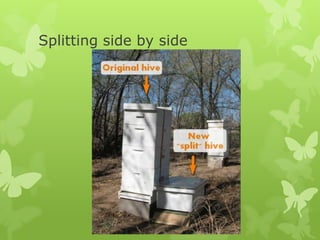
Splitting side by side
Side by Side Hive Splits

 Double Brood Boxes
 Put 2 hive floors together – in front of the old hive
 Put one box on each of the hive floors
 Check to see which box has the queen

 Re-queen the other box – mated queen/queen cell
Walk Away Splits
 Split the hive in half (brood frames and honey)
 Leave them alone

 The Queen-less hive will raise a queen (16 days to
hatching – another week for her to mate)
 Compare this to a mated queen – about 5 days to get
out of the cage – another 5 days to get laying well
 Ripe queen cell – is about 11 days from hatching to
mating and laying
Hive Splitting

 If you do it in the spring – 21 days for the hive to get
going if you leave it queenless
 If you use a mature queen cell – 11 days for the hive to
get going

 If you use a mated queen – it will take about 10 days
(maximum) to get going
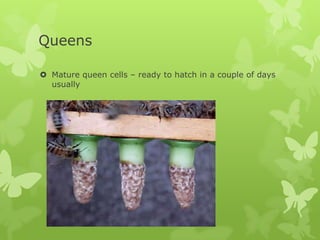
Queens
 Mature queen cells – ready to hatch in a couple of days
usually
Queens
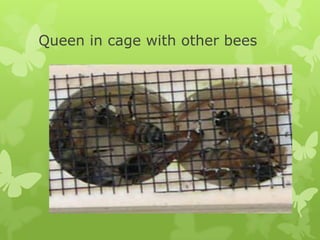
Buy Mated queens – come in a cage, with other
bees
- They have a sugar ‘end’ – you MUST remove the
plastic cap so that the bees can eat through the
sugar end to release the queen -- takes about 45 days
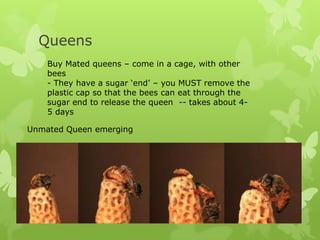
Unmated Queen emerging
Queen in cage with other bees
Questions????

Bees Week 4 - Queens, Hive Splitting and Swarms of Honey Bees

  • 1.
    Week 4 Queens, HiveSplitting and Swarms Dara K. Dimitrov dkd4@waikato.ac.nz
  • 2.
    Swarms  Can bean easy way to increase the number of hives you have  It is the natural way that bees replicate themselves  It usually occurs in early spring to mid summer  Happens in large active healthily hives (so if the hive is weak – it won’t swarm)  If you live in the city – swarming of your bees is a public nuisance
  • 4.
    Types of Swarms Primary Swarms  1st Swarm of the season  Contains a Queen and can have up to 25,000 bees  Sometimes this maybe the only swarm from a hive  Sometimes maybe the original queen (she ceases laying eggs, so abdomen reduces and allows her to fly)
  • 7.
    Types of Swarms Secondary Swarms (sometimes called after-swarms)  Happen after the primary swarms (maybe only be a couple a weeks after the primary one sometimes)  Usually a virgin queen
  • 9.
    Types of Swarms Absconding Swarms  The whole hive leaves the box  They are starving  There is disease present  Insects are attacking the hive (hive month or ants) This is rare – but it does happen More common – the hive will die out before vacating the hive
  • 10.
    Catching the Swarm You need to consider 3 main points  How long the bees have been sitting there  Where exactly the swarm is located  The size of the swarm
  • 11.
    Catching the Swarm If the bees have not settled properly  They will not go into your box easily  They will probably move on very quickly  If the bees have been there a couple of days  They will move on very quickly to their new home  The Scout bees will have located a new hive spot  Even if you manage to catch them – they may leave
  • 12.
    Location of theSwarm  If the bees settle in a very high tree or some other difficult spot – it will be very difficult to catch them  Your success rate is very low  Accessibility – can you reach them  Do you need a ladder?  How high????  If the bees are in someone’s house wall, roof, inside part of a building structure (which requires removal of the part of the structure ----------CALL PEST CONTROL! You must consider the safety aspect – and use caution when grabbing the swarm
  • 13.
    Size of theSwarm  If it is a primary swarm –  You may need a full size box  10 frames  If it is a secondary swarm  Use a nuc box  5 frames
  • 14.
    Catching the Swarm 1.Suit up 2. Make sure you have all your wood ware ready - put a couple of drawn frames in the hive box - the bees have gorged on honey – so they don’t need any honey frames - Swarms are often used to repair damaged frames and draw foundation
  • 15.
    Catching the Swarm The bees will be clustering around the queen  Shake the bees into a bucket  If possible – put the hive box underneath the swarm  Try disturb the bees as little as possible  You might have to shake the bees off several times before they will stay in the box  You can tell that you have caught the queen because the worker bees will ‘fan’
  • 16.
  • 17.
    Catching the Swarm Leave the lid off the swarm for the first 15-20 mins  Then when the bees start fanning and the majority of the bees are in the hive box  Put the lid on BUT leave a gap for the bees to enter and exit from  The bees will use the regular entrance as well as the gap on the top  Leave the box on location until evening so that you catch the entire hive before removing it
  • 18.
    Emergency  You canput them into a cardboard box – use one that closes  You can use a bucket with a lid – slip the bucket under the swarm and put the lid on the bucket (snip the branch)  Try to not to disturb the cluster – just quietly place the box/bucket under the swarm – and shut it quickly  You won’t get all the bees – but most of them & the queen
  • 20.
    Final thoughts onSwarms  You can use Bait hives to catch swarms when you are not around – (nuc box with some drawn frames)  If the swarm is a secondary – you are better off jamming it on top of a weaker hive  Greater number of bees === stronger hive, better cluster  Disease can be transferred with Swarms  If it is not your own hive swarm ----Play it safe and leave the swarms separate from your own hives  Keep an eye on the brood for signs of disease
  • 22.
    Splitting Hives  Ifyou want to increase the number of producing hives for either the current year or the following year  It discourages swarming  You can generate an income from the sale of nucs
  • 23.
    Hive Splits andTime of the Year  If you get the timing wrong – it will be a waste of time, money and bees  Generally mid spring (when numbers in the hives begin to increase) and before the honey flow peaks  There has to be adequate food in both splits for the both hives to thrive (so you may have to feed them too)  The general rule – the earlier and the stronger each split is – the more successful you will be
  • 24.
    How to Splitthem  Split a double brood hive in half  Leave the queen in one box  Put a queen cell/mated queen in the other box  Make sure there is brood in both hives  Select brood and feed from a hive – and make up nucs  Minimum number of frames is 3 for a nuc  REMEMBER clustering and temperatures so 5 frames is best  You need a queen cell/mated queen for the nuc
  • 25.
  • 26.
    Side by SideHive Splits  Double Brood Boxes  Put 2 hive floors together – in front of the old hive  Put one box on each of the hive floors  Check to see which box has the queen  Re-queen the other box – mated queen/queen cell
  • 27.
    Walk Away Splits Split the hive in half (brood frames and honey)  Leave them alone  The Queen-less hive will raise a queen (16 days to hatching – another week for her to mate)  Compare this to a mated queen – about 5 days to get out of the cage – another 5 days to get laying well  Ripe queen cell – is about 11 days from hatching to mating and laying
  • 28.
    Hive Splitting  Ifyou do it in the spring – 21 days for the hive to get going if you leave it queenless  If you use a mature queen cell – 11 days for the hive to get going  If you use a mated queen – it will take about 10 days (maximum) to get going
  • 29.
    Queens  Mature queencells – ready to hatch in a couple of days usually
  • 30.
    Queens Buy Mated queens– come in a cage, with other bees - They have a sugar ‘end’ – you MUST remove the plastic cap so that the bees can eat through the sugar end to release the queen -- takes about 45 days Unmated Queen emerging
  • 31.
    Queen in cagewith other bees
  • 32.