Name -Riya Pahwa
Class - 10 A
Roll no -28
What is a dam ????
   A dam is a barrier that impounds water or
    underground streams. Dams generally
    serve the primary purpose of retaining
    water, while other structures such
    asfloodgates or levees (also known
    as dikes) are used to manage or prevent
    water flow into specific land
    regions. Hydropower and pumped-storage
    hydroelectricityare often used in
    conjunction with dams to generate
    electricity. A dam can also be used to
    collect water or for storage of water which
    can be evenly distributed between
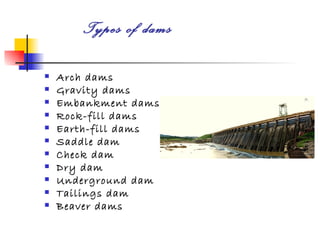
Types of dams

   Arch dams
   Gravity dams
   Embankment dams
   Rock-fill dams
   Earth-fill dams
   Saddle dam
   Check dam
   Dry dam
   Underground dam
   Tailings dam
   Beaver dams
Uses of dams

1.   To provide a supply of water for towns, cities
     and mining sites
2.   To contain and store waste (tailings) from
     mines
3.   To provide a supply of water for the irrigation
     of crops
4.   To generate electricity in hydro-electric power
     stations
5.   To help control or mitigate floods
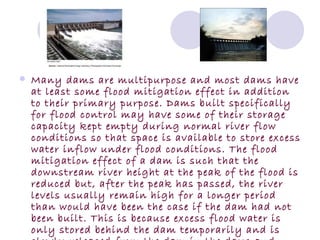
   Many dams are multipurpose and most dams have
    at least some flood mitigation effect in addition
    to their primary purpose. Dams built specifically
    for flood control may have some of their storage
    capacity kept empty during normal river flow
    conditions so that space is available to store excess
    water inflow under flood conditions. The flood
    mitigation effect of a dam is such that the
    downstream river height at the peak of the flood is
    reduced but, after the peak has passed, the river
    levels usually remain high for a longer period
    than would have been the case if the dam had not
    been built. This is because excess flood water is
    only stored behind the dam temporarily and is
DAMS IN INDIA
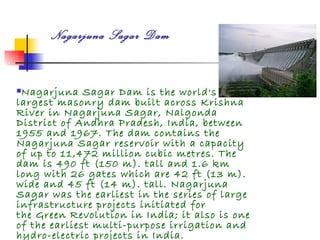
Nagarjuna Sagar Dam


Nagarjuna Sagar Dam is the world's
largest masonry dam built across Krishna
River in Nagarjuna Sagar, Nalgonda
District of Andhra Pradesh, India, between
1955 and 1967. The dam contains the
Nagarjuna Sagar reservoir with a capacity
of up to 11,472 million cubic metres. The
dam is 490 ft (150 m). tall and 1.6 km
long with 26 gates which are 42 ft (13 m).
wide and 45 ft (14 m). tall. Nagarjuna
Sagar was the earliest in the series of large
infrastructure projects initiated for
the Green Revolution in India; it also is one
of the earliest multi-purpose irrigation and
hydro-electric projects in India.
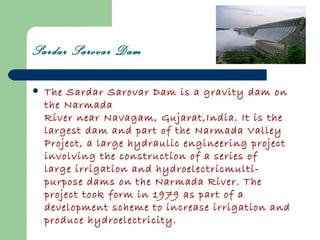
Sardar Sarovar Dam

   The Sardar Sarovar Dam is a gravity dam on
    the Narmada
    River near Navagam, Gujarat,India. It is the
    largest dam and part of the Narmada Valley
    Project, a large hydraulic engineering project
    involving the construction of a series of
    large irrigation and hydroelectricmulti-
    purpose dams on the Narmada River. The
    project took form in 1979 as part of a
    development scheme to increase irrigation and
    produce hydroelectricity.
Bhakra Dam

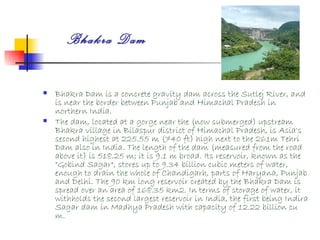
   Bhakra Dam is a concrete gravity dam across the Sutlej River, and
    is near the border between Punjab and Himachal Pradesh in
    northern India.
   The dam, located at a gorge near the (now submerged) upstream
    Bhakra village in Bilaspur district of Himachal Pradesh, is Asia's
    second highest at 225.55 m (740 ft) high next to the 261m Tehri
    Dam also in India. The length of the dam (measured from the road
    above it) is 518.25 m; it is 9.1 m broad. Its reservoir, known as the
    "Gobind Sagar", stores up to 9.34 billion cubic meters of water,
    enough to drain the whole of Chandigarh, parts of Haryana, Punjab
    and Delhi. The 90 km long reservoir created by the Bhakra Dam is
    spread over an area of 168.35 km2. In terms of storage of water, it
    withholds the second largest reservoir in India, the first being Indira
    Sagar dam in Madhya Pradesh with capacity of 12.22 billion cu
    m.
Krishna Raja Sagara

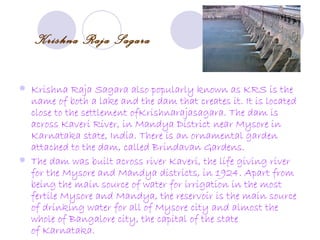
   Krishna Raja Sagara also popularly known as KRS is the
    name of both a lake and the dam that creates it. It is located
    close to the settlement ofKrishnarajasagara. The dam is
    across Kaveri River, in Mandya District near Mysore in
    Karnataka state, India. There is an ornamental garden
    attached to the dam, called Brindavan Gardens.
   The dam was built across river Kaveri, the life giving river
    for the Mysore and Mandya districts, in 1924. Apart from
    being the main source of water for irrigation in the most
    fertile Mysore and Mandya, the reservoir is the main source
    of drinking water for all of Mysore city and almost the
    whole of Bangalore city, the capital of the state
    of Karnataka.
Gandhi Sagar Dam

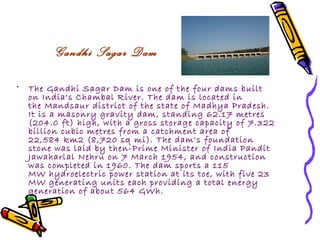
•   The Gandhi Sagar Dam is one of the four dams built
    on India's Chambal River. The dam is located in
    the Mandsaur district of the state of Madhya Pradesh.
    It is a masonry gravity dam, standing 62.17 metres
    (204.0 ft) high, with a gross storage capacity of 7.322
    billion cubic metres from a catchment area of
    22,584 km2 (8,720 sq mi). The dam's foundation
    stone was laid by then-Prime Minister of India Pandit
    Jawaharlal Nehru on 7 March 1954, and construction
    was completed in 1960. The dam sports a 115
    MW hydroelectric power station at its toe, with five 23
    MW generating units each providing a total energy
    generation of about 564 GWh.
Indirasagar Dam
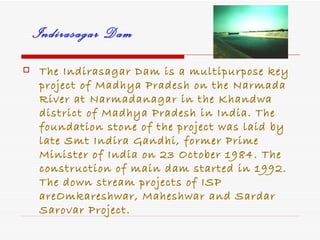
    The Indirasagar Dam is a multipurpose key
     project of Madhya Pradesh on the Narmada
     River at Narmadanagar in the Khandwa
     district of Madhya Pradesh in India. The
     foundation stone of the project was laid by
     late Smt Indira Gandhi, former Prime
     Minister of India on 23 October 1984. The
     construction of main dam started in 1992.
     The down stream projects of ISP
     areOmkareshwar, Maheshwar and Sardar
     Sarovar Project.
Koyna Dam

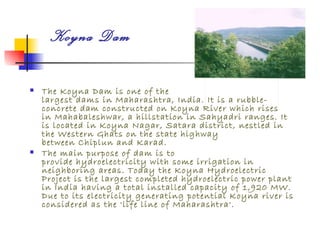
   The Koyna Dam is one of the
    largest dams in Maharashtra, India. It is a rubble-
    concrete dam constructed on Koyna River which rises
    in Mahabaleshwar, a hillstation in Sahyadri ranges. It
    is located in Koyna Nagar, Satara district, nestled in
    the Western Ghats on the state highway
    between Chiplun and Karad.
   The main purpose of dam is to
    provide hydroelectricity with some irrigation in
    neighboring areas. Today the Koyna Hydroelectric
    Project is the largest completed hydroelectric power plant
    in India having a total installed capacity of 1,920 MW.
    Due to its electricity generating potential Koyna river is
    considered as the 'life line of Maharashtra'.
Hirakud Dam

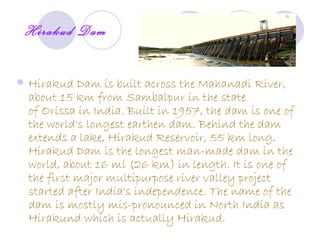
   Hirakud Dam is built across the Mahanadi River,
    about 15 km from Sambalpur in the state
    of Orissa in India. Built in 1957, the dam is one of
    the world's longest earthen dam. Behind the dam
    extends a lake, Hirakud Reservoir, 55 km long.
    Hirakud Dam is the longest man-made dam in the
    world, about 16 mi (26 km) in length. It is one of
    the first major multipurpose river valley project
    started after India's independence. The name of the
    dam is mostly mis-pronounced in North India as
    Hirakund which is actually Hirakud.
Rana Pratap Sagar Dam

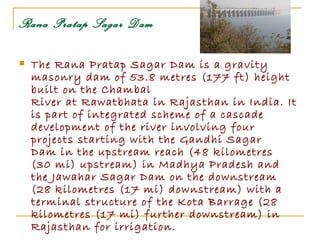
   The Rana Pratap Sagar Dam is a gravity
    masonry dam of 53.8 metres (177 ft) height
    built on the Chambal
    River at Rawatbhata in Rajasthan in India. It
    is part of integrated scheme of a cascade
    development of the river involving four
    projects starting with the Gandhi Sagar
    Dam in the upstream reach (48 kilometres
    (30 mi) upstream) in Madhya Pradesh and
    the Jawahar Sagar Dam on the downstream
    (28 kilometres (17 mi) downstream) with a
    terminal structure of the Kota Barrage (28
    kilometres (17 mi) further downstream) in
    Rajasthan for irrigation.
Pong Dam

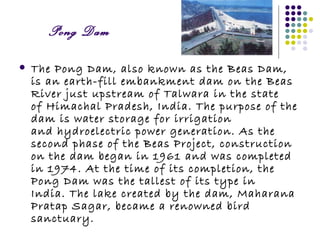
   The Pong Dam, also known as the Beas Dam,
    is an earth-fill embankment dam on the Beas
    River just upstream of Talwara in the state
    of Himachal Pradesh, India. The purpose of the
    dam is water storage for irrigation
    and hydroelectric power generation. As the
    second phase of the Beas Project, construction
    on the dam began in 1961 and was completed
    in 1974. At the time of its completion, the
    Pong Dam was the tallest of its type in
    India. The lake created by the dam, Maharana
    Pratap Sagar, became a renowned bird
    sanctuary.
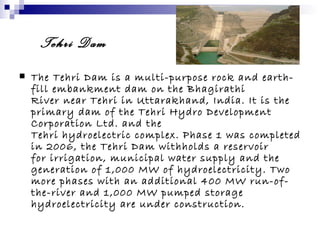
Tehri Dam
   The Tehri Dam is a multi-purpose rock and earth-
    fill embankment dam on the Bhagirathi
    River near Tehri in Uttarakhand, India. It is the
    primary dam of the Tehri Hydro Development
    Corporation Ltd. and the
    Tehri hydroelectric complex. Phase 1 was completed
    in 2006, the Tehri Dam withholds a reservoir
    for irrigation, municipal water supply and the
    generation of 1,000 MW of hydroelectricity. Two
    more phases with an additional 400 MW run-of-
    the-river and 1,000 MW pumped storage
    hydroelectricity are under construction.
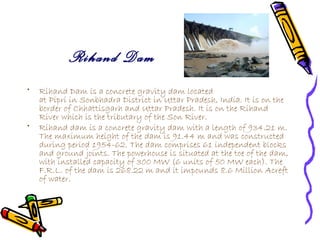
Rihand Dam
•   Rihand Dam is a concrete gravity dam located
    at Pipri in Sonbhadra District in Uttar Pradesh, India. It is on the
    border of Chhattisgarh and Uttar Pradesh. It is on the Rihand
    River which is the tributary of the Son River.
•   Rihand dam is a concrete gravity dam with a length of 934.21 m.
    The maximum height of the dam is 91.44 m and was constructed
    during period 1954-62. The dam comprises 61 independent blocks
    and ground joints. The powerhouse is situated at the toe of the dam,
    with installed capacity of 300 MW (6 units of 50 MW each). The
    F.R.L. of the dam is 268.22 m and it impounds 8.6 Million Acreft
    of water.
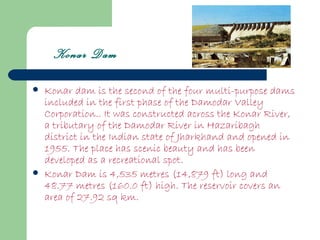
Konar Dam

   Konar dam is the second of the four multi-purpose dams
    included in the first phase of the Damodar Valley
    Corporation.. It was constructed across the Konar River,
    a tributary of the Damodar River in Hazaribagh
    district in the Indian state of Jharkhand and opened in
    1955. The place has scenic beauty and has been
    developed as a recreational spot.
   Konar Dam is 4,535 metres (14,879 ft) long and
    48.77 metres (160.0 ft) high. The reservoir covers an
    area of 27.92 sq km.
The End

Dams in india

  • 1.
    Name -Riya Pahwa Class- 10 A Roll no -28
  • 2.
    What is adam ????  A dam is a barrier that impounds water or underground streams. Dams generally serve the primary purpose of retaining water, while other structures such asfloodgates or levees (also known as dikes) are used to manage or prevent water flow into specific land regions. Hydropower and pumped-storage hydroelectricityare often used in conjunction with dams to generate electricity. A dam can also be used to collect water or for storage of water which can be evenly distributed between
  • 3.
    Types of dams  Arch dams  Gravity dams  Embankment dams  Rock-fill dams  Earth-fill dams  Saddle dam  Check dam  Dry dam  Underground dam  Tailings dam  Beaver dams
  • 4.
    Uses of dams 1. To provide a supply of water for towns, cities and mining sites 2. To contain and store waste (tailings) from mines 3. To provide a supply of water for the irrigation of crops 4. To generate electricity in hydro-electric power stations 5. To help control or mitigate floods
  • 5.
    Many dams are multipurpose and most dams have at least some flood mitigation effect in addition to their primary purpose. Dams built specifically for flood control may have some of their storage capacity kept empty during normal river flow conditions so that space is available to store excess water inflow under flood conditions. The flood mitigation effect of a dam is such that the downstream river height at the peak of the flood is reduced but, after the peak has passed, the river levels usually remain high for a longer period than would have been the case if the dam had not been built. This is because excess flood water is only stored behind the dam temporarily and is
  • 7.
  • 8.
    Nagarjuna Sagar Dam NagarjunaSagar Dam is the world's largest masonry dam built across Krishna River in Nagarjuna Sagar, Nalgonda District of Andhra Pradesh, India, between 1955 and 1967. The dam contains the Nagarjuna Sagar reservoir with a capacity of up to 11,472 million cubic metres. The dam is 490 ft (150 m). tall and 1.6 km long with 26 gates which are 42 ft (13 m). wide and 45 ft (14 m). tall. Nagarjuna Sagar was the earliest in the series of large infrastructure projects initiated for the Green Revolution in India; it also is one of the earliest multi-purpose irrigation and hydro-electric projects in India.
  • 9.
    Sardar Sarovar Dam  The Sardar Sarovar Dam is a gravity dam on the Narmada River near Navagam, Gujarat,India. It is the largest dam and part of the Narmada Valley Project, a large hydraulic engineering project involving the construction of a series of large irrigation and hydroelectricmulti- purpose dams on the Narmada River. The project took form in 1979 as part of a development scheme to increase irrigation and produce hydroelectricity.
  • 10.
    Bhakra Dam  Bhakra Dam is a concrete gravity dam across the Sutlej River, and is near the border between Punjab and Himachal Pradesh in northern India.  The dam, located at a gorge near the (now submerged) upstream Bhakra village in Bilaspur district of Himachal Pradesh, is Asia's second highest at 225.55 m (740 ft) high next to the 261m Tehri Dam also in India. The length of the dam (measured from the road above it) is 518.25 m; it is 9.1 m broad. Its reservoir, known as the "Gobind Sagar", stores up to 9.34 billion cubic meters of water, enough to drain the whole of Chandigarh, parts of Haryana, Punjab and Delhi. The 90 km long reservoir created by the Bhakra Dam is spread over an area of 168.35 km2. In terms of storage of water, it withholds the second largest reservoir in India, the first being Indira Sagar dam in Madhya Pradesh with capacity of 12.22 billion cu m.
  • 11.
    Krishna Raja Sagara  Krishna Raja Sagara also popularly known as KRS is the name of both a lake and the dam that creates it. It is located close to the settlement ofKrishnarajasagara. The dam is across Kaveri River, in Mandya District near Mysore in Karnataka state, India. There is an ornamental garden attached to the dam, called Brindavan Gardens.  The dam was built across river Kaveri, the life giving river for the Mysore and Mandya districts, in 1924. Apart from being the main source of water for irrigation in the most fertile Mysore and Mandya, the reservoir is the main source of drinking water for all of Mysore city and almost the whole of Bangalore city, the capital of the state of Karnataka.
  • 12.
    Gandhi Sagar Dam • The Gandhi Sagar Dam is one of the four dams built on India's Chambal River. The dam is located in the Mandsaur district of the state of Madhya Pradesh. It is a masonry gravity dam, standing 62.17 metres (204.0 ft) high, with a gross storage capacity of 7.322 billion cubic metres from a catchment area of 22,584 km2 (8,720 sq mi). The dam's foundation stone was laid by then-Prime Minister of India Pandit Jawaharlal Nehru on 7 March 1954, and construction was completed in 1960. The dam sports a 115 MW hydroelectric power station at its toe, with five 23 MW generating units each providing a total energy generation of about 564 GWh.
  • 13.
    Indirasagar Dam  The Indirasagar Dam is a multipurpose key project of Madhya Pradesh on the Narmada River at Narmadanagar in the Khandwa district of Madhya Pradesh in India. The foundation stone of the project was laid by late Smt Indira Gandhi, former Prime Minister of India on 23 October 1984. The construction of main dam started in 1992. The down stream projects of ISP areOmkareshwar, Maheshwar and Sardar Sarovar Project.
  • 14.
    Koyna Dam  The Koyna Dam is one of the largest dams in Maharashtra, India. It is a rubble- concrete dam constructed on Koyna River which rises in Mahabaleshwar, a hillstation in Sahyadri ranges. It is located in Koyna Nagar, Satara district, nestled in the Western Ghats on the state highway between Chiplun and Karad.  The main purpose of dam is to provide hydroelectricity with some irrigation in neighboring areas. Today the Koyna Hydroelectric Project is the largest completed hydroelectric power plant in India having a total installed capacity of 1,920 MW. Due to its electricity generating potential Koyna river is considered as the 'life line of Maharashtra'.
  • 15.
    Hirakud Dam  Hirakud Dam is built across the Mahanadi River, about 15 km from Sambalpur in the state of Orissa in India. Built in 1957, the dam is one of the world's longest earthen dam. Behind the dam extends a lake, Hirakud Reservoir, 55 km long. Hirakud Dam is the longest man-made dam in the world, about 16 mi (26 km) in length. It is one of the first major multipurpose river valley project started after India's independence. The name of the dam is mostly mis-pronounced in North India as Hirakund which is actually Hirakud.
  • 16.
    Rana Pratap SagarDam  The Rana Pratap Sagar Dam is a gravity masonry dam of 53.8 metres (177 ft) height built on the Chambal River at Rawatbhata in Rajasthan in India. It is part of integrated scheme of a cascade development of the river involving four projects starting with the Gandhi Sagar Dam in the upstream reach (48 kilometres (30 mi) upstream) in Madhya Pradesh and the Jawahar Sagar Dam on the downstream (28 kilometres (17 mi) downstream) with a terminal structure of the Kota Barrage (28 kilometres (17 mi) further downstream) in Rajasthan for irrigation.
  • 17.
    Pong Dam  The Pong Dam, also known as the Beas Dam, is an earth-fill embankment dam on the Beas River just upstream of Talwara in the state of Himachal Pradesh, India. The purpose of the dam is water storage for irrigation and hydroelectric power generation. As the second phase of the Beas Project, construction on the dam began in 1961 and was completed in 1974. At the time of its completion, the Pong Dam was the tallest of its type in India. The lake created by the dam, Maharana Pratap Sagar, became a renowned bird sanctuary.
  • 18.
    Tehri Dam  The Tehri Dam is a multi-purpose rock and earth- fill embankment dam on the Bhagirathi River near Tehri in Uttarakhand, India. It is the primary dam of the Tehri Hydro Development Corporation Ltd. and the Tehri hydroelectric complex. Phase 1 was completed in 2006, the Tehri Dam withholds a reservoir for irrigation, municipal water supply and the generation of 1,000 MW of hydroelectricity. Two more phases with an additional 400 MW run-of- the-river and 1,000 MW pumped storage hydroelectricity are under construction.
  • 19.
    Rihand Dam • Rihand Dam is a concrete gravity dam located at Pipri in Sonbhadra District in Uttar Pradesh, India. It is on the border of Chhattisgarh and Uttar Pradesh. It is on the Rihand River which is the tributary of the Son River. • Rihand dam is a concrete gravity dam with a length of 934.21 m. The maximum height of the dam is 91.44 m and was constructed during period 1954-62. The dam comprises 61 independent blocks and ground joints. The powerhouse is situated at the toe of the dam, with installed capacity of 300 MW (6 units of 50 MW each). The F.R.L. of the dam is 268.22 m and it impounds 8.6 Million Acreft of water.
  • 20.
    Konar Dam  Konar dam is the second of the four multi-purpose dams included in the first phase of the Damodar Valley Corporation.. It was constructed across the Konar River, a tributary of the Damodar River in Hazaribagh district in the Indian state of Jharkhand and opened in 1955. The place has scenic beauty and has been developed as a recreational spot.  Konar Dam is 4,535 metres (14,879 ft) long and 48.77 metres (160.0 ft) high. The reservoir covers an area of 27.92 sq km.
  • 21.