DAMPERS
Submitted To:
Sir, Muhammad Shafiq Ahmad
PRESENTED BY:
Rana Adeel BSET-01113066
Shafiq-ur-Rehman BSET-01113035
DAMPING SYSTEMS
 Due to wind, overhead transmission lines will be excited to
vibrations and oscillations that can lead to damage on the
conductor of the overhead transmission line, single parts or
the pole. In order to reduce these vibrations and oscillations
to an uncritical dimension, damping systems will have to be
installed in the overhead transmission lines.
VIBRATION DAMPER IN TRANSMISSION LINE
 Wind-induced vibration of overhead conductors is common
worldwide and can cause conductor fatigue Near a hardware
attachment.
EFFECT OF VIBRATION:
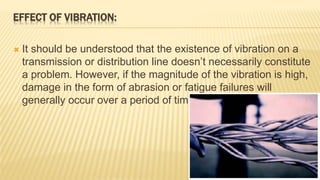
 It should be understood that the existence of vibration on a
transmission or distribution line doesn’t necessarily constitute
a problem. However, if the magnitude of the vibration is high,
damage in the form of abrasion or fatigue failures will
generally occur over a period of time.
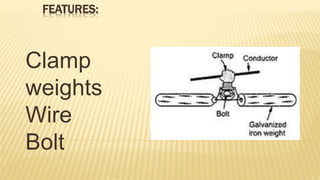
FEATURES:
Clamp
weights
Wire
Bolt
TYPES OF DAMPERS
1. Stockbridge Damper
2. ELGRA dampers
3. Tersional dampers
4. Haro damper
5. Twin Spacer Damper
6. Triple spacer Damper
7. Quadruple Spacer Damper
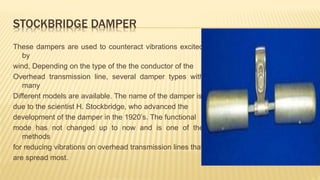
STOCKBRIDGE DAMPER
These dampers are used to counteract vibrations excited
by
wind, Depending on the type of the the conductor of the
Overhead transmission line, several damper types with
many
Different models are available. The name of the damper is
due to the scientist H. Stockbridge, who advanced the
development of the damper in the 1920’s. The functional
mode has not changed up to now and is one of the
methods
for reducing vibrations on overhead transmission lines that
are spread most.
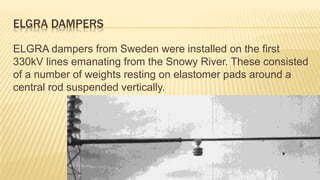
ELGRA DAMPERS
ELGRA dampers from Sweden were installed on the first
330kV lines emanating from the Snowy River. These consisted
of a number of weights resting on elastomer pads around a
central rod suspended vertically.
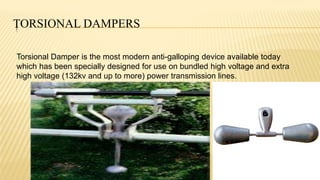
TORSIONAL DAMPERS
Torsional Damper is the most modern anti-galloping device available today
which has been specially designed for use on bundled high voltage and extra
high voltage (132kv and up to more) power transmission lines.
HARO DAMPER
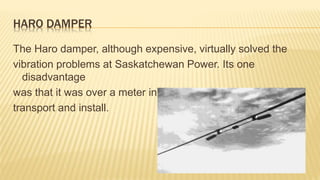
The Haro damper, although expensive, virtually solved the
vibration problems at Saskatchewan Power. Its one
disadvantage
was that it was over a meter in length and was difficult to
transport and install.
SPACER DAMPERS
Spacers serve to establish a distance between the partial
conductors of a bundle line in order to prevent the conductors
from knocking together and thus avoid damage done to
conductors. Spacer dampers will be used if vibrations excited by
wind need to be expected. the vibration amplitudes of the conductor
can be reduced to an uncritical dimension. In this context, many
different models of the spacers are available for different bundle
arrangements.
TWIN SPACER
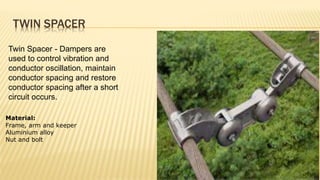
Twin Spacer - Dampers are
used to control vibration and
conductor oscillation, maintain
conductor spacing and restore
conductor spacing after a short
circuit occurs.
Material:
Frame, arm and keeper
Aluminium alloy
Nut and bolt
TRIPLE SPACER DAMPER
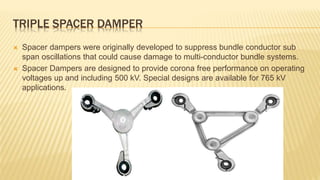
 Spacer dampers were originally developed to suppress bundle conductor sub
span oscillations that could cause damage to multi-conductor bundle systems.
 Spacer Dampers are designed to provide corona free performance on operating
voltages up and including 500 kV. Special designs are available for 765 kV
applications.
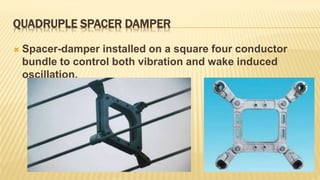
QUADRUPLE SPACER DAMPER
 Spacer-damper installed on a square four conductor
bundle to control both vibration and wake induced
oscillation.
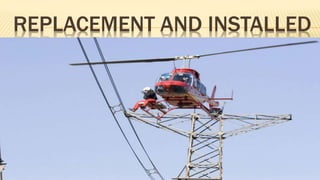
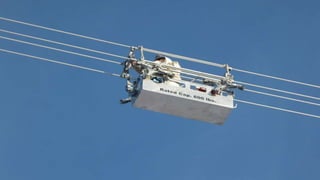
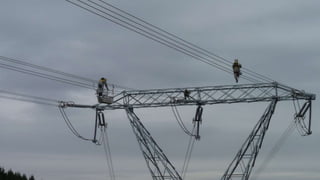
REPLACEMENT AND INSTALLED
Dampers used in electrical transmission lines

Dampers used in electrical transmission lines

  • 2.
    DAMPERS Submitted To: Sir, MuhammadShafiq Ahmad PRESENTED BY: Rana Adeel BSET-01113066 Shafiq-ur-Rehman BSET-01113035
  • 3.
    DAMPING SYSTEMS  Dueto wind, overhead transmission lines will be excited to vibrations and oscillations that can lead to damage on the conductor of the overhead transmission line, single parts or the pole. In order to reduce these vibrations and oscillations to an uncritical dimension, damping systems will have to be installed in the overhead transmission lines.
  • 4.
    VIBRATION DAMPER INTRANSMISSION LINE  Wind-induced vibration of overhead conductors is common worldwide and can cause conductor fatigue Near a hardware attachment.
  • 5.
    EFFECT OF VIBRATION: It should be understood that the existence of vibration on a transmission or distribution line doesn’t necessarily constitute a problem. However, if the magnitude of the vibration is high, damage in the form of abrasion or fatigue failures will generally occur over a period of time.
  • 6.
  • 7.
    TYPES OF DAMPERS 1.Stockbridge Damper 2. ELGRA dampers 3. Tersional dampers 4. Haro damper 5. Twin Spacer Damper 6. Triple spacer Damper 7. Quadruple Spacer Damper
  • 8.
    STOCKBRIDGE DAMPER These dampersare used to counteract vibrations excited by wind, Depending on the type of the the conductor of the Overhead transmission line, several damper types with many Different models are available. The name of the damper is due to the scientist H. Stockbridge, who advanced the development of the damper in the 1920’s. The functional mode has not changed up to now and is one of the methods for reducing vibrations on overhead transmission lines that are spread most.
  • 9.
    ELGRA DAMPERS ELGRA dampersfrom Sweden were installed on the first 330kV lines emanating from the Snowy River. These consisted of a number of weights resting on elastomer pads around a central rod suspended vertically.
  • 10.
    TORSIONAL DAMPERS Torsional Damperis the most modern anti-galloping device available today which has been specially designed for use on bundled high voltage and extra high voltage (132kv and up to more) power transmission lines.
  • 11.
    HARO DAMPER The Harodamper, although expensive, virtually solved the vibration problems at Saskatchewan Power. Its one disadvantage was that it was over a meter in length and was difficult to transport and install.
  • 12.
    SPACER DAMPERS Spacers serveto establish a distance between the partial conductors of a bundle line in order to prevent the conductors from knocking together and thus avoid damage done to conductors. Spacer dampers will be used if vibrations excited by wind need to be expected. the vibration amplitudes of the conductor can be reduced to an uncritical dimension. In this context, many different models of the spacers are available for different bundle arrangements.
  • 13.
    TWIN SPACER Twin Spacer- Dampers are used to control vibration and conductor oscillation, maintain conductor spacing and restore conductor spacing after a short circuit occurs. Material: Frame, arm and keeper Aluminium alloy Nut and bolt
  • 14.
    TRIPLE SPACER DAMPER Spacer dampers were originally developed to suppress bundle conductor sub span oscillations that could cause damage to multi-conductor bundle systems.  Spacer Dampers are designed to provide corona free performance on operating voltages up and including 500 kV. Special designs are available for 765 kV applications.
  • 15.
    QUADRUPLE SPACER DAMPER Spacer-damper installed on a square four conductor bundle to control both vibration and wake induced oscillation.
  • 16.