www.iied.org @IIED
Governing quality and
safety in informal dairy
markets: Evidence from
Kenya, Tanzania and
Assam (India)
Alejandro Guarín, Emma Blackmore, Giulia Nicolini and Bill
Vorley (IIED)
Silvia Alonso, Ram Deka, Charity Kinyua and Delia Grace
(ILRI)
www.ANH-Academy.org/ANH2021
#ANH2021
29 June 2021
• Informal markets are crucial for access,
affordability, nutrition, and livelihoods
• Unpasteurised milk + lack of refrigeration =
concerns about quality and safety
• Policy approaches: conflict, tolerance, or
marginalisation
Our key questions:
• How is informal dairy regulated?
• What are the perceptions and practices of
informal actors?
• What are the opportunities for innovative
approaches to governance?
2
Informal dairy markets: important but
sidelined
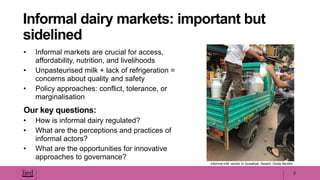
Informal milk vendor in Guwahati, Assam. Giulia Nicolini
• Urban and peri-urban locations in
Nairobi (Kenya), Arusha
(Tanzania) and Guwahati (India)
• Survey of market actors (n=431)
• 45 interviews with key informants
3
Locations and Methods
Producers 10%
Wholesalers 14%
Traders/retailers 38%
Consumers 38%
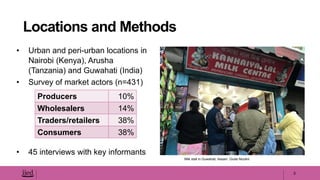
Milk stall in Guwahati, Assam. Giulia Nicolini
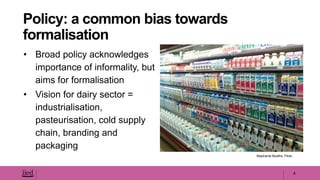
• Broad policy acknowledges
importance of informality, but
aims for formalisation
• Vision for dairy sector =
industrialisation,
pasteurisation, cold supply
chain, branding and
packaging
4
Policy: a common bias towards
formalisation
Stephanie Booths, Flickr
• Raw milk: (semi) illegal in Kenya;
legal in Tanzania and Assam
• Licences: multiple and complex in
Kenya; simpler in Tanzania and
Assam
• Institutional design: Dairy Boards
in Kenya and Tanzania,
Directorate in Assam
• Enforcement: capacities generally
weak
5
Regulation and enforcement: from
repression to ‘benign neglect’
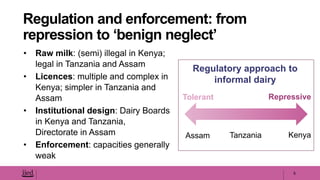
Tolerant Repressive
Assam Tanzania Kenya
Regulatory approach to
informal dairy
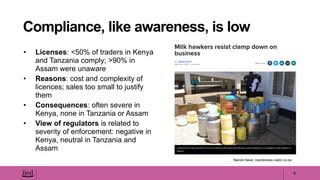
• Licenses: <50% of traders in Kenya
and Tanzania comply; >90% in
Assam were unaware
• Reasons: cost and complexity of
licences; sales too small to justify
them
• Consequences: often severe in
Kenya, none in Tanzania or Assam
• View of regulators is related to
severity of enforcement: negative in
Kenya, neutral in Tanzania and
Assam
6
Compliance, like awareness, is low
Nairobi News: nairobinews.nation.co.ke
• Formal testing (lactometer) and refrigeration
are rare – actors rely on appearance and
smell
• Choice of seller is based in trust and
loyalty; traders and consumers rarely
change suppliers
• Consumers boil milk to manage risk; they
don’t care about labels/certificates
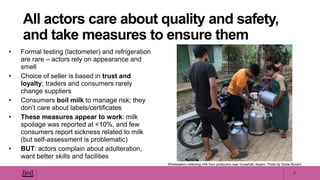
• These measures appear to work: milk
spoilage was reported at <10%, and few
consumers report sickness related to milk
(but self-assessment is problematic)
• BUT: actors complain about adulteration,
want better skills and facilities
7
All actors care about quality and safety,
and take measures to ensure them
Wholesalers collecting milk from producers near Guwahati, Assam. Photo by Giulia Nicolini
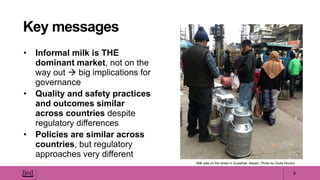
• Informal milk is THE
dominant market, not on the
way out  big implications for
governance
• Quality and safety practices
and outcomes similar
across countries despite
regulatory differences
• Policies are similar across
countries, but regulatory
approaches very different
8
Key messages
Milk sale on the street in Guwahati, Assam. Photo by Giulia Nicolini
• Policies are not aligned with the capabilities
or incentives of actors
• A pasteurised future is unlikely, at least in
the medium term: costs of non-compliance
remain low, plus there is sustained demand for
raw milk
• Confrontational approach (e.g. Kenya) doesn’t
seem to lead to better quality and safety
outcomes
• Relationships are based on trust and loyalty:
certifications and labels unlikely to sway
demand
9
Implications for governance and innovation
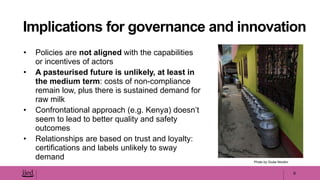
Photo by Giulia Nicolini
10
Thank you
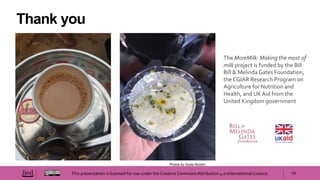
Photos by Giulia Nicolini
The MoreMilk: Making the most of
milk project is funded by the Bill
Bill & Melinda Gates Foundation,
the CGIAR Research Program on
Agriculture for Nutrition and
Health, and UK Aid from the
United Kingdom government
This presentation is licensed for use under the Creative CommonsAttribution 4.0 International Licence.

Governing quality and safety in informal dairy markets: Evidence from Kenya, Tanzania and Assam (India)

  • 1.
    www.iied.org @IIED Governing qualityand safety in informal dairy markets: Evidence from Kenya, Tanzania and Assam (India) Alejandro Guarín, Emma Blackmore, Giulia Nicolini and Bill Vorley (IIED) Silvia Alonso, Ram Deka, Charity Kinyua and Delia Grace (ILRI) www.ANH-Academy.org/ANH2021 #ANH2021 29 June 2021
  • 2.
    • Informal marketsare crucial for access, affordability, nutrition, and livelihoods • Unpasteurised milk + lack of refrigeration = concerns about quality and safety • Policy approaches: conflict, tolerance, or marginalisation Our key questions: • How is informal dairy regulated? • What are the perceptions and practices of informal actors? • What are the opportunities for innovative approaches to governance? 2 Informal dairy markets: important but sidelined Informal milk vendor in Guwahati, Assam. Giulia Nicolini
  • 3.
    • Urban andperi-urban locations in Nairobi (Kenya), Arusha (Tanzania) and Guwahati (India) • Survey of market actors (n=431) • 45 interviews with key informants 3 Locations and Methods Producers 10% Wholesalers 14% Traders/retailers 38% Consumers 38% Milk stall in Guwahati, Assam. Giulia Nicolini
  • 4.
    • Broad policyacknowledges importance of informality, but aims for formalisation • Vision for dairy sector = industrialisation, pasteurisation, cold supply chain, branding and packaging 4 Policy: a common bias towards formalisation Stephanie Booths, Flickr
  • 5.
    • Raw milk:(semi) illegal in Kenya; legal in Tanzania and Assam • Licences: multiple and complex in Kenya; simpler in Tanzania and Assam • Institutional design: Dairy Boards in Kenya and Tanzania, Directorate in Assam • Enforcement: capacities generally weak 5 Regulation and enforcement: from repression to ‘benign neglect’ Tolerant Repressive Assam Tanzania Kenya Regulatory approach to informal dairy
  • 6.
    • Licenses: <50%of traders in Kenya and Tanzania comply; >90% in Assam were unaware • Reasons: cost and complexity of licences; sales too small to justify them • Consequences: often severe in Kenya, none in Tanzania or Assam • View of regulators is related to severity of enforcement: negative in Kenya, neutral in Tanzania and Assam 6 Compliance, like awareness, is low Nairobi News: nairobinews.nation.co.ke
  • 7.
    • Formal testing(lactometer) and refrigeration are rare – actors rely on appearance and smell • Choice of seller is based in trust and loyalty; traders and consumers rarely change suppliers • Consumers boil milk to manage risk; they don’t care about labels/certificates • These measures appear to work: milk spoilage was reported at <10%, and few consumers report sickness related to milk (but self-assessment is problematic) • BUT: actors complain about adulteration, want better skills and facilities 7 All actors care about quality and safety, and take measures to ensure them Wholesalers collecting milk from producers near Guwahati, Assam. Photo by Giulia Nicolini
  • 8.
    • Informal milkis THE dominant market, not on the way out  big implications for governance • Quality and safety practices and outcomes similar across countries despite regulatory differences • Policies are similar across countries, but regulatory approaches very different 8 Key messages Milk sale on the street in Guwahati, Assam. Photo by Giulia Nicolini
  • 9.
    • Policies arenot aligned with the capabilities or incentives of actors • A pasteurised future is unlikely, at least in the medium term: costs of non-compliance remain low, plus there is sustained demand for raw milk • Confrontational approach (e.g. Kenya) doesn’t seem to lead to better quality and safety outcomes • Relationships are based on trust and loyalty: certifications and labels unlikely to sway demand 9 Implications for governance and innovation Photo by Giulia Nicolini
  • 10.
    10 Thank you Photos byGiulia Nicolini The MoreMilk: Making the most of milk project is funded by the Bill Bill & Melinda Gates Foundation, the CGIAR Research Program on Agriculture for Nutrition and Health, and UK Aid from the United Kingdom government This presentation is licensed for use under the Creative CommonsAttribution 4.0 International Licence.