Overcoming Obstacles to Self-
Confidence
Presented by Monique Tallon
CEO, Highest Path Consulting
Agenda
• Introduction
• Why Does Self-Confidence Matter?
• Definition of Self-Confidence
• What are the Barriers to Self-
Confidence?
• Tools for Building Self-Confidence
Who Am I?
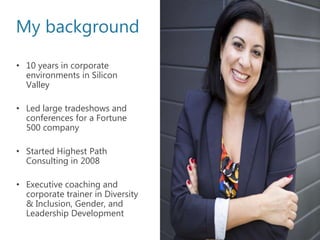
My background
• 10 years in corporate
environments in Silicon
Valley
• Led large tradeshows and
conferences for a Fortune
500 company
• Started Highest Path
Consulting in 2008
• Executive coaching and
corporate trainer in Diversity
& Inclusion, Gender, and
Leadership Development
It Impacts How We Value Ourselves
• According to studies, women believe
they are 20% less valuable than men
when asked what they deserve to earn
in salary
Marilyn J. Davidson and Ronald J. Burke, Women in Management Worldwide (Aldershot: Ashgate, 2004)
It Impacts How We Perceive Ourselves
• According to another study, when
asked to assess how well they
answered questions on a quiz, women
rated themselves as correctly
answering 5.8 out of 10, men 7.1 out of
10.
• Their actual performance scores were
about the same.
David Dunning, Kerri Johnson, Joyce Ehrlinger, and Justin Kruger, “Why People Fail to Recognize their Own
Incompetence,” Current Directions in Psychological Science, no. 3
It Impacts Our Ambition
• The same people were asked to
participate in a science competition.
• Only 49% of women signed up vs. 71%
of men
David Dunning, Kerri Johnson, Joyce Ehrlinger, and Justin Kruger, “Why People Fail to Recognize their Own
Incompetence,” Current Directions in Psychological Science, no. 3
It Impacts Our Voice
• During a Princeton study, they found
women when in a minority, spoke 75%
less than men when having to work
together to solve a budget challenge
Christopher F. Karpowtiz, Tali Mendelberg, and Lee Shaker, “Gender inequality in deliberative participation,” American
Political Science Review 106, no. 3 (2012)
The Gender Gap Persists
• Because of lack of self-confidence and a lack of
belief in themselves, women...
• Dont apply for certain jobs
• Dont speak up and voice their opinions
• Dont negotiate competitive salaries
• Dont aim for jobs in STEM or male dominated
fields
• Dont ask for a promotion
• Fill in the blank...
So What is
Confidence
Really?
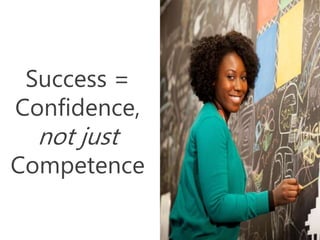
Success =
Confidence,
not just
Competence
Confidence Defined
• A belief we can create a successful
outcome through our actions
• Confidence is a feeling we experience in
ourselves
Confidence is What Sways
• Confident people are more admired to,
listened to and have more sway in
discussions and decisions.
Confidence = Happiness
• Confident people are happier, more
fulfilled and feel more on purpose
What are the
Barriers to Self-
Confidence?
Gender Bias
Unconscious
Bias
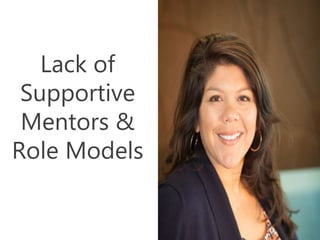
Lack of
Supportive
Mentors &
Role Models
Tools for
Building Self-
Confidence
First Step: Awareness
• Become familiar with the voices in your head!
• What is your Inner Critic telling you?
• What is the negative dialogue in your head
saying?
• Start noticing the words that pop up and what the
impact is when you listen to them
Exercise#1: Identify the Inner Critic
• What are the words of your your Inner
Critic? Jot them down on the handout.
• Examples: I’m not good enough, I’m not
qualified, I’m not competent…
Next Step: Access Your Inner Mentor
• Replace the negative statements with
positive ones from your Inner Mentor
• Jot down the words of your Inner Mentor
on the handout
• Examples: I am perfect as I am, I deserve it,
I am good enough…
Practice Makes Perfect
• Rewiring the brain’s neural pathways takes
work
• Notice each time the Inner Critic shows up
• Learn to access your Inner Mentor
• Practice self-empathy and kindness
towards yourself
Body Wisdom
• Helps us when we feel stuck or need to
make a decision
• Helps us develop a positive relationship
with our body
• Builds integrity and trust with ourselves
• Practice and leverage in your day to day
Exercise #2: Body Wisdom
• Bring to mind a situation where you
currently feel stuck or where you need to
make a difficult decision
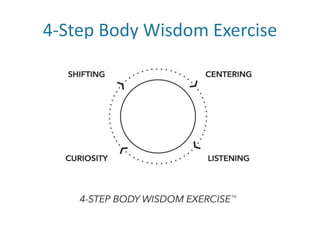
4-Step Body Wisdom Exercise
• Centering: Drop down into your body
• Listening: Listen to your body’s signals –
emotions, feelings, sensations
• Curiosity: Get curious to find out the
meaning behind those signals
• Shifting: Make a new choice based on your
findings
Exercise #3: Power Positions
• Our brain is connected to our body and
takes signals from the body
• Inhabit confident and powerful body
language to shift your mindset
• Practice your power pose
• Fake it till you make it
More Tips
• Fail Faster
• Leave your Comfort Zone
• Don’t Ruminate
• Don’t take things personally
• Speak Up, without apology
• Be authentic
• Get enough sleep and exercise
• Form supportive networks of women
• Find your mentors/role models
• Celebrate yours and others successes!
Thank You!
Get in touch:
monique@highestpath.com
www.moniquetallon.com
FB: facebook.com/m.svazlian.tallon
Twitter: @moniquetallon

Overcoming Obstacles to Self Confidence Presented Highest Path Consulting

  • 1.
    Overcoming Obstacles toSelf- Confidence Presented by Monique Tallon CEO, Highest Path Consulting
  • 2.
    Agenda • Introduction • WhyDoes Self-Confidence Matter? • Definition of Self-Confidence • What are the Barriers to Self- Confidence? • Tools for Building Self-Confidence
  • 3.
  • 4.
    My background • 10years in corporate environments in Silicon Valley • Led large tradeshows and conferences for a Fortune 500 company • Started Highest Path Consulting in 2008 • Executive coaching and corporate trainer in Diversity & Inclusion, Gender, and Leadership Development
  • 6.
    It Impacts HowWe Value Ourselves • According to studies, women believe they are 20% less valuable than men when asked what they deserve to earn in salary Marilyn J. Davidson and Ronald J. Burke, Women in Management Worldwide (Aldershot: Ashgate, 2004)
  • 7.
    It Impacts HowWe Perceive Ourselves • According to another study, when asked to assess how well they answered questions on a quiz, women rated themselves as correctly answering 5.8 out of 10, men 7.1 out of 10. • Their actual performance scores were about the same. David Dunning, Kerri Johnson, Joyce Ehrlinger, and Justin Kruger, “Why People Fail to Recognize their Own Incompetence,” Current Directions in Psychological Science, no. 3
  • 8.
    It Impacts OurAmbition • The same people were asked to participate in a science competition. • Only 49% of women signed up vs. 71% of men David Dunning, Kerri Johnson, Joyce Ehrlinger, and Justin Kruger, “Why People Fail to Recognize their Own Incompetence,” Current Directions in Psychological Science, no. 3
  • 9.
    It Impacts OurVoice • During a Princeton study, they found women when in a minority, spoke 75% less than men when having to work together to solve a budget challenge Christopher F. Karpowtiz, Tali Mendelberg, and Lee Shaker, “Gender inequality in deliberative participation,” American Political Science Review 106, no. 3 (2012)
  • 11.
    The Gender GapPersists • Because of lack of self-confidence and a lack of belief in themselves, women... • Dont apply for certain jobs • Dont speak up and voice their opinions • Dont negotiate competitive salaries • Dont aim for jobs in STEM or male dominated fields • Dont ask for a promotion • Fill in the blank...
  • 12.
  • 13.
  • 14.
    Confidence Defined • Abelief we can create a successful outcome through our actions • Confidence is a feeling we experience in ourselves
  • 15.
    Confidence is WhatSways • Confident people are more admired to, listened to and have more sway in discussions and decisions.
  • 16.
    Confidence = Happiness •Confident people are happier, more fulfilled and feel more on purpose
  • 18.
    What are the Barriersto Self- Confidence?
  • 19.
  • 20.
  • 21.
  • 22.
  • 23.
    First Step: Awareness •Become familiar with the voices in your head! • What is your Inner Critic telling you? • What is the negative dialogue in your head saying? • Start noticing the words that pop up and what the impact is when you listen to them
  • 24.
    Exercise#1: Identify theInner Critic • What are the words of your your Inner Critic? Jot them down on the handout. • Examples: I’m not good enough, I’m not qualified, I’m not competent…
  • 25.
    Next Step: AccessYour Inner Mentor • Replace the negative statements with positive ones from your Inner Mentor • Jot down the words of your Inner Mentor on the handout • Examples: I am perfect as I am, I deserve it, I am good enough…
  • 26.
    Practice Makes Perfect •Rewiring the brain’s neural pathways takes work • Notice each time the Inner Critic shows up • Learn to access your Inner Mentor • Practice self-empathy and kindness towards yourself
  • 28.
    Body Wisdom • Helpsus when we feel stuck or need to make a decision • Helps us develop a positive relationship with our body • Builds integrity and trust with ourselves • Practice and leverage in your day to day
  • 29.
    Exercise #2: BodyWisdom • Bring to mind a situation where you currently feel stuck or where you need to make a difficult decision
  • 30.
  • 31.
    4-Step Body WisdomExercise • Centering: Drop down into your body • Listening: Listen to your body’s signals – emotions, feelings, sensations • Curiosity: Get curious to find out the meaning behind those signals • Shifting: Make a new choice based on your findings
  • 33.
    Exercise #3: PowerPositions • Our brain is connected to our body and takes signals from the body • Inhabit confident and powerful body language to shift your mindset • Practice your power pose • Fake it till you make it
  • 34.
    More Tips • FailFaster • Leave your Comfort Zone • Don’t Ruminate • Don’t take things personally • Speak Up, without apology • Be authentic • Get enough sleep and exercise • Form supportive networks of women • Find your mentors/role models • Celebrate yours and others successes!
  • 35.
    Thank You! Get intouch: monique@highestpath.com www.moniquetallon.com FB: facebook.com/m.svazlian.tallon Twitter: @moniquetallon

Editor's Notes

  • #5 Read slide EXERCISE: Now this session is going to be as interactive as possible, and you’re going to be working with a partner throughout the next hour and a half, so I’d like you to turn and find a partner, introduce yourself and just let them know what attracted you to this session? Why did you sign up?
  • #14 The way I would like to reframe success in your minds today is that success equal confidence, not just competence. Here is what I mean by that - A lot of women think that if they show how competent they are – if they work that much harder, put in more hours, take on more projects, then they will be rewarded for it. How many of you believe that to be true? How many of you feel like you can’t apply for a job if you don’t have every singe qualification that it asks for? Yeah, and that is a general belief that many of us hold – and unfortunately it just isnt enough. Because what they’ve found in research, is that it’s not enough to be competent, you need to have confidence in order to succeed and to get ahead. For decades women have misunderstood an important law of the professional world – Having talent isnt merely about being competent, confidence is actually a part of that talent. You have to have it to be good at your job and confident to succeed. So let’s look at how we define confidence – if confidence is that important, we need to understand what it is first.
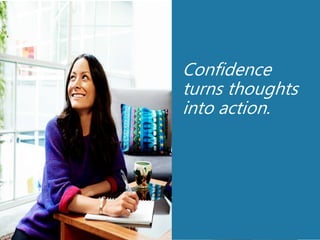
  • #18 So really what I want you to take away from this last section is that confidence turns thoughts into action – without it, we hold ourselves back, and we freeze. So we need it to get into action.
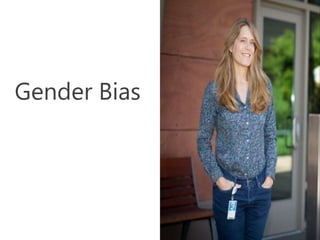
  • #20 So I’ve identified three main barriers, and I’m sure there are others and I’m sure you have your own that you can probably name but these are more high-level barriers that exist that I want to point out, and then I’m going to ask you to name the ones that are true for you. They are Gender Bias, Unconscious Bias, and Lack of Support or Role Models. Let’s look at Gender Bias first: Gender bias is all around us right – we can see it right now what’s happening in the election, as we look at Hillary Clinton and all the pressure she is under and all the scrutinizing they do of her. The fact of the matter is that gender bias exits, its not going away tomorrow, but here at Microsoft I’ve personally been involved in many initiatives to address gender bias and I know the company starting all the way from Satya are dedicated to solve the gender bias issue. But what we need to watch out for is not let gender bias get in the way of how we view ourself – meaning, lets not give into the greater narrative that exists about women or women leaders specifically. It’s really easy to let the negative stereotypes get in the way and it creates this sort of double bind – which is youre damned if you do or damned if you don’t. For example, when a woman raises her voice to make a point it’s perceived as being shrill or like she is whining, but when a man does it is seen as leader like. So we are constantly trying to walk this fine line and not be too masculine, or too feminine, and what I call that is the Tightrope. So what we have to find is an authentic leadership style that we can feel comfortable in, where we can be ourself, and still get the job done. The main point that I want to get across is that we cannot allow the stereotypes that we hear around us impact our confidence.
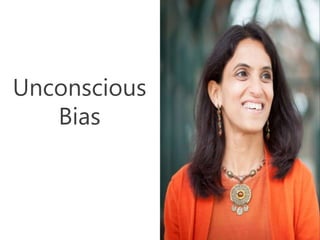
  • #21 The next is UB …. When I talk about UB, in this instance I’m referring to the Unconscious biases we have about ourselves. Which are really the beliefs we hold about ourselves. Now we know that if we are human beings, we have unconscious bias and we also now know that it has to do with the way the brain stores information and creates mental shortcuts, and that a lot of the information that comes at us is stored in our subconscious brain. Im not going to get into the mechanics of UB, but what we need to know is that our unconscious beliefs about ourselves is what hurts our confidence. It’s those whispers in the back of our head that tell us we’re not good enough, we’re not qualified, we’re not pretty enough – whatever it may be – those beliefs are what drives how we feel about our selves and ultimately our confidence. I call those unconscious biases the Inner Critic – and we’re going to look at the inner critic in more detail when we get into the tools section, but I wanted to introduce this notion that we can have unconscious biases about our selves and how we view ourselves in relation to others and that is something that we need to watch out for.
  • #22 And finally, the lack of supportive mentors and role models…. This one is might be a little bit less obvious but I wanted to mention this here because I think it’s worth mentioning. I told you earlier that 53% of women drop out mid-career in STEM fields, and contrary to what most people thing, it’s not because they are leaving to start families. One of the main reasons they site for opting out is because they feel unsupported in their career growth and due to lack of mentors and role models. Let’s just get a show of hands, how many of you feel like if you had more support, mentors, advocates or sponsors that would greatly help you in your career growth? Ok – so the fact of the matter is that we have to do better when it comes to this. I know Microsoft offers many initiatives, this conference being a great example of investing in women’s leadership, but we have to continue to think of ways to foster this. And we can also look at this from a micro level, which is that women on an individual basis have to do better in championing other women, and forming what I call the Womans Club…because the lack of a woman’s club, like the boys’ club inhibits our collective efforts to get ahead, and I truly believe we can do better at this. EXERCISE: So before we move on, I want to know What stands in the way of your self-confidence? Turn to a partner and share.