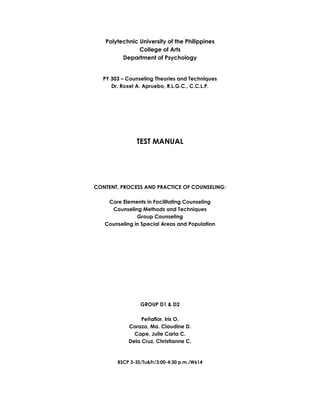
Polytechnic University of the Philippines<br />College of Arts<br />Department of Psychology<br />PY 303 – Counseling Theories and Techniques<br />Dr. Roxel A. Apruebo, R.L.G.C., C.C.L.P.<br />TEST MANUAL <br />CONTENT, PROCESS AND PRACTICE OF COUNSELING:<br />Core Elements in Facilitating Counseling<br />Counseling Methods and Techniques<br />Group Counseling<br />Counseling in Special Areas and Population<br />GROUP D1 & D2 <br />Peñaflor, Iris O.<br />Corazo, Ma. Claudine D. <br />Cape, Julie Carla C. <br />Dela Cruz, Christianne C.<br />BSCP 3-3S/Tu&Fr/3:00-4:30 p.m./W614<br />ANSWER KEY:<br />It is an internal condition in counseling wherein clients are encouraged to work hard on their problem and consider perspectives that are not easy for them.
Caring detachment
Trustworthiness
Warmth
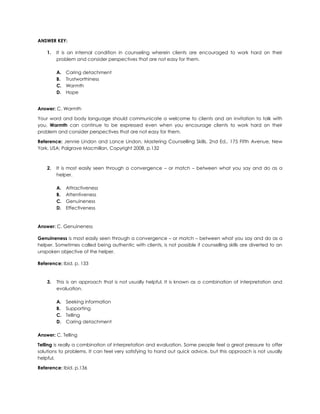
Hope Answer: C. Warmth<br />Your word and body language should communicate a welcome to clients and an invitation to talk with you. Warmth can continue to be expressed even when you encourage clients to work hard on their problem and consider perspectives that are not easy for them. <br />Reference: Jennie Lindon and Lance Lindon, Mastering Counselling Skills, 2nd Ed., 175 Fifth Avenue, New York, USA: Palgrave Macmillan, Copyright 2008, p.132<br />It is most easily seen through a convergence – or match – between what you say and do as a helper.
Attractiveness
Attentiveness
Genuineness
EffectivenessAnswer: C. Genuineness <br />Genuineness is most easily seen through a convergence – or match – between what you say and do as a helper. Sometimes called being authentic with clients, is not possible if counselling skills are diverted to an unspoken objective of the helper. <br />Reference: Ibid. p. 133<br />This is an approach that is not usually helpful. It is known as a combination of interpretation and evaluation.
Seeking information
Supporting
Telling
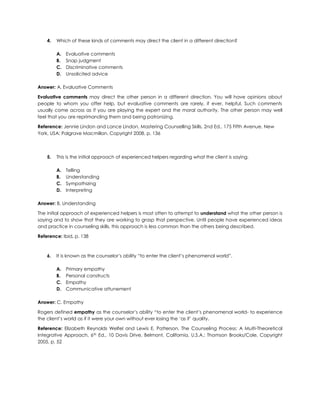
Caring detachmentAnswer: C. Telling<br />Telling is really a combination of interpretation and evaluation. Some people feel a great pressure to offer solutions to problems. It can feel very satisfying to hand out quick advice, but this approach is not usually helpful.<br />Reference: Ibid. p.136<br />Which of these kinds of comments may direct the client in a different direction?
Evaluative comments
Snap judgment
Discriminative comments
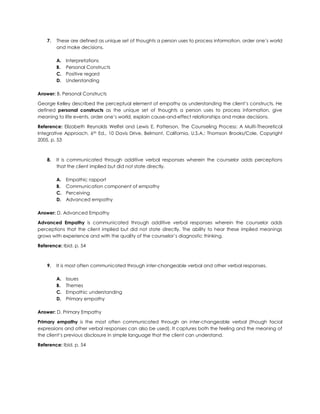
Unsolicited adviceAnswer: A. Evaluative Comments <br />Evaluative comments may direct the other person in a different direction. You will have opinions about people to whom you offer help, but evaluative comments are rarely, if ever, helpful. Such comments usually come across as if you are playing the expert and the moral authority. The other person may well feel that you are reprimanding them and being patronizing.<br />Reference: Jennie Lindon and Lance Lindon, Mastering Counselling Skills, 2nd Ed., 175 Fifth Avenue, New York, USA: Palgrave Macmillan, Copyright 2008, p. 136 <br />This is the initial approach of experienced helpers regarding what the client is saying.
Telling

D1 and d2 (test manuals)

  • 1.
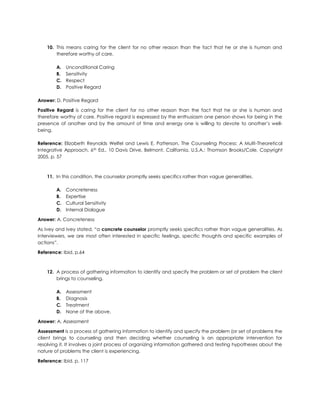
    Polytechnic University ofthe Philippines<br />College of Arts<br />Department of Psychology<br />PY 303 – Counseling Theories and Techniques<br />Dr. Roxel A. Apruebo, R.L.G.C., C.C.L.P.<br />TEST MANUAL <br />CONTENT, PROCESS AND PRACTICE OF COUNSELING:<br />Core Elements in Facilitating Counseling<br />Counseling Methods and Techniques<br />Group Counseling<br />Counseling in Special Areas and Population<br />GROUP D1 & D2 <br />Peñaflor, Iris O.<br />Corazo, Ma. Claudine D. <br />Cape, Julie Carla C. <br />Dela Cruz, Christianne C.<br />BSCP 3-3S/Tu&Fr/3:00-4:30 p.m./W614<br />ANSWER KEY:<br />It is an internal condition in counseling wherein clients are encouraged to work hard on their problem and consider perspectives that are not easy for them.
  • 2.
  • 3.
  • 4.
  • 5.
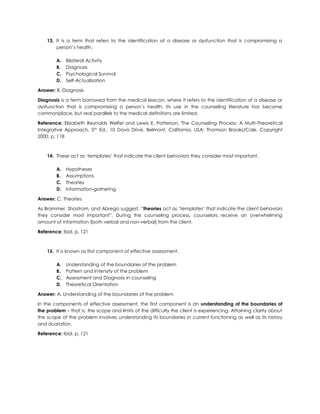
    Hope Answer: C.Warmth<br />Your word and body language should communicate a welcome to clients and an invitation to talk with you. Warmth can continue to be expressed even when you encourage clients to work hard on their problem and consider perspectives that are not easy for them. <br />Reference: Jennie Lindon and Lance Lindon, Mastering Counselling Skills, 2nd Ed., 175 Fifth Avenue, New York, USA: Palgrave Macmillan, Copyright 2008, p.132<br />It is most easily seen through a convergence – or match – between what you say and do as a helper.
  • 6.
  • 7.
  • 8.
  • 9.
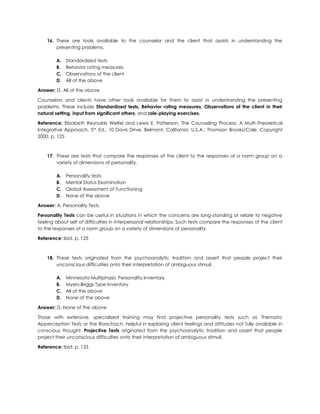
    EffectivenessAnswer: C. Genuineness<br />Genuineness is most easily seen through a convergence – or match – between what you say and do as a helper. Sometimes called being authentic with clients, is not possible if counselling skills are diverted to an unspoken objective of the helper. <br />Reference: Ibid. p. 133<br />This is an approach that is not usually helpful. It is known as a combination of interpretation and evaluation.
  • 10.
  • 11.
  • 12.
  • 13.
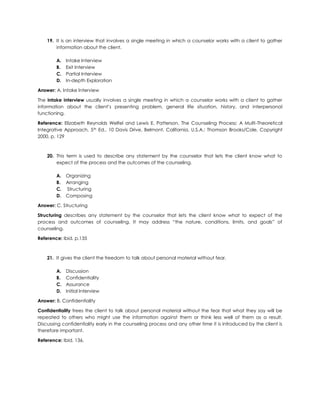
    Caring detachmentAnswer: C.Telling<br />Telling is really a combination of interpretation and evaluation. Some people feel a great pressure to offer solutions to problems. It can feel very satisfying to hand out quick advice, but this approach is not usually helpful.<br />Reference: Ibid. p.136<br />Which of these kinds of comments may direct the client in a different direction?
  • 14.
  • 15.
  • 16.
  • 17.
    Unsolicited adviceAnswer: A.Evaluative Comments <br />Evaluative comments may direct the other person in a different direction. You will have opinions about people to whom you offer help, but evaluative comments are rarely, if ever, helpful. Such comments usually come across as if you are playing the expert and the moral authority. The other person may well feel that you are reprimanding them and being patronizing.<br />Reference: Jennie Lindon and Lance Lindon, Mastering Counselling Skills, 2nd Ed., 175 Fifth Avenue, New York, USA: Palgrave Macmillan, Copyright 2008, p. 136 <br />This is the initial approach of experienced helpers regarding what the client is saying.
  • 18.