Choosing the Right
Cloud Database
Janakiram MSV
@janakiramm
Principal Analyst Head – Cloud Services
Janakiram & Associates Aditi Technologies
www.janakiram.com www.aditi.com
Agenda
• Evolution of Database on Cloud
• Key factors to consider
• Current landscape
• Roadmap and predictions
*Covers only RDBMS offered as a managed service (DBaaS)
Evolution of Database on Cloud
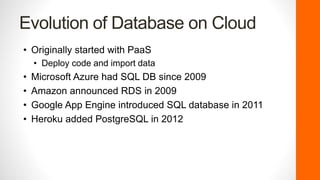
• Originally started with PaaS
• Deploy code and import data
• Microsoft Azure had SQL DB since 2009
• Amazon announced RDS in 2009
• Google App Engine introduced SQL database in 2011
• Heroku added PostgreSQL in 2012
Popular RDBMS on Cloud
• MySQL
• PostgreSQL
• MS SQL
• Oracle
Top 5 Factors to Consider
1. Database container types
2. Compatibility & supported database size
3. Purchasing options
4. License mobility
5. Hybrid capability and integration
1. Database Container Types
• Analogues to VM instance types
• Varies in configuration
• CPU, Memory and I/O
• Have direct impact on cost and performance
• Look for choice of instance types
2. Compatibility & Supported DB Size
• Cloud DB engine may not be compatible with the original
database
• Check the supported DB version and ability to apply
custom configuration
• Maximum supported size can make or break the
migration
3. Purchasing Options
• Cloud DB provider may support
• On-demand pricing
• Commitment based pricing
• Utilization based pricing
• Purchasing option will have significant impact on cost
4. License Mobility
• Check if your enterprise DB vendor certified the cloud
platform
• Evaluate if you can “bring your own license” to cloud
platform
• Help protect the investments made in volume licensing
deal with your DB vendor
5. Hybrid capability and integration
• Cloud databases are mostly obscure resources not
exposed to the public
• Cloud databases should be launched in private subnets
with discreet access
• They should support easy integration with the on-
premise counter parts
High Availability & Monitoring
(Bonus)
• Mature cloud providers support HA
• Check how the cloud provider implements high
availability of database service
• Evaluate the monitoring tools provided by the vendor
Top 5 Cloud Databases
• Amazon RDS
• Google Cloud SQL
• HP Cloud SQL
• Microsoft Azure SQL Database
• Rackspace Cloud SQL
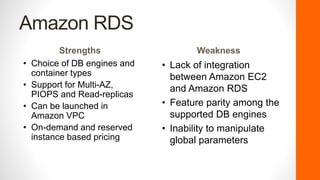
Amazon RDS
Strengths
• Choice of DB engines and
container types
• Support for Multi-AZ,
PIOPS and Read-replicas
• Can be launched in
Amazon VPC
• On-demand and reserved
instance based pricing
Weakness
• Lack of integration
between Amazon EC2
and Amazon RDS
• Feature parity among the
supported DB engines
• Inability to manipulate
global parameters
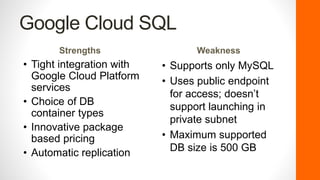
Google Cloud SQL
Strengths
• Tight integration with
Google Cloud Platform
services
• Choice of DB
container types
• Innovative package
based pricing
• Automatic replication
Weakness
• Supports only MySQL
• Uses public endpoint
for access; doesn’t
support launching in
private subnet
• Maximum supported
DB size is 500 GB
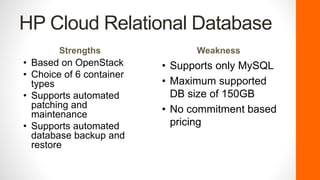
HP Cloud Relational Database
Strengths
• Based on OpenStack
• Choice of 6 container
types
• Supports automated
patching and
maintenance
• Supports automated
database backup and
restore
Weakness
• Supports only MySQL
• Maximum supported
DB size of 150GB
• No commitment based
pricing
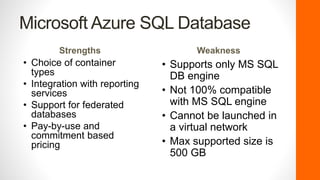
Microsoft Azure SQL Database
Strengths
• Choice of container
types
• Integration with reporting
services
• Support for federated
databases
• Pay-by-use and
commitment based
pricing
Weakness
• Supports only MS SQL
DB engine
• Not 100% compatible
with MS SQL engine
• Cannot be launched in
a virtual network
• Max supported size is
500 GB
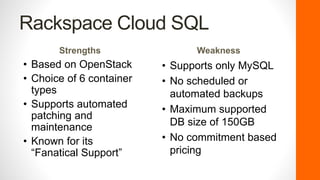
Rackspace Cloud SQL
Strengths
• Based on OpenStack
• Choice of 6 container
types
• Supports automated
patching and
maintenance
• Known for its
“Fanatical Support”
Weakness
• Supports only MySQL
• No scheduled or
automated backups
• Maximum supported
DB size of 150GB
• No commitment based
pricing
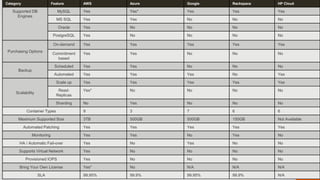
Category Feature AWS Azure Google Rackspace HP Cloud
Supported DB
Engines
MySQL Yes Yes* Yes Yes Yes
MS SQL Yes Yes No No No
Oracle Yes No No No No
PostgreSQL Yes No No No No
Purchasing Options
On-demand Yes Yes Yes Yes Yes
Commitment
based
Yes Yes No No No
Backup
Scheduled Yes Yes No No No
Automated Yes Yes Yes No Yes
Scalability
Scale up Yes Yes Yes Yes Yes
Read-
Replicas
Yes* No No No No
Sharding No Yes No No No
Container Types 9 3 7 6 6
Maximum Supported Size 3TB 500GB 500GB 150GB Not Available
Automated Patching Yes Yes Yes Yes Yes
Monitoring Yes Yes No Yes No
HA / Automatic Fail-over Yes No Yes No No
Supports Virtual Network Yes No No No No
Provisioned IOPS Yes No No No No
Bring Your Own License Yes* No N/A N/A N/A
SLA 99.95% 99.9% 99.95% 99.9% N/A
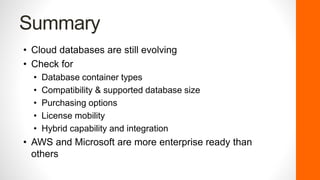
Summary
• Cloud databases are still evolving
• Check for
• Database container types
• Compatibility & supported database size
• Purchasing options
• License mobility
• Hybrid capability and integration
• AWS and Microsoft are more enterprise ready than
others
Thank You!
Janakiram MSV
jani@janakiram.com
@janakiramm

Choosing the right Cloud Database

  • 1.
    Choosing the Right CloudDatabase Janakiram MSV @janakiramm Principal Analyst Head – Cloud Services Janakiram & Associates Aditi Technologies www.janakiram.com www.aditi.com
  • 2.
    Agenda • Evolution ofDatabase on Cloud • Key factors to consider • Current landscape • Roadmap and predictions *Covers only RDBMS offered as a managed service (DBaaS)
  • 3.
    Evolution of Databaseon Cloud • Originally started with PaaS • Deploy code and import data • Microsoft Azure had SQL DB since 2009 • Amazon announced RDS in 2009 • Google App Engine introduced SQL database in 2011 • Heroku added PostgreSQL in 2012
  • 4.
    Popular RDBMS onCloud • MySQL • PostgreSQL • MS SQL • Oracle
  • 5.
    Top 5 Factorsto Consider 1. Database container types 2. Compatibility & supported database size 3. Purchasing options 4. License mobility 5. Hybrid capability and integration
  • 6.
    1. Database ContainerTypes • Analogues to VM instance types • Varies in configuration • CPU, Memory and I/O • Have direct impact on cost and performance • Look for choice of instance types
  • 7.
    2. Compatibility &Supported DB Size • Cloud DB engine may not be compatible with the original database • Check the supported DB version and ability to apply custom configuration • Maximum supported size can make or break the migration
  • 8.
    3. Purchasing Options •Cloud DB provider may support • On-demand pricing • Commitment based pricing • Utilization based pricing • Purchasing option will have significant impact on cost
  • 9.
    4. License Mobility •Check if your enterprise DB vendor certified the cloud platform • Evaluate if you can “bring your own license” to cloud platform • Help protect the investments made in volume licensing deal with your DB vendor
  • 10.
    5. Hybrid capabilityand integration • Cloud databases are mostly obscure resources not exposed to the public • Cloud databases should be launched in private subnets with discreet access • They should support easy integration with the on- premise counter parts
  • 11.
    High Availability &Monitoring (Bonus) • Mature cloud providers support HA • Check how the cloud provider implements high availability of database service • Evaluate the monitoring tools provided by the vendor
  • 12.
    Top 5 CloudDatabases • Amazon RDS • Google Cloud SQL • HP Cloud SQL • Microsoft Azure SQL Database • Rackspace Cloud SQL
  • 13.
    Amazon RDS Strengths • Choiceof DB engines and container types • Support for Multi-AZ, PIOPS and Read-replicas • Can be launched in Amazon VPC • On-demand and reserved instance based pricing Weakness • Lack of integration between Amazon EC2 and Amazon RDS • Feature parity among the supported DB engines • Inability to manipulate global parameters
  • 14.
    Google Cloud SQL Strengths •Tight integration with Google Cloud Platform services • Choice of DB container types • Innovative package based pricing • Automatic replication Weakness • Supports only MySQL • Uses public endpoint for access; doesn’t support launching in private subnet • Maximum supported DB size is 500 GB
  • 15.
    HP Cloud RelationalDatabase Strengths • Based on OpenStack • Choice of 6 container types • Supports automated patching and maintenance • Supports automated database backup and restore Weakness • Supports only MySQL • Maximum supported DB size of 150GB • No commitment based pricing
  • 16.
    Microsoft Azure SQLDatabase Strengths • Choice of container types • Integration with reporting services • Support for federated databases • Pay-by-use and commitment based pricing Weakness • Supports only MS SQL DB engine • Not 100% compatible with MS SQL engine • Cannot be launched in a virtual network • Max supported size is 500 GB
  • 17.
    Rackspace Cloud SQL Strengths •Based on OpenStack • Choice of 6 container types • Supports automated patching and maintenance • Known for its “Fanatical Support” Weakness • Supports only MySQL • No scheduled or automated backups • Maximum supported DB size of 150GB • No commitment based pricing
  • 18.
    Category Feature AWSAzure Google Rackspace HP Cloud Supported DB Engines MySQL Yes Yes* Yes Yes Yes MS SQL Yes Yes No No No Oracle Yes No No No No PostgreSQL Yes No No No No Purchasing Options On-demand Yes Yes Yes Yes Yes Commitment based Yes Yes No No No Backup Scheduled Yes Yes No No No Automated Yes Yes Yes No Yes Scalability Scale up Yes Yes Yes Yes Yes Read- Replicas Yes* No No No No Sharding No Yes No No No Container Types 9 3 7 6 6 Maximum Supported Size 3TB 500GB 500GB 150GB Not Available Automated Patching Yes Yes Yes Yes Yes Monitoring Yes Yes No Yes No HA / Automatic Fail-over Yes No Yes No No Supports Virtual Network Yes No No No No Provisioned IOPS Yes No No No No Bring Your Own License Yes* No N/A N/A N/A SLA 99.95% 99.9% 99.95% 99.9% N/A
  • 19.
    Summary • Cloud databasesare still evolving • Check for • Database container types • Compatibility & supported database size • Purchasing options • License mobility • Hybrid capability and integration • AWS and Microsoft are more enterprise ready than others
  • 20.