Databases in the
Hosted Cloud
Colin Charles, MariaDB Corporation Ab
colin@mariadb.org | byte@bytebot.net
http://mariadb.com/ | http://mariadb.org/
http://bytebot.net/blog/ | @bytebot on Twitter
Percona Live Europe,Amsterdam, Netherlands
22 September 2015
1
whoami
• Work on MariaDB at MariaDB Corporation
(SkySQL Ab)
• Merged with Monty Program Ab, makers of
MariaDB
• Formerly MySQL AB (exit: Sun Microsystems)
• Past lives include Fedora Project (FESCO),
OpenOffice.org
• Recipient of the MySQL Community Contributor of
theYear Award 2014
2
Agenda
• MySQL as a service offering (DBaaS)
• Choices
• Considerations
• MySQL versions & access
• Costs
• Deeper into RDS
• Should you run this on EC2 or an equivalent?
• Conclusion
3
MySQL as a service
• Database as a Service (DBaaS)
• MySQL available on-demand, without any
installation/configuration of hardware/
software
• Pay-per-usage based
• Provider maintains MySQL, you don’t
maintain, upgrade, or administer the database
4
New way of
deployment
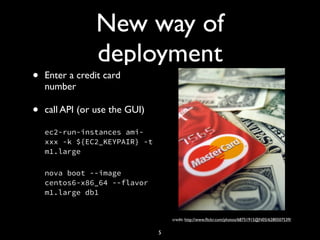
• Enter a credit card
number
• call API (or use the GUI)
ec2-run-instances ami-
xxx -k ${EC2_KEYPAIR} -t
m1.large
nova boot --image
centos6-x86_64 --flavor
m1.large db1
5
credit: http://www.flickr.com/photos/68751915@N05/6280507539/
Why DBaaS?
• “Couldn’t we just have a few more servers
to handle the traffic spike during the
elections?”
• Don’t have a lot of DBAs, optimise for
operational ease
• Rapid deployment & scale-out
6
Your choices today
• Amazon Web Services Relational Database
Service (RDS)
• Rackspace Cloud Databases
• Google Cloud SQL
7
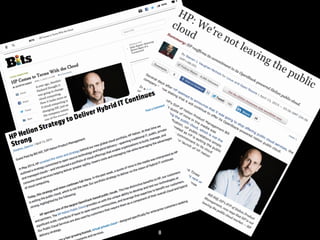
8
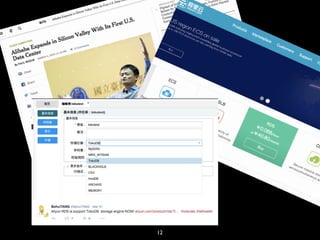
There are more
• Jelastic - PaaS offering MySQL, MariaDB
• ClearDB - MySQL partnered with heroku,
Azure clouds
• Joyent - Image offers Percona MySQL and a
Percona SmartMachine
9
The new entrants
• Google Compute Engine offers Percona
XtraDB Cluster as a “click-to-deploy” app
• comes with Galera 3, Percona Toolkit,
XtraBackup as well
• Pivotal CloudFoundry - “MySQL” PaaS which
is MariaDB Galera Cluster 10
• Red Hat OpenShift - MySQL 5.1/5.5,
MariaDB 5.5
10
Beware
• GenieDB - globally distributed MySQL as a
service, master-master replication, works
on EC2, Rackspace, Google Compute
Engine, HP Cloud
• Xeround - 2 weeks notice...
11
12
What else do you get?
• AWS RDS has PostgreSQL — notice the
price
• Most MongoDB users run within the cloud —
but not hosted, it tends to be “roll your own”
• Compose.io (now IBM) & the like
(MongoLab) — hosted MongoDB, Redis,
Enhanced PostgreSQL, ElasticSearch,
RethinkDB
13
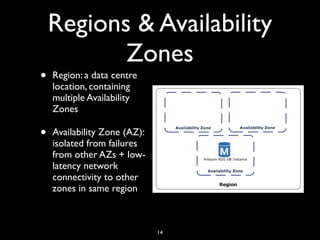
Regions & Availability
Zones
• Region: a data centre
location, containing
multiple Availability
Zones
• Availability Zone (AZ):
isolated from failures
from other AZs + low-
latency network
connectivity to other
zones in same region
14
Location, location,
location
• AWS RDS: US East (N.Virginia), US West
(Oregon), US West (California), EU (Ireland,
Frankfurt),APAC (Singapore,Tokyo, Sydney), South
America (São Paulo), GovCloud
• Rackspace: USA (Dallas DFW, Chicago ORD, N.
Virginia IAD),APAC (Sydney, Hong Kong), EU
(London)*
• Google Cloud SQL: US, EU,Asia
• HP Cloud: US-East (Virginia), US-West
15
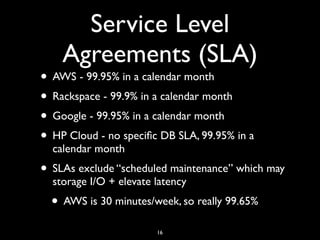
Service Level
Agreements (SLA)
• AWS - 99.95% in a calendar month
• Rackspace - 99.9% in a calendar month
• Google - 99.95% in a calendar month
• HP Cloud - no specific DB SLA, 99.95% in a
calendar month
• SLAs exclude “scheduled maintenance” which may
storage I/O + elevate latency
• AWS is 30 minutes/week, so really 99.65%
16
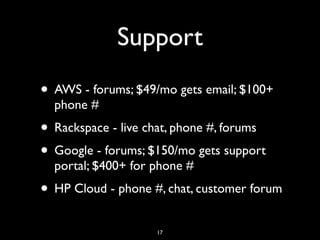
Support
• AWS - forums; $49/mo gets email; $100+
phone #
• Rackspace - live chat, phone #, forums
• Google - forums; $150/mo gets support
portal; $400+ for phone #
• HP Cloud - phone #, chat, customer forum
17
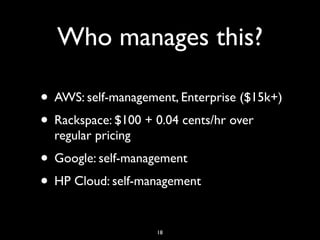
Who manages this?
• AWS: self-management, Enterprise ($15k+)
• Rackspace: $100 + 0.04 cents/hr over
regular pricing
• Google: self-management
• HP Cloud: self-management
18
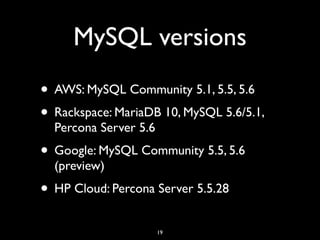
MySQL versions
• AWS: MySQL Community 5.1, 5.5, 5.6
• Rackspace: MariaDB 10, MySQL 5.6/5.1,
Percona Server 5.6
• Google: MySQL Community 5.5, 5.6
(preview)
• HP Cloud: Percona Server 5.5.28
19
Access methods
• AWS - within Amazon, externally via mysql client,
API access.
• Rackspace - private hostname within Rackspace
network, API access.
• Google - within AppEngine, a command line Java
tool (gcutil), standard mysql client
• HP Cloud - within HP Cloud, externally via client
(trove-cli, reddwarf),API access, mysql client
20
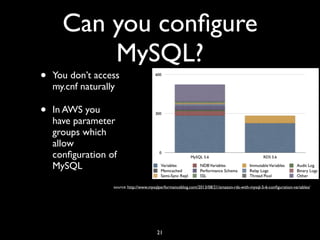
Can you configure
MySQL?
• You don’t access
my.cnf naturally
• In AWS you
have parameter
groups which
allow
configuration of
MySQL
21
source: http://www.mysqlperformanceblog.com/2013/08/21/amazon-rds-with-mysql-5-6-configuration-variables/
Cost
• Subscribe to relevant newsletters of your
services
• Cost changes rapidly, plus you get new
instance types and new features (IOPS)
• Don’t forget network access costs
• Monitor your costs daily, hourly if possible
(EC2 instances can have spot pricing)
22
Costs:AWS
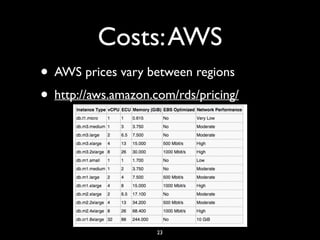
• AWS prices vary between regions
• http://aws.amazon.com/rds/pricing/
23
Costs:AWS II
• Medium instances (3.75GB) useful for
testing ($1,577/yr [2014] vs $2,411/yr
[2013])
• Large instance (7.5GB) production ready
($3,241/yr vs $4,777/yr [2013])
• m3.2XL (30GB, 8vCPUs) ($12,964/yr)
• XL instance (15GB, 8ECUs) ($9,555/yr)
24
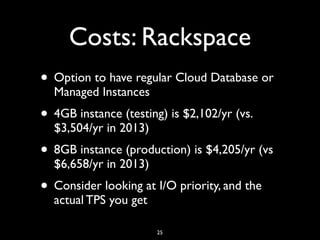
Costs: Rackspace
• Option to have regular Cloud Database or
Managed Instances
• 4GB instance (testing) is $2,102/yr (vs.
$3,504/yr in 2013)
• 8GB instance (production) is $4,205/yr (vs
$6,658/yr in 2013)
• Consider looking at I/O priority, and the
actual TPS you get
25
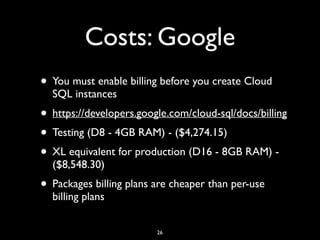
Costs: Google
• You must enable billing before you create Cloud
SQL instances
• https://developers.google.com/cloud-sql/docs/billing
• Testing (D8 - 4GB RAM) - ($4,274.15)
• XL equivalent for production (D16 - 8GB RAM) -
($8,548.30)
• Packages billing plans are cheaper than per-use
billing plans
26
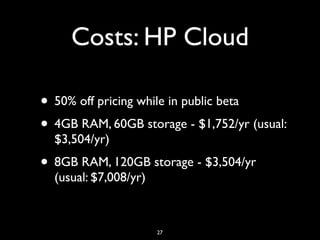
Costs: HP Cloud
• 50% off pricing while in public beta
• 4GB RAM, 60GB storage - $1,752/yr (usual:
$3,504/yr)
• 8GB RAM, 120GB storage - $3,504/yr
(usual: $7,008/yr)
27
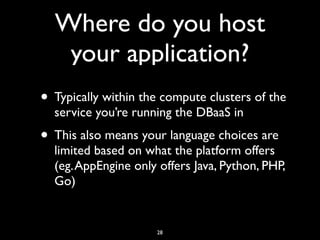
Where do you host
your application?
• Typically within the compute clusters of the
service you’re running the DBaaS in
• This also means your language choices are
limited based on what the platform offers
(eg.AppEngine only offers Java, Python, PHP,
Go)
28
RDS: Multi-AZ
• Provides enhanced durability (synchronous
data replication)
• Increased availability (automatic failover)
• Warning: can be slow (1-10 mins+)
• Easy GUI administration
• Doesn’t give you another usable “read-
replica” though
29
External replication
• MySQL 5.6 you can do RDS -> Non-RDS
• enable backup retention, you now have
binlog access
• target: exporting data out of RDS
• Replicate into RDS with 5.5.33 or later
• AWS provides stored procedures like
mysql.rds_set_external_master nowadays
30
MySQL 5.6, MariaDB
10
• MySQL 5.6 in RDS provides crash-safe slaves, the
InnoDB memcached interface, online schema
changes, full-text InnoDB indexes, optimizer
improvements, INFORMATION_SCHEMA
enhancements, scalability/replication
improvements, PERFORMANCE_SCHEMA
enhancements
• MariaDB 10 has much of that that, plus multi-
source replication, GTIDs that don’t require full
restarts, threadpool, audit plugin and more
31
Getting started
• Importing data into the cloud?
• mysqldump is a good choice today
• Upgrading from RDS 5.5 to RDS 5.6?
• mysqldump before, but nowadays you can
do this via Read Replicas
32
Handling backups
• You don’t get to use xtrabackup!
• Google Cloud SQL automates backups (has
a backup window - 4h)
• Amazon has automated backups (with point-
in-time recovery), with full daily snapshots
(has a backup window).
• Rackspace + HPCloud allow instance
backups too
33
Monitoring
• Options are limited,AWS has the best
options currently available
• Today you have CloudWatch
• Google has basic read/write graphs
• Rackspace has started with basic graphs,
visuals for MySQL coming soon, have a beta
Cloud Intelligence product
34
Storage Engines
• MySQL (/MariaDB) have many
• cool ones include TokuDB, SPIDER,
CONNECT
• You basically use InnoDB and MyISAM with
cloud solutions
• MyISAM on RDS won’t guarantee point-
in-time recovery, snapshot restore
35
High Availability
• Plan for node failures
• Don’t assume node provisioning is quick
• Backup, backup, backup!
• “Bad” nodes exist
• HA is not equal across options - RDS wins
so far
36
Unsupported features
• AWS: GTIDs, InnoDB Cache Warming,
InnoDB transportable tablespaces,
authentication plugins, semi-sync replication
• Google: UDFs, replication, LOAD DATA
INFILE, INSTALL PLUGIN, SELECT ... INTO
OUTFILE
37
Provisioned IOPS
• Only available on Amazon
• Faster, predictable, consistent I/O
performance with low latencies
• Good throughput, RAID on backed
• EBS is more reliable
38
More on RDS
• log access via API
• no SUPER access to skip replication errors
easily
• sync_binlog=0 not available
• no OS access (sar, ps, tcpdump)
• https://github.com/boto/boto
39
Warning: automatic
upgrades
• Regressions happen even with a minor
version upgrade in the MySQL world
• InnoDB update that modifies rows PK
triggers recursive behaviour until all disk
space is exceeded? 5.5.24->5.5.25 (fixed:
5.5.25a)
• Using query cache for partitioned tables?
Disabled since 5.5.22->5.5.23!
40
Benchmarking for use
• sysbench
• OLTP test, use tables
with 20M rows and 20M
transactions, check
1-128 threads/run (run
this on RDS, Rackspace)
• June 2013, tps,
performance per dollar,
Rackspace delivers more
performance across all
flavours except 512MB
instance
• Yahoo! Cloud Serving
Benchmark
• https://github.com/
brianfrankcooper/YCSB
• Google’s PerfKit
Benchmarker
• https://github.com/
GoogleCloudPlatform/
PerfKitBenchmarker
41
Roadmaps?
• There don’t seem to be public roadmaps.
You find out when there’s a change!
• Presumably HPCloud will get 5.6… and
maybe Google will get some MariaDB?
42
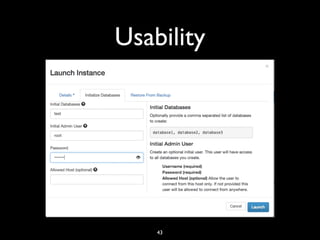
Usability
43
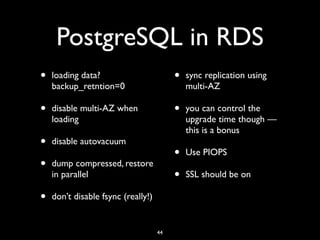
PostgreSQL in RDS
• loading data?
backup_retntion=0
• disable multi-AZ when
loading
• disable autovacuum
• dump compressed, restore
in parallel
• don’t disable fsync (really!)
• sync replication using
multi-AZ
• you can control the
upgrade time though —
this is a bonus
• Use PIOPS
• SSL should be on
44
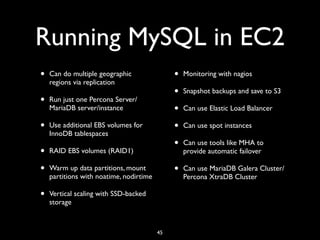
Running MySQL in EC2
• Can do multiple geographic
regions via replication
• Run just one Percona Server/
MariaDB server/instance
• Use additional EBS volumes for
InnoDB tablespaces
• RAID EBS volumes (RAID1)
• Warm up data partitions, mount
partitions with noatime, nodirtime
• Vertical scaling with SSD-backed
storage
• Monitoring with nagios
• Snapshot backups and save to S3
• Can use Elastic Load Balancer
• Can use spot instances
• Can use tools like MHA to
provide automatic failover
• Can use MariaDB Galera Cluster/
Percona XtraDB Cluster
45
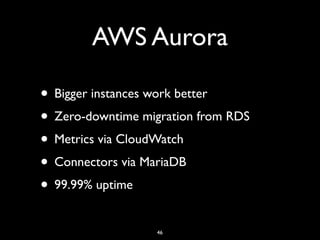
AWS Aurora
• Bigger instances work better
• Zero-downtime migration from RDS
• Metrics via CloudWatch
• Connectors via MariaDB
• 99.99% uptime
46
Some closing thoughts
• Hardware varies per region
• Sometimes, software manageability varies
per region
• Beware cost on your credit card!
47
Q&A.ThankYou.
colin@mariadb.org | byte@bytebot.net
http://bytebot.net/blog/ | @bytebot on Twitter
Download MariaDB and give it a try: http://mariadb.org/
48

Databases in the hosted cloud

  • 1.
    Databases in the HostedCloud Colin Charles, MariaDB Corporation Ab colin@mariadb.org | byte@bytebot.net http://mariadb.com/ | http://mariadb.org/ http://bytebot.net/blog/ | @bytebot on Twitter Percona Live Europe,Amsterdam, Netherlands 22 September 2015 1
  • 2.
    whoami • Work onMariaDB at MariaDB Corporation (SkySQL Ab) • Merged with Monty Program Ab, makers of MariaDB • Formerly MySQL AB (exit: Sun Microsystems) • Past lives include Fedora Project (FESCO), OpenOffice.org • Recipient of the MySQL Community Contributor of theYear Award 2014 2
  • 3.
    Agenda • MySQL asa service offering (DBaaS) • Choices • Considerations • MySQL versions & access • Costs • Deeper into RDS • Should you run this on EC2 or an equivalent? • Conclusion 3
  • 4.
    MySQL as aservice • Database as a Service (DBaaS) • MySQL available on-demand, without any installation/configuration of hardware/ software • Pay-per-usage based • Provider maintains MySQL, you don’t maintain, upgrade, or administer the database 4
  • 5.
    New way of deployment •Enter a credit card number • call API (or use the GUI) ec2-run-instances ami- xxx -k ${EC2_KEYPAIR} -t m1.large nova boot --image centos6-x86_64 --flavor m1.large db1 5 credit: http://www.flickr.com/photos/68751915@N05/6280507539/
  • 6.
    Why DBaaS? • “Couldn’twe just have a few more servers to handle the traffic spike during the elections?” • Don’t have a lot of DBAs, optimise for operational ease • Rapid deployment & scale-out 6
  • 7.
    Your choices today •Amazon Web Services Relational Database Service (RDS) • Rackspace Cloud Databases • Google Cloud SQL 7
  • 8.
  • 9.
    There are more •Jelastic - PaaS offering MySQL, MariaDB • ClearDB - MySQL partnered with heroku, Azure clouds • Joyent - Image offers Percona MySQL and a Percona SmartMachine 9
  • 10.
    The new entrants •Google Compute Engine offers Percona XtraDB Cluster as a “click-to-deploy” app • comes with Galera 3, Percona Toolkit, XtraBackup as well • Pivotal CloudFoundry - “MySQL” PaaS which is MariaDB Galera Cluster 10 • Red Hat OpenShift - MySQL 5.1/5.5, MariaDB 5.5 10
  • 11.
    Beware • GenieDB -globally distributed MySQL as a service, master-master replication, works on EC2, Rackspace, Google Compute Engine, HP Cloud • Xeround - 2 weeks notice... 11
  • 12.
  • 13.
    What else doyou get? • AWS RDS has PostgreSQL — notice the price • Most MongoDB users run within the cloud — but not hosted, it tends to be “roll your own” • Compose.io (now IBM) & the like (MongoLab) — hosted MongoDB, Redis, Enhanced PostgreSQL, ElasticSearch, RethinkDB 13
  • 14.
    Regions & Availability Zones •Region: a data centre location, containing multiple Availability Zones • Availability Zone (AZ): isolated from failures from other AZs + low- latency network connectivity to other zones in same region 14
  • 15.
    Location, location, location • AWSRDS: US East (N.Virginia), US West (Oregon), US West (California), EU (Ireland, Frankfurt),APAC (Singapore,Tokyo, Sydney), South America (São Paulo), GovCloud • Rackspace: USA (Dallas DFW, Chicago ORD, N. Virginia IAD),APAC (Sydney, Hong Kong), EU (London)* • Google Cloud SQL: US, EU,Asia • HP Cloud: US-East (Virginia), US-West 15
  • 16.
    Service Level Agreements (SLA) •AWS - 99.95% in a calendar month • Rackspace - 99.9% in a calendar month • Google - 99.95% in a calendar month • HP Cloud - no specific DB SLA, 99.95% in a calendar month • SLAs exclude “scheduled maintenance” which may storage I/O + elevate latency • AWS is 30 minutes/week, so really 99.65% 16
  • 17.
    Support • AWS -forums; $49/mo gets email; $100+ phone # • Rackspace - live chat, phone #, forums • Google - forums; $150/mo gets support portal; $400+ for phone # • HP Cloud - phone #, chat, customer forum 17
  • 18.
    Who manages this? •AWS: self-management, Enterprise ($15k+) • Rackspace: $100 + 0.04 cents/hr over regular pricing • Google: self-management • HP Cloud: self-management 18
  • 19.
    MySQL versions • AWS:MySQL Community 5.1, 5.5, 5.6 • Rackspace: MariaDB 10, MySQL 5.6/5.1, Percona Server 5.6 • Google: MySQL Community 5.5, 5.6 (preview) • HP Cloud: Percona Server 5.5.28 19
  • 20.
    Access methods • AWS- within Amazon, externally via mysql client, API access. • Rackspace - private hostname within Rackspace network, API access. • Google - within AppEngine, a command line Java tool (gcutil), standard mysql client • HP Cloud - within HP Cloud, externally via client (trove-cli, reddwarf),API access, mysql client 20
  • 21.
    Can you configure MySQL? •You don’t access my.cnf naturally • In AWS you have parameter groups which allow configuration of MySQL 21 source: http://www.mysqlperformanceblog.com/2013/08/21/amazon-rds-with-mysql-5-6-configuration-variables/
  • 22.
    Cost • Subscribe torelevant newsletters of your services • Cost changes rapidly, plus you get new instance types and new features (IOPS) • Don’t forget network access costs • Monitor your costs daily, hourly if possible (EC2 instances can have spot pricing) 22
  • 23.
    Costs:AWS • AWS pricesvary between regions • http://aws.amazon.com/rds/pricing/ 23
  • 24.
    Costs:AWS II • Mediuminstances (3.75GB) useful for testing ($1,577/yr [2014] vs $2,411/yr [2013]) • Large instance (7.5GB) production ready ($3,241/yr vs $4,777/yr [2013]) • m3.2XL (30GB, 8vCPUs) ($12,964/yr) • XL instance (15GB, 8ECUs) ($9,555/yr) 24
  • 25.
    Costs: Rackspace • Optionto have regular Cloud Database or Managed Instances • 4GB instance (testing) is $2,102/yr (vs. $3,504/yr in 2013) • 8GB instance (production) is $4,205/yr (vs $6,658/yr in 2013) • Consider looking at I/O priority, and the actual TPS you get 25
  • 26.
    Costs: Google • Youmust enable billing before you create Cloud SQL instances • https://developers.google.com/cloud-sql/docs/billing • Testing (D8 - 4GB RAM) - ($4,274.15) • XL equivalent for production (D16 - 8GB RAM) - ($8,548.30) • Packages billing plans are cheaper than per-use billing plans 26
  • 27.
    Costs: HP Cloud •50% off pricing while in public beta • 4GB RAM, 60GB storage - $1,752/yr (usual: $3,504/yr) • 8GB RAM, 120GB storage - $3,504/yr (usual: $7,008/yr) 27
  • 28.
    Where do youhost your application? • Typically within the compute clusters of the service you’re running the DBaaS in • This also means your language choices are limited based on what the platform offers (eg.AppEngine only offers Java, Python, PHP, Go) 28
  • 29.
    RDS: Multi-AZ • Providesenhanced durability (synchronous data replication) • Increased availability (automatic failover) • Warning: can be slow (1-10 mins+) • Easy GUI administration • Doesn’t give you another usable “read- replica” though 29
  • 30.
    External replication • MySQL5.6 you can do RDS -> Non-RDS • enable backup retention, you now have binlog access • target: exporting data out of RDS • Replicate into RDS with 5.5.33 or later • AWS provides stored procedures like mysql.rds_set_external_master nowadays 30
  • 31.
    MySQL 5.6, MariaDB 10 •MySQL 5.6 in RDS provides crash-safe slaves, the InnoDB memcached interface, online schema changes, full-text InnoDB indexes, optimizer improvements, INFORMATION_SCHEMA enhancements, scalability/replication improvements, PERFORMANCE_SCHEMA enhancements • MariaDB 10 has much of that that, plus multi- source replication, GTIDs that don’t require full restarts, threadpool, audit plugin and more 31
  • 32.
    Getting started • Importingdata into the cloud? • mysqldump is a good choice today • Upgrading from RDS 5.5 to RDS 5.6? • mysqldump before, but nowadays you can do this via Read Replicas 32
  • 33.
    Handling backups • Youdon’t get to use xtrabackup! • Google Cloud SQL automates backups (has a backup window - 4h) • Amazon has automated backups (with point- in-time recovery), with full daily snapshots (has a backup window). • Rackspace + HPCloud allow instance backups too 33
  • 34.
    Monitoring • Options arelimited,AWS has the best options currently available • Today you have CloudWatch • Google has basic read/write graphs • Rackspace has started with basic graphs, visuals for MySQL coming soon, have a beta Cloud Intelligence product 34
  • 35.
    Storage Engines • MySQL(/MariaDB) have many • cool ones include TokuDB, SPIDER, CONNECT • You basically use InnoDB and MyISAM with cloud solutions • MyISAM on RDS won’t guarantee point- in-time recovery, snapshot restore 35
  • 36.
    High Availability • Planfor node failures • Don’t assume node provisioning is quick • Backup, backup, backup! • “Bad” nodes exist • HA is not equal across options - RDS wins so far 36
  • 37.
    Unsupported features • AWS:GTIDs, InnoDB Cache Warming, InnoDB transportable tablespaces, authentication plugins, semi-sync replication • Google: UDFs, replication, LOAD DATA INFILE, INSTALL PLUGIN, SELECT ... INTO OUTFILE 37
  • 38.
    Provisioned IOPS • Onlyavailable on Amazon • Faster, predictable, consistent I/O performance with low latencies • Good throughput, RAID on backed • EBS is more reliable 38
  • 39.
    More on RDS •log access via API • no SUPER access to skip replication errors easily • sync_binlog=0 not available • no OS access (sar, ps, tcpdump) • https://github.com/boto/boto 39
  • 40.
    Warning: automatic upgrades • Regressionshappen even with a minor version upgrade in the MySQL world • InnoDB update that modifies rows PK triggers recursive behaviour until all disk space is exceeded? 5.5.24->5.5.25 (fixed: 5.5.25a) • Using query cache for partitioned tables? Disabled since 5.5.22->5.5.23! 40
  • 41.
    Benchmarking for use •sysbench • OLTP test, use tables with 20M rows and 20M transactions, check 1-128 threads/run (run this on RDS, Rackspace) • June 2013, tps, performance per dollar, Rackspace delivers more performance across all flavours except 512MB instance • Yahoo! Cloud Serving Benchmark • https://github.com/ brianfrankcooper/YCSB • Google’s PerfKit Benchmarker • https://github.com/ GoogleCloudPlatform/ PerfKitBenchmarker 41
  • 42.
    Roadmaps? • There don’tseem to be public roadmaps. You find out when there’s a change! • Presumably HPCloud will get 5.6… and maybe Google will get some MariaDB? 42
  • 43.
  • 44.
    PostgreSQL in RDS •loading data? backup_retntion=0 • disable multi-AZ when loading • disable autovacuum • dump compressed, restore in parallel • don’t disable fsync (really!) • sync replication using multi-AZ • you can control the upgrade time though — this is a bonus • Use PIOPS • SSL should be on 44
  • 45.
    Running MySQL inEC2 • Can do multiple geographic regions via replication • Run just one Percona Server/ MariaDB server/instance • Use additional EBS volumes for InnoDB tablespaces • RAID EBS volumes (RAID1) • Warm up data partitions, mount partitions with noatime, nodirtime • Vertical scaling with SSD-backed storage • Monitoring with nagios • Snapshot backups and save to S3 • Can use Elastic Load Balancer • Can use spot instances • Can use tools like MHA to provide automatic failover • Can use MariaDB Galera Cluster/ Percona XtraDB Cluster 45
  • 46.
    AWS Aurora • Biggerinstances work better • Zero-downtime migration from RDS • Metrics via CloudWatch • Connectors via MariaDB • 99.99% uptime 46
  • 47.
    Some closing thoughts •Hardware varies per region • Sometimes, software manageability varies per region • Beware cost on your credit card! 47
  • 48.
    Q&A.ThankYou. colin@mariadb.org | byte@bytebot.net http://bytebot.net/blog/| @bytebot on Twitter Download MariaDB and give it a try: http://mariadb.org/ 48