Databases in the Hosted Cloud
Colin Charles, Chief Evangelist, Percona Inc.

colin.charles@percona.com / byte@bytebot.net 

http://bytebot.net/blog/ | @bytebot on Twitter

OSCON, Portland, Oregon

19 July 2018
whoami
• Chief Evangelist, Percona Inc

• Focusing on the MySQL ecosystem (MySQL, Percona Server, MariaDB
Server), as well as the MongoDB ecosystem (Percona Server for MongoDB)
+ 100% open source tools from Percona like Percona Monitoring &
Management, Percona xtrabackup, Percona Toolkit, etc. and now
PostgreSQL too!

• Founding team of MariaDB Server (2009-2016), previously at Monty Program
Ab, merged with SkySQL Ab, now MariaDB Corporation

• Formerly MySQL AB (exit: Sun Microsystems)

• Past lives include Fedora Project (FESCO), OpenOffice.org

• MySQL Community Contributor of the Year Award winner 2014
Agenda
• MySQL as a service offering (DBaaS)

• Choices

• Considerations

• MySQL versions & access

• Costs

• Deeper into RDS

• Should you run this on EC2 or an equivalent?

• What about PostgreSQL? MongoDB?

• Conclusion
Database as a service
• Database as a Service (DBaaS)

• MySQL/PostgreSQL available on-demand, without any installation/
configuration of hardware/software

• Pay-per-usage based

• Provider maintains database, you don’t maintain, upgrade, or
administer the database
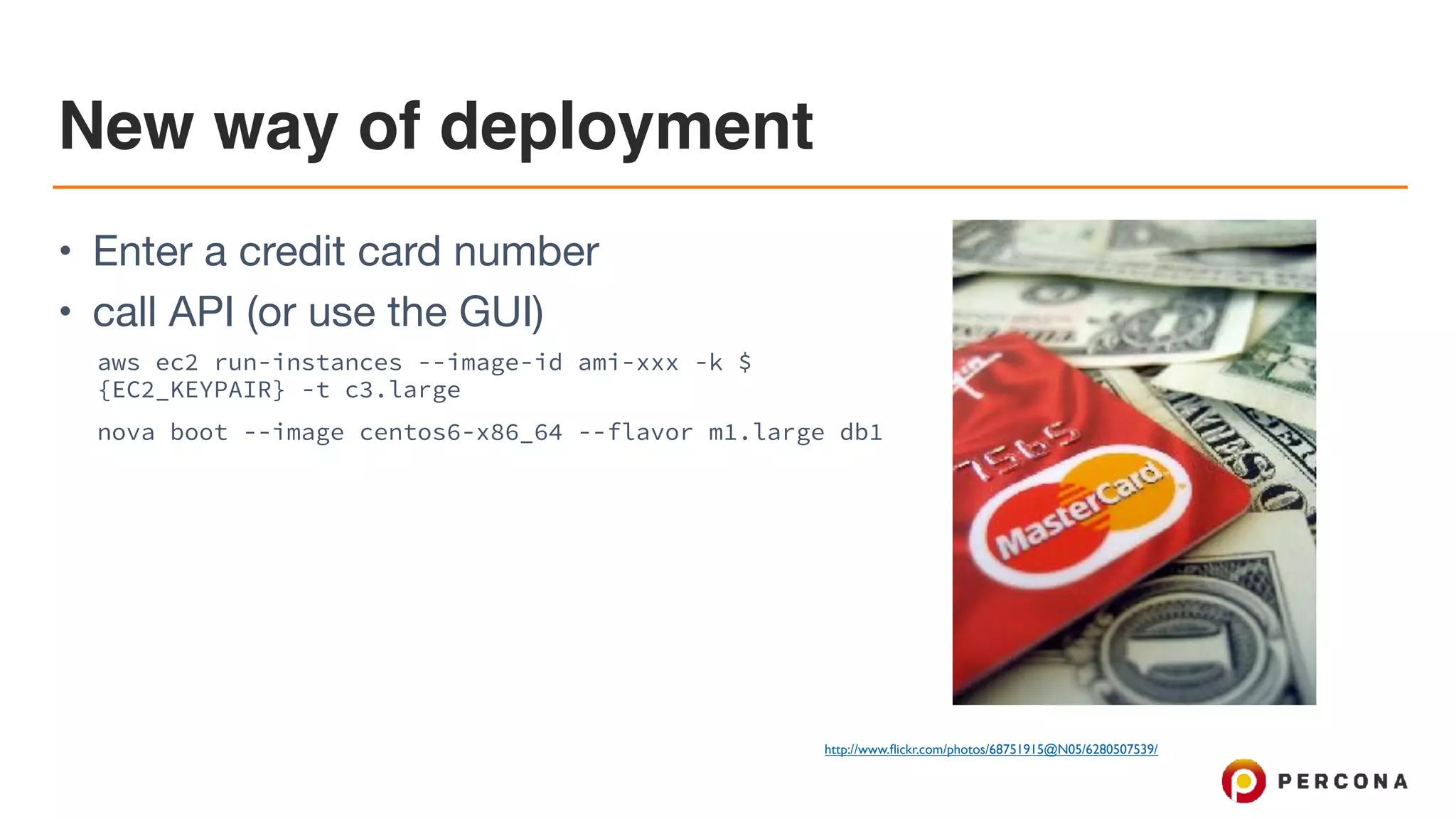
New way of deployment
• Enter a credit card number

• call API (or use the GUI)

aws ec2 run-instances --image-id ami-xxx -k $
{EC2_KEYPAIR} -t c3.large
nova boot --image centos6-x86_64 --flavor m1.large db1
credit: http://www.flickr.com/photos/68751915@N05/6280507539/
Why DBaaS?
• “Couldn’t we just have a few more servers to handle the traffic spike
during the elections?”

• Don’t have a lot of DBAs, optimise for operational ease

• Rapid deployment & scale-out
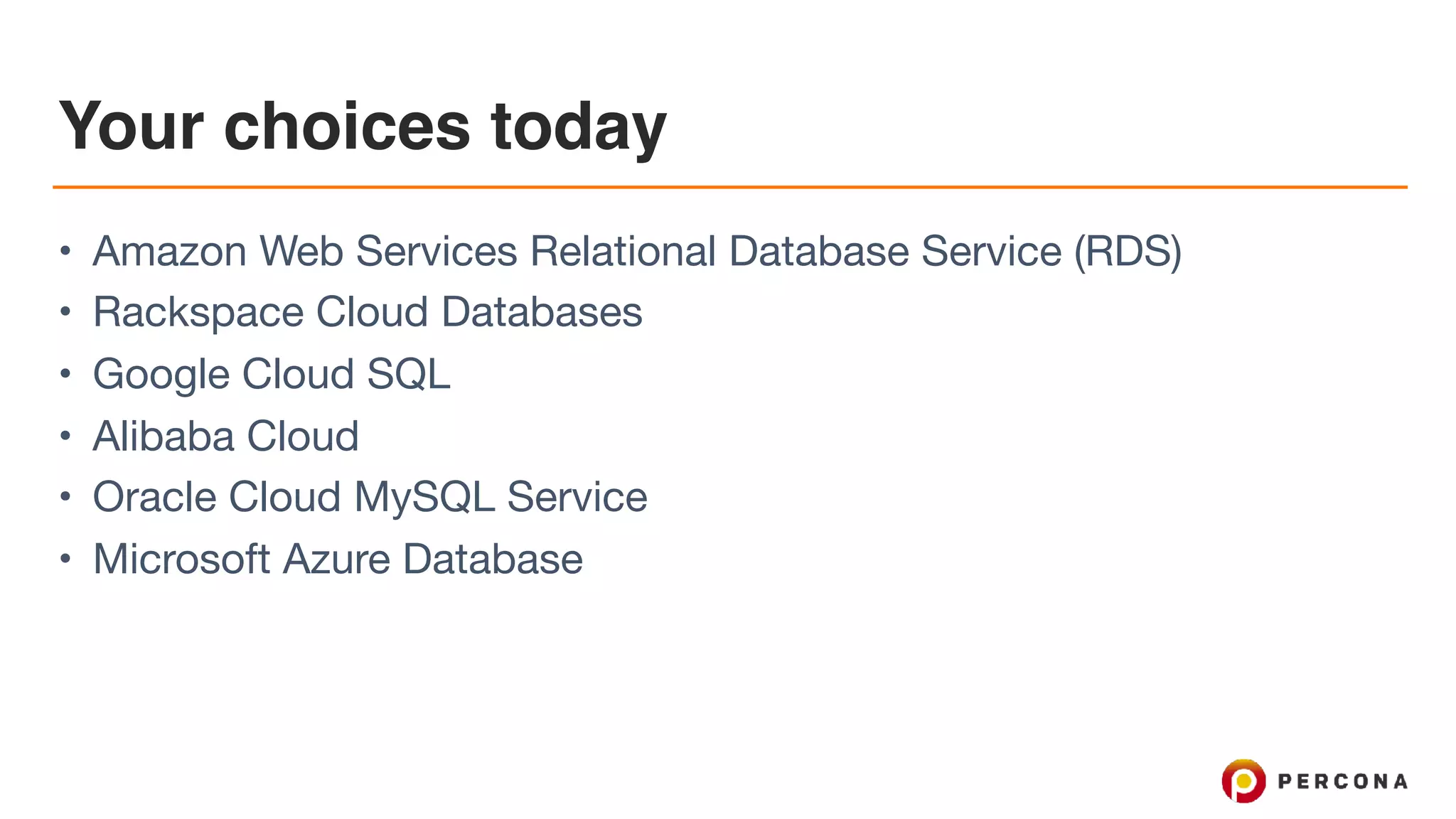
Your choices today
• Amazon Web Services Relational Database Service (RDS)

• Rackspace Cloud Databases

• Google Cloud SQL

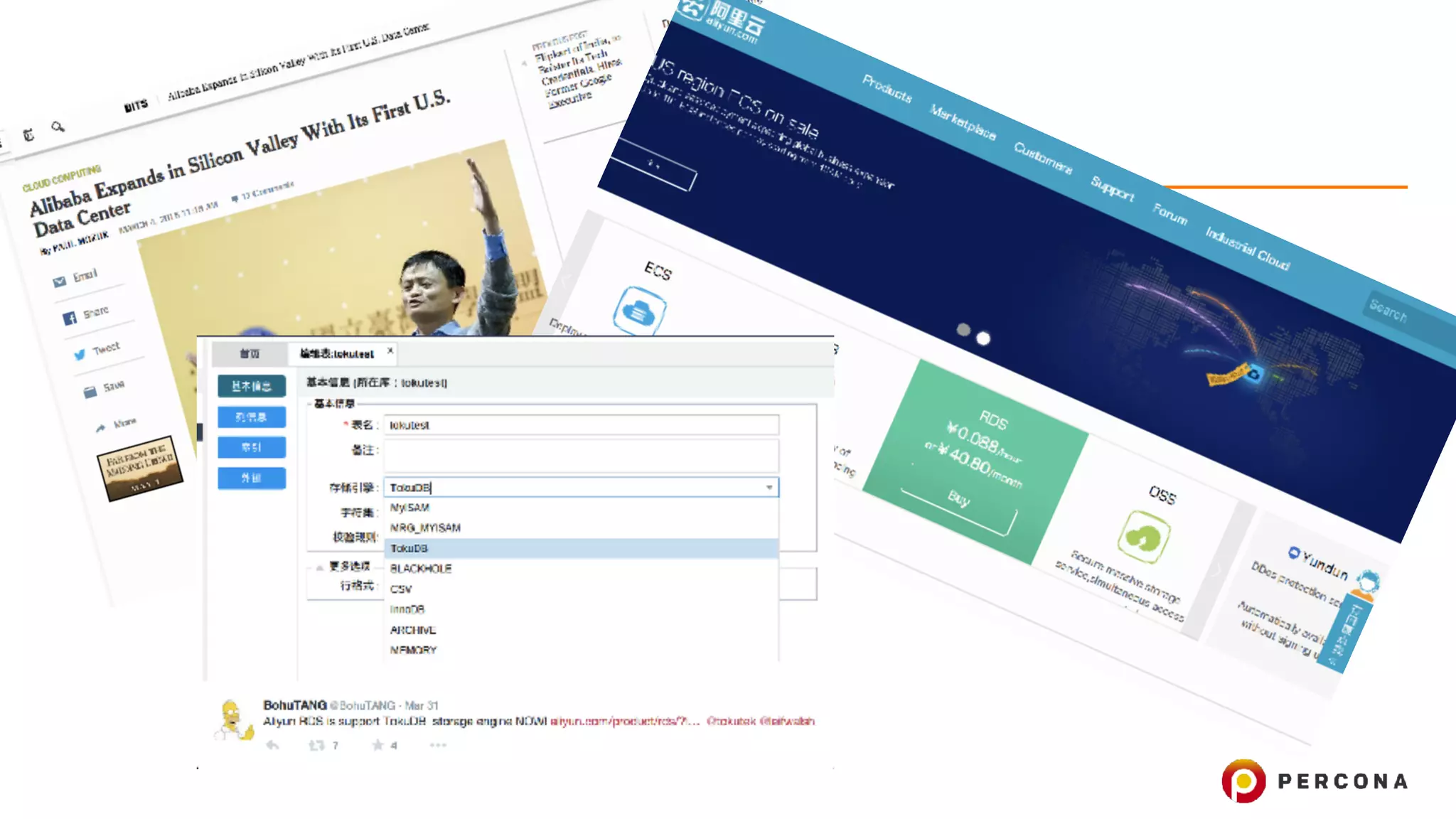
• Alibaba Cloud

• Oracle Cloud MySQL Service

• Microsoft Azure Database
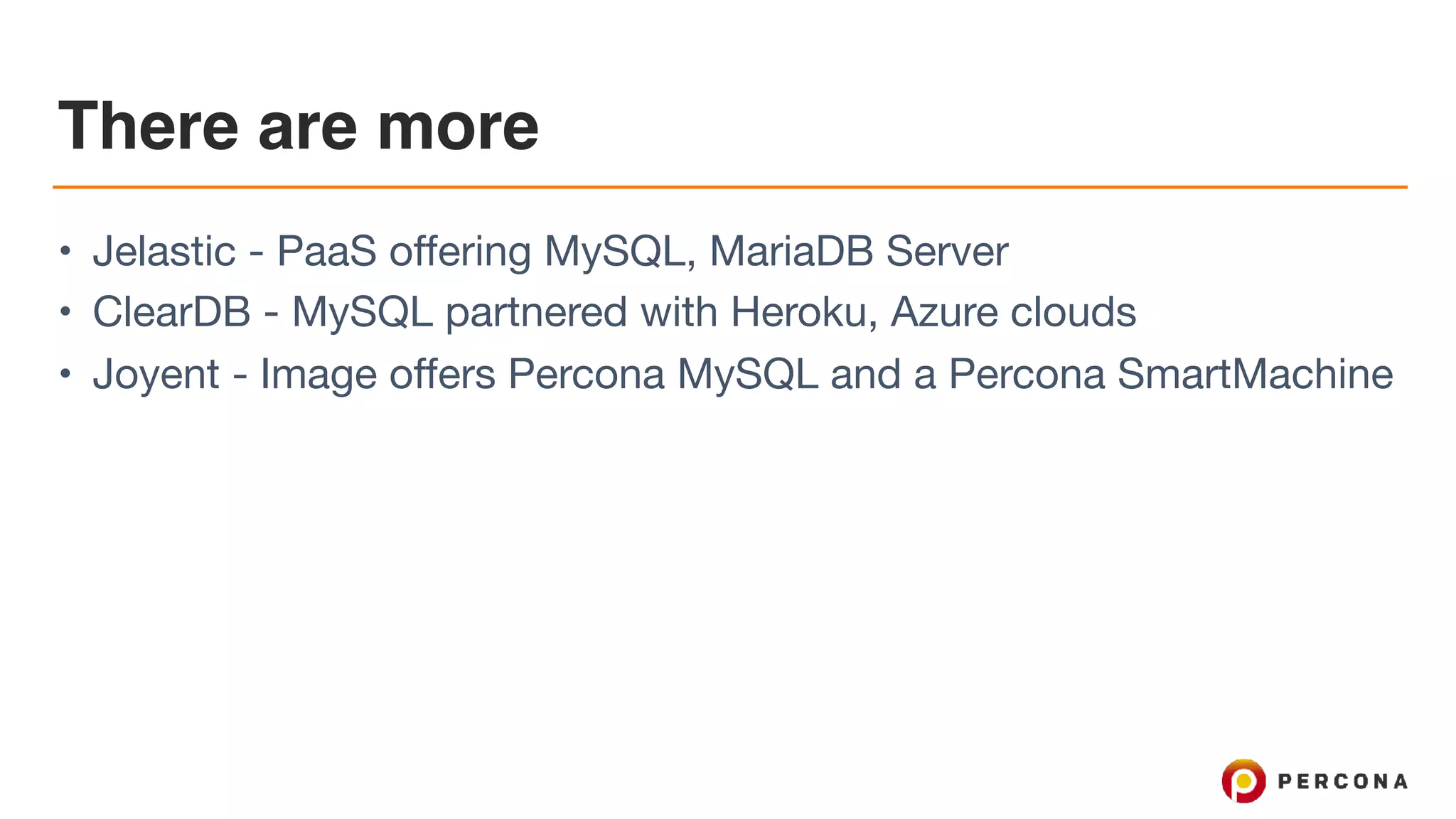
There are more
• Jelastic - PaaS offering MySQL, MariaDB Server

• ClearDB - MySQL partnered with Heroku, Azure clouds

• Joyent - Image offers Percona MySQL and a Percona SmartMachine
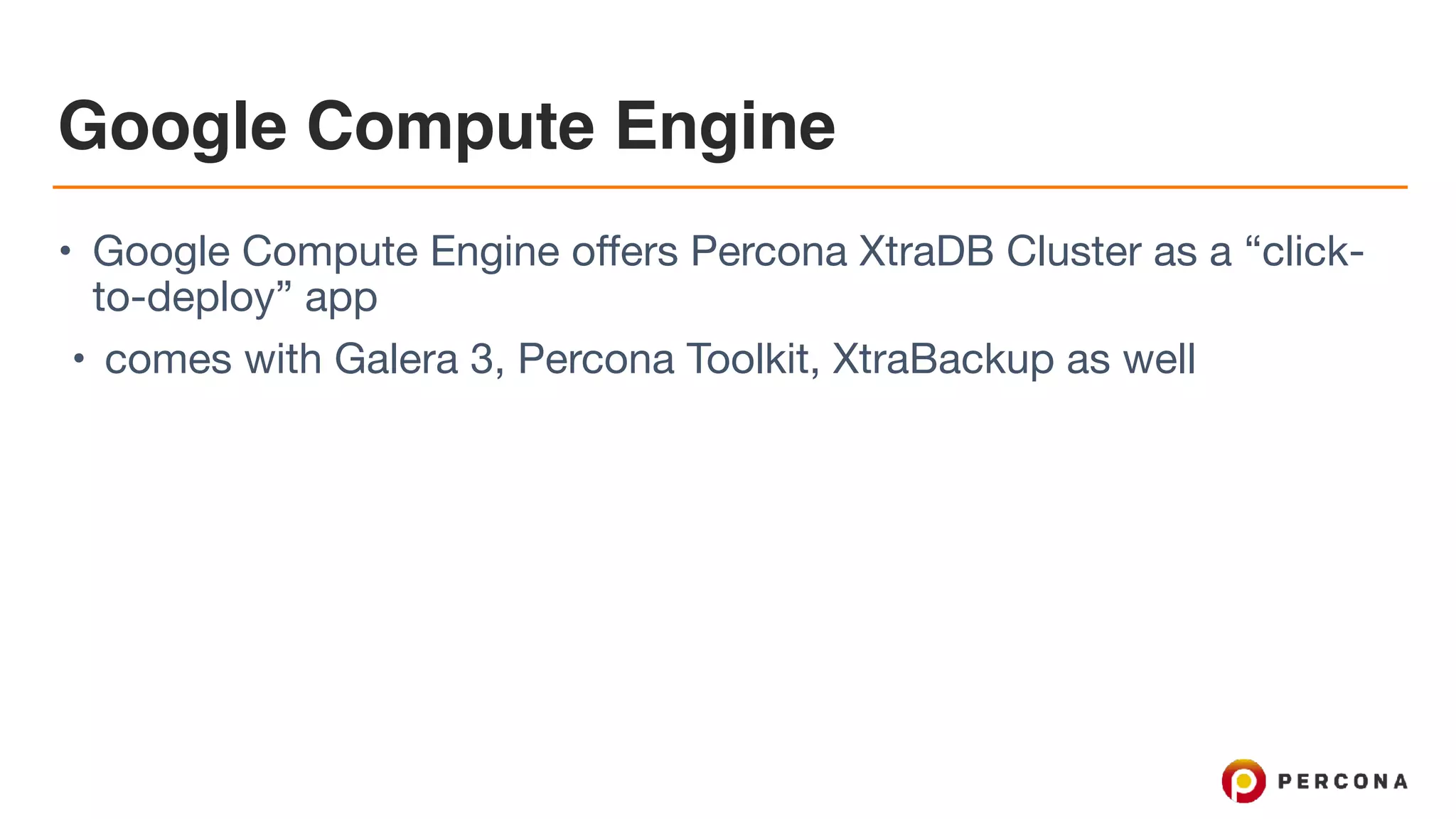
Google Compute Engine
• Google Compute Engine offers Percona XtraDB Cluster as a “click-
to-deploy” app

• comes with Galera 3, Percona Toolkit, XtraBackup as well
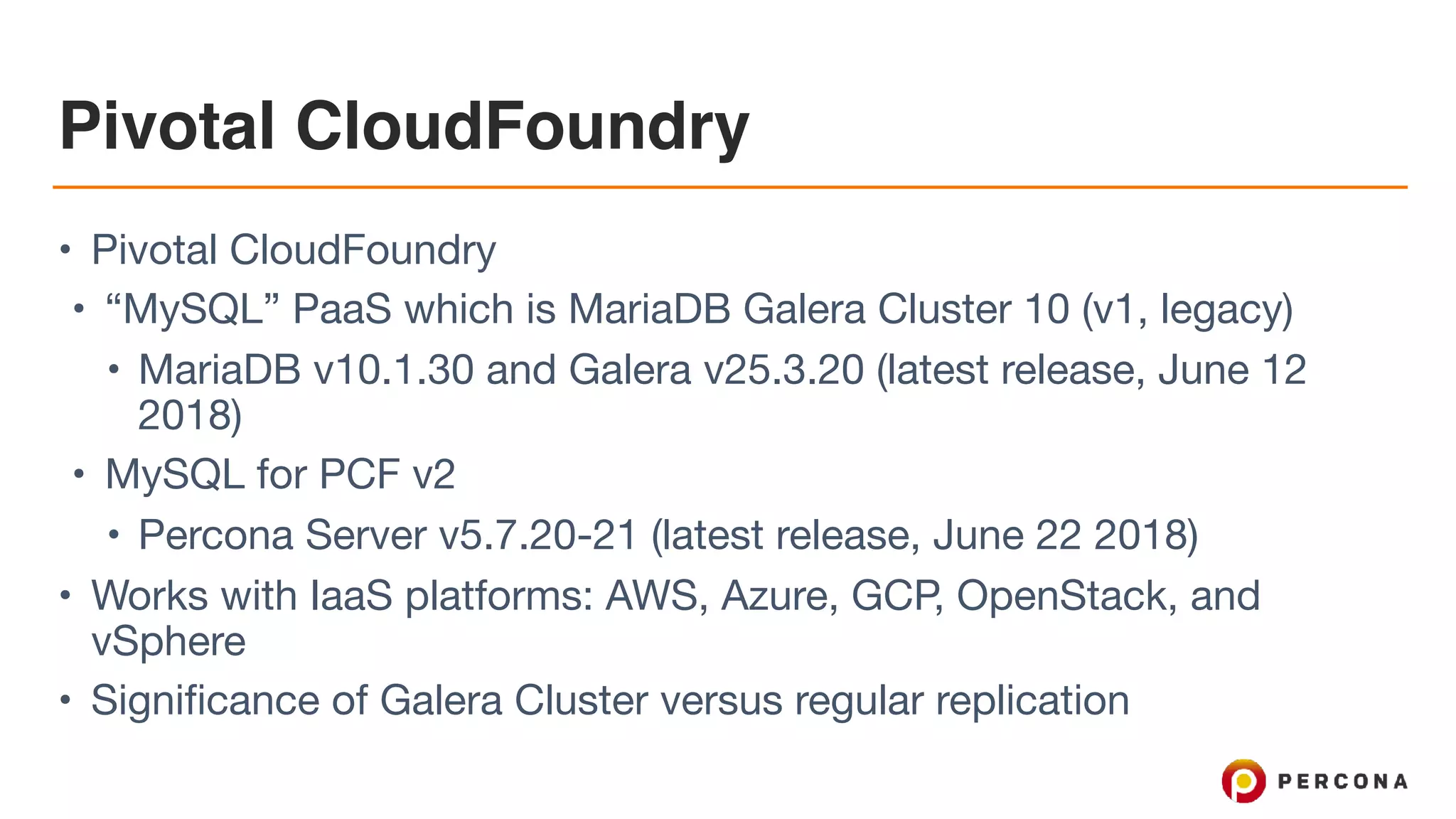
Pivotal CloudFoundry
• Pivotal CloudFoundry

• “MySQL” PaaS which is MariaDB Galera Cluster 10 (v1, legacy)

• MariaDB v10.1.30 and Galera v25.3.20 (latest release, June 12
2018)

• MySQL for PCF v2

• Percona Server v5.7.20-21 (latest release, June 22 2018)

• Works with IaaS platforms: AWS, Azure, GCP, OpenStack, and
vSphere

• Significance of Galera Cluster versus regular replication
Red Hat OpenShift
• Variants between Online & Enterprise editions (usually you get
access to modern releases with OpenShift Online)

• MySQL 5.5/5.6/5.7

• MariaDB 10.0/10.1

• PostgreSQL 9.4/9.5

• MongoDB 2.4/2.6/3.2/3.4
Beware
• GenieDB - globally distributed MySQL as a service, master-master
replication, works on EC2, Rackspace, Google Compute Engine, HP
Cloud

• Xeround - 2 weeks notice...
Thank you HPCloud
• http://www.bytebot.net/blog/archives/2015/10/27/sunsetting-
hpcloud-whom-contributed-to-making-mysql-better

• Utility user

• enforce_storage_engine

• prevent LOAD DATA INFILE/SELECT INTO OUTFILE

• restrict # of binlog files
What else do you get?
• PostgreSQL is getting popular in the cloud: AWS RDS, AWS Aurora,
Microsoft Azure, Alibaba Cloud, Google Cloud SQL

• Most MongoDB users run within the cloud — but not hosted, it tends
to be “roll your own” or via ObjectRocket (and lately MongoDB Atlas
c- reasonable free tier!)

• Compose.io (now IBM) & the like (MongoLab) — hosted MongoDB,
Redis, Enhanced PostgreSQL, ElasticSearch, RethinkDB (!?), MySQL
with group replication, ScyllaDB, etc.
Regions & Availability Zones
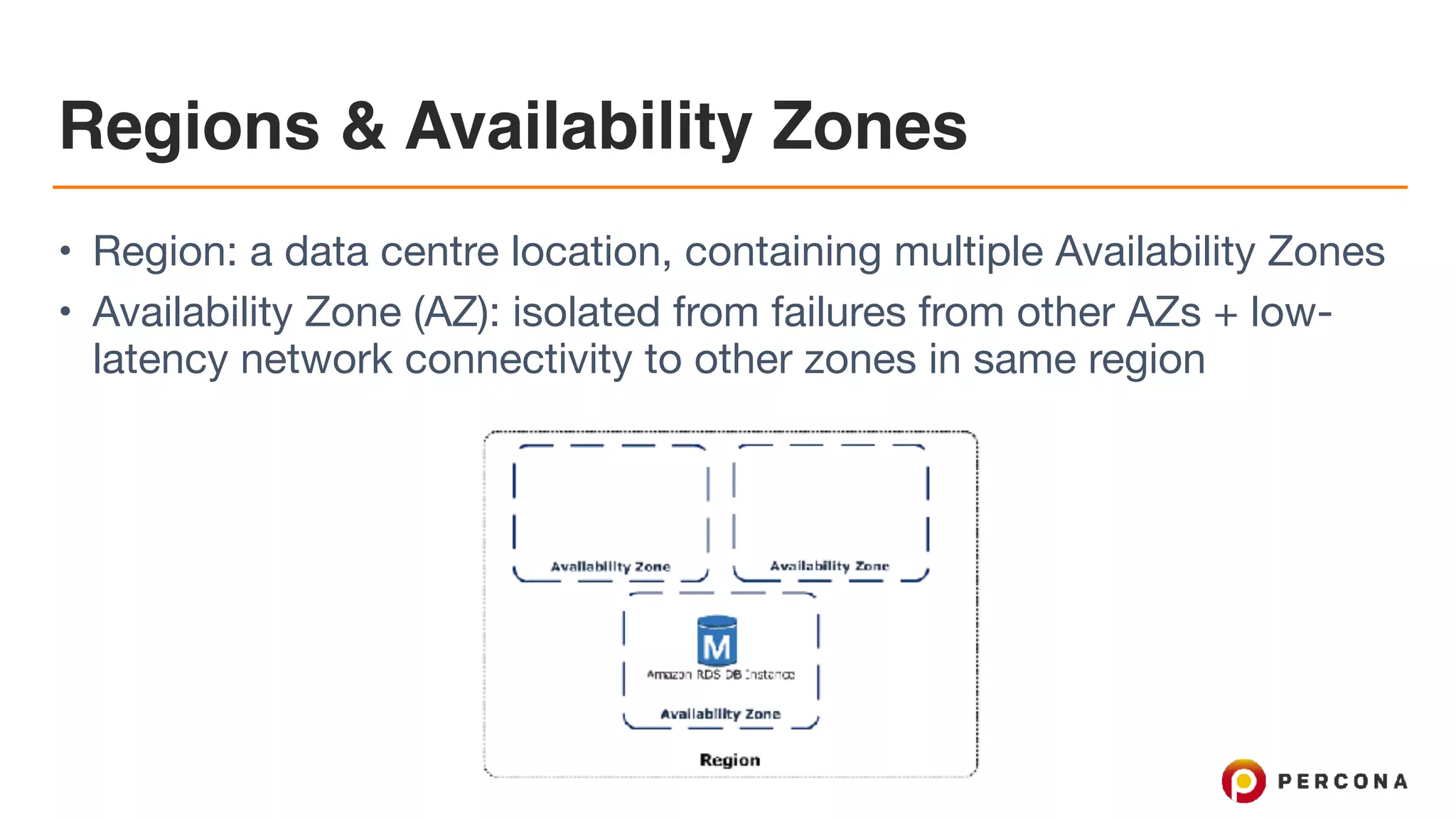
• Region: a data centre location, containing multiple Availability Zones

• Availability Zone (AZ): isolated from failures from other AZs + low-
latency network connectivity to other zones in same region
Location, location, location
• AWS RDS: US East (N. Virginia, Ohio), US West (Oregon, Northern
California, California), EU (Ireland, Frankfurt, London, Paris), APAC
(Singapore, Tokyo, Sydney, Seoul, Mumbai), South America (São
Paulo), GovCloud, Canada (Central), China (Beijing)

• Rackspace: USA (Dallas DFW, Chicago ORD, N. Virginia IAD), APAC
(Sydney, Hong Kong), EU (London)*

• Google Cloud SQL: 

• 2nd generation instances: Montréal, Iowa, N. Virginia, Oregon, LA,
São Paulo, Finland, London, Frankfurt, Netherlands, Tokyo, Mumbai,
Singapore, Sydney
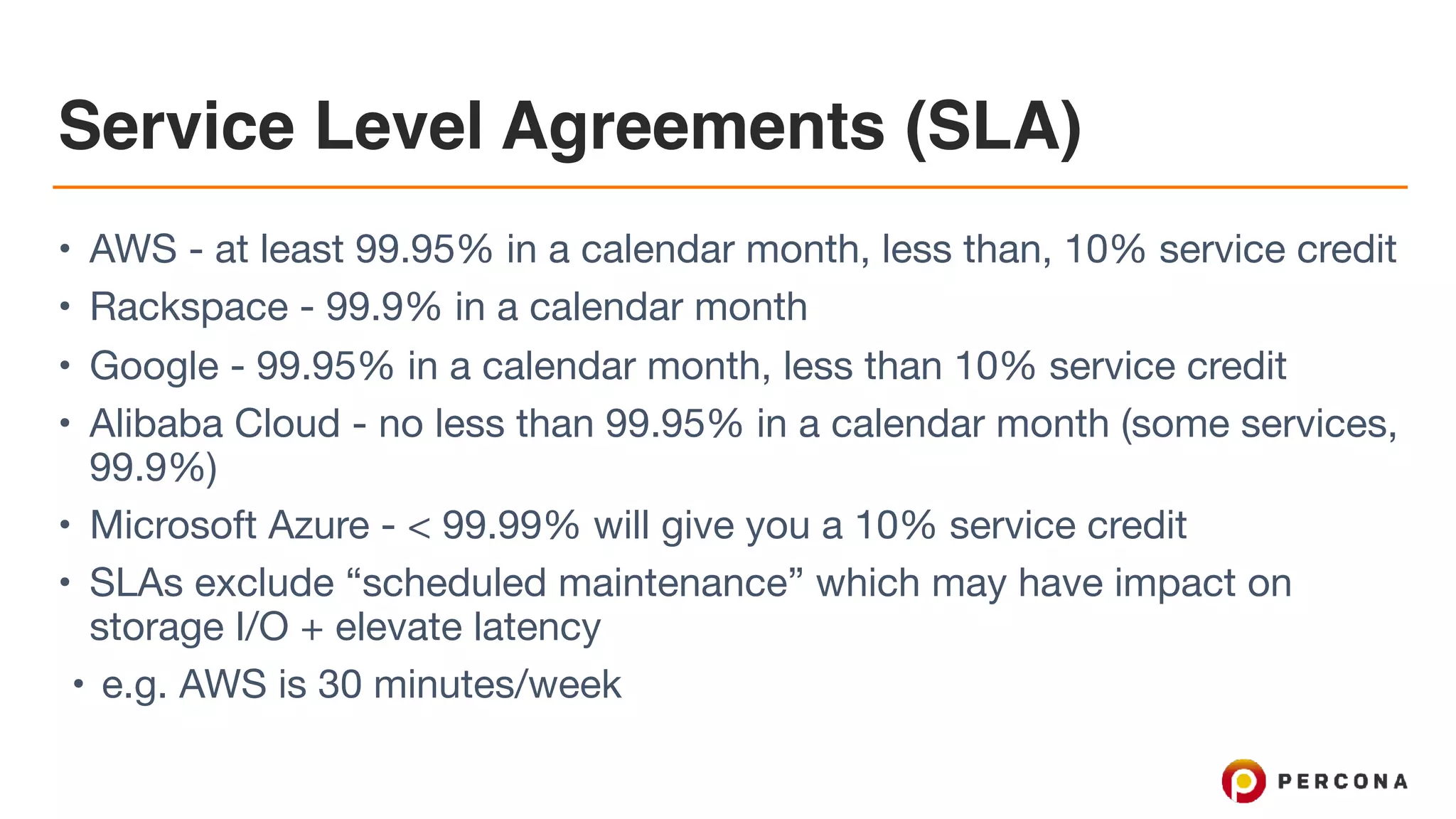
Service Level Agreements (SLA)
• AWS - at least 99.95% in a calendar month, less than, 10% service credit

• Rackspace - 99.9% in a calendar month

• Google - 99.95% in a calendar month, less than 10% service credit

• Alibaba Cloud - no less than 99.95% in a calendar month (some services,
99.9%)

• Microsoft Azure - < 99.99% will give you a 10% service credit

• SLAs exclude “scheduled maintenance” which may have impact on
storage I/O + elevate latency

• e.g. AWS is 30 minutes/week
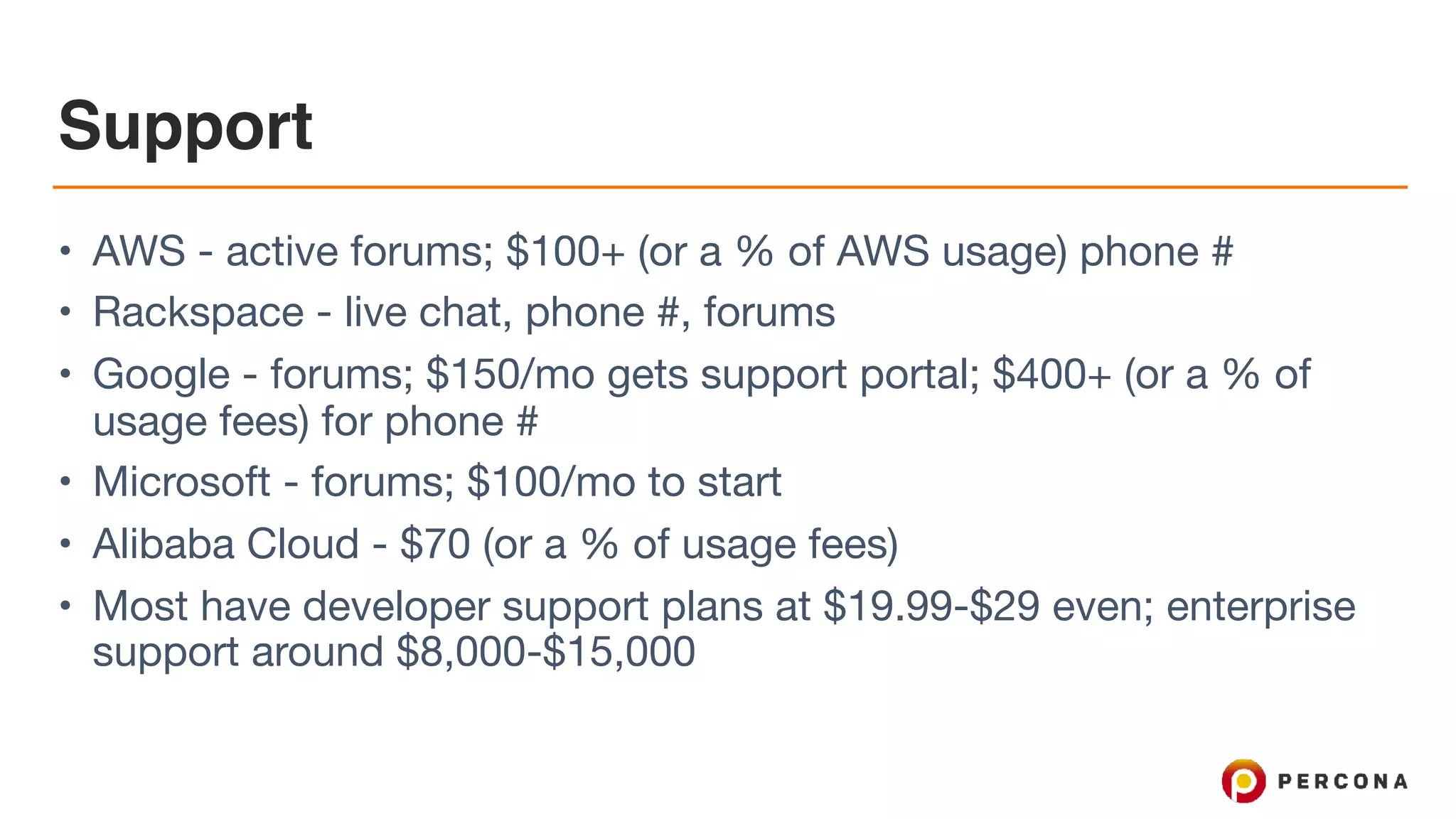
Support
• AWS - active forums; $100+ (or a % of AWS usage) phone #

• Rackspace - live chat, phone #, forums

• Google - forums; $150/mo gets support portal; $400+ (or a % of
usage fees) for phone #

• Microsoft - forums; $100/mo to start

• Alibaba Cloud - $70 (or a % of usage fees)

• Most have developer support plans at $19.99-$29 even; enterprise
support around $8,000-$15,000
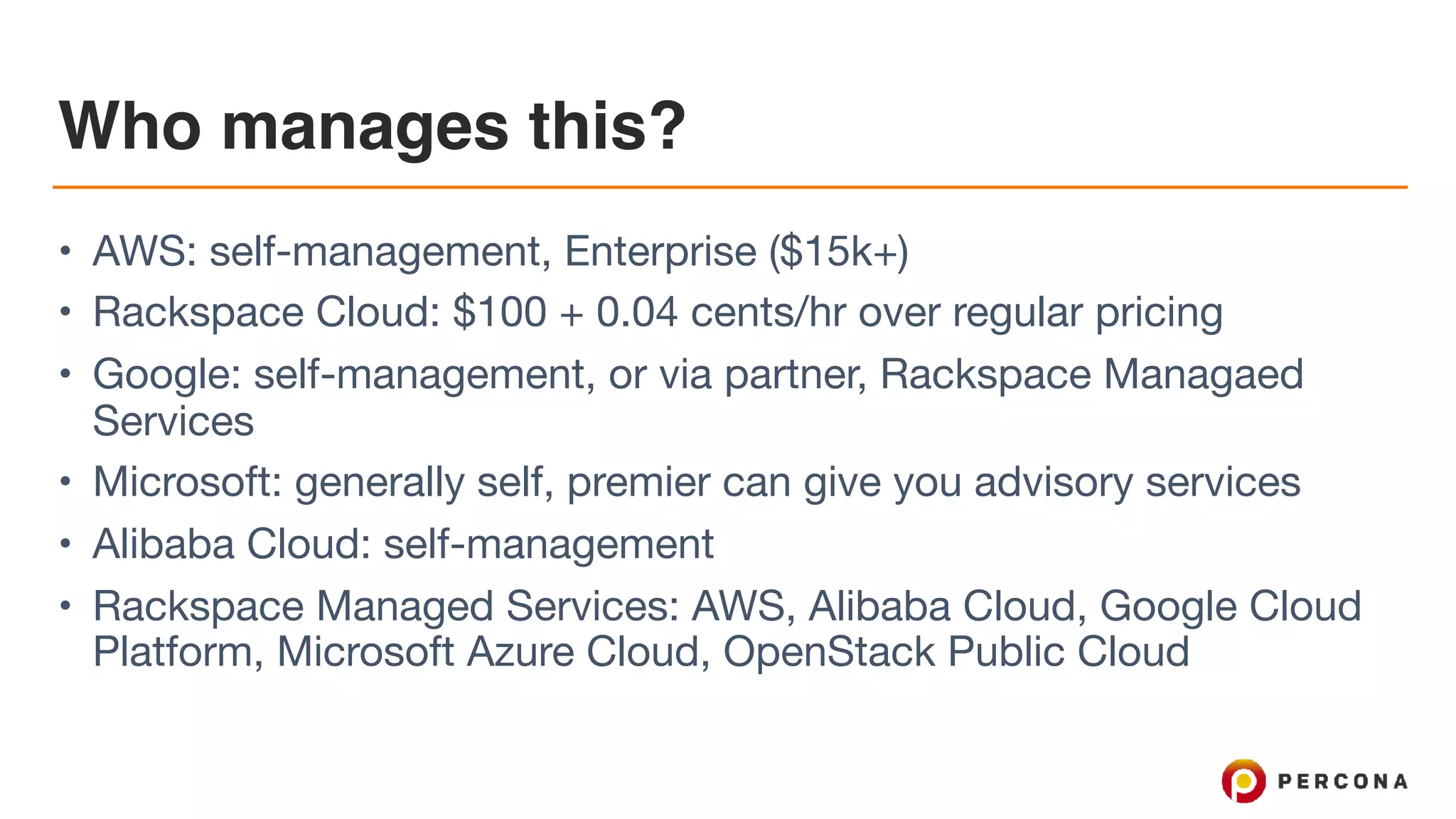
Who manages this?
• AWS: self-management, Enterprise ($15k+)

• Rackspace Cloud: $100 + 0.04 cents/hr over regular pricing

• Google: self-management, or via partner, Rackspace Managaed
Services

• Microsoft: generally self, premier can give you advisory services

• Alibaba Cloud: self-management

• Rackspace Managed Services: AWS, Alibaba Cloud, Google Cloud
Platform, Microsoft Azure Cloud, OpenStack Public Cloud
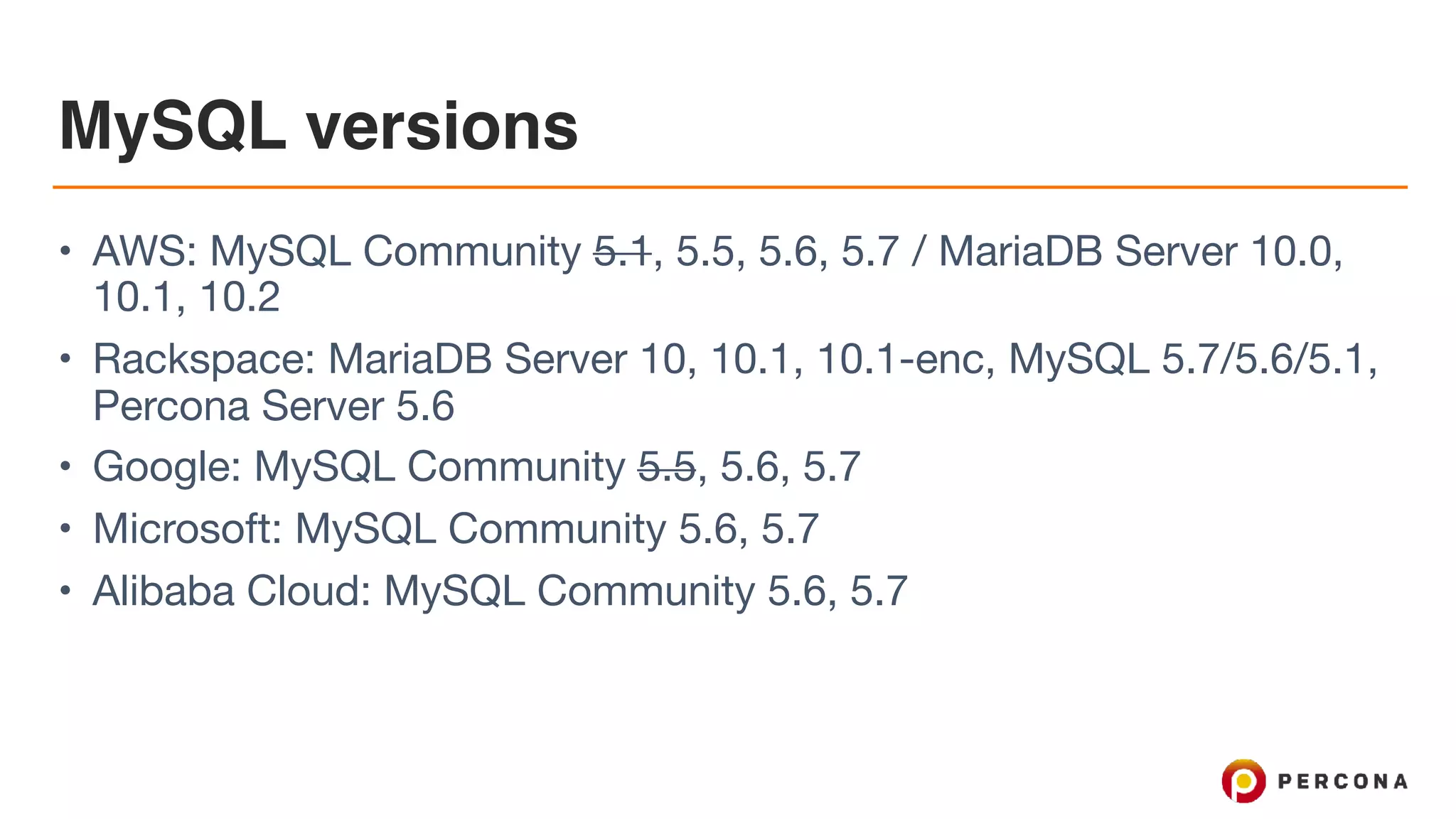
MySQL versions
• AWS: MySQL Community 5.1, 5.5, 5.6, 5.7 / MariaDB Server 10.0,
10.1, 10.2

• Rackspace: MariaDB Server 10, 10.1, 10.1-enc, MySQL 5.7/5.6/5.1,
Percona Server 5.6

• Google: MySQL Community 5.5, 5.6, 5.7

• Microsoft: MySQL Community 5.6, 5.7

• Alibaba Cloud: MySQL Community 5.6, 5.7
Access methods
• AWS - within Amazon, externally via mysql client, API access.

• Rackspace - private hostname within Rackspace network, API
access.

• Google - within AppEngine, a command line Java tool (gcutil),
standard mysql client

• Microsoft - within Azure, externally via mysql client 

• Alibaba Cloud - standard mysql client
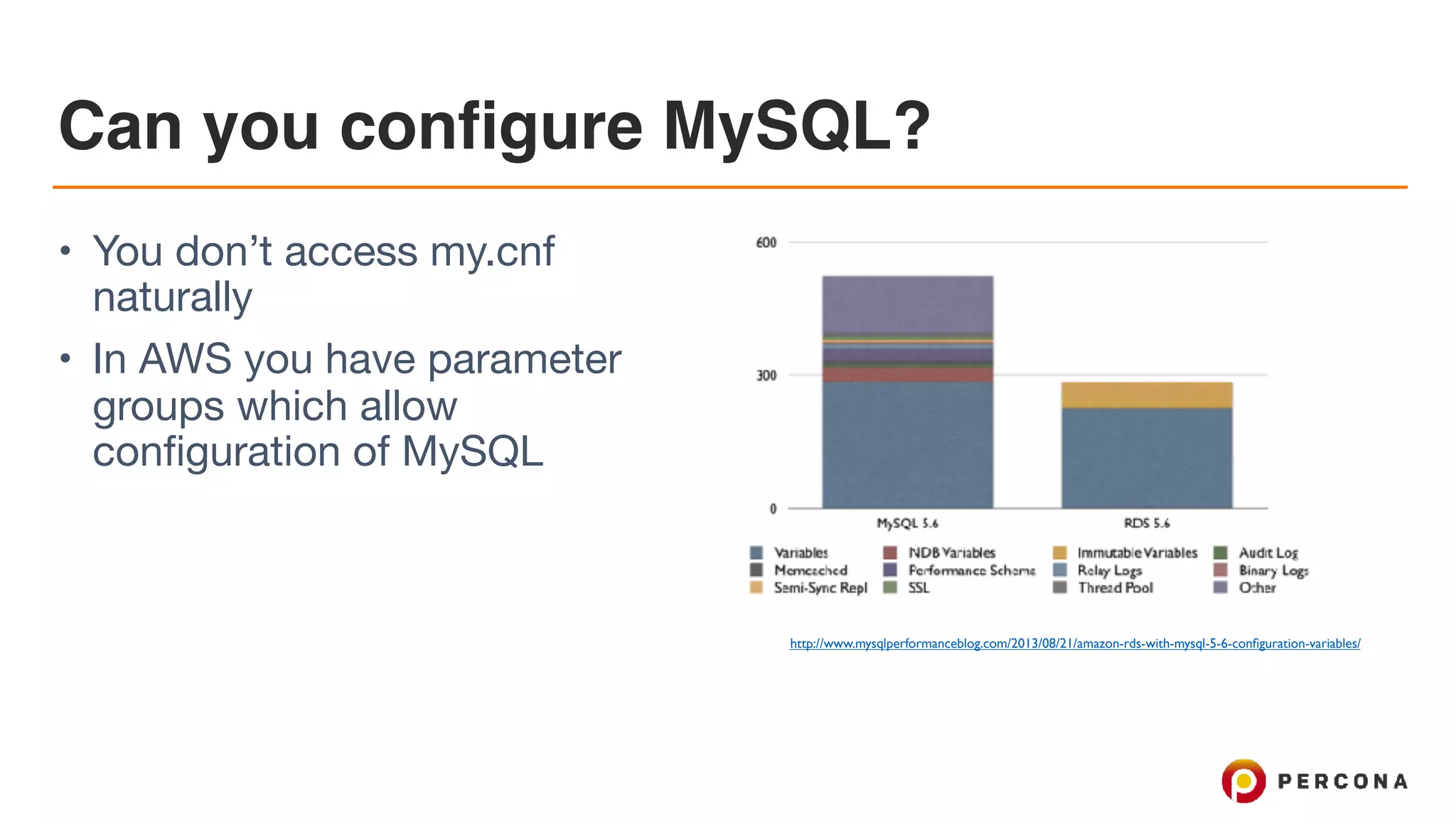
Can you configure MySQL?
• You don’t access my.cnf
naturally

• In AWS you have parameter
groups which allow
configuration of MySQL
source: http://www.mysqlperformanceblog.com/2013/08/21/amazon-rds-with-mysql-5-6-configuration-variables/
Cost
• Subscribe to relevant newsletters of your services

• Cost changes rapidly, plus you get new instance types and new
features (IOPS)

• Don’t forget network access costs

• Monitor your costs daily, hourly if possible (spot pricing — if roll your
own)
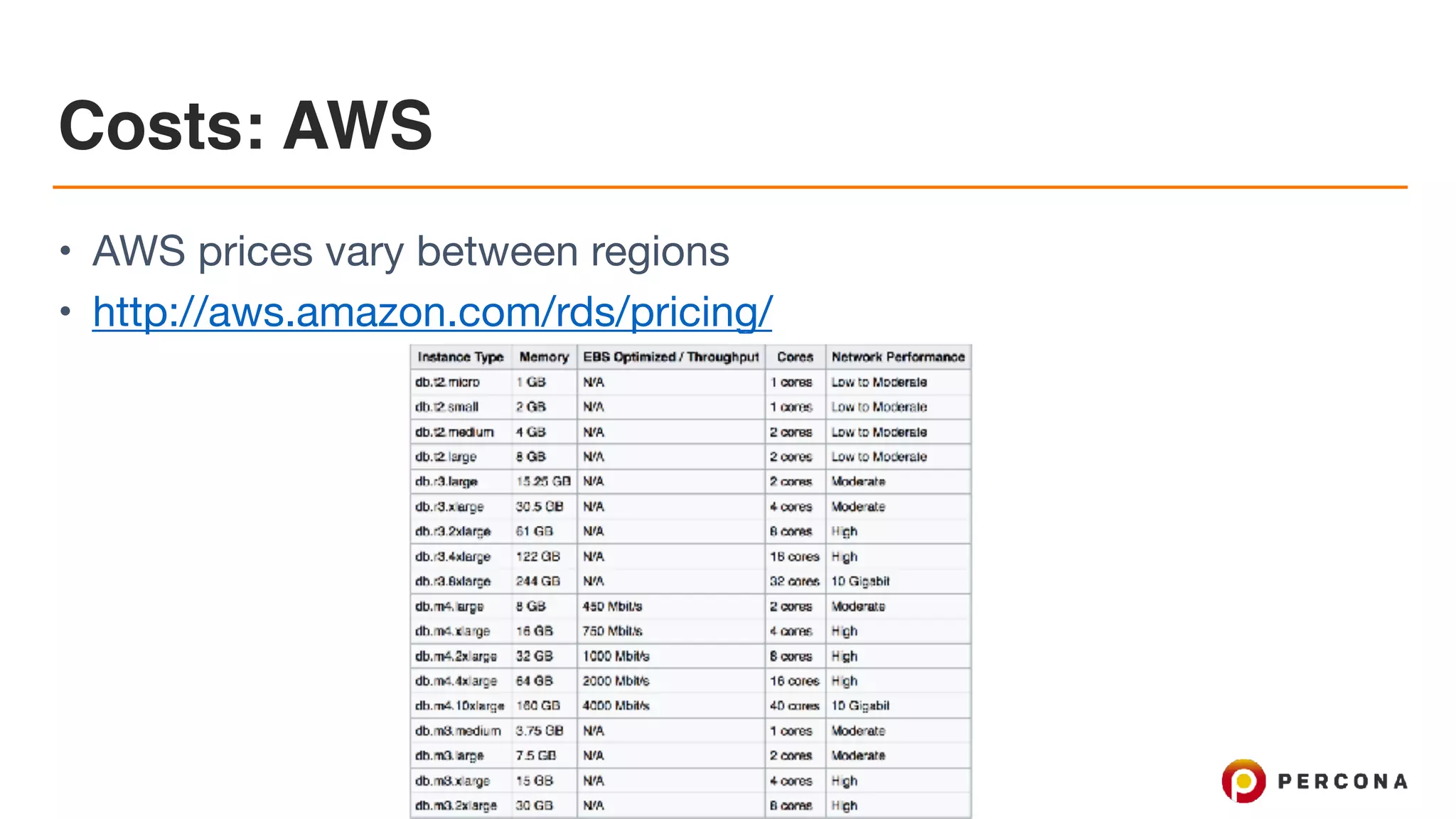
Costs: AWS
• AWS prices vary between regions

• http://aws.amazon.com/rds/pricing/
Costs: AWS II
• Standard latest generation: db.m4.large (2vCPU/8GB) at $1,533/yr
[2017]

• Previous generation: Medium instances (3.75GB) useful for testing
($1,577/yr [2014] vs $2,411/yr [2013])

• Large instance (7.5GB) production ready ($3,241/yr vs $4,777/yr
[2013])

• Multi-AZ production ready: db.m4.2xlarge (32GB, 8vCPUs) at
$12,264/yr [2017]

• Previous generation: m3.2XL (30GB, 8vCPUs) ($12,964/yr)
Costs: Rackspace
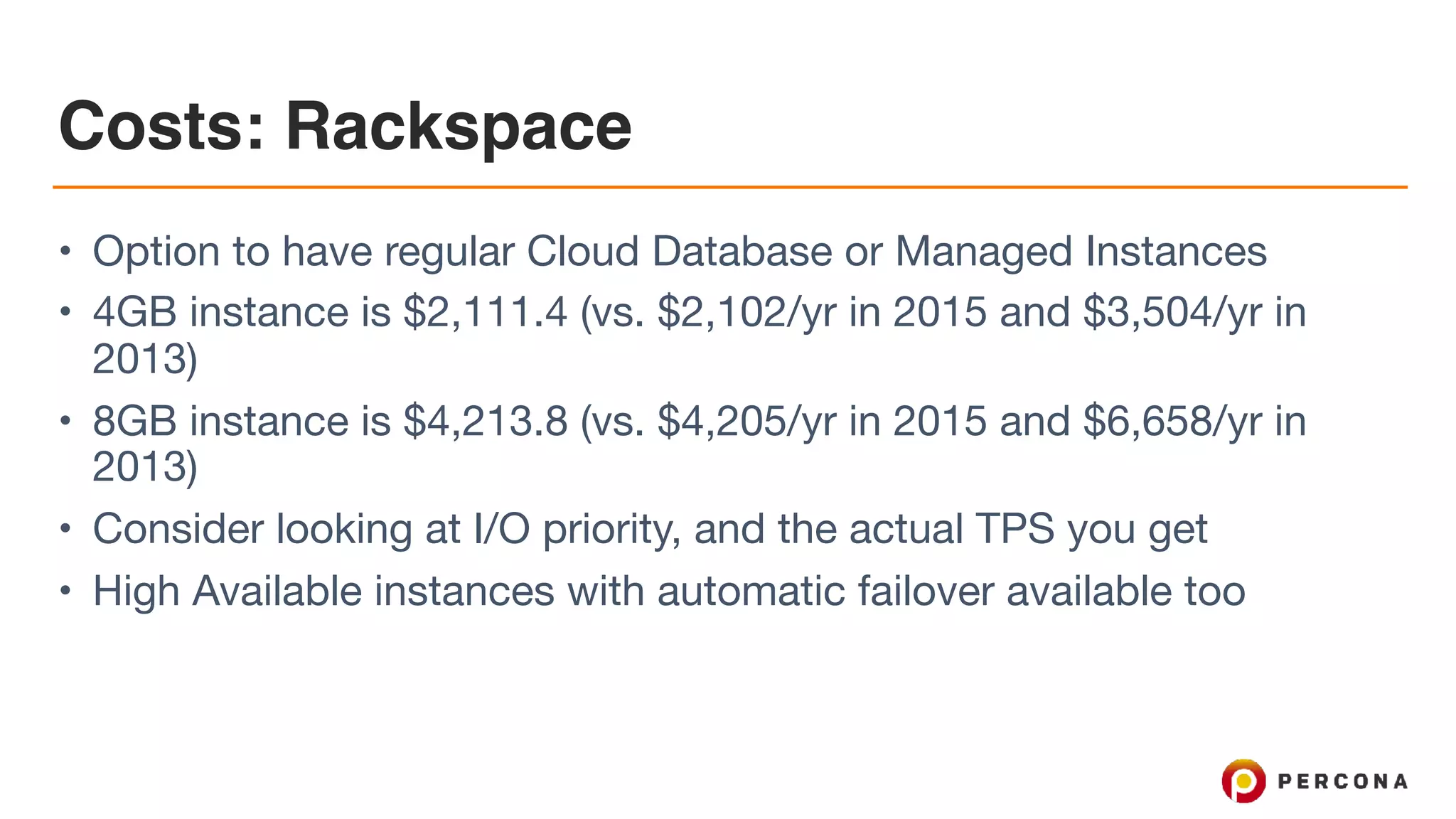
• Option to have regular Cloud Database or Managed Instances

• 4GB instance is $2,111.4 (vs. $2,102/yr in 2015 and $3,504/yr in
2013)

• 8GB instance is $4,213.8 (vs. $4,205/yr in 2015 and $6,658/yr in
2013)

• Consider looking at I/O priority, and the actual TPS you get

• High Available instances with automatic failover available too
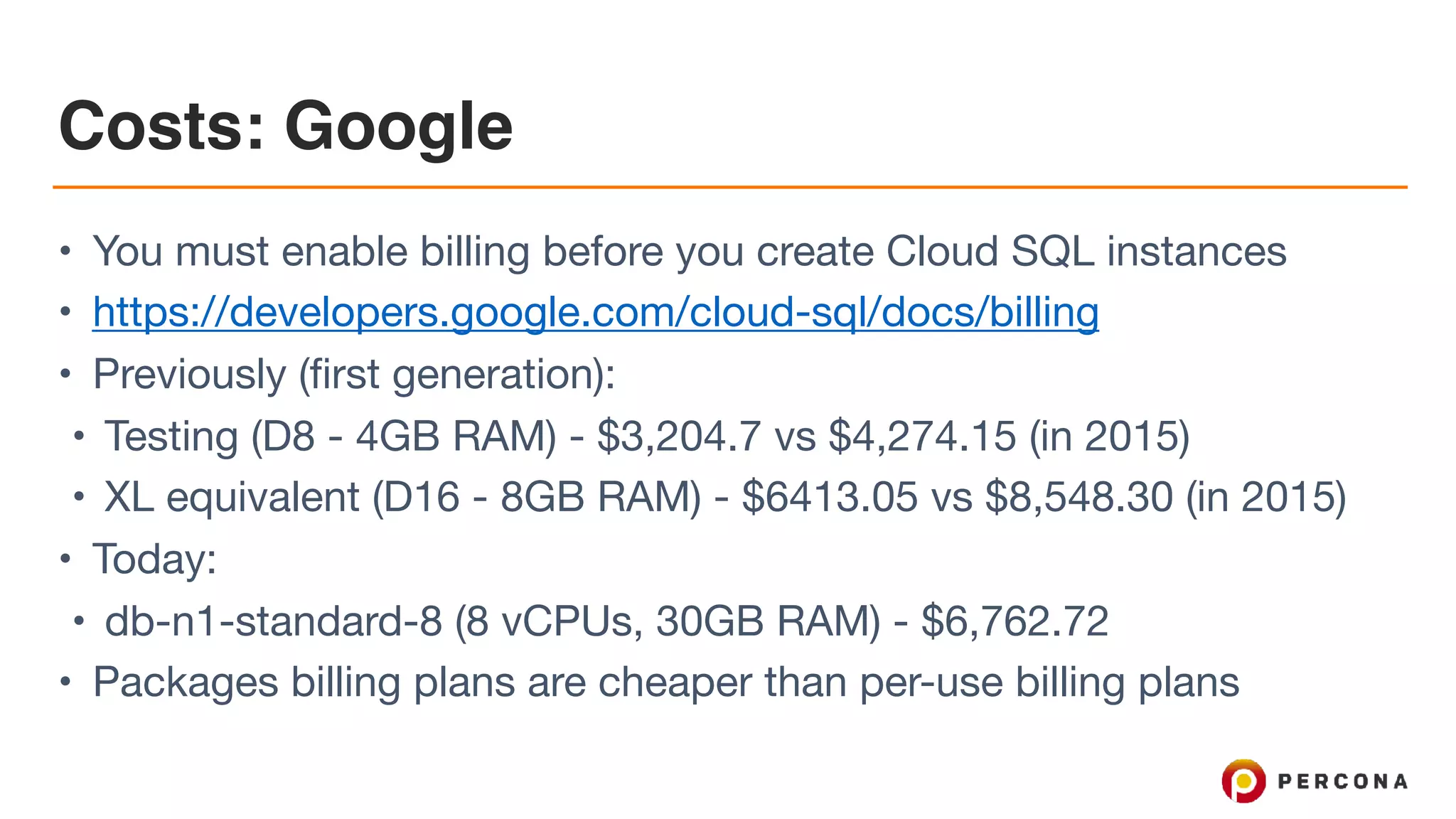
Costs: Google
• You must enable billing before you create Cloud SQL instances

• https://developers.google.com/cloud-sql/docs/billing

• Previously (first generation):

• Testing (D8 - 4GB RAM) - $3,204.7 vs $4,274.15 (in 2015)

• XL equivalent (D16 - 8GB RAM) - $6413.05 vs $8,548.30 (in 2015)

• Today:

• db-n1-standard-8 (8 vCPUs, 30GB RAM) - $6,762.72

• Packages billing plans are cheaper than per-use billing plans
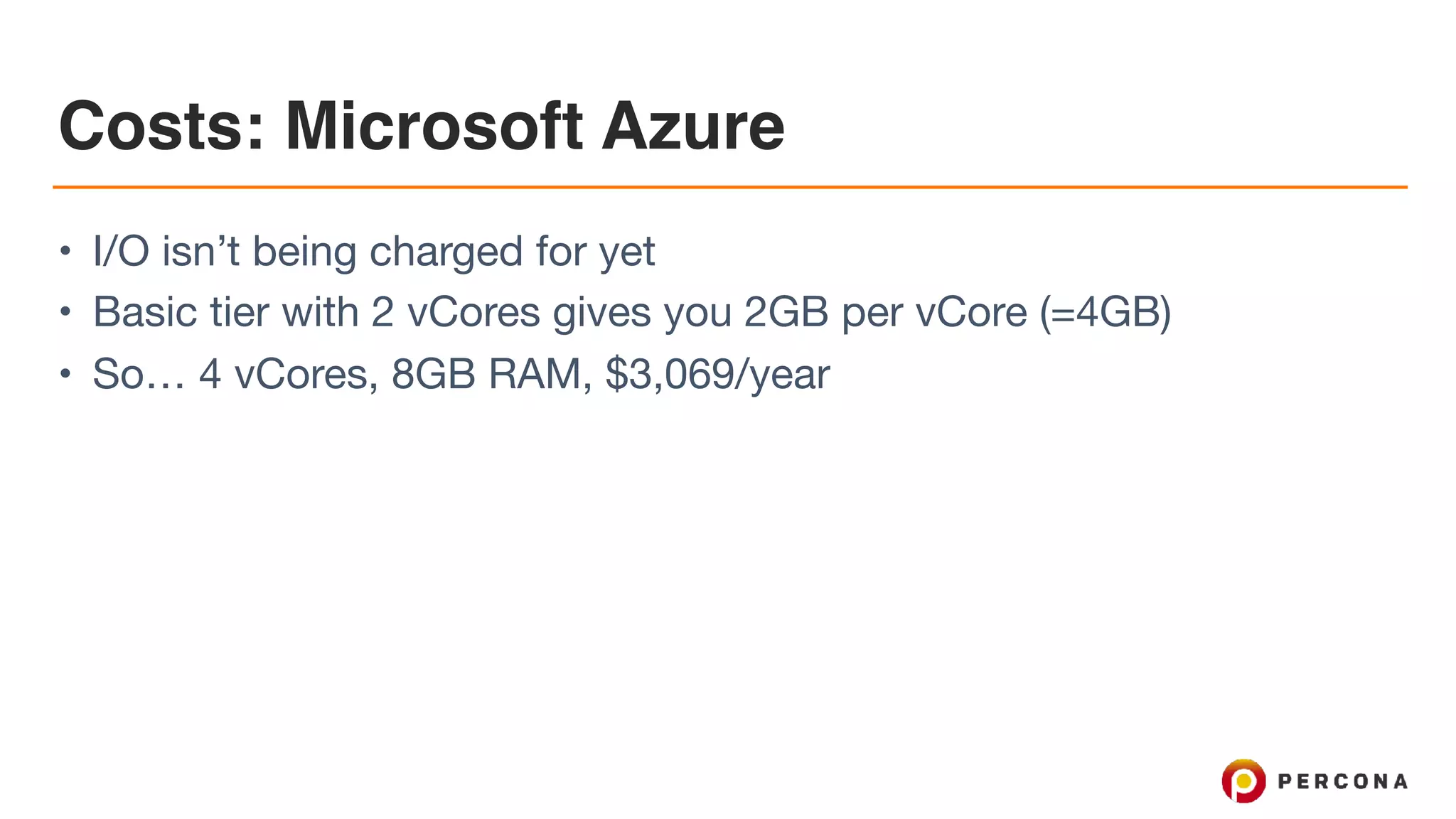
Costs: Microsoft Azure
• I/O isn’t being charged for yet

• Basic tier with 2 vCores gives you 2GB per vCore (=4GB)

• So… 4 vCores, 8GB RAM, $3,069/year
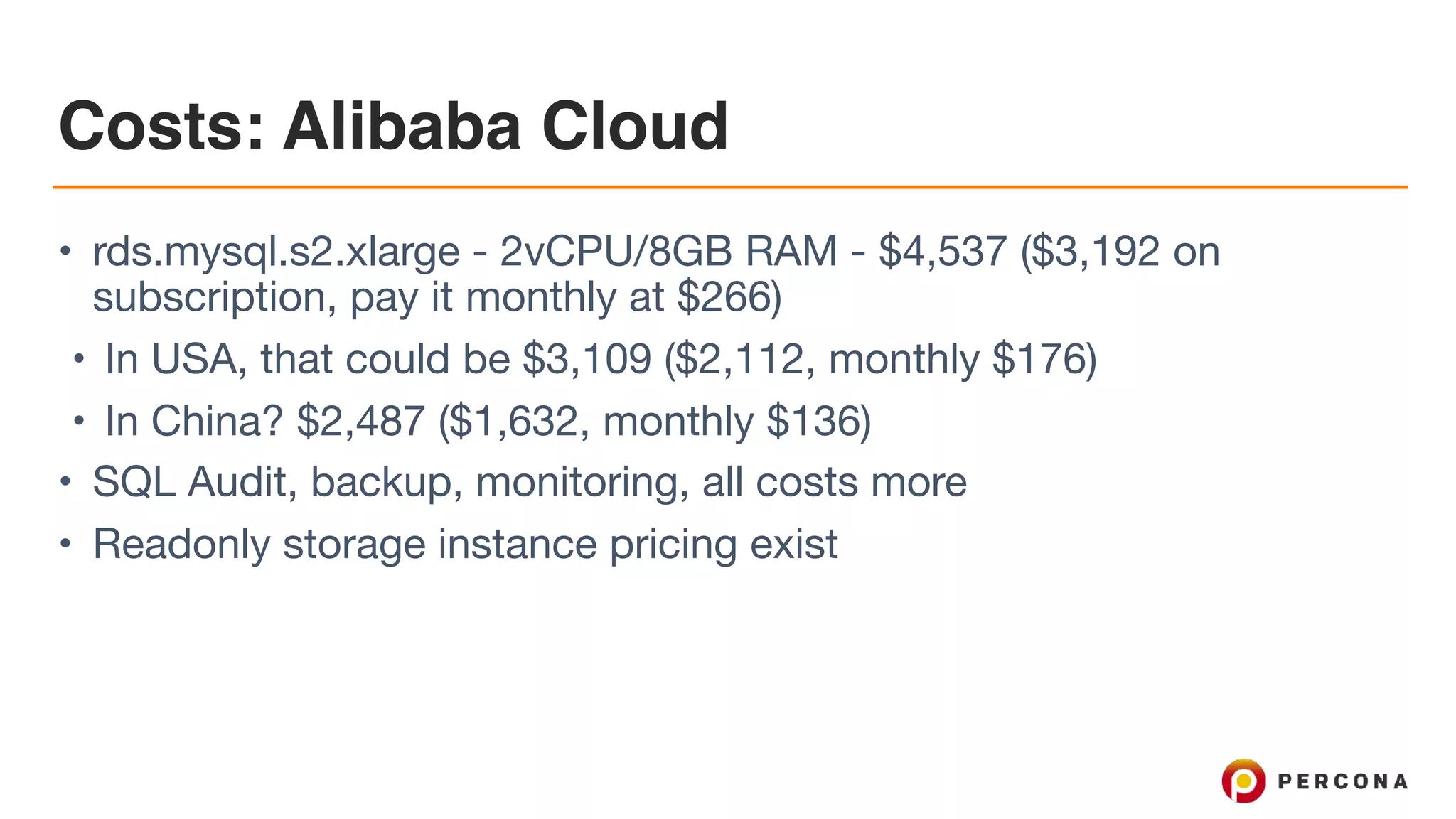
Costs: Alibaba Cloud
• rds.mysql.s2.xlarge - 2vCPU/8GB RAM - $4,537 ($3,192 on
subscription, pay it monthly at $266)

• In USA, that could be $3,109 ($2,112, monthly $176)

• In China? $2,487 ($1,632, monthly $136)

• SQL Audit, backup, monitoring, all costs more

• Readonly storage instance pricing exist
Where do you host your application?
• Typically within the compute clusters of the service you’re running
the DBaaS in

• You wan’t a multi-cloud strategy? You will have to have your entire
layers of applications replicated on different clouds
RDS: Multi-AZ
• Provides enhanced durability (synchronous data replication)

• Increased availability (automatic failover)

• Warning: can be slow with large database size

• Easy GUI administration

• Doesn’t give you another usable “read-replica” though
External replication
• MySQL 5.6 you can do RDS -> Non-RDS

• enable backup retention, you now have binlog access

• target: exporting data out of RDS

• This can help you migrate to another platform as well

• Replicate into RDS with 5.5.33 or later

• AWS provides stored procedures like
mysql.rds_set_external_master nowadays
Getting started
• Importing data into the cloud?

• mysqldump is a good choice today

• Upgrading from RDS 5.5 to RDS 5.6?

• mysqldump before, but nowadays you can do this via Read
Replicas
Handling backups
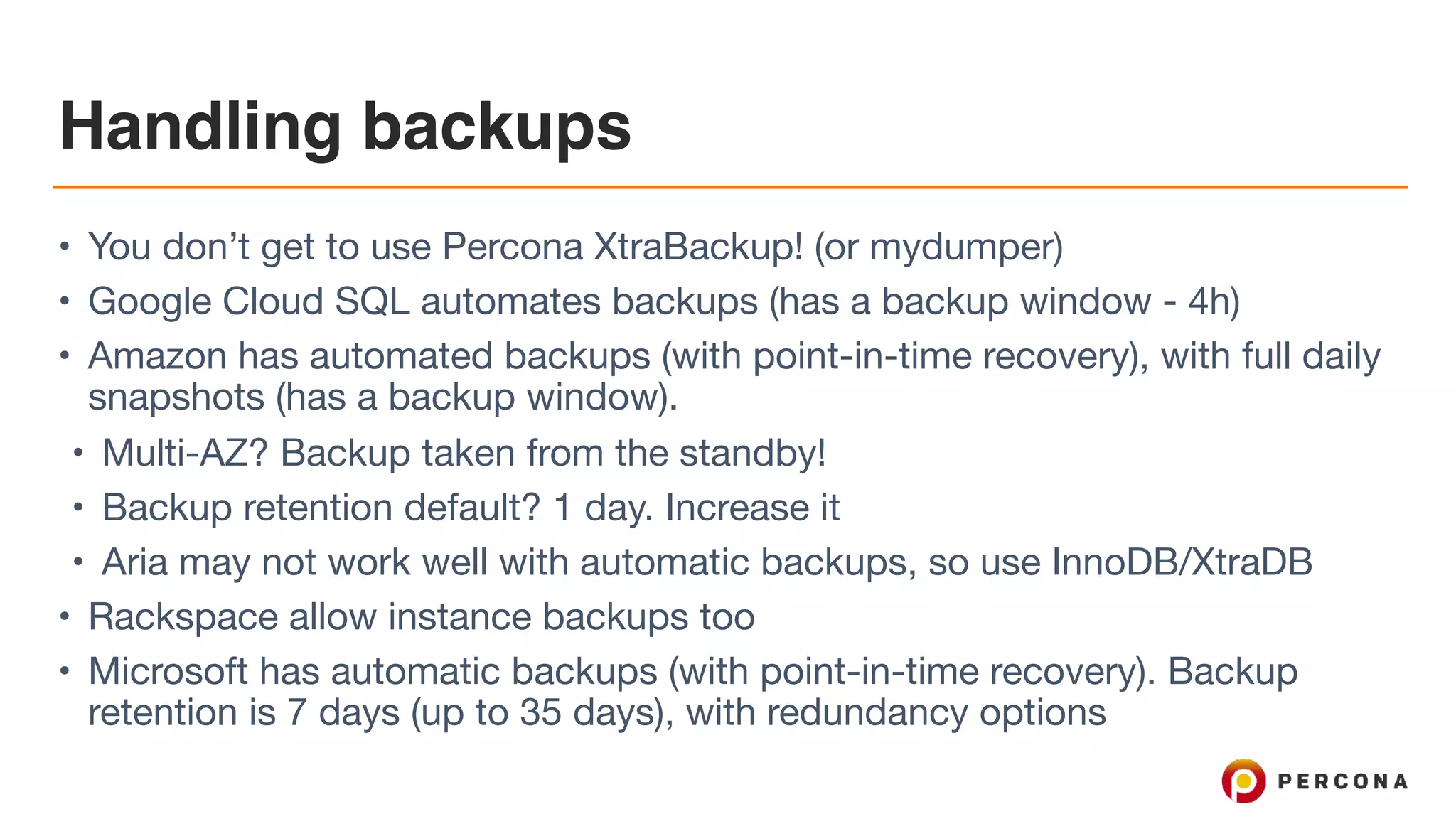
• You don’t get to use Percona XtraBackup! (or mydumper)

• Google Cloud SQL automates backups (has a backup window - 4h)

• Amazon has automated backups (with point-in-time recovery), with full daily
snapshots (has a backup window). 

• Multi-AZ? Backup taken from the standby!

• Backup retention default? 1 day. Increase it

• Aria may not work well with automatic backups, so use InnoDB/XtraDB

• Rackspace allow instance backups too

• Microsoft has automatic backups (with point-in-time recovery). Backup
retention is 7 days (up to 35 days), with redundancy options
Monitoring
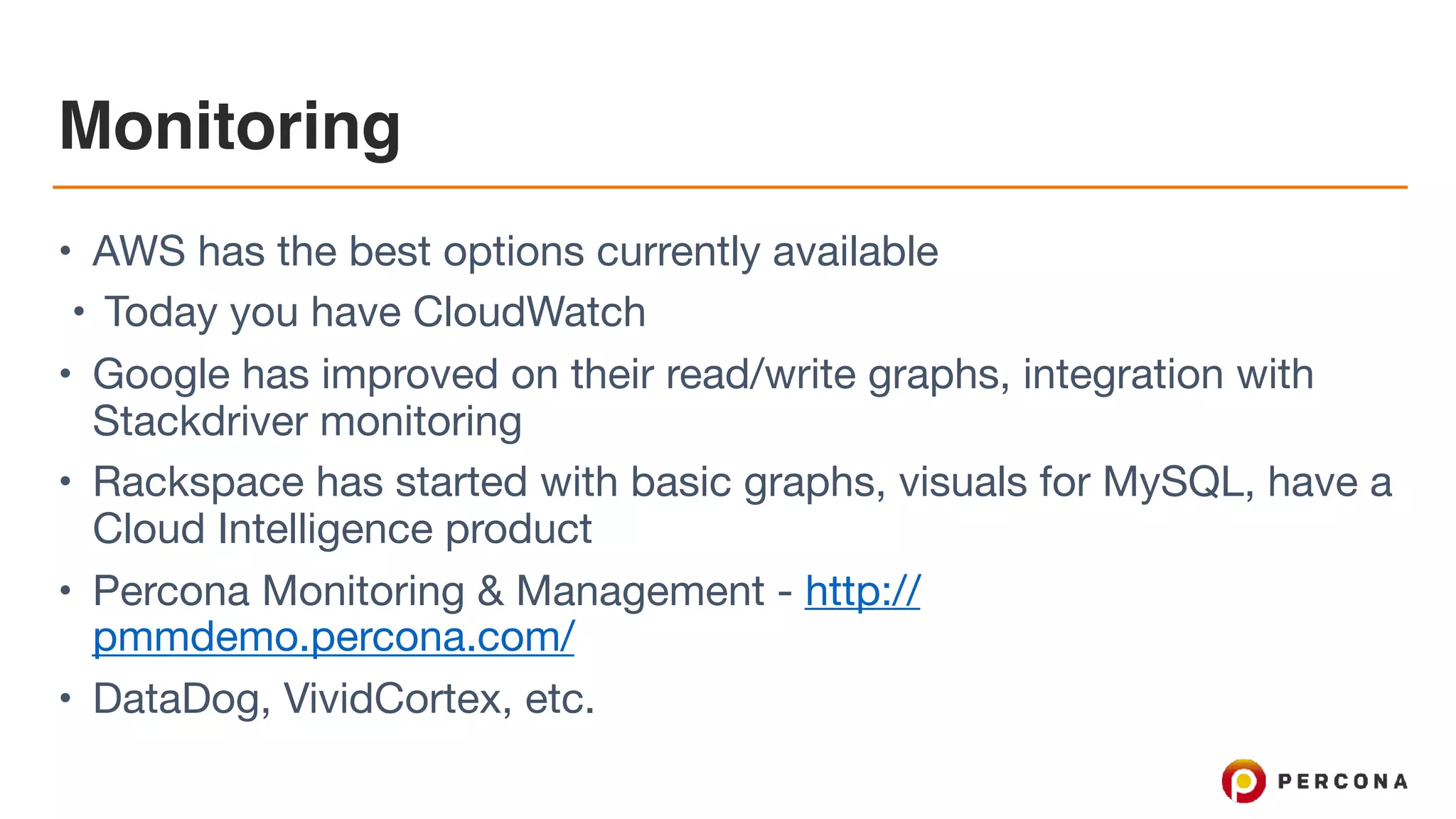
• AWS has the best options currently available

• Today you have CloudWatch

• Google has improved on their read/write graphs, integration with
Stackdriver monitoring

• Rackspace has started with basic graphs, visuals for MySQL, have a
Cloud Intelligence product

• Percona Monitoring & Management - http://
pmmdemo.percona.com/

• DataDog, VividCortex, etc.
Storage Engines
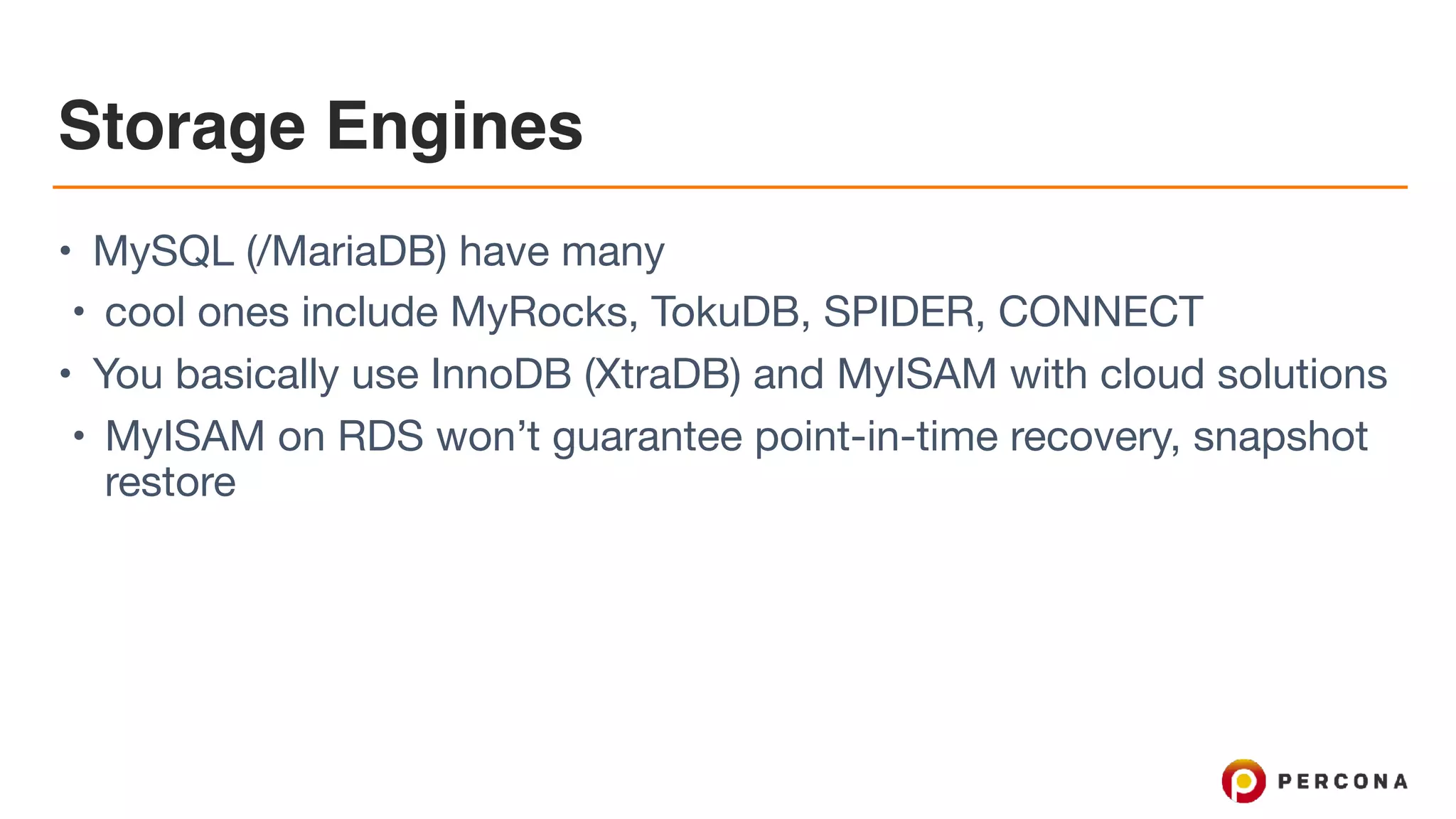
• MySQL (/MariaDB) have many

• cool ones include MyRocks, TokuDB, SPIDER, CONNECT

• You basically use InnoDB (XtraDB) and MyISAM with cloud solutions

• MyISAM on RDS won’t guarantee point-in-time recovery, snapshot
restore
High Availability
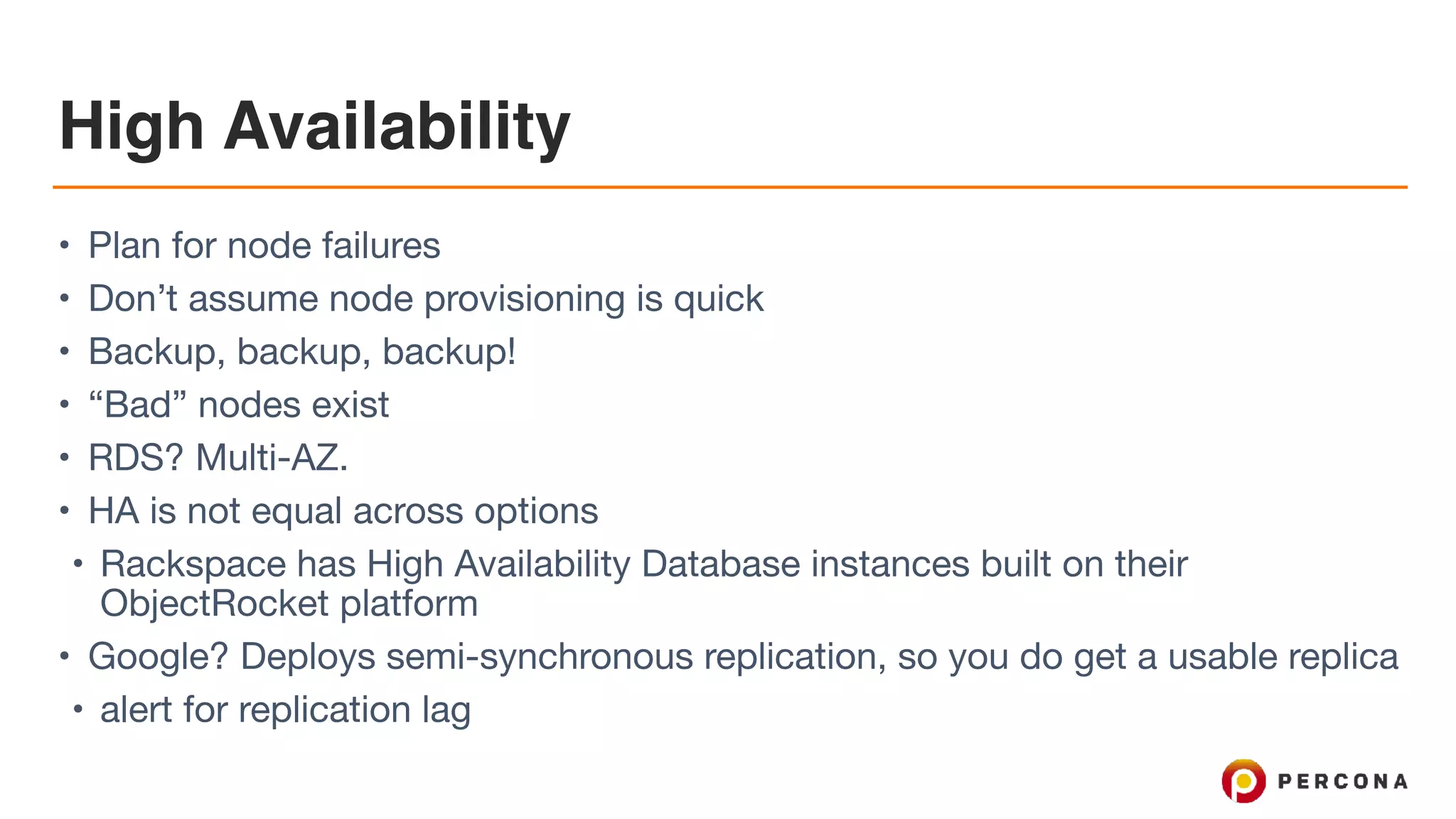
• Plan for node failures

• Don’t assume node provisioning is quick

• Backup, backup, backup!

• “Bad” nodes exist

• RDS? Multi-AZ.

• HA is not equal across options

• Rackspace has High Availability Database instances built on their
ObjectRocket platform

• Google? Deploys semi-synchronous replication, so you do get a usable replica 

• alert for replication lag
Unsupported features
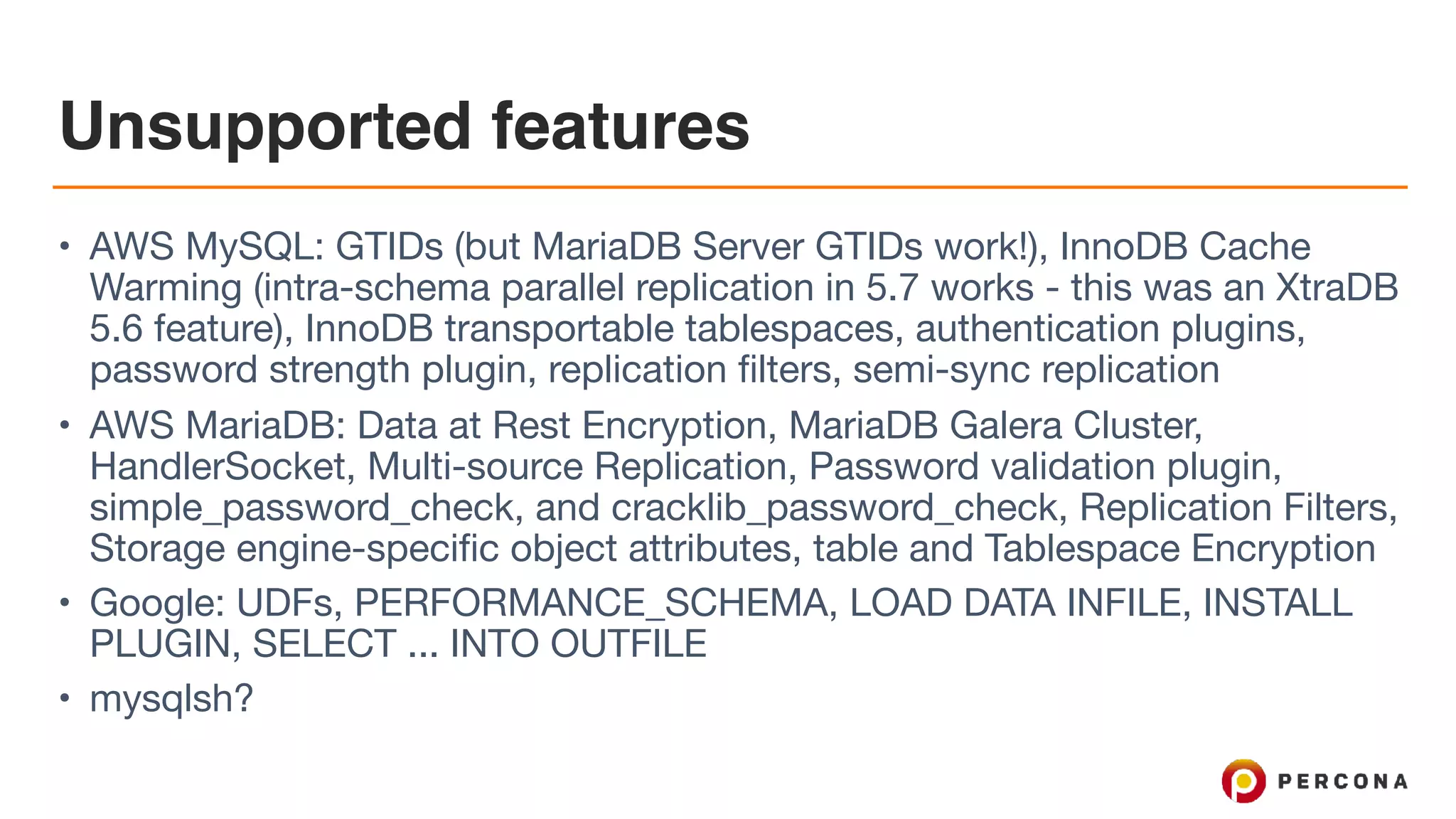
• AWS MySQL: GTIDs (but MariaDB Server GTIDs work!), InnoDB Cache
Warming (intra-schema parallel replication in 5.7 works - this was an XtraDB
5.6 feature), InnoDB transportable tablespaces, authentication plugins,
password strength plugin, replication filters, semi-sync replication

• AWS MariaDB: Data at Rest Encryption, MariaDB Galera Cluster,
HandlerSocket, Multi-source Replication, Password validation plugin,
simple_password_check, and cracklib_password_check, Replication Filters,
Storage engine-specific object attributes, table and Tablespace Encryption

• Google: UDFs, PERFORMANCE_SCHEMA, LOAD DATA INFILE, INSTALL
PLUGIN, SELECT ... INTO OUTFILE

• mysqlsh?
Option groups
• InnoDB memcached

• MariaDB Server Audit Plugin
Provisioned IOPS
• Available on Amazon, and recently Google

• Faster, predictable, consistent I/O performance with low latencies

• Good throughput, RAID on backed

• EBS is more reliable
More on running in the hosted cloud…
• log access via API

• no SUPER access to skip replication errors easily

• sync_binlog=0 not available

• no OS access (sar, ps, tcpdump)
Warning: automatic upgrades
• Regressions happen even with a minor version upgrade in the
MySQL world (though this is happening a lot less as quality has
increased tremendously)

• InnoDB update that modifies rows PK triggers recursive behaviour
until all disk space is exceeded? 5.5.24->5.5.25 (fixed: 5.5.25a)

• Using query cache for partitioned tables? Disabled since 5.5.22-
>5.5.23!
Benchmarking for use
• sysbench
• OLTP test, use tables with 20M rows and 20M transactions, check
1-128 threads/run (run this on RDS, Rackspace)

• June 2013, tps, performance per dollar, Rackspace delivers more
performance across all flavours except 512MB instance

• Yahoo! Cloud Serving Benchmark

• https://github.com/brianfrankcooper/YCSB

• Google’s PerfKit Benchmarker

• https://github.com/GoogleCloudPlatform/PerfKitBenchmarker
Roadmaps?
• There don’t seem to be public roadmaps. You find out when there’s a
change!

• Watch out for those events…
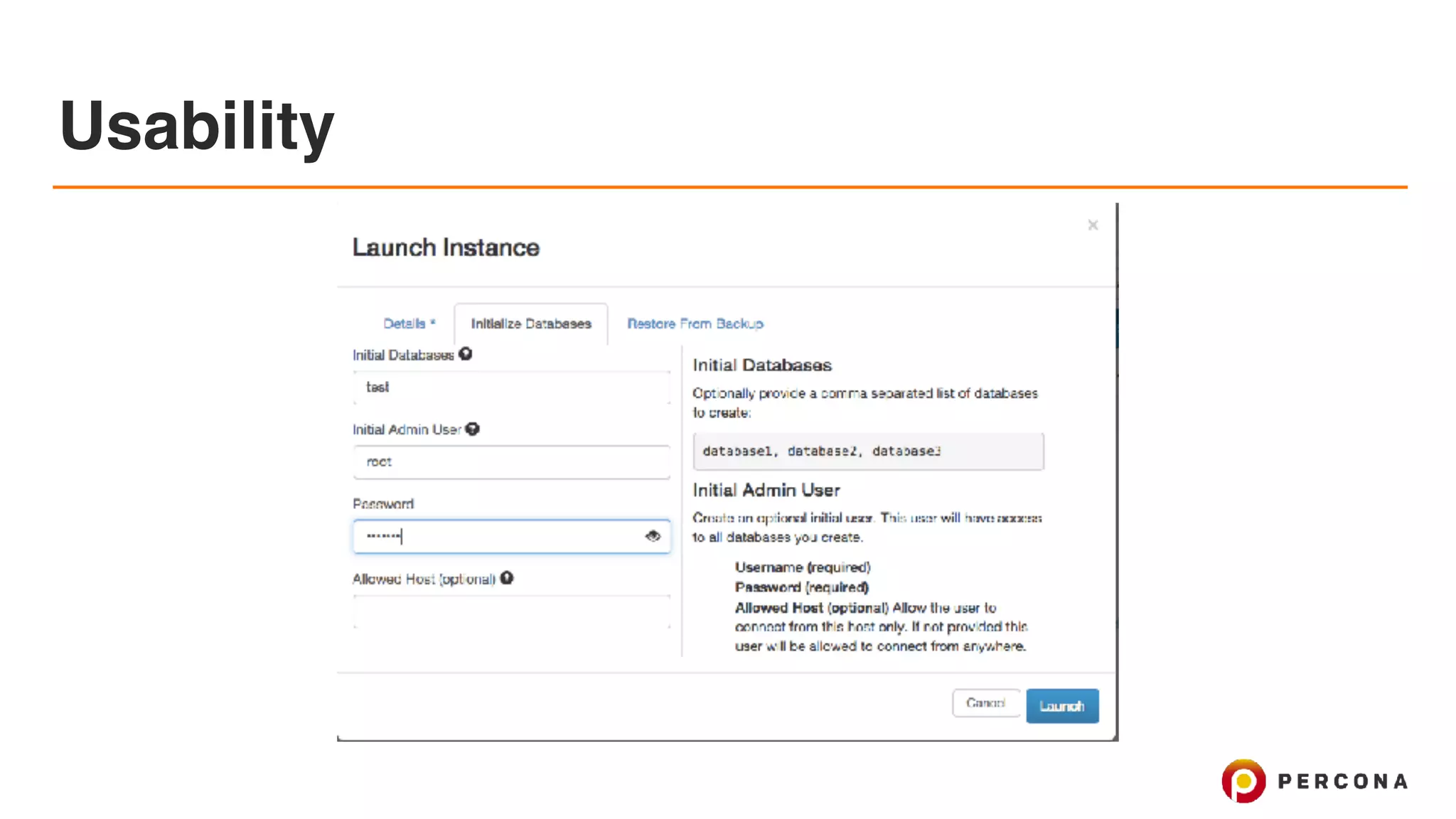
Usability
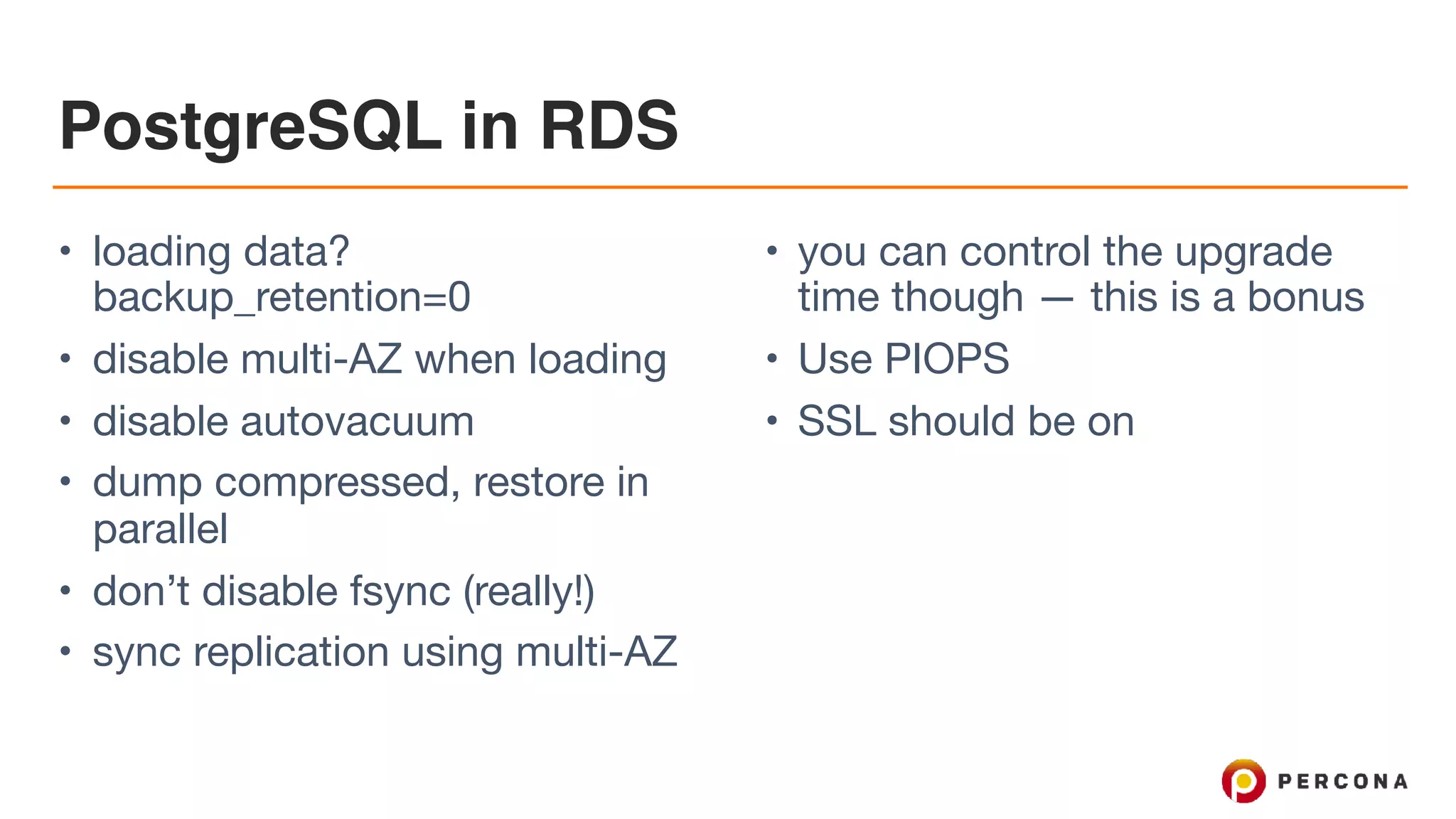
PostgreSQL in RDS
• loading data?
backup_retention=0

• disable multi-AZ when loading

• disable autovacuum

• dump compressed, restore in
parallel

• don’t disable fsync (really!)

• sync replication using multi-AZ

• you can control the upgrade
time though — this is a bonus

• Use PIOPS

• SSL should be on
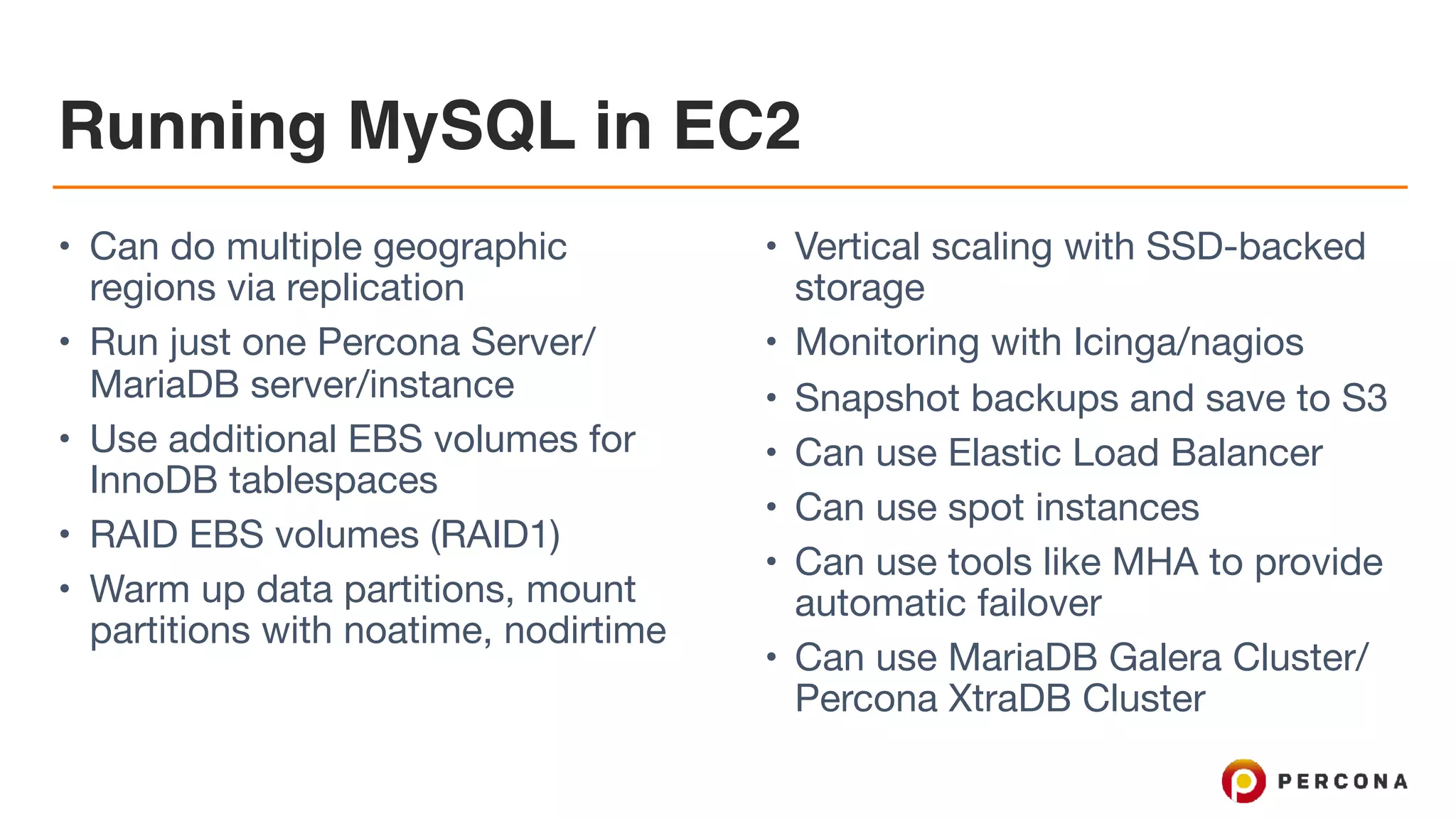
Running MySQL in EC2
• Can do multiple geographic
regions via replication

• Run just one Percona Server/
MariaDB server/instance

• Use additional EBS volumes for
InnoDB tablespaces

• RAID EBS volumes (RAID1)

• Warm up data partitions, mount
partitions with noatime, nodirtime

• Vertical scaling with SSD-backed
storage

• Monitoring with Icinga/nagios

• Snapshot backups and save to S3

• Can use Elastic Load Balancer

• Can use spot instances

• Can use tools like MHA to provide
automatic failover

• Can use MariaDB Galera Cluster/
Percona XtraDB Cluster
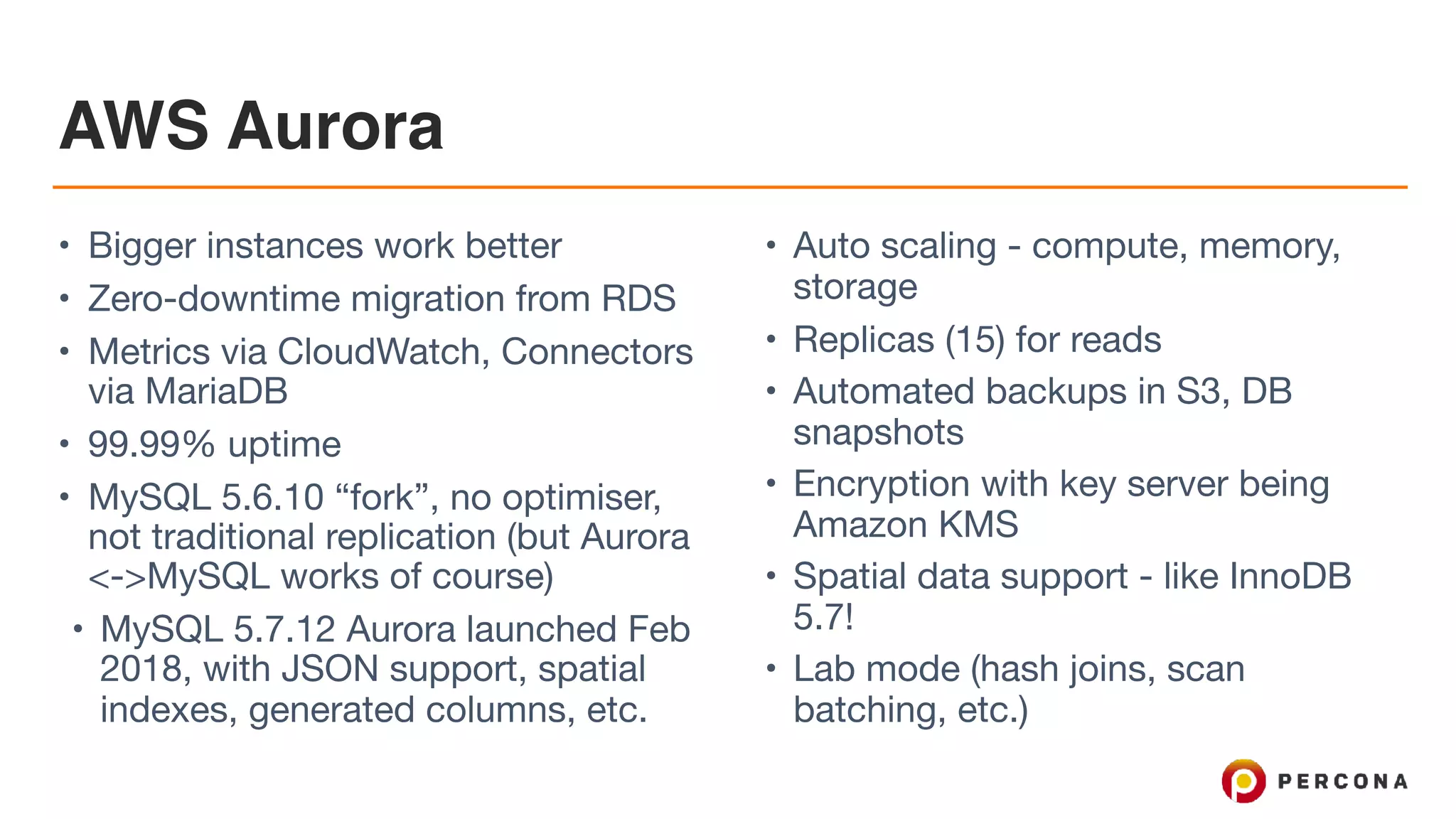
AWS Aurora
• Bigger instances work better

• Zero-downtime migration from RDS

• Metrics via CloudWatch, Connectors
via MariaDB

• 99.99% uptime

• MySQL 5.6.10 “fork”, no optimiser,
not traditional replication (but Aurora
<->MySQL works of course)

• MySQL 5.7.12 Aurora launched Feb
2018, with JSON support, spatial
indexes, generated columns, etc.

• Auto scaling - compute, memory,
storage

• Replicas (15) for reads

• Automated backups in S3, DB
snapshots

• Encryption with key server being
Amazon KMS

• Spatial data support - like InnoDB
5.7!

• Lab mode (hash joins, scan
batching, etc.)
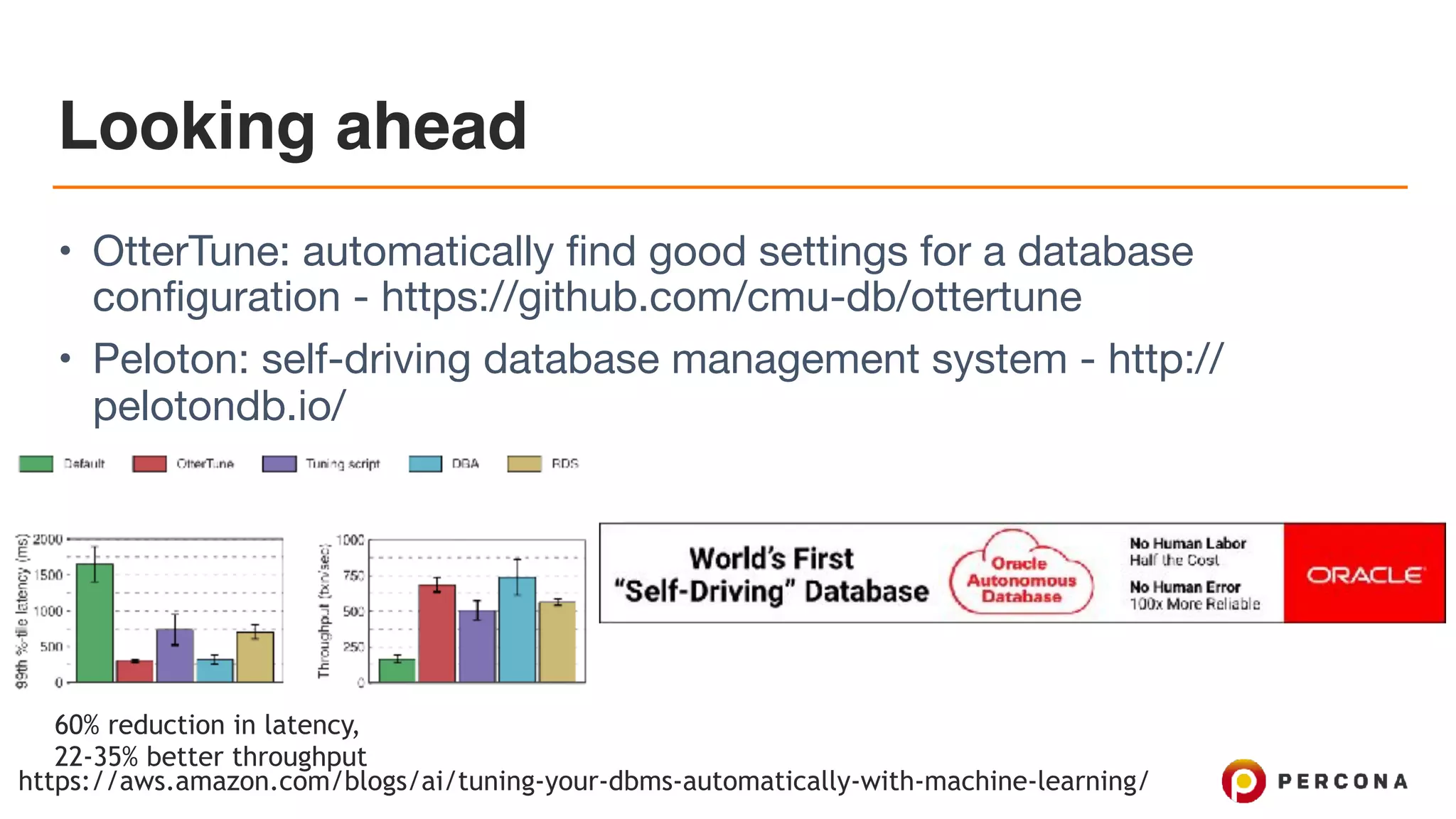
Looking ahead
• OtterTune: automatically find good settings for a database
configuration - https://github.com/cmu-db/ottertune 

• Peloton: self-driving database management system - http://
pelotondb.io/
60% reduction in latency,
22-35% better throughput
https://aws.amazon.com/blogs/ai/tuning-your-dbms-automatically-with-machine-learning/
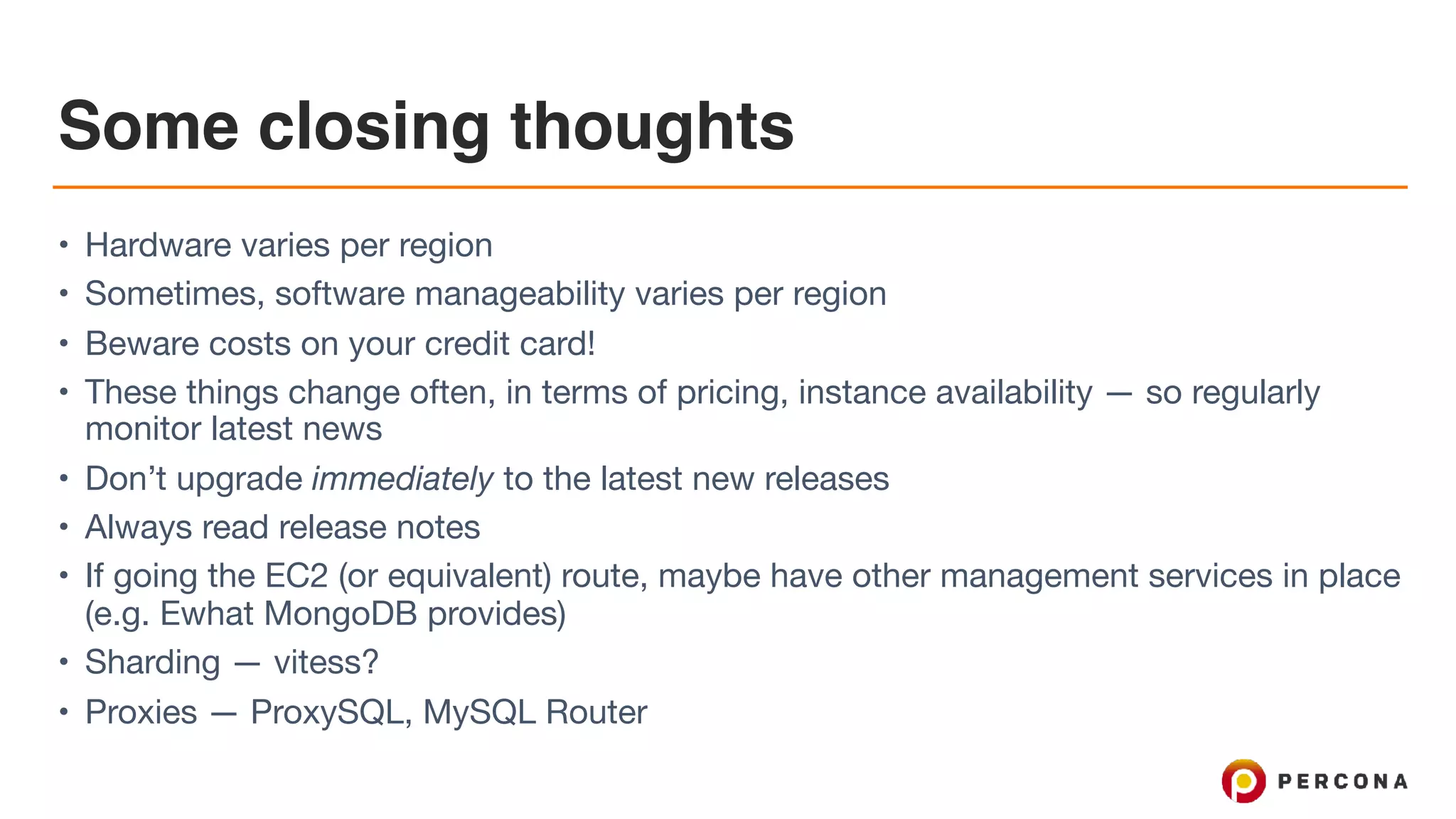
Some closing thoughts
• Hardware varies per region

• Sometimes, software manageability varies per region

• Beware costs on your credit card!

• These things change often, in terms of pricing, instance availability — so regularly
monitor latest news

• Don’t upgrade immediately to the latest new releases

• Always read release notes

• If going the EC2 (or equivalent) route, maybe have other management services in place
(e.g. Ewhat MongoDB provides)

• Sharding — vitess? 

• Proxies — ProxySQL, MySQL Router
Thank you!
Colin Charles
colin.charles@percona.com / byte@bytebot.net
http://bytebot.net/blog | @bytebot on twitter
slides: slideshare.net/bytebot

Databases in the hosted cloud

  • 1.
    Databases in theHosted Cloud Colin Charles, Chief Evangelist, Percona Inc. colin.charles@percona.com / byte@bytebot.net http://bytebot.net/blog/ | @bytebot on Twitter OSCON, Portland, Oregon 19 July 2018
  • 2.
    whoami • Chief Evangelist,Percona Inc • Focusing on the MySQL ecosystem (MySQL, Percona Server, MariaDB Server), as well as the MongoDB ecosystem (Percona Server for MongoDB) + 100% open source tools from Percona like Percona Monitoring & Management, Percona xtrabackup, Percona Toolkit, etc. and now PostgreSQL too! • Founding team of MariaDB Server (2009-2016), previously at Monty Program Ab, merged with SkySQL Ab, now MariaDB Corporation • Formerly MySQL AB (exit: Sun Microsystems) • Past lives include Fedora Project (FESCO), OpenOffice.org • MySQL Community Contributor of the Year Award winner 2014
  • 3.
    Agenda • MySQL asa service offering (DBaaS) • Choices • Considerations • MySQL versions & access • Costs • Deeper into RDS • Should you run this on EC2 or an equivalent? • What about PostgreSQL? MongoDB? • Conclusion
  • 4.
    Database as aservice • Database as a Service (DBaaS) • MySQL/PostgreSQL available on-demand, without any installation/ configuration of hardware/software • Pay-per-usage based • Provider maintains database, you don’t maintain, upgrade, or administer the database
  • 5.
    New way ofdeployment • Enter a credit card number • call API (or use the GUI) aws ec2 run-instances --image-id ami-xxx -k $ {EC2_KEYPAIR} -t c3.large nova boot --image centos6-x86_64 --flavor m1.large db1 credit: http://www.flickr.com/photos/68751915@N05/6280507539/
  • 6.
    Why DBaaS? • “Couldn’twe just have a few more servers to handle the traffic spike during the elections?” • Don’t have a lot of DBAs, optimise for operational ease • Rapid deployment & scale-out
  • 7.
    Your choices today •Amazon Web Services Relational Database Service (RDS) • Rackspace Cloud Databases • Google Cloud SQL • Alibaba Cloud • Oracle Cloud MySQL Service • Microsoft Azure Database
  • 8.
    There are more •Jelastic - PaaS offering MySQL, MariaDB Server • ClearDB - MySQL partnered with Heroku, Azure clouds • Joyent - Image offers Percona MySQL and a Percona SmartMachine
  • 9.
    Google Compute Engine •Google Compute Engine offers Percona XtraDB Cluster as a “click- to-deploy” app • comes with Galera 3, Percona Toolkit, XtraBackup as well
  • 10.
    Pivotal CloudFoundry • PivotalCloudFoundry • “MySQL” PaaS which is MariaDB Galera Cluster 10 (v1, legacy) • MariaDB v10.1.30 and Galera v25.3.20 (latest release, June 12 2018) • MySQL for PCF v2 • Percona Server v5.7.20-21 (latest release, June 22 2018) • Works with IaaS platforms: AWS, Azure, GCP, OpenStack, and vSphere • Significance of Galera Cluster versus regular replication
  • 11.
    Red Hat OpenShift •Variants between Online & Enterprise editions (usually you get access to modern releases with OpenShift Online) • MySQL 5.5/5.6/5.7 • MariaDB 10.0/10.1 • PostgreSQL 9.4/9.5 • MongoDB 2.4/2.6/3.2/3.4
  • 12.
    Beware • GenieDB -globally distributed MySQL as a service, master-master replication, works on EC2, Rackspace, Google Compute Engine, HP Cloud • Xeround - 2 weeks notice...
  • 14.
    Thank you HPCloud •http://www.bytebot.net/blog/archives/2015/10/27/sunsetting- hpcloud-whom-contributed-to-making-mysql-better • Utility user • enforce_storage_engine • prevent LOAD DATA INFILE/SELECT INTO OUTFILE • restrict # of binlog files
  • 16.
    What else doyou get? • PostgreSQL is getting popular in the cloud: AWS RDS, AWS Aurora, Microsoft Azure, Alibaba Cloud, Google Cloud SQL • Most MongoDB users run within the cloud — but not hosted, it tends to be “roll your own” or via ObjectRocket (and lately MongoDB Atlas c- reasonable free tier!) • Compose.io (now IBM) & the like (MongoLab) — hosted MongoDB, Redis, Enhanced PostgreSQL, ElasticSearch, RethinkDB (!?), MySQL with group replication, ScyllaDB, etc.
  • 17.
    Regions & AvailabilityZones • Region: a data centre location, containing multiple Availability Zones • Availability Zone (AZ): isolated from failures from other AZs + low- latency network connectivity to other zones in same region
  • 18.
    Location, location, location •AWS RDS: US East (N. Virginia, Ohio), US West (Oregon, Northern California, California), EU (Ireland, Frankfurt, London, Paris), APAC (Singapore, Tokyo, Sydney, Seoul, Mumbai), South America (São Paulo), GovCloud, Canada (Central), China (Beijing) • Rackspace: USA (Dallas DFW, Chicago ORD, N. Virginia IAD), APAC (Sydney, Hong Kong), EU (London)* • Google Cloud SQL: • 2nd generation instances: Montréal, Iowa, N. Virginia, Oregon, LA, São Paulo, Finland, London, Frankfurt, Netherlands, Tokyo, Mumbai, Singapore, Sydney
  • 19.
    Service Level Agreements(SLA) • AWS - at least 99.95% in a calendar month, less than, 10% service credit • Rackspace - 99.9% in a calendar month • Google - 99.95% in a calendar month, less than 10% service credit • Alibaba Cloud - no less than 99.95% in a calendar month (some services, 99.9%) • Microsoft Azure - < 99.99% will give you a 10% service credit • SLAs exclude “scheduled maintenance” which may have impact on storage I/O + elevate latency • e.g. AWS is 30 minutes/week
  • 20.
    Support • AWS -active forums; $100+ (or a % of AWS usage) phone # • Rackspace - live chat, phone #, forums • Google - forums; $150/mo gets support portal; $400+ (or a % of usage fees) for phone # • Microsoft - forums; $100/mo to start • Alibaba Cloud - $70 (or a % of usage fees) • Most have developer support plans at $19.99-$29 even; enterprise support around $8,000-$15,000
  • 21.
    Who manages this? •AWS: self-management, Enterprise ($15k+) • Rackspace Cloud: $100 + 0.04 cents/hr over regular pricing • Google: self-management, or via partner, Rackspace Managaed Services • Microsoft: generally self, premier can give you advisory services • Alibaba Cloud: self-management • Rackspace Managed Services: AWS, Alibaba Cloud, Google Cloud Platform, Microsoft Azure Cloud, OpenStack Public Cloud
  • 22.
    MySQL versions • AWS:MySQL Community 5.1, 5.5, 5.6, 5.7 / MariaDB Server 10.0, 10.1, 10.2 • Rackspace: MariaDB Server 10, 10.1, 10.1-enc, MySQL 5.7/5.6/5.1, Percona Server 5.6 • Google: MySQL Community 5.5, 5.6, 5.7 • Microsoft: MySQL Community 5.6, 5.7 • Alibaba Cloud: MySQL Community 5.6, 5.7
  • 23.
    Access methods • AWS- within Amazon, externally via mysql client, API access. • Rackspace - private hostname within Rackspace network, API access. • Google - within AppEngine, a command line Java tool (gcutil), standard mysql client • Microsoft - within Azure, externally via mysql client • Alibaba Cloud - standard mysql client
  • 24.
    Can you configureMySQL? • You don’t access my.cnf naturally • In AWS you have parameter groups which allow configuration of MySQL source: http://www.mysqlperformanceblog.com/2013/08/21/amazon-rds-with-mysql-5-6-configuration-variables/
  • 25.
    Cost • Subscribe torelevant newsletters of your services • Cost changes rapidly, plus you get new instance types and new features (IOPS) • Don’t forget network access costs • Monitor your costs daily, hourly if possible (spot pricing — if roll your own)
  • 26.
    Costs: AWS • AWSprices vary between regions • http://aws.amazon.com/rds/pricing/
  • 27.
    Costs: AWS II •Standard latest generation: db.m4.large (2vCPU/8GB) at $1,533/yr [2017] • Previous generation: Medium instances (3.75GB) useful for testing ($1,577/yr [2014] vs $2,411/yr [2013]) • Large instance (7.5GB) production ready ($3,241/yr vs $4,777/yr [2013]) • Multi-AZ production ready: db.m4.2xlarge (32GB, 8vCPUs) at $12,264/yr [2017] • Previous generation: m3.2XL (30GB, 8vCPUs) ($12,964/yr)
  • 28.
    Costs: Rackspace • Optionto have regular Cloud Database or Managed Instances • 4GB instance is $2,111.4 (vs. $2,102/yr in 2015 and $3,504/yr in 2013) • 8GB instance is $4,213.8 (vs. $4,205/yr in 2015 and $6,658/yr in 2013) • Consider looking at I/O priority, and the actual TPS you get • High Available instances with automatic failover available too
  • 29.
    Costs: Google • Youmust enable billing before you create Cloud SQL instances • https://developers.google.com/cloud-sql/docs/billing • Previously (first generation): • Testing (D8 - 4GB RAM) - $3,204.7 vs $4,274.15 (in 2015) • XL equivalent (D16 - 8GB RAM) - $6413.05 vs $8,548.30 (in 2015) • Today: • db-n1-standard-8 (8 vCPUs, 30GB RAM) - $6,762.72 • Packages billing plans are cheaper than per-use billing plans
  • 30.
    Costs: Microsoft Azure •I/O isn’t being charged for yet • Basic tier with 2 vCores gives you 2GB per vCore (=4GB) • So… 4 vCores, 8GB RAM, $3,069/year
  • 31.
    Costs: Alibaba Cloud •rds.mysql.s2.xlarge - 2vCPU/8GB RAM - $4,537 ($3,192 on subscription, pay it monthly at $266) • In USA, that could be $3,109 ($2,112, monthly $176) • In China? $2,487 ($1,632, monthly $136) • SQL Audit, backup, monitoring, all costs more • Readonly storage instance pricing exist
  • 32.
    Where do youhost your application? • Typically within the compute clusters of the service you’re running the DBaaS in • You wan’t a multi-cloud strategy? You will have to have your entire layers of applications replicated on different clouds
  • 33.
    RDS: Multi-AZ • Providesenhanced durability (synchronous data replication) • Increased availability (automatic failover) • Warning: can be slow with large database size • Easy GUI administration • Doesn’t give you another usable “read-replica” though
  • 34.
    External replication • MySQL5.6 you can do RDS -> Non-RDS • enable backup retention, you now have binlog access • target: exporting data out of RDS • This can help you migrate to another platform as well • Replicate into RDS with 5.5.33 or later • AWS provides stored procedures like mysql.rds_set_external_master nowadays
  • 35.
    Getting started • Importingdata into the cloud? • mysqldump is a good choice today • Upgrading from RDS 5.5 to RDS 5.6? • mysqldump before, but nowadays you can do this via Read Replicas
  • 36.
    Handling backups • Youdon’t get to use Percona XtraBackup! (or mydumper) • Google Cloud SQL automates backups (has a backup window - 4h) • Amazon has automated backups (with point-in-time recovery), with full daily snapshots (has a backup window). • Multi-AZ? Backup taken from the standby! • Backup retention default? 1 day. Increase it • Aria may not work well with automatic backups, so use InnoDB/XtraDB • Rackspace allow instance backups too • Microsoft has automatic backups (with point-in-time recovery). Backup retention is 7 days (up to 35 days), with redundancy options
  • 37.
    Monitoring • AWS hasthe best options currently available • Today you have CloudWatch • Google has improved on their read/write graphs, integration with Stackdriver monitoring • Rackspace has started with basic graphs, visuals for MySQL, have a Cloud Intelligence product • Percona Monitoring & Management - http:// pmmdemo.percona.com/ • DataDog, VividCortex, etc.
  • 38.
    Storage Engines • MySQL(/MariaDB) have many • cool ones include MyRocks, TokuDB, SPIDER, CONNECT • You basically use InnoDB (XtraDB) and MyISAM with cloud solutions • MyISAM on RDS won’t guarantee point-in-time recovery, snapshot restore
  • 39.
    High Availability • Planfor node failures • Don’t assume node provisioning is quick • Backup, backup, backup! • “Bad” nodes exist • RDS? Multi-AZ. • HA is not equal across options • Rackspace has High Availability Database instances built on their ObjectRocket platform • Google? Deploys semi-synchronous replication, so you do get a usable replica • alert for replication lag
  • 40.
    Unsupported features • AWSMySQL: GTIDs (but MariaDB Server GTIDs work!), InnoDB Cache Warming (intra-schema parallel replication in 5.7 works - this was an XtraDB 5.6 feature), InnoDB transportable tablespaces, authentication plugins, password strength plugin, replication filters, semi-sync replication • AWS MariaDB: Data at Rest Encryption, MariaDB Galera Cluster, HandlerSocket, Multi-source Replication, Password validation plugin, simple_password_check, and cracklib_password_check, Replication Filters, Storage engine-specific object attributes, table and Tablespace Encryption • Google: UDFs, PERFORMANCE_SCHEMA, LOAD DATA INFILE, INSTALL PLUGIN, SELECT ... INTO OUTFILE • mysqlsh?
  • 41.
    Option groups • InnoDBmemcached • MariaDB Server Audit Plugin
  • 42.
    Provisioned IOPS • Availableon Amazon, and recently Google • Faster, predictable, consistent I/O performance with low latencies • Good throughput, RAID on backed • EBS is more reliable
  • 43.
    More on runningin the hosted cloud… • log access via API • no SUPER access to skip replication errors easily • sync_binlog=0 not available • no OS access (sar, ps, tcpdump)
  • 44.
    Warning: automatic upgrades •Regressions happen even with a minor version upgrade in the MySQL world (though this is happening a lot less as quality has increased tremendously) • InnoDB update that modifies rows PK triggers recursive behaviour until all disk space is exceeded? 5.5.24->5.5.25 (fixed: 5.5.25a) • Using query cache for partitioned tables? Disabled since 5.5.22- >5.5.23!
  • 45.
    Benchmarking for use •sysbench • OLTP test, use tables with 20M rows and 20M transactions, check 1-128 threads/run (run this on RDS, Rackspace) • June 2013, tps, performance per dollar, Rackspace delivers more performance across all flavours except 512MB instance • Yahoo! Cloud Serving Benchmark • https://github.com/brianfrankcooper/YCSB • Google’s PerfKit Benchmarker • https://github.com/GoogleCloudPlatform/PerfKitBenchmarker
  • 46.
    Roadmaps? • There don’tseem to be public roadmaps. You find out when there’s a change! • Watch out for those events…
  • 47.
  • 48.
    PostgreSQL in RDS •loading data? backup_retention=0 • disable multi-AZ when loading • disable autovacuum • dump compressed, restore in parallel • don’t disable fsync (really!) • sync replication using multi-AZ • you can control the upgrade time though — this is a bonus • Use PIOPS • SSL should be on
  • 49.
    Running MySQL inEC2 • Can do multiple geographic regions via replication • Run just one Percona Server/ MariaDB server/instance • Use additional EBS volumes for InnoDB tablespaces • RAID EBS volumes (RAID1) • Warm up data partitions, mount partitions with noatime, nodirtime • Vertical scaling with SSD-backed storage • Monitoring with Icinga/nagios • Snapshot backups and save to S3 • Can use Elastic Load Balancer • Can use spot instances • Can use tools like MHA to provide automatic failover • Can use MariaDB Galera Cluster/ Percona XtraDB Cluster
  • 50.
    AWS Aurora • Biggerinstances work better • Zero-downtime migration from RDS • Metrics via CloudWatch, Connectors via MariaDB • 99.99% uptime • MySQL 5.6.10 “fork”, no optimiser, not traditional replication (but Aurora <->MySQL works of course) • MySQL 5.7.12 Aurora launched Feb 2018, with JSON support, spatial indexes, generated columns, etc. • Auto scaling - compute, memory, storage • Replicas (15) for reads • Automated backups in S3, DB snapshots • Encryption with key server being Amazon KMS • Spatial data support - like InnoDB 5.7! • Lab mode (hash joins, scan batching, etc.)
  • 51.
    Looking ahead • OtterTune:automatically find good settings for a database configuration - https://github.com/cmu-db/ottertune • Peloton: self-driving database management system - http:// pelotondb.io/ 60% reduction in latency, 22-35% better throughput https://aws.amazon.com/blogs/ai/tuning-your-dbms-automatically-with-machine-learning/
  • 52.
    Some closing thoughts •Hardware varies per region • Sometimes, software manageability varies per region • Beware costs on your credit card! • These things change often, in terms of pricing, instance availability — so regularly monitor latest news • Don’t upgrade immediately to the latest new releases • Always read release notes • If going the EC2 (or equivalent) route, maybe have other management services in place (e.g. Ewhat MongoDB provides) • Sharding — vitess? • Proxies — ProxySQL, MySQL Router
  • 53.
    Thank you! Colin Charles colin.charles@percona.com/ byte@bytebot.net http://bytebot.net/blog | @bytebot on twitter slides: slideshare.net/bytebot