CycleMorph: Cycle consistent unsupervised
deformable image registration
Medical Image Analysis
Boah Kim, Dong Hwan Kim, Seong Ho Park,
Jieun Kim, June-Goo Lee, Jong Chul Ye
CycleMorph 2
Introduction
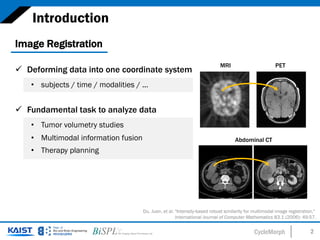
Image Registration
MRI
Abdominal CT
 Deforming data into one coordinate system
• subjects / time / modalities / ...
Du, Juan, et al. "Intensity-based robust similarity for multimodal image registration."
International Journal of Computer Mathematics 83.1 (2006): 49-57.
 Fundamental task to analyze data
• Tumor volumetry studies
• Multimodal information fusion
• Therapy planning
PET
CycleMorph 3
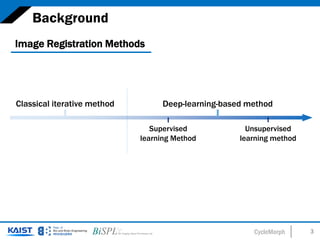
Background
Classical iterative method Deep-learning-based method
Supervised
learning Method
Unsupervised
learning method
Image Registration Methods
CycleMorph 4
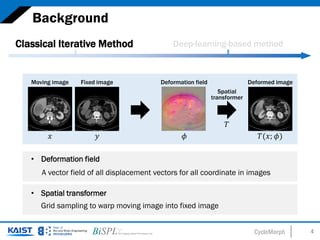
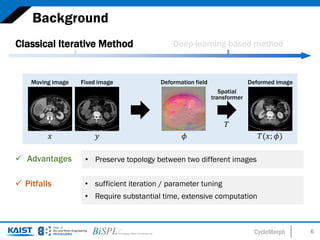
• Deformation field
A vector field of all displacement vectors for all coordinate in images
Background
Classical Iterative Method Deep-learning-based method
• Spatial transformer
Grid sampling to warp moving image into fixed image
𝑥𝑥 𝑦𝑦
Moving image Fixed image
𝜙𝜙
Deformation field
𝑇𝑇(𝑥𝑥; 𝜙𝜙)
Deformed image
𝑇𝑇
Spatial
transformer
CycleMorph 5
Background
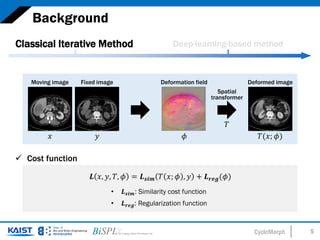
𝑳𝑳 𝑥𝑥, 𝑦𝑦, 𝑇𝑇, 𝜙𝜙 = 𝑳𝑳𝒔𝒔𝒔𝒔𝒔𝒔 𝑇𝑇 𝑥𝑥; 𝜙𝜙 , 𝑦𝑦 + 𝑳𝑳𝒓𝒓𝒓𝒓𝒓𝒓(𝜙𝜙)
Deep-learning-based method
𝑥𝑥 𝑦𝑦
Moving image Fixed image
𝜙𝜙
Deformation field
𝑇𝑇(𝑥𝑥; 𝜙𝜙)
Deformed image
𝑇𝑇
 Cost function
• 𝑳𝑳𝒔𝒔𝒔𝒔𝒔𝒔: Similarity cost function
• 𝑳𝑳𝒓𝒓𝒓𝒓𝒓𝒓: Regularization function
Classical Iterative Method
Spatial
transformer
CycleMorph 6
Background
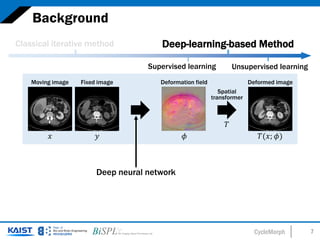
 Advantages
 Pitfalls
• Preserve topology between two different images
• sufficient iteration / parameter tuning
• Require substantial time, extensive computation
Deep-learning-based method
𝑥𝑥 𝑦𝑦
Moving image Fixed image
𝜙𝜙
Deformation field
𝑇𝑇(𝑥𝑥; 𝜙𝜙)
Deformed image
𝑇𝑇
Classical Iterative Method
Spatial
transformer
CycleMorph 7
Background
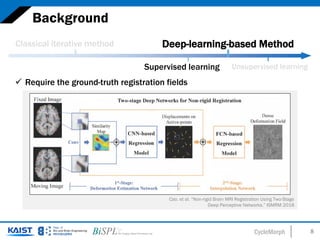
Classical iterative method Deep-learning-based Method
𝑥𝑥 𝑦𝑦
Moving image Fixed image
𝜙𝜙
Deformation field
𝑇𝑇(𝑥𝑥; 𝜙𝜙)
Deformed image
𝑇𝑇
Deep neural network
Supervised learning Unsupervised learning
Spatial
transformer
CycleMorph 8
Background
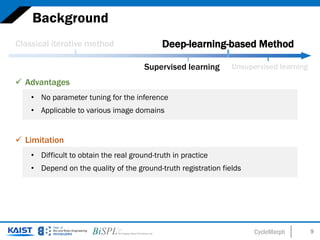
 Require the ground-truth registration fields
Cao. et al. “Non-rigid Brain MRI Registration Using Two-Stage
Deep Perceptive Networks.” ISMRM 2018
Supervised learning Unsupervised learning
Classical iterative method Deep-learning-based Method
CycleMorph 9
Background
 Limitation
• Difficult to obtain the real ground-truth in practice
• Depend on the quality of the ground-truth registration fields
 Advantages
• No parameter tuning for the inference
• Applicable to various image domains
Supervised learning Unsupervised learning
Classical iterative method Deep-learning-based Method
CycleMorph 10
Background
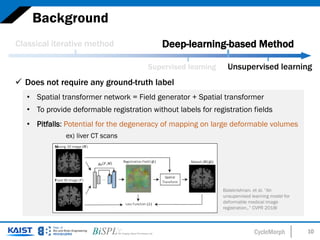
 Does not require any ground-truth label
Balakrishnan. et al. “An
unsupervised learning model for
deformable medical image
registration,.” CVPR 2018l
• Spatial transformer network = Field generator + Spatial transformer
• To provide deformable registration without labels for registration fields
• Pitfalls: Potential for the degeneracy of mapping on large deformable volumes
ex) liver CT scans
Supervised learning Unsupervised learning
Classical iterative method Deep-learning-based Method
CycleMorph 11
Proposed Method
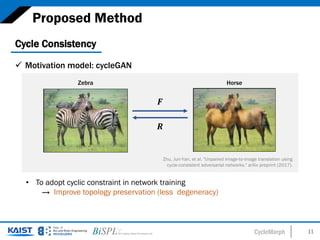
Cycle Consistency
Zhu, Jun-Yan, et al. "Unpaired image-to-image translation using
cycle-consistent adversarial networks." arXiv preprint (2017).
 Motivation model: cycleGAN
Horse
𝑭𝑭
𝑹𝑹
Zebra
• To adopt cyclic constraint in network training
→ Improve topology preservation (less degeneracy)
CycleMorph 12
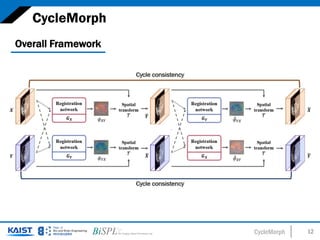
CycleMorph
Overall Framework
CycleMorph 13
CycleMorph
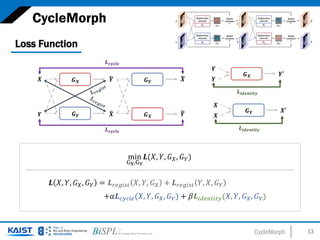
min
GX,GY
𝑳𝑳(𝑋𝑋, 𝑌𝑌, 𝐺𝐺𝑋𝑋, 𝐺𝐺𝑌𝑌)
𝑳𝑳 𝑋𝑋, 𝑌𝑌, 𝐺𝐺𝑋𝑋, 𝐺𝐺𝑌𝑌 = 𝑳𝑳𝑟𝑟𝑟𝑟𝑟𝑟𝑟𝑟𝑟𝑟𝑟𝑟 𝑋𝑋, 𝑌𝑌, 𝐺𝐺𝑋𝑋 + 𝑳𝑳𝑟𝑟𝑟𝑟𝑟𝑟𝑟𝑟𝑟𝑟𝑟𝑟 𝑌𝑌, 𝑋𝑋, 𝐺𝐺𝑌𝑌
+𝛼𝛼𝑳𝑳𝑐𝑐𝑐𝑐𝑐𝑐𝑐𝑐𝑐𝑐(𝑋𝑋, 𝑌𝑌, 𝐺𝐺𝑋𝑋, 𝐺𝐺𝑌𝑌) + 𝛽𝛽𝑳𝑳𝑖𝑖𝑖𝑖𝑖𝑖𝑖𝑖𝑖𝑖𝑖𝑖𝑖𝑖𝑖𝑖(𝑋𝑋, 𝑌𝑌, 𝐺𝐺𝑋𝑋, 𝐺𝐺𝑌𝑌)
Loss Function
CycleMorph 14
Loss Function
CycleMorph
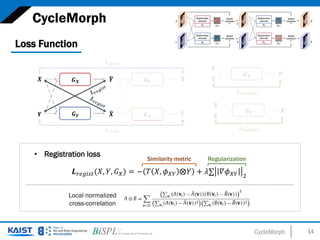
𝑳𝑳𝑟𝑟𝑟𝑟𝑟𝑟𝑟𝑟𝑟𝑟𝑟𝑟(𝑋𝑋, 𝑌𝑌, 𝐺𝐺𝑋𝑋) = − 𝑇𝑇 𝑋𝑋, 𝜙𝜙𝑋𝑋𝑋𝑋 ⨂𝑌𝑌 + 𝜆𝜆∑ 𝛻𝛻𝜙𝜙𝑋𝑋𝑋𝑋 2
• Registration loss
Similarity metric Regularization
Local normalized
cross-correlation
CycleMorph 15
CycleMorph
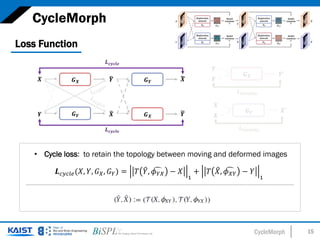
𝑳𝑳𝑐𝑐𝑐𝑐𝑐𝑐𝑐𝑐𝑐𝑐(𝑋𝑋, 𝑌𝑌, 𝐺𝐺𝑋𝑋, 𝐺𝐺𝑌𝑌) = 𝑇𝑇 �
𝑌𝑌, �
𝜙𝜙𝑌𝑌𝑌𝑌 − 𝑋𝑋
1
+ 𝑇𝑇 �
𝑋𝑋, �
𝜙𝜙𝑋𝑋𝑋𝑋 − 𝑌𝑌
1
Loss Function
• Cycle loss: to retain the topology between moving and deformed images
CycleMorph 16
CycleMorph
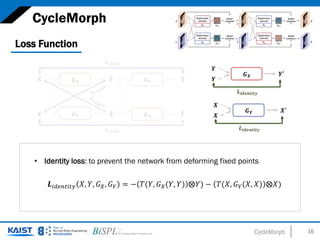
𝑳𝑳𝑖𝑖𝑖𝑖𝑖𝑖𝑖𝑖𝑖𝑖𝑖𝑖𝑖𝑖𝑖𝑖 𝑋𝑋, 𝑌𝑌, 𝐺𝐺𝑋𝑋, 𝐺𝐺𝑌𝑌 = − 𝑇𝑇(𝑌𝑌, 𝐺𝐺𝑋𝑋(𝑌𝑌, 𝑌𝑌) ⨂𝑌𝑌) − 𝑇𝑇(𝑋𝑋, 𝐺𝐺𝑌𝑌(𝑋𝑋, 𝑋𝑋) ⨂𝑋𝑋)
Loss Function
• Identity loss: to prevent the network from deforming fixed points
CycleMorph 17
CycleMorph
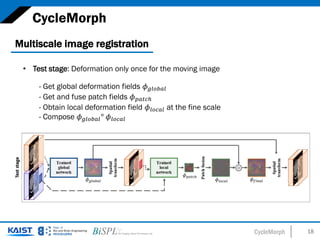
Multiscale image registration
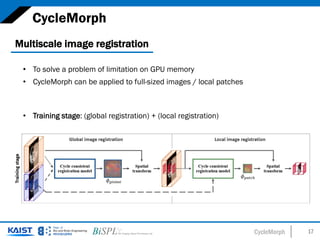
• To solve a problem of limitation on GPU memory
• CycleMorph can be applied to full-sized images / local patches
• Training stage: (global registration) + (local registration)
CycleMorph 18
CycleMorph
Multiscale image registration
• Test stage: Deformation only once for the moving image
- Get global deformation fields 𝜙𝜙𝑔𝑔𝑔𝑔𝑔𝑔𝑔𝑔𝑔𝑔𝑔𝑔
- Get and fuse patch fields 𝜙𝜙𝑝𝑝𝑝𝑝𝑝𝑝𝑝𝑝𝑝
- Obtain local deformation field 𝜙𝜙𝑙𝑙𝑙𝑙𝑙𝑙𝑙𝑙𝑙𝑙 at the fine scale
- Compose 𝜙𝜙𝑔𝑔𝑔𝑔𝑔𝑔𝑔𝑔𝑔𝑔𝑔𝑔° 𝜙𝜙𝑙𝑙𝑙𝑙𝑙𝑙𝑙𝑙𝑙𝑙
CycleMorph 19
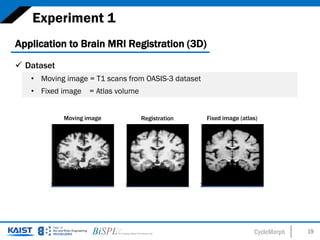
 Dataset
• Moving image = T1 scans from OASIS-3 dataset
• Fixed image = Atlas volume
Experiment 1
Application to Brain MRI Registration (3D)
Moving image Registration Fixed image (atlas)
CycleMorph 20
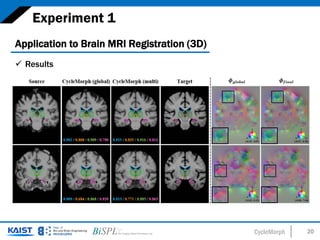
 Results
Experiment 1
Application to Brain MRI Registration (3D)
CycleMorph 21
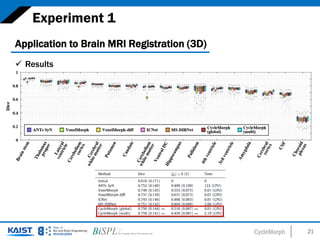
 Results
Experiment 1
Application to Brain MRI Registration (3D)
CycleMorph 22
Experiment 2
Application to Liver CT Registration (3D)
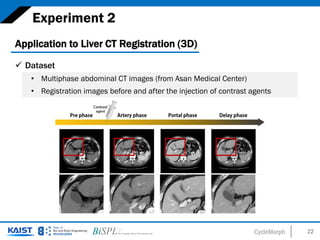
 Dataset
• Multiphase abdominal CT images (from Asan Medical Center)
• Registration images before and after the injection of contrast agents
CycleMorph 23
Experiment 2
Application to Liver CT Registration (3D)
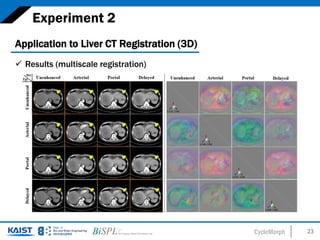
 Results (multiscale registration)
CycleMorph 24
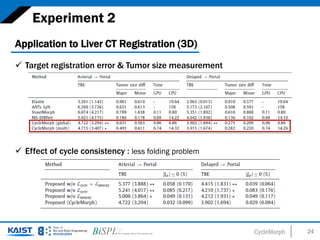
 Target registration error & Tumor size measurement
Experiment 2
Application to Liver CT Registration (3D)
 Effect of cycle consistency : less folding problem
CycleMorph 25
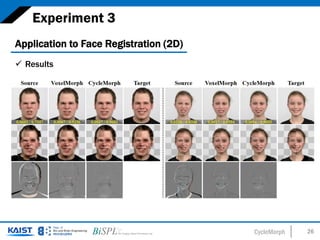
Experiment 3
Application to Face Registration (2D)
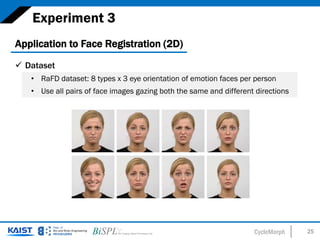
 Dataset
• RaFD dataset: 8 types x 3 eye orientation of emotion faces per person
• Use all pairs of face images gazing both the same and different directions
CycleMorph 26
Experiment 3
Application to Face Registration (2D)
 Results
CycleMorph 27
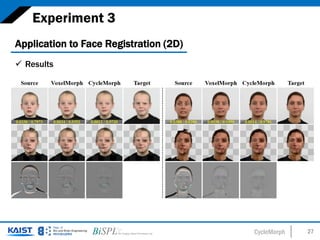
Experiment 3
Application to Face Registration (2D)
 Results
CycleMorph 28
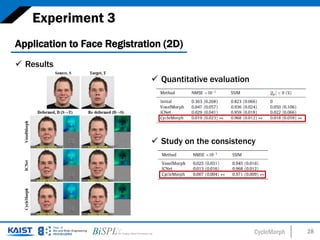
Experiment 3
Application to Face Registration (2D)
 Results
 Quantitative evaluation
 Study on the consistency
CycleMorph 29
Medical Image Analysis
Thank you.

CycleMorph: Cycle consistent unsupervised deformable image registration

  • 1.
    CycleMorph: Cycle consistentunsupervised deformable image registration Medical Image Analysis Boah Kim, Dong Hwan Kim, Seong Ho Park, Jieun Kim, June-Goo Lee, Jong Chul Ye
  • 2.
    CycleMorph 2 Introduction Image Registration MRI AbdominalCT  Deforming data into one coordinate system • subjects / time / modalities / ... Du, Juan, et al. "Intensity-based robust similarity for multimodal image registration." International Journal of Computer Mathematics 83.1 (2006): 49-57.  Fundamental task to analyze data • Tumor volumetry studies • Multimodal information fusion • Therapy planning PET
  • 3.
    CycleMorph 3 Background Classical iterativemethod Deep-learning-based method Supervised learning Method Unsupervised learning method Image Registration Methods
  • 4.
    CycleMorph 4 • Deformationfield A vector field of all displacement vectors for all coordinate in images Background Classical Iterative Method Deep-learning-based method • Spatial transformer Grid sampling to warp moving image into fixed image 𝑥𝑥 𝑦𝑦 Moving image Fixed image 𝜙𝜙 Deformation field 𝑇𝑇(𝑥𝑥; 𝜙𝜙) Deformed image 𝑇𝑇 Spatial transformer
  • 5.
    CycleMorph 5 Background 𝑳𝑳 𝑥𝑥,𝑦𝑦, 𝑇𝑇, 𝜙𝜙 = 𝑳𝑳𝒔𝒔𝒔𝒔𝒔𝒔 𝑇𝑇 𝑥𝑥; 𝜙𝜙 , 𝑦𝑦 + 𝑳𝑳𝒓𝒓𝒓𝒓𝒓𝒓(𝜙𝜙) Deep-learning-based method 𝑥𝑥 𝑦𝑦 Moving image Fixed image 𝜙𝜙 Deformation field 𝑇𝑇(𝑥𝑥; 𝜙𝜙) Deformed image 𝑇𝑇  Cost function • 𝑳𝑳𝒔𝒔𝒔𝒔𝒔𝒔: Similarity cost function • 𝑳𝑳𝒓𝒓𝒓𝒓𝒓𝒓: Regularization function Classical Iterative Method Spatial transformer
  • 6.
    CycleMorph 6 Background  Advantages Pitfalls • Preserve topology between two different images • sufficient iteration / parameter tuning • Require substantial time, extensive computation Deep-learning-based method 𝑥𝑥 𝑦𝑦 Moving image Fixed image 𝜙𝜙 Deformation field 𝑇𝑇(𝑥𝑥; 𝜙𝜙) Deformed image 𝑇𝑇 Classical Iterative Method Spatial transformer
  • 7.
    CycleMorph 7 Background Classical iterativemethod Deep-learning-based Method 𝑥𝑥 𝑦𝑦 Moving image Fixed image 𝜙𝜙 Deformation field 𝑇𝑇(𝑥𝑥; 𝜙𝜙) Deformed image 𝑇𝑇 Deep neural network Supervised learning Unsupervised learning Spatial transformer
  • 8.
    CycleMorph 8 Background  Requirethe ground-truth registration fields Cao. et al. “Non-rigid Brain MRI Registration Using Two-Stage Deep Perceptive Networks.” ISMRM 2018 Supervised learning Unsupervised learning Classical iterative method Deep-learning-based Method
  • 9.
    CycleMorph 9 Background  Limitation •Difficult to obtain the real ground-truth in practice • Depend on the quality of the ground-truth registration fields  Advantages • No parameter tuning for the inference • Applicable to various image domains Supervised learning Unsupervised learning Classical iterative method Deep-learning-based Method
  • 10.
    CycleMorph 10 Background  Doesnot require any ground-truth label Balakrishnan. et al. “An unsupervised learning model for deformable medical image registration,.” CVPR 2018l • Spatial transformer network = Field generator + Spatial transformer • To provide deformable registration without labels for registration fields • Pitfalls: Potential for the degeneracy of mapping on large deformable volumes ex) liver CT scans Supervised learning Unsupervised learning Classical iterative method Deep-learning-based Method
  • 11.
    CycleMorph 11 Proposed Method CycleConsistency Zhu, Jun-Yan, et al. "Unpaired image-to-image translation using cycle-consistent adversarial networks." arXiv preprint (2017).  Motivation model: cycleGAN Horse 𝑭𝑭 𝑹𝑹 Zebra • To adopt cyclic constraint in network training → Improve topology preservation (less degeneracy)
  • 12.
  • 13.
    CycleMorph 13 CycleMorph min GX,GY 𝑳𝑳(𝑋𝑋, 𝑌𝑌,𝐺𝐺𝑋𝑋, 𝐺𝐺𝑌𝑌) 𝑳𝑳 𝑋𝑋, 𝑌𝑌, 𝐺𝐺𝑋𝑋, 𝐺𝐺𝑌𝑌 = 𝑳𝑳𝑟𝑟𝑟𝑟𝑟𝑟𝑟𝑟𝑟𝑟𝑟𝑟 𝑋𝑋, 𝑌𝑌, 𝐺𝐺𝑋𝑋 + 𝑳𝑳𝑟𝑟𝑟𝑟𝑟𝑟𝑟𝑟𝑟𝑟𝑟𝑟 𝑌𝑌, 𝑋𝑋, 𝐺𝐺𝑌𝑌 +𝛼𝛼𝑳𝑳𝑐𝑐𝑐𝑐𝑐𝑐𝑐𝑐𝑐𝑐(𝑋𝑋, 𝑌𝑌, 𝐺𝐺𝑋𝑋, 𝐺𝐺𝑌𝑌) + 𝛽𝛽𝑳𝑳𝑖𝑖𝑖𝑖𝑖𝑖𝑖𝑖𝑖𝑖𝑖𝑖𝑖𝑖𝑖𝑖(𝑋𝑋, 𝑌𝑌, 𝐺𝐺𝑋𝑋, 𝐺𝐺𝑌𝑌) Loss Function
  • 14.
    CycleMorph 14 Loss Function CycleMorph 𝑳𝑳𝑟𝑟𝑟𝑟𝑟𝑟𝑟𝑟𝑟𝑟𝑟𝑟(𝑋𝑋,𝑌𝑌, 𝐺𝐺𝑋𝑋) = − 𝑇𝑇 𝑋𝑋, 𝜙𝜙𝑋𝑋𝑋𝑋 ⨂𝑌𝑌 + 𝜆𝜆∑ 𝛻𝛻𝜙𝜙𝑋𝑋𝑋𝑋 2 • Registration loss Similarity metric Regularization Local normalized cross-correlation
  • 15.
    CycleMorph 15 CycleMorph 𝑳𝑳𝑐𝑐𝑐𝑐𝑐𝑐𝑐𝑐𝑐𝑐(𝑋𝑋, 𝑌𝑌,𝐺𝐺𝑋𝑋, 𝐺𝐺𝑌𝑌) = 𝑇𝑇 � 𝑌𝑌, � 𝜙𝜙𝑌𝑌𝑌𝑌 − 𝑋𝑋 1 + 𝑇𝑇 � 𝑋𝑋, � 𝜙𝜙𝑋𝑋𝑋𝑋 − 𝑌𝑌 1 Loss Function • Cycle loss: to retain the topology between moving and deformed images
  • 16.
    CycleMorph 16 CycleMorph 𝑳𝑳𝑖𝑖𝑖𝑖𝑖𝑖𝑖𝑖𝑖𝑖𝑖𝑖𝑖𝑖𝑖𝑖 𝑋𝑋,𝑌𝑌, 𝐺𝐺𝑋𝑋, 𝐺𝐺𝑌𝑌 = − 𝑇𝑇(𝑌𝑌, 𝐺𝐺𝑋𝑋(𝑌𝑌, 𝑌𝑌) ⨂𝑌𝑌) − 𝑇𝑇(𝑋𝑋, 𝐺𝐺𝑌𝑌(𝑋𝑋, 𝑋𝑋) ⨂𝑋𝑋) Loss Function • Identity loss: to prevent the network from deforming fixed points
  • 17.
    CycleMorph 17 CycleMorph Multiscale imageregistration • To solve a problem of limitation on GPU memory • CycleMorph can be applied to full-sized images / local patches • Training stage: (global registration) + (local registration)
  • 18.
    CycleMorph 18 CycleMorph Multiscale imageregistration • Test stage: Deformation only once for the moving image - Get global deformation fields 𝜙𝜙𝑔𝑔𝑔𝑔𝑔𝑔𝑔𝑔𝑔𝑔𝑔𝑔 - Get and fuse patch fields 𝜙𝜙𝑝𝑝𝑝𝑝𝑝𝑝𝑝𝑝𝑝 - Obtain local deformation field 𝜙𝜙𝑙𝑙𝑙𝑙𝑙𝑙𝑙𝑙𝑙𝑙 at the fine scale - Compose 𝜙𝜙𝑔𝑔𝑔𝑔𝑔𝑔𝑔𝑔𝑔𝑔𝑔𝑔° 𝜙𝜙𝑙𝑙𝑙𝑙𝑙𝑙𝑙𝑙𝑙𝑙
  • 19.
    CycleMorph 19  Dataset •Moving image = T1 scans from OASIS-3 dataset • Fixed image = Atlas volume Experiment 1 Application to Brain MRI Registration (3D) Moving image Registration Fixed image (atlas)
  • 20.
    CycleMorph 20  Results Experiment1 Application to Brain MRI Registration (3D)
  • 21.
    CycleMorph 21  Results Experiment1 Application to Brain MRI Registration (3D)
  • 22.
    CycleMorph 22 Experiment 2 Applicationto Liver CT Registration (3D)  Dataset • Multiphase abdominal CT images (from Asan Medical Center) • Registration images before and after the injection of contrast agents
  • 23.
    CycleMorph 23 Experiment 2 Applicationto Liver CT Registration (3D)  Results (multiscale registration)
  • 24.
    CycleMorph 24  Targetregistration error & Tumor size measurement Experiment 2 Application to Liver CT Registration (3D)  Effect of cycle consistency : less folding problem
  • 25.
    CycleMorph 25 Experiment 3 Applicationto Face Registration (2D)  Dataset • RaFD dataset: 8 types x 3 eye orientation of emotion faces per person • Use all pairs of face images gazing both the same and different directions
  • 26.
    CycleMorph 26 Experiment 3 Applicationto Face Registration (2D)  Results
  • 27.
    CycleMorph 27 Experiment 3 Applicationto Face Registration (2D)  Results
  • 28.
    CycleMorph 28 Experiment 3 Applicationto Face Registration (2D)  Results  Quantitative evaluation  Study on the consistency
  • 29.
    CycleMorph 29 Medical ImageAnalysis Thank you.