CYBORG
ABHIJITH KRISHNA GL
U11CW001
TECHNICAL SEMINAR II
WHAT IS A CYBORG ?
 A CYBORG IS A CYBERNATIC ORGANISM
 THE TERM CYBORG IS DEFINED AS AN ORGANISM
THAT IS A SELF REGULATING INTEGRATION OF
ARTIFICIAL AND NATURAL SYSTEMS.
 A HUMAN CYBORG IS A HUMAN WHO HAS CERTAIN
PHYSIOGICAL PROCESSES AIDED OR CONTROLLED BY
MECHANICAL OR ELECTRONIC DEVICES.
ANALOGY WITH HUMAN NERVOUS
SYSTEM
The human nervous system contains:
1. A Central Nervous System (CNS) - where information is
processed. Our central nervous system consists of the brain
and the spinal cord.
2. A Peripheral Nervous System (PNS) - a highway which allows
signals to travel between the cns and the body's receptors
and effectors
Since the nerve conduction is in the form of electrical
signals, this opens up a possibility of intercepting, interpreting
and processing them with the help of machine interfaces.
Neural impulses at the nerve endings, transmitting them to a
database, correlating them to existing data and modulating it to
a desired effect.
History of cyborg
 In 1960 Manfred Clynes and Nathan Kline coined
the term Cyborg.
In 1967, Dr Steve Mann made eyetap glasses.
 This glass not only helped for a clear vision but
also one of its function is a wearable face recognizer
to help people with Alzheimer's recognize and
remember and see things, or people with visual
memory disability find their way around .
Goal of this project is to help people see better and
remember things better.
Types of cyborg
 INDIVIDUAL CYBORG :
i. Cyborgs is used to refer to a man or woman
with bionic or robotic implants
ii.Today,the C-LEG system is used to replace
human legs that are amputated because of injuries
or illness
 SOCIAL CYBORG:
i. More broadly, the full term “CYBernetic
ORGanism” is used to describe larger networks of
communication and control
ii. A corporation can be considered as an
artificial intelligence that makes uses of replaceable
human components to function
Kevin warwick
 Kevin Warwick is Professor of Cybernetics at the
University of Reading
 The world's leading expert in cybernetics,
Mainly interested in connecting human brain with
machine brain.
 He is the world’s first human cyborg, he implanted
microchips under his arms so that he could easily
communicate with computers and electronic devices at his
laboratory.
 He and his team of scientists have created robot with a
rat brain, implanting microchips, bionic devices etc.
PROJECT CYBORG 1.0
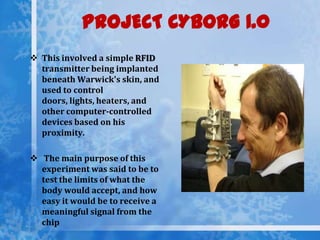
 This involved a simple RFID
transmitter being implanted
beneath Warwick's skin, and
used to control
doors, lights, heaters, and
other computer-controlled
devices based on his
proximity.
 The main purpose of this
experiment was said to be to
test the limits of what the
body would accept, and how
easy it would be to receive a
meaningful signal from the
chip
HOW CAN IT BE USEFUL ?
It gives you a unique code.
It is quite possible for an implant to replace an
access, visa or bankers card
An implant could carry huge amounts of data on
an individual, such as national insurance number
and blood type, bank account information etc.
Used to clock in and out of office automatically.
Project cyborg 2.0
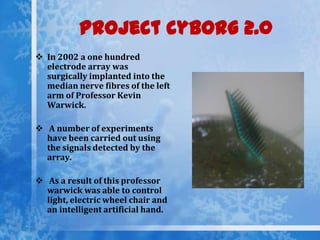
 In 2002 a one hundred
electrode array was
surgically implanted into the
median nerve fibres of the left
arm of Professor Kevin
Warwick.
 A number of experiments
have been carried out using
the signals detected by the
array.
 As a result of this professor
warwick was able to control
light, electric wheel chair and
an intelligent artificial hand.
RESULT OF CYBORG 2.0
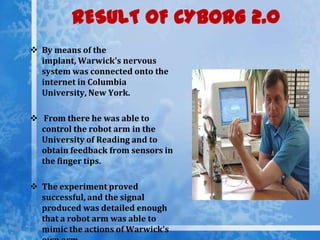
 By means of the
implant, Warwick's nervous
system was connected onto the
internet in Columbia
University, New York.
 From there he was able to
control the robot arm in the
University of Reading and to
obtain feedback from sensors in
the finger tips.
 The experiment proved
successful, and the signal
produced was detailed enough
that a robot arm was able to
mimic the actions of Warwick's
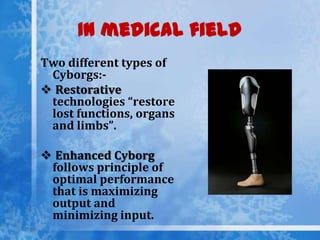
In medical field
Two different types of
Cyborgs:-
 Restorative
technologies “restore
lost functions, organs
and limbs”.
 Enhanced Cyborg
follows principle of
optimal performance
that is maximizing
output and
minimizing input.
IN THE MILITARY
 The “cyborg soldier” often
refers to soldier whose
weapon and survival
systems are integrated into
the self, creating a human-
machine interface.
 Military organizations
research has recently
focused on the utilization of
cyborg animals for inter-
species relationships for the
purposes of a supposed a
tactical advantage.
CYBORG INSESTS
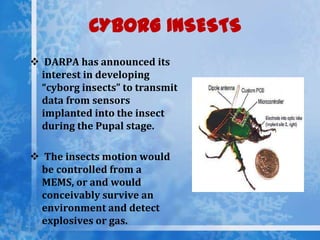
 DARPA has announced its
interest in developing
“cyborg insects” to transmit
data from sensors
implanted into the insect
during the Pupal stage.
 The insects motion would
be controlled from a
MEMS, or and would
conceivably survive an
environment and detect
explosives or gas.
advantages
 Giving artificial sight to blind people.
 Would be implemented in almost all
fields where human interaction is needed.
 Diseases could be analyzed and cured in
terms of neural impulse signals.
 To establish intercommunication
between two or more peoples without
using speech.
disadvantages
Training is needed for doctors
Implants are expensive
Psychological problems
Feeling different to everyone else
The risk of infection
conclusion
The use of such technology will upgrade human
turning them into Cyborgs, presents a much more
difficult problem.
Who gets an implant and who doesn’t? Who
controls their use? Indeed should humans be allowed
to upgrade their capabilities and ‘super humans’?
Humans now have the potential to control another
aspect of their own destiny. It will be interesting to
see how quickly and easily this will be brought about.
Cyborgs

Cyborgs

  • 1.
  • 2.
    WHAT IS ACYBORG ?  A CYBORG IS A CYBERNATIC ORGANISM  THE TERM CYBORG IS DEFINED AS AN ORGANISM THAT IS A SELF REGULATING INTEGRATION OF ARTIFICIAL AND NATURAL SYSTEMS.  A HUMAN CYBORG IS A HUMAN WHO HAS CERTAIN PHYSIOGICAL PROCESSES AIDED OR CONTROLLED BY MECHANICAL OR ELECTRONIC DEVICES.
  • 3.
    ANALOGY WITH HUMANNERVOUS SYSTEM The human nervous system contains: 1. A Central Nervous System (CNS) - where information is processed. Our central nervous system consists of the brain and the spinal cord. 2. A Peripheral Nervous System (PNS) - a highway which allows signals to travel between the cns and the body's receptors and effectors Since the nerve conduction is in the form of electrical signals, this opens up a possibility of intercepting, interpreting and processing them with the help of machine interfaces. Neural impulses at the nerve endings, transmitting them to a database, correlating them to existing data and modulating it to a desired effect.
  • 4.
    History of cyborg In 1960 Manfred Clynes and Nathan Kline coined the term Cyborg. In 1967, Dr Steve Mann made eyetap glasses.  This glass not only helped for a clear vision but also one of its function is a wearable face recognizer to help people with Alzheimer's recognize and remember and see things, or people with visual memory disability find their way around . Goal of this project is to help people see better and remember things better.
  • 5.
    Types of cyborg INDIVIDUAL CYBORG : i. Cyborgs is used to refer to a man or woman with bionic or robotic implants ii.Today,the C-LEG system is used to replace human legs that are amputated because of injuries or illness  SOCIAL CYBORG: i. More broadly, the full term “CYBernetic ORGanism” is used to describe larger networks of communication and control ii. A corporation can be considered as an artificial intelligence that makes uses of replaceable human components to function
  • 6.
    Kevin warwick  KevinWarwick is Professor of Cybernetics at the University of Reading  The world's leading expert in cybernetics, Mainly interested in connecting human brain with machine brain.  He is the world’s first human cyborg, he implanted microchips under his arms so that he could easily communicate with computers and electronic devices at his laboratory.  He and his team of scientists have created robot with a rat brain, implanting microchips, bionic devices etc.
  • 7.
    PROJECT CYBORG 1.0 This involved a simple RFID transmitter being implanted beneath Warwick's skin, and used to control doors, lights, heaters, and other computer-controlled devices based on his proximity.  The main purpose of this experiment was said to be to test the limits of what the body would accept, and how easy it would be to receive a meaningful signal from the chip
  • 8.
    HOW CAN ITBE USEFUL ? It gives you a unique code. It is quite possible for an implant to replace an access, visa or bankers card An implant could carry huge amounts of data on an individual, such as national insurance number and blood type, bank account information etc. Used to clock in and out of office automatically.
  • 9.
    Project cyborg 2.0 In 2002 a one hundred electrode array was surgically implanted into the median nerve fibres of the left arm of Professor Kevin Warwick.  A number of experiments have been carried out using the signals detected by the array.  As a result of this professor warwick was able to control light, electric wheel chair and an intelligent artificial hand.
  • 10.
    RESULT OF CYBORG2.0  By means of the implant, Warwick's nervous system was connected onto the internet in Columbia University, New York.  From there he was able to control the robot arm in the University of Reading and to obtain feedback from sensors in the finger tips.  The experiment proved successful, and the signal produced was detailed enough that a robot arm was able to mimic the actions of Warwick's
  • 11.
    In medical field Twodifferent types of Cyborgs:-  Restorative technologies “restore lost functions, organs and limbs”.  Enhanced Cyborg follows principle of optimal performance that is maximizing output and minimizing input.
  • 12.
    IN THE MILITARY The “cyborg soldier” often refers to soldier whose weapon and survival systems are integrated into the self, creating a human- machine interface.  Military organizations research has recently focused on the utilization of cyborg animals for inter- species relationships for the purposes of a supposed a tactical advantage.
  • 13.
    CYBORG INSESTS  DARPAhas announced its interest in developing “cyborg insects” to transmit data from sensors implanted into the insect during the Pupal stage.  The insects motion would be controlled from a MEMS, or and would conceivably survive an environment and detect explosives or gas.
  • 15.
    advantages  Giving artificialsight to blind people.  Would be implemented in almost all fields where human interaction is needed.  Diseases could be analyzed and cured in terms of neural impulse signals.  To establish intercommunication between two or more peoples without using speech.
  • 16.
    disadvantages Training is neededfor doctors Implants are expensive Psychological problems Feeling different to everyone else The risk of infection
  • 17.
    conclusion The use ofsuch technology will upgrade human turning them into Cyborgs, presents a much more difficult problem. Who gets an implant and who doesn’t? Who controls their use? Indeed should humans be allowed to upgrade their capabilities and ‘super humans’? Humans now have the potential to control another aspect of their own destiny. It will be interesting to see how quickly and easily this will be brought about.