Cyborgs: the
Body, Information an
Technology
(Murphy, A., & Potts J.,
Culture and Technology
Michelle Thomas
Edgar Allen
Poe 1843
“a person whose physiological functioning is aided by or dependent up
a mechanical or electronic device”
“For the exogenously extended organizational complex
functioning as an integrated homeostatic system,
unconsciously we propose the term „Cyborg‟
•Cyborg – Indefinable?
”a fictional or hypothetical person whose physical abilities are
extended beyond normal human limitations by mechanical elements
built into the body.”
A cyborg essentially a man-made system in which the control
mechanisms of the human portion are modified externally by
drugs or regulatory devices so that the being can live in an
environment different from the normal one]
The concept of a man-machine mixture was widespread in
science fiction before World War II. As early as 1843 Edgar Allan
Described a man with extensive prostheses in the short story
The Man That Was Used Up".
Oxford
Definition
Other dictionary
definitions
Clynes and
Klyne 1960
New York
Times 1960
FACT: „Cyborg is a
merging of the words
cyber and organism or
merging of organic and
cybernetic
FACT: Term appeared
due to HCI or Human
Computer Interaction
Cyborgs: A global debate
• The definition of cyborg is debated in many
fields: medicine, art, technology, religion
but more prevalent are the conversations
over context and implications.
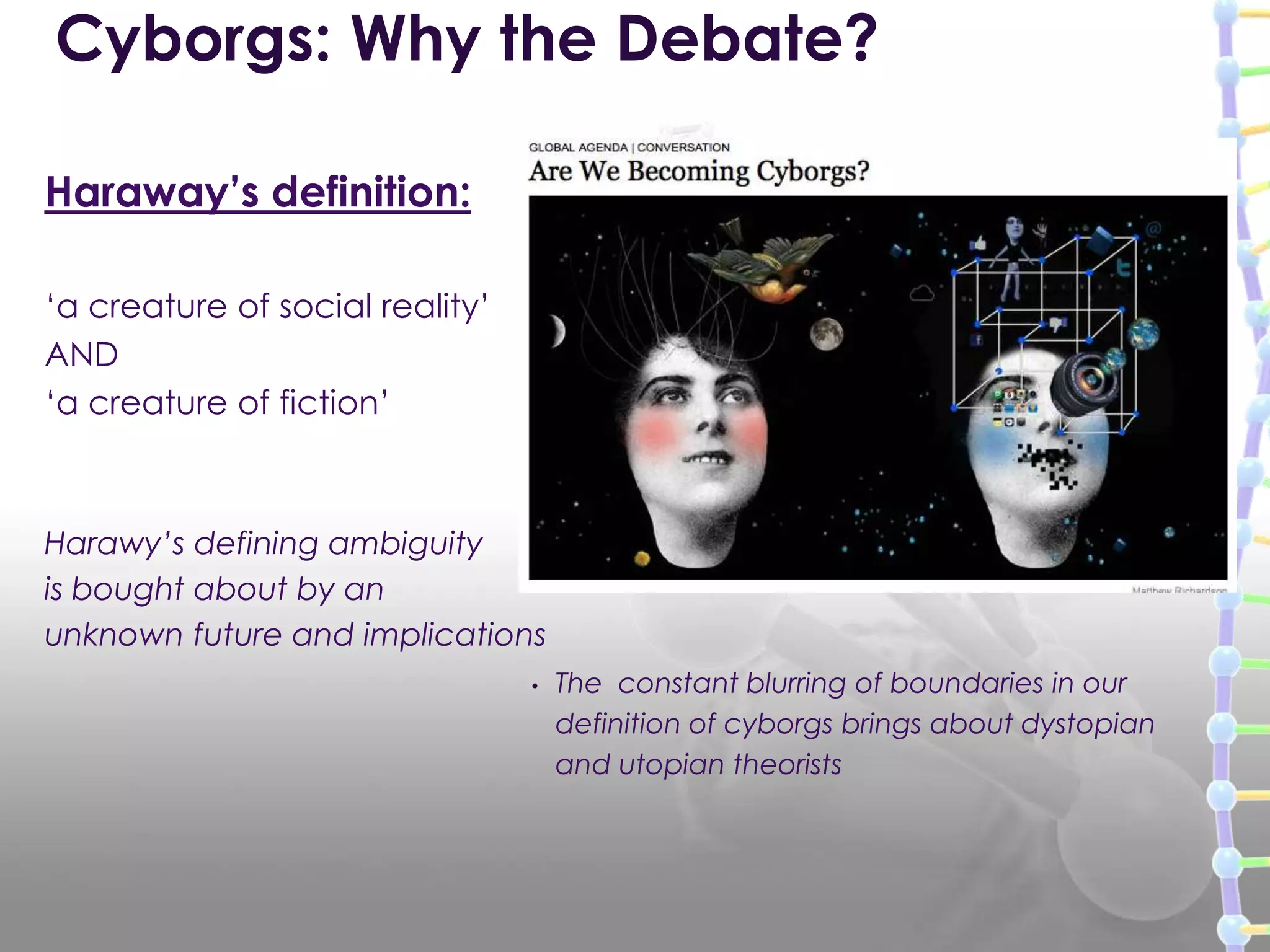
Haraway’s definition:
„a creature of social reality‟
AND
„a creature of fiction‟
Harawy‟s defining ambiguity
is bought about by an
unknown future and implications
Cyborgs: Why the Debate?
• The constant blurring of boundaries in our
definition of cyborgs brings about dystopian
and utopian theorists
•Question 1:
• Why can we not agree about what a cyborg is?
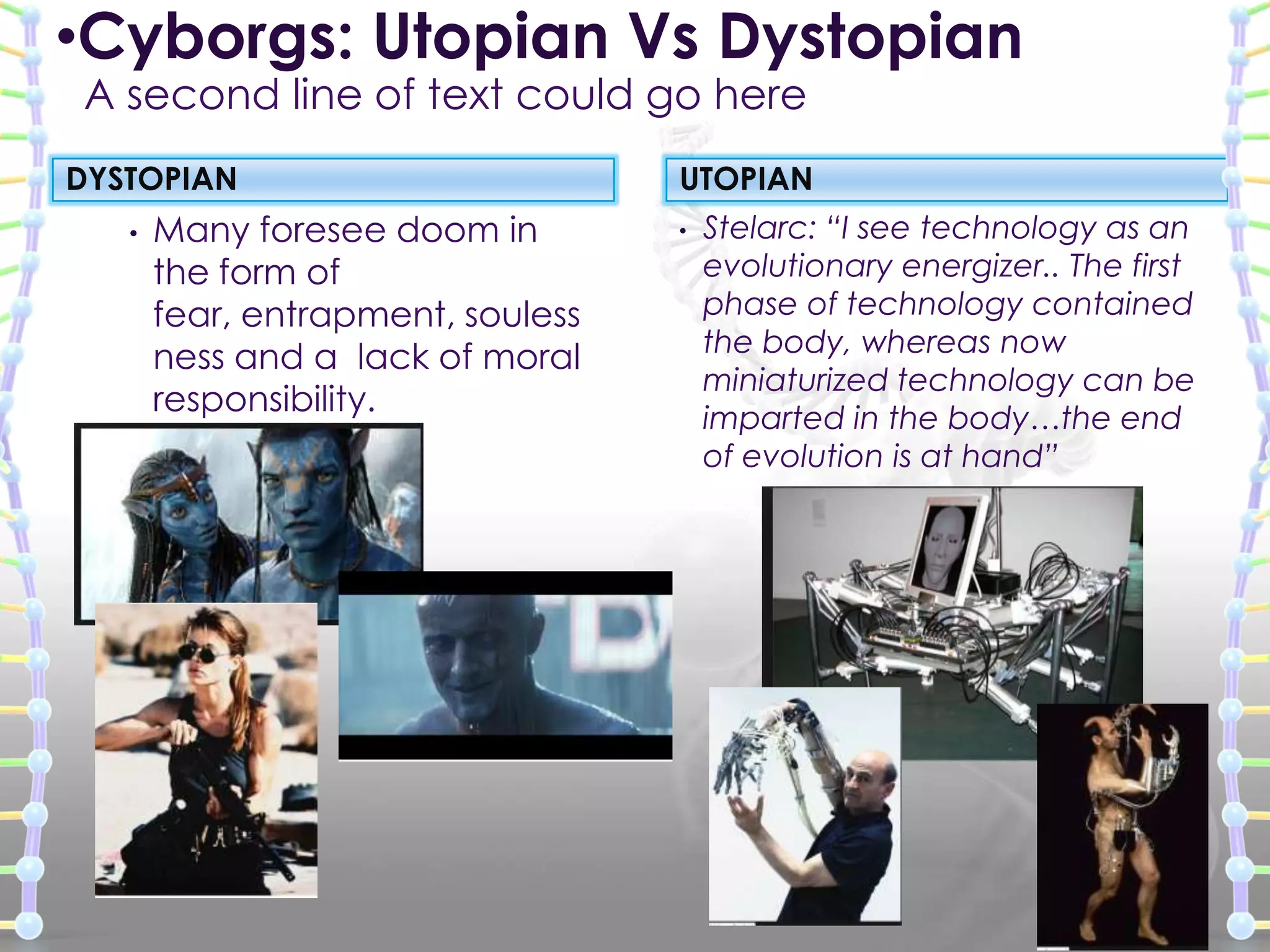
DYSTOPIAN
• Many foresee doom in
the form of
fear, entrapment, souless
ness and a lack of moral
responsibility.
• Stelarc: “I see technology as an
evolutionary energizer.. The first
phase of technology contained
the body, whereas now
miniaturized technology can be
imparted in the body…the end
of evolution is at hand”
UTOPIAN
•Cyborgs: Utopian Vs Dystopian
A second line of text could go here
• “Our best machines are made of sunshine, they
are all light and clean because they are all light
and clean because they are nothing but
signals, electromagnetic waves, a section of the
spectrum and these machines are eminently
portable, mobile.. the ubiquity and invisibility of
cyborgs as precisely why these sunshine-belt
machines are so deadly. They are as hard to see
politically as materially (1991b_153 – Haraway)
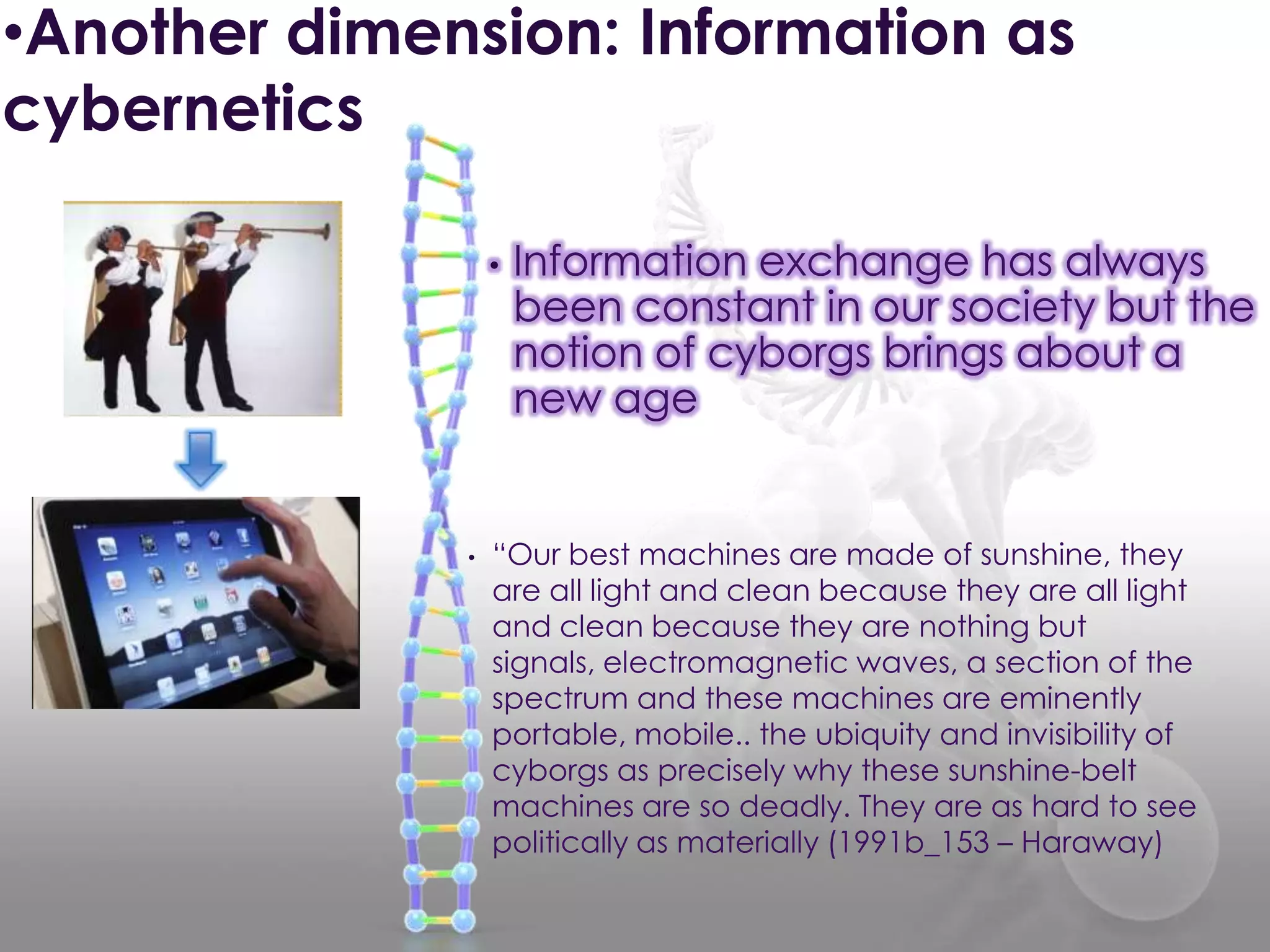
• Information exchange has always
been constant in our society but the
notion of cyborgs brings about a
new age
•Another dimension: Information as
cybernetics
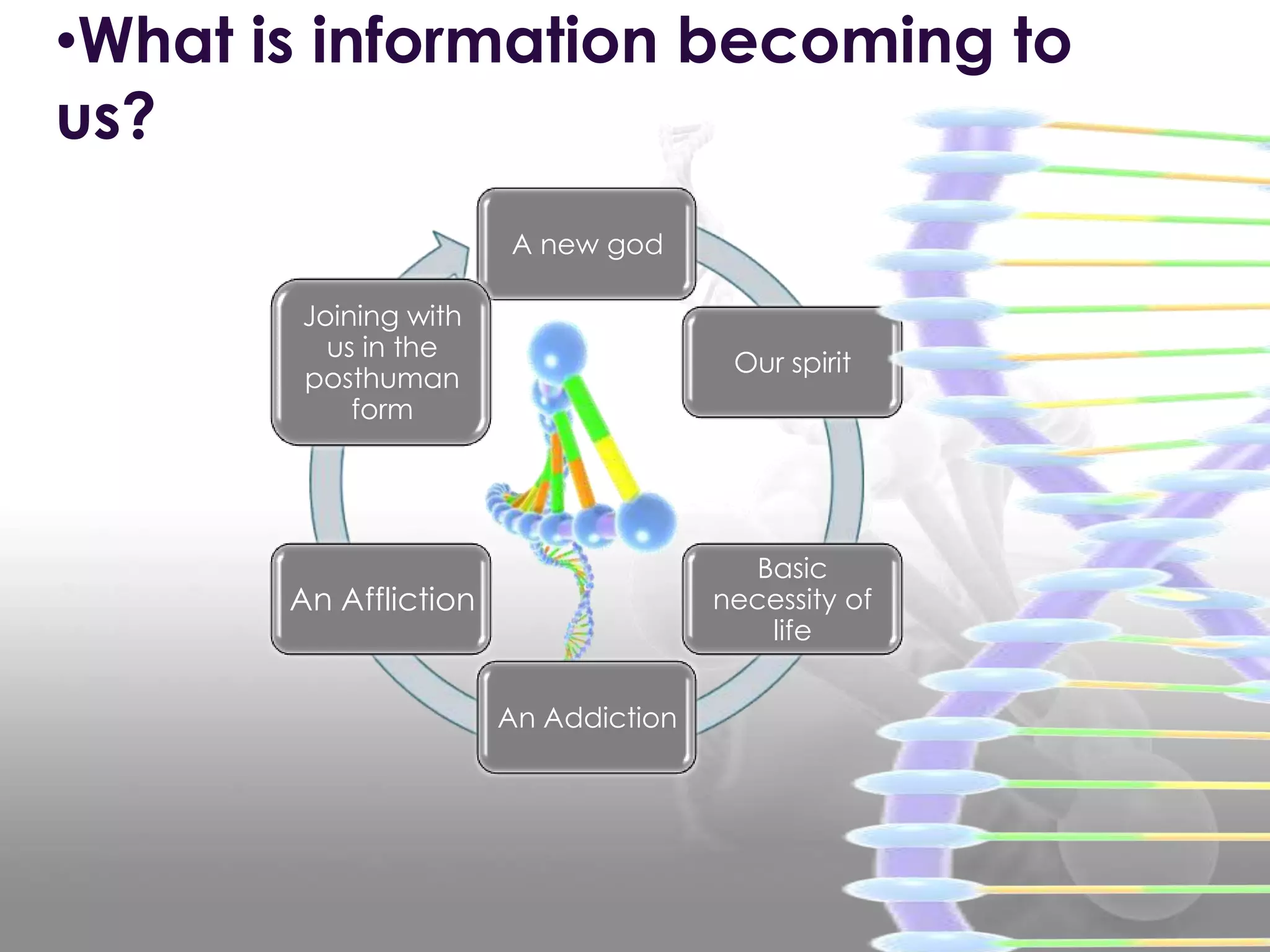
A new god
Our spirit
Basic
necessity of
life
An Addiction
An Affliction
Joining with
us in the
posthuman
form
•What is information becoming to
us?
• “when computers were virtually real
machines, women wrote the software on which they
ran. And when computer was a term applied to flesh
and blood workers, the bodies which composed
them were female.” (Sadie Plant, 1997)
•The Age of Posthuman
• There will be no autonomous individuals as such.
Leaving gender an uncertain future.(Katherine
Hayles)
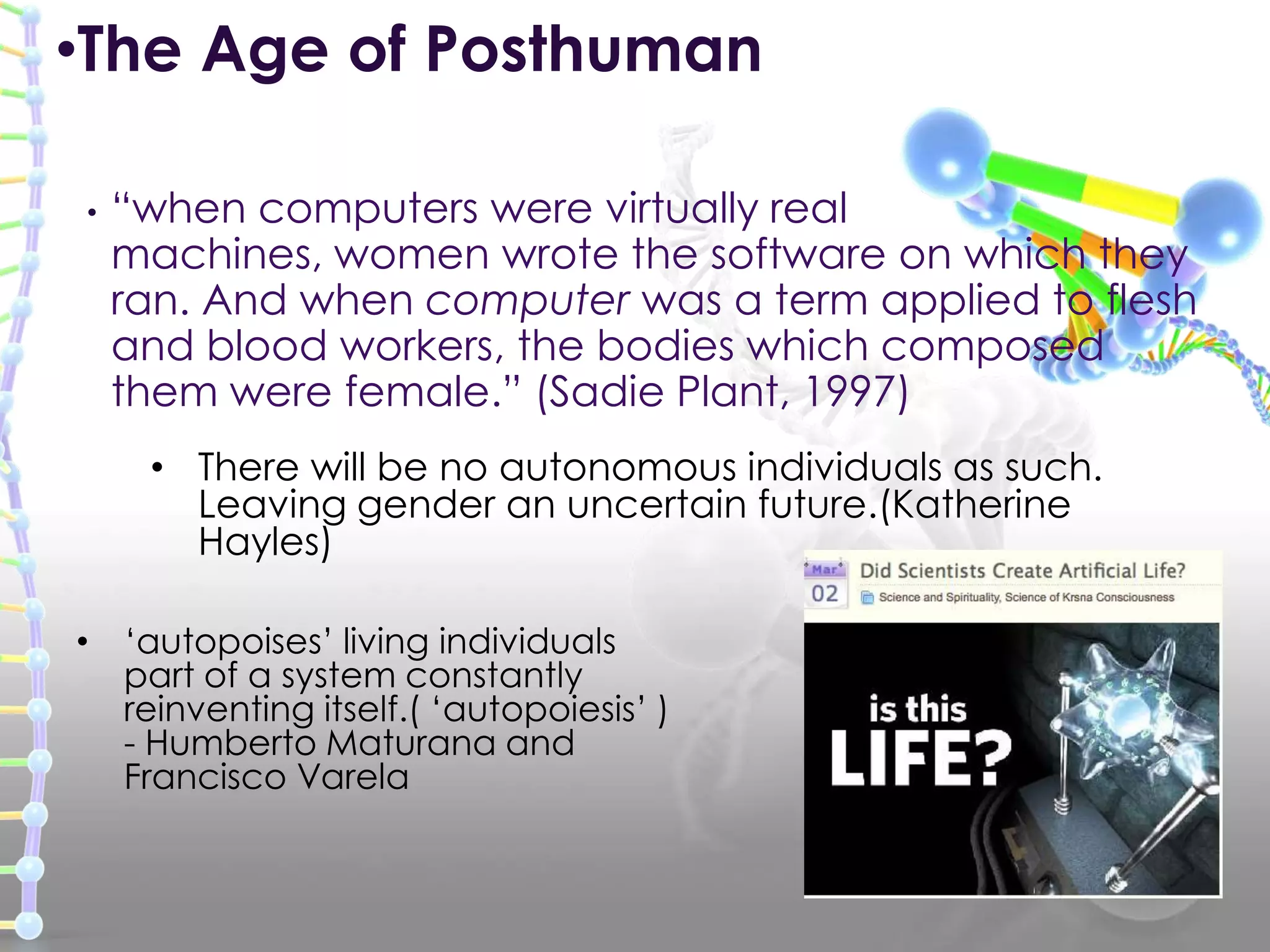
• „autopoises‟ living individuals
part of a system constantly
reinventing itself.( „autopoiesis‟ )
- Humberto Maturana and
Francisco Varela
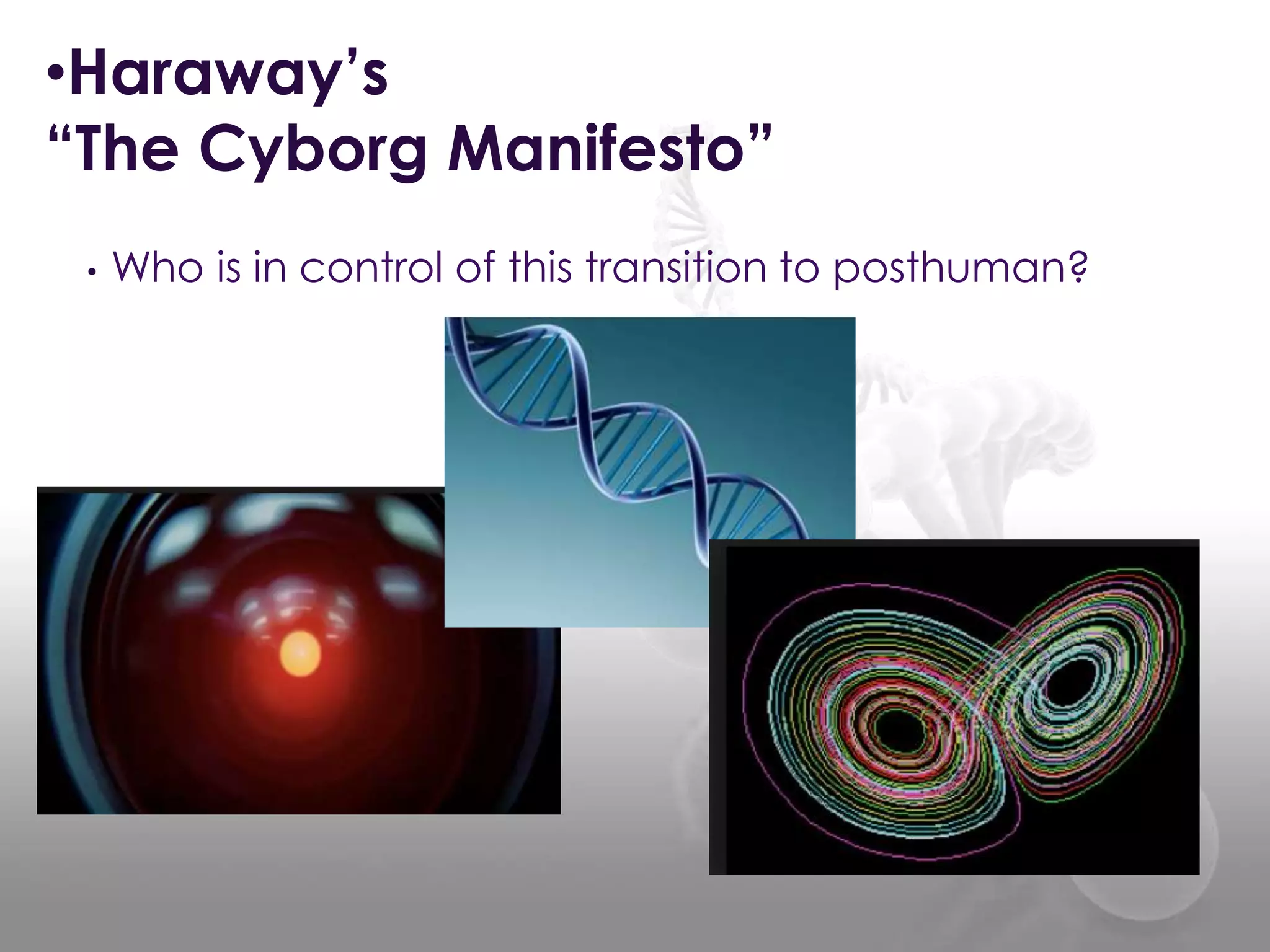
• Who is in control of this transition to posthuman?
•Haraway’s
“The Cyborg Manifesto”
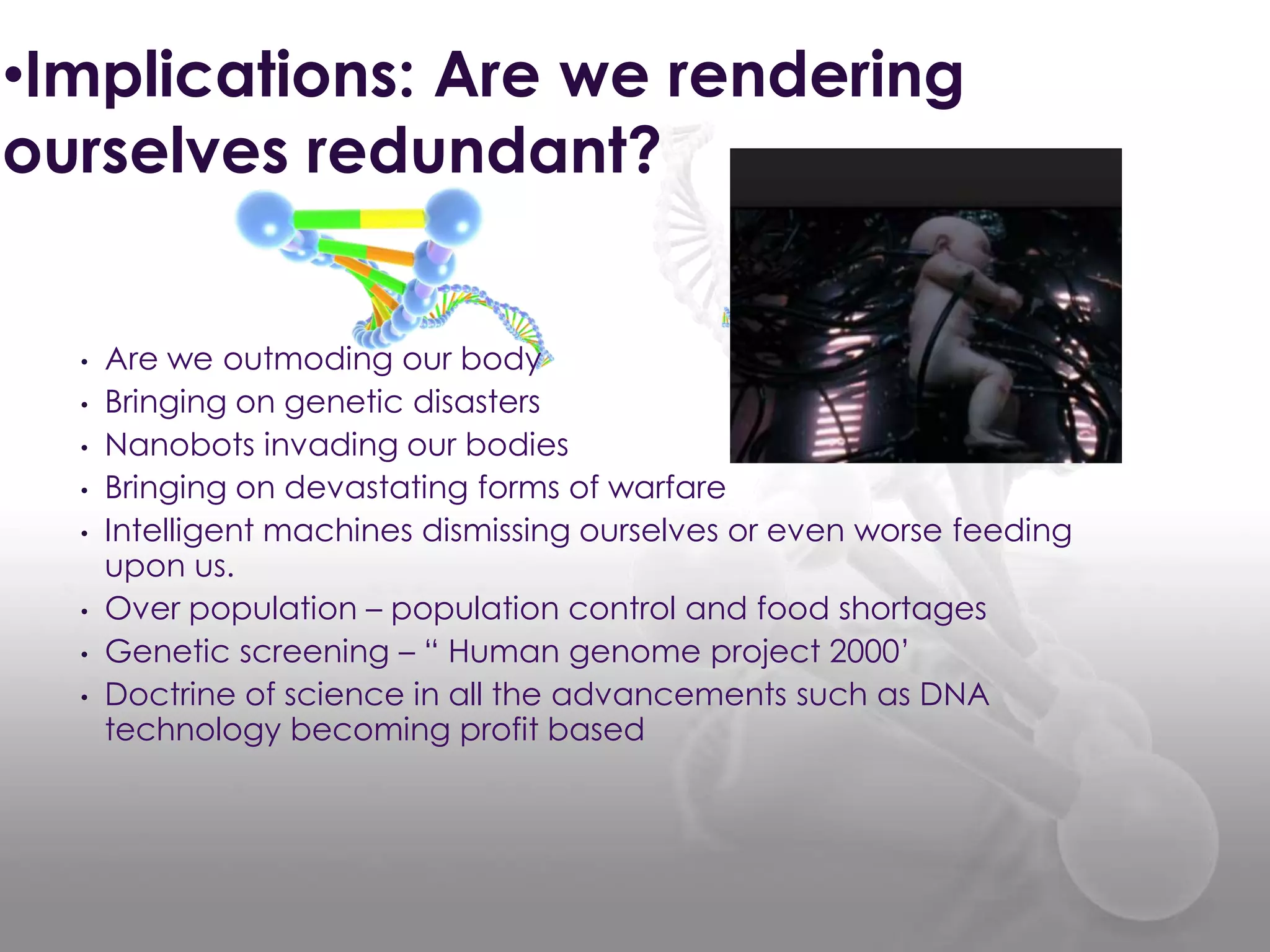
•Implications: Are we rendering
ourselves redundant?
• Are we outmoding our body
• Bringing on genetic disasters
• Nanobots invading our bodies
• Bringing on devastating forms of warfare
• Intelligent machines dismissing ourselves or even worse feeding
upon us.
• Over population – population control and food shortages
• Genetic screening – “ Human genome project 2000‟
• Doctrine of science in all the advancements such as DNA
technology becoming profit based
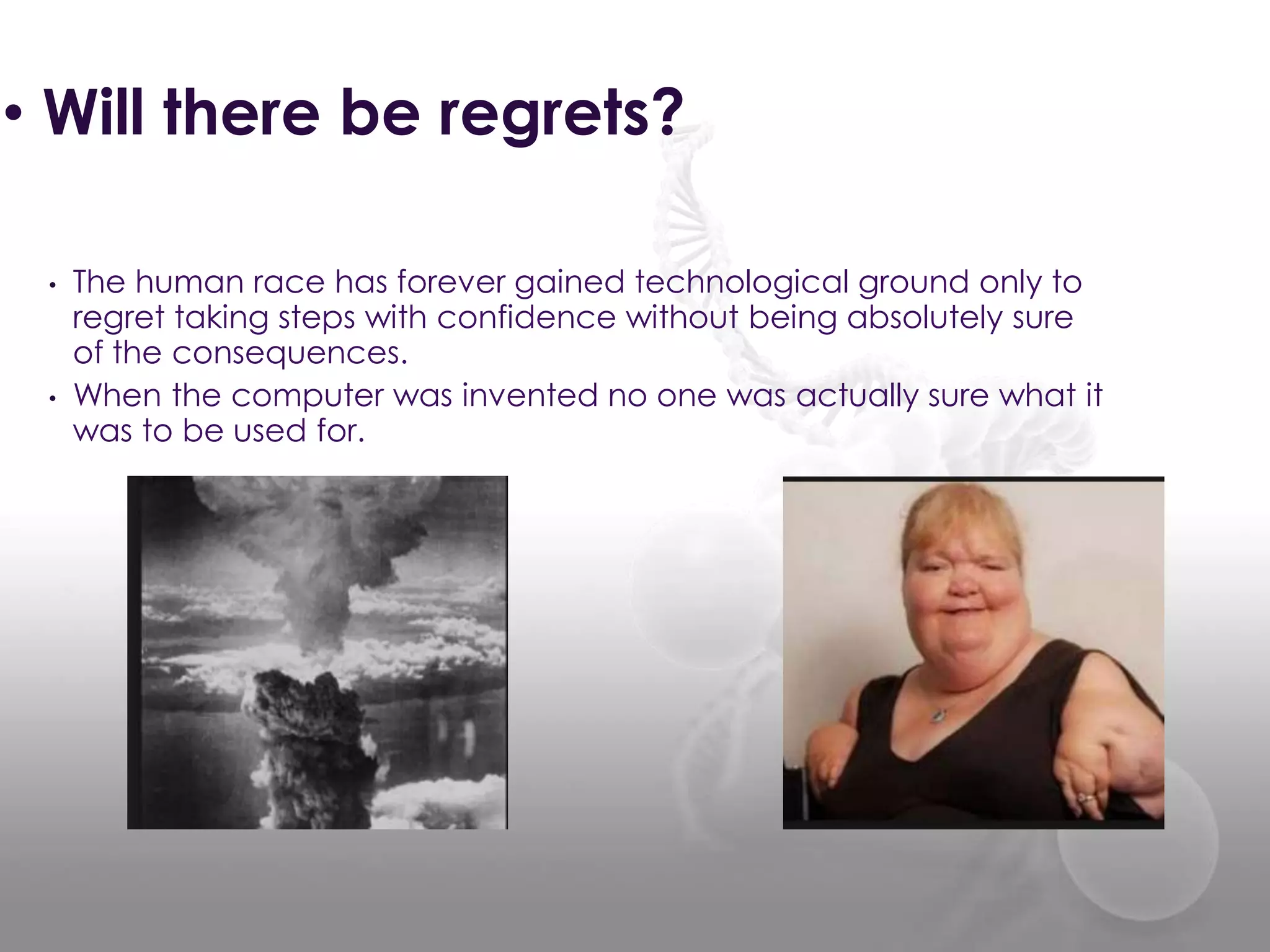
• Will there be regrets?
• The human race has forever gained technological ground only to
regret taking steps with confidence without being absolutely sure
of the consequences.
• When the computer was invented no one was actually sure what it
was to be used for.
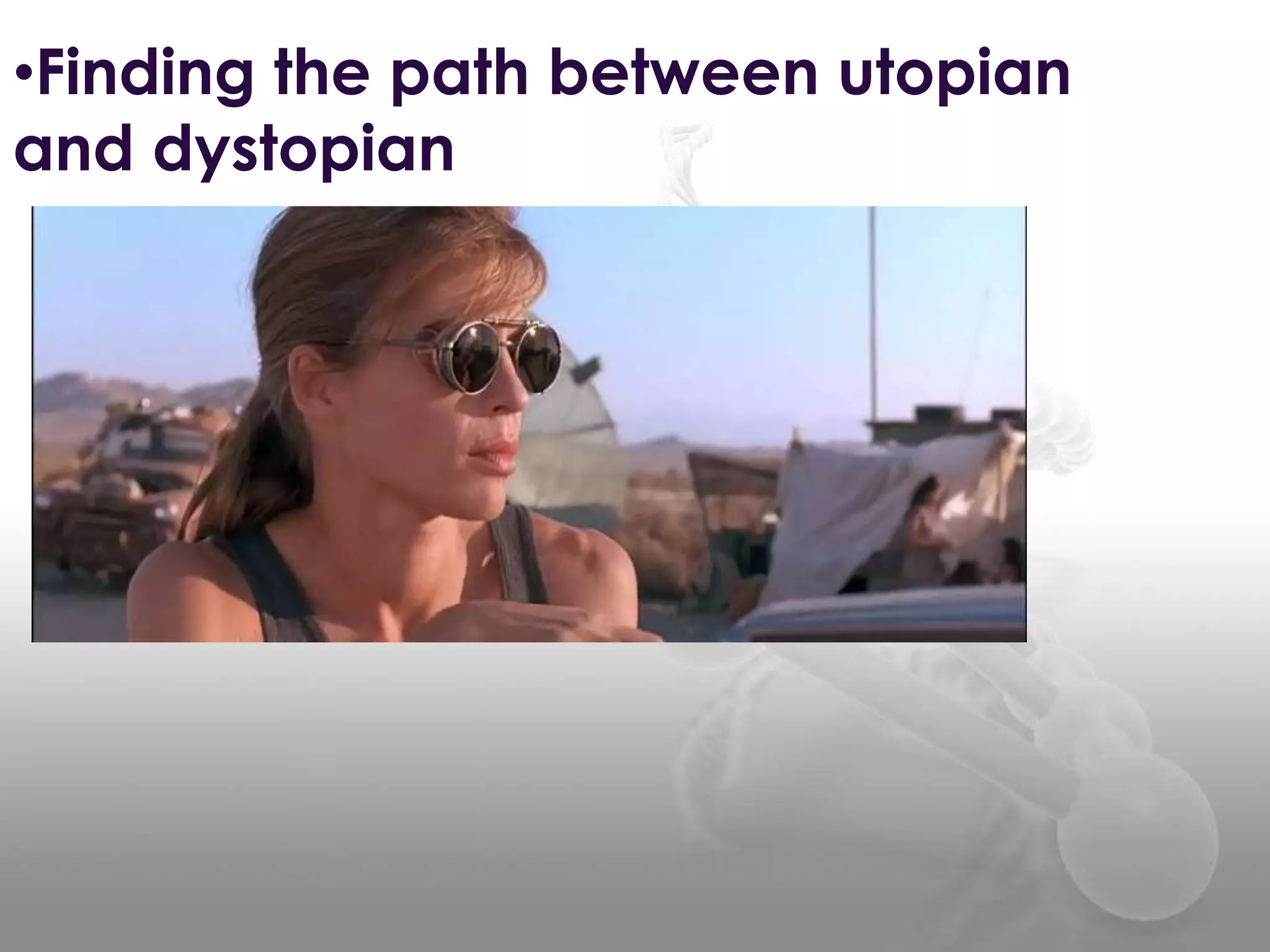
•Finding the path between utopian
and dystopian
•
•Question 2
• Can becoming cyborg really mean to engage with
our information culture meaning our conscious choice
to have a second online presence and modifying
ourselves both with information and technology?
• QUESTIONS:

Cyborgs the body, the information and the technology

  • 1.
    Cyborgs: the Body, Informationan Technology (Murphy, A., & Potts J., Culture and Technology Michelle Thomas
  • 2.
    Edgar Allen Poe 1843 “aperson whose physiological functioning is aided by or dependent up a mechanical or electronic device” “For the exogenously extended organizational complex functioning as an integrated homeostatic system, unconsciously we propose the term „Cyborg‟ •Cyborg – Indefinable? ”a fictional or hypothetical person whose physical abilities are extended beyond normal human limitations by mechanical elements built into the body.” A cyborg essentially a man-made system in which the control mechanisms of the human portion are modified externally by drugs or regulatory devices so that the being can live in an environment different from the normal one] The concept of a man-machine mixture was widespread in science fiction before World War II. As early as 1843 Edgar Allan Described a man with extensive prostheses in the short story The Man That Was Used Up". Oxford Definition Other dictionary definitions Clynes and Klyne 1960 New York Times 1960
  • 3.
    FACT: „Cyborg isa merging of the words cyber and organism or merging of organic and cybernetic FACT: Term appeared due to HCI or Human Computer Interaction Cyborgs: A global debate • The definition of cyborg is debated in many fields: medicine, art, technology, religion but more prevalent are the conversations over context and implications.
  • 4.
    Haraway’s definition: „a creatureof social reality‟ AND „a creature of fiction‟ Harawy‟s defining ambiguity is bought about by an unknown future and implications Cyborgs: Why the Debate? • The constant blurring of boundaries in our definition of cyborgs brings about dystopian and utopian theorists
  • 5.
    •Question 1: • Whycan we not agree about what a cyborg is?
  • 6.
    DYSTOPIAN • Many foreseedoom in the form of fear, entrapment, souless ness and a lack of moral responsibility. • Stelarc: “I see technology as an evolutionary energizer.. The first phase of technology contained the body, whereas now miniaturized technology can be imparted in the body…the end of evolution is at hand” UTOPIAN •Cyborgs: Utopian Vs Dystopian A second line of text could go here
  • 7.
    • “Our bestmachines are made of sunshine, they are all light and clean because they are all light and clean because they are nothing but signals, electromagnetic waves, a section of the spectrum and these machines are eminently portable, mobile.. the ubiquity and invisibility of cyborgs as precisely why these sunshine-belt machines are so deadly. They are as hard to see politically as materially (1991b_153 – Haraway) • Information exchange has always been constant in our society but the notion of cyborgs brings about a new age •Another dimension: Information as cybernetics
  • 8.
    A new god Ourspirit Basic necessity of life An Addiction An Affliction Joining with us in the posthuman form •What is information becoming to us?
  • 9.
    • “when computerswere virtually real machines, women wrote the software on which they ran. And when computer was a term applied to flesh and blood workers, the bodies which composed them were female.” (Sadie Plant, 1997) •The Age of Posthuman • There will be no autonomous individuals as such. Leaving gender an uncertain future.(Katherine Hayles) • „autopoises‟ living individuals part of a system constantly reinventing itself.( „autopoiesis‟ ) - Humberto Maturana and Francisco Varela
  • 10.
    • Who isin control of this transition to posthuman? •Haraway’s “The Cyborg Manifesto”
  • 11.
    •Implications: Are werendering ourselves redundant? • Are we outmoding our body • Bringing on genetic disasters • Nanobots invading our bodies • Bringing on devastating forms of warfare • Intelligent machines dismissing ourselves or even worse feeding upon us. • Over population – population control and food shortages • Genetic screening – “ Human genome project 2000‟ • Doctrine of science in all the advancements such as DNA technology becoming profit based
  • 12.
    • Will therebe regrets? • The human race has forever gained technological ground only to regret taking steps with confidence without being absolutely sure of the consequences. • When the computer was invented no one was actually sure what it was to be used for.
  • 13.
    •Finding the pathbetween utopian and dystopian
  • 14.
    • •Question 2 • Canbecoming cyborg really mean to engage with our information culture meaning our conscious choice to have a second online presence and modifying ourselves both with information and technology? • QUESTIONS: