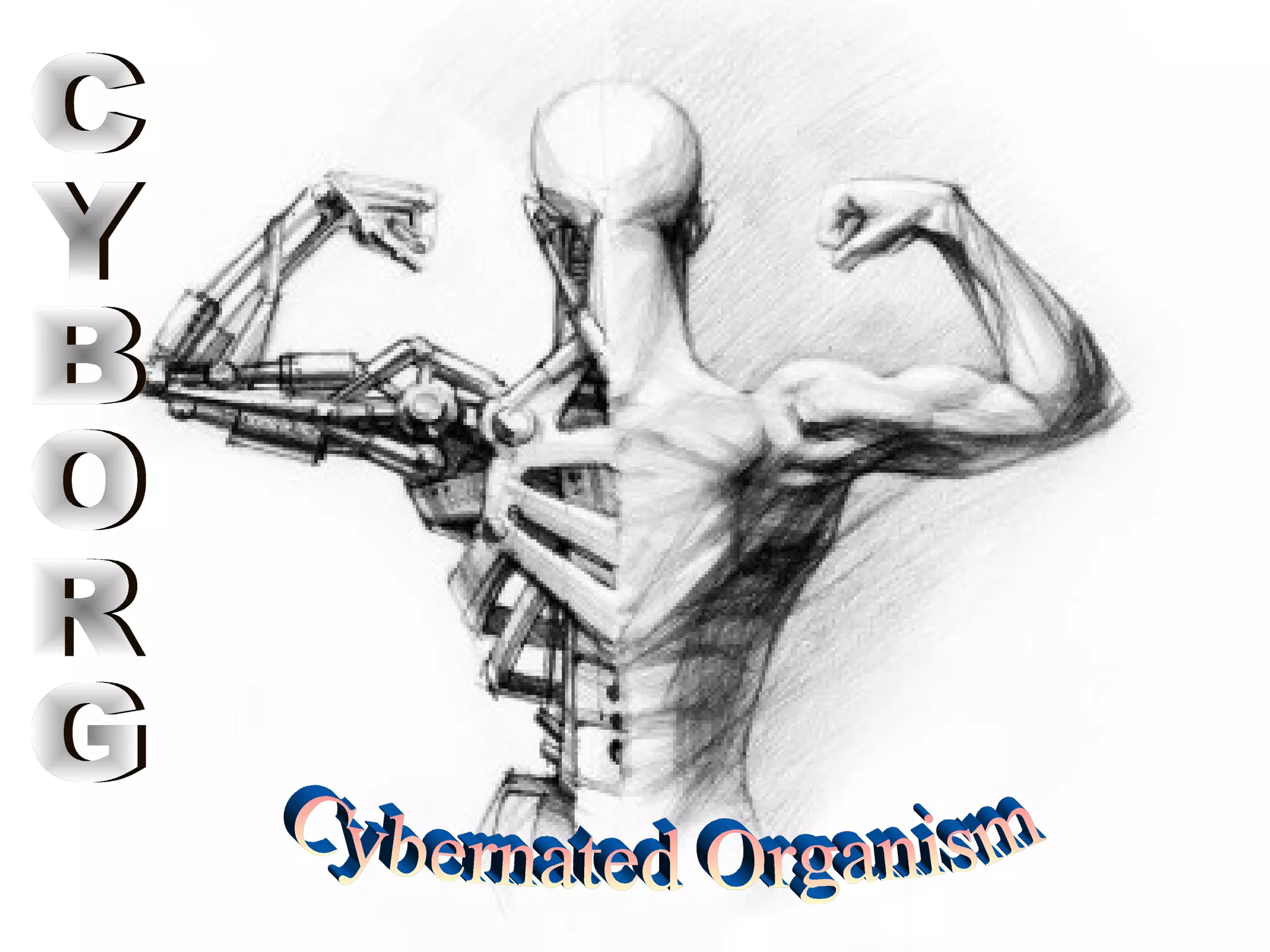

A Cyborg, also known as a Cybernetic organism,
is a being with both biological and artificial
(e.g. electronic, mechanical or robotic) parts.
The term was coined in 1960 when
Manfred Clynes and Nathan Kline used it in
an article about the advantages of
self-regulating human-machine systems in
outer space .
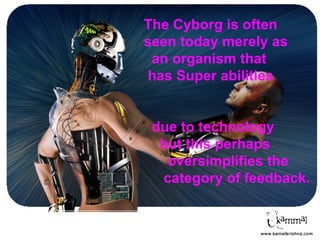
The Cyborg is often
seen today merely as
 an organism that
 has Super abilities


 due to technology
  but this perhaps
   oversimplifies the
  category of feedback.
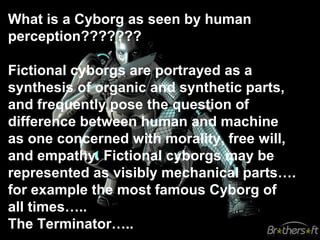
What is a Cyborg as seen by human
perception???????

Fictional cyborgs are portrayed as a
synthesis of organic and synthetic parts,
and frequently pose the question of
difference between human and machine
as one concerned with morality, free will,
and empathy. Fictional cyborgs may be
represented as visibly mechanical parts….
for example the most famous Cyborg of
all times…..
The Terminator…..
As being a human and have a tendency to
see the negative part of subject….
We lack our confidence of
being optimistic …….

Now everything in this universe has
two perspectives to reach it….

NEGATIVE                      POSITIVE
Scope of Cyborgs on the positive front.........

 • Medics…..
 • Physical help…
 • space stations….
 • Work holds……
 • Communication And Control
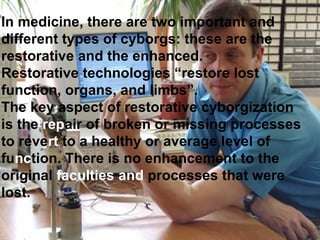
In medicine, there are two important and
different types of cyborgs: these are the
restorative and the enhanced.
Restorative technologies “restore lost
function, organs, and limbs”.
The key aspect of restorative cyborgization
is the repair of broken or missing processes
to revert to a healthy or average level of
function. There is no enhancement to the
original faculties and processes that were
lost.
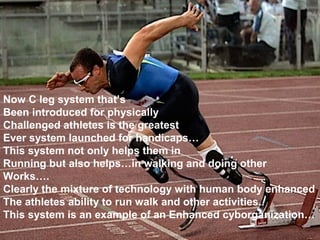
Now C leg system that’s
Been introduced for physically
Challenged athletes is the greatest
Ever system launched for handicaps…
This system not only helps them in
Running but also helps…in walking and doing other
Works….
Clearly the mixture of technology with human body enhanced
The athletes ability to run walk and other activities..
This system is an example of an Enhanced cyborganization…
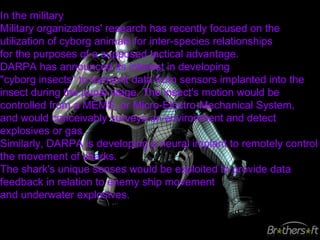
In the military
Military organizations' research has recently focused on the
utilization of cyborg animals for inter-species relationships
for the purposes of a supposed tactical advantage.
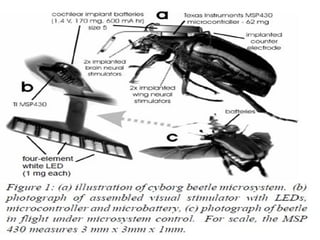
DARPA has announced its interest in developing
"cyborg insects" to transmit data from sensors implanted into the
insect during the pupal stage. The insect's motion would be
controlled from a MEMS, or Micro-Electro-Mechanical System,
and would conceivably surveys an environment and detect
explosives or gas.
Similarly, DARPA is developing a neural implant to remotely control
the movement of sharks.
The shark's unique senses would be exploited to provide data
feedback in relation to enemy ship movement
and underwater explosives.
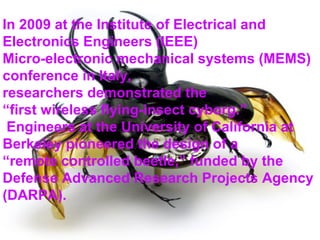
In 2009 at the Institute of Electrical and
Electronics Engineers (IEEE)
Micro-electronic mechanical systems (MEMS)
conference in Italy,
researchers demonstrated the
“first wireless flying-insect cyborg.”
 Engineers at the University of California at
Berkeley pioneered the design of a
“remote controlled beetle,” funded by the
Defense Advanced Research Projects Agency
(DARPA).
The concept of the cyborg is a rejection of rigid
boundaries, notably those separating
"human" from "animal" and "human" from "machine.
“ In the Cyborg Manifesto, she writes:
"The cyborg does not dream of community
on the model of the organic family, this time without
the oedipal project. The cyborg would not recognize
the Garden of Eden;
it is not made of mud and cannot dream
of returning to dust."
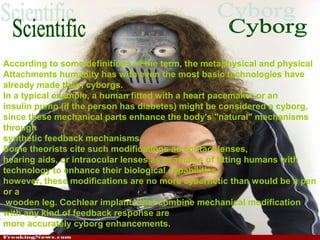
According to some definitions of the term, the metaphysical and physical
Attachments humanity has with even the most basic technologies have
already made them cyborgs.
In a typical example, a human fitted with a heart pacemaker or an
insulin pump (if the person has diabetes) might be considered a cyborg,
since these mechanical parts enhance the body's "natural" mechanisms
through
synthetic feedback mechanisms.
Some theorists cite such modifications as contact lenses,
hearing aids, or intraocular lenses as examples of fitting humans with
technology to enhance their biological capabilities;
however, these modifications are no more cybernetic than would be a pen
or a
 wooden leg. Cochlear implants that combine mechanical modification
with any kind of feedback response are
more accurately cyborg enhancements.
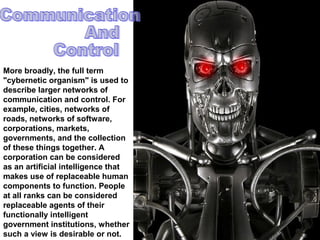
More broadly, the full term
"cybernetic organism" is used to
describe larger networks of
communication and control. For
example, cities, networks of
roads, networks of software,
corporations, markets,
governments, and the collection
of these things together. A
corporation can be considered
as an artificial intelligence that
makes use of replaceable human
components to function. People
at all ranks can be considered
replaceable agents of their
functionally intelligent
government institutions, whether
such a view is desirable or not.
Now taking all the positive aspects of cyborg
till we control it………..it leaves a question
in our mind that embarks…..
& that is what if…..

It has the power like humans to think and
innovate…….?????
Cyborg: cybernated organism

Cyborg: cybernated organism

  • 2.
    A Cyborg, alsoknown as a Cybernetic organism, is a being with both biological and artificial (e.g. electronic, mechanical or robotic) parts. The term was coined in 1960 when Manfred Clynes and Nathan Kline used it in an article about the advantages of self-regulating human-machine systems in outer space .
  • 3.
    The Cyborg isoften seen today merely as an organism that has Super abilities due to technology but this perhaps oversimplifies the category of feedback.
  • 5.
    What is aCyborg as seen by human perception??????? Fictional cyborgs are portrayed as a synthesis of organic and synthetic parts, and frequently pose the question of difference between human and machine as one concerned with morality, free will, and empathy. Fictional cyborgs may be represented as visibly mechanical parts…. for example the most famous Cyborg of all times….. The Terminator…..
  • 6.
    As being ahuman and have a tendency to see the negative part of subject…. We lack our confidence of being optimistic ……. Now everything in this universe has two perspectives to reach it…. NEGATIVE POSITIVE
  • 8.
    Scope of Cyborgson the positive front......... • Medics….. • Physical help… • space stations…. • Work holds…… • Communication And Control
  • 9.
    In medicine, thereare two important and different types of cyborgs: these are the restorative and the enhanced. Restorative technologies “restore lost function, organs, and limbs”. The key aspect of restorative cyborgization is the repair of broken or missing processes to revert to a healthy or average level of function. There is no enhancement to the original faculties and processes that were lost.
  • 10.
    Now C legsystem that’s Been introduced for physically Challenged athletes is the greatest Ever system launched for handicaps… This system not only helps them in Running but also helps…in walking and doing other Works…. Clearly the mixture of technology with human body enhanced The athletes ability to run walk and other activities.. This system is an example of an Enhanced cyborganization…
  • 11.
    In the military Militaryorganizations' research has recently focused on the utilization of cyborg animals for inter-species relationships for the purposes of a supposed tactical advantage. DARPA has announced its interest in developing "cyborg insects" to transmit data from sensors implanted into the insect during the pupal stage. The insect's motion would be controlled from a MEMS, or Micro-Electro-Mechanical System, and would conceivably surveys an environment and detect explosives or gas. Similarly, DARPA is developing a neural implant to remotely control the movement of sharks. The shark's unique senses would be exploited to provide data feedback in relation to enemy ship movement and underwater explosives.
  • 12.
    In 2009 atthe Institute of Electrical and Electronics Engineers (IEEE) Micro-electronic mechanical systems (MEMS) conference in Italy, researchers demonstrated the “first wireless flying-insect cyborg.” Engineers at the University of California at Berkeley pioneered the design of a “remote controlled beetle,” funded by the Defense Advanced Research Projects Agency (DARPA).
  • 14.
    The concept ofthe cyborg is a rejection of rigid boundaries, notably those separating "human" from "animal" and "human" from "machine. “ In the Cyborg Manifesto, she writes: "The cyborg does not dream of community on the model of the organic family, this time without the oedipal project. The cyborg would not recognize the Garden of Eden; it is not made of mud and cannot dream of returning to dust."
  • 15.
    According to somedefinitions of the term, the metaphysical and physical Attachments humanity has with even the most basic technologies have already made them cyborgs. In a typical example, a human fitted with a heart pacemaker or an insulin pump (if the person has diabetes) might be considered a cyborg, since these mechanical parts enhance the body's "natural" mechanisms through synthetic feedback mechanisms. Some theorists cite such modifications as contact lenses, hearing aids, or intraocular lenses as examples of fitting humans with technology to enhance their biological capabilities; however, these modifications are no more cybernetic than would be a pen or a wooden leg. Cochlear implants that combine mechanical modification with any kind of feedback response are more accurately cyborg enhancements.
  • 16.
    More broadly, thefull term "cybernetic organism" is used to describe larger networks of communication and control. For example, cities, networks of roads, networks of software, corporations, markets, governments, and the collection of these things together. A corporation can be considered as an artificial intelligence that makes use of replaceable human components to function. People at all ranks can be considered replaceable agents of their functionally intelligent government institutions, whether such a view is desirable or not.
  • 17.
    Now taking allthe positive aspects of cyborg till we control it………..it leaves a question in our mind that embarks….. & that is what if….. It has the power like humans to think and innovate…….?????