CLASSIFICATION OF DM
Name: Khushboo Jethwa
Enrollment no. : 140950107028
Subject: DMBI
Subject Guide: Archana Magare
DATA MARTS
• Data marts contain a subset of organization-wide data that is
valuable to specific group of people in an organization.
• A data mart contains only those data that is specific to a particular
group.
• Data marts improve end-user response time by allowing users to
have access to the specific type of data they need to view most
often by providing the data in a way that supports the collective
view of a group of users.
• A data mart is basically a condensed and more focused version of a
data warehouse that reflects the regulations and process
specifications of each business unit within an organization.
• Each data mart is dedicated to a specific business function or region.
• For Example, the marketing data mart may contain only data related
to items, customers, and sales. Data marts are confined to subjects.
CLASSIFICATION OF DM
• Three basic types of data marts are dependent, independent,
and hybrid.
• The categorization is based primarily on the data source that
feeds the data mart.
• Dependent data marts, in contrast, are standalone systems
built by drawing data directly from operational or external
sources of data or both.
• Hybrid data marts can draw data from operational systems or
data warehouses
DEPENDENT DATA MART
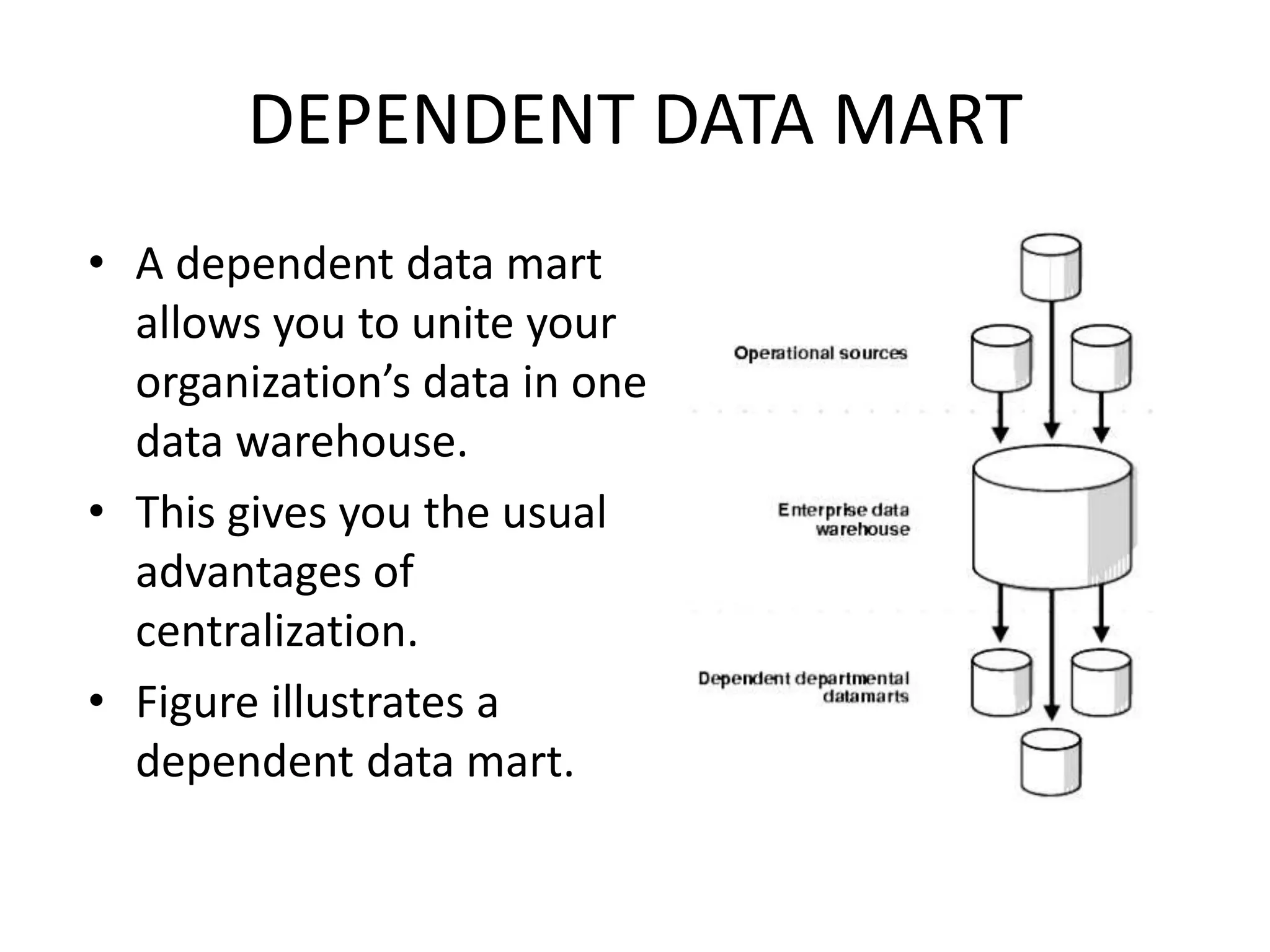
• A dependent data mart
allows you to unite your
organization’s data in one
data warehouse.
• This gives you the usual
advantages of
centralization.
• Figure illustrates a
dependent data mart.
INDEPENDENT DATA MART
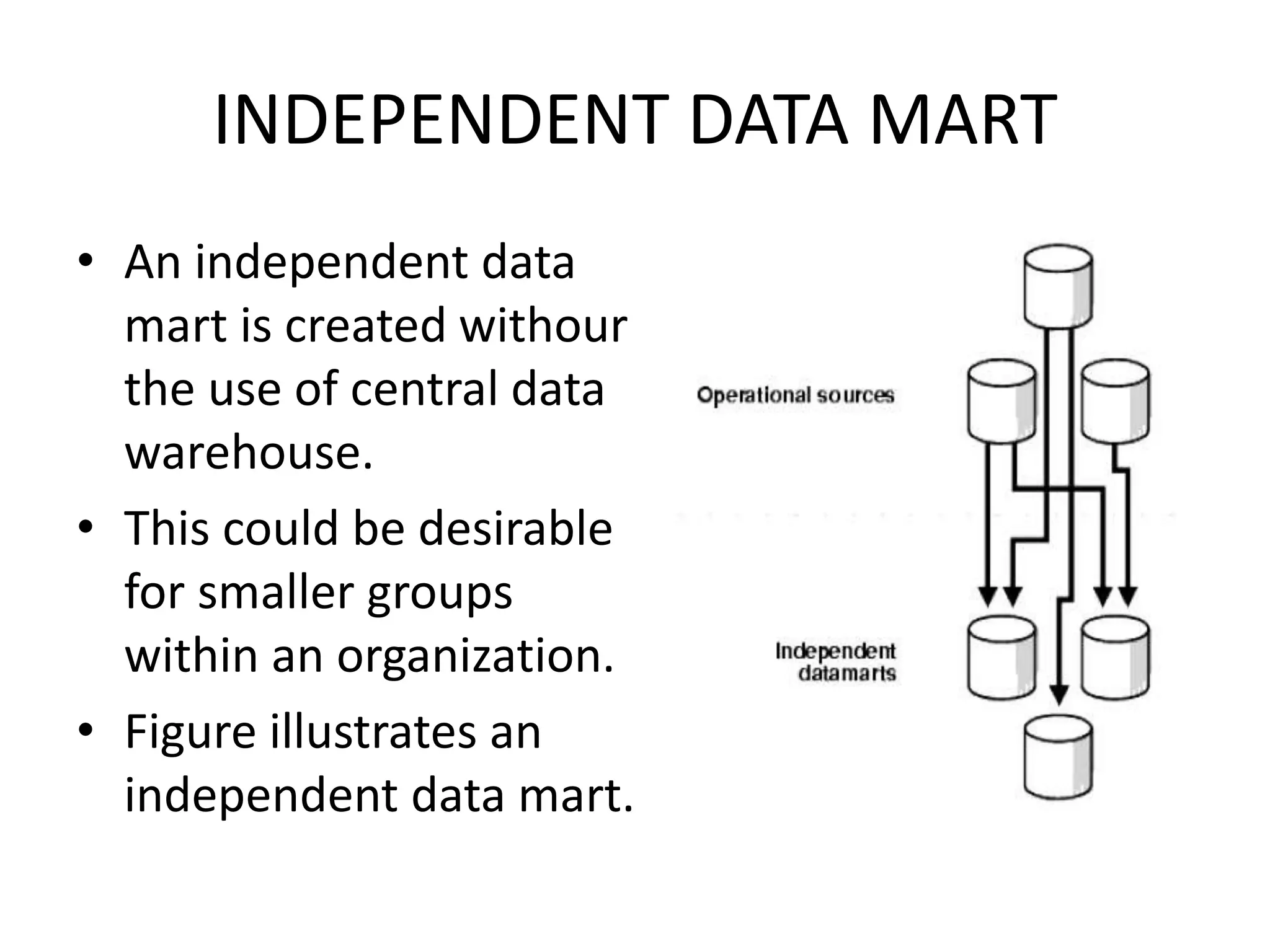
• An independent data
mart is created withour
the use of central data
warehouse.
• This could be desirable
for smaller groups
within an organization.
• Figure illustrates an
independent data mart.
HYBRID DATA MART
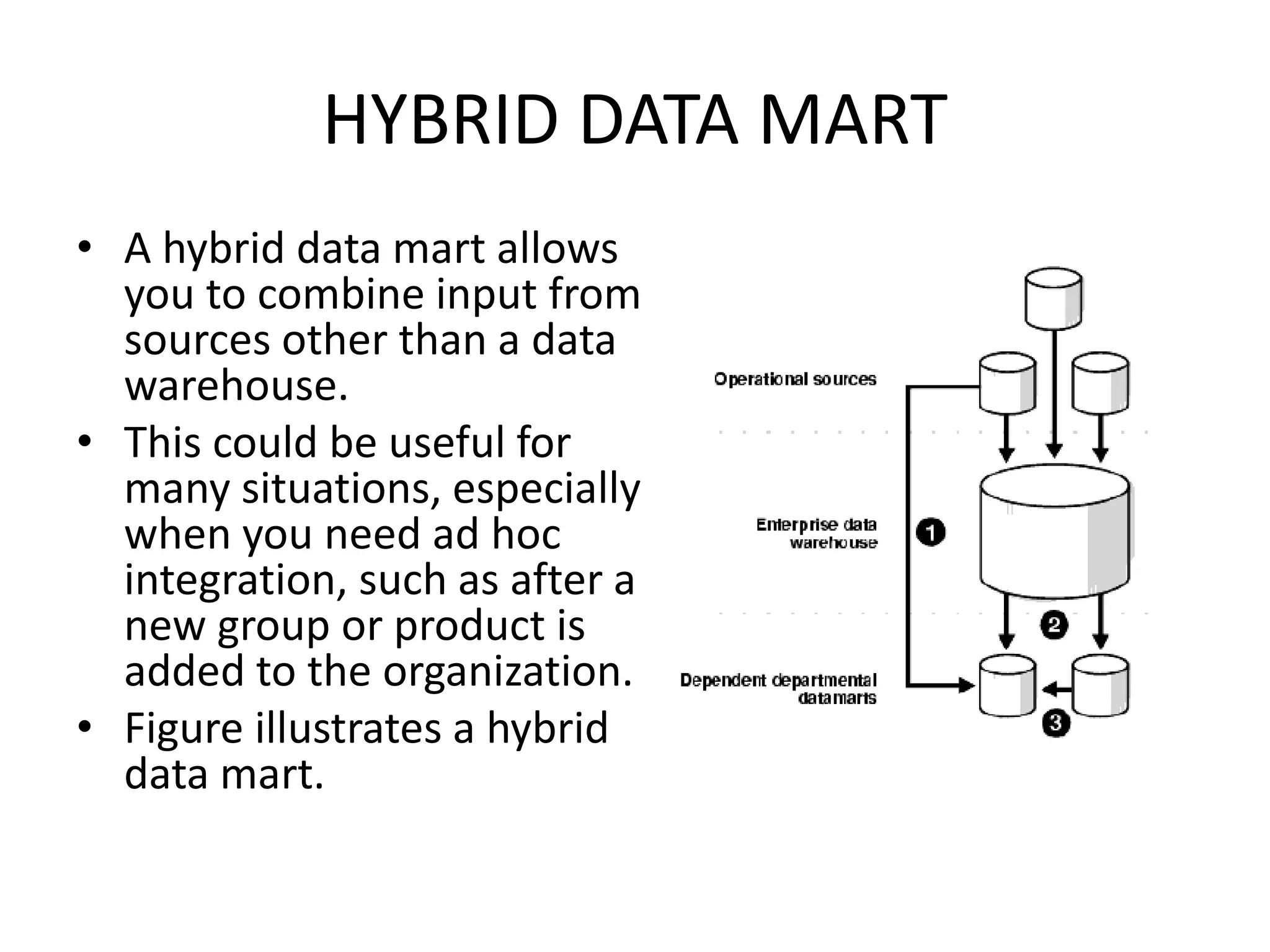
• A hybrid data mart allows
you to combine input from
sources other than a data
warehouse.
• This could be useful for
many situations, especially
when you need ad hoc
integration, such as after a
new group or product is
added to the organization.
• Figure illustrates a hybrid
data mart.
THANK YOU

Classification of data mart

  • 1.
    CLASSIFICATION OF DM Name:Khushboo Jethwa Enrollment no. : 140950107028 Subject: DMBI Subject Guide: Archana Magare
  • 2.
    DATA MARTS • Datamarts contain a subset of organization-wide data that is valuable to specific group of people in an organization. • A data mart contains only those data that is specific to a particular group. • Data marts improve end-user response time by allowing users to have access to the specific type of data they need to view most often by providing the data in a way that supports the collective view of a group of users. • A data mart is basically a condensed and more focused version of a data warehouse that reflects the regulations and process specifications of each business unit within an organization. • Each data mart is dedicated to a specific business function or region. • For Example, the marketing data mart may contain only data related to items, customers, and sales. Data marts are confined to subjects.
  • 3.
    CLASSIFICATION OF DM •Three basic types of data marts are dependent, independent, and hybrid. • The categorization is based primarily on the data source that feeds the data mart. • Dependent data marts, in contrast, are standalone systems built by drawing data directly from operational or external sources of data or both. • Hybrid data marts can draw data from operational systems or data warehouses
  • 4.
    DEPENDENT DATA MART •A dependent data mart allows you to unite your organization’s data in one data warehouse. • This gives you the usual advantages of centralization. • Figure illustrates a dependent data mart.
  • 5.
    INDEPENDENT DATA MART •An independent data mart is created withour the use of central data warehouse. • This could be desirable for smaller groups within an organization. • Figure illustrates an independent data mart.
  • 6.
    HYBRID DATA MART •A hybrid data mart allows you to combine input from sources other than a data warehouse. • This could be useful for many situations, especially when you need ad hoc integration, such as after a new group or product is added to the organization. • Figure illustrates a hybrid data mart.
  • 7.