PAPER SERIES: NO. 16 — JULY 2015
Global Cyberspace Is Safer than You
Think: Real Trends in Cybercrime
Eric Jardine
GLOBAL CYBERSPACE IS SAFER THAN YOU THINK:
REAL TRENDS IN CYBERCRIME
Eric Jardine
Copyright © 2015 by the Centre for International Governance Innovation and the Royal
Institute for International Affairs
Published by the Centre for International Governance Innovation and Chatham House.
The opinions expressed in this publication are those of the authors and do not necessarily
reflect the views of the Centre for International Governance Innovation or its Board of
Directors.
This work is licensed under a Creative Commons Attribution — Non-commercial — No
Derivatives License. To view this license, visit (www.creativecommons.org/licenses/by-nc-
nd/3.0/). For re-use or distribution, please include this copyright notice.
67 Erb Street West
Waterloo, Ontario N2L 6C2
Canada
tel +1 519 885 2444 fax +1 519 885 5450
www.cigionline.org
10 St James’s Square
London, England SW1Y 4LE
United Kingdom
tel +44 (0)20 7957 5700 fax +44 (0)20 7957 5710
www.chathamhouse.org
TABLE OF CONTENTS
vi	 About the Global Commission on Internet Governance
vi	 About the Author
1	 Executive Summary
1	Introduction
3	 The Size of Cyberspace
5	 The Security of Cyberspace: Vectors, Occurrence and Damage
8	 Trends in the Vectors of Attack: Vulnerabilities and Malicious Sites
12	 Occurrence of Cyber Attacks: Web-based Attacks
14	 The Cost of Successful Cyber Attacks
17	 Conclusions and Policy Recommendations
20	 Works Cited
23	 About CIGI
23	 CIGI Masthead
GLOBAL COMMISSION ON INTERNET GOVERNANCE Paper Series: no. 16 — July 2015
vi • CENTRE FOR INTERNATIONAL GOVERNANCE INNOVATION • CHATHAM HOUSE
ABOUT THE AUTHOR
Eric Jardine joined CIGI as a research fellow in May 2014
in the Global Security & Politics Program. He contributes
to CIGI’s work on Internet governance, including the
CIGI–Chatham House-sponsored Global Commission
on Internet Governance. His current research focuses
on cyber security, cyber terrorism, cybercrime and cyber
protest. He holds a Ph.D. in international relations from
the Norman Paterson School of International Affairs at
Carleton University.
ABOUT THE GLOBAL
COMMISSION ON INTERNET
GOVERNANCE
The Global Commission on Internet Governance was
established in January 2014 to articulate and advance a
strategic vision for the future of Internet governance. The
two-year project conducts and supports independent
research on Internet-related dimensions of global public
policy, culminating in an official commission report that
will articulate concrete policy recommendations for the
future of Internet governance. These recommendations
willaddressconcernsaboutthestability,interoperability,
security and resilience of the Internet ecosystem.
Launched by two independent global think tanks,
the Centre for International Governance Innovation
(CIGI) and Chatham House, the Global Commission on
Internet Governance will help educate the wider public
on the most effective ways to promote Internet access,
while simultaneously championing the principles of
freedom of expression and the free flow of ideas over
the Internet.
The Global Commission on Internet Governance will
focus on four key themes:
•	 enhancing governance legitimacy — including
regulatory approaches and standards;
•	 stimulating economic innovation and growth —
including critical Internet resources, infrastructure
and competition policy;
•	 ensuring human rights online — including
establishing the principle of technological
neutrality for human rights, privacy and free
expression; and
•	 avoiding systemic risk — including establishing
norms regarding state conduct, cybercrime
cooperation and non-proliferation, confidence-
building measures and disarmament issues.
The goal of the Global Commission on Internet
Governance is two-fold. First, it will encourage globally
inclusive public discussions on the future of Internet
governance. Second, through its comprehensive policy-
oriented report, and the subsequent promotion of
this final report, the Global Commission on Internet
Governance will communicate its findings with senior
stakeholders at key Internet governance events.
www.ourinternet.org
Global Cyberspace Is Safer than You Think: Real Trends in Cybercrime
Eric Jardine • 1
In politics, what begins in fear usually ends in folly.
— Samuel Taylor Coleridge
EXECUTIVE SUMMARY
What are the real trends in cybercrime? Recent media
coverage has been rife with stories of large-scale data
breaches, hacks and online financial crime. Information
technology (IT) security firms such as Norton Symantec
and Kaspersky Labs publish yearly reports that generally
show the security of cyberspace to be poor and often
getting worse. This paper argues that the level of security
in cyberspace is actually far better than the picture
described by media accounts and IT security reports.
Currently, numbers on the occurrence of cybercrime are
almost always depicted in either absolute (1,000 attacks
per year) or as year-over-year percentage change terms
(50 percent more attacks in 2014 than in 2013). To get an
accurate picture of the security of cyberspace, cybercrime
statistics need to be expressed as a proportion of the
growing size of the Internet (similar to the routine practice
of expressing crime as a proportion of a population, i.e.,
15 murders per 1,000 people per year). To substantiate this
argument, data was collected on the size of the Internet,
with a focus on users, points of interaction and volume of
online activity. Data was then collected on the vectors of
cyber attack, the occurrence of cyber attacks and the cost
of cybercrime. Normalizing these crime statistics around
various measures of the growing size of cyberspace, a
clear picture emerges: the absolute numbers always paint
a worse scenario of the security of cyberspace than the
normalized numbers. In particular, the absolute numbers
tend to lead to one of three misrepresentations: first, the
absolute numbers say things are getting worse, while the
normalized numbers show that the situation is improving;
second, both numbers show that things are improving,
but the normalized numbers show that things are getting
better at a faster rate; and third, both numbers say that
things are getting worse, but the normalized numbers
indicate that the situation is deteriorating more slowly
than the absolute numbers. Overall, global cyberspace is
actually far safer than commonly thought.
INTRODUCTION
Recent media coverage has been chock full of high-profile
accounts of cybercrime. Hacks, data breaches, destruction
of property and the theft of personal information seems to
be rampant. In February 2014, eBay’s online system was
breached after some of its employees’ credentials were
stolen, leading to the compromise of some 145 million
account holders (Finkle, Chatterjee and Maan 2014). In
July, the American bank JPMorgan Chase was hacked,
with online bandits making off with account information
on approximately 76 million households and some eight
million small businesses (Silver-Greenberg, Goldstein
and Perlroth 2014). In November, Sony Pictures was
subject to a sophisticated cyber attack, causing massive
physical damage to its computer systems and exposing
sensitive emails regarding pay disparities and personal
relationships. In December 2014, Sony estimated that the
remediation and investigation costs of the hack could
enter into the $100 million1
range (Richwine 2014). What is
more, these are just a few of the publicly known breaches.
As the Internet comes to underwrite more and more of our
daily life, the vectors of attack for cybercriminals, hackers
and state officials multiply, the total number of cyber
attacks grows year over year and the potential damage
from cyber attacks increases. Governments, corporations
and individuals have prudently responded to these trends
by stepping up their cyber defences. Shortly after the Sony
Pictures hacks, for example, the United States and the
United Kingdom announced a series of “cyber war games”
to prepare their government agencies for the potential
of broad-based cyber attacks on critical infrastructure,
including the banking and financial sector (BBC News
2015). Over 60 percent of businesses’ representatives
surveyed in a recent Gandalf Group C-Suite study have
responded to the perception of a deteriorating cyber
security environment by increasing their IT security
budgets (Gandalf Group 2014). Likewise, a recent CIGI-
IPSOS poll surveying over 23,000 respondents in 24
countries found that 64 percent of respondents were more
worried about their online privacy compared to one year
ago and 78 percent of respondents were concerned about
criminal hackers stealing their banking information. An
additional 77 percent of respondents were concerned
that online criminals would steal their private messages
and photos. Indicating the behavioural changes that
people have undertaken in response to perceptions of the
poor security of cyberspace, the survey also found that
compared to one year ago, some 43 percent of respondents
now avoid certain Internet sites and web applications,
about 39 percent change their passwords regularly and
roughly 10 percent actually use the Internet less often
(CIGI-IPSOS 2014).
Clearly, the proliferation of cybercrime and the media’s
coverage of high-profile hacks have generated a severely
negativeperceptionofthesecurityofcyberspaceandcaused
governments, business and individual citizens to take
additional steps to protect themselves online. The problem
is that the existing picture of the security of cyberspace is
misleading. Currently, statistics on cybercrime are, as far
as I am aware, always expressed in either absolute (1,000
attacks per year) or year-over-year (2013 had 46 percent
1	 All currency is in US dollars.
GLOBAL COMMISSION ON INTERNET GOVERNANCE Paper Series: no. 16 — July 2015
2 • CENTRE FOR INTERNATIONAL GOVERNANCE INNOVATION • CHATHAM HOUSE
more cyber attacks than 2012) terms.2
The difficulty with
this expression of the numbers is that it gives an inaccurate
picture of the actual trends in cybercrime over time, and
thus a false impression of the actual security of cyberspace.
To state the obvious (but perhaps not well understood), the
occurrence of cybercrime is inevitably related to the size
of the Internet. Since cyberspace is, in a number of ways,
expanding at an exponential rate, it is reasonable to expect
that the absolute number of cyber attacks will also increase
simply because the Internet ecosystem is getting bigger
and not necessarily because the situation is growing worse.
These observations raise two questions: What is the actual
trend in cyber security? And is cyberspace becoming less
safe, safer or staying roughly the same over time?
In order to provide an accurate picture of the security
of cyberspace, all indicators of cybercrime need to be
normalized around data that captures the growing size of
the Internet.3
An example to help clarify the importance
of normalizing (or, essentially, expressing numbers as a
proportion of a population) data on cybercrime around the
size of the Internet is as follows: Imagine there is a town of
1,000 people with 100 violent crimes a year. Now imagine
that there is a city with 100,000 people with 1,000 violent
crimes per year. When normalizing the crime statistics for
these two hypothetical population centres, it is found that
the town has a violent crime rate of 0.1, while the city has a
violent crime rate of 0.01. In other words, even though the
city has as many violent crimes as the entire population of
the town, a person’s chance of being subject to a violent
crime in the city is only 1 in 100, while the chance of being
the victim of a violent crime in the town is 1 in 10.
In the case of the global Internet, the occurrence of
cybercrime can only be meaningfully normalized
around figures that capture the full width and breadth
of cyberspace. Cyber attacks in one country can originate
in any other country on the planet that has an Internet
connection. Normalizing crime statistics around national-
level data, therefore, gives a partial and highly skewed
glimpse at real trends in the occurrence and cost of
cybercrime.
2	 The two exceptions involve spam and phishing emails, often
expressed as a percentage of all emails sent. There is no clear rationale
given for why cybercrime statistics are expressed in absolute or year-
over-year terms. One potential reason is that, as shown in this paper, the
numbers tend to be more severe and point to a worse situation. Since
most collectors of cybercrime data are private, for-profit companies, a
cynic could conclude that the companies present data in a specific way
to help them sell product. I have no proof at all of this interpretation. It is
merely one potential explanation.
3	 In this paper, the terms Internet and cyberspace are used
synonymously. The Internet usually refers to the physical structure of
the network, while cyberspace is the larger, over-the-top portion of the
Web involving things such as apps. Both terms herein mean cyberspace
and both are used in the paper to mean the same thing in the interest of
readability.
Taking data on the size of the Internet and normalizing
various cybercrime indicators around these figures from
2008 to the end of 2014, the security of cyberspace is better
than one would think from looking at just the absolute
numbers often presented in the media and in IT security
reports. Over 30 comparisons of the absolute (1,000
attacks) and normalized (0.15 attacks per 1,000 Internet
users) numbers bear out this claim.
When the normalized indicators of cybercrime are
compared to the absolute numbers that are usually used
to discuss the level of security in cyberspace, one of three
misrepresentations occurs:
•	 the absolute numbers indicate the situation is getting
worse when the normalized numbers say it is getting
better (as in the case of new vulnerabilities, zero-
day vulnerabilities, browser vulnerabilities, mobile
vulnerabilities, post-breach response costs and
notification costs);
•	 both the absolute and the normalized numbers say
the situation is worsening, but the absolute numbers
say it is growing worse at a faster rate than the
normalized numbers (as in the case of detection and
escalation costs, when the full sample is considered); or
•	 both the absolute and the normalized numbers say
the situation is improving, but the absolute numbers
indicate a slower rate of improvement than the
normalized numbers (as in the case of malicious
web domains, botnets, web-based attacks since 2012,
average per capita data breach costs, organizational
costs due to data breaches, detection and escalation
costs from 2010 to 2013 or lost business costs).
In short, when the number of cyber attack vectors, the
number of cyber attacks and the amount of damage
caused by cybercrime are expressed as a proportion of the
size of the Internet, each of the normalized numbers point
to the idea that the security of cyberspace is better than
is suggested by the un-normalized or absolute numbers.
As a result, the security of cyberspace is likely better than
is commonly perceived by the general public, private
companies and state officials.
A realistic understanding of the level of security in
cyberspace is important because an unnecessarily negative
image of the situation can lead to radical policy responses
that could easily produce more harm than good. If online
crime is rampant, then restricting online activity might
be warranted, likely to the ultimate detriment of cultural
expression, commerce and innovation. If, on the other
hand, cyberspace security is relatively good, then current
policies could be sufficient and things can go on more or
less as they do now. In any case, a more realistic impression
of the security of cyberspace provides a better foundation
for cyber security policy.
Global Cyberspace Is Safer than You Think: Real Trends in Cybercrime
Eric Jardine • 3
The paper first discusses how to conceptualize the size
of cyberspace and details the data that is used herein
to measure this concept. It then provides a three-part
framework for thinking about the security of cyberspace
and details the measures used to operationalize each part
of the framework. The next three sections examine the
normalized trends in each of these areas and compares
them to the trends in the absolute numbers. The paper
concludes with policy recommendations based on the
finding that cyberspace security is better than what is
indicated when looking at only the absolute numbers and
is actually, in many cases, getting better rather than worse.4
THE SIZE OF CYBERSPACE
The cyberspace ecosystem is built upon the physical
infrastructure of the Internet and is basically composed of
users, points of online interaction (websites, for instance)
and the volume of activity that occurs online. The online
ecosystem gets larger as the number of users, points of
interaction and volume of activity increases. This section
lays out a three-part framework for understanding the
scope, size, width and breadth of cyberspace. Cyberspace
is essentially an amalgamation of the number of users
(people and devices, etc.), the number of points of
interaction (websites and domains, etc.) and the activity
linking these broad categories (data flows and commerce,
etc.).5
The basic point is that the ecosystem of cyberspace is big
and getting a lot bigger at a fairly rapid pace. This growth
is akin to the growth of a population in a city or country,
in the sense that a fixed amount of crime and a growing
population will result in a lower crime rate or a better
chance that one will not be subject to a crime.
As detailed below, data was collected from a variety of
sources on the following variables for the concept of
Internet users:
•	 the number of Internet users;
•	 the number of email users;
4	 Readers interested solely in the difference between absolute and
normalized numbers, rather than the method of measuring these
numbers, can skip ahead to the section “Trends in the Vectors of Attack:
Vulnerabilities and Malicious Sites.”
5	 Studying cyberspace from an empirical perspective involves a bit of
irony. While we live in the age of big data, where nearly everything a
person does online is tracked and recorded, most of this information is
proprietary and fragmented among numerous private actors. The result
is that it is not easy to get a clear picture of either the size of the Internet
or the occurrence of cybercrime. Data, therefore, have to be drawn from
multiple sources and often estimates have to be used in place of actual
figures. As a disclaimer: all the data used in this paper presents at best a
partial view of the actual ins and outs of cyberspace. Despite the fact that
many of the sources consulted lay out their data collection procedures, it
is not clear how random of a sample of Internet activity the data actually
depicts, and so extrapolating from these findings to the entirety of
cyberspace can only be done with great care.
•	 the number of active mobile broadband subscriptions;
and
•	 the number of smartphones sold to end-users.
The following data was collected on the concept of points
of online interaction:
•	 the number of domains; and
•	 the number of websites.
And on the volume of online activity:
•	 the volume of total data flows;
•	 the volume of mobile data flows;
•	 the annual number of Google searches; and
•	 the Internet’s contribution to GDP.
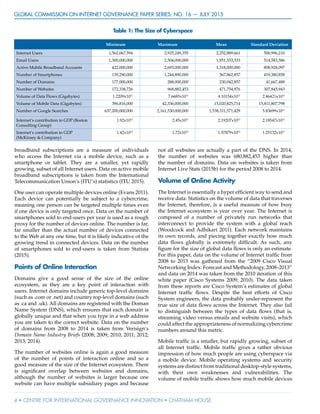
Table 1 provides some basic summary statistics for the
data capturing the size of cyberspace.
Internet Users
The number of Internet users is a good measure of the
size of cyberspace because it shows the actual number of
people that are a part of the “network of networks.” In
this sense, it is akin to the number of people in a city or
country. It is also a good proxy for the number of devices
online, although this number surpassed that of humans
on the network around 2008 (Evans 2011). Data on the
number of Internet users from 2008 to the end of 2014
was taken from the website Internet Live Stats, which
provides real-time statistics on various indicators of the
size of the Internet (Internet Live Stats 2015a).
Email is one of the most basic uses of the Internet. The
number of email users online is a good measure of the
size of the active population base of the online ecosystem
because it captures not just the number of people who
have web access (as done via Internet users statistics), but
also the number of people who actually use the Internet
as a part of their daily lives. Email users, therefore, are an
active subset of all Internet users. In 2014, for example,
there were 421,249,355 more Internet users than email
users for that year. Data on email users from 2008 to 2012
was taken from a data aggregation blog called Royal
Pingdom, which is operated by the website monitoring
company Pingdom (Royal Pingdom 2009; 2010; 2011; 2012;
2013). Data for email users for 2013 and 2014 were taken
from a Radicati Group (2013) study of the email market.
Increasingly, people access the Internet via a mobile
platform rather than a traditional desktop computer. In
January 2014, mobile usage surpassed desktop usage in
the United States for the first time (O’Toole 2014). The
trend is even more pronounced in the developing world,
where Internet access has expanded primarily by skipping
the fixed access/desktop stage and moving directly into
the mobile/wireless broadband stage. Active mobile
GLOBAL COMMISSION ON INTERNET GOVERNANCE Paper Series: no. 16 — July 2015
4 • CENTRE FOR INTERNATIONAL GOVERNANCE INNOVATION • CHATHAM HOUSE
broadband subscriptions are a measure of individuals
who access the Internet via a mobile device, such as a
smartphone or tablet. They are a smaller, yet rapidly
growing, subset of all Internet users. Data on active mobile
broadband subscriptions is taken from the International
Telecommunication Union’s (ITU’s) statistics (ITU 2015).
One user can operate multiple devices online (Evans 2011).
Each device can potentially be subject to a cybercrime,
meaning one person can be targeted multiple times even
if one device is only targeted once. Data on the number of
smartphones sold to end-users per year is used as a rough
proxy for the number of devices online. The number is far,
far smaller than the actual number of devices connected
to the Web at any one time, but it is likely indicative of the
growing trend in connected devices. Data on the number
of smartphones sold to end-users is taken from Statista
(2015).
Points of Online Interaction
Domains give a good sense of the size of the online
ecosystem, as they are a key point of interaction with
users. Internet domains include generic top-level domains
(such as .com or .net) and country top-level domains (such
as .ca and .uk). All domains are registered with the Doman
Name System (DNS), which ensures that each domain is
globally unique and that when you type in a web address
you are taken to the correct website. Data on the number
of domains from 2008 to 2014 is taken from Verisign’s
Domain Name Industry Briefs (2008; 2009; 2010; 2011; 2012;
2013; 2014).
The number of websites online is again a good measure
of the number of points of interaction online and so a
good measure of the size of the Internet ecosystem. There
is significant overlap between websites and domains,
although the number of websites is larger because one
website can have multiple subsidiary pages and because
not all websites are actually a part of the DNS. In 2014,
the number of websites was 680,882,453 higher than
the number of domains. Data on websites is taken from
Internet Live Stats (2015b) for the period 2008 to 2014.
Volume of Online Activity
The Internet is essentially a hyper efficient way to send and
receive data. Statistics on the volume of data that traverses
the Internet, therefore, is a useful measure of how busy
the Internet ecosystem is year over year. The Internet is
composed of a number of privately run networks that
interconnect to provide the system with a global reach
(Woodcock and Adhikari 2011). Each network maintains
its own records, and piecing together exactly how much
data flows globally is extremely difficult. As such, any
figure for the size of global data flows is only an estimate.
For this paper, data on the volume of Internet traffic from
2008 to 2013 was gathered from the “2009 Cisco Visual
Networking Index: Forecast and Methodology, 2008–2013”
and data on 2014 was taken from the 2010 iteration of this
white paper (Cisco Systems 2009; 2010). The data taken
from these reports are Cisco System’s estimates of global
Internet traffic flows. Despite the best efforts of Cisco
System engineers, the data probably under-represent the
true size of data flows across the Internet. They also fail
to distinguish between the types of data flows (that is,
streaming video versus emails and website visits), which
could affect the appropriateness of normalizing cybercrime
numbers around this metric.
Mobile traffic is a smaller, but rapidly growing, subset of
all Internet traffic. Mobile traffic gives a rather obvious
impression of how much people are using cyberspace via
a mobile device. Mobile operating systems and security
systems are distinct from traditional desktop-style systems,
with their own weaknesses and vulnerabilities. The
volume of mobile traffic shows how much mobile devices
Table 1: The Size of Cyberspace
Minimum Maximum Mean Standard Deviation
Internet Users 1,562,067,594 2,925,249,355 2,252,889,661 500,996,210
Email Users 1,300,000,000 2,504,000,000 1,951,333,333 514,583,586
Active Mobile Broadband Accounts 422,000,000 2,693,000,000 1,318,000,000 808,928,097
Number of Smartphones 139,290,000 1,244,890,000 567,862,857 419,380,858
Number of Domains 177,000,000 288,000,000 230,042,857 41,667,488
Number of Websites 172,338,726 968,882,453 471,754,976 307,845,943
Volume of Data Flows (Gigabytes) 1.2209x10¹¹
7.6685x10¹¹
4.10154x10¹¹
2.46421x10¹¹
Volume of Mobile Data (Gigabytes) 396,816,000 42,336,000,000 13,020,825,714 15,811,807,798
Number of Google Searches 637,200,000,000 2,161,530,000,000 1,538,311,571,429 5.83699x10¹¹
Internet’s contribution to GDP (Boston
Consulting Group)
1.92x10¹²
2.45x10¹²
2.19207x10¹²
2.18547x10¹¹
Internet’s contribution to GDP
(McKinsey & Company)
1.42x10¹²
1.72x10¹²
1.57879x10¹²
1.25132x10¹¹
Global Cyberspace Is Safer than You Think: Real Trends in Cybercrime
Eric Jardine • 5
are used to access the Internet and, correspondingly, how
likely they are to be the subject of a cybercrime. Data of
mobile traffic is also taken from Cisco’s two forecasting
reports.
The Internet is also, as it is colloquially known, an
“information superhighway.” Another measure of the
activity that occurs on the Internet, therefore, is the
number of search engine queries per year. Data on the
annual number of Google searches was used as a measure
for Internet search queries(Statistics Brain 2015). Globally,
Google Chrome is also the largest web browser in every
region of the world (StatsCounter 2015). These trends
suggest that Google searches are a good proxy for the
occurrence of Internet-based searches more generally.
The Internet is becoming increasingly integrated into every
aspect of society. One of the most meaningful (or at least
most measureable) effects of this growing integration and
importance is the Internet’s share of global GDP. Currently,
no comprehensive time series data exists for this measure.
To operationalize the Internet’s contribution to global
GDP, two separate estimates on the Internet’s contribution
to various nations’ GDP are used here. First is a McKinsey
& Company estimate on the contribution of the Internet to
the economy of 13 large nations in 2009.6
Together, these
13 nations make up some 70 percent of the world’s GDP.
Although the Internet’s contribution to global GDP is
likely larger than outlined in the McKinsey & Company
study, the findings are fairly indicative of the Net’s general
effect on global GDP. The second measure for the size of
the global Internet economy is from a Boston Consulting
Group study that looks at the Internet’s contribution to
GDP in Group of Twenty (G20) nations in the year 2010
(Dean et al. 2012). Together, the G20 makes up around
70 percent of the world’s population and close to 90
percent of Global GDP (Griffith-Jones, Helleiner and
Woods 2010, 25). Again, the Boston Consulting Group’s
study provides a partial, but still strongly indicative,
picture of the Internet’s contribution to global GDP. On
average, and this is important to note for the later analysis,
the Boston Consulting Group’s 2010 estimates of the
Internet’s contribution to the global economy are, as one
would expect, larger than the McKinsey & Company’s
estimates for the size of the Internet’s contribution in
2009. This is in line with the rather intuitive idea that the
Internet’s contribution to the global economy is becoming
proportionately more important over time. The Boston
Consulting Group’s figures are also more representative of
the global contribution of the Internet because they include
more countries. As such, even though the McKinsey &
Company and the Boston Consulting Group estimates
point to similar patterns vis-à-vis the absolute numbers,
6	 The countries included in the McKinsey study are Sweden, the
United Kingdom, South Korea, Japan, the United States, Germany, India,
France, Canada, China, Italy, Brazil and the Russian Federation (Pélissié
du Rausas et al. 2011).
this paper relies on the more inclusive estimates of the
latter in the analysis below.
One additional assumption involving the GDP numbers
needs to be laid bare. Both studies provide only a static
snapshot of the Internet’s contribution to global GDP,
one in 2009 and one in 2010. In using these data in the
comparisons below, it is assumed that the Internet’s
proportional contribution to each country’s GDP remains
constant, so if, as in the case of Sweden in the McKinsey
& Company study, the Internet contributed 6.3 percent
to the country’s GDP in 2009, it is assumed that it also
contributed 6.3 percent in 2008 and will only contribute
that amount moving forward from 2009 into 2013. Since
the Internet and Internet-enabled platforms are becoming
increasingly common in business, industry and commerce,
this assumption likely works against the real world trend
of the Internet expanding in its importance to the economy
year over year. The assumption is necessary, however, to
get enough data in normalize cybercrime trends against
an indicator of the economic size and importance of the
Internet. This assumption will effectively under-represent
the growing size of the Internet economy and thus shrink
the denominator in the normalization of cybercrime
statistics below. The assumption (although needed) will
paint a picture of the security of cyberspace that is likely
worse than what actually exists.
THE SECURITY OF CYBERSPACE:
VECTORS, OCCURRENCE AND
DAMAGE
The security of cyberspace can be conceptualized best from
a user’s perspective, broadly defined. A secure cyberspace
is one in which a user can make use of the Internet without
an unreasonable fear of suffering a high cost, with cost
being defined in some combination of reputational,
monetary and rights violations terms. An insecure
cyberspace environment is the opposite, or basically one
in which using the Internet is likely to impose a large cost
upon the user. This section outlines how to operationalize
the level of security in cyberspace by looking at the
available vectors for attack, the occurrence of online cyber
attacks and the costs of successful attacks. Together, these
three categories give a sense of how insecure cyberspace is
for an individual user.
Many aspects of the security of cyberspace are worsening
over time, but many others are actually remaining fairly
static year over year. In the odd case, a given indicator is
actually improving. These measures of the insecurity of
cyberspace are akin to the crime rate in a city or country. If
they are increasingly slower than the population, staying
the same size as the population grows, or improving as the
population increases, the common result is an improved
crime rate.
GLOBAL COMMISSION ON INTERNET GOVERNANCE Paper Series: no. 16 — July 2015
6 • CENTRE FOR INTERNATIONAL GOVERNANCE INNOVATION • CHATHAM HOUSE
This conceptualization of the security of cyberspace can be
expressed as a function of three factors:
•	 the vectors available for cyber attack;
•	 the occurrence of cyber attacks; and
•	 the damage caused by successful cyber attacks.
Together, these three factors determine how secure
cyberspace is for an individual user. For instance, when
the vectors of attack are few, cyber attacks are harder to
effectively launch, making the cyberspace environment
more secure. When the number of attacks is low, the
probability that a user will be subject to a cyber attack
is less, again making cyberspace more secure. Likewise,
when the damage caused by a successful attack is low,
the cost of a successful cybercrime for an individual is
less severe, meaning the environment is less threatening
overall. In every case, as the vectors, occurrence or damage
of cyber attacks goes up, the overall security of cyberspace
from a user’s perceptive goes down.
This paper operationalizes the concept of the vectors of
cyber attack via the following measures:
•	 new vulnerabilities;
•	 malicious web domains;
•	 zero-day vulnerabilities;
•	 new browser vulnerabilities; and
•	 mobile vulnerabilities.
The concept of the number of attacks are operationalized
via:
•	 botnets; and
•	 recorded web-based attacks.
And the concept of the damage of attacks are
operationalized via:
•	 average cost per data breach;
•	 overall organizational cost from data breaches;
•	 the cost of detecting a data breach and escalating;
•	 post-breach reaction costs;
•	 lost business costs; and
•	 victim notification costs.
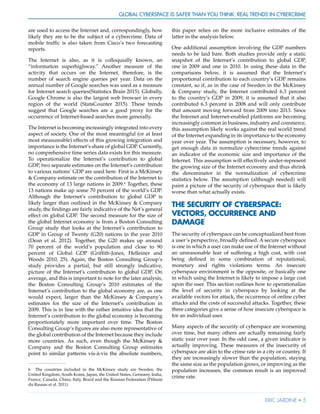
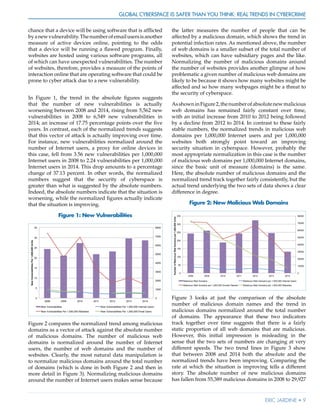
Table 2 presents some basic summary statistics on the
various indicators of the insecurity of cyberspace.
Vectors of Attack
New vulnerabilities are exploitable points in the
software code underwriting a program that can provide
a cybercriminal with unwanted access to a device.7
New
vulnerabilities are distinct from zero-day vulnerabilities
in that they are publicly known. Companies provide
routine updates to their programs (Microsoft updates
roughly every Wednesday, for example). These updates
often include patches for newly discovered vulnerabilities.
Failure to update a program can lead to serious problems,
as cybercriminals can exploit peoples’ sluggish behaviour
to infect a system through these publicly known, but
inadequately patched, weak points. Data on new
vulnerabilities from 2008 to 2014 are taken from the 2009
through 2015 Norton Symantec Internet Security Threat
Reports (Norton Symantec 2009; 2010; 2011; 2012; 2013;
2014; 2015).
7	 In the case of the various vulnerabilities discussed in this paper, the
numbers are a count of the new vulnerabilities for that year and not a
count of all the vulnerabilities that have ever been discovered.
Table 2: Summary Statistics for the Security of Cyberspace
Minimum Maximum Mean Standard Deviation
New Vulnerabilities 4,814 6,787 5,749 781.880
Malicious Web Domains 29,927 74,000 53,317 13,769.99
Zero-day Vulnerabilities 8 24 14.85714 6.336
New Browser Vulnerabilities 232 891 513 240.570
Mobile Vulnerabilities 115 416 217.35 120.85
Botnets 1,900,000 9,437,536 4,485,843 2,724,254
Web-based Attacks 23,680,646 1,432,660,467 907,597,833 702,817,362
Average per Capita Cost 188 214 202.5 8.893818078
Organizational Cost 5,403,644 7,240,000 6,233,941 753,057
Detection and Escalation Costs 264,280 455,304 372,272 83,331
Response Costs 1,294,702 1,738,761 1,511,804 152,502.2526
Lost Business Costs 3,010,000 4,592,214 3,827,732 782,084
Victim Notification Costs 497,758 565,020 523,965 30,342
Global Cyberspace Is Safer than You Think: Real Trends in Cybercrime
Eric Jardine • 7
Malicious web domains are domains that have known bits
of malicious code embedded within them. This code is
designed to infect a visiting user’s computer with a virus.
Malicious web domains are a passive vector of attack
for cybercriminals because they require that the user go
to an infected domain. Nevertheless, this can still be a
potent avenue of attack. Data on malicious web domains
are taken from the 2009 through 2015 Norton Symantec
Internet Security Threat Reports (ibid.).
Newzero-dayvulnerabilitiesarevulnerabilitiesinsoftware
code that are as of yet unknown. The “zero day” part of
the name refers to the fact that there have been zero days
available to provide a patch that fixes the vulnerability.
Zero-day vulnerabilities are fairly rare and quite valuable.
Cybercriminals that gain access to a zero-day vulnerability
can attack computers easily, as there is no defence against
this exploitation; therefore, they are a highly potent vector
of attack. Data on zero-day vulnerabilities are taken from
the 2009 through 2015 Norton Symantec Internet Security
Threat Reports (ibid.).
New browser vulnerabilities are weak points in the code
of web browsers, such as Google, Safari and Internet
Explorer. As most of the top level of the Internet is digested
via a web browser, they are useful avenues for attack by
cybercriminals. The data on web browser vulnerabilities
are taken from the 2009 through 2015 Norton Symantec
Internet Security Threat Reports (ibid.).8
New mobile vulnerabilities refer to vulnerabilities that
are specific to mobile devices, such as Android devices
or iPhones, rather than laptops and desktop computers.
The data on mobile vulnerabilities are taken from the 2009
through 2015 Norton Symantec Internet Security Threat
Reports (ibid.).
Occurrence of Cyber Attacks
Botnets are computers that have been infected by a virus
that allows them to be hijacked and used remotely by a
third party for some illicit purpose. Botnets are often
employed in distributed denial of service (DDoS) attacks,
which require that a large number of requests be made of
a website in a short period of time. Botnets are also often
used to send spam emails. To become a part of a botnet,
an online device needs to have been the subject of a cyber
attack. A measure of botnet computers is one way to get at
8	 There is a major discrepancy in the Norton 2013 report compared
to the Norton 2014 report. The 2013 report indicates that new browser
vulnerabilities rose from 591 in 2011 to 891 in 2012 before falling to
351 in 2013. The 2014 report indicates that new browser vulnerabilities
rose from 351 in 2011 to 891 in 2012 before declining to 591 in 2013. The
paper retains the earlier, 2013, data because it actually works against
the hypothesis that the security of cyberspace is better than the absolute
numbers by moving a higher number earlier in time. In the tests below,
using the 2014 data only changes the magnitude, and not the direction, of
the relationship.
the number of victims of a crime, although certainly not
the only one. The number of botnet computers, therefore,
gives a sense of the occurrence of successful cyber attacks.
Data on botnets are taken from the 2009 through 2015
Norton Symantec Internet Security Threat Reports (ibid.).
Recorded web-based attacks are cyber attacks that were
launched against one part of the network from an online
source and are a good measure of the occurrence of cyber
attacks. These attacks exclude cyber attacks that result
from, say, the use of an infected USB key. Web-based
attacks provide a picture of the overall occurrence of cyber
attacks, although, due to reporting problems and the
fact that cybercriminals often try to have their attacks go
unnoticed, the actual number of attacks is probably higher
than the recorded figure. Data on web-based attacks are
drawn from the IT security firm Kaspersky Lab’s “Security
Bulletin” reports (Kaspersky Lab 2008; 2009; 2010; 2011;
2012; 2013; 2014).
The Damage of Cybercrime
The concept of the damage done by cybercrime is
operationalized in five ways. This paper focuses
exclusively on the cost of data breaches for companies,
although this is certainly not the be-all and end-all of the
costs cybercrime imposes on to users of the Internet. All
the data on breaches is taken from the Ponemon Institute’s
annual Cost of Data Breach Study, which records the overall
cost of data breaches (Ponemon Institute 2011; 2013;
2014). Unfortunately, the Ponemon Institute only started
collecting a global sample in 2013 and previously only
collected the costs associated with US data breaches. The
United States is still in the later global assessments, so
for the purpose of over-time comparability, only the US
numbers are included in the analysis below. Due to the
overall lack of statistics on data breach costs, this paper
makes the assumption that the US cost of cybercrime data
is indicative of the world’s costs. In reality, the average costs
for the world are almost certainly far lower than the US
costs. For example, in 2013, the organizational cost of data
breaches in the United States was US$5,850,000. Globally,
the average based on the weighted numbers from the later
Ponemon Institute studies, including the United States, is
US$2,282,095, or a difference of over twice as much. Using
the US numbers, in other words, will overstate the costs of
cybercrime and actually work against the argument herein
that the security of cyberspace is better than the impression
given by the absolute numbers.
Before turning to a discussion of the various measures used
to operationalize the cost of cybercrime, it is important to
note two additional limitations to the statistics collected
on data breaches. The companies studied vary from
year to year, as does the number of companies that are
observed. Clearly, from a methodological point of view,
this is not ideal, as the shifting foundational sands of
the studies means that the inter-year samples are not
GLOBAL COMMISSION ON INTERNET GOVERNANCE Paper Series: no. 16 — July 2015
8 • CENTRE FOR INTERNATIONAL GOVERNANCE INNOVATION • CHATHAM HOUSE
strictly comparable. Another limitation is that the studies
exclude “mega breaches,” or those involving more
than 100,000 breached records in a single attack. This
restriction essentially excludes high-damage but low-
probability events in favour of the more representative
high-probability but comparatively low-damage events
that occur most of the time. Despite all these limitations,
the Ponemon Institute’s studies of the cost of data breaches
are the best publicly available data on the overtime costs
of data breaches.
The first operational measure of the cost of cybercrime
is the average cost for a company per breached record.
This measure shows the organization’s cost divided by
the number of compromised files. This measure is one
way to show how much an organization has to pay as a
consequence of cybercrime.
Another way to portray this cost — and the second
measure of the costs of cybercrime — is the overall average
organizational cost of data breaches in a given year. This
figure is basically the total price tag of dealing with data
breaches. It is a good measure of the cost of cybercrime
because it quantifies the absolute cost that a company
needs to pay as a result of online criminal behaviour.
A third measure of the costs of cybercrime involves a
company’s detection and escalation costs. Data breaches
are bad; undetected data breaches are worse. Companies
invest considerable resources into IT security so that they
can detect data breaches, and, if warranted, act to repel
them, although these sums are not necessarily sufficient.
This is a good measure of the cost of cybercrime because it
involves the investment that companies need to undertake
since they operate in an environment with less than perfect
security.
A fourth measure is the cost that an organization needs
to pay after a data breach in order to fix any damage
done. Cybercrime can often result in damage to software
and computer hardware. This is a good measure of the
cost of cybercrime, because, like a broken window after a
burglar breaks into a person’s home, the damage done by
cybercrime is not just a result of what is stolen.
A fifth measure of the costs of cybercrime is the cost of lost
business. Companies, in particular those that provide an
online service, rely on the public’s perception that their
services are trustworthy. If the public thinks that using
a company’s services will lead to a loss of personal or
financial information, individuals are likely to choose
other service providers or cease that activity entirely. The
cost of lost business as a result of the occurrence of data
breaches is a good measure of the sort of second-order
effect of cybercrime on a company’s balance sheet.
A final measure of the costs of cybercrime is the cost of
notifying victims that their records, be they personal,
financial or otherwise, have been compromised in a data
breach. Even though companies might have an incentive
to cover up a data breach for fear of losing business, many
are legally obliged to inform those individuals that have
had their information compromised.
TRENDS IN THE VECTORS OF ATTACK:
VULNERABILITIES AND MALICIOUS
SITES
This section compares the absolute numbers for the
various vectors of attack against the normalized trend. In
every case, the normalized trends presents a picture of the
security of cyberspace that is better than the one presented
by the un-normalized absolute figures.
This section looks at vectors of cyber attack, which are
basically the ways in which cyber attacks can occur to
an Internet user. The relative number of ways in which
an Internet user can be attacked are declining, given
the growing size of the Internet. One way to think
of this is to imagine a city with a number of high-
crime neighbourhoods. If the city is made up of 10
neighbourhoods and five of them are dangerous, then the
crime rate is 50 percent. If the city grows (as cyberspace
has grown) faster than the number of bad neighbourhoods,
then the crime rate declines and people are relatively
safer. Imagine the hypothetical city grows in size to
15 neighbourhoods, but the number of high-crime areas
stays at five. The new crime rate is only 33 percent. The city
is safer as a result and a person’s chance of being subject
to a crime declines. Cybercrime vectors are like the high-
crime neighbourhoods.
The analysis below undertakes a number of different
normalizations for each measure of the security of
cyberspace. A justification for each normalization is
provided in each section. Multiple normalizations are used,
rather than just a single one for each measure of cybercrime,
because there is not an agreed-upon denominator that
makes the most sense across the different measures. So,
in the interest of painting the broadest possible picture
and of forestalling the notion that this paper uses only
the normalizations that support its argument, several
normalizations per cybercrime measure are included.
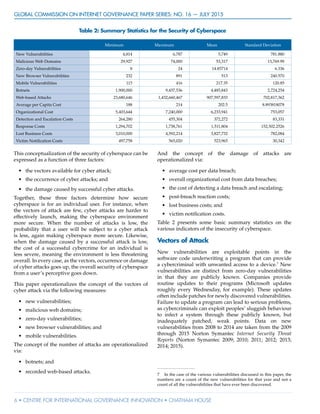
Figure 1 normalizes new vulnerabilities as a vector of attack
around the number of Internet users, the number of email
users and the number of websites. Since vulnerabilities
are weaknesses in computer code, the ideal denominator
for new vulnerabilities would be the number of software
programs that are in use around the world. Unfortunately,
the number of programs is not even partially known. In
the absence of this data, Internet users, email users and
websites will have to do. The number of Internet users
gives an (admittedly partial) impression of the number
of devices that are operating online and so indicates the
Global Cyberspace Is Safer than You Think: Real Trends in Cybercrime
Eric Jardine • 9
chance that a device will be using software that is afflicted
byanewvulnerability.Thenumberofemailusersisanother
measure of active devices online, pointing to the odds
that a device will be running a flawed program. Finally,
websites are hosted using various software programs, all
of which can have unexpected vulnerabilities. The number
of websites, therefore, provides a measure of the points of
interaction online that are operating software that could be
prone to cyber attack due to a new vulnerability.
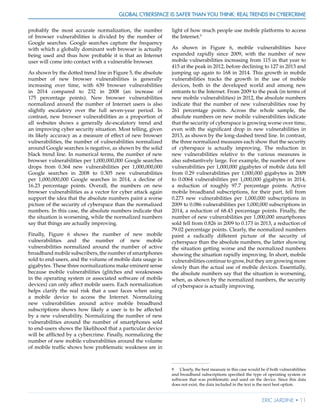
In Figure 1, the trend in the absolute figures suggests
that the number of new vulnerabilities is actually
worsening between 2008 and 2014, rising from 5,562 new
vulnerabilities in 2008 to 6,549 new vulnerabilities in
2014; an increase of 17.75 percentage points over the five
years. In contrast, each of the normalized trends suggests
that this vector of attack is actually improving over time.
For instance, new vulnerabilities normalized around the
number of Internet users, a proxy for online devices in
this case, fell from 3.56 new vulnerabilities per 1,000,000
Internet users in 2008 to 2.24 vulnerabilities per 1,000,000
Internet users in 2014. This drop amounts to a percentage
change of 37.13 percent. In other words, the normalized
numbers suggest that the security of cyberspace is
greater than what is suggested by the absolute numbers.
Indeed, the absolute numbers indicate that the situation is
worsening, while the normalized figures actually indicate
that the situation is improving.
Figure 1: New Vulnerabilities
0
1000
2000
3000
4000
5000
6000
7000
8000
0
5
10
15
20
25
30
35
2008 2009 2010 2011 2012 2013 2014
NewVulnerabilitiesPer1,000,000Units
New Vulnerabilities New Vulnerabilities Per 1,000,000 Internet Users
New Vulnerabilities Per 1,000,000 Websites New Vulnerabilities Per 1,000,000 Email Users
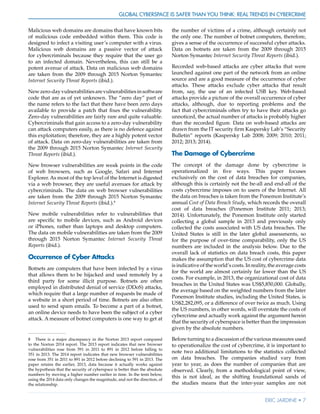
Figure 2 compares the normalized trend among malicious
domains as a vector of attack against the absolute number
of malicious domains. The number of malicious web
domains is normalized around the number of Internet
users, the number of web domains and the number of
websites. Clearly, the most natural data manipulation is
to normalize malicious domains around the total number
of domains (which is done in both Figure 2 and then in
more detail in Figure 3). Normalizing malicious domains
around the number of Internet users makes sense because
the latter measures the number of people that can be
affected by a malicious domain, which shows the trend in
potential infection rates. As mentioned above, the number
of web domains is a smaller subset of the total number of
websites, which can have subsidiary pages and the like.
Normalizing the number of malicious domains around
the number of websites provides another glimpse of how
problematic a given number of malicious web domains are
likely to be because it shows how many websites might be
affected and so how many webpages might be a threat to
the security of cyberspace.
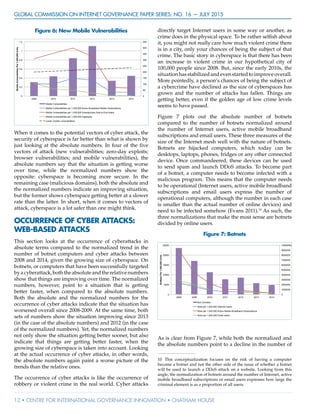
AsshowninFigure2,thenumberofabsolutenewmalicious
web domains has remained fairly constant over time,
with an initial increase from 2010 to 2012 being followed
by a decline from 2012 to 2014. In contrast to these fairly
stable numbers, the normalized trends in malicious web
domains per 1,000,000 Internet users and per 1,000,000
websites both strongly point toward an improving
security situation in cyberspace. However, probably the
most appropriate normalization in this case is the number
of malicious web domains per 1,000,000 Internet domains,
since the basic unit of measure (domains) is the same.
Here, the absolute number of malicious domains and the
normalized trend track together fairly consistently, but the
actual trend underlying the two sets of data shows a clear
difference in degree.
Figure 2: New Malicious Web Domains
0
10000
20000
30000
40000
50000
60000
70000
80000
0
50
100
150
200
250
300
350
2008 2009 2010 2011 2012 2013 2014
NumberofMaliciousWebDomainsper1,000,000Units
Malicious Web Domains Malicious Web Domains per 1,000,000 Internet Users
Malicious Web Domains per 1,000,000 Domain Names Malicious Web Domains per 1,000,000 Websites
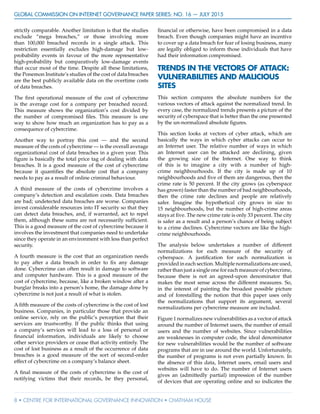
Figure 3 looks at just the comparison of the absolute
number of malicious domain names and the trend in
malicious domains normalized around the total number
of domains. The appearance that these two indicators
track together over time suggests that there is a fairly
static proportion of all web domains that are malicious.
However, this initial impression is misleading in the
sense that the two sets of numbers are changing at very
different speeds. The two trend lines in Figure 3 show
that between 2008 and 2014 both the absolute and the
normalized trends have been improving. Comparing the
rate at which the situation is improving tells a different
story. The absolute number of new malicious domains
has fallen from 55,389 malicious domains in 2008 to 29,927
GLOBAL COMMISSION ON INTERNET GOVERNANCE Paper Series: no. 16 — July 2015
10 • CENTRE FOR INTERNATIONAL GOVERNANCE INNOVATION • CHATHAM HOUSE
malicious domains in 2014, a decline of 45.96 percent.
In contrast, the normalized numbers fell from 312.93
malicious domains per 1,000,000 domains in 2008 to only
103.91 malicious domains per 1,000,000 domains in 2014,
which amounts to a decline of 66.79 percentage points. As
with the new vulnerabilities, the data from Figures 2 and 3
support the idea that the absolute numbers overrepresent
the insecurity of cyberspace compared to the normalized
trends by showing the picture improving more slowly
than is actually the case.
Figure 3: Normalized versus Absolute Domains
0
10000
20000
30000
40000
50000
60000
70000
80000
0
50
100
150
200
250
300
350
2008 2009 2010 2011 2012 2013 2014
NumberofMaliciousDomainNamesper1,000,000
Domains
Malicious Web Domains
Malicious Web Domains per 1,000,000 Domain Names
Linear (Malicious Web Domains)
Linear (Malicious Web Domains per 1,000,000 Domain Names)
Figure 4 presents the data on the number of zero-day
vulnerabilities normalized around the number of Internet
users, web domains and the number of websites, and
contrasts these numbers with the absolute trend. As
with new vulnerabilities, the best measure to normalize
zero-day vulnerabilities around would be the number of
software programs used in the world, the data for which
does not exist. Nevertheless, since zero-day vulnerabilities
are weaknesses in computer code, the normalization
that makes the most sense is the number of zero-days
per 1,000,000 websites, since websites rely on a growing
number of software platforms (think of the Heartbleed
zero-day exploit in Secure Sockets Layer [SSL] in 2014). In
the interest of presenting the broadest possible story, the
number of zero-day vulnerabilities normalized around the
number of Internet users and email users are also included
(both proxies for the number of potentially vulnerable
devices operating various pieces of software).
The dotted trend line in Figure 4 shows that over time
the absolute number of zero-day vulnerabilities is
getting larger, suggesting a worsening cyber security
environment. This finding is mirrored by the trend in
zero-day vulnerabilities per 1,000,000 email users and per
1,000,000 Internet users. However, the trend in zero-day
vulnerabilities per 1,000,000 websites is actually declining
over time, despite a jump upward in 2013. To the extent
that normalizing the number of zero-day vulnerabilities
around the number of online websites is the most accurate
measure of this vector of cyberattack, the fact that the
trend is negative suggests that, as is the case with the other
measures, the security of cyberspace is improving over
time even as the absolute number of zero-day exploits
increases.
Figure 4: New Zero-day Vulnerabilities
0
5
10
15
20
25
30
0
0.02
0.04
0.06
0.08
0.1
0.12
2008 2009 2010 2011 2012 2013 2014
Zero-DayVulnerabilitiesper1,000,000Units
Zero-day vulnerabilities Zero Days per 1,000,000 Internet Users
Zero Days per 1,000,000 Email Users Zero Days per 1,000,000 Websites
Linear (Zero-day vulnerabilities ) Linear (Zero Days per 1,000,000 Websites)
Figure 5: New Browser Vulnerabilities
0
100
200
300
400
500
600
700
800
900
1000
0.000000
0.200000
0.400000
0.600000
0.800000
1.000000
1.200000
1.400000
1.600000
1.800000
2008 2009 2010 2011 2012 2013 2014
NumberofNewBrowserVulnerabilitiesper'X'Units
New Browser Vulnerabilities
New Browser Vulnerabilities per 1,000,000,000 Google Searches
New Browser Vulnerabilities per 1,000,000 Internet Users
New Browser Vulnerabilities per 1,000,000 Websites
Linear (New Browser Vulnerabilities)
Linear (New Browser Vulnerabilities per 1,000,000,000 Google Searches)
Figure 5 summarizes the data on browser vulnerabilities
as a vector of cyber attack, depicting both the absolute
numbers and the number of new browser vulnerabilities
normalized around the number of Internet users, the
number of websites and the number of Google searches.
The number of new browser vulnerabilities are normalized
around the number of Internet users because this
manipulation of the data shows the rate at which people
will come into contact with vulnerable browsers (not
accounting for the fact that different browsers are used
more frequently than others). The number of new browser
vulnerabilities are normalized around the number of
websites because these are the points of online interaction
that people are trying to reach via a web browser. The
more websites that exist, the more people will be pulled
to use a web browser and so the larger the potential that
a browser will affect an online device. Finally, in what is
Global Cyberspace Is Safer than You Think: Real Trends in Cybercrime
Eric Jardine • 11
probably the most accurate normalization, the number
of browser vulnerabilities is divided by the number of
Google searches. Google searches capture the frequency
with which a globally dominant web browser is actually
being used and thus how probable it is that an Internet
user will come into contact with a vulnerable browser.
As shown by the dotted trend line in Figure 5, the absolute
number of new browser vulnerabilities is generally
increasing over time, with 639 browser vulnerabilities
in 2014 compared to 232 in 2008 (an increase of
175 percentage points). New browser vulnerabilities
normalized around the number of Internet users is also
slightly escalatory over the full seven-year period. In
contrast, new browser vulnerabilities as a proportion of
all websites shows a generally de-escalatory trend and
an improving cyber security situation. Most telling, given
its likely accuracy as a measure of effect of new browser
vulnerabilities, the number of vulnerabilities normalized
around Google searches is negative, as shown by the solid
black trend line. In numerical terms, the number of new
browser vulnerabilities per 1,000,000,000 Google searches
drops from 0.364 new vulnerabilities per 1,000,000,000
Google searches in 2008 to 0.305 new vulnerabilities
per 1,000,000,000 Google searches in 2014, a decline of
16.23 percentage points. Overall, the numbers on new
browser vulnerabilities as a vector for cyber attack again
support the idea that the absolute numbers paint a worse
picture of the security of cyberspace than the normalized
numbers. In this case, the absolute numbers indicate that
the situation is worsening, while the normalized numbers
say that things are actually improving.
Finally, Figure 6 shows the number of new mobile
vulnerabilities and the number of new mobile
vulnerabilities normalized around the number of active
broadband mobile subscribers, the number of smartphones
sold to end-users, and the volume of mobile data usage in
gigabytes. These three normalizations make eminent sense
because mobile vulnerabilities (glitches and weaknesses
in the operating system or associated software of mobile
devices) can only affect mobile users. Each normalization
helps clarify the real risk that a user faces when using
a mobile device to access the Internet. Normalizing
new vulnerabilities around active mobile broadband
subscriptions shows how likely a user is to be affected
by a new vulnerability. Normalizing the number of new
vulnerabilities around the number of smartphones sold
to end-users shows the likelihood that a particular device
will be afflicted by a cybercrime. Finally, normalizing the
number of new mobile vulnerabilities around the volume
of mobile traffic shows how problematic weakness are in
light of how much people use mobile platforms to access
the Internet.9
As shown in Figure 6, mobile vulnerabilities have
expanded rapidly since 2009, with the number of new
mobile vulnerabilities increasing from 115 in that year to
415 at the peak in 2012, before declining to 127 in 2013 and
jumping up again to 168 in 2014. This growth in mobile
vulnerabilities tracks the growth in the use of mobile
devices, both in the developed world and among new
entrants to the Internet. From 2009 to the peak (in terms of
new mobile vulnerabilities) in 2012, the absolute numbers
indicate that the number of new vulnerabilities rose by
261 percentage points. Across the whole sample, the
absolute numbers on new mobile vulnerabilities indicate
that the security of cyberspace is growing worse over time,
even with the significant drop in new vulnerabilities in
2013, as shown by the long-dashed trend line. In contrast,
the three normalized measures each show that the security
of cyberspace is actually improving. The reduction in
new vulnerabilities relative to the various measures is
also substantively large. For example, the number of new
vulnerabilities per 1,000,000 gigabytes of mobile data fell
from 0.29 vulnerabilities per 1,000,000 gigabytes in 2009
to 0.0064 vulnerabilities per 1,000,000 gigabytes in 2014,
a reduction of roughly 97.7 percentage points. Active
mobile broadband subscriptions, for their part, fell from
0.273 new vulnerabilities per 1,000,000 subscriptions in
2009 to 0.086 vulnerabilities per 1,000,000 subscriptions in
2014, a reduction of 68.43 percentage points. Finally, the
number of new vulnerabilities per 1,000,000 smartphones
sold fell from 0.826 in 2009 to 0.173 in 2013, a reduction of
79.02 percentage points. Clearly, the normalized numbers
paint a radically different picture of the security of
cyberspace than the absolute numbers, the latter showing
the situation getting worse and the normalized numbers
showing the situation rapidly improving. In short, mobile
vulnerabilities continue to grow, but they are growing more
slowly than the actual use of mobile devices. Essentially,
the absolute numbers say that the situation is worsening,
when, as shown by the normalized numbers, the security
of cyberspace is actually improving.
9	 Clearly, the best measure in this case would be if both vulnerabilities
and broadband subscriptions specified the type of operating system or
software that was problematic and used on the device. Since this data
does not exist, the data included in the text is the next best option.
GLOBAL COMMISSION ON INTERNET GOVERNANCE Paper Series: no. 16 — July 2015
12 • CENTRE FOR INTERNATIONAL GOVERNANCE INNOVATION • CHATHAM HOUSE
Figure 6: New Mobile Vulnerabilities
0
50
100
150
200
250
300
350
400
450
0
0.2
0.4
0.6
0.8
1
1.2
2009 2010 2011 2012 2013 2014
MobileVulnerabilitiesPer1,000,000Units
Mobile Vulnerabilities
Mobile Vulnerabilities per 1,000,000 Active Broadband Mobile Subscriptions
Mobile Vulnerabilities per 1,000,000 Smartphones Sold to End-Users
Mobile Vulnerabilities per 1,000,000 Gigabytes
Linear (mobile vulnerabilities)
When it comes to the potential vectors of cyber attack, the
security of cyberspace is far better than what is shown by
just looking at the absolute numbers. In four of the five
vectors of attack (new vulnerabilities; zero-day exploits;
browser vulnerabilities; and mobile vulnerabilities), the
absolute numbers say that the situation is getting worse
over time, while the normalized numbers show the
opposite: cyberspace is becoming more secure. In the
remaining case (malicious domains), both the absolute and
the normalized numbers indicate an improving situation,
but the former shows cyberspace getting better at a slower
rate than the latter. In short, when it comes to vectors of
attack, cyberspace is a lot safer than one might think.
OCCURRENCE OF CYBER ATTACKS:
WEB-BASED ATTACKS
This section looks at the occurrence of cyberattacks in
absolute terms compared to the normalized trend in the
number of botnet computers and cyber attacks between
2008 and 2014, given the growing size of cyberspace. On
botnets, or computers that have been successfully targeted
byacyberattack,boththeabsoluteandtherelativenumbers
show that things are improving over time. The normalized
numbers, however, point to a situation that is getting
better faster, when compared to the absolute numbers.
Both the absolute and the normalized numbers for the
occurrence of cyber attacks indicate that the situation has
worsened overall since 2008-2009. At the same time, both
sets of numbers show the situation improving since 2013
(in the case of the absolute numbers) and 2012 (in the case
of the normalized numbers). Yet, the normalized numbers
not only show the situation getting better sooner, but also
indicate that things are getting better faster, when the
growing size of cyberspace is taken into account. Looking
at the actual occurrence of cyber attacks, in other words,
the absolute numbers again paint a worse picture of the
trends than the relative ones.
The occurrence of cyber attacks is like the occurrence of
robbery or violent crime in the real world. Cyber attacks
directly target Internet users in some way or another, as
crime does in the physical space. To be rather selfish about
it, you might not really care how much violent crime there
is in a city, only your chances of being the subject of that
crime. The basic story in cyberspace is that there has been
an increase in violent crime in our hypothetical city of
100,000 people since 2008. But, since the early 2010s, the
situationhasstabilizedandevenstartedtoimproveoverall.
More pointedly, a person’s chances of being the subject of
a cybercrime have declined as the size of cyberspaces has
grown and the number of attacks has fallen. Things are
getting better, even if the golden age of low crime levels
seems to have passed.
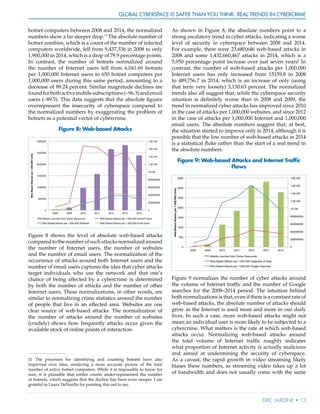
Figure 7 plots out the absolute number of botnets
compared to the number of botnets normalized around
the number of Internet users, active mobile broadband
subscriptions and email users. These three measures of the
size of the Internet mesh well with the nature of botnets.
Botnets are hijacked computers, which today can be
desktops, laptops, phones, fridges or any other connected
device. Once commandeered, these devices can be used
to send spam and launch DDoS attacks. To become part
of a botnet, a computer needs to become infected with a
malicious program. This means that the computer needs
to be operational (Internet users, active mobile broadband
subscriptions and email users express the number of
operational computers, although the number in each case
is smaller than the actual number of online devices) and
need to be infected somehow (Evans 2011).10
As such, the
three normalizations that make the most sense are botnets
divided by online users.
Figure 7: Botnets
0
1000000
2000000
3000000
4000000
5000000
6000000
7000000
8000000
9000000
10000000
0
5000
10000
15000
20000
25000
2008 2009 2010 2011 2012 2013 2014
BotNetsPer1,000,000Units
Bot Zombies
Bots per 1,000,000 Internet Users
Bots per 1,000,000 Active Mobile Broadband Subscriptions
Bots per 1,000,000 Email Users
As is clear from Figure 7, while both the normalized and
the absolute numbers point to a decline in the number of
10	 This conceptualization focuses on the risk of having a computer
become a botnet and not the other side of the issue of whether a botnet
will be used to launch a DDoS attack on a website. Looking from this
angle, the normalization of botnets around the number of Internet, active
mobile broadband subscriptions or email users expresses how large the
criminal element is as a proportion of all users.
Global Cyberspace Is Safer than You Think: Real Trends in Cybercrime
Eric Jardine • 13
botnet computers between 2008 and 2014, the normalized
numbers show a far steeper drop.11
The absolute number of
botnet zombies, which is a count of the number of infected
computers worldwide, fell from 9,437,536 in 2008 to only
1,900,000 in 2014, which is a drop of 79.9 percentage points.
In contrast, the number of botnets normalized around
the number of Internet users fell from 6,041.69 botnets
per 1,000,000 Internet users to 650 botnet computers per
1,000,000 users during this same period, amounting to a
decrease of 89.24 percent. Similar magnitude declines are
foundforbothactivemobilesubscriptions(–96.3)andemail
users (–89.5). This data suggests that the absolute figures
overrepresent the insecurity of cyberspace compared to
the normalized numbers by exaggerating the problem of
botnets as a potential vector of cybercrime.
Figure 8: Web-based Attacks
0
200000000
400000000
600000000
800000000
1E+09
1.2E+09
1.4E+09
1.6E+09
1.8E+09
0
500000
1000000
1500000
2000000
2500000
3000000
2008 2009 2010 2011 2012 2013 2014
Web-BasedAttacksper1,000,000Units
Attacks Lauched from Online Resources Web-Based Attacks per 1,000,000 Internet Users
Web-Based Attacks per 1,000,000 Websites Web-Based Attacks per 1,000,000 Email Users
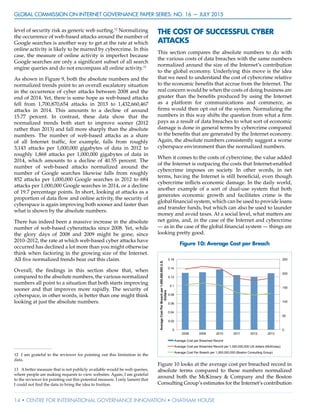
Figure 8 shows the level of absolute web-based attacks
comparedtothenumberofsuchattacksnormalizedaround
the number of Internet users, the number of websites
and the number of email users. The normalization of the
occurrence of attacks around both Internet users and the
number of email users captures the idea that cyber attacks
target individuals who use the network and that one’s
chance of being affected by a cybercrime is determined
by both the number of attacks and the number of other
Internet users. These normalizations, in other words, are
similar to normalizing crime statistics around the number
of people that live in an affected area. Websites are one
clear source of web-based attacks. The normalization of
the number of attacks around the number of websites
(crudely) shows how frequently attacks occur given the
available stock of online points of interaction.
11	The processes for identifying and counting botnets have also
improved over time, rendering a more accurate picture of the total
number of active botnet computers. While it is impossible to know for
sure, it is plausible that earlier counts under-represented the number
of botnets, which suggests that the decline has been even steeper. I am
grateful to Laura DeNardis for pointing this out to me.
As shown in Figure 8, the absolute numbers point to a
strong escalatory trend in cyber attacks, indicating a worse
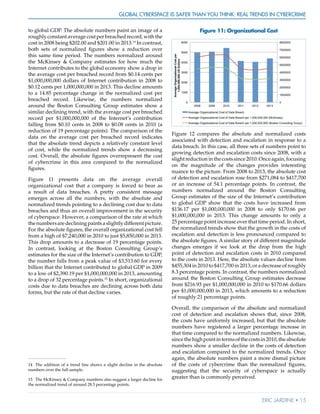
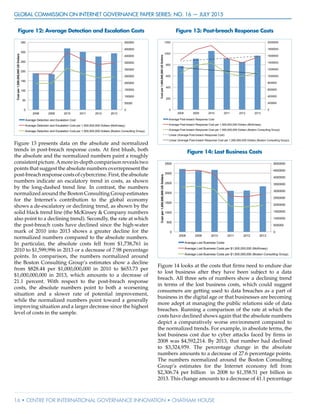
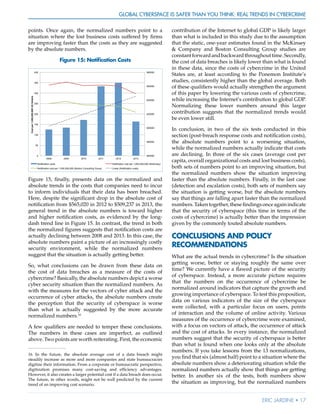
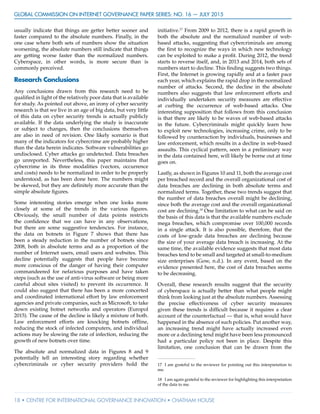
level of security in cyberspace between 2008 and 2014.
For example, there were 23,680,646 web-based attacks in
2008 and some 1,432,660,467 attacks in 2014, which is a
5,950 percentage point increase over just seven years! In
contrast, the number of web-based attacks per 1,000,000
Internet users has only increased from 15159.8 in 2008
to 489,756.7 in 2014, which is an increase of only (using
that term very loosely) 3,130.63 percent. The normalized
trends also all suggest that, while the cyberspace security
situation is definitely worse than in 2008 and 2009, the
trend in normalized cyber attacks has improved since 2010
in the case of attacks per 1,000,000 websites, and since 2012
in the case of attacks per 1,000,000 Internet and 1,000,000
email users. The absolute numbers suggest that, at best,
the situation started to improve only in 2014, although it is
possible that the low number of web-based attacks in 2014
is a statistical fluke rather than the start of a real trend in
the absolute numbers.
Figure 9: Web-based Attacks and Internet Traffic
Flows
0
200000000
400000000
600000000
800000000
1E+09
1.2E+09
1.4E+09
1.6E+09
1.8E+09
0
500
1000
1500
2000
2500
3000
3500
2008 2009 2010 2011 2012 2013 2014
Web-BasedAttacksper1,000,000Units
Attacks Lauched from Online Resources
Web-Based Attacks per 1,000,000 Gigabytes of Data
Web-Based Attacks per 1,000,000 Google Searches
Figure 9 normalizes the number of cyber attacks around
the volume of Internet traffic and the number of Google
searches for the 2008–2014 period. The intuition behind
both normalizations is that, even if there is a constant rate of
web-based attacks, the absolute number of attacks should
grow as the Internet is used more and more in our daily
lives. In such a case, more web-based attacks might not
mean an individual user is more likely to be subjected to a
cybercrime. What matters is the rate at which web-based
attacks occur. Normalizing web-based attacks around
the total volume of Internet traffic roughly indicates
what proportion of Internet activity is actually malicious
and aimed at undermining the security of cyberspace.
As a caveat, the rapid growth in video streaming likely
biases these numbers, as streaming video takes up a lot
of bandwidth and does not usually come with the same
GLOBAL COMMISSION ON INTERNET GOVERNANCE Paper Series: no. 16 — July 2015
14 • CENTRE FOR INTERNATIONAL GOVERNANCE INNOVATION • CHATHAM HOUSE
level of security risk as generic web surfing.12
Normalizing
the occurrence of web-based attacks around the number of
Google searches is another way to get at the rate at which
online activity is likely to be marred by cybercrime. In this
case, the measure of online activity is imperfect because
Google searches are only a significant subset of all search
engine queries and do not encompass all online activity.13
As shown in Figure 9, both the absolute numbers and the
normalized trends point to an overall escalatory situation
in the occurrence of cyber attacks between 2008 and the
end of 2014. Yet, there is some hope as web-based attacks
fell from 1,700,870,654 attacks in 2013 to 1,432,660,467
attacks in 2014. This amounts to a decline of around
15.77 percent. In contrast, these data show that the
normalized trends both start to improve sooner (2012
rather than 2013) and fall more sharply than the absolute
numbers. The number of web-based attacks as a share
of all Internet traffic, for example, falls from roughly
3,143 attacks per 1,000,000 gigabytes of data in 2012 to
roughly 1,868 attacks per 1,000,000 gigabytes of data in
2014, which amounts to a decline of 40.55 percent. The
number of web-based attacks normalized around the
number of Google searches likewise falls from roughly
852 attacks per 1,000,000 Google searches in 2012 to 684
attacks per 1,000,000 Google searches in 2014, or a decline
of 19.7 percentage points. In short, looking at attacks as a
proportion of data flow and online activity, the security of
cyberspace is again improving both sooner and faster than
what is shown by the absolute numbers.
There has indeed been a massive increase in the absolute
number of web-based cyberattacks since 2008. Yet, while
the glory days of 2008 and 2009 might be gone, since
2010–2012, the rate at which web-based cyber attacks have
occurred has declined a lot more than you might otherwise
think when factoring in the growing size of the Internet.
All five normalized trends bear out this claim.
Overall, the findings in this section show that, when
compared to the absolute numbers, the various normalized
numbers all point to a situation that both starts improving
sooner and that improves more rapidly. The security of
cyberspace, in other words, is better than one might think
looking at just the absolute numbers.
12	 I am grateful to the reviewer for pointing out this limitation in the
data.
13	 A better measure that is not publicly available would be web queries,
where people are making requests to view websites. Again, I am grateful
to the reviewer for pointing out this potential measure. I only lament that
I could not find the data to bring the idea to fruition.
THE COST OF SUCCESSFUL CYBER
ATTACKS
This section compares the absolute numbers to do with
the various costs of data breaches with the same numbers
normalized around the size of the Internet’s contribution
to the global economy. Underlying this move is the idea
that we need to understand the cost of cybercrime relative
to the economic benefits that accrue from the Internet. The
real concern would be when the costs of doing business are
greater than the benefits produced by using the Internet
as a platform for communications and commerce, as
firms would then opt out of the system. Normalizing the
numbers in this way shifts the question from what a firm
pays as a result of data breaches to what sort of economic
damage is done in general terms by cybercrime compared
to the benefits that are generated by the Internet economy.
Again, the absolute numbers consistently suggest a worse
cyberspace environment than the normalized numbers.
When it comes to the costs of cybercrime, the value added
of the Internet is outpacing the costs that Internet-enabled
cybercrime imposes on society. In other words, in net
terms, having the Internet is still beneficial, even though
cybercrime inflicts economic damage. In the daily world,
another example of a sort of dual-use system that both
generates economic growth and facilitates crime is the
global financial system, which can be used to provide loans
and transfer funds, but which can also be used to launder
money and avoid taxes. At a social level, what matters are
net gains, and, in the case of the Internet and cybercrime
— as in the case of the global financial system — things are
looking pretty good.
Figure 10: Average Cost per Breach
0
50
100
150
200
250
0
0.02
0.04
0.06
0.08
0.1
0.12
0.14
0.16
2008 2009 2010 2011 2012 2013
AverageCostPerBreachper1,000,000,000U.S.
Dollars
Average Cost per Breached Record
Average Cost per Breached Record per 1,000,000,000 US dollars (McKinsey)
Average Cost Per Breach per 1,000,000,000 (Boston Consulting Group)
Figure 10 looks at the average cost per breached record in
absolute terms compared to these numbers normalized
around both the McKinsey & Company and the Boston
Consulting Group’s estimates for the Internet’s contribution
Global Cyberspace Is Safer than You Think: Real Trends in Cybercrime
Eric Jardine • 15
to global GDP. The absolute numbers paint an image of a
roughlyconstantaveragecostperbreachedrecord,withthe
cost in 2008 being $202.00 and $201.00 in 2013.14
In contrast,
both sets of normalized figures show a reduction over
this same time period. The numbers normalized around
the McKinsey & Company estimates for how much the
Internet contributes to the global economy show a drop in
the average cost per breached record from $0.14 cents per
$1,000,000,000 dollars of Internet contribution in 2008 to
$0.12 cents per 1,000,000,000 in 2013. This decline amounts
to a 14.85 percentage change in the normalized cost per
breached record. Likewise, the numbers normalized
around the Boston Consulting Group estimates show a
similar declining trend, with the average cost per breached
record per $1,000,000,000 of the Internet’s contribution
falling from $0.10 cents in 2008 to $0.08 cents in 2010 (a
reduction of 19 percentage points). The comparison of the
data on the average cost per breached record indicates
that the absolute trend depicts a relatively constant level
of cost, while the normalized trends show a decreasing
cost. Overall, the absolute figures overrepresent the cost
of cybercrime in this area compared to the normalized
figures.
Figure 11 presents data on the average overall
organizational cost that a company is forced to bear as
a result of data breaches. A pretty consistent message
emerges across all the numbers, with the absolute and
normalized trends pointing to a declining cost due to data
breaches and thus an overall improvement in the security
of cyberspace. However, a comparison of the rate at which
thenumbersaredecliningpaintsaslightlydifferentpicture.
For the absolute figures, the overall organizational cost fell
from a high of $7,240,000 in 2010 to just $5,850,000 in 2013.
This drop amounts to a decrease of 19 percentage points.
In contrast, looking at the Boston Consulting Group’s
estimates for the size of the Internet’s contribution to GDP,
the number falls from a peak value of $3,513.60 for every
billion that the Internet contributed to global GDP in 2009
to a low of $2,390.19 per $1,000,000,000 in 2013, amounting
to a drop of 32 percentage points.15
In short, organizational
costs due to data breaches are declining across both data
forms, but the rate of that decline varies.
14	 The addition of a trend line shows a slight decline in the absolute
numbers over the full sample.
15	 The McKinsey & Company numbers also suggest a larger decline for
the normalized trend of around 28.5 percentage points.
Figure 11: Organizational Cost
0
1000000
2000000
3000000
4000000
5000000
6000000
7000000
8000000
0
1000
2000
3000
4000
5000
6000
2008 2009 2010 2011 2012 2013
AverageOrganizationalCostper
1,000,000,000USDollars
Average Organizational Cost of Data Breach
Average Organizational Cost of Data Breach per 1,000,000,000 (McKinsey)
Average Organizational Cost of Data Breach per 1,000,000,000 (Boston Consulting Group)
Figure 12 compares the absolute and normalized costs
associated with detection and escalation in response to a
data breach. In this case, all three sets of numbers point to
growing detection and escalation costs since 2008, with a
slightreductioninthecostssince2010.Onceagain,focusing
on the magnitude of the changes provides interesting
nuance to the picture. From 2008 to 2013, the absolute cost
of detection and escalation rose from $271,084 to $417,700
or an increase of 54.1 percentage points. In contrast, the
numbers normalized around the Boston Consulting
Group estimates of the size of the Internet’s contribution
to global GDP show that the costs have increased from
$136.17 per $1,000,000,000 in 2008 to only $170.66 per
$1,000,000,000 in 2013. This change amounts to only a
25 percentage point increase over that time period. In short,
the normalized trends show that the growth in the costs of
escalation and detection is less pronounced compared to
the absolute figures. A similar story of different magnitude
changes emerges if we look at the drop from the high
point of detection and escalation costs in 2010 compared
to the costs in 2013. Here, the absolute values decline from
$455,304 in 2010 to $417,700 in 2013, or a decrease of roughly
8.3 percentage points. In contrast, the numbers normalized
around the Boston Consulting Group estimates decrease
from $216.93 per $1,000,000,000 in 2010 to $170.66 dollars
per $1,000,000,000 in 2013, which amounts to a reduction
of roughly 21 percentage points.
Overall, the comparison of the absolute and normalized
cost of detection and escalation shows that, since 2008,
the costs have uniformly increased, but that the absolute
numbers have registered a larger percentage increase in
that time compared to the normalized numbers. Likewise,
sincethehighpointintermsofthecostsin2010,theabsolute
numbers show a smaller decline in the costs of detection
and escalation compared to the normalized trends. Once
again, the absolute numbers paint a more dismal picture
of the costs of cybercrime than the normalized figures,
suggesting that the security of cyberspace is actually
greater than is commonly perceived.
GLOBAL COMMISSION ON INTERNET GOVERNANCE Paper Series: no. 16 — July 2015
16 • CENTRE FOR INTERNATIONAL GOVERNANCE INNOVATION • CHATHAM HOUSE
Figure 12: Average Detection and Escalation Costs
0
50000
100000
150000
200000
250000
300000
350000
400000
450000
500000
0
50
100
150
200
250
300
350
2008 2009 2010 2011 2012 2013
Costper1,000,000,000USDollars
Average Detection and Escalation Cost
Average Detection and Escalation Cost per 1,000,000,000 Dollars (McKinsey)
Average Detection and Escalation Cost per 1,000,000,000 Dollars (Boston Consulting Group)
Figure 13 presents data on the absolute and normalized
trends in post-breach response costs. At first blush, both
the absolute and the normalized numbers paint a roughly
consistentpicture.Amorein-depthcomparisonrevealstwo
points that suggest the absolute numbers overrepresent the
post-breachresponsecostsofcybercrime.First,theabsolute
numbers indicate an escalatory trend in costs, as shown
by the long-dashed trend line. In contrast, the numbers
normalized around the Boston Consulting Group estimates
for the Internet’s contribution to the global economy
shows a de-escalatory or declining trend, as shown by the
solid black trend line (the McKinsey & Company numbers
also point to a declining trend). Secondly, the rate at which
the post-breach costs have declined since the high-water
mark of 2010 into 2013 shows a greater decline for the
normalized numbers compared to the absolute numbers.
In particular, the absolute costs fell from $1,738,761 in
2010 to $1,599,996 in 2013 or a decrease of 7.98 percentage
points. In comparison, the numbers normalized around
the Boston Consulting Group’s estimates show a decline
from $828.44 per $1,000,000,000 in 2010 to $653.73 per
$1,000,000,000 in 2013, which amounts to a decrease of
21.1 percent. With respect to the post-breach response
costs, the absolute numbers point to both a worsening
situation and a slower rate of potential improvement,
while the normalized numbers point toward a generally
improving situation and a larger decrease since the highest
level of costs in the sample.
Figure 13: Post-breach Response Costs
0
200000
400000
600000
800000
1000000
1200000
1400000
1600000
1800000
2000000
0
200
400
600
800
1000
1200
2008 2009 2010 2011 2012 2013
Costper1,000,000,000USDollars
Average Post-breach Response Cost
Average Post-breach Response Cost per 1,000,000,000 Dollars (McKinsey)
Average Post-breach Response Cost per 1,000,000,000 Dollars (Boston Consulting Group)
Linear (Average Post-breach Response Cost)
Linear (Average Post-breach Response Cost per 1,000,000,000 Dollars (Boston Consulting Goup))
Figure 14: Lost Business Costs
0
500000
1000000
1500000
2000000
2500000
3000000
3500000
4000000
4500000
5000000
0
500
1000
1500
2000
2500
3000
3500
2008 2009 2010 2011 2012 2013
Costper1,000,000,000USDollars
Average Lost Business Costs
Average Lost Business Costs per $1,000,000,000 (McKinsey)
Average Lost Business Costs per $1,000,000,000 (Boston Consulting Group)
Figure 14 looks at the costs that firms need to endure due
to lost business after they have been subject to a data
breach. All three sets of numbers show a declining trend
in terms of the lost business costs, which could suggest
consumers are getting used to data breaches as a part of
business in the digital age or that businesses are becoming
more adept at managing the public relations side of data
breaches. Running a comparison of the rate at which the
costs have declined shows again that the absolute numbers
depict a comparatively worse environment compared to
the normalized trends. For example, in absolute terms, the
lost business cost due to cyber attacks faced by firms in
2008 was $4,592,214. By 2013, that number had declined
to $3,324,959. The percentage change in the absolute
numbers amounts to a decrease of 27.6 percentage points.
The numbers normalized around the Boston Consulting
Group’s estimates for the Internet economy fell from
$2,306.74 per billion in 2008 to $1,358.51 per billion in
2013. This change amounts to a decrease of 41.1 percentage
Global Cyberspace Is Safer than You Think: Real Trends in Cybercrime
Eric Jardine • 17
points. Once again, the normalized numbers point to a
situation where the lost business costs suffered by firms
are improving faster than the costs as they are suggested
by the absolute numbers.
Figure 15: Notification Costs
460000
480000
500000
520000
540000
560000
580000
0
50
100
150
200
250
300
350
400
2008 2009 2010 2011 2012 2013
Costper1,000,000,000USDolalrs
Notification costs Notification cost per 1,000,000,000 (McKinsey)
Notification cost per 1,000,000,000 (Boston Consulting Group) Linear (Notification costs)
Figure 15, finally, presents data on the normalized and
absolute trends in the costs that companies need to incur
to inform individuals that their data has been breached.
Here, despite the significant drop in the absolute cost of
notification from $565,020 in 2012 to $509,237 in 2013, the
general trend in the absolute numbers is toward higher
and higher notification costs, as evidenced by the long-
dash trend line in Figure 15. In contrast, the trend in both
the normalized figures suggests that notification costs are
actually declining between 2008 and 2013. In this case, the
absolute numbers paint a picture of an increasingly costly
security environment, while the normalized numbers
suggest that the situation is actually getting better.
So, what conclusions can be drawn from these data on
the cost of data breaches as a measure of the costs of
cybercrime? Basically, the absolute numbers depict a worse
cyber security situation than the normalized numbers. As
with the measures for the vectors of cyber attack and the
occurrence of cyber attacks, the absolute numbers create
the perception that the security of cyberspace is worse
than what is actually suggested by the more accurate
normalized numbers.16
A few qualifiers are needed to temper these conclusions.
The numbers in these cases are imperfect, as outlined
above. Two points are worth reiterating. First, the economic
16	 In the future, the absolute average cost of a data breach might
steadily increase as more and more companies and state bureaucracies
digitize their information. From a corporate or bureaucratic perspective,
digitization promises many cost-saving and efficiency advantages.
However, it also creates a larger potential cost if a data breach does occur.
The future, in other words, might not be well predicted by the current
trend of an improving cost scenario.
contribution of the Internet to global GDP is likely larger
than what is included in this study due to the assumption
that the static, one-year estimates found in the McKinsey
& Company and Boston Consulting Group studies are
constantforwardandbackwardthroughouttime.Secondly,
the cost of data breaches is likely lower than what is found
in these data, since the costs of cybercrime in the United
States are, at least according to the Ponemon Institute’s
studies, consistently higher than the global average. Both
of these qualifiers would actually strengthen the argument
of this paper by lowering the various costs of cybercrime,
while increasing the Internet’s contribution to global GDP.
Normalizing these lower numbers around this larger
contribution suggests that the normalized trends would
be even lower still.
In conclusion, in two of the six tests conducted in this
section (post-breach response costs and notification costs),
the absolute numbers point to a worsening situation,
while the normalized numbers actually indicate that costs
are declining. In three of the six cases (average cost per
capita, overall organizational costs and lost business costs),
both sets of numbers point to an improving situation, but
the normalized numbers show the situation improving
faster than the absolute numbers. Finally, in the last case
(detection and escalation costs), both sets of numbers say
the situation is getting worse, but the absolute numbers
say that things are falling apart faster than the normalized
numbers.Takentogether,thesefindingsonceagainindicate
that the security of cyberspace (this time in terms of the
costs of cybercrime) is actually better than the impression
given by the commonly touted absolute numbers.
CONCLUSIONS AND POLICY
RECOMMENDATIONS
What are the actual trends in cybercrime? Is the situation
getting worse, better or staying roughly the same over
time? We currently have a flawed picture of the security
of cyberspace. Instead, a more accurate picture requires
that the numbers on the occurrence of cybercrime be
normalized around indicators that capture the growth and
growing importance of cyberspace. To test this proposition,
data on various indicators of the size of the cyberspace
were collected, with a particular focus on users, points
of interaction and the volume of online activity. Various
measures of the occurrence of cybercrime were examined,
with a focus on vectors of attack, the occurrence of attack
and the cost of attacks. In every instance, the normalized
numbers suggest that the security of cyberspace is better
than what is found when one looks only at the absolute
numbers. If you take lessons from the 13 normalizations,
you find that six (almost half) point to a situation where the
absolute numbers show a deteriorating situation while the
normalized numbers actually show that things are getting
better. In another six of the tests, both numbers show
the situation as improving, but the normalized numbers
GLOBAL COMMISSION ON INTERNET GOVERNANCE Paper Series: no. 16 — July 2015
18 • CENTRE FOR INTERNATIONAL GOVERNANCE INNOVATION • CHATHAM HOUSE
usually indicate that things are getter better sooner and
faster compared to the absolute numbers. Finally, in the
one case where both sets of numbers show the situation
worsening, the absolute numbers still indicate that things
are getting worse faster than the normalized numbers.
Cyberspace, in other words, is more secure than is
commonly perceived.
Research Conclusions
Any conclusions drawn from this research need to be
qualified in light of the relatively poor data that is available
for study. As pointed out above, an irony of cyber security
research is that we live in an age of big data, but very little
of this data on cyber security trends is actually publicly
available. If the data underlying the study is inaccurate
or subject to changes, then the conclusions themselves
are also in need of revision. One likely scenario is that
many of the indicators for cybercrime are probably higher
than the data herein indicates. Software vulnerabilities go
undisclosed. Cyber attacks go undetected. Data breaches
go unreported. Nevertheless, this paper maintains that
cybercrime in its three modalities (vectors, occurrence
and costs) needs to be normalized in order to be properly
understood, as has been done here. The numbers might
be skewed, but they are definitely more accurate than the
simple absolute figures.
Some interesting stories emerge when one looks more
closely at some of the trends in the various figures.
Obviously, the small number of data points restricts
the confidence that we can have in any observations,
but there are some suggestive tendencies. For instance,
the data on botnets in Figure 7 shows that there has
been a steady reduction in the number of botnets since
2008, both in absolute terms and as a proportion of the
number of Internet users, email users and websites. This
decline potentially suggests that people have become
more conscious of the danger of having their computer
commandeered for nefarious purposes and have taken
steps (such as the use of anti-virus software or being more
careful about sites visited) to prevent its occurrence. It
could also suggest that there has been a more concerted
and coordinated international effort by law enforcement
agencies and private companies, such as Microsoft, to take
down existing botnet networks and operators (Europol
2015). The cause of the decline is likely a mixture of both.
Law enforcement efforts are knocking botnets offline,
reducing the stock of infected computers, and individual
actions may be slowing the rate of infection, reducing the
growth of new botnets over time.
The absolute and normalized data in Figures 8 and 9
potentially tell an interesting story regarding whether
cybercriminals or cyber security providers hold the
initiative.17
From 2009 to 2012, there is a rapid growth in
both the absolute and the normalized number of web-
based attacks, suggesting that cybercriminals are among
the first to recognize the ways in which new technology
can be exploited to make a profit. During 2012, the trend
starts to reverse itself, and, in 2013 and 2014, both sets of
numbers start to decline. This finding suggests two things.
First, the Internet is growing rapidly and at a faster pace
each year, which explains the rapid drop in the normalized
number of attacks. Second, the decline in the absolute
numbers also suggests that law enforcement efforts and
individually undertaken security measures are effective
at curbing the occurrence of web-based attacks. One
interesting supposition that follows from this conclusion
is that there are likely to be waves of web-based attacks
in the future. Cybercriminals might quickly learn how
to exploit new technologies, increasing crime, only to be
followed by counteraction by individuals, businesses and
law enforcement, which results in a decline in web-based
assaults. This cyclical pattern, seen in a preliminary way
in the data contained here, will likely be borne out at time
goes on.
Lastly, as shown in Figures 10 and 11, both the average cost
per breached record and the overall organizational cost of
data breaches are declining in both absolute terms and
normalized terms. Together, these two trends suggest that
the number of data breaches overall might be declining,
since both the average cost and the overall organizational
cost are declining.18
One limitation to what can be said on
the basis of this data is that the available numbers exclude
mega breaches, which compromise over 100,000 records
in a single attack. It is also possible, therefore, that the
costs of low-grade data breaches are declining because
the size of your average data breach is increasing. At the
same time, the available evidence suggests that most data
breaches tend to be small and targeted at small-to-medium
size enterprises (Gow, n.d.). In any event, based on the
evidence presented here, the cost of data breaches seems
to be decreasing.
Overall, these research results suggest that the security
of cyberspace is actually better than what people might
think from looking just at the absolute numbers. Assessing
the precise effectiveness of cyber security measures
given these trends is difficult because it requires a clear
account of the counterfactual — that is, what would have
happened in the absence of such policies. Put another way,
an increasing trend might have actually increased even
more or a declining tend might have been less pronounced
had a particular policy not been in place. Despite this
limitation, one conclusion that can be drawn from the
17	 I am grateful to the reviewer for pointing out this interpretation to
me.
18	 I am again grateful to the reviewer for highlighting this interpretation
of the data to me.
Global Cyberspace Is Safer than You Think: Real Trends in Cybercrime
Eric Jardine • 19
presented evidence is that current cyber security efforts
are effective enough to limit the growth in vectors of
attack, occurrence of attacks and the costs of attack to some
extent. Since these signs of insecurity in cyberspace are not
worsening too quickly in most cases, the rapidly growing
size of cyberspace actually means that the overall security
of cyberspace is, in a lot of cases, generally improving
over time. In short, current cyber security policies, rather
than being ineffective, are most likely actually helping the
situation to a not insignificant degree.
Policy Recommendations
Several policy implications follow from the main finding of
the paper. One cardinal mistake would be to assume that
because the security of cyberspace seems to be improving,
individuals, companies and governments do not need to
act to protect themselves. If perceptions of the security
of cyberspace are truly guided by the absolute figures
(showing a poor and often worsening environment),
then the real improvement in the security of cyberspace
is probably driven in part by users’ actions intended to
counter this dangerous environment by increasing their IT
security. More efforts along these lines are needed.
The following recommendations follow from the
conclusions of this paper and the improvement of IT
security more generally:
Focus on the individual. The weak point in most IT
security systems is often the individual user and not
the technical system itself. Spam and phishing emails
are designed to capitalize on this weakness, which stems
largely from a combination of a lack of knowledge and a
likely moral hazard to do with individual responsibility
for cyber security. In other words, many people do not
know enough to not click the link in a phishing email and
many people will likely click links in a work environment
that they would never click at home because there is an
IT staff to deal with the consequences and individual
accountability for data breaches is inconsistent.
Detect and counter new vulnerabilities faster by relying
on open source software where possible. Open source
software, such as SSL, is often more secure than strictly
proprietary programs because it can be examined by
so many eyes, although some examples, such as the
Heartbleed exploit in SSL, show that all software is
vulnerable. Many, indeed most, individuals with a
computer science or computer engineering background
are committed to ideals of an open and free Internet. For
that to occur, programs need to be secure. Available open
source software tends to get examined more often because
it is publicly available and this reveals vulnerabilities faster,
leading to quicker fixes and more security. In comparison,
proprietary programs tend, in general terms, to eventually
get leaked, so criminals have access to that code too, but it
is not examined by as many eyes, leading to less security
on average (Clarke, Dorwin and Nash, n.d.).
Reduce the ability of state security agencies to retain
zero-day exploits for law enforcement or national
security purposes by requiring that they be disclosed to
the software developer within a reasonable timeframe.19
The US National Security Agency’s (NSA’s) policy toward
zero-day vulnerabilities is one example of the problem
of retention by state agencies. According to government
sources, the NSA apparently must tell a company that it
has discovered a zero-day exploit in its system (Zetter
2014). The major caveat to this requirement is that the NSA
can closely guard its knowledge of the zero-day exploit if
national security or law enforcement needs dictate (ibid.).
Many, if not most, computer programs can be used the
world over, so a zero-day exploit in nearly any program
can theoretically have national security or law enforcement
purposes because it could be used by adversaries of the
United States. In the interregnum, while governments sit
on zero-day exploits waiting for the chance to use them, the
vulnerabilities can also be discovered by criminal elements
and used to launch cyber attacks. Creating stricter rules
around the disclosure of zero-day exploits, likely along the
lines of a reasonable time frame for retention, perhaps on
the order of six months to one year after discovery, would
help limit the use of these exploits for criminal purposes.
Develop international agreements on spam, phishing
emails and other forms of web-based attacks. Some
agreements, particularly to do with spam, already exist. As
the Internet spreads globally, the reach of these agreements
must also spread. Bringing new nations into the potential
agreements is also needed. In the case of some attacks, such
as DDoS attacks, no agreement exists and there is much
more to be done. Figuring out uniform rules to govern
these different forms of cyber attack is an important step
going forward.
Figure out ways — either through market mechanisms,
state intervention or some combination of both — to
spread out the costs of cybercrime. As shown above, the
Internetcontributesalotmoretotheglobaleconomythanis
taken away due to the costs of cybercrime. Overall average
organizational costs due to data breaches, for example, is
only a few thousand dollars for every billion dollars of
global GDP that the Internet generates. At a global level,
the costs of cybercrime are negligible, when you see how
much the Internet is contributing to global GDP. Yet, these
costs can cause individual firms considerable hardship.
Cybercrime insurance is the likely way forward. In this
vein, market mechanisms can help protect firms from the
costs of cybercrime via a market-driven pricing mechanism
that focuses on the risk and potential damage of a cyber
attack. Governments could also intervene in the market to
19	 I am grateful to Melissa E. Hathaway for suggesting this framing of
this recommendation.
GLOBAL COMMISSION ON INTERNET GOVERNANCE Paper Series: no. 16 — July 2015
20 • CENTRE FOR INTERNATIONAL GOVERNANCE INNOVATION • CHATHAM HOUSE
regulate the cost of cybercrime insurance and potentially
even provide insurance themselves to help protect firms,
possibly using a social, rather than a market, discount rate.
In all likelihood, a combination of both market and state
involvement in the insurance market is needed, especially
in the short run, as the market is new and rife with
imperfect information. The core idea is that some of the
tremendous wealth generated by the Internet should be
allocated toward insuring that the actual firms affected by
data breaches are not completely destroyed by cybercrime.
Private companies whose operations rely on the Internet
need to do more to protect themselves through training,
capacity building and investment in IT security systems,
at times supported by government grants in the case of
small-to-medium sized enterprises (SMEs). The choice
of who to target for a cybercrime is likely to be driven
by two factors: the probability of successfully targeting
the company and the size of the prize to be had.20
Large
companies tend to invest more in absolute terms in IT
security than SMEs, making them more secure.At the same
time, larger companies also offer a more tantalizing target
than SMEs as they have more to steal. SMEs, in contrast,
tend to invest less in IT security, making them easier targets,
but are a less alluring prize for cybercriminals due to their
smaller size. Essentially, all businesses are vulnerable.
An important secondary implication is that rigorous
efforts to provide for IT security at one level can actually
displace criminals to another part of the economy, so if
larger companies respond to insecurity in cyberspace with
large investments in IT security, SMEs might be targeted
more frequently. Recognizing this, there is a place for a
government grant system to help SMEs develop better IT
security so that they are not targeted disproportionately by
cybercriminals.
Norton Symantec, Kaspersky Lab and other cyber
security companies should start to collect and represent
their data on cybercrime in normalized terms rather than
as absolute or year-over-year figures. Understanding
the level of insecurity that exists in cyberspace is vitally
important and should form the basis of all public and
corporate policy going forward. To get an accurate picture
of the situation, the numbers on new vectors of attack,
web-based attacks and the costs of cybercrime all need
to be normalized around the growing size of cyberspace,
otherwise a false impression is given, as shown in this
paper. Norton Symantec, Kaspersky Lab and other
20	 Another way to express this notion is that the probability of success
(p = 0 to 1) discounts the value of what can be taken via a cyberattack
(X = 0 through ∞). The basic cybercrime equation becomes P(X). For
example, a cyberattack that is 50 percent likely to succeed and that is
targeting a prize worth, say, 1,000,000 dollars results in 500,000 dollars’
worth of prospective benefit (0.50[1,000,000] = 500,000). Likewise, a
cybercrime that was 100 percent likely to succeed, but which the prize
was only worth 500,000, would also be worth a total of 500,000 dollars to
the cybercriminal. In short, the difficulty of the attack and the size of the
prize both matter when a cybercriminal is picking a company to target.
companies of this sort could help provide valuable data
for policy makers by developing — and publicly sharing—
clear normalized numbers.
This paper has shown that the security of cyberspace is
actually greater than the impression one gets when looking
at the commonly used absolute figures. When the vectors
of cyber attack, the occurrence of cyber attacks and the cost
of data breaches are normalized around the growing size
of cyberspace, the situation seems much less grim.
Acknowledgements
This paper has benefitted from a number of capable eyes.
Vivian Moser and Carol Bonnett of CIGI’s publications
team strengthened the language immensely. And, in no
particular order, Andy Wyckoff, Simon Palamar, Laura
DeNardis, Melissa Hathaway, Fen Osler Hampson, Gordon
Smith, Bill Graham, David Clark and Leanna Ireland all
provided terrific comments on the substance and style of
the paper. Their efforts made it far stronger and sharpened
the analysis and ideas. The remaining errors are mine and
mine alone.
WORKS CITED
BBC News. 2015. “Cyber War Games to be Staged By UK
and US.” BBC News, January 16. www.bbc.com/news/
uk-politics-30842669.
CIGI-IPSOS. 2014. “Global Survey on Internet Security
and Trust.” www.cigionline.org/internet-survey.
Cisco Systems. 2009. “Cisco Visual Networking
Index: Forecast and Methodology, 2008-2013.”
www.cisco.com/web/BR/assets/docs/whitepaper_
VNI_06_09.pdf.
———. 2010. “Cisco Visual Networking Index: Forecast
and Methodology, 2009-2014.” http://large.stanford.
edu/courses/2010/ph240/abdul-kafi1/docs/white_
paper_c11-481360.pdf
Clarke, Russel, David Dorwin and Rob Nash.
n.d. “Is Open Source Software More Secure?”
http://courses.cs.washington.edu/courses/
csep590/05au/whitepaper_turnin/oss%2810%29.pdf.
Dean, David, Sebastian Digrande, Dominic Field, Andreas
Lundmark, James O’Day, John Pineda and Paul
Zwillenberg. 2012. The Connected World: The Internet
Economy in the G20: The 4.2 Trillion Growth Opportunity.
Boston Consulting Group. www.bcg.com/documents/
file100409.pdf.
Europol. 2015. “Botnet Taken Down through International
Law Enforcement Cooperation.” Europol, February 25.
Global Cyberspace Is Safer than You Think: Real Trends in Cybercrime
Eric Jardine • 21
Evans, Dave. 2011. “The Internet of Things: How the Next
Evolution of the Internet is Changing Everything.”
Cisco White Paper.April. www.cisco.com/web/about/
ac79/docs/innov/IoT_IBSG_0411FINAL.pdf.
Finkle, Jim, Soham Chatterjee and Lehar Maan.
2014. “EBay Asks 145 Million Users to Change
Passwords after Cyber Attack.” Reuters, May 21.
www.reuters.com/article/2014/05/21/us-ebay-
password-idUSBREA4K0B420140521.
Gandalf Group. 2014. “The 36th Quarterly C-Suite
Survey: Cyber-Security, Trade Agreements and
Foreign Investment.” www.gandalfgroup.ca/
downloads/2014/C-Suite%20Presentation%20Q3%20
2014%20Oct%2020%20TC.pdf.
Griffith-Jones, Stephany, Eric Helleiner and Ngaire Woods.
2010. The Financial Stability Board: An Effective Fourth
Pillar of Global Economic Governance. Special Report.
Waterloo, ON: CIGI.
Gow, Brad. n.d. “Data Security Breaches: More Reach
and Frequency Requires More Diligence.” Zurich.
www.zurich.com/NR/rdonlyres/C4FC10D0-2156-
42F8-84E7-63C3BF69B6B6/0/Tech_Cold2_DataBreach.
pdf.
Internet Live Stats. 2015a. “Internet Users.”
www.internetlivestats.com/internet-users/.
———. 2015b. “Total Number of Website.”
www.internetlivestats.com/total-number-of-
websites/#trend.
ITU. 2015. Statistics. www.itu.int/en/ITU-D/Statistics/
Pages/stat/default.aspx.
Kaspersky Lab. 2008. “Kaspersky Security Bulletin
2008.” http://securelist.com/analysis/kaspersky-
security-bulletin/36241/kaspersky-security-bulletin-
statistics-2008/.
———. 2009. “Kaspersky Security Bulletin 2009.”
http://securelist.com/analysis/kaspersky-security-
bulletin/36284/kaspersky-security-bulletin-2009-
statistics-2009/.
———. 2010. “Kaspersky Security Bulletin 2010.”
http://securelist.com/analysis/kaspersky-security-
bulletin/36345/kaspersky-security-bulletin-2010-
statistics-2010/.
———. 2011. “Kaspersky Security Bulletin 2011.”
http://securelist.com/analysis/kaspersky-security-
bulletin/36344/kaspersky-security-bulletin-
statistics-2011/.
———. 2012. “Kaspersky Security Bulletin 2012.”
http://securelist.com/analysis/kaspersky-security-
bulletin/36703/kaspersky-security-bulletin-2012-the-
overall-statistics-for-2012/.
———. 2013. “Kaspersky Security Bulletin 2013.”
http://media.kaspersky.com/pdf/KSB_2013_EN.pdf.
———. 2014. “Kaspersky Security Bulletin 2014.”
http://cdn.securelist.com/files/2014/12/Kaspersky-
Security-Bulletin-2014-EN.pdf.
Norton Symantec. 2009. Internet Security Threat Reports.
http://eval.symantec.com/mktginfo/enterprise/
white_papers/b-whitepaper_internet_security_threat_
report_xiv_04-2009.en-us.pdf.
———. 2010. Internet Security Threat Reports.
http://eval.symantec.com/mktginfo/enterprise/
white_papers/b-whitepaper_internet_security_threat_
report_xv_04-2010.en-us.pdf.
———. 2011. Internet Security Threat Reports.
w w w 4 . s y m a n t e c . c o m / m k t g i n f o /
downloads/21182883_GA_REPORT_ISTR_Main-
Report_04-11_HI-RES.pdf .
———. 2012. Internet Security Threat Reports. www.trustico.
com/news/internet_security_reports/internet_
security_report_2012_04.en-us.pdf.
———. 2013. Internet Security Threat Reports.
w w w . s y m a n t e c . c o m / c o n t e n t / e n / u s /
enterprise/other_resources/b-istr_main_report_
v18_2012_21291018.en-us.pdf.
———. 2014. Internet Security Threat Reports.
www.symantec.com/content/en/us/enterprise/
other_resources/b-istr_main_report_v19_21291018.en-
us.pdf.
———. 2015. Internet Security Threat Reports.
www4.symantec.com/mktginfo/whitepaper/
ISTR/21347932_GA-internet-security-threat-report-
volume-20-2015-social_v2.pdf.
O’Toole, James. 2014. “Mobile Apps Overtake Desktop
Internet Usage in U.S.” CNN Money, February 28.
http://money.cnn.com/2014/02/28/technology/
mobile/mobile-apps-internet/.
Pélissié du Rausas, Matthieu, James Manyika, Eric Hazan,
Jacques Bughin, Michael Chui and Rémi Said. 2011.
Internet Matters: The Net’s Sweeping Impact on Growth,
Jobs and Prosperity. McKinsey & Company. May. www.
mckinsey.com/insights/high_tech_telecoms_internet/
internet_matters.
Ponemon Institute. 2011. 2011 Cost of Data Breach Study:
United States. Ponemon Institute Research Report.
www.ponemon.org/local/upload/file/2011_US_
CODB_FINAL_5.pdf.
———. 2013. 2013 Cost of Data Breach Study: A Global
Analysis. Ponemon Institute Research Report.
www4.symantec.com/mktginfo/whitepaper/053013_
GL_NA_WP_Ponemon-2013-Cost-of-a-Data-Breach-
Report_daiNA_cta72382.pdf.
———. 2014. 2014 Cost of Data Breach Study: Global Analysis.
Ponemon Institute Research Report. www-935.ibm.
GLOBAL COMMISSION ON INTERNET GOVERNANCE Paper Series: no. 16 — July 2015
22 • CENTRE FOR INTERNATIONAL GOVERNANCE INNOVATION • CHATHAM HOUSE
com/services/us/en/it-services/security-services/
cost-of-data-breach/.
Radicati Group. 2013. “Email Market 2013-2017.”
w w w . r a d i c a t i . c o m / w p / w p - c o n t e n t /
uploads/2013/11/Email-Market-2013-2017-Executive-
Summary.pdf.
Richwine, Lisa. 2014. “Sony’s Hacking Scandal Could Cost
the Company $100 Million.” Business Insider, December
9. www.businessinsider.com/sonys-hacking-scandal-
could-cost-the-company-100-million-2014-12.
Royal Pingdom. 2009. “Internet 2008 in Numbers.”
http://royal.pingdom.com/2009/01/22/internet-
2008-in-numbers/.
———. 2010. “Internet 2009 in Numbers.”
http://royal.pingdom.com/2010/01/22/internet-
2009-in-numbers/ .
———. 2011. “Internet 2010 in Numbers.”
http://royal.pingdom.com/2011/01/12/internet-
2010-in-numbers/.
———. 2012. “Internet 2011 in Numbers.”
http://royal.pingdom.com/2012/01/17/internet-
2011-in-numbers/.
———. 2013. “Internet 2012 in Numbers.”
http://royal.pingdom.com/2013/01/16/internet-
2012-in-numbers/.
Silver-Greenberg, Jessica, Matthew Goldstein and Nicole
Perlroth. 2014. “JPMorgan Chase Hacking Affects 76
Million Households.” The New York Times, October
2. http://dealbook.nytimes.com/2014/10/02/
jpmorgan-discovers-further-cyber-security-issues/?_
r=0.
Statista. 2015. “Number of Smartphones Sold to End
Users Worldwide from 2007 to 2014 (in million units).”
www.statista.com/statistics/263437/global-
smartphone-sales-to-end-users-since-2007/.
Statistics Brain. 2015. “Google Annual Search Statistics.”
www.statisticbrain.com/google-searches/.
StatsCounter. 2015. “Top Desktop, Console and Tablet
Browers per Country, Oct 2014.” http://gs.statcounter.
com/#browser-ww-monthly-201410-201410-map.
Verisign. 2009. Domain Name Industry Brief 6 (1). Verisign.
www.verisigninc.com/assets/domain-name-report-
feb09.pdf.
———. 2010. Domain Name Industry Brief 7 (1). Verisign.
www.verisigninc.com/assets/domain-name-report-
feb10.pdf.
———. 2011. Domain Name Industry Brief 8 (1). Verisign.
www.verisigninc.com/assets/domain-name-report-
feb-2011.pdf.
———. 2012. Domain Name Industry Brief 9 (1). Verisign.
www.verisigninc.com/assets/domain-name-brief-
march2012.pdf.
———. 2013. Domain Name Industry Brief 10 (1). Verisign.
www.verisigninc.com/assets/domain-name-brief-
april2013.pdf.
———. 2014. Domain Name Industry Brief 11 (1). Verisign.
www.verisigninc.com/assets/domain-name-report-
april2014.pdf.
———. 2015. Domain Name Industry Brief 12 (1). Verisign.
www.verisigninc.com/assets/domain-name-report-
march2015.pdf.
Woodcock, Bill and Vijay Adhikari. 2011. “Survey of
Characteristics of Internet Carrier Interconnection
Agreements.” Packet Clearing House. May 2.
www.pch.net/resources/papers/peering-survey/
PCH-Peering-Survey-2011.pdf.
Zetter, Kim. 2014. “U.S. Gov Insists it Doesn’t Stockpile
Zero-Day Exploits to Hack Enemies.” Wired, November
17. www.wired.com/2014/11/michael-daniel-no-zero-
day-stockpile/.
CIGI PUBLICATIONS
ADVANCING POLICY IDEAS AND DEBATE
Finding Common Ground
A Briefing Book Prepared for the Global Commission on Internet Governance
This briefing book contextualizes the current debate on the many challenges involved in Internet governance. These
include: managing systemic risk — norms of state conduct, cybercrime and surveillance, as well as infrastructure
protection and risk management; interconnection and economic development; and ensuring rights online — such as
technological neutrality for human rights, privacy, the right to be forgotten and the right to Internet access.
Global Commission on Internet Governance
The Global Commission on Internet Governance (GCIG) was established in January 2014 to articulate and advance a strategic
vision for the future of Internet governance. The two-year project conducts and supports independent research on Internet-related
dimensions of global public policy, culminating in an official commission report that will articulate concrete policy recommendations
for the future of Internet governance. These recommendations will address concerns about the stability, interoperability, security
and resilience of the Internet ecosystem. Launched by two independent global think tanks, the Centre for International Governance
Innovation and Chatham House, the GCIG will help educate the wider public on the most effective ways to promote Internet
access, while simultaneously championing the principles of freedom of expression and the free flow of ideas over the Internet.
Centre for International Governance Innovation
Available as free downloads at www.cigionline.org
The Regime Complex for Managing Global Cyber
Activities
GCIG Paper Series No. 1
Joseph S. Nye, Jr.
Tipping the Scale: An Analysis of Global Swing
States in the Internet Governance Debate
GCIG Paper Series No. 2
Tim Maurer and Robert Morgus
Legal Mechanisms for Governing the Transition
of Key Domain Name Functions to the Global
Multi-stakeholder Community
GCIG Paper Series No. 3
Aaron Shull, Paul Twomey and Christopher S. Yoo
Legal Interoperability as a Tool for Combatting
Fragmentation
GCIG Paper Series No. 4
Rolf H. Weber
Innovations in Global Governance: Toward a
Distributed Internet Governance Ecosystem
GCIG Paper Series No. 5
Stefaan G. Verhulst, Beth S. Noveck, Jillian Raines and
Antony Declercq
The Impact of the Dark Web on Internet
Governance and Cyber Security
GCIG Paper Series No. 6
Tobby Simon and Michael Chertoff
On the Nature of the Internet
GCIG Paper Series No. 7
Leslie Daigle
Understanding Digital Intelligence and the
Norms That Might Govern It
GCIG Paper Series No. 8
David Omand
ICANN: Bridging the Trust Gap
GCIG Paper Series No. 9
Emily Taylor
A Primer on Globally Harmonizing Internet
Jurisdiction and Regulations
GCIG Paper Series No. 10
Michael Chertoff and Paul Rosenzweig
Connected Choices: How the Internet is
Challenging Sovereign Decisions
GCIG Paper Series No. 11
Melissa E. Hathaway
Solving the International Internet Policy
Coordination Problem
GCIG Paper Series No. 12
Nick Ashton-Hart
Net Neutrality: Reflections on the
Current Debate
GCIG Paper Series No. 13
Pablo Bello and Juan Jung
Addressing the Impact of Data Location
Regulation in Financial Services
GCIG Paper Series No. 14
James M. Kaplan and Kayvaun Rowshankish
Cyber Security and Cyber Resilience in East Africa
GCIG Paper Series No. 15
Iginio Gagliardone and Nanjira Sambuli
ABOUT CIGI
The Centre for International Governance Innovation is an independent, non-partisan think tank on international governance. Led
by experienced practitioners and distinguished academics, CIGI supports research, forms networks, advances policy debate and
generates ideas for multilateral governance improvements. Conducting an active agenda of research, events and publications, CIGI’s
interdisciplinary work includes collaboration with policy, business and academic communities around the world.
CIGI’s current research programs focus on three themes: the global economy; global security & politics; and international law.
CIGI was founded in 2001 by Jim Balsillie, then co-CEO of Research In Motion (BlackBerry), and collaborates with and gratefully
acknowledges support from a number of strategic partners, in particular the Government of Canada and the Government of Ontario.
Le CIGI a été fondé en 2001 par Jim Balsillie, qui était alors co-chef de la direction de Research In Motion (BlackBerry). Il collabore
avec de nombreux partenaires stratégiques et exprime sa reconnaissance du soutien reçu de ceux-ci, notamment de l’appui reçu du
gouvernement du Canada et de celui du gouvernement de l’Ontario.
For more information, please visit www.cigionline.org.
ABOUT CHATHAM HOUSE
Chatham House, the Royal Institute of International Affairs, is based in London. Chatham House’s mission is to be a world-leading
source of independent analysis, informed debate and influential ideas on how to build a prosperous and secure world for all. The
institute: engages governments, the private sector, civil society and its members in open debates and confidential discussions about
significant developments in international affairs; produces independent and rigorous analysis of critical global, regional and country-
specific challenges and opportunities; and offers new ideas to decision-makers and -shapers on how these could best be tackled from
the near- to the long-term. For more information, please visit: www.chathamhouse.org.
CIGI MASTHEAD
Executive
President	 Rohinton P. Medhora
Director of the International Law Research Program	 Oonagh Fitzgerald
Director of the Global Security & Politics Program	 Fen Osler Hampson
Director of Human Resources	 Susan Hirst
Vice President of Public Affairs	 Fred Kuntz
Director of the Global Economy Program	 Domenico Lombardi
Vice President of Finance	 Mark Menard
Chief of Staff and General Counsel	 Aaron Shull
Publications
Managing Editor, Publications 	 Carol Bonnett
Publications Editor	 Jennifer Goyder
Publications Editor	 Vivian Moser
Publications Editor	 Patricia Holmes
Publications Editor	 Nicole Langlois
Graphic Designer	 Melodie Wakefield
Graphic Designer	 Sara Moore
Communications
Communications Manager	 Tammy Bender	 tbender@cigionline.org (1 519 885 2444 x 7356)
10 St James’s Square
London, England SW1Y 4LE, United Kingdom
tel +44 (0)20 7957 5700 fax +44 (0)20 7957 5710
www.chathamhouse.org
67 Erb Street West
Waterloo, Ontario N2L 6C2
tel +1 519 885 2444 fax +1 519 885 5450
www.cigionline.org

Global Commision on Internet Governance

  • 1.
    PAPER SERIES: NO.16 — JULY 2015 Global Cyberspace Is Safer than You Think: Real Trends in Cybercrime Eric Jardine
  • 3.
    GLOBAL CYBERSPACE ISSAFER THAN YOU THINK: REAL TRENDS IN CYBERCRIME Eric Jardine
  • 4.
    Copyright © 2015by the Centre for International Governance Innovation and the Royal Institute for International Affairs Published by the Centre for International Governance Innovation and Chatham House. The opinions expressed in this publication are those of the authors and do not necessarily reflect the views of the Centre for International Governance Innovation or its Board of Directors. This work is licensed under a Creative Commons Attribution — Non-commercial — No Derivatives License. To view this license, visit (www.creativecommons.org/licenses/by-nc- nd/3.0/). For re-use or distribution, please include this copyright notice. 67 Erb Street West Waterloo, Ontario N2L 6C2 Canada tel +1 519 885 2444 fax +1 519 885 5450 www.cigionline.org 10 St James’s Square London, England SW1Y 4LE United Kingdom tel +44 (0)20 7957 5700 fax +44 (0)20 7957 5710 www.chathamhouse.org
  • 5.
    TABLE OF CONTENTS vi About the Global Commission on Internet Governance vi About the Author 1 Executive Summary 1 Introduction 3 The Size of Cyberspace 5 The Security of Cyberspace: Vectors, Occurrence and Damage 8 Trends in the Vectors of Attack: Vulnerabilities and Malicious Sites 12 Occurrence of Cyber Attacks: Web-based Attacks 14 The Cost of Successful Cyber Attacks 17 Conclusions and Policy Recommendations 20 Works Cited 23 About CIGI 23 CIGI Masthead
  • 6.
    GLOBAL COMMISSION ONINTERNET GOVERNANCE Paper Series: no. 16 — July 2015 vi • CENTRE FOR INTERNATIONAL GOVERNANCE INNOVATION • CHATHAM HOUSE ABOUT THE AUTHOR Eric Jardine joined CIGI as a research fellow in May 2014 in the Global Security & Politics Program. He contributes to CIGI’s work on Internet governance, including the CIGI–Chatham House-sponsored Global Commission on Internet Governance. His current research focuses on cyber security, cyber terrorism, cybercrime and cyber protest. He holds a Ph.D. in international relations from the Norman Paterson School of International Affairs at Carleton University. ABOUT THE GLOBAL COMMISSION ON INTERNET GOVERNANCE The Global Commission on Internet Governance was established in January 2014 to articulate and advance a strategic vision for the future of Internet governance. The two-year project conducts and supports independent research on Internet-related dimensions of global public policy, culminating in an official commission report that will articulate concrete policy recommendations for the future of Internet governance. These recommendations willaddressconcernsaboutthestability,interoperability, security and resilience of the Internet ecosystem. Launched by two independent global think tanks, the Centre for International Governance Innovation (CIGI) and Chatham House, the Global Commission on Internet Governance will help educate the wider public on the most effective ways to promote Internet access, while simultaneously championing the principles of freedom of expression and the free flow of ideas over the Internet. The Global Commission on Internet Governance will focus on four key themes: • enhancing governance legitimacy — including regulatory approaches and standards; • stimulating economic innovation and growth — including critical Internet resources, infrastructure and competition policy; • ensuring human rights online — including establishing the principle of technological neutrality for human rights, privacy and free expression; and • avoiding systemic risk — including establishing norms regarding state conduct, cybercrime cooperation and non-proliferation, confidence- building measures and disarmament issues. The goal of the Global Commission on Internet Governance is two-fold. First, it will encourage globally inclusive public discussions on the future of Internet governance. Second, through its comprehensive policy- oriented report, and the subsequent promotion of this final report, the Global Commission on Internet Governance will communicate its findings with senior stakeholders at key Internet governance events. www.ourinternet.org
  • 7.
    Global Cyberspace IsSafer than You Think: Real Trends in Cybercrime Eric Jardine • 1 In politics, what begins in fear usually ends in folly. — Samuel Taylor Coleridge EXECUTIVE SUMMARY What are the real trends in cybercrime? Recent media coverage has been rife with stories of large-scale data breaches, hacks and online financial crime. Information technology (IT) security firms such as Norton Symantec and Kaspersky Labs publish yearly reports that generally show the security of cyberspace to be poor and often getting worse. This paper argues that the level of security in cyberspace is actually far better than the picture described by media accounts and IT security reports. Currently, numbers on the occurrence of cybercrime are almost always depicted in either absolute (1,000 attacks per year) or as year-over-year percentage change terms (50 percent more attacks in 2014 than in 2013). To get an accurate picture of the security of cyberspace, cybercrime statistics need to be expressed as a proportion of the growing size of the Internet (similar to the routine practice of expressing crime as a proportion of a population, i.e., 15 murders per 1,000 people per year). To substantiate this argument, data was collected on the size of the Internet, with a focus on users, points of interaction and volume of online activity. Data was then collected on the vectors of cyber attack, the occurrence of cyber attacks and the cost of cybercrime. Normalizing these crime statistics around various measures of the growing size of cyberspace, a clear picture emerges: the absolute numbers always paint a worse scenario of the security of cyberspace than the normalized numbers. In particular, the absolute numbers tend to lead to one of three misrepresentations: first, the absolute numbers say things are getting worse, while the normalized numbers show that the situation is improving; second, both numbers show that things are improving, but the normalized numbers show that things are getting better at a faster rate; and third, both numbers say that things are getting worse, but the normalized numbers indicate that the situation is deteriorating more slowly than the absolute numbers. Overall, global cyberspace is actually far safer than commonly thought. INTRODUCTION Recent media coverage has been chock full of high-profile accounts of cybercrime. Hacks, data breaches, destruction of property and the theft of personal information seems to be rampant. In February 2014, eBay’s online system was breached after some of its employees’ credentials were stolen, leading to the compromise of some 145 million account holders (Finkle, Chatterjee and Maan 2014). In July, the American bank JPMorgan Chase was hacked, with online bandits making off with account information on approximately 76 million households and some eight million small businesses (Silver-Greenberg, Goldstein and Perlroth 2014). In November, Sony Pictures was subject to a sophisticated cyber attack, causing massive physical damage to its computer systems and exposing sensitive emails regarding pay disparities and personal relationships. In December 2014, Sony estimated that the remediation and investigation costs of the hack could enter into the $100 million1 range (Richwine 2014). What is more, these are just a few of the publicly known breaches. As the Internet comes to underwrite more and more of our daily life, the vectors of attack for cybercriminals, hackers and state officials multiply, the total number of cyber attacks grows year over year and the potential damage from cyber attacks increases. Governments, corporations and individuals have prudently responded to these trends by stepping up their cyber defences. Shortly after the Sony Pictures hacks, for example, the United States and the United Kingdom announced a series of “cyber war games” to prepare their government agencies for the potential of broad-based cyber attacks on critical infrastructure, including the banking and financial sector (BBC News 2015). Over 60 percent of businesses’ representatives surveyed in a recent Gandalf Group C-Suite study have responded to the perception of a deteriorating cyber security environment by increasing their IT security budgets (Gandalf Group 2014). Likewise, a recent CIGI- IPSOS poll surveying over 23,000 respondents in 24 countries found that 64 percent of respondents were more worried about their online privacy compared to one year ago and 78 percent of respondents were concerned about criminal hackers stealing their banking information. An additional 77 percent of respondents were concerned that online criminals would steal their private messages and photos. Indicating the behavioural changes that people have undertaken in response to perceptions of the poor security of cyberspace, the survey also found that compared to one year ago, some 43 percent of respondents now avoid certain Internet sites and web applications, about 39 percent change their passwords regularly and roughly 10 percent actually use the Internet less often (CIGI-IPSOS 2014). Clearly, the proliferation of cybercrime and the media’s coverage of high-profile hacks have generated a severely negativeperceptionofthesecurityofcyberspaceandcaused governments, business and individual citizens to take additional steps to protect themselves online. The problem is that the existing picture of the security of cyberspace is misleading. Currently, statistics on cybercrime are, as far as I am aware, always expressed in either absolute (1,000 attacks per year) or year-over-year (2013 had 46 percent 1 All currency is in US dollars.
  • 8.
    GLOBAL COMMISSION ONINTERNET GOVERNANCE Paper Series: no. 16 — July 2015 2 • CENTRE FOR INTERNATIONAL GOVERNANCE INNOVATION • CHATHAM HOUSE more cyber attacks than 2012) terms.2 The difficulty with this expression of the numbers is that it gives an inaccurate picture of the actual trends in cybercrime over time, and thus a false impression of the actual security of cyberspace. To state the obvious (but perhaps not well understood), the occurrence of cybercrime is inevitably related to the size of the Internet. Since cyberspace is, in a number of ways, expanding at an exponential rate, it is reasonable to expect that the absolute number of cyber attacks will also increase simply because the Internet ecosystem is getting bigger and not necessarily because the situation is growing worse. These observations raise two questions: What is the actual trend in cyber security? And is cyberspace becoming less safe, safer or staying roughly the same over time? In order to provide an accurate picture of the security of cyberspace, all indicators of cybercrime need to be normalized around data that captures the growing size of the Internet.3 An example to help clarify the importance of normalizing (or, essentially, expressing numbers as a proportion of a population) data on cybercrime around the size of the Internet is as follows: Imagine there is a town of 1,000 people with 100 violent crimes a year. Now imagine that there is a city with 100,000 people with 1,000 violent crimes per year. When normalizing the crime statistics for these two hypothetical population centres, it is found that the town has a violent crime rate of 0.1, while the city has a violent crime rate of 0.01. In other words, even though the city has as many violent crimes as the entire population of the town, a person’s chance of being subject to a violent crime in the city is only 1 in 100, while the chance of being the victim of a violent crime in the town is 1 in 10. In the case of the global Internet, the occurrence of cybercrime can only be meaningfully normalized around figures that capture the full width and breadth of cyberspace. Cyber attacks in one country can originate in any other country on the planet that has an Internet connection. Normalizing crime statistics around national- level data, therefore, gives a partial and highly skewed glimpse at real trends in the occurrence and cost of cybercrime. 2 The two exceptions involve spam and phishing emails, often expressed as a percentage of all emails sent. There is no clear rationale given for why cybercrime statistics are expressed in absolute or year- over-year terms. One potential reason is that, as shown in this paper, the numbers tend to be more severe and point to a worse situation. Since most collectors of cybercrime data are private, for-profit companies, a cynic could conclude that the companies present data in a specific way to help them sell product. I have no proof at all of this interpretation. It is merely one potential explanation. 3 In this paper, the terms Internet and cyberspace are used synonymously. The Internet usually refers to the physical structure of the network, while cyberspace is the larger, over-the-top portion of the Web involving things such as apps. Both terms herein mean cyberspace and both are used in the paper to mean the same thing in the interest of readability. Taking data on the size of the Internet and normalizing various cybercrime indicators around these figures from 2008 to the end of 2014, the security of cyberspace is better than one would think from looking at just the absolute numbers often presented in the media and in IT security reports. Over 30 comparisons of the absolute (1,000 attacks) and normalized (0.15 attacks per 1,000 Internet users) numbers bear out this claim. When the normalized indicators of cybercrime are compared to the absolute numbers that are usually used to discuss the level of security in cyberspace, one of three misrepresentations occurs: • the absolute numbers indicate the situation is getting worse when the normalized numbers say it is getting better (as in the case of new vulnerabilities, zero- day vulnerabilities, browser vulnerabilities, mobile vulnerabilities, post-breach response costs and notification costs); • both the absolute and the normalized numbers say the situation is worsening, but the absolute numbers say it is growing worse at a faster rate than the normalized numbers (as in the case of detection and escalation costs, when the full sample is considered); or • both the absolute and the normalized numbers say the situation is improving, but the absolute numbers indicate a slower rate of improvement than the normalized numbers (as in the case of malicious web domains, botnets, web-based attacks since 2012, average per capita data breach costs, organizational costs due to data breaches, detection and escalation costs from 2010 to 2013 or lost business costs). In short, when the number of cyber attack vectors, the number of cyber attacks and the amount of damage caused by cybercrime are expressed as a proportion of the size of the Internet, each of the normalized numbers point to the idea that the security of cyberspace is better than is suggested by the un-normalized or absolute numbers. As a result, the security of cyberspace is likely better than is commonly perceived by the general public, private companies and state officials. A realistic understanding of the level of security in cyberspace is important because an unnecessarily negative image of the situation can lead to radical policy responses that could easily produce more harm than good. If online crime is rampant, then restricting online activity might be warranted, likely to the ultimate detriment of cultural expression, commerce and innovation. If, on the other hand, cyberspace security is relatively good, then current policies could be sufficient and things can go on more or less as they do now. In any case, a more realistic impression of the security of cyberspace provides a better foundation for cyber security policy.
  • 9.
    Global Cyberspace IsSafer than You Think: Real Trends in Cybercrime Eric Jardine • 3 The paper first discusses how to conceptualize the size of cyberspace and details the data that is used herein to measure this concept. It then provides a three-part framework for thinking about the security of cyberspace and details the measures used to operationalize each part of the framework. The next three sections examine the normalized trends in each of these areas and compares them to the trends in the absolute numbers. The paper concludes with policy recommendations based on the finding that cyberspace security is better than what is indicated when looking at only the absolute numbers and is actually, in many cases, getting better rather than worse.4 THE SIZE OF CYBERSPACE The cyberspace ecosystem is built upon the physical infrastructure of the Internet and is basically composed of users, points of online interaction (websites, for instance) and the volume of activity that occurs online. The online ecosystem gets larger as the number of users, points of interaction and volume of activity increases. This section lays out a three-part framework for understanding the scope, size, width and breadth of cyberspace. Cyberspace is essentially an amalgamation of the number of users (people and devices, etc.), the number of points of interaction (websites and domains, etc.) and the activity linking these broad categories (data flows and commerce, etc.).5 The basic point is that the ecosystem of cyberspace is big and getting a lot bigger at a fairly rapid pace. This growth is akin to the growth of a population in a city or country, in the sense that a fixed amount of crime and a growing population will result in a lower crime rate or a better chance that one will not be subject to a crime. As detailed below, data was collected from a variety of sources on the following variables for the concept of Internet users: • the number of Internet users; • the number of email users; 4 Readers interested solely in the difference between absolute and normalized numbers, rather than the method of measuring these numbers, can skip ahead to the section “Trends in the Vectors of Attack: Vulnerabilities and Malicious Sites.” 5 Studying cyberspace from an empirical perspective involves a bit of irony. While we live in the age of big data, where nearly everything a person does online is tracked and recorded, most of this information is proprietary and fragmented among numerous private actors. The result is that it is not easy to get a clear picture of either the size of the Internet or the occurrence of cybercrime. Data, therefore, have to be drawn from multiple sources and often estimates have to be used in place of actual figures. As a disclaimer: all the data used in this paper presents at best a partial view of the actual ins and outs of cyberspace. Despite the fact that many of the sources consulted lay out their data collection procedures, it is not clear how random of a sample of Internet activity the data actually depicts, and so extrapolating from these findings to the entirety of cyberspace can only be done with great care. • the number of active mobile broadband subscriptions; and • the number of smartphones sold to end-users. The following data was collected on the concept of points of online interaction: • the number of domains; and • the number of websites. And on the volume of online activity: • the volume of total data flows; • the volume of mobile data flows; • the annual number of Google searches; and • the Internet’s contribution to GDP. Table 1 provides some basic summary statistics for the data capturing the size of cyberspace. Internet Users The number of Internet users is a good measure of the size of cyberspace because it shows the actual number of people that are a part of the “network of networks.” In this sense, it is akin to the number of people in a city or country. It is also a good proxy for the number of devices online, although this number surpassed that of humans on the network around 2008 (Evans 2011). Data on the number of Internet users from 2008 to the end of 2014 was taken from the website Internet Live Stats, which provides real-time statistics on various indicators of the size of the Internet (Internet Live Stats 2015a). Email is one of the most basic uses of the Internet. The number of email users online is a good measure of the size of the active population base of the online ecosystem because it captures not just the number of people who have web access (as done via Internet users statistics), but also the number of people who actually use the Internet as a part of their daily lives. Email users, therefore, are an active subset of all Internet users. In 2014, for example, there were 421,249,355 more Internet users than email users for that year. Data on email users from 2008 to 2012 was taken from a data aggregation blog called Royal Pingdom, which is operated by the website monitoring company Pingdom (Royal Pingdom 2009; 2010; 2011; 2012; 2013). Data for email users for 2013 and 2014 were taken from a Radicati Group (2013) study of the email market. Increasingly, people access the Internet via a mobile platform rather than a traditional desktop computer. In January 2014, mobile usage surpassed desktop usage in the United States for the first time (O’Toole 2014). The trend is even more pronounced in the developing world, where Internet access has expanded primarily by skipping the fixed access/desktop stage and moving directly into the mobile/wireless broadband stage. Active mobile
  • 10.
    GLOBAL COMMISSION ONINTERNET GOVERNANCE Paper Series: no. 16 — July 2015 4 • CENTRE FOR INTERNATIONAL GOVERNANCE INNOVATION • CHATHAM HOUSE broadband subscriptions are a measure of individuals who access the Internet via a mobile device, such as a smartphone or tablet. They are a smaller, yet rapidly growing, subset of all Internet users. Data on active mobile broadband subscriptions is taken from the International Telecommunication Union’s (ITU’s) statistics (ITU 2015). One user can operate multiple devices online (Evans 2011). Each device can potentially be subject to a cybercrime, meaning one person can be targeted multiple times even if one device is only targeted once. Data on the number of smartphones sold to end-users per year is used as a rough proxy for the number of devices online. The number is far, far smaller than the actual number of devices connected to the Web at any one time, but it is likely indicative of the growing trend in connected devices. Data on the number of smartphones sold to end-users is taken from Statista (2015). Points of Online Interaction Domains give a good sense of the size of the online ecosystem, as they are a key point of interaction with users. Internet domains include generic top-level domains (such as .com or .net) and country top-level domains (such as .ca and .uk). All domains are registered with the Doman Name System (DNS), which ensures that each domain is globally unique and that when you type in a web address you are taken to the correct website. Data on the number of domains from 2008 to 2014 is taken from Verisign’s Domain Name Industry Briefs (2008; 2009; 2010; 2011; 2012; 2013; 2014). The number of websites online is again a good measure of the number of points of interaction online and so a good measure of the size of the Internet ecosystem. There is significant overlap between websites and domains, although the number of websites is larger because one website can have multiple subsidiary pages and because not all websites are actually a part of the DNS. In 2014, the number of websites was 680,882,453 higher than the number of domains. Data on websites is taken from Internet Live Stats (2015b) for the period 2008 to 2014. Volume of Online Activity The Internet is essentially a hyper efficient way to send and receive data. Statistics on the volume of data that traverses the Internet, therefore, is a useful measure of how busy the Internet ecosystem is year over year. The Internet is composed of a number of privately run networks that interconnect to provide the system with a global reach (Woodcock and Adhikari 2011). Each network maintains its own records, and piecing together exactly how much data flows globally is extremely difficult. As such, any figure for the size of global data flows is only an estimate. For this paper, data on the volume of Internet traffic from 2008 to 2013 was gathered from the “2009 Cisco Visual Networking Index: Forecast and Methodology, 2008–2013” and data on 2014 was taken from the 2010 iteration of this white paper (Cisco Systems 2009; 2010). The data taken from these reports are Cisco System’s estimates of global Internet traffic flows. Despite the best efforts of Cisco System engineers, the data probably under-represent the true size of data flows across the Internet. They also fail to distinguish between the types of data flows (that is, streaming video versus emails and website visits), which could affect the appropriateness of normalizing cybercrime numbers around this metric. Mobile traffic is a smaller, but rapidly growing, subset of all Internet traffic. Mobile traffic gives a rather obvious impression of how much people are using cyberspace via a mobile device. Mobile operating systems and security systems are distinct from traditional desktop-style systems, with their own weaknesses and vulnerabilities. The volume of mobile traffic shows how much mobile devices Table 1: The Size of Cyberspace Minimum Maximum Mean Standard Deviation Internet Users 1,562,067,594 2,925,249,355 2,252,889,661 500,996,210 Email Users 1,300,000,000 2,504,000,000 1,951,333,333 514,583,586 Active Mobile Broadband Accounts 422,000,000 2,693,000,000 1,318,000,000 808,928,097 Number of Smartphones 139,290,000 1,244,890,000 567,862,857 419,380,858 Number of Domains 177,000,000 288,000,000 230,042,857 41,667,488 Number of Websites 172,338,726 968,882,453 471,754,976 307,845,943 Volume of Data Flows (Gigabytes) 1.2209x10¹¹ 7.6685x10¹¹ 4.10154x10¹¹ 2.46421x10¹¹ Volume of Mobile Data (Gigabytes) 396,816,000 42,336,000,000 13,020,825,714 15,811,807,798 Number of Google Searches 637,200,000,000 2,161,530,000,000 1,538,311,571,429 5.83699x10¹¹ Internet’s contribution to GDP (Boston Consulting Group) 1.92x10¹² 2.45x10¹² 2.19207x10¹² 2.18547x10¹¹ Internet’s contribution to GDP (McKinsey & Company) 1.42x10¹² 1.72x10¹² 1.57879x10¹² 1.25132x10¹¹
  • 11.
    Global Cyberspace IsSafer than You Think: Real Trends in Cybercrime Eric Jardine • 5 are used to access the Internet and, correspondingly, how likely they are to be the subject of a cybercrime. Data of mobile traffic is also taken from Cisco’s two forecasting reports. The Internet is also, as it is colloquially known, an “information superhighway.” Another measure of the activity that occurs on the Internet, therefore, is the number of search engine queries per year. Data on the annual number of Google searches was used as a measure for Internet search queries(Statistics Brain 2015). Globally, Google Chrome is also the largest web browser in every region of the world (StatsCounter 2015). These trends suggest that Google searches are a good proxy for the occurrence of Internet-based searches more generally. The Internet is becoming increasingly integrated into every aspect of society. One of the most meaningful (or at least most measureable) effects of this growing integration and importance is the Internet’s share of global GDP. Currently, no comprehensive time series data exists for this measure. To operationalize the Internet’s contribution to global GDP, two separate estimates on the Internet’s contribution to various nations’ GDP are used here. First is a McKinsey & Company estimate on the contribution of the Internet to the economy of 13 large nations in 2009.6 Together, these 13 nations make up some 70 percent of the world’s GDP. Although the Internet’s contribution to global GDP is likely larger than outlined in the McKinsey & Company study, the findings are fairly indicative of the Net’s general effect on global GDP. The second measure for the size of the global Internet economy is from a Boston Consulting Group study that looks at the Internet’s contribution to GDP in Group of Twenty (G20) nations in the year 2010 (Dean et al. 2012). Together, the G20 makes up around 70 percent of the world’s population and close to 90 percent of Global GDP (Griffith-Jones, Helleiner and Woods 2010, 25). Again, the Boston Consulting Group’s study provides a partial, but still strongly indicative, picture of the Internet’s contribution to global GDP. On average, and this is important to note for the later analysis, the Boston Consulting Group’s 2010 estimates of the Internet’s contribution to the global economy are, as one would expect, larger than the McKinsey & Company’s estimates for the size of the Internet’s contribution in 2009. This is in line with the rather intuitive idea that the Internet’s contribution to the global economy is becoming proportionately more important over time. The Boston Consulting Group’s figures are also more representative of the global contribution of the Internet because they include more countries. As such, even though the McKinsey & Company and the Boston Consulting Group estimates point to similar patterns vis-à-vis the absolute numbers, 6 The countries included in the McKinsey study are Sweden, the United Kingdom, South Korea, Japan, the United States, Germany, India, France, Canada, China, Italy, Brazil and the Russian Federation (Pélissié du Rausas et al. 2011). this paper relies on the more inclusive estimates of the latter in the analysis below. One additional assumption involving the GDP numbers needs to be laid bare. Both studies provide only a static snapshot of the Internet’s contribution to global GDP, one in 2009 and one in 2010. In using these data in the comparisons below, it is assumed that the Internet’s proportional contribution to each country’s GDP remains constant, so if, as in the case of Sweden in the McKinsey & Company study, the Internet contributed 6.3 percent to the country’s GDP in 2009, it is assumed that it also contributed 6.3 percent in 2008 and will only contribute that amount moving forward from 2009 into 2013. Since the Internet and Internet-enabled platforms are becoming increasingly common in business, industry and commerce, this assumption likely works against the real world trend of the Internet expanding in its importance to the economy year over year. The assumption is necessary, however, to get enough data in normalize cybercrime trends against an indicator of the economic size and importance of the Internet. This assumption will effectively under-represent the growing size of the Internet economy and thus shrink the denominator in the normalization of cybercrime statistics below. The assumption (although needed) will paint a picture of the security of cyberspace that is likely worse than what actually exists. THE SECURITY OF CYBERSPACE: VECTORS, OCCURRENCE AND DAMAGE The security of cyberspace can be conceptualized best from a user’s perspective, broadly defined. A secure cyberspace is one in which a user can make use of the Internet without an unreasonable fear of suffering a high cost, with cost being defined in some combination of reputational, monetary and rights violations terms. An insecure cyberspace environment is the opposite, or basically one in which using the Internet is likely to impose a large cost upon the user. This section outlines how to operationalize the level of security in cyberspace by looking at the available vectors for attack, the occurrence of online cyber attacks and the costs of successful attacks. Together, these three categories give a sense of how insecure cyberspace is for an individual user. Many aspects of the security of cyberspace are worsening over time, but many others are actually remaining fairly static year over year. In the odd case, a given indicator is actually improving. These measures of the insecurity of cyberspace are akin to the crime rate in a city or country. If they are increasingly slower than the population, staying the same size as the population grows, or improving as the population increases, the common result is an improved crime rate.
  • 12.
    GLOBAL COMMISSION ONINTERNET GOVERNANCE Paper Series: no. 16 — July 2015 6 • CENTRE FOR INTERNATIONAL GOVERNANCE INNOVATION • CHATHAM HOUSE This conceptualization of the security of cyberspace can be expressed as a function of three factors: • the vectors available for cyber attack; • the occurrence of cyber attacks; and • the damage caused by successful cyber attacks. Together, these three factors determine how secure cyberspace is for an individual user. For instance, when the vectors of attack are few, cyber attacks are harder to effectively launch, making the cyberspace environment more secure. When the number of attacks is low, the probability that a user will be subject to a cyber attack is less, again making cyberspace more secure. Likewise, when the damage caused by a successful attack is low, the cost of a successful cybercrime for an individual is less severe, meaning the environment is less threatening overall. In every case, as the vectors, occurrence or damage of cyber attacks goes up, the overall security of cyberspace from a user’s perceptive goes down. This paper operationalizes the concept of the vectors of cyber attack via the following measures: • new vulnerabilities; • malicious web domains; • zero-day vulnerabilities; • new browser vulnerabilities; and • mobile vulnerabilities. The concept of the number of attacks are operationalized via: • botnets; and • recorded web-based attacks. And the concept of the damage of attacks are operationalized via: • average cost per data breach; • overall organizational cost from data breaches; • the cost of detecting a data breach and escalating; • post-breach reaction costs; • lost business costs; and • victim notification costs. Table 2 presents some basic summary statistics on the various indicators of the insecurity of cyberspace. Vectors of Attack New vulnerabilities are exploitable points in the software code underwriting a program that can provide a cybercriminal with unwanted access to a device.7 New vulnerabilities are distinct from zero-day vulnerabilities in that they are publicly known. Companies provide routine updates to their programs (Microsoft updates roughly every Wednesday, for example). These updates often include patches for newly discovered vulnerabilities. Failure to update a program can lead to serious problems, as cybercriminals can exploit peoples’ sluggish behaviour to infect a system through these publicly known, but inadequately patched, weak points. Data on new vulnerabilities from 2008 to 2014 are taken from the 2009 through 2015 Norton Symantec Internet Security Threat Reports (Norton Symantec 2009; 2010; 2011; 2012; 2013; 2014; 2015). 7 In the case of the various vulnerabilities discussed in this paper, the numbers are a count of the new vulnerabilities for that year and not a count of all the vulnerabilities that have ever been discovered. Table 2: Summary Statistics for the Security of Cyberspace Minimum Maximum Mean Standard Deviation New Vulnerabilities 4,814 6,787 5,749 781.880 Malicious Web Domains 29,927 74,000 53,317 13,769.99 Zero-day Vulnerabilities 8 24 14.85714 6.336 New Browser Vulnerabilities 232 891 513 240.570 Mobile Vulnerabilities 115 416 217.35 120.85 Botnets 1,900,000 9,437,536 4,485,843 2,724,254 Web-based Attacks 23,680,646 1,432,660,467 907,597,833 702,817,362 Average per Capita Cost 188 214 202.5 8.893818078 Organizational Cost 5,403,644 7,240,000 6,233,941 753,057 Detection and Escalation Costs 264,280 455,304 372,272 83,331 Response Costs 1,294,702 1,738,761 1,511,804 152,502.2526 Lost Business Costs 3,010,000 4,592,214 3,827,732 782,084 Victim Notification Costs 497,758 565,020 523,965 30,342
  • 13.
    Global Cyberspace IsSafer than You Think: Real Trends in Cybercrime Eric Jardine • 7 Malicious web domains are domains that have known bits of malicious code embedded within them. This code is designed to infect a visiting user’s computer with a virus. Malicious web domains are a passive vector of attack for cybercriminals because they require that the user go to an infected domain. Nevertheless, this can still be a potent avenue of attack. Data on malicious web domains are taken from the 2009 through 2015 Norton Symantec Internet Security Threat Reports (ibid.). Newzero-dayvulnerabilitiesarevulnerabilitiesinsoftware code that are as of yet unknown. The “zero day” part of the name refers to the fact that there have been zero days available to provide a patch that fixes the vulnerability. Zero-day vulnerabilities are fairly rare and quite valuable. Cybercriminals that gain access to a zero-day vulnerability can attack computers easily, as there is no defence against this exploitation; therefore, they are a highly potent vector of attack. Data on zero-day vulnerabilities are taken from the 2009 through 2015 Norton Symantec Internet Security Threat Reports (ibid.). New browser vulnerabilities are weak points in the code of web browsers, such as Google, Safari and Internet Explorer. As most of the top level of the Internet is digested via a web browser, they are useful avenues for attack by cybercriminals. The data on web browser vulnerabilities are taken from the 2009 through 2015 Norton Symantec Internet Security Threat Reports (ibid.).8 New mobile vulnerabilities refer to vulnerabilities that are specific to mobile devices, such as Android devices or iPhones, rather than laptops and desktop computers. The data on mobile vulnerabilities are taken from the 2009 through 2015 Norton Symantec Internet Security Threat Reports (ibid.). Occurrence of Cyber Attacks Botnets are computers that have been infected by a virus that allows them to be hijacked and used remotely by a third party for some illicit purpose. Botnets are often employed in distributed denial of service (DDoS) attacks, which require that a large number of requests be made of a website in a short period of time. Botnets are also often used to send spam emails. To become a part of a botnet, an online device needs to have been the subject of a cyber attack. A measure of botnet computers is one way to get at 8 There is a major discrepancy in the Norton 2013 report compared to the Norton 2014 report. The 2013 report indicates that new browser vulnerabilities rose from 591 in 2011 to 891 in 2012 before falling to 351 in 2013. The 2014 report indicates that new browser vulnerabilities rose from 351 in 2011 to 891 in 2012 before declining to 591 in 2013. The paper retains the earlier, 2013, data because it actually works against the hypothesis that the security of cyberspace is better than the absolute numbers by moving a higher number earlier in time. In the tests below, using the 2014 data only changes the magnitude, and not the direction, of the relationship. the number of victims of a crime, although certainly not the only one. The number of botnet computers, therefore, gives a sense of the occurrence of successful cyber attacks. Data on botnets are taken from the 2009 through 2015 Norton Symantec Internet Security Threat Reports (ibid.). Recorded web-based attacks are cyber attacks that were launched against one part of the network from an online source and are a good measure of the occurrence of cyber attacks. These attacks exclude cyber attacks that result from, say, the use of an infected USB key. Web-based attacks provide a picture of the overall occurrence of cyber attacks, although, due to reporting problems and the fact that cybercriminals often try to have their attacks go unnoticed, the actual number of attacks is probably higher than the recorded figure. Data on web-based attacks are drawn from the IT security firm Kaspersky Lab’s “Security Bulletin” reports (Kaspersky Lab 2008; 2009; 2010; 2011; 2012; 2013; 2014). The Damage of Cybercrime The concept of the damage done by cybercrime is operationalized in five ways. This paper focuses exclusively on the cost of data breaches for companies, although this is certainly not the be-all and end-all of the costs cybercrime imposes on to users of the Internet. All the data on breaches is taken from the Ponemon Institute’s annual Cost of Data Breach Study, which records the overall cost of data breaches (Ponemon Institute 2011; 2013; 2014). Unfortunately, the Ponemon Institute only started collecting a global sample in 2013 and previously only collected the costs associated with US data breaches. The United States is still in the later global assessments, so for the purpose of over-time comparability, only the US numbers are included in the analysis below. Due to the overall lack of statistics on data breach costs, this paper makes the assumption that the US cost of cybercrime data is indicative of the world’s costs. In reality, the average costs for the world are almost certainly far lower than the US costs. For example, in 2013, the organizational cost of data breaches in the United States was US$5,850,000. Globally, the average based on the weighted numbers from the later Ponemon Institute studies, including the United States, is US$2,282,095, or a difference of over twice as much. Using the US numbers, in other words, will overstate the costs of cybercrime and actually work against the argument herein that the security of cyberspace is better than the impression given by the absolute numbers. Before turning to a discussion of the various measures used to operationalize the cost of cybercrime, it is important to note two additional limitations to the statistics collected on data breaches. The companies studied vary from year to year, as does the number of companies that are observed. Clearly, from a methodological point of view, this is not ideal, as the shifting foundational sands of the studies means that the inter-year samples are not
  • 14.
    GLOBAL COMMISSION ONINTERNET GOVERNANCE Paper Series: no. 16 — July 2015 8 • CENTRE FOR INTERNATIONAL GOVERNANCE INNOVATION • CHATHAM HOUSE strictly comparable. Another limitation is that the studies exclude “mega breaches,” or those involving more than 100,000 breached records in a single attack. This restriction essentially excludes high-damage but low- probability events in favour of the more representative high-probability but comparatively low-damage events that occur most of the time. Despite all these limitations, the Ponemon Institute’s studies of the cost of data breaches are the best publicly available data on the overtime costs of data breaches. The first operational measure of the cost of cybercrime is the average cost for a company per breached record. This measure shows the organization’s cost divided by the number of compromised files. This measure is one way to show how much an organization has to pay as a consequence of cybercrime. Another way to portray this cost — and the second measure of the costs of cybercrime — is the overall average organizational cost of data breaches in a given year. This figure is basically the total price tag of dealing with data breaches. It is a good measure of the cost of cybercrime because it quantifies the absolute cost that a company needs to pay as a result of online criminal behaviour. A third measure of the costs of cybercrime involves a company’s detection and escalation costs. Data breaches are bad; undetected data breaches are worse. Companies invest considerable resources into IT security so that they can detect data breaches, and, if warranted, act to repel them, although these sums are not necessarily sufficient. This is a good measure of the cost of cybercrime because it involves the investment that companies need to undertake since they operate in an environment with less than perfect security. A fourth measure is the cost that an organization needs to pay after a data breach in order to fix any damage done. Cybercrime can often result in damage to software and computer hardware. This is a good measure of the cost of cybercrime, because, like a broken window after a burglar breaks into a person’s home, the damage done by cybercrime is not just a result of what is stolen. A fifth measure of the costs of cybercrime is the cost of lost business. Companies, in particular those that provide an online service, rely on the public’s perception that their services are trustworthy. If the public thinks that using a company’s services will lead to a loss of personal or financial information, individuals are likely to choose other service providers or cease that activity entirely. The cost of lost business as a result of the occurrence of data breaches is a good measure of the sort of second-order effect of cybercrime on a company’s balance sheet. A final measure of the costs of cybercrime is the cost of notifying victims that their records, be they personal, financial or otherwise, have been compromised in a data breach. Even though companies might have an incentive to cover up a data breach for fear of losing business, many are legally obliged to inform those individuals that have had their information compromised. TRENDS IN THE VECTORS OF ATTACK: VULNERABILITIES AND MALICIOUS SITES This section compares the absolute numbers for the various vectors of attack against the normalized trend. In every case, the normalized trends presents a picture of the security of cyberspace that is better than the one presented by the un-normalized absolute figures. This section looks at vectors of cyber attack, which are basically the ways in which cyber attacks can occur to an Internet user. The relative number of ways in which an Internet user can be attacked are declining, given the growing size of the Internet. One way to think of this is to imagine a city with a number of high- crime neighbourhoods. If the city is made up of 10 neighbourhoods and five of them are dangerous, then the crime rate is 50 percent. If the city grows (as cyberspace has grown) faster than the number of bad neighbourhoods, then the crime rate declines and people are relatively safer. Imagine the hypothetical city grows in size to 15 neighbourhoods, but the number of high-crime areas stays at five. The new crime rate is only 33 percent. The city is safer as a result and a person’s chance of being subject to a crime declines. Cybercrime vectors are like the high- crime neighbourhoods. The analysis below undertakes a number of different normalizations for each measure of the security of cyberspace. A justification for each normalization is provided in each section. Multiple normalizations are used, rather than just a single one for each measure of cybercrime, because there is not an agreed-upon denominator that makes the most sense across the different measures. So, in the interest of painting the broadest possible picture and of forestalling the notion that this paper uses only the normalizations that support its argument, several normalizations per cybercrime measure are included. Figure 1 normalizes new vulnerabilities as a vector of attack around the number of Internet users, the number of email users and the number of websites. Since vulnerabilities are weaknesses in computer code, the ideal denominator for new vulnerabilities would be the number of software programs that are in use around the world. Unfortunately, the number of programs is not even partially known. In the absence of this data, Internet users, email users and websites will have to do. The number of Internet users gives an (admittedly partial) impression of the number of devices that are operating online and so indicates the
  • 15.
    Global Cyberspace IsSafer than You Think: Real Trends in Cybercrime Eric Jardine • 9 chance that a device will be using software that is afflicted byanewvulnerability.Thenumberofemailusersisanother measure of active devices online, pointing to the odds that a device will be running a flawed program. Finally, websites are hosted using various software programs, all of which can have unexpected vulnerabilities. The number of websites, therefore, provides a measure of the points of interaction online that are operating software that could be prone to cyber attack due to a new vulnerability. In Figure 1, the trend in the absolute figures suggests that the number of new vulnerabilities is actually worsening between 2008 and 2014, rising from 5,562 new vulnerabilities in 2008 to 6,549 new vulnerabilities in 2014; an increase of 17.75 percentage points over the five years. In contrast, each of the normalized trends suggests that this vector of attack is actually improving over time. For instance, new vulnerabilities normalized around the number of Internet users, a proxy for online devices in this case, fell from 3.56 new vulnerabilities per 1,000,000 Internet users in 2008 to 2.24 vulnerabilities per 1,000,000 Internet users in 2014. This drop amounts to a percentage change of 37.13 percent. In other words, the normalized numbers suggest that the security of cyberspace is greater than what is suggested by the absolute numbers. Indeed, the absolute numbers indicate that the situation is worsening, while the normalized figures actually indicate that the situation is improving. Figure 1: New Vulnerabilities 0 1000 2000 3000 4000 5000 6000 7000 8000 0 5 10 15 20 25 30 35 2008 2009 2010 2011 2012 2013 2014 NewVulnerabilitiesPer1,000,000Units New Vulnerabilities New Vulnerabilities Per 1,000,000 Internet Users New Vulnerabilities Per 1,000,000 Websites New Vulnerabilities Per 1,000,000 Email Users Figure 2 compares the normalized trend among malicious domains as a vector of attack against the absolute number of malicious domains. The number of malicious web domains is normalized around the number of Internet users, the number of web domains and the number of websites. Clearly, the most natural data manipulation is to normalize malicious domains around the total number of domains (which is done in both Figure 2 and then in more detail in Figure 3). Normalizing malicious domains around the number of Internet users makes sense because the latter measures the number of people that can be affected by a malicious domain, which shows the trend in potential infection rates. As mentioned above, the number of web domains is a smaller subset of the total number of websites, which can have subsidiary pages and the like. Normalizing the number of malicious domains around the number of websites provides another glimpse of how problematic a given number of malicious web domains are likely to be because it shows how many websites might be affected and so how many webpages might be a threat to the security of cyberspace. AsshowninFigure2,thenumberofabsolutenewmalicious web domains has remained fairly constant over time, with an initial increase from 2010 to 2012 being followed by a decline from 2012 to 2014. In contrast to these fairly stable numbers, the normalized trends in malicious web domains per 1,000,000 Internet users and per 1,000,000 websites both strongly point toward an improving security situation in cyberspace. However, probably the most appropriate normalization in this case is the number of malicious web domains per 1,000,000 Internet domains, since the basic unit of measure (domains) is the same. Here, the absolute number of malicious domains and the normalized trend track together fairly consistently, but the actual trend underlying the two sets of data shows a clear difference in degree. Figure 2: New Malicious Web Domains 0 10000 20000 30000 40000 50000 60000 70000 80000 0 50 100 150 200 250 300 350 2008 2009 2010 2011 2012 2013 2014 NumberofMaliciousWebDomainsper1,000,000Units Malicious Web Domains Malicious Web Domains per 1,000,000 Internet Users Malicious Web Domains per 1,000,000 Domain Names Malicious Web Domains per 1,000,000 Websites Figure 3 looks at just the comparison of the absolute number of malicious domain names and the trend in malicious domains normalized around the total number of domains. The appearance that these two indicators track together over time suggests that there is a fairly static proportion of all web domains that are malicious. However, this initial impression is misleading in the sense that the two sets of numbers are changing at very different speeds. The two trend lines in Figure 3 show that between 2008 and 2014 both the absolute and the normalized trends have been improving. Comparing the rate at which the situation is improving tells a different story. The absolute number of new malicious domains has fallen from 55,389 malicious domains in 2008 to 29,927
  • 16.
    GLOBAL COMMISSION ONINTERNET GOVERNANCE Paper Series: no. 16 — July 2015 10 • CENTRE FOR INTERNATIONAL GOVERNANCE INNOVATION • CHATHAM HOUSE malicious domains in 2014, a decline of 45.96 percent. In contrast, the normalized numbers fell from 312.93 malicious domains per 1,000,000 domains in 2008 to only 103.91 malicious domains per 1,000,000 domains in 2014, which amounts to a decline of 66.79 percentage points. As with the new vulnerabilities, the data from Figures 2 and 3 support the idea that the absolute numbers overrepresent the insecurity of cyberspace compared to the normalized trends by showing the picture improving more slowly than is actually the case. Figure 3: Normalized versus Absolute Domains 0 10000 20000 30000 40000 50000 60000 70000 80000 0 50 100 150 200 250 300 350 2008 2009 2010 2011 2012 2013 2014 NumberofMaliciousDomainNamesper1,000,000 Domains Malicious Web Domains Malicious Web Domains per 1,000,000 Domain Names Linear (Malicious Web Domains) Linear (Malicious Web Domains per 1,000,000 Domain Names) Figure 4 presents the data on the number of zero-day vulnerabilities normalized around the number of Internet users, web domains and the number of websites, and contrasts these numbers with the absolute trend. As with new vulnerabilities, the best measure to normalize zero-day vulnerabilities around would be the number of software programs used in the world, the data for which does not exist. Nevertheless, since zero-day vulnerabilities are weaknesses in computer code, the normalization that makes the most sense is the number of zero-days per 1,000,000 websites, since websites rely on a growing number of software platforms (think of the Heartbleed zero-day exploit in Secure Sockets Layer [SSL] in 2014). In the interest of presenting the broadest possible story, the number of zero-day vulnerabilities normalized around the number of Internet users and email users are also included (both proxies for the number of potentially vulnerable devices operating various pieces of software). The dotted trend line in Figure 4 shows that over time the absolute number of zero-day vulnerabilities is getting larger, suggesting a worsening cyber security environment. This finding is mirrored by the trend in zero-day vulnerabilities per 1,000,000 email users and per 1,000,000 Internet users. However, the trend in zero-day vulnerabilities per 1,000,000 websites is actually declining over time, despite a jump upward in 2013. To the extent that normalizing the number of zero-day vulnerabilities around the number of online websites is the most accurate measure of this vector of cyberattack, the fact that the trend is negative suggests that, as is the case with the other measures, the security of cyberspace is improving over time even as the absolute number of zero-day exploits increases. Figure 4: New Zero-day Vulnerabilities 0 5 10 15 20 25 30 0 0.02 0.04 0.06 0.08 0.1 0.12 2008 2009 2010 2011 2012 2013 2014 Zero-DayVulnerabilitiesper1,000,000Units Zero-day vulnerabilities Zero Days per 1,000,000 Internet Users Zero Days per 1,000,000 Email Users Zero Days per 1,000,000 Websites Linear (Zero-day vulnerabilities ) Linear (Zero Days per 1,000,000 Websites) Figure 5: New Browser Vulnerabilities 0 100 200 300 400 500 600 700 800 900 1000 0.000000 0.200000 0.400000 0.600000 0.800000 1.000000 1.200000 1.400000 1.600000 1.800000 2008 2009 2010 2011 2012 2013 2014 NumberofNewBrowserVulnerabilitiesper'X'Units New Browser Vulnerabilities New Browser Vulnerabilities per 1,000,000,000 Google Searches New Browser Vulnerabilities per 1,000,000 Internet Users New Browser Vulnerabilities per 1,000,000 Websites Linear (New Browser Vulnerabilities) Linear (New Browser Vulnerabilities per 1,000,000,000 Google Searches) Figure 5 summarizes the data on browser vulnerabilities as a vector of cyber attack, depicting both the absolute numbers and the number of new browser vulnerabilities normalized around the number of Internet users, the number of websites and the number of Google searches. The number of new browser vulnerabilities are normalized around the number of Internet users because this manipulation of the data shows the rate at which people will come into contact with vulnerable browsers (not accounting for the fact that different browsers are used more frequently than others). The number of new browser vulnerabilities are normalized around the number of websites because these are the points of online interaction that people are trying to reach via a web browser. The more websites that exist, the more people will be pulled to use a web browser and so the larger the potential that a browser will affect an online device. Finally, in what is
  • 17.
    Global Cyberspace IsSafer than You Think: Real Trends in Cybercrime Eric Jardine • 11 probably the most accurate normalization, the number of browser vulnerabilities is divided by the number of Google searches. Google searches capture the frequency with which a globally dominant web browser is actually being used and thus how probable it is that an Internet user will come into contact with a vulnerable browser. As shown by the dotted trend line in Figure 5, the absolute number of new browser vulnerabilities is generally increasing over time, with 639 browser vulnerabilities in 2014 compared to 232 in 2008 (an increase of 175 percentage points). New browser vulnerabilities normalized around the number of Internet users is also slightly escalatory over the full seven-year period. In contrast, new browser vulnerabilities as a proportion of all websites shows a generally de-escalatory trend and an improving cyber security situation. Most telling, given its likely accuracy as a measure of effect of new browser vulnerabilities, the number of vulnerabilities normalized around Google searches is negative, as shown by the solid black trend line. In numerical terms, the number of new browser vulnerabilities per 1,000,000,000 Google searches drops from 0.364 new vulnerabilities per 1,000,000,000 Google searches in 2008 to 0.305 new vulnerabilities per 1,000,000,000 Google searches in 2014, a decline of 16.23 percentage points. Overall, the numbers on new browser vulnerabilities as a vector for cyber attack again support the idea that the absolute numbers paint a worse picture of the security of cyberspace than the normalized numbers. In this case, the absolute numbers indicate that the situation is worsening, while the normalized numbers say that things are actually improving. Finally, Figure 6 shows the number of new mobile vulnerabilities and the number of new mobile vulnerabilities normalized around the number of active broadband mobile subscribers, the number of smartphones sold to end-users, and the volume of mobile data usage in gigabytes. These three normalizations make eminent sense because mobile vulnerabilities (glitches and weaknesses in the operating system or associated software of mobile devices) can only affect mobile users. Each normalization helps clarify the real risk that a user faces when using a mobile device to access the Internet. Normalizing new vulnerabilities around active mobile broadband subscriptions shows how likely a user is to be affected by a new vulnerability. Normalizing the number of new vulnerabilities around the number of smartphones sold to end-users shows the likelihood that a particular device will be afflicted by a cybercrime. Finally, normalizing the number of new mobile vulnerabilities around the volume of mobile traffic shows how problematic weakness are in light of how much people use mobile platforms to access the Internet.9 As shown in Figure 6, mobile vulnerabilities have expanded rapidly since 2009, with the number of new mobile vulnerabilities increasing from 115 in that year to 415 at the peak in 2012, before declining to 127 in 2013 and jumping up again to 168 in 2014. This growth in mobile vulnerabilities tracks the growth in the use of mobile devices, both in the developed world and among new entrants to the Internet. From 2009 to the peak (in terms of new mobile vulnerabilities) in 2012, the absolute numbers indicate that the number of new vulnerabilities rose by 261 percentage points. Across the whole sample, the absolute numbers on new mobile vulnerabilities indicate that the security of cyberspace is growing worse over time, even with the significant drop in new vulnerabilities in 2013, as shown by the long-dashed trend line. In contrast, the three normalized measures each show that the security of cyberspace is actually improving. The reduction in new vulnerabilities relative to the various measures is also substantively large. For example, the number of new vulnerabilities per 1,000,000 gigabytes of mobile data fell from 0.29 vulnerabilities per 1,000,000 gigabytes in 2009 to 0.0064 vulnerabilities per 1,000,000 gigabytes in 2014, a reduction of roughly 97.7 percentage points. Active mobile broadband subscriptions, for their part, fell from 0.273 new vulnerabilities per 1,000,000 subscriptions in 2009 to 0.086 vulnerabilities per 1,000,000 subscriptions in 2014, a reduction of 68.43 percentage points. Finally, the number of new vulnerabilities per 1,000,000 smartphones sold fell from 0.826 in 2009 to 0.173 in 2013, a reduction of 79.02 percentage points. Clearly, the normalized numbers paint a radically different picture of the security of cyberspace than the absolute numbers, the latter showing the situation getting worse and the normalized numbers showing the situation rapidly improving. In short, mobile vulnerabilities continue to grow, but they are growing more slowly than the actual use of mobile devices. Essentially, the absolute numbers say that the situation is worsening, when, as shown by the normalized numbers, the security of cyberspace is actually improving. 9 Clearly, the best measure in this case would be if both vulnerabilities and broadband subscriptions specified the type of operating system or software that was problematic and used on the device. Since this data does not exist, the data included in the text is the next best option.
  • 18.
    GLOBAL COMMISSION ONINTERNET GOVERNANCE Paper Series: no. 16 — July 2015 12 • CENTRE FOR INTERNATIONAL GOVERNANCE INNOVATION • CHATHAM HOUSE Figure 6: New Mobile Vulnerabilities 0 50 100 150 200 250 300 350 400 450 0 0.2 0.4 0.6 0.8 1 1.2 2009 2010 2011 2012 2013 2014 MobileVulnerabilitiesPer1,000,000Units Mobile Vulnerabilities Mobile Vulnerabilities per 1,000,000 Active Broadband Mobile Subscriptions Mobile Vulnerabilities per 1,000,000 Smartphones Sold to End-Users Mobile Vulnerabilities per 1,000,000 Gigabytes Linear (mobile vulnerabilities) When it comes to the potential vectors of cyber attack, the security of cyberspace is far better than what is shown by just looking at the absolute numbers. In four of the five vectors of attack (new vulnerabilities; zero-day exploits; browser vulnerabilities; and mobile vulnerabilities), the absolute numbers say that the situation is getting worse over time, while the normalized numbers show the opposite: cyberspace is becoming more secure. In the remaining case (malicious domains), both the absolute and the normalized numbers indicate an improving situation, but the former shows cyberspace getting better at a slower rate than the latter. In short, when it comes to vectors of attack, cyberspace is a lot safer than one might think. OCCURRENCE OF CYBER ATTACKS: WEB-BASED ATTACKS This section looks at the occurrence of cyberattacks in absolute terms compared to the normalized trend in the number of botnet computers and cyber attacks between 2008 and 2014, given the growing size of cyberspace. On botnets, or computers that have been successfully targeted byacyberattack,boththeabsoluteandtherelativenumbers show that things are improving over time. The normalized numbers, however, point to a situation that is getting better faster, when compared to the absolute numbers. Both the absolute and the normalized numbers for the occurrence of cyber attacks indicate that the situation has worsened overall since 2008-2009. At the same time, both sets of numbers show the situation improving since 2013 (in the case of the absolute numbers) and 2012 (in the case of the normalized numbers). Yet, the normalized numbers not only show the situation getting better sooner, but also indicate that things are getting better faster, when the growing size of cyberspace is taken into account. Looking at the actual occurrence of cyber attacks, in other words, the absolute numbers again paint a worse picture of the trends than the relative ones. The occurrence of cyber attacks is like the occurrence of robbery or violent crime in the real world. Cyber attacks directly target Internet users in some way or another, as crime does in the physical space. To be rather selfish about it, you might not really care how much violent crime there is in a city, only your chances of being the subject of that crime. The basic story in cyberspace is that there has been an increase in violent crime in our hypothetical city of 100,000 people since 2008. But, since the early 2010s, the situationhasstabilizedandevenstartedtoimproveoverall. More pointedly, a person’s chances of being the subject of a cybercrime have declined as the size of cyberspaces has grown and the number of attacks has fallen. Things are getting better, even if the golden age of low crime levels seems to have passed. Figure 7 plots out the absolute number of botnets compared to the number of botnets normalized around the number of Internet users, active mobile broadband subscriptions and email users. These three measures of the size of the Internet mesh well with the nature of botnets. Botnets are hijacked computers, which today can be desktops, laptops, phones, fridges or any other connected device. Once commandeered, these devices can be used to send spam and launch DDoS attacks. To become part of a botnet, a computer needs to become infected with a malicious program. This means that the computer needs to be operational (Internet users, active mobile broadband subscriptions and email users express the number of operational computers, although the number in each case is smaller than the actual number of online devices) and need to be infected somehow (Evans 2011).10 As such, the three normalizations that make the most sense are botnets divided by online users. Figure 7: Botnets 0 1000000 2000000 3000000 4000000 5000000 6000000 7000000 8000000 9000000 10000000 0 5000 10000 15000 20000 25000 2008 2009 2010 2011 2012 2013 2014 BotNetsPer1,000,000Units Bot Zombies Bots per 1,000,000 Internet Users Bots per 1,000,000 Active Mobile Broadband Subscriptions Bots per 1,000,000 Email Users As is clear from Figure 7, while both the normalized and the absolute numbers point to a decline in the number of 10 This conceptualization focuses on the risk of having a computer become a botnet and not the other side of the issue of whether a botnet will be used to launch a DDoS attack on a website. Looking from this angle, the normalization of botnets around the number of Internet, active mobile broadband subscriptions or email users expresses how large the criminal element is as a proportion of all users.
  • 19.
    Global Cyberspace IsSafer than You Think: Real Trends in Cybercrime Eric Jardine • 13 botnet computers between 2008 and 2014, the normalized numbers show a far steeper drop.11 The absolute number of botnet zombies, which is a count of the number of infected computers worldwide, fell from 9,437,536 in 2008 to only 1,900,000 in 2014, which is a drop of 79.9 percentage points. In contrast, the number of botnets normalized around the number of Internet users fell from 6,041.69 botnets per 1,000,000 Internet users to 650 botnet computers per 1,000,000 users during this same period, amounting to a decrease of 89.24 percent. Similar magnitude declines are foundforbothactivemobilesubscriptions(–96.3)andemail users (–89.5). This data suggests that the absolute figures overrepresent the insecurity of cyberspace compared to the normalized numbers by exaggerating the problem of botnets as a potential vector of cybercrime. Figure 8: Web-based Attacks 0 200000000 400000000 600000000 800000000 1E+09 1.2E+09 1.4E+09 1.6E+09 1.8E+09 0 500000 1000000 1500000 2000000 2500000 3000000 2008 2009 2010 2011 2012 2013 2014 Web-BasedAttacksper1,000,000Units Attacks Lauched from Online Resources Web-Based Attacks per 1,000,000 Internet Users Web-Based Attacks per 1,000,000 Websites Web-Based Attacks per 1,000,000 Email Users Figure 8 shows the level of absolute web-based attacks comparedtothenumberofsuchattacksnormalizedaround the number of Internet users, the number of websites and the number of email users. The normalization of the occurrence of attacks around both Internet users and the number of email users captures the idea that cyber attacks target individuals who use the network and that one’s chance of being affected by a cybercrime is determined by both the number of attacks and the number of other Internet users. These normalizations, in other words, are similar to normalizing crime statistics around the number of people that live in an affected area. Websites are one clear source of web-based attacks. The normalization of the number of attacks around the number of websites (crudely) shows how frequently attacks occur given the available stock of online points of interaction. 11 The processes for identifying and counting botnets have also improved over time, rendering a more accurate picture of the total number of active botnet computers. While it is impossible to know for sure, it is plausible that earlier counts under-represented the number of botnets, which suggests that the decline has been even steeper. I am grateful to Laura DeNardis for pointing this out to me. As shown in Figure 8, the absolute numbers point to a strong escalatory trend in cyber attacks, indicating a worse level of security in cyberspace between 2008 and 2014. For example, there were 23,680,646 web-based attacks in 2008 and some 1,432,660,467 attacks in 2014, which is a 5,950 percentage point increase over just seven years! In contrast, the number of web-based attacks per 1,000,000 Internet users has only increased from 15159.8 in 2008 to 489,756.7 in 2014, which is an increase of only (using that term very loosely) 3,130.63 percent. The normalized trends also all suggest that, while the cyberspace security situation is definitely worse than in 2008 and 2009, the trend in normalized cyber attacks has improved since 2010 in the case of attacks per 1,000,000 websites, and since 2012 in the case of attacks per 1,000,000 Internet and 1,000,000 email users. The absolute numbers suggest that, at best, the situation started to improve only in 2014, although it is possible that the low number of web-based attacks in 2014 is a statistical fluke rather than the start of a real trend in the absolute numbers. Figure 9: Web-based Attacks and Internet Traffic Flows 0 200000000 400000000 600000000 800000000 1E+09 1.2E+09 1.4E+09 1.6E+09 1.8E+09 0 500 1000 1500 2000 2500 3000 3500 2008 2009 2010 2011 2012 2013 2014 Web-BasedAttacksper1,000,000Units Attacks Lauched from Online Resources Web-Based Attacks per 1,000,000 Gigabytes of Data Web-Based Attacks per 1,000,000 Google Searches Figure 9 normalizes the number of cyber attacks around the volume of Internet traffic and the number of Google searches for the 2008–2014 period. The intuition behind both normalizations is that, even if there is a constant rate of web-based attacks, the absolute number of attacks should grow as the Internet is used more and more in our daily lives. In such a case, more web-based attacks might not mean an individual user is more likely to be subjected to a cybercrime. What matters is the rate at which web-based attacks occur. Normalizing web-based attacks around the total volume of Internet traffic roughly indicates what proportion of Internet activity is actually malicious and aimed at undermining the security of cyberspace. As a caveat, the rapid growth in video streaming likely biases these numbers, as streaming video takes up a lot of bandwidth and does not usually come with the same
  • 20.
    GLOBAL COMMISSION ONINTERNET GOVERNANCE Paper Series: no. 16 — July 2015 14 • CENTRE FOR INTERNATIONAL GOVERNANCE INNOVATION • CHATHAM HOUSE level of security risk as generic web surfing.12 Normalizing the occurrence of web-based attacks around the number of Google searches is another way to get at the rate at which online activity is likely to be marred by cybercrime. In this case, the measure of online activity is imperfect because Google searches are only a significant subset of all search engine queries and do not encompass all online activity.13 As shown in Figure 9, both the absolute numbers and the normalized trends point to an overall escalatory situation in the occurrence of cyber attacks between 2008 and the end of 2014. Yet, there is some hope as web-based attacks fell from 1,700,870,654 attacks in 2013 to 1,432,660,467 attacks in 2014. This amounts to a decline of around 15.77 percent. In contrast, these data show that the normalized trends both start to improve sooner (2012 rather than 2013) and fall more sharply than the absolute numbers. The number of web-based attacks as a share of all Internet traffic, for example, falls from roughly 3,143 attacks per 1,000,000 gigabytes of data in 2012 to roughly 1,868 attacks per 1,000,000 gigabytes of data in 2014, which amounts to a decline of 40.55 percent. The number of web-based attacks normalized around the number of Google searches likewise falls from roughly 852 attacks per 1,000,000 Google searches in 2012 to 684 attacks per 1,000,000 Google searches in 2014, or a decline of 19.7 percentage points. In short, looking at attacks as a proportion of data flow and online activity, the security of cyberspace is again improving both sooner and faster than what is shown by the absolute numbers. There has indeed been a massive increase in the absolute number of web-based cyberattacks since 2008. Yet, while the glory days of 2008 and 2009 might be gone, since 2010–2012, the rate at which web-based cyber attacks have occurred has declined a lot more than you might otherwise think when factoring in the growing size of the Internet. All five normalized trends bear out this claim. Overall, the findings in this section show that, when compared to the absolute numbers, the various normalized numbers all point to a situation that both starts improving sooner and that improves more rapidly. The security of cyberspace, in other words, is better than one might think looking at just the absolute numbers. 12 I am grateful to the reviewer for pointing out this limitation in the data. 13 A better measure that is not publicly available would be web queries, where people are making requests to view websites. Again, I am grateful to the reviewer for pointing out this potential measure. I only lament that I could not find the data to bring the idea to fruition. THE COST OF SUCCESSFUL CYBER ATTACKS This section compares the absolute numbers to do with the various costs of data breaches with the same numbers normalized around the size of the Internet’s contribution to the global economy. Underlying this move is the idea that we need to understand the cost of cybercrime relative to the economic benefits that accrue from the Internet. The real concern would be when the costs of doing business are greater than the benefits produced by using the Internet as a platform for communications and commerce, as firms would then opt out of the system. Normalizing the numbers in this way shifts the question from what a firm pays as a result of data breaches to what sort of economic damage is done in general terms by cybercrime compared to the benefits that are generated by the Internet economy. Again, the absolute numbers consistently suggest a worse cyberspace environment than the normalized numbers. When it comes to the costs of cybercrime, the value added of the Internet is outpacing the costs that Internet-enabled cybercrime imposes on society. In other words, in net terms, having the Internet is still beneficial, even though cybercrime inflicts economic damage. In the daily world, another example of a sort of dual-use system that both generates economic growth and facilitates crime is the global financial system, which can be used to provide loans and transfer funds, but which can also be used to launder money and avoid taxes. At a social level, what matters are net gains, and, in the case of the Internet and cybercrime — as in the case of the global financial system — things are looking pretty good. Figure 10: Average Cost per Breach 0 50 100 150 200 250 0 0.02 0.04 0.06 0.08 0.1 0.12 0.14 0.16 2008 2009 2010 2011 2012 2013 AverageCostPerBreachper1,000,000,000U.S. Dollars Average Cost per Breached Record Average Cost per Breached Record per 1,000,000,000 US dollars (McKinsey) Average Cost Per Breach per 1,000,000,000 (Boston Consulting Group) Figure 10 looks at the average cost per breached record in absolute terms compared to these numbers normalized around both the McKinsey & Company and the Boston Consulting Group’s estimates for the Internet’s contribution
  • 21.
    Global Cyberspace IsSafer than You Think: Real Trends in Cybercrime Eric Jardine • 15 to global GDP. The absolute numbers paint an image of a roughlyconstantaveragecostperbreachedrecord,withthe cost in 2008 being $202.00 and $201.00 in 2013.14 In contrast, both sets of normalized figures show a reduction over this same time period. The numbers normalized around the McKinsey & Company estimates for how much the Internet contributes to the global economy show a drop in the average cost per breached record from $0.14 cents per $1,000,000,000 dollars of Internet contribution in 2008 to $0.12 cents per 1,000,000,000 in 2013. This decline amounts to a 14.85 percentage change in the normalized cost per breached record. Likewise, the numbers normalized around the Boston Consulting Group estimates show a similar declining trend, with the average cost per breached record per $1,000,000,000 of the Internet’s contribution falling from $0.10 cents in 2008 to $0.08 cents in 2010 (a reduction of 19 percentage points). The comparison of the data on the average cost per breached record indicates that the absolute trend depicts a relatively constant level of cost, while the normalized trends show a decreasing cost. Overall, the absolute figures overrepresent the cost of cybercrime in this area compared to the normalized figures. Figure 11 presents data on the average overall organizational cost that a company is forced to bear as a result of data breaches. A pretty consistent message emerges across all the numbers, with the absolute and normalized trends pointing to a declining cost due to data breaches and thus an overall improvement in the security of cyberspace. However, a comparison of the rate at which thenumbersaredecliningpaintsaslightlydifferentpicture. For the absolute figures, the overall organizational cost fell from a high of $7,240,000 in 2010 to just $5,850,000 in 2013. This drop amounts to a decrease of 19 percentage points. In contrast, looking at the Boston Consulting Group’s estimates for the size of the Internet’s contribution to GDP, the number falls from a peak value of $3,513.60 for every billion that the Internet contributed to global GDP in 2009 to a low of $2,390.19 per $1,000,000,000 in 2013, amounting to a drop of 32 percentage points.15 In short, organizational costs due to data breaches are declining across both data forms, but the rate of that decline varies. 14 The addition of a trend line shows a slight decline in the absolute numbers over the full sample. 15 The McKinsey & Company numbers also suggest a larger decline for the normalized trend of around 28.5 percentage points. Figure 11: Organizational Cost 0 1000000 2000000 3000000 4000000 5000000 6000000 7000000 8000000 0 1000 2000 3000 4000 5000 6000 2008 2009 2010 2011 2012 2013 AverageOrganizationalCostper 1,000,000,000USDollars Average Organizational Cost of Data Breach Average Organizational Cost of Data Breach per 1,000,000,000 (McKinsey) Average Organizational Cost of Data Breach per 1,000,000,000 (Boston Consulting Group) Figure 12 compares the absolute and normalized costs associated with detection and escalation in response to a data breach. In this case, all three sets of numbers point to growing detection and escalation costs since 2008, with a slightreductioninthecostssince2010.Onceagain,focusing on the magnitude of the changes provides interesting nuance to the picture. From 2008 to 2013, the absolute cost of detection and escalation rose from $271,084 to $417,700 or an increase of 54.1 percentage points. In contrast, the numbers normalized around the Boston Consulting Group estimates of the size of the Internet’s contribution to global GDP show that the costs have increased from $136.17 per $1,000,000,000 in 2008 to only $170.66 per $1,000,000,000 in 2013. This change amounts to only a 25 percentage point increase over that time period. In short, the normalized trends show that the growth in the costs of escalation and detection is less pronounced compared to the absolute figures. A similar story of different magnitude changes emerges if we look at the drop from the high point of detection and escalation costs in 2010 compared to the costs in 2013. Here, the absolute values decline from $455,304 in 2010 to $417,700 in 2013, or a decrease of roughly 8.3 percentage points. In contrast, the numbers normalized around the Boston Consulting Group estimates decrease from $216.93 per $1,000,000,000 in 2010 to $170.66 dollars per $1,000,000,000 in 2013, which amounts to a reduction of roughly 21 percentage points. Overall, the comparison of the absolute and normalized cost of detection and escalation shows that, since 2008, the costs have uniformly increased, but that the absolute numbers have registered a larger percentage increase in that time compared to the normalized numbers. Likewise, sincethehighpointintermsofthecostsin2010,theabsolute numbers show a smaller decline in the costs of detection and escalation compared to the normalized trends. Once again, the absolute numbers paint a more dismal picture of the costs of cybercrime than the normalized figures, suggesting that the security of cyberspace is actually greater than is commonly perceived.
  • 22.
    GLOBAL COMMISSION ONINTERNET GOVERNANCE Paper Series: no. 16 — July 2015 16 • CENTRE FOR INTERNATIONAL GOVERNANCE INNOVATION • CHATHAM HOUSE Figure 12: Average Detection and Escalation Costs 0 50000 100000 150000 200000 250000 300000 350000 400000 450000 500000 0 50 100 150 200 250 300 350 2008 2009 2010 2011 2012 2013 Costper1,000,000,000USDollars Average Detection and Escalation Cost Average Detection and Escalation Cost per 1,000,000,000 Dollars (McKinsey) Average Detection and Escalation Cost per 1,000,000,000 Dollars (Boston Consulting Group) Figure 13 presents data on the absolute and normalized trends in post-breach response costs. At first blush, both the absolute and the normalized numbers paint a roughly consistentpicture.Amorein-depthcomparisonrevealstwo points that suggest the absolute numbers overrepresent the post-breachresponsecostsofcybercrime.First,theabsolute numbers indicate an escalatory trend in costs, as shown by the long-dashed trend line. In contrast, the numbers normalized around the Boston Consulting Group estimates for the Internet’s contribution to the global economy shows a de-escalatory or declining trend, as shown by the solid black trend line (the McKinsey & Company numbers also point to a declining trend). Secondly, the rate at which the post-breach costs have declined since the high-water mark of 2010 into 2013 shows a greater decline for the normalized numbers compared to the absolute numbers. In particular, the absolute costs fell from $1,738,761 in 2010 to $1,599,996 in 2013 or a decrease of 7.98 percentage points. In comparison, the numbers normalized around the Boston Consulting Group’s estimates show a decline from $828.44 per $1,000,000,000 in 2010 to $653.73 per $1,000,000,000 in 2013, which amounts to a decrease of 21.1 percent. With respect to the post-breach response costs, the absolute numbers point to both a worsening situation and a slower rate of potential improvement, while the normalized numbers point toward a generally improving situation and a larger decrease since the highest level of costs in the sample. Figure 13: Post-breach Response Costs 0 200000 400000 600000 800000 1000000 1200000 1400000 1600000 1800000 2000000 0 200 400 600 800 1000 1200 2008 2009 2010 2011 2012 2013 Costper1,000,000,000USDollars Average Post-breach Response Cost Average Post-breach Response Cost per 1,000,000,000 Dollars (McKinsey) Average Post-breach Response Cost per 1,000,000,000 Dollars (Boston Consulting Group) Linear (Average Post-breach Response Cost) Linear (Average Post-breach Response Cost per 1,000,000,000 Dollars (Boston Consulting Goup)) Figure 14: Lost Business Costs 0 500000 1000000 1500000 2000000 2500000 3000000 3500000 4000000 4500000 5000000 0 500 1000 1500 2000 2500 3000 3500 2008 2009 2010 2011 2012 2013 Costper1,000,000,000USDollars Average Lost Business Costs Average Lost Business Costs per $1,000,000,000 (McKinsey) Average Lost Business Costs per $1,000,000,000 (Boston Consulting Group) Figure 14 looks at the costs that firms need to endure due to lost business after they have been subject to a data breach. All three sets of numbers show a declining trend in terms of the lost business costs, which could suggest consumers are getting used to data breaches as a part of business in the digital age or that businesses are becoming more adept at managing the public relations side of data breaches. Running a comparison of the rate at which the costs have declined shows again that the absolute numbers depict a comparatively worse environment compared to the normalized trends. For example, in absolute terms, the lost business cost due to cyber attacks faced by firms in 2008 was $4,592,214. By 2013, that number had declined to $3,324,959. The percentage change in the absolute numbers amounts to a decrease of 27.6 percentage points. The numbers normalized around the Boston Consulting Group’s estimates for the Internet economy fell from $2,306.74 per billion in 2008 to $1,358.51 per billion in 2013. This change amounts to a decrease of 41.1 percentage
  • 23.
    Global Cyberspace IsSafer than You Think: Real Trends in Cybercrime Eric Jardine • 17 points. Once again, the normalized numbers point to a situation where the lost business costs suffered by firms are improving faster than the costs as they are suggested by the absolute numbers. Figure 15: Notification Costs 460000 480000 500000 520000 540000 560000 580000 0 50 100 150 200 250 300 350 400 2008 2009 2010 2011 2012 2013 Costper1,000,000,000USDolalrs Notification costs Notification cost per 1,000,000,000 (McKinsey) Notification cost per 1,000,000,000 (Boston Consulting Group) Linear (Notification costs) Figure 15, finally, presents data on the normalized and absolute trends in the costs that companies need to incur to inform individuals that their data has been breached. Here, despite the significant drop in the absolute cost of notification from $565,020 in 2012 to $509,237 in 2013, the general trend in the absolute numbers is toward higher and higher notification costs, as evidenced by the long- dash trend line in Figure 15. In contrast, the trend in both the normalized figures suggests that notification costs are actually declining between 2008 and 2013. In this case, the absolute numbers paint a picture of an increasingly costly security environment, while the normalized numbers suggest that the situation is actually getting better. So, what conclusions can be drawn from these data on the cost of data breaches as a measure of the costs of cybercrime? Basically, the absolute numbers depict a worse cyber security situation than the normalized numbers. As with the measures for the vectors of cyber attack and the occurrence of cyber attacks, the absolute numbers create the perception that the security of cyberspace is worse than what is actually suggested by the more accurate normalized numbers.16 A few qualifiers are needed to temper these conclusions. The numbers in these cases are imperfect, as outlined above. Two points are worth reiterating. First, the economic 16 In the future, the absolute average cost of a data breach might steadily increase as more and more companies and state bureaucracies digitize their information. From a corporate or bureaucratic perspective, digitization promises many cost-saving and efficiency advantages. However, it also creates a larger potential cost if a data breach does occur. The future, in other words, might not be well predicted by the current trend of an improving cost scenario. contribution of the Internet to global GDP is likely larger than what is included in this study due to the assumption that the static, one-year estimates found in the McKinsey & Company and Boston Consulting Group studies are constantforwardandbackwardthroughouttime.Secondly, the cost of data breaches is likely lower than what is found in these data, since the costs of cybercrime in the United States are, at least according to the Ponemon Institute’s studies, consistently higher than the global average. Both of these qualifiers would actually strengthen the argument of this paper by lowering the various costs of cybercrime, while increasing the Internet’s contribution to global GDP. Normalizing these lower numbers around this larger contribution suggests that the normalized trends would be even lower still. In conclusion, in two of the six tests conducted in this section (post-breach response costs and notification costs), the absolute numbers point to a worsening situation, while the normalized numbers actually indicate that costs are declining. In three of the six cases (average cost per capita, overall organizational costs and lost business costs), both sets of numbers point to an improving situation, but the normalized numbers show the situation improving faster than the absolute numbers. Finally, in the last case (detection and escalation costs), both sets of numbers say the situation is getting worse, but the absolute numbers say that things are falling apart faster than the normalized numbers.Takentogether,thesefindingsonceagainindicate that the security of cyberspace (this time in terms of the costs of cybercrime) is actually better than the impression given by the commonly touted absolute numbers. CONCLUSIONS AND POLICY RECOMMENDATIONS What are the actual trends in cybercrime? Is the situation getting worse, better or staying roughly the same over time? We currently have a flawed picture of the security of cyberspace. Instead, a more accurate picture requires that the numbers on the occurrence of cybercrime be normalized around indicators that capture the growth and growing importance of cyberspace. To test this proposition, data on various indicators of the size of the cyberspace were collected, with a particular focus on users, points of interaction and the volume of online activity. Various measures of the occurrence of cybercrime were examined, with a focus on vectors of attack, the occurrence of attack and the cost of attacks. In every instance, the normalized numbers suggest that the security of cyberspace is better than what is found when one looks only at the absolute numbers. If you take lessons from the 13 normalizations, you find that six (almost half) point to a situation where the absolute numbers show a deteriorating situation while the normalized numbers actually show that things are getting better. In another six of the tests, both numbers show the situation as improving, but the normalized numbers
  • 24.
    GLOBAL COMMISSION ONINTERNET GOVERNANCE Paper Series: no. 16 — July 2015 18 • CENTRE FOR INTERNATIONAL GOVERNANCE INNOVATION • CHATHAM HOUSE usually indicate that things are getter better sooner and faster compared to the absolute numbers. Finally, in the one case where both sets of numbers show the situation worsening, the absolute numbers still indicate that things are getting worse faster than the normalized numbers. Cyberspace, in other words, is more secure than is commonly perceived. Research Conclusions Any conclusions drawn from this research need to be qualified in light of the relatively poor data that is available for study. As pointed out above, an irony of cyber security research is that we live in an age of big data, but very little of this data on cyber security trends is actually publicly available. If the data underlying the study is inaccurate or subject to changes, then the conclusions themselves are also in need of revision. One likely scenario is that many of the indicators for cybercrime are probably higher than the data herein indicates. Software vulnerabilities go undisclosed. Cyber attacks go undetected. Data breaches go unreported. Nevertheless, this paper maintains that cybercrime in its three modalities (vectors, occurrence and costs) needs to be normalized in order to be properly understood, as has been done here. The numbers might be skewed, but they are definitely more accurate than the simple absolute figures. Some interesting stories emerge when one looks more closely at some of the trends in the various figures. Obviously, the small number of data points restricts the confidence that we can have in any observations, but there are some suggestive tendencies. For instance, the data on botnets in Figure 7 shows that there has been a steady reduction in the number of botnets since 2008, both in absolute terms and as a proportion of the number of Internet users, email users and websites. This decline potentially suggests that people have become more conscious of the danger of having their computer commandeered for nefarious purposes and have taken steps (such as the use of anti-virus software or being more careful about sites visited) to prevent its occurrence. It could also suggest that there has been a more concerted and coordinated international effort by law enforcement agencies and private companies, such as Microsoft, to take down existing botnet networks and operators (Europol 2015). The cause of the decline is likely a mixture of both. Law enforcement efforts are knocking botnets offline, reducing the stock of infected computers, and individual actions may be slowing the rate of infection, reducing the growth of new botnets over time. The absolute and normalized data in Figures 8 and 9 potentially tell an interesting story regarding whether cybercriminals or cyber security providers hold the initiative.17 From 2009 to 2012, there is a rapid growth in both the absolute and the normalized number of web- based attacks, suggesting that cybercriminals are among the first to recognize the ways in which new technology can be exploited to make a profit. During 2012, the trend starts to reverse itself, and, in 2013 and 2014, both sets of numbers start to decline. This finding suggests two things. First, the Internet is growing rapidly and at a faster pace each year, which explains the rapid drop in the normalized number of attacks. Second, the decline in the absolute numbers also suggests that law enforcement efforts and individually undertaken security measures are effective at curbing the occurrence of web-based attacks. One interesting supposition that follows from this conclusion is that there are likely to be waves of web-based attacks in the future. Cybercriminals might quickly learn how to exploit new technologies, increasing crime, only to be followed by counteraction by individuals, businesses and law enforcement, which results in a decline in web-based assaults. This cyclical pattern, seen in a preliminary way in the data contained here, will likely be borne out at time goes on. Lastly, as shown in Figures 10 and 11, both the average cost per breached record and the overall organizational cost of data breaches are declining in both absolute terms and normalized terms. Together, these two trends suggest that the number of data breaches overall might be declining, since both the average cost and the overall organizational cost are declining.18 One limitation to what can be said on the basis of this data is that the available numbers exclude mega breaches, which compromise over 100,000 records in a single attack. It is also possible, therefore, that the costs of low-grade data breaches are declining because the size of your average data breach is increasing. At the same time, the available evidence suggests that most data breaches tend to be small and targeted at small-to-medium size enterprises (Gow, n.d.). In any event, based on the evidence presented here, the cost of data breaches seems to be decreasing. Overall, these research results suggest that the security of cyberspace is actually better than what people might think from looking just at the absolute numbers. Assessing the precise effectiveness of cyber security measures given these trends is difficult because it requires a clear account of the counterfactual — that is, what would have happened in the absence of such policies. Put another way, an increasing trend might have actually increased even more or a declining tend might have been less pronounced had a particular policy not been in place. Despite this limitation, one conclusion that can be drawn from the 17 I am grateful to the reviewer for pointing out this interpretation to me. 18 I am again grateful to the reviewer for highlighting this interpretation of the data to me.
  • 25.
    Global Cyberspace IsSafer than You Think: Real Trends in Cybercrime Eric Jardine • 19 presented evidence is that current cyber security efforts are effective enough to limit the growth in vectors of attack, occurrence of attacks and the costs of attack to some extent. Since these signs of insecurity in cyberspace are not worsening too quickly in most cases, the rapidly growing size of cyberspace actually means that the overall security of cyberspace is, in a lot of cases, generally improving over time. In short, current cyber security policies, rather than being ineffective, are most likely actually helping the situation to a not insignificant degree. Policy Recommendations Several policy implications follow from the main finding of the paper. One cardinal mistake would be to assume that because the security of cyberspace seems to be improving, individuals, companies and governments do not need to act to protect themselves. If perceptions of the security of cyberspace are truly guided by the absolute figures (showing a poor and often worsening environment), then the real improvement in the security of cyberspace is probably driven in part by users’ actions intended to counter this dangerous environment by increasing their IT security. More efforts along these lines are needed. The following recommendations follow from the conclusions of this paper and the improvement of IT security more generally: Focus on the individual. The weak point in most IT security systems is often the individual user and not the technical system itself. Spam and phishing emails are designed to capitalize on this weakness, which stems largely from a combination of a lack of knowledge and a likely moral hazard to do with individual responsibility for cyber security. In other words, many people do not know enough to not click the link in a phishing email and many people will likely click links in a work environment that they would never click at home because there is an IT staff to deal with the consequences and individual accountability for data breaches is inconsistent. Detect and counter new vulnerabilities faster by relying on open source software where possible. Open source software, such as SSL, is often more secure than strictly proprietary programs because it can be examined by so many eyes, although some examples, such as the Heartbleed exploit in SSL, show that all software is vulnerable. Many, indeed most, individuals with a computer science or computer engineering background are committed to ideals of an open and free Internet. For that to occur, programs need to be secure. Available open source software tends to get examined more often because it is publicly available and this reveals vulnerabilities faster, leading to quicker fixes and more security. In comparison, proprietary programs tend, in general terms, to eventually get leaked, so criminals have access to that code too, but it is not examined by as many eyes, leading to less security on average (Clarke, Dorwin and Nash, n.d.). Reduce the ability of state security agencies to retain zero-day exploits for law enforcement or national security purposes by requiring that they be disclosed to the software developer within a reasonable timeframe.19 The US National Security Agency’s (NSA’s) policy toward zero-day vulnerabilities is one example of the problem of retention by state agencies. According to government sources, the NSA apparently must tell a company that it has discovered a zero-day exploit in its system (Zetter 2014). The major caveat to this requirement is that the NSA can closely guard its knowledge of the zero-day exploit if national security or law enforcement needs dictate (ibid.). Many, if not most, computer programs can be used the world over, so a zero-day exploit in nearly any program can theoretically have national security or law enforcement purposes because it could be used by adversaries of the United States. In the interregnum, while governments sit on zero-day exploits waiting for the chance to use them, the vulnerabilities can also be discovered by criminal elements and used to launch cyber attacks. Creating stricter rules around the disclosure of zero-day exploits, likely along the lines of a reasonable time frame for retention, perhaps on the order of six months to one year after discovery, would help limit the use of these exploits for criminal purposes. Develop international agreements on spam, phishing emails and other forms of web-based attacks. Some agreements, particularly to do with spam, already exist. As the Internet spreads globally, the reach of these agreements must also spread. Bringing new nations into the potential agreements is also needed. In the case of some attacks, such as DDoS attacks, no agreement exists and there is much more to be done. Figuring out uniform rules to govern these different forms of cyber attack is an important step going forward. Figure out ways — either through market mechanisms, state intervention or some combination of both — to spread out the costs of cybercrime. As shown above, the Internetcontributesalotmoretotheglobaleconomythanis taken away due to the costs of cybercrime. Overall average organizational costs due to data breaches, for example, is only a few thousand dollars for every billion dollars of global GDP that the Internet generates. At a global level, the costs of cybercrime are negligible, when you see how much the Internet is contributing to global GDP. Yet, these costs can cause individual firms considerable hardship. Cybercrime insurance is the likely way forward. In this vein, market mechanisms can help protect firms from the costs of cybercrime via a market-driven pricing mechanism that focuses on the risk and potential damage of a cyber attack. Governments could also intervene in the market to 19 I am grateful to Melissa E. Hathaway for suggesting this framing of this recommendation.
  • 26.
    GLOBAL COMMISSION ONINTERNET GOVERNANCE Paper Series: no. 16 — July 2015 20 • CENTRE FOR INTERNATIONAL GOVERNANCE INNOVATION • CHATHAM HOUSE regulate the cost of cybercrime insurance and potentially even provide insurance themselves to help protect firms, possibly using a social, rather than a market, discount rate. In all likelihood, a combination of both market and state involvement in the insurance market is needed, especially in the short run, as the market is new and rife with imperfect information. The core idea is that some of the tremendous wealth generated by the Internet should be allocated toward insuring that the actual firms affected by data breaches are not completely destroyed by cybercrime. Private companies whose operations rely on the Internet need to do more to protect themselves through training, capacity building and investment in IT security systems, at times supported by government grants in the case of small-to-medium sized enterprises (SMEs). The choice of who to target for a cybercrime is likely to be driven by two factors: the probability of successfully targeting the company and the size of the prize to be had.20 Large companies tend to invest more in absolute terms in IT security than SMEs, making them more secure.At the same time, larger companies also offer a more tantalizing target than SMEs as they have more to steal. SMEs, in contrast, tend to invest less in IT security, making them easier targets, but are a less alluring prize for cybercriminals due to their smaller size. Essentially, all businesses are vulnerable. An important secondary implication is that rigorous efforts to provide for IT security at one level can actually displace criminals to another part of the economy, so if larger companies respond to insecurity in cyberspace with large investments in IT security, SMEs might be targeted more frequently. Recognizing this, there is a place for a government grant system to help SMEs develop better IT security so that they are not targeted disproportionately by cybercriminals. Norton Symantec, Kaspersky Lab and other cyber security companies should start to collect and represent their data on cybercrime in normalized terms rather than as absolute or year-over-year figures. Understanding the level of insecurity that exists in cyberspace is vitally important and should form the basis of all public and corporate policy going forward. To get an accurate picture of the situation, the numbers on new vectors of attack, web-based attacks and the costs of cybercrime all need to be normalized around the growing size of cyberspace, otherwise a false impression is given, as shown in this paper. Norton Symantec, Kaspersky Lab and other 20 Another way to express this notion is that the probability of success (p = 0 to 1) discounts the value of what can be taken via a cyberattack (X = 0 through ∞). The basic cybercrime equation becomes P(X). For example, a cyberattack that is 50 percent likely to succeed and that is targeting a prize worth, say, 1,000,000 dollars results in 500,000 dollars’ worth of prospective benefit (0.50[1,000,000] = 500,000). Likewise, a cybercrime that was 100 percent likely to succeed, but which the prize was only worth 500,000, would also be worth a total of 500,000 dollars to the cybercriminal. In short, the difficulty of the attack and the size of the prize both matter when a cybercriminal is picking a company to target. companies of this sort could help provide valuable data for policy makers by developing — and publicly sharing— clear normalized numbers. This paper has shown that the security of cyberspace is actually greater than the impression one gets when looking at the commonly used absolute figures. When the vectors of cyber attack, the occurrence of cyber attacks and the cost of data breaches are normalized around the growing size of cyberspace, the situation seems much less grim. Acknowledgements This paper has benefitted from a number of capable eyes. Vivian Moser and Carol Bonnett of CIGI’s publications team strengthened the language immensely. And, in no particular order, Andy Wyckoff, Simon Palamar, Laura DeNardis, Melissa Hathaway, Fen Osler Hampson, Gordon Smith, Bill Graham, David Clark and Leanna Ireland all provided terrific comments on the substance and style of the paper. Their efforts made it far stronger and sharpened the analysis and ideas. The remaining errors are mine and mine alone. WORKS CITED BBC News. 2015. “Cyber War Games to be Staged By UK and US.” BBC News, January 16. www.bbc.com/news/ uk-politics-30842669. CIGI-IPSOS. 2014. “Global Survey on Internet Security and Trust.” www.cigionline.org/internet-survey. Cisco Systems. 2009. “Cisco Visual Networking Index: Forecast and Methodology, 2008-2013.” www.cisco.com/web/BR/assets/docs/whitepaper_ VNI_06_09.pdf. ———. 2010. “Cisco Visual Networking Index: Forecast and Methodology, 2009-2014.” http://large.stanford. edu/courses/2010/ph240/abdul-kafi1/docs/white_ paper_c11-481360.pdf Clarke, Russel, David Dorwin and Rob Nash. n.d. “Is Open Source Software More Secure?” http://courses.cs.washington.edu/courses/ csep590/05au/whitepaper_turnin/oss%2810%29.pdf. Dean, David, Sebastian Digrande, Dominic Field, Andreas Lundmark, James O’Day, John Pineda and Paul Zwillenberg. 2012. The Connected World: The Internet Economy in the G20: The 4.2 Trillion Growth Opportunity. Boston Consulting Group. www.bcg.com/documents/ file100409.pdf. Europol. 2015. “Botnet Taken Down through International Law Enforcement Cooperation.” Europol, February 25.
  • 27.
    Global Cyberspace IsSafer than You Think: Real Trends in Cybercrime Eric Jardine • 21 Evans, Dave. 2011. “The Internet of Things: How the Next Evolution of the Internet is Changing Everything.” Cisco White Paper.April. www.cisco.com/web/about/ ac79/docs/innov/IoT_IBSG_0411FINAL.pdf. Finkle, Jim, Soham Chatterjee and Lehar Maan. 2014. “EBay Asks 145 Million Users to Change Passwords after Cyber Attack.” Reuters, May 21. www.reuters.com/article/2014/05/21/us-ebay- password-idUSBREA4K0B420140521. Gandalf Group. 2014. “The 36th Quarterly C-Suite Survey: Cyber-Security, Trade Agreements and Foreign Investment.” www.gandalfgroup.ca/ downloads/2014/C-Suite%20Presentation%20Q3%20 2014%20Oct%2020%20TC.pdf. Griffith-Jones, Stephany, Eric Helleiner and Ngaire Woods. 2010. The Financial Stability Board: An Effective Fourth Pillar of Global Economic Governance. Special Report. Waterloo, ON: CIGI. Gow, Brad. n.d. “Data Security Breaches: More Reach and Frequency Requires More Diligence.” Zurich. www.zurich.com/NR/rdonlyres/C4FC10D0-2156- 42F8-84E7-63C3BF69B6B6/0/Tech_Cold2_DataBreach. pdf. Internet Live Stats. 2015a. “Internet Users.” www.internetlivestats.com/internet-users/. ———. 2015b. “Total Number of Website.” www.internetlivestats.com/total-number-of- websites/#trend. ITU. 2015. Statistics. www.itu.int/en/ITU-D/Statistics/ Pages/stat/default.aspx. Kaspersky Lab. 2008. “Kaspersky Security Bulletin 2008.” http://securelist.com/analysis/kaspersky- security-bulletin/36241/kaspersky-security-bulletin- statistics-2008/. ———. 2009. “Kaspersky Security Bulletin 2009.” http://securelist.com/analysis/kaspersky-security- bulletin/36284/kaspersky-security-bulletin-2009- statistics-2009/. ———. 2010. “Kaspersky Security Bulletin 2010.” http://securelist.com/analysis/kaspersky-security- bulletin/36345/kaspersky-security-bulletin-2010- statistics-2010/. ———. 2011. “Kaspersky Security Bulletin 2011.” http://securelist.com/analysis/kaspersky-security- bulletin/36344/kaspersky-security-bulletin- statistics-2011/. ———. 2012. “Kaspersky Security Bulletin 2012.” http://securelist.com/analysis/kaspersky-security- bulletin/36703/kaspersky-security-bulletin-2012-the- overall-statistics-for-2012/. ———. 2013. “Kaspersky Security Bulletin 2013.” http://media.kaspersky.com/pdf/KSB_2013_EN.pdf. ———. 2014. “Kaspersky Security Bulletin 2014.” http://cdn.securelist.com/files/2014/12/Kaspersky- Security-Bulletin-2014-EN.pdf. Norton Symantec. 2009. Internet Security Threat Reports. http://eval.symantec.com/mktginfo/enterprise/ white_papers/b-whitepaper_internet_security_threat_ report_xiv_04-2009.en-us.pdf. ———. 2010. Internet Security Threat Reports. http://eval.symantec.com/mktginfo/enterprise/ white_papers/b-whitepaper_internet_security_threat_ report_xv_04-2010.en-us.pdf. ———. 2011. Internet Security Threat Reports. w w w 4 . s y m a n t e c . c o m / m k t g i n f o / downloads/21182883_GA_REPORT_ISTR_Main- Report_04-11_HI-RES.pdf . ———. 2012. Internet Security Threat Reports. www.trustico. com/news/internet_security_reports/internet_ security_report_2012_04.en-us.pdf. ———. 2013. Internet Security Threat Reports. w w w . s y m a n t e c . c o m / c o n t e n t / e n / u s / enterprise/other_resources/b-istr_main_report_ v18_2012_21291018.en-us.pdf. ———. 2014. Internet Security Threat Reports. www.symantec.com/content/en/us/enterprise/ other_resources/b-istr_main_report_v19_21291018.en- us.pdf. ———. 2015. Internet Security Threat Reports. www4.symantec.com/mktginfo/whitepaper/ ISTR/21347932_GA-internet-security-threat-report- volume-20-2015-social_v2.pdf. O’Toole, James. 2014. “Mobile Apps Overtake Desktop Internet Usage in U.S.” CNN Money, February 28. http://money.cnn.com/2014/02/28/technology/ mobile/mobile-apps-internet/. Pélissié du Rausas, Matthieu, James Manyika, Eric Hazan, Jacques Bughin, Michael Chui and Rémi Said. 2011. Internet Matters: The Net’s Sweeping Impact on Growth, Jobs and Prosperity. McKinsey & Company. May. www. mckinsey.com/insights/high_tech_telecoms_internet/ internet_matters. Ponemon Institute. 2011. 2011 Cost of Data Breach Study: United States. Ponemon Institute Research Report. www.ponemon.org/local/upload/file/2011_US_ CODB_FINAL_5.pdf. ———. 2013. 2013 Cost of Data Breach Study: A Global Analysis. Ponemon Institute Research Report. www4.symantec.com/mktginfo/whitepaper/053013_ GL_NA_WP_Ponemon-2013-Cost-of-a-Data-Breach- Report_daiNA_cta72382.pdf. ———. 2014. 2014 Cost of Data Breach Study: Global Analysis. Ponemon Institute Research Report. www-935.ibm.
  • 28.
    GLOBAL COMMISSION ONINTERNET GOVERNANCE Paper Series: no. 16 — July 2015 22 • CENTRE FOR INTERNATIONAL GOVERNANCE INNOVATION • CHATHAM HOUSE com/services/us/en/it-services/security-services/ cost-of-data-breach/. Radicati Group. 2013. “Email Market 2013-2017.” w w w . r a d i c a t i . c o m / w p / w p - c o n t e n t / uploads/2013/11/Email-Market-2013-2017-Executive- Summary.pdf. Richwine, Lisa. 2014. “Sony’s Hacking Scandal Could Cost the Company $100 Million.” Business Insider, December 9. www.businessinsider.com/sonys-hacking-scandal- could-cost-the-company-100-million-2014-12. Royal Pingdom. 2009. “Internet 2008 in Numbers.” http://royal.pingdom.com/2009/01/22/internet- 2008-in-numbers/. ———. 2010. “Internet 2009 in Numbers.” http://royal.pingdom.com/2010/01/22/internet- 2009-in-numbers/ . ———. 2011. “Internet 2010 in Numbers.” http://royal.pingdom.com/2011/01/12/internet- 2010-in-numbers/. ———. 2012. “Internet 2011 in Numbers.” http://royal.pingdom.com/2012/01/17/internet- 2011-in-numbers/. ———. 2013. “Internet 2012 in Numbers.” http://royal.pingdom.com/2013/01/16/internet- 2012-in-numbers/. Silver-Greenberg, Jessica, Matthew Goldstein and Nicole Perlroth. 2014. “JPMorgan Chase Hacking Affects 76 Million Households.” The New York Times, October 2. http://dealbook.nytimes.com/2014/10/02/ jpmorgan-discovers-further-cyber-security-issues/?_ r=0. Statista. 2015. “Number of Smartphones Sold to End Users Worldwide from 2007 to 2014 (in million units).” www.statista.com/statistics/263437/global- smartphone-sales-to-end-users-since-2007/. Statistics Brain. 2015. “Google Annual Search Statistics.” www.statisticbrain.com/google-searches/. StatsCounter. 2015. “Top Desktop, Console and Tablet Browers per Country, Oct 2014.” http://gs.statcounter. com/#browser-ww-monthly-201410-201410-map. Verisign. 2009. Domain Name Industry Brief 6 (1). Verisign. www.verisigninc.com/assets/domain-name-report- feb09.pdf. ———. 2010. Domain Name Industry Brief 7 (1). Verisign. www.verisigninc.com/assets/domain-name-report- feb10.pdf. ———. 2011. Domain Name Industry Brief 8 (1). Verisign. www.verisigninc.com/assets/domain-name-report- feb-2011.pdf. ———. 2012. Domain Name Industry Brief 9 (1). Verisign. www.verisigninc.com/assets/domain-name-brief- march2012.pdf. ———. 2013. Domain Name Industry Brief 10 (1). Verisign. www.verisigninc.com/assets/domain-name-brief- april2013.pdf. ———. 2014. Domain Name Industry Brief 11 (1). Verisign. www.verisigninc.com/assets/domain-name-report- april2014.pdf. ———. 2015. Domain Name Industry Brief 12 (1). Verisign. www.verisigninc.com/assets/domain-name-report- march2015.pdf. Woodcock, Bill and Vijay Adhikari. 2011. “Survey of Characteristics of Internet Carrier Interconnection Agreements.” Packet Clearing House. May 2. www.pch.net/resources/papers/peering-survey/ PCH-Peering-Survey-2011.pdf. Zetter, Kim. 2014. “U.S. Gov Insists it Doesn’t Stockpile Zero-Day Exploits to Hack Enemies.” Wired, November 17. www.wired.com/2014/11/michael-daniel-no-zero- day-stockpile/.
  • 29.
    CIGI PUBLICATIONS ADVANCING POLICYIDEAS AND DEBATE Finding Common Ground A Briefing Book Prepared for the Global Commission on Internet Governance This briefing book contextualizes the current debate on the many challenges involved in Internet governance. These include: managing systemic risk — norms of state conduct, cybercrime and surveillance, as well as infrastructure protection and risk management; interconnection and economic development; and ensuring rights online — such as technological neutrality for human rights, privacy, the right to be forgotten and the right to Internet access. Global Commission on Internet Governance The Global Commission on Internet Governance (GCIG) was established in January 2014 to articulate and advance a strategic vision for the future of Internet governance. The two-year project conducts and supports independent research on Internet-related dimensions of global public policy, culminating in an official commission report that will articulate concrete policy recommendations for the future of Internet governance. These recommendations will address concerns about the stability, interoperability, security and resilience of the Internet ecosystem. Launched by two independent global think tanks, the Centre for International Governance Innovation and Chatham House, the GCIG will help educate the wider public on the most effective ways to promote Internet access, while simultaneously championing the principles of freedom of expression and the free flow of ideas over the Internet. Centre for International Governance Innovation Available as free downloads at www.cigionline.org The Regime Complex for Managing Global Cyber Activities GCIG Paper Series No. 1 Joseph S. Nye, Jr. Tipping the Scale: An Analysis of Global Swing States in the Internet Governance Debate GCIG Paper Series No. 2 Tim Maurer and Robert Morgus Legal Mechanisms for Governing the Transition of Key Domain Name Functions to the Global Multi-stakeholder Community GCIG Paper Series No. 3 Aaron Shull, Paul Twomey and Christopher S. Yoo Legal Interoperability as a Tool for Combatting Fragmentation GCIG Paper Series No. 4 Rolf H. Weber Innovations in Global Governance: Toward a Distributed Internet Governance Ecosystem GCIG Paper Series No. 5 Stefaan G. Verhulst, Beth S. Noveck, Jillian Raines and Antony Declercq The Impact of the Dark Web on Internet Governance and Cyber Security GCIG Paper Series No. 6 Tobby Simon and Michael Chertoff On the Nature of the Internet GCIG Paper Series No. 7 Leslie Daigle Understanding Digital Intelligence and the Norms That Might Govern It GCIG Paper Series No. 8 David Omand ICANN: Bridging the Trust Gap GCIG Paper Series No. 9 Emily Taylor A Primer on Globally Harmonizing Internet Jurisdiction and Regulations GCIG Paper Series No. 10 Michael Chertoff and Paul Rosenzweig Connected Choices: How the Internet is Challenging Sovereign Decisions GCIG Paper Series No. 11 Melissa E. Hathaway Solving the International Internet Policy Coordination Problem GCIG Paper Series No. 12 Nick Ashton-Hart Net Neutrality: Reflections on the Current Debate GCIG Paper Series No. 13 Pablo Bello and Juan Jung Addressing the Impact of Data Location Regulation in Financial Services GCIG Paper Series No. 14 James M. Kaplan and Kayvaun Rowshankish Cyber Security and Cyber Resilience in East Africa GCIG Paper Series No. 15 Iginio Gagliardone and Nanjira Sambuli
  • 30.
    ABOUT CIGI The Centrefor International Governance Innovation is an independent, non-partisan think tank on international governance. Led by experienced practitioners and distinguished academics, CIGI supports research, forms networks, advances policy debate and generates ideas for multilateral governance improvements. Conducting an active agenda of research, events and publications, CIGI’s interdisciplinary work includes collaboration with policy, business and academic communities around the world. CIGI’s current research programs focus on three themes: the global economy; global security & politics; and international law. CIGI was founded in 2001 by Jim Balsillie, then co-CEO of Research In Motion (BlackBerry), and collaborates with and gratefully acknowledges support from a number of strategic partners, in particular the Government of Canada and the Government of Ontario. Le CIGI a été fondé en 2001 par Jim Balsillie, qui était alors co-chef de la direction de Research In Motion (BlackBerry). Il collabore avec de nombreux partenaires stratégiques et exprime sa reconnaissance du soutien reçu de ceux-ci, notamment de l’appui reçu du gouvernement du Canada et de celui du gouvernement de l’Ontario. For more information, please visit www.cigionline.org. ABOUT CHATHAM HOUSE Chatham House, the Royal Institute of International Affairs, is based in London. Chatham House’s mission is to be a world-leading source of independent analysis, informed debate and influential ideas on how to build a prosperous and secure world for all. The institute: engages governments, the private sector, civil society and its members in open debates and confidential discussions about significant developments in international affairs; produces independent and rigorous analysis of critical global, regional and country- specific challenges and opportunities; and offers new ideas to decision-makers and -shapers on how these could best be tackled from the near- to the long-term. For more information, please visit: www.chathamhouse.org. CIGI MASTHEAD Executive President Rohinton P. Medhora Director of the International Law Research Program Oonagh Fitzgerald Director of the Global Security & Politics Program Fen Osler Hampson Director of Human Resources Susan Hirst Vice President of Public Affairs Fred Kuntz Director of the Global Economy Program Domenico Lombardi Vice President of Finance Mark Menard Chief of Staff and General Counsel Aaron Shull Publications Managing Editor, Publications Carol Bonnett Publications Editor Jennifer Goyder Publications Editor Vivian Moser Publications Editor Patricia Holmes Publications Editor Nicole Langlois Graphic Designer Melodie Wakefield Graphic Designer Sara Moore Communications Communications Manager Tammy Bender tbender@cigionline.org (1 519 885 2444 x 7356)
  • 32.
    10 St James’sSquare London, England SW1Y 4LE, United Kingdom tel +44 (0)20 7957 5700 fax +44 (0)20 7957 5710 www.chathamhouse.org 67 Erb Street West Waterloo, Ontario N2L 6C2 tel +1 519 885 2444 fax +1 519 885 5450 www.cigionline.org