
Deepak Bhojwani
CS-4TH Year
CYBER CRIME

 The term “cyber crime” was first coined by
Barry Collins in 1980‟s
 “Any criminal activity that uses a computer
either as an instrumentality, target or a means
for perpetuating further crimes comes within
the ambit of cyber crime”
 A generalized definition of cyber crime
may be “ unlawful acts wherein the computer
is either a tool or target or both”
CYBER CRIMINALS:

 The cyber criminals constitute of various groups/
category. The following are the category of cyber
criminals:
• Children and adolescents between the age group of 6 – 18
years
• Organised hackers
• Professional hackers / crackers
• Discontented employees
MODE AND MANNER OF
COMMITING CYBER CRIME:



 Hacking
 Theft of information contained in electronic
form
 Email bombing
 Data diddling
 Salami attacks
 Denial of Service attack
 Virus / worm attacks
Contd.


 Logic bombs
 Trojan attacks
 Internet time thefts
 Web jacking
TYPES OF CYBER CRIME:


 AGAINST INDIVIDUALS
 AGAINST ORGANISATION
 AGAINST SOCIETY AT LARGE
AGAINST INDIVIDUALS:


 Harassment via e-mails.
 Cyber-stalking.
 Dissemination of obscene material.
 Defamation.
 Unauthorized control/access over computers
 Indecent exposure.
 Email spoofing.
 Cheating & Fraud.
AGAINST ORGANISATION:


 Cyber terrorism against the government
organization.
 Distribution of pirated software etc.
AGAINST SOCIETY AT LARGE:


 Pornography (basically child pornography).
 Polluting the youth through indecent exposure.
 Trafficking.
 Financial crimes.
 Sale of illegal articles.
 Online gambling.
 Forgery.
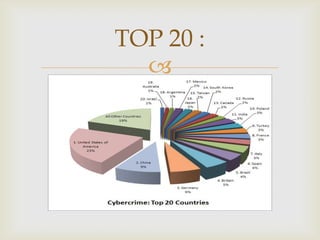
TOP 20 :

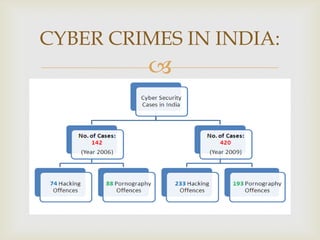
CYBER CRIMES IN INDIA:


STATUTORY PROVISONS:


 The Indian parliament considered it necessary to
give effect to the resolution by which the General
Assembly adopted Model Law on Electronic
Commerce adopted by the United Nations
 As a consequence of which the Information
Technology Act 2000 was passed and enforced on
17th May 2000.
 The Information Technology Act deals with the
various cyber crimes in chapters IX & XI. The
important sections are Ss. 43,65,66,67
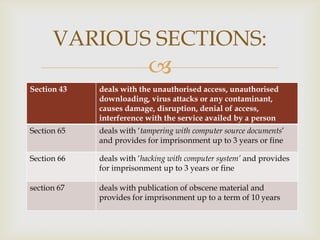
VARIOUS SECTIONS:


Section 43

deals with the unauthorised access, unauthorised
downloading, virus attacks or any contaminant,
causes damage, disruption, denial of access,
interference with the service availed by a person

Section 65

deals with „tampering with computer source documents‟
and provides for imprisonment up to 3 years or fine

Section 66

deals with „hacking with computer system’ and provides
for imprisonment up to 3 years or fine

section 67

deals with publication of obscene material and
provides for imprisonment up to a term of 10 years
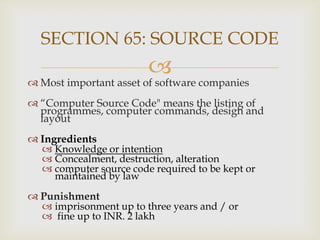
SECTION 65: SOURCE CODE



 Most important asset of software companies
 “Computer Source Code" means the listing of
programmes, computer commands, design and
layout
 Ingredients
 Knowledge or intention
 Concealment, destruction, alteration
 computer source code required to be kept or
maintained by law
 Punishment
 imprisonment up to three years and / or
 fine up to INR. 2 lakh
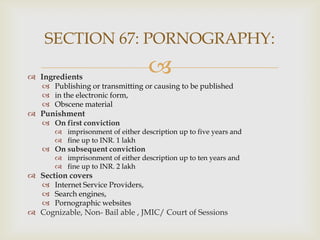
SECTION 67: PORNOGRAPHY:
 Ingredients



 Publishing or transmitting or causing to be published
 in the electronic form,
 Obscene material

 Punishment

 On first conviction
 imprisonment of either description up to five years and
 fine up to INR. 1 lakh

 On subsequent conviction

 imprisonment of either description up to ten years and
 fine up to INR. 2 lakh

 Section covers
 Internet Service Providers,
 Search engines,
 Pornographic websites

 Cognizable, Non- Bail able , JMIC/ Court of Sessions
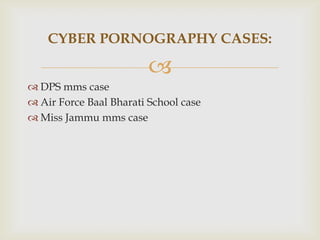
CYBER PORNOGRAPHY CASES:


 DPS mms case
 Air Force Baal Bharati School case
 Miss Jammu mms case
Sec 69: Decryption of information:



 Ingredients
 Controller issues order to Government agency to intercept
any information transmitted through any computer
resource.
 Order is issued in the interest of the






sovereignty or integrity of India,
the security of the State,
friendly relations with foreign States,
public order or
preventing incitement for commission of a cognizable
offence

 Person in charge of the computer resource fails to extend all
facilities and technical assistance to decrypt the
information-punishment up to 7 years.
Sec 70: Protected System
 Ingredients



 Securing unauthorised access or attempting to secure
unauthorised access
 to „protected system‟

 Acts covered by this section:





Switching computer on / off
Using installed software / hardware
Installing software / hardware
Port scanning

 Punishment

 Imprisonment up to 10 years and fine
 Cognizable, Non-Bail able, Court of Sessions
Sections 71
 Section – 71:



 Offence Name - Misrepresentation to the Controller or the
Certifying Authority
 Description - Making any misrepresentation to, or suppression
of any material fact from, the Controller or the Certifying
Authority for obtaining any license or Digital Signature
Certificate, as the case may be.
 Penalty - Imprisonment for a term which may extend to 2
years, or with fine up to 1 lakh Rupees, or with both
Section 72
 section – 72:



 Offence Name - Penalty for breach of confidentiality and
privacy
 Description - Any person who, in pursuance of any of the
powers conferred under IT Act, has secured access to any
electronic record, book, register, correspondence,
information or document without the consent of the person
concerned discloses such electronic record, book., register,
correspondence, information, document to any other
person.
 Penalty - Imprisonment for a term which may extend to 2
years, or with fine up to 1 lakh Rupees, or with both.
Sections 73
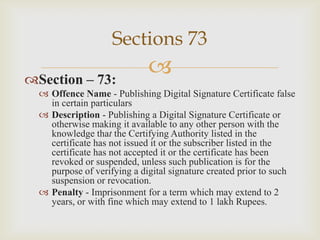
Section – 73:



 Offence Name - Publishing Digital Signature Certificate false
in certain particulars
 Description - Publishing a Digital Signature Certificate or
otherwise making it available to any other person with the
knowledge that the Certifying Authority listed in the
certificate has not issued it or the subscriber listed in the
certificate has not accepted it or the certificate has been
revoked or suspended, unless such publication is for the
purpose of verifying a digital signature created prior to such
suspension or revocation.
 Penalty - Imprisonment for a term which may extend to 2
years, or with fine which may extend to 1 lakh Rupees.
SECTION 74


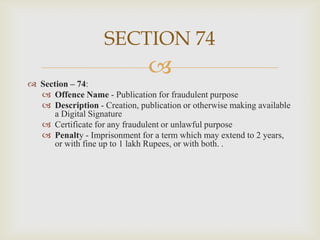
 Section – 74:
 Offence Name - Publication for fraudulent purpose
 Description - Creation, publication or otherwise making available
a Digital Signature
 Certificate for any fraudulent or unlawful purpose
 Penalty - Imprisonment for a term which may extend to 2 years,
or with fine up to 1 lakh Rupees, or with both. .
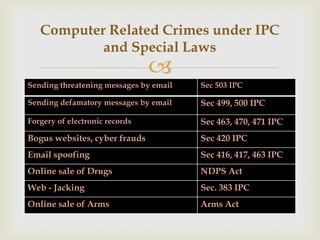
Computer Related Crimes under IPC
and Special Laws



Sending threatening messages by email

Sec 503 IPC

Sending defamatory messages by email

Sec 499, 500 IPC

Forgery of electronic records

Sec 463, 470, 471 IPC

Bogus websites, cyber frauds

Sec 420 IPC

Email spoofing

Sec 416, 417, 463 IPC

Online sale of Drugs

NDPS Act

Web - Jacking

Sec. 383 IPC

Online sale of Arms

Arms Act
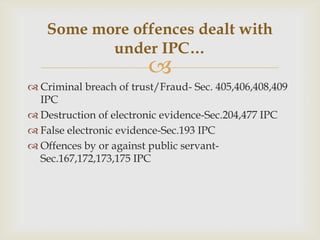
Some more offences dealt with
under IPC…



 Criminal breach of trust/Fraud- Sec. 405,406,408,409
IPC
 Destruction of electronic evidence-Sec.204,477 IPC
 False electronic evidence-Sec.193 IPC
 Offences by or against public servantSec.167,172,173,175 IPC
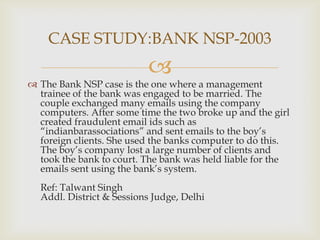
CASE STUDY:BANK NSP-2003



 The Bank NSP case is the one where a management
trainee of the bank was engaged to be married. The
couple exchanged many emails using the company
computers. After some time the two broke up and the girl
created fraudulent email ids such as
“indianbarassociations” and sent emails to the boy‟s
foreign clients. She used the banks computer to do this.
The boy‟s company lost a large number of clients and
took the bank to court. The bank was held liable for the
emails sent using the bank‟s system.
Ref: Talwant Singh
Addl. District & Sessions Judge, Delhi
PREVENTION OF CYBER CRIME:



 To prevent cyber stalking avoid disclosing any
information pertaining to oneself. This is as good as
disclosing your identity to strangers in public place.
 Always avoid sending any photograph online particularly
to strangers and chat friends as there have been incidents
of misuse of the photographs.
 Always use latest and up date anti virus software to
guard against virus attacks.
 Always keep back up volumes so that one may not suffer
data loss in case of virus contamination
 Never send your credit card number to any site that is not
secured, to guard against frauds.
CONTD.:


 Always keep a watch on the sites that your children are
accessing to prevent any kind of harassment or depravation in
children.
 Web site owners should watch traffic and check any
irregularity on the site. Putting host-based intrusion detection
devices on servers may do this
 Web servers running public sites must be physically separate
protected from internal corporate network.
CONCLUSION


 History is the witness that no legislation has succeeded in
totally eliminating crime from the globe.
 The only possible step is to make people aware of their
rights and duties (to report crime as a collective duty
towards the society) and further making the application
of the laws more stringent to check crime.
 Undoubtedly the IT Act is a historical step in the cyber
world. Further I all together do not deny that there is a
need to bring changes in the Information Technology Act
to make it more effective to combat cyber crime
THANK YOU


Cyber crime

  • 1.
  • 2.
    CYBER CRIME   Theterm “cyber crime” was first coined by Barry Collins in 1980‟s  “Any criminal activity that uses a computer either as an instrumentality, target or a means for perpetuating further crimes comes within the ambit of cyber crime”  A generalized definition of cyber crime may be “ unlawful acts wherein the computer is either a tool or target or both”
  • 3.
    CYBER CRIMINALS:   Thecyber criminals constitute of various groups/ category. The following are the category of cyber criminals: • Children and adolescents between the age group of 6 – 18 years • Organised hackers • Professional hackers / crackers • Discontented employees
  • 4.
    MODE AND MANNEROF COMMITING CYBER CRIME:   Hacking  Theft of information contained in electronic form  Email bombing  Data diddling  Salami attacks  Denial of Service attack  Virus / worm attacks
  • 5.
    Contd.   Logic bombs Trojan attacks  Internet time thefts  Web jacking
  • 6.
    TYPES OF CYBERCRIME:   AGAINST INDIVIDUALS  AGAINST ORGANISATION  AGAINST SOCIETY AT LARGE
  • 7.
    AGAINST INDIVIDUALS:   Harassmentvia e-mails.  Cyber-stalking.  Dissemination of obscene material.  Defamation.  Unauthorized control/access over computers  Indecent exposure.  Email spoofing.  Cheating & Fraud.
  • 8.
    AGAINST ORGANISATION:   Cyberterrorism against the government organization.  Distribution of pirated software etc.
  • 9.
    AGAINST SOCIETY ATLARGE:   Pornography (basically child pornography).  Polluting the youth through indecent exposure.  Trafficking.  Financial crimes.  Sale of illegal articles.  Online gambling.  Forgery.
  • 10.
  • 11.
    CYBER CRIMES ININDIA: 
  • 12.
    STATUTORY PROVISONS:   TheIndian parliament considered it necessary to give effect to the resolution by which the General Assembly adopted Model Law on Electronic Commerce adopted by the United Nations  As a consequence of which the Information Technology Act 2000 was passed and enforced on 17th May 2000.  The Information Technology Act deals with the various cyber crimes in chapters IX & XI. The important sections are Ss. 43,65,66,67
  • 13.
    VARIOUS SECTIONS:  Section 43 dealswith the unauthorised access, unauthorised downloading, virus attacks or any contaminant, causes damage, disruption, denial of access, interference with the service availed by a person Section 65 deals with „tampering with computer source documents‟ and provides for imprisonment up to 3 years or fine Section 66 deals with „hacking with computer system’ and provides for imprisonment up to 3 years or fine section 67 deals with publication of obscene material and provides for imprisonment up to a term of 10 years
  • 14.
    SECTION 65: SOURCECODE   Most important asset of software companies  “Computer Source Code" means the listing of programmes, computer commands, design and layout  Ingredients  Knowledge or intention  Concealment, destruction, alteration  computer source code required to be kept or maintained by law  Punishment  imprisonment up to three years and / or  fine up to INR. 2 lakh
  • 15.
    SECTION 67: PORNOGRAPHY: Ingredients   Publishing or transmitting or causing to be published  in the electronic form,  Obscene material  Punishment  On first conviction  imprisonment of either description up to five years and  fine up to INR. 1 lakh  On subsequent conviction  imprisonment of either description up to ten years and  fine up to INR. 2 lakh  Section covers  Internet Service Providers,  Search engines,  Pornographic websites  Cognizable, Non- Bail able , JMIC/ Court of Sessions
  • 16.
    CYBER PORNOGRAPHY CASES:  DPS mms case  Air Force Baal Bharati School case  Miss Jammu mms case
  • 17.
    Sec 69: Decryptionof information:   Ingredients  Controller issues order to Government agency to intercept any information transmitted through any computer resource.  Order is issued in the interest of the      sovereignty or integrity of India, the security of the State, friendly relations with foreign States, public order or preventing incitement for commission of a cognizable offence  Person in charge of the computer resource fails to extend all facilities and technical assistance to decrypt the information-punishment up to 7 years.
  • 18.
    Sec 70: ProtectedSystem  Ingredients   Securing unauthorised access or attempting to secure unauthorised access  to „protected system‟  Acts covered by this section:     Switching computer on / off Using installed software / hardware Installing software / hardware Port scanning  Punishment  Imprisonment up to 10 years and fine  Cognizable, Non-Bail able, Court of Sessions
  • 19.
    Sections 71  Section– 71:   Offence Name - Misrepresentation to the Controller or the Certifying Authority  Description - Making any misrepresentation to, or suppression of any material fact from, the Controller or the Certifying Authority for obtaining any license or Digital Signature Certificate, as the case may be.  Penalty - Imprisonment for a term which may extend to 2 years, or with fine up to 1 lakh Rupees, or with both
  • 20.
    Section 72  section– 72:   Offence Name - Penalty for breach of confidentiality and privacy  Description - Any person who, in pursuance of any of the powers conferred under IT Act, has secured access to any electronic record, book, register, correspondence, information or document without the consent of the person concerned discloses such electronic record, book., register, correspondence, information, document to any other person.  Penalty - Imprisonment for a term which may extend to 2 years, or with fine up to 1 lakh Rupees, or with both.
  • 21.
    Sections 73 Section –73:   Offence Name - Publishing Digital Signature Certificate false in certain particulars  Description - Publishing a Digital Signature Certificate or otherwise making it available to any other person with the knowledge that the Certifying Authority listed in the certificate has not issued it or the subscriber listed in the certificate has not accepted it or the certificate has been revoked or suspended, unless such publication is for the purpose of verifying a digital signature created prior to such suspension or revocation.  Penalty - Imprisonment for a term which may extend to 2 years, or with fine which may extend to 1 lakh Rupees.
  • 22.
    SECTION 74   Section– 74:  Offence Name - Publication for fraudulent purpose  Description - Creation, publication or otherwise making available a Digital Signature  Certificate for any fraudulent or unlawful purpose  Penalty - Imprisonment for a term which may extend to 2 years, or with fine up to 1 lakh Rupees, or with both. .
  • 23.
    Computer Related Crimesunder IPC and Special Laws  Sending threatening messages by email Sec 503 IPC Sending defamatory messages by email Sec 499, 500 IPC Forgery of electronic records Sec 463, 470, 471 IPC Bogus websites, cyber frauds Sec 420 IPC Email spoofing Sec 416, 417, 463 IPC Online sale of Drugs NDPS Act Web - Jacking Sec. 383 IPC Online sale of Arms Arms Act
  • 24.
    Some more offencesdealt with under IPC…   Criminal breach of trust/Fraud- Sec. 405,406,408,409 IPC  Destruction of electronic evidence-Sec.204,477 IPC  False electronic evidence-Sec.193 IPC  Offences by or against public servantSec.167,172,173,175 IPC
  • 25.
    CASE STUDY:BANK NSP-2003  The Bank NSP case is the one where a management trainee of the bank was engaged to be married. The couple exchanged many emails using the company computers. After some time the two broke up and the girl created fraudulent email ids such as “indianbarassociations” and sent emails to the boy‟s foreign clients. She used the banks computer to do this. The boy‟s company lost a large number of clients and took the bank to court. The bank was held liable for the emails sent using the bank‟s system. Ref: Talwant Singh Addl. District & Sessions Judge, Delhi
  • 26.
    PREVENTION OF CYBERCRIME:   To prevent cyber stalking avoid disclosing any information pertaining to oneself. This is as good as disclosing your identity to strangers in public place.  Always avoid sending any photograph online particularly to strangers and chat friends as there have been incidents of misuse of the photographs.  Always use latest and up date anti virus software to guard against virus attacks.  Always keep back up volumes so that one may not suffer data loss in case of virus contamination  Never send your credit card number to any site that is not secured, to guard against frauds.
  • 27.
    CONTD.:   Always keepa watch on the sites that your children are accessing to prevent any kind of harassment or depravation in children.  Web site owners should watch traffic and check any irregularity on the site. Putting host-based intrusion detection devices on servers may do this  Web servers running public sites must be physically separate protected from internal corporate network.
  • 28.
    CONCLUSION   History isthe witness that no legislation has succeeded in totally eliminating crime from the globe.  The only possible step is to make people aware of their rights and duties (to report crime as a collective duty towards the society) and further making the application of the laws more stringent to check crime.  Undoubtedly the IT Act is a historical step in the cyber world. Further I all together do not deny that there is a need to bring changes in the Information Technology Act to make it more effective to combat cyber crime
  • 29.