
Cyber Law in India
Mr. Rahul Kailas Bharati
Designation: Class I Gazetted Officer
Head and Assistant Professor in Law
Department of Law
Government Institute of Forensic Science, Aurangabad
Department of Higher and Technical Education,
Government of Maharashtra
Government Institute
of Forensic Science,
Aurangabad
Information Technology Act,
2000
Enacted on 17th October 2000- India
is 12th nation in the world to adopt
cyber laws.
IT Act is based on Model law on e-
commerce adopted by UNCITRAL.
 UNCITRAL = United Nation
commission on International Trade
Law
Structure of IT Act, 2000
Total 13 Chapters and 90 sections
 Sections 91 to 94 deal with the
amendments to the four Acts namely
Indian Penal Code 1860, The Indian
Evidence Act 1872, The Bankers’
Books Evidence Act 1891 and the
Reserve Bank of India Act 1934.
Section 91 to 94 omitted by
IT(Amendment) Act, 2008.
Objectives of passing India’s
Cyber Law (IT Act, 2000)
 To provide legal recognition for
transactions:-
• Carried out by means of electronic data
interchange, and other means of electronic
communication, commonly referred to as
"electronic commerce”.
• To facilitate electronic filing of documents
with Government agencies and E-Payments.
• To amend the Indian Penal Code, Indian
Evidence Act,1872, the Banker’s Books
Evidence Act 1891,Reserve Bank of India
Act ,1934
Arrangement of Chapters in IT
Act
 Chapter I : Preliminary Sections
 Chapter II : Digital Signature and
Electronic Signature Sec. 3& 3 A)
 Chapter III : Electronic Governance
(Secs.4 to 10 A)
 Chapter IV : Attribution,
Acknowledgment And dispatch of
electronic records (Secs.11 to 13)
 Chapter V : Secure electronic records
and electronic signature (Secs. 14 to
16)
 Chapter VI : Regulation of Certifying
authorities (Secs. 17 to 34)
 Chapter VII : Electronic Signature
Certificates (Secs. 35 to 39)
 Chapter VIII : Duties of Subscriber
(Secs. 35 to 39)
 Chapter IX : Penalties and
Adjudication (Secs. 43 to 47)
 Chapter X : The Appellate Tribunal
(Secs. 48 to 64)
 Chapter XI : Offences (Secs. 65 to 78)
 Chapter XII : Liability of Intermediaries
(Secs. 79) = Information Technology
(Intermediary Guidelines and Digital
Media Ethics Code) Rules, 2021
 Chapter XIIA : Examiner of Electronic
Evidence
 Chapter XIII : Miscellaneous (Secs. 80
to 90)
Cyber crime
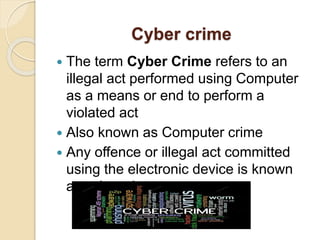
 The term Cyber Crime refers to an
illegal act performed using Computer
as a means or end to perform a
violated act
 Also known as Computer crime
 Any offence or illegal act committed
using the electronic device is known
as cybercrime.
Reasons behind Cybercrime
 Make quick money
 Cause an individual to think what he/she
believes in
 Steal a person’s identity
 Deny the assess to previous regulatory
 Lack of reports and standards
 Utilize the technical framework, perform
illegal activities
 Proceed wrong prosecution against
authorized enquiry
 Make personal Identification highly
complex
 Restrict media coverage
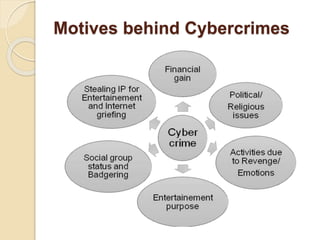
Motives behind Cybercrimes
History of Cybercrime in India
 India witnessed more cyber security
threats and incidents.
 Approximately close to 27000 incidents
in the first half of 2017.
 As per the report by Indian Computer
Emergency Response Team ( CERT –
In),the number of cyber security
incidents is :-
 In 2014 – 44679,
In 2015 – 49455
In2016 – 50362
In 2017 - 53081
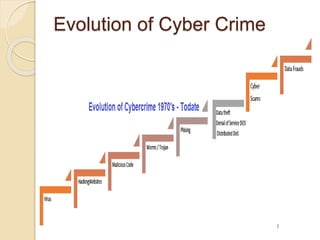
Evolution of Cyber Crime
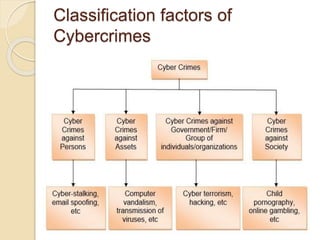
Classification factors of
Cybercrimes
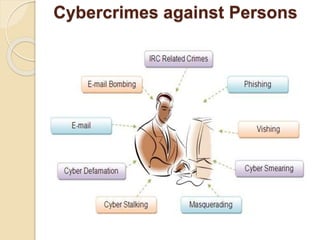
Cybercrimes against Persons
E-mail Spamming
• Email spamis also well-known as
junk email or Unsolicited Bulk Email
(UBE)
• Flooding the web with different
copies of similar messages is
known as spam.
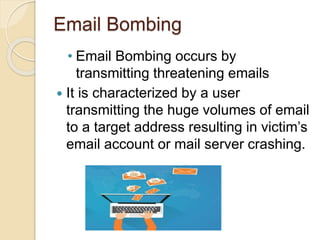
Email Bombing
• Email Bombing occurs by
transmitting threatening emails
 It is characterized by a user
transmitting the huge volumes of email
to a target address resulting in victim’s
email account or mail server crashing.
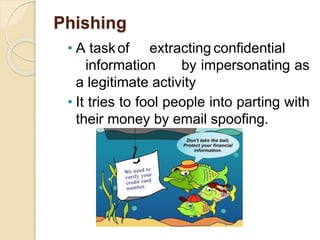
Phishing
• A taskof extracting confidential
information by impersonating as
a legitimate activity
• It tries to fool people into parting with
their money by email spoofing.
Vishing
• Vishing is also known as Voice
Phishing
• It engages calls to victims by using
fake identity for fooling them
• Considers the call to be from
a trustworthy organization
• One mustbe cautious about
unsolicited mobile calls with
uncertainty
• Never make available any private
Cyber Stalking and Cyber
Defamation
•Cyber Stalking - utilization of the
web or the other electronic use
device to stalk someone
Cyber Defamation occurs when
defamation is achieved with help
of the computers or the Internet.
Cyber Squatting, Cyber
Vandalism and Cyber
Extortion
• Cyber squatting – illegal registration
of domain name and usage
• Vandalism – involves deliberate
destruction or damage to public or
private property
• Cyber Extortion – involves an attack
or threat coupled with a demand for
money or some other response in
return for stopping or remediating the
attack
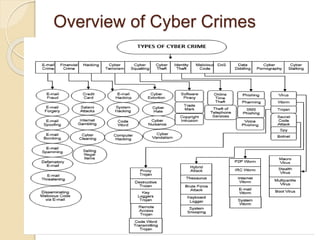
Overview of Cyber Crimes
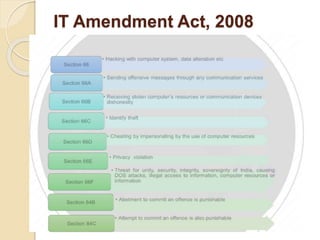
IT Amendment Act, 2008
IT Act (chapter XI ) : Offences
Three parts:
 Where computer
/server/communication device is
object/target.
(Secs.65,66,66F ,70)
Sec.65 . Tampering with computer
source documents.
Penalty : Imprisonment up to 3years or
fine up to two lakhs rupees or both.
Case : Syed Asifuddin v. State of A.P.,
Sec.66. Computer related offences
( Dishonest and fraudulent intension)
Includes destruction, damage, disruption,
denial, deletion, concealment, stealing
of information.
Examples : Cyber spying, Data theft,
Denial of Service Attacks (Dos),
Ramsomware, Virus attack.
Penalty : Imprisonment up to 3years or a
fine up to 5lakhs rupees or both.
Sec.66 F. Cyber Terrorism
Illegal Activities with the computer
resource with intent to threaten the
unity, integrity, security or sovereignty
of India
Penalty : Imprisonment for life.
Example : 26/11 attacks on Taj and
Trident Hotel.
Where crime is committed using a
computer / communication device
Three sub parts :
a) Offences affecting the human
body/person :
Sec.66 A. and Sec. 66 E (Added by
2008 Amendment Act)
Sec.66 A : Punishment for sending
offensive messages through
communication service
 Messages which are grossly offensive
sent through emails, SMS, blogs,
tweets.
Examples : cyber stalking, morphing of
images, unsolicited e-mails.
Penalty : 3 year imprisonment and with
fine.
Challenge to the Constitutionality
of Sec. 66A
Shreya Singhal v. Union of India,
2015
Supreme Court of India Struck down
Sec 66A as violative of Art. 19(1)(a) of
the Constitution of India on 24th March
2015.
Sec. 66 E. Punishment for violation
of privacy
Intentionally capturing , publishing or
transmitting pictures of private parts of
person without consent.
Examples : Installation of spy
cams/hidden cameras inside wash
rooms, bedrooms, changing rooms,
hotel rooms.
Penalty : Imprisonment up to 3 years or
fine not exceeding 2 lakh rupees or
both.
b) Offences affecting property
Sec.66 B, 66 C, 66 D.
 Sec.66B : Punishment for dishonestly
receiving stolen computer resource.
Sec.66C : Punishment for identity
theft (Fraudulently making use of
password)
Examples : phishing, data theft.
 Sec. 66D : Punishment for cheating
by personation
Examples of Sec. 66D :
Creation of clone website to capture
personal information, Intentionally
creating a fake profile on matrimonial
social networking sites with intention
to cheat that person.
Penalty for above three sections :
Imprisonment up to 3 years and fine up
to one lakh rupees.
c) Offences affecting Decency
and Morals
Sec.67, 67A , 67 B.
 Sec.67. punishment for publishing or
transmitting obscene material in
electronic form.
Penalty :
First conviction : 3 year imprisonment
with fine up to 5 lakh rupees .
Second Conviction : 5year
imprisonment and fine up to 10 lakh
rupees
Sec. 67 and Bazee Case.
Sec. 67 A : Punishment for publishing /
transmitting of material sexually explicit
act in electronic form.
Penalty :
First conviction : 5 years and fine may
extend to 10 lakh rupees.
Second conviction: 7years and fine may
extend to 10 lakh rupees.
Sec. 67 B. Punishment for publishing
or transmitting material depicting
children in sexually explicit act in
electronic form. (Child Pornography)
Penalty :
First Conviction : 5 years imprisonment
with fine up to 10 lakh rupees.
Second conviction : 7 years
imprisonment and fine up to 10 lakh
Rupees.
Common Cyber-crime scenarios and
Applicability of Legal Sections
Harassment via fake public profile on
social networking site
A fake profile of a person is created on a
social networking site with the correct
address, residential information or
contact details but he/she is labeled as
‘prostitute’ or a person of ‘loose
character’. This leads to harassment of
the victim.
Provisions Applicable:- Sections 67 of
IT Act and Section 509 of the Indian
Email Account Hacking
If victim’s email account is hacked and
obscene emails are sent to people in
victim’s address book.
Provisions Applicable:- Sections 43,
66, 66C, 67, 67A and 67B of IT Act.
Credit Card Fraud
Unsuspecting victims would use
infected computers to make online
transactions.
Provisions Applicable:- Sections 43,
66, 66C, 66D of IT Act and section 420
Web Defacement
The homepage of a website is
replaced with a pornographic or
defamatory page. Government sites
generally face the wrath of hackers on
symbolic days.
Provisions Applicable:- Sections 43
and 66 of IT Act and Sections 66F, 67
and 70 of IT Act also apply in some
cases.
 Introducing Viruses, Worms,
Backdoors, Rootkits, Trojans, Bugs
All of the above are some sort of
malicious programs which are used to
destroy or gain access to some
electronic information.
Provisions Applicable:- Sections 43,
66, 66A of IT Act and Section 426 of
Indian Penal Code.
 Cyber Pornography
Among the largest businesses on
Internet. Pornography may not be illegal
in many countries, but child pornography
is.
Provisions Applicable:- Sections 67, 67A
and 67B of the IT Act.
Phishing and Email Scams
Phishing involves fraudulently acquiring
sensitive information through
masquerading a site as a trusted entity.
(E.g. Passwords, credit card information)
Provisions Applicable:- Section 66, 66D
of IT Act and Section 420 of IPC
 Theft of Confidential Information
Many business organizations store
their confidential information in
computer systems. This information is
targeted by rivals, criminals and
disgruntled employees.
Provisions Applicable:- Sections 43,
66, 66B of IT Act and Section 426 of
Indian Penal Code.
Cyber Warfare
The use of computer technology to
disrupt the activities of a state or
organization, especially the deliberate
attacking of information systems for
strategic or military purposes.
Ecosystem of Cyber warfare
 Cyber Terrorism
 Cyber Fraud
 Cyber Spying
 Cyber Stalking
Cyber Security measures taken
by Indian Govt.
 National Cyber Policy in 2013
 Enactment of IT Act, 2000
 Setting up of CERT-In and National
Critical Information Infrastructure
Protection Centre (NCIIPC)
 Setting up National Cyber Coordination
Centre
 Implementing ''Information Security
Education and Awareness (ISEA)’ project
to train professionals / government
officials and create mass information
security awareness among citizens
Thank you

Cyber Law in India.pptx

  • 1.
    Cyber Law inIndia Mr. Rahul Kailas Bharati Designation: Class I Gazetted Officer Head and Assistant Professor in Law Department of Law Government Institute of Forensic Science, Aurangabad Department of Higher and Technical Education, Government of Maharashtra Government Institute of Forensic Science, Aurangabad
  • 2.
    Information Technology Act, 2000 Enactedon 17th October 2000- India is 12th nation in the world to adopt cyber laws. IT Act is based on Model law on e- commerce adopted by UNCITRAL.  UNCITRAL = United Nation commission on International Trade Law
  • 3.
    Structure of ITAct, 2000 Total 13 Chapters and 90 sections  Sections 91 to 94 deal with the amendments to the four Acts namely Indian Penal Code 1860, The Indian Evidence Act 1872, The Bankers’ Books Evidence Act 1891 and the Reserve Bank of India Act 1934. Section 91 to 94 omitted by IT(Amendment) Act, 2008.
  • 4.
    Objectives of passingIndia’s Cyber Law (IT Act, 2000)  To provide legal recognition for transactions:- • Carried out by means of electronic data interchange, and other means of electronic communication, commonly referred to as "electronic commerce”. • To facilitate electronic filing of documents with Government agencies and E-Payments. • To amend the Indian Penal Code, Indian Evidence Act,1872, the Banker’s Books Evidence Act 1891,Reserve Bank of India Act ,1934
  • 5.
    Arrangement of Chaptersin IT Act  Chapter I : Preliminary Sections  Chapter II : Digital Signature and Electronic Signature Sec. 3& 3 A)  Chapter III : Electronic Governance (Secs.4 to 10 A)  Chapter IV : Attribution, Acknowledgment And dispatch of electronic records (Secs.11 to 13)
  • 6.
     Chapter V: Secure electronic records and electronic signature (Secs. 14 to 16)  Chapter VI : Regulation of Certifying authorities (Secs. 17 to 34)  Chapter VII : Electronic Signature Certificates (Secs. 35 to 39)  Chapter VIII : Duties of Subscriber (Secs. 35 to 39)  Chapter IX : Penalties and Adjudication (Secs. 43 to 47)
  • 7.
     Chapter X: The Appellate Tribunal (Secs. 48 to 64)  Chapter XI : Offences (Secs. 65 to 78)  Chapter XII : Liability of Intermediaries (Secs. 79) = Information Technology (Intermediary Guidelines and Digital Media Ethics Code) Rules, 2021  Chapter XIIA : Examiner of Electronic Evidence  Chapter XIII : Miscellaneous (Secs. 80 to 90)
  • 8.
    Cyber crime  Theterm Cyber Crime refers to an illegal act performed using Computer as a means or end to perform a violated act  Also known as Computer crime  Any offence or illegal act committed using the electronic device is known as cybercrime.
  • 9.
    Reasons behind Cybercrime Make quick money  Cause an individual to think what he/she believes in  Steal a person’s identity  Deny the assess to previous regulatory  Lack of reports and standards  Utilize the technical framework, perform illegal activities  Proceed wrong prosecution against authorized enquiry  Make personal Identification highly complex  Restrict media coverage
  • 10.
  • 11.
    History of Cybercrimein India  India witnessed more cyber security threats and incidents.  Approximately close to 27000 incidents in the first half of 2017.  As per the report by Indian Computer Emergency Response Team ( CERT – In),the number of cyber security incidents is :-  In 2014 – 44679, In 2015 – 49455 In2016 – 50362 In 2017 - 53081
  • 12.
  • 13.
  • 14.
  • 15.
    E-mail Spamming • Emailspamis also well-known as junk email or Unsolicited Bulk Email (UBE) • Flooding the web with different copies of similar messages is known as spam.
  • 16.
    Email Bombing • EmailBombing occurs by transmitting threatening emails  It is characterized by a user transmitting the huge volumes of email to a target address resulting in victim’s email account or mail server crashing.
  • 17.
    Phishing • A taskofextracting confidential information by impersonating as a legitimate activity • It tries to fool people into parting with their money by email spoofing.
  • 18.
    Vishing • Vishing isalso known as Voice Phishing • It engages calls to victims by using fake identity for fooling them • Considers the call to be from a trustworthy organization • One mustbe cautious about unsolicited mobile calls with uncertainty • Never make available any private
  • 19.
    Cyber Stalking andCyber Defamation •Cyber Stalking - utilization of the web or the other electronic use device to stalk someone Cyber Defamation occurs when defamation is achieved with help of the computers or the Internet.
  • 20.
    Cyber Squatting, Cyber Vandalismand Cyber Extortion • Cyber squatting – illegal registration of domain name and usage • Vandalism – involves deliberate destruction or damage to public or private property • Cyber Extortion – involves an attack or threat coupled with a demand for money or some other response in return for stopping or remediating the attack
  • 21.
  • 22.
  • 23.
    IT Act (chapterXI ) : Offences Three parts:  Where computer /server/communication device is object/target. (Secs.65,66,66F ,70) Sec.65 . Tampering with computer source documents. Penalty : Imprisonment up to 3years or fine up to two lakhs rupees or both. Case : Syed Asifuddin v. State of A.P.,
  • 24.
    Sec.66. Computer relatedoffences ( Dishonest and fraudulent intension) Includes destruction, damage, disruption, denial, deletion, concealment, stealing of information. Examples : Cyber spying, Data theft, Denial of Service Attacks (Dos), Ramsomware, Virus attack. Penalty : Imprisonment up to 3years or a fine up to 5lakhs rupees or both.
  • 25.
    Sec.66 F. CyberTerrorism Illegal Activities with the computer resource with intent to threaten the unity, integrity, security or sovereignty of India Penalty : Imprisonment for life. Example : 26/11 attacks on Taj and Trident Hotel.
  • 26.
    Where crime iscommitted using a computer / communication device Three sub parts : a) Offences affecting the human body/person : Sec.66 A. and Sec. 66 E (Added by 2008 Amendment Act)
  • 27.
    Sec.66 A :Punishment for sending offensive messages through communication service  Messages which are grossly offensive sent through emails, SMS, blogs, tweets. Examples : cyber stalking, morphing of images, unsolicited e-mails. Penalty : 3 year imprisonment and with fine.
  • 28.
    Challenge to theConstitutionality of Sec. 66A Shreya Singhal v. Union of India, 2015 Supreme Court of India Struck down Sec 66A as violative of Art. 19(1)(a) of the Constitution of India on 24th March 2015.
  • 29.
    Sec. 66 E.Punishment for violation of privacy Intentionally capturing , publishing or transmitting pictures of private parts of person without consent. Examples : Installation of spy cams/hidden cameras inside wash rooms, bedrooms, changing rooms, hotel rooms. Penalty : Imprisonment up to 3 years or fine not exceeding 2 lakh rupees or both.
  • 30.
    b) Offences affectingproperty Sec.66 B, 66 C, 66 D.  Sec.66B : Punishment for dishonestly receiving stolen computer resource. Sec.66C : Punishment for identity theft (Fraudulently making use of password) Examples : phishing, data theft.  Sec. 66D : Punishment for cheating by personation
  • 31.
    Examples of Sec.66D : Creation of clone website to capture personal information, Intentionally creating a fake profile on matrimonial social networking sites with intention to cheat that person. Penalty for above three sections : Imprisonment up to 3 years and fine up to one lakh rupees.
  • 32.
    c) Offences affectingDecency and Morals Sec.67, 67A , 67 B.  Sec.67. punishment for publishing or transmitting obscene material in electronic form. Penalty : First conviction : 3 year imprisonment with fine up to 5 lakh rupees . Second Conviction : 5year imprisonment and fine up to 10 lakh rupees
  • 33.
    Sec. 67 andBazee Case. Sec. 67 A : Punishment for publishing / transmitting of material sexually explicit act in electronic form. Penalty : First conviction : 5 years and fine may extend to 10 lakh rupees. Second conviction: 7years and fine may extend to 10 lakh rupees.
  • 34.
    Sec. 67 B.Punishment for publishing or transmitting material depicting children in sexually explicit act in electronic form. (Child Pornography) Penalty : First Conviction : 5 years imprisonment with fine up to 10 lakh rupees. Second conviction : 7 years imprisonment and fine up to 10 lakh Rupees.
  • 35.
    Common Cyber-crime scenariosand Applicability of Legal Sections Harassment via fake public profile on social networking site A fake profile of a person is created on a social networking site with the correct address, residential information or contact details but he/she is labeled as ‘prostitute’ or a person of ‘loose character’. This leads to harassment of the victim. Provisions Applicable:- Sections 67 of IT Act and Section 509 of the Indian
  • 36.
    Email Account Hacking Ifvictim’s email account is hacked and obscene emails are sent to people in victim’s address book. Provisions Applicable:- Sections 43, 66, 66C, 67, 67A and 67B of IT Act. Credit Card Fraud Unsuspecting victims would use infected computers to make online transactions. Provisions Applicable:- Sections 43, 66, 66C, 66D of IT Act and section 420
  • 37.
    Web Defacement The homepageof a website is replaced with a pornographic or defamatory page. Government sites generally face the wrath of hackers on symbolic days. Provisions Applicable:- Sections 43 and 66 of IT Act and Sections 66F, 67 and 70 of IT Act also apply in some cases.
  • 38.
     Introducing Viruses,Worms, Backdoors, Rootkits, Trojans, Bugs All of the above are some sort of malicious programs which are used to destroy or gain access to some electronic information. Provisions Applicable:- Sections 43, 66, 66A of IT Act and Section 426 of Indian Penal Code.
  • 39.
     Cyber Pornography Amongthe largest businesses on Internet. Pornography may not be illegal in many countries, but child pornography is. Provisions Applicable:- Sections 67, 67A and 67B of the IT Act. Phishing and Email Scams Phishing involves fraudulently acquiring sensitive information through masquerading a site as a trusted entity. (E.g. Passwords, credit card information) Provisions Applicable:- Section 66, 66D of IT Act and Section 420 of IPC
  • 40.
     Theft ofConfidential Information Many business organizations store their confidential information in computer systems. This information is targeted by rivals, criminals and disgruntled employees. Provisions Applicable:- Sections 43, 66, 66B of IT Act and Section 426 of Indian Penal Code.
  • 41.
    Cyber Warfare The useof computer technology to disrupt the activities of a state or organization, especially the deliberate attacking of information systems for strategic or military purposes.
  • 42.
    Ecosystem of Cyberwarfare  Cyber Terrorism  Cyber Fraud  Cyber Spying  Cyber Stalking
  • 43.
    Cyber Security measurestaken by Indian Govt.  National Cyber Policy in 2013  Enactment of IT Act, 2000  Setting up of CERT-In and National Critical Information Infrastructure Protection Centre (NCIIPC)  Setting up National Cyber Coordination Centre  Implementing ''Information Security Education and Awareness (ISEA)’ project to train professionals / government officials and create mass information security awareness among citizens
  • 44.