
Different Types of Phishing Attacks
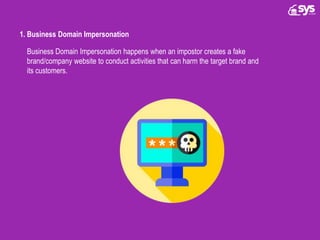
1. Business Domain Impersonation
Business Domain Impersonation happens when an impostor creates a fake
brand/company website to conduct activities that can harm the target brand and
its customers.
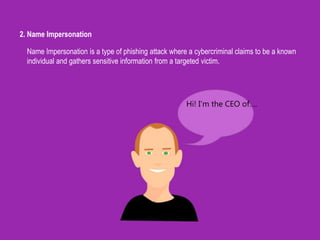
2. Name Impersonation
Name Impersonation is a type of phishing attack where a cybercriminal claims to be a known
individual and gathers sensitive information from a targeted victim.
Hi! I’m the CEO of….
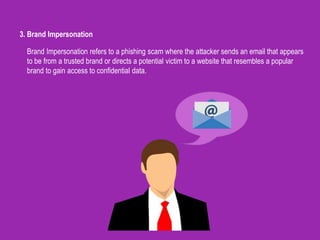
3. Brand Impersonation
Brand Impersonation refers to a phishing scam where the attacker sends an email that appears
to be from a trusted brand or directs a potential victim to a website that resembles a popular
brand to gain access to confidential data.
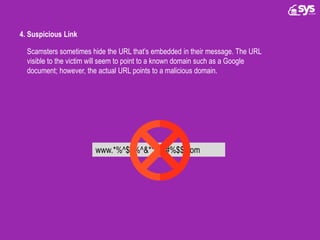
4. Suspicious Link
Scamsters sometimes hide the URL that’s embedded in their message. The URL
visible to the victim will seem to point to a known domain such as a Google
document; however, the actual URL points to a malicious domain.
www.*%^$#%^&**$@#%$$.com
5. Content-Injection
Content-Injection is a type of phishing attack where the attackers use a set of
macro codes to create an infected email attachment or a visual content.
Clicking on this attachment will lead the victim to a phishing page or will result
in the download of a malware from a remote server.
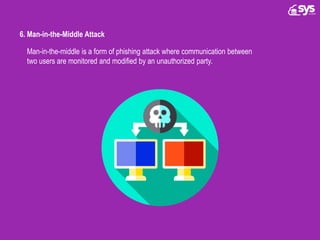
6. Man-in-the-Middle Attack
Man-in-the-middle is a form of phishing attack where communication between
two users are monitored and modified by an unauthorized party.
7. Search Engine Attack
Hackers publish malicious pages and rank them on search engines or run paid
ads to attract victims to their sites. Clicking on these search results or ads will
take the user to a phishing page.
Do you want to know more about phishing attacks?
Read our in-depth article
• What is a phishing attack
• The relentless growth of phishing attacks
• Different types of phishing attacks
• 17 easy hacks to prevent phishing attacks
READ NOW!

Different Types of Phishing Attacks

  • 1.
    Different Types ofPhishing Attacks
  • 2.
    1. Business DomainImpersonation Business Domain Impersonation happens when an impostor creates a fake brand/company website to conduct activities that can harm the target brand and its customers.
  • 3.
    2. Name Impersonation NameImpersonation is a type of phishing attack where a cybercriminal claims to be a known individual and gathers sensitive information from a targeted victim. Hi! I’m the CEO of….
  • 4.
    3. Brand Impersonation BrandImpersonation refers to a phishing scam where the attacker sends an email that appears to be from a trusted brand or directs a potential victim to a website that resembles a popular brand to gain access to confidential data.
  • 5.
    4. Suspicious Link Scamsterssometimes hide the URL that’s embedded in their message. The URL visible to the victim will seem to point to a known domain such as a Google document; however, the actual URL points to a malicious domain. www.*%^$#%^&**$@#%$$.com
  • 6.
    5. Content-Injection Content-Injection isa type of phishing attack where the attackers use a set of macro codes to create an infected email attachment or a visual content. Clicking on this attachment will lead the victim to a phishing page or will result in the download of a malware from a remote server.
  • 7.
    6. Man-in-the-Middle Attack Man-in-the-middleis a form of phishing attack where communication between two users are monitored and modified by an unauthorized party.
  • 8.
    7. Search EngineAttack Hackers publish malicious pages and rank them on search engines or run paid ads to attract victims to their sites. Clicking on these search results or ads will take the user to a phishing page.
  • 9.
    Do you wantto know more about phishing attacks?
  • 10.
    Read our in-deptharticle • What is a phishing attack • The relentless growth of phishing attacks • Different types of phishing attacks • 17 easy hacks to prevent phishing attacks READ NOW!