Presented by
Chitra Lekha.A
Definition

   Registered trademark of CyberCash Corp. which offers
secure means through which credit card information can be
exchanged over internet. Cyber cash permits online payments
without the fear of cyber fraud, expensive credit card approval
equipment, and dedicational telephone lines.
Cyber cash has been described as Federal Express
of Internet payment business, since it offers safe, efficient and
inexpensive delivery of payments across Internet. Cyber cash
makes available the software and services needed to exchange
payments securely across the Internet with its Secure Internet
Payment Service. Using a procedure that incorporates
encryption and digital signatures, cyber cash gives consumers
a “digital wallet”, and merchants a conduit to Internet payment
processing through their own banks. Customers are able to
authorize payments out of their digital wallets. The payments
are signed and encrypted, then sent through the merchant bank
to cyber cash, which in turn passes the transaction to the
merchant’s bank for processing. The digital wallet initially
supported only credit cards, but now supports digital cash
transfers for small dollar amounts for products and services
that are too expensive to justify using a credit card.
The Credit Card Service lets any consumer with a valid
credit card buy from any Cyber Cash enabled merchant.
Designed to integrate fully with existing transaction processing
systems used by banks and other financial institutions, the
service     provides      automated       and      instantaneous
authentication, enabling order processing to traverse the
Internet 24 hours a day, 7 days a week.
Cyber Cash's Secure Internet
               Payment Service


     CyberCash, Inc. was founded in August 1994. The
company is focused on providing Secure Financial
Transactions Services over the Internet, including secure credit
card transactions, electronic checks and micro transactions.
Features of Cybercash

• Secure Internet credit card (macro-level) transactions since
  April 1995.
• Thousands of transactions processed daily.
• Over 500,000 CyberCash Customer-Wallets in the distribution
  channel, including CyberCash, Checkfree, and Compuserve
  wallets.
• Connected to 80% of the banks in the U.S

  CyberCoin-- The CyberCoin service enables small cash
  payments for instantaneous electronic delivery of information,
  products and services.
Advantages:
• CyberCash uses strong encryption for transporting payment
  information.
   – They claim to be the only Internet payment company
      granted an export license to use RSA's 786 bit encryption
      algorithm.
• The Merchant does not see the buyer's credit card number.
• Merchants do not have a waiting period for receiving
  payment, as with First Virtual. The merchant's bank account is
  credited within in the normal time frame for credit card
  transactions.

Disadvantages:
• Potential buyers and merchants must both install extra
  software in order to use the system. This makes the system
  harder to use for people with little computer experience.
• Merchants need to have an account with an acquiring bank that
  accepts CyberCash Secure Internet Payments.
Players
• Merchant: The first player is the merchant, the organization that
  wants to sell products online.
• Acquiring Financial Institution: This is the bank where the
  Merchant has set up a merchant account and hopes lots of money
  will eventually be deposited.
• CyberCash: This organization functions as a gateway. CyberCash
  facilitates credit card transactions by interacting with other
  organizations to handle credit card authorizations and captures.
• Cardholder Financial Institution: This organization issues the
  credit card to the consumer and maintains the account from
  which funds will be deducted if the transaction succeeds.
• Third-Party Processor: Banks that often outsource various
  merchant services to a separate company. This organization may
  handle services such as settlement, billing, authorization, and
  reporting. There may or may not be a third-party processor
  involved in the transaction process.
The CyberCash Credit Card
            Purchasing/Payment System
       The CyberCash credit card payment system consists of
  three parts :
• The CyberCash Wallet-software distributed free to consumers
  (Windows or Mac-based)
• The Secure Merchant Payment System (SMPS) for the seller's
  web-server; It communicates with the customer and the
  Wallet-software.
• CyberCash Gateway Servers for banks; It links the seller's
  server to existing financial networks of the bank in a safe
  manner for the bank and acts as a firewall.
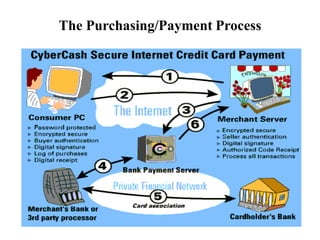
The Purchasing/Payment Process
1. The Customer has decided what it is he/she wishes to
   purchase, where he/she wants it shipped, etc.... The seller's
   server returns a summary of the item, price, transaction
   ID,             etc.             to               consumer.

2. If everything is OK, the customer clicks on the "Pay" Button
   which launches the CyberCash, Checkfree or Compuserve
   Wallet. The customer chooses the credit card from their
   "wallet" with which he/she wishes to pay with and clicks OK
   to forward the order and encrypted payment information to the
   seller.
3.                The seller's server receives the packet, strips off
     the order and forwards the still encrypted payment information
     digitally signed with the seller's private key to the bank's
     CyberCash gateway-server. The merchant cannot see the
     consumer's credit card information, since it is encrypted with a
     key that only the bank's CyberCash gateway can decrypt.

4.               CyberCash      gateway-server     receives      the
     packet, takes the transaction behind its firewall and off the
     Internet, unwraps the data, reformats the transaction (the
     payer's identity, amount to pay and the seller's identity) and
     forwards it to the seller's bank over dedicated financial
                               networks.
5. The seller's bank then forwards the authorization request to the
   issuing (customer's) bank via the card associations or directly
   to American Express or Discover in those cases (this is
   applicable only to the USA). The approval or denial code then
   is sent back to CyberCash gateway-server.

6. CyberCash gateway-server then returns the approval or denial
   code to the seller who then passes it on to the customer.

       To complete the transaction, the seller's server sends the
  customer a digital receipt. A transaction can be captured and
  posted to the seller's account while the customer is still on-
  line, or later if you cannot ship the purchased product
  immediately.
Consumers Benefits:
•      Safe, private and easy to use. Protected by the highest
  allowed levels of Internet encryption with assured
  authentication.
•      Use existing Visa, MasterCard, American Express or
  Discover. No special credit cards are necessary.
•     Complete on-line payments
Merchant Benefits:
•     Real-time authorization and settlement
•     Receive payments instantly and secure
•     No need to maintain expensive phone or fax operations
•     Open 24 hours a day
Sources

• http://www.tml.tkk.fi/Studies/Tik-
  110.350/1997/Ecommerce/sips_4.html
• http://www.virtualschool.edu/mon/ElectronicP
  roperty/klamond/Cyberpmt.htm
• http://www.keenertech.com/articles/2006/09/0
  9/credit_cards_and_cybercash
Thank You !!!

Cyber cash

  • 1.
  • 2.
    Definition Registered trademark of CyberCash Corp. which offers secure means through which credit card information can be exchanged over internet. Cyber cash permits online payments without the fear of cyber fraud, expensive credit card approval equipment, and dedicational telephone lines.
  • 3.
    Cyber cash hasbeen described as Federal Express of Internet payment business, since it offers safe, efficient and inexpensive delivery of payments across Internet. Cyber cash makes available the software and services needed to exchange payments securely across the Internet with its Secure Internet Payment Service. Using a procedure that incorporates encryption and digital signatures, cyber cash gives consumers a “digital wallet”, and merchants a conduit to Internet payment processing through their own banks. Customers are able to authorize payments out of their digital wallets. The payments are signed and encrypted, then sent through the merchant bank to cyber cash, which in turn passes the transaction to the merchant’s bank for processing. The digital wallet initially supported only credit cards, but now supports digital cash transfers for small dollar amounts for products and services that are too expensive to justify using a credit card.
  • 4.
    The Credit CardService lets any consumer with a valid credit card buy from any Cyber Cash enabled merchant. Designed to integrate fully with existing transaction processing systems used by banks and other financial institutions, the service provides automated and instantaneous authentication, enabling order processing to traverse the Internet 24 hours a day, 7 days a week.
  • 5.
    Cyber Cash's SecureInternet Payment Service CyberCash, Inc. was founded in August 1994. The company is focused on providing Secure Financial Transactions Services over the Internet, including secure credit card transactions, electronic checks and micro transactions.
  • 6.
    Features of Cybercash •Secure Internet credit card (macro-level) transactions since April 1995. • Thousands of transactions processed daily. • Over 500,000 CyberCash Customer-Wallets in the distribution channel, including CyberCash, Checkfree, and Compuserve wallets. • Connected to 80% of the banks in the U.S CyberCoin-- The CyberCoin service enables small cash payments for instantaneous electronic delivery of information, products and services.
  • 7.
    Advantages: • CyberCash usesstrong encryption for transporting payment information. – They claim to be the only Internet payment company granted an export license to use RSA's 786 bit encryption algorithm. • The Merchant does not see the buyer's credit card number. • Merchants do not have a waiting period for receiving payment, as with First Virtual. The merchant's bank account is credited within in the normal time frame for credit card transactions. Disadvantages: • Potential buyers and merchants must both install extra software in order to use the system. This makes the system harder to use for people with little computer experience. • Merchants need to have an account with an acquiring bank that accepts CyberCash Secure Internet Payments.
  • 8.
    Players • Merchant: Thefirst player is the merchant, the organization that wants to sell products online. • Acquiring Financial Institution: This is the bank where the Merchant has set up a merchant account and hopes lots of money will eventually be deposited. • CyberCash: This organization functions as a gateway. CyberCash facilitates credit card transactions by interacting with other organizations to handle credit card authorizations and captures. • Cardholder Financial Institution: This organization issues the credit card to the consumer and maintains the account from which funds will be deducted if the transaction succeeds. • Third-Party Processor: Banks that often outsource various merchant services to a separate company. This organization may handle services such as settlement, billing, authorization, and reporting. There may or may not be a third-party processor involved in the transaction process.
  • 9.
    The CyberCash CreditCard Purchasing/Payment System The CyberCash credit card payment system consists of three parts : • The CyberCash Wallet-software distributed free to consumers (Windows or Mac-based) • The Secure Merchant Payment System (SMPS) for the seller's web-server; It communicates with the customer and the Wallet-software. • CyberCash Gateway Servers for banks; It links the seller's server to existing financial networks of the bank in a safe manner for the bank and acts as a firewall.
  • 10.
  • 11.
    1. The Customerhas decided what it is he/she wishes to purchase, where he/she wants it shipped, etc.... The seller's server returns a summary of the item, price, transaction ID, etc. to consumer. 2. If everything is OK, the customer clicks on the "Pay" Button which launches the CyberCash, Checkfree or Compuserve Wallet. The customer chooses the credit card from their "wallet" with which he/she wishes to pay with and clicks OK to forward the order and encrypted payment information to the seller.
  • 12.
    3. The seller's server receives the packet, strips off the order and forwards the still encrypted payment information digitally signed with the seller's private key to the bank's CyberCash gateway-server. The merchant cannot see the consumer's credit card information, since it is encrypted with a key that only the bank's CyberCash gateway can decrypt. 4. CyberCash gateway-server receives the packet, takes the transaction behind its firewall and off the Internet, unwraps the data, reformats the transaction (the payer's identity, amount to pay and the seller's identity) and forwards it to the seller's bank over dedicated financial networks.
  • 13.
    5. The seller'sbank then forwards the authorization request to the issuing (customer's) bank via the card associations or directly to American Express or Discover in those cases (this is applicable only to the USA). The approval or denial code then is sent back to CyberCash gateway-server. 6. CyberCash gateway-server then returns the approval or denial code to the seller who then passes it on to the customer. To complete the transaction, the seller's server sends the customer a digital receipt. A transaction can be captured and posted to the seller's account while the customer is still on- line, or later if you cannot ship the purchased product immediately.
  • 14.
    Consumers Benefits: • Safe, private and easy to use. Protected by the highest allowed levels of Internet encryption with assured authentication. • Use existing Visa, MasterCard, American Express or Discover. No special credit cards are necessary. • Complete on-line payments Merchant Benefits: • Real-time authorization and settlement • Receive payments instantly and secure • No need to maintain expensive phone or fax operations • Open 24 hours a day
  • 15.
    Sources • http://www.tml.tkk.fi/Studies/Tik- 110.350/1997/Ecommerce/sips_4.html • http://www.virtualschool.edu/mon/ElectronicP roperty/klamond/Cyberpmt.htm • http://www.keenertech.com/articles/2006/09/0 9/credit_cards_and_cybercash
  • 16.