Cyber Attack Detection & Prediction Using Machine Learning Algorithms
Narendra Singh
(23SCSE2010003)
Research Scholar-SCSE
GALGOTIAS UNIVERSITY
Dr. Sudhakar - Professor
Supervisor-SCSE
GALGOTIAS UNIVERSITY
Doctoral Committee Meeting - 2
School of computer science and engineering
School of Computing Science and Engineering
Outline
1. Course work completion and Result Status
2. Research Abstract, Gaps, Problem Statement and Objectives
3. Literature Review
4. Overall Workflow diagram and Proposed System
5. Dataset
6. Progress
7. List of Publication
8. References
Faculty Name: Dr. Santosh Kumar Srivastava ame:
School of Computing Science and Engineering
Course Work and Result
School of Computing Science and Engineering
Results
The results of the experimental setup are presented in two sections: one for user responses and the other for the AI
chatbot.
Results from User Responses
The responses from users yielded interesting and sometimes contradictory results.
Results from AI Chatbot
To assess the reasoning capability of the AI chatbot, questions of three types were posed: logical questions,
probability-based questions, and questions based on a case study.
Abstract
School of Computing Science and Engineering
• In today's fast-growing digital landscape, the widespread use of the internet is on the rise, driven by affordable electronic
devices and accessible data packages. The internet plays a pivotal role in the daily lives of individuals, yet this increased
connectivity raises concerns about the inadvertent exposure of confidential information online. Cybersecurity, as a
multifaceted field, is dedicated to addressing the core issues of data misuse and safeguarding against internet security
threats. Its significance spans across various industries, where protecting corporate data and understanding potential
attack vectors is paramount.
• The escalating challenge of safeguarding information from cyber-attacks necessitates innovative solutions. This paper
introduces a proposed system designed to analyze datasets and determine whether the provided data is normal or exhibits
anomalies. Leveraging machine learning algorithms, the proposed system aims to identify and predict cyber-attacks after
a thorough examination of the dataset
• The dataset utilized in this study encompasses a wide range of simulated intrusions into a military network environment,
made accessible for research purposes. The paper conducts a comparative analysis of machine learning algorithms based
on essential parameters, including Precision, Recall, F1 Score, Accuracy, and Cross-Validation of the system.
Research Gaps
School of Computing Science and Engineering
1. IoT Security:
1. As the number of connected devices continues to rise, securing the Internet of Things (IoT) remains a significant challenge. Research
can focus on developing robust security mechanisms for IoT devices, including authentication, encryption, and intrusion detection.
2. AI and Machine Learning in Cybersecurity:
1. The integration of artificial intelligence (AI) and machine learning (ML) into cybersecurity introduces new challenges and
opportunities. Research may explore the development of AI-driven attacks, adversarial machine learning, and the enhancement of
defensive mechanisms using AI.
3. Quantum Computing Threats:
1. The advent of quantum computing poses potential threats to current encryption algorithms. Research is needed to develop quantum-
resistant cryptographic methods and understand the implications of quantum computing on current cybersecurity protocols.
4. Supply Chain Security:
1. Securing the software and hardware supply chain is crucial to prevent attacks such as software supply chain compromises. Research
gaps may include developing methods for ensuring the integrity of software and hardware components throughout the supply chain.
Problem Statement
School of Computing Science and Engineering
• Background:
• As organizations increasingly rely on interconnected digital systems, the frequency and sophistication of cyber attacks, specifically
Advanced Persistent Threats (APTs), pose a critical risk to the security of critical infrastructure networks. APTs involve persistent,
targeted attacks that often go undetected for extended periods, compromising sensitive data and disrupting essential services.
• Problem Description:
• The existing cybersecurity infrastructure for critical systems faces significant challenges in detecting and mitigating Advanced
Persistent Threats. These challenges include:
1. Stealth and Persistence: APTs are designed to evade traditional security measures, residing undetected within networks for extended
durations, making them difficult to identify and eradicate.
2. Targeted Exploitation: Cyber adversaries are increasingly employing targeted strategies, exploiting specific vulnerabilities unique
to each infrastructure sector. This demands a more adaptive and sector-specific defense mechanism.
3. Insufficient Threat Intelligence Sharing: The lack of effective information sharing mechanisms among organizations and across
sectors hampers timely threat detection and response, enabling APTs to move laterally across interconnected systems.
Objectives
School of Computing Science and Engineering
• The objective of this research is to enhance the resilience of critical infrastructure networks against Advanced Persistent Threats by addressing the
challenges related to stealth, persistence, targeted exploitation, and inadequate threat intelligence sharing.
1. Enhance Resilience:
1. The primary goal is to improve the overall resilience of critical infrastructure networks. Resilience refers to the ability of a system to withstand, adapt
to, and recover from disruptive events. In the context of cybersecurity, this involves developing measures that not only prevent APTs but also ensure
the rapid recovery of systems in case of a successful attack.
2. Address Challenges Related to Stealth:
1. A major challenge with APTs is their ability to operate stealthily within a network. The research aims to develop techniques and technologies that
can effectively detect and counteract the stealthy nature of APTs, ensuring that they are identified at an early stage.
3. Address Challenges Related to Persistence:
1. APTs often establish a persistent presence within a network, allowing them to maintain access and carry out their objectives over an extended period.
The objective is to develop strategies and technologies to disrupt the persistence of APTs, making it more difficult for them to maintain a foothold in
the network.
4. Address Challenges Related to Targeted Exploitation:
1. APTs are known for their targeted nature, exploiting specific vulnerabilities in critical infrastructure sectors. The research aims to identify and
address these sector-specific vulnerabilities, providing tailored cybersecurity measures to mitigate the risk of targeted exploitation.
Literature Review
School of Computing Science and Engineering
• The growing interconnectivity of critical infrastructure networks has heightened the vulnerability to cyber threats, particularly
Advanced Persistent Threats (APTs). This literature review aims to present a comprehensive overview of current research on
cybersecurity, APTs, and strategies aimed at fortifying the resilience of critical infrastructure networks.
• 1. Advanced Persistent Threats (APTs): APTs, known for their sophisticated and persistent nature, pose a formidable challenge to
conventional cybersecurity measures. Mandiant (2013) and FireEye (2018) underscore the prevalence of APTs in targeted attacks on
critical infrastructure, emphasizing the necessity for advanced detection and mitigation approaches.
• 2. Cybersecurity Measures in Critical Infrastructure: NIST (2018) and the Department of Homeland Security (DHS) (2019) stress
the importance of robust cybersecurity measures in critical infrastructure sectors, encompassing risk assessments, intrusion detection
systems, and incident response plans. However, the dynamic tactics of APTs necessitate continual enhancements to these strategies.
• 3. Resilience in Critical Infrastructure: Resilience against cyber threats is pivotal in safeguarding critical infrastructure. Ouyang et al.
(2015) delve into cybersecurity resilience, advocating for adaptive systems capable of enduring and rebounding from APTs. Identified
gaps in current resilience strategies spotlight areas for improvement.
• 4. Machine Learning and APT Detection: Recent strides in machine learning have been harnessed for APT detection. Li et al. (2020)
and Kumar et al. (2021) showcase the efficacy of machine learning algorithms in pinpointing anomalous patterns associated with APTs.
Nonetheless, challenges like adversarial attacks on machine learning models remain a noteworthy concern.
Overall Workflow diagram and Proposed
System
School of Computing Science and Engineering
• Overall Workflow Diagram:
1. Data Collection:
1. Ingest data from various sources such as network logs, system events, and threat intelligence feeds.
2. Threat Intelligence Analysis:
1. Analyze threat intelligence to identify APT indicators, tactics, techniques, and procedures (TTPs).
3. Machine Learning Analysis:
1. Utilize machine learning algorithms for real-time analysis of network traffic and system behavior, identifying anomalies associated with potential APT
activities.
4. Sector-Specific Vulnerability Assessment:
1. Conduct vulnerability assessments specific to critical infrastructure sectors to identify and address sector-specific vulnerabilities.
5. Incident Detection:
1. Integrate threat intelligence, machine learning analysis, and vulnerability assessment results to detect potential APT incidents.
6. Incident Response:
1. Initiate incident response procedures to contain, isolate, and eradicate APTs. This may involve automated responses and human intervention.
School of Computing Science and Engineering
• Proposed System:
• The proposed system is an integrated cybersecurity platform designed to address the challenges posed by APTs in
critical infrastructure networks. It consists of several key components:
1. Threat Intelligence Module:
1. Collects and analyzes threat intelligence feeds to identify APT indicators, TTPs, and emerging threats.
2. Machine Learning and Anomaly Detection Module:
1. Utilizes machine learning algorithms to analyze network and system behavior in real-time, detecting anomalies indicative of APT
activities.
3. Sector-Specific Vulnerability Assessment Module:
1. Conducts regular assessments to identify and mitigate vulnerabilities specific to each critical infrastructure sector.
4. Incident Response and Resilience Module:
1. Implements automated incident response measures and adaptive resilience strategies to mitigate the impact of APT incidents.
Dataset
School of Computing Science and Engineering
1. National Institute of Standards and Technology (NIST):
1. NIST may provide datasets related to cybersecurity and critical infrastructure. Explore their Computer Security Resource Center
(CSRC) for potential datasets: NIST CSRC.
2. The Center for Internet Security (CIS):
1. CIS is known for providing cybersecurity best practices. While they may not offer specific datasets, their resources could be
valuable for understanding cybersecurity principles: CIS.
3. Common Vulnerabilities and Exposures (CVE) Database:
1. The CVE database provides information about software vulnerabilities. While not a traditional dataset, you can use the data for
research purposes: CVE.
4. Open Source Threat Intelligence Feeds:
1. Some organizations and projects release threat intelligence feeds that you can use for research. Examples include Open Threat
Exchange (OTX) by AlienVault or the MISP Threat Intelligence Platform: OTX, MISP.
5. Kaggle:
1. Kaggle is a platform that hosts various datasets, including those related to cybersecurity. Search for relevant terms such as
"cybersecurity" or "network security" to find potentially useful datasets: Kaggle Datasets.
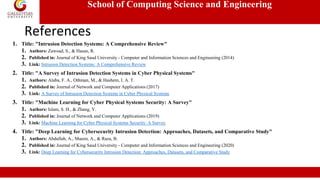
References
School of Computing Science and Engineering
1. Title: "Intrusion Detection Systems: A Comprehensive Review"
1. Authors: Zawoad, S., & Hasan, R.
2. Published in: Journal of King Saud University - Computer and Information Sciences and Engineering (2014)
3. Link: Intrusion Detection Systems: A Comprehensive Review
2. Title: "A Survey of Intrusion Detection Systems in Cyber Physical Systems"
1. Authors: Alaba, F. A., Othman, M., & Hashem, I. A. T.
2. Published in: Journal of Network and Computer Applications (2017)
3. Link: A Survey of Intrusion Detection Systems in Cyber Physical Systems
3. Title: "Machine Learning for Cyber Physical Systems Security: A Survey"
1. Authors: Islam, S. H., & Zhang, Y.
2. Published in: Journal of Network and Computer Applications (2019)
3. Link: Machine Learning for Cyber Physical Systems Security: A Survey
4. Title: "Deep Learning for Cybersecurity Intrusion Detection: Approaches, Datasets, and Comparative Study"
1. Authors: Abdullah, A., Mueen, A., & Raza, B.
2. Published in: Journal of King Saud University - Computer and Information Sciences and Engineering (2020)
3. Link: Deep Learning for Cybersecurity Intrusion Detection: Approaches, Datasets, and Comparative Study

Cyber Attack Detection and protection using machine learning algorithm

  • 1.
    Cyber Attack Detection& Prediction Using Machine Learning Algorithms Narendra Singh (23SCSE2010003) Research Scholar-SCSE GALGOTIAS UNIVERSITY Dr. Sudhakar - Professor Supervisor-SCSE GALGOTIAS UNIVERSITY Doctoral Committee Meeting - 2 School of computer science and engineering School of Computing Science and Engineering
  • 2.
    Outline 1. Course workcompletion and Result Status 2. Research Abstract, Gaps, Problem Statement and Objectives 3. Literature Review 4. Overall Workflow diagram and Proposed System 5. Dataset 6. Progress 7. List of Publication 8. References Faculty Name: Dr. Santosh Kumar Srivastava ame: School of Computing Science and Engineering
  • 3.
    Course Work andResult School of Computing Science and Engineering Results The results of the experimental setup are presented in two sections: one for user responses and the other for the AI chatbot. Results from User Responses The responses from users yielded interesting and sometimes contradictory results. Results from AI Chatbot To assess the reasoning capability of the AI chatbot, questions of three types were posed: logical questions, probability-based questions, and questions based on a case study.
  • 4.
    Abstract School of ComputingScience and Engineering • In today's fast-growing digital landscape, the widespread use of the internet is on the rise, driven by affordable electronic devices and accessible data packages. The internet plays a pivotal role in the daily lives of individuals, yet this increased connectivity raises concerns about the inadvertent exposure of confidential information online. Cybersecurity, as a multifaceted field, is dedicated to addressing the core issues of data misuse and safeguarding against internet security threats. Its significance spans across various industries, where protecting corporate data and understanding potential attack vectors is paramount. • The escalating challenge of safeguarding information from cyber-attacks necessitates innovative solutions. This paper introduces a proposed system designed to analyze datasets and determine whether the provided data is normal or exhibits anomalies. Leveraging machine learning algorithms, the proposed system aims to identify and predict cyber-attacks after a thorough examination of the dataset • The dataset utilized in this study encompasses a wide range of simulated intrusions into a military network environment, made accessible for research purposes. The paper conducts a comparative analysis of machine learning algorithms based on essential parameters, including Precision, Recall, F1 Score, Accuracy, and Cross-Validation of the system.
  • 5.
    Research Gaps School ofComputing Science and Engineering 1. IoT Security: 1. As the number of connected devices continues to rise, securing the Internet of Things (IoT) remains a significant challenge. Research can focus on developing robust security mechanisms for IoT devices, including authentication, encryption, and intrusion detection. 2. AI and Machine Learning in Cybersecurity: 1. The integration of artificial intelligence (AI) and machine learning (ML) into cybersecurity introduces new challenges and opportunities. Research may explore the development of AI-driven attacks, adversarial machine learning, and the enhancement of defensive mechanisms using AI. 3. Quantum Computing Threats: 1. The advent of quantum computing poses potential threats to current encryption algorithms. Research is needed to develop quantum- resistant cryptographic methods and understand the implications of quantum computing on current cybersecurity protocols. 4. Supply Chain Security: 1. Securing the software and hardware supply chain is crucial to prevent attacks such as software supply chain compromises. Research gaps may include developing methods for ensuring the integrity of software and hardware components throughout the supply chain.
  • 6.
    Problem Statement School ofComputing Science and Engineering • Background: • As organizations increasingly rely on interconnected digital systems, the frequency and sophistication of cyber attacks, specifically Advanced Persistent Threats (APTs), pose a critical risk to the security of critical infrastructure networks. APTs involve persistent, targeted attacks that often go undetected for extended periods, compromising sensitive data and disrupting essential services. • Problem Description: • The existing cybersecurity infrastructure for critical systems faces significant challenges in detecting and mitigating Advanced Persistent Threats. These challenges include: 1. Stealth and Persistence: APTs are designed to evade traditional security measures, residing undetected within networks for extended durations, making them difficult to identify and eradicate. 2. Targeted Exploitation: Cyber adversaries are increasingly employing targeted strategies, exploiting specific vulnerabilities unique to each infrastructure sector. This demands a more adaptive and sector-specific defense mechanism. 3. Insufficient Threat Intelligence Sharing: The lack of effective information sharing mechanisms among organizations and across sectors hampers timely threat detection and response, enabling APTs to move laterally across interconnected systems.
  • 7.
    Objectives School of ComputingScience and Engineering • The objective of this research is to enhance the resilience of critical infrastructure networks against Advanced Persistent Threats by addressing the challenges related to stealth, persistence, targeted exploitation, and inadequate threat intelligence sharing. 1. Enhance Resilience: 1. The primary goal is to improve the overall resilience of critical infrastructure networks. Resilience refers to the ability of a system to withstand, adapt to, and recover from disruptive events. In the context of cybersecurity, this involves developing measures that not only prevent APTs but also ensure the rapid recovery of systems in case of a successful attack. 2. Address Challenges Related to Stealth: 1. A major challenge with APTs is their ability to operate stealthily within a network. The research aims to develop techniques and technologies that can effectively detect and counteract the stealthy nature of APTs, ensuring that they are identified at an early stage. 3. Address Challenges Related to Persistence: 1. APTs often establish a persistent presence within a network, allowing them to maintain access and carry out their objectives over an extended period. The objective is to develop strategies and technologies to disrupt the persistence of APTs, making it more difficult for them to maintain a foothold in the network. 4. Address Challenges Related to Targeted Exploitation: 1. APTs are known for their targeted nature, exploiting specific vulnerabilities in critical infrastructure sectors. The research aims to identify and address these sector-specific vulnerabilities, providing tailored cybersecurity measures to mitigate the risk of targeted exploitation.
  • 8.
    Literature Review School ofComputing Science and Engineering • The growing interconnectivity of critical infrastructure networks has heightened the vulnerability to cyber threats, particularly Advanced Persistent Threats (APTs). This literature review aims to present a comprehensive overview of current research on cybersecurity, APTs, and strategies aimed at fortifying the resilience of critical infrastructure networks. • 1. Advanced Persistent Threats (APTs): APTs, known for their sophisticated and persistent nature, pose a formidable challenge to conventional cybersecurity measures. Mandiant (2013) and FireEye (2018) underscore the prevalence of APTs in targeted attacks on critical infrastructure, emphasizing the necessity for advanced detection and mitigation approaches. • 2. Cybersecurity Measures in Critical Infrastructure: NIST (2018) and the Department of Homeland Security (DHS) (2019) stress the importance of robust cybersecurity measures in critical infrastructure sectors, encompassing risk assessments, intrusion detection systems, and incident response plans. However, the dynamic tactics of APTs necessitate continual enhancements to these strategies. • 3. Resilience in Critical Infrastructure: Resilience against cyber threats is pivotal in safeguarding critical infrastructure. Ouyang et al. (2015) delve into cybersecurity resilience, advocating for adaptive systems capable of enduring and rebounding from APTs. Identified gaps in current resilience strategies spotlight areas for improvement. • 4. Machine Learning and APT Detection: Recent strides in machine learning have been harnessed for APT detection. Li et al. (2020) and Kumar et al. (2021) showcase the efficacy of machine learning algorithms in pinpointing anomalous patterns associated with APTs. Nonetheless, challenges like adversarial attacks on machine learning models remain a noteworthy concern.
  • 9.
    Overall Workflow diagramand Proposed System School of Computing Science and Engineering • Overall Workflow Diagram: 1. Data Collection: 1. Ingest data from various sources such as network logs, system events, and threat intelligence feeds. 2. Threat Intelligence Analysis: 1. Analyze threat intelligence to identify APT indicators, tactics, techniques, and procedures (TTPs). 3. Machine Learning Analysis: 1. Utilize machine learning algorithms for real-time analysis of network traffic and system behavior, identifying anomalies associated with potential APT activities. 4. Sector-Specific Vulnerability Assessment: 1. Conduct vulnerability assessments specific to critical infrastructure sectors to identify and address sector-specific vulnerabilities. 5. Incident Detection: 1. Integrate threat intelligence, machine learning analysis, and vulnerability assessment results to detect potential APT incidents. 6. Incident Response: 1. Initiate incident response procedures to contain, isolate, and eradicate APTs. This may involve automated responses and human intervention.
  • 10.
    School of ComputingScience and Engineering • Proposed System: • The proposed system is an integrated cybersecurity platform designed to address the challenges posed by APTs in critical infrastructure networks. It consists of several key components: 1. Threat Intelligence Module: 1. Collects and analyzes threat intelligence feeds to identify APT indicators, TTPs, and emerging threats. 2. Machine Learning and Anomaly Detection Module: 1. Utilizes machine learning algorithms to analyze network and system behavior in real-time, detecting anomalies indicative of APT activities. 3. Sector-Specific Vulnerability Assessment Module: 1. Conducts regular assessments to identify and mitigate vulnerabilities specific to each critical infrastructure sector. 4. Incident Response and Resilience Module: 1. Implements automated incident response measures and adaptive resilience strategies to mitigate the impact of APT incidents.
  • 11.
    Dataset School of ComputingScience and Engineering 1. National Institute of Standards and Technology (NIST): 1. NIST may provide datasets related to cybersecurity and critical infrastructure. Explore their Computer Security Resource Center (CSRC) for potential datasets: NIST CSRC. 2. The Center for Internet Security (CIS): 1. CIS is known for providing cybersecurity best practices. While they may not offer specific datasets, their resources could be valuable for understanding cybersecurity principles: CIS. 3. Common Vulnerabilities and Exposures (CVE) Database: 1. The CVE database provides information about software vulnerabilities. While not a traditional dataset, you can use the data for research purposes: CVE. 4. Open Source Threat Intelligence Feeds: 1. Some organizations and projects release threat intelligence feeds that you can use for research. Examples include Open Threat Exchange (OTX) by AlienVault or the MISP Threat Intelligence Platform: OTX, MISP. 5. Kaggle: 1. Kaggle is a platform that hosts various datasets, including those related to cybersecurity. Search for relevant terms such as "cybersecurity" or "network security" to find potentially useful datasets: Kaggle Datasets.
  • 12.
    References School of ComputingScience and Engineering 1. Title: "Intrusion Detection Systems: A Comprehensive Review" 1. Authors: Zawoad, S., & Hasan, R. 2. Published in: Journal of King Saud University - Computer and Information Sciences and Engineering (2014) 3. Link: Intrusion Detection Systems: A Comprehensive Review 2. Title: "A Survey of Intrusion Detection Systems in Cyber Physical Systems" 1. Authors: Alaba, F. A., Othman, M., & Hashem, I. A. T. 2. Published in: Journal of Network and Computer Applications (2017) 3. Link: A Survey of Intrusion Detection Systems in Cyber Physical Systems 3. Title: "Machine Learning for Cyber Physical Systems Security: A Survey" 1. Authors: Islam, S. H., & Zhang, Y. 2. Published in: Journal of Network and Computer Applications (2019) 3. Link: Machine Learning for Cyber Physical Systems Security: A Survey 4. Title: "Deep Learning for Cybersecurity Intrusion Detection: Approaches, Datasets, and Comparative Study" 1. Authors: Abdullah, A., Mueen, A., & Raza, B. 2. Published in: Journal of King Saud University - Computer and Information Sciences and Engineering (2020) 3. Link: Deep Learning for Cybersecurity Intrusion Detection: Approaches, Datasets, and Comparative Study