CENTRE FOR RESEARCH
ANNA UNIVERSITY,CHENNAI.
INTERVIEW FOR Ph.D. ADMISSION FOR JAN 2026
SESSION
1
Format for Preparation of PPT for Interview
INTERVIEW FOR Ph.D. ADMISSION FOR JAN 2026 SESSION 2
Name of the Candidate : Mrs. MERLIN ROSIA J
Reference No. : 261941534
Affiliation (of Scholars) : Anna University
Name of the Proposed Supervisor : Dr. AROCKIA XAVIER ANNIE R
Affiliation : ANNA UNIVERSITY
Addressing the Rise of AI-Powered Cyber Threats Through Adaptive and Intelligent Security Solutions
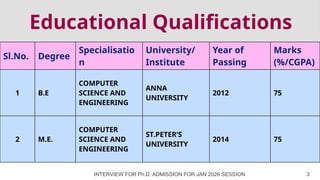
Educational Qualifications
INTERVIEW FOR Ph.D. ADMISSION FOR JAN 2026 SESSION 3
Sl.No. Degree
Specialisatio
n
University/
Institute
Year of
Passing
Marks
(%/CGPA)
1 B.E
COMPUTER
SCIENCE AND
ENGINEERING
ANNA
UNIVERSITY
2012 75
2 M.E.
COMPUTER
SCIENCE AND
ENGINEERING
ST.PETER’S
UNIVERSITY
2014 75
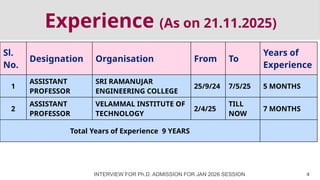
Experience (As on 21.11.2025)
INTERVIEW FOR Ph.D. ADMISSION FOR JAN 2026 SESSION 4
Sl.
No.
Designation Organisation From To
Years of
Experience
1
ASSISTANT
PROFESSOR
SRI RAMANUJAR
ENGINEERING COLLEGE
25/9/24 7/5/25 5 MONTHS
2
ASSISTANT
PROFESSOR
VELAMMAL INSTITUTE OF
TECHNOLOGY
2/4/25
TILL
NOW
7 MONTHS
Total Years of Experience 9 YEARS
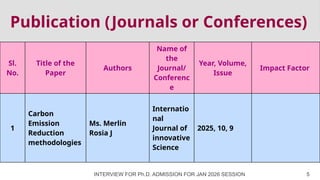
Publication (Journals or Conferences)
INTERVIEW FOR Ph.D. ADMISSION FOR JAN 2026 SESSION 5
Sl.
No.
Title of the
Paper
Authors
Name of
the
Journal/
Conferenc
e
Year, Volume,
Issue
Impact Factor
1
Carbon
Emission
Reduction
methodologies
Ms. Merlin
Rosia J
Internatio
nal
Journal of
innovative
Science
2025, 10, 9
INTRODUCTION
 Cybercrime is a constantly evolving field, with attackers continually
seeking new and innovative ways to exploit vulnerabilities and
compromise systems.
 This research explores the growing danger of cybercriminals using
Artificial Intelligence (AI) to launch more sophisticated and effective
attacks
 The use of AI in cybercrime is constantly evolving, making it difficult for
security professionals to keep up with the latest threats.
 Behavioral analytics is used to monitor user and system behavior to
identify deviations from normal patterns that may indicate a security
INTERVIEW FOR Ph.D. ADMISSION FOR JANUARY 2022 SESSION 6
INTRODUCTION
 AI can be used to detect and prevent intrusions by analyzing network
traffic and system logs for malicious activity.
 AI can be used to detect and analyze malware by identifying suspicious
code patterns and behaviors.
 AI can be used to detect phishing emails by analyzing the content and
structure of emails for suspicious characteristics
 AI can be used to identify and prioritize vulnerabilities by analyzing
system configurations and software versions.
INTERVIEW FOR Ph.D. ADMISSION FOR JANUARY 2022 SESSION 7
Summary of Literature
INTERVIEW FOR Ph.D. ADMISSION FOR JAN 2026 SESSION 8
Sl.
No.
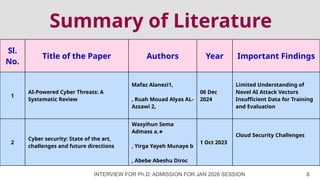
Title of the Paper Authors Year Important Findings
1
AI-Powered Cyber Threats: A
Systematic Review
Mafaz Alanezi1,
, Ruah Mouad Alyas AL-
Azzawi 2,
06 Dec
2024
Limited Understanding of
Novel AI Attack Vectors
Insufficient Data for Training
and Evaluation
2
Cyber security: State of the art,
challenges and future directions
Wasyihun Sema
Admass a,∗
, Yirga Yayeh Munaye b
, Abebe Abeshu Diroc
1 Oct 2023
Cloud Security Challenges
Sl.
No.
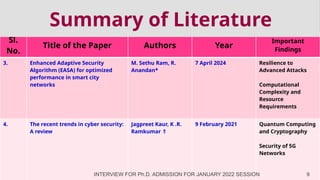
Title of the Paper Authors Year
Important
Findings
3. Enhanced Adaptive Security
Algorithm (EASA) for optimized
performance in smart city
networks
M. Sethu Ram, R.
Anandan*
7 April 2024 Resilience to
Advanced Attacks
Computational
Complexity and
Resource
Requirements
4. The recent trends in cyber security:
A review
Jagpreet Kaur, K .R.
Ramkumar ⇑
9 February 2021 Quantum Computing
and Cryptography
Security of 5G
Networks
INTERVIEW FOR Ph.D. ADMISSION FOR JANUARY 2022 SESSION 9
Summary of Literature
Research Gap
 Limited Understanding of Novel AI Attack Vectors: The rapid advancement of AI techniques
means that new attack vectors are constantly emerging. There's a need for continuous research
to identify and understand these novel threats, including adversarial attacks on AI systems
themselves.
 Insufficient Data for Training and Evaluation : The effectiveness of AI-based security
solutions depends on the availability of large, high-quality datasets for training and evaluation.
There's a need for more comprehensive and diverse datasets that accurately reflect the real-
world threat landscape.
 Cloud Security Challenges: Cloud computing introduces new security challenges, such as data
breaches, mis configurations, and insider threats. Research is needed to address these
challenges and develop effective cloud security solutions.
.
INTERVIEW FOR Ph.D. ADMISSION FOR JAN 2026 SESSION 10
 Resilience to Advanced Attacks: The EASA algorithm may be vulnerable to advanced attacks
that are not considered in its design. Research is needed to evaluate the algorithm's resilience
to these attacks and to develop countermeasures to mitigate them.
 Computational Complexity and Resource Requirements: The EASA algorithm may have
high computational complexity and resource requirements, which could limit its applicability in
resource-constrained smart city devices. Research is needed to optimize the algorithm's
performance and reduce its resource requirements.
 Quantum Computing and Cryptography: The advent of quantum computing poses a
significant threat to current cryptographic algorithms. Research is needed to develop quantum-
resistant cryptographic algorithms and security protocols.
 Security of 5G Networks : 5G networks offer increased bandwidth and connectivity, but also
introduce new security risks. Research is needed to address the security vulnerabilities of 5G
networks and to develop secure 5G applications.
INTERVIEW FOR Ph.D. ADMISSION FOR JANUARY 2022 SESSION 11
Research Gap
Objectives
 The main objective is to deploy AI-based anomaly detection systems that can identify
deviations from normal network behavior, user activity, and system processes.
 Utilize the AI to accelerate forensic analysis by automating the process of analyzing
logs, network traffic, and system images.
 Create platforms for sharing threat intelligence and best practices among
organizations, government agencies, and security vendors.
 Adopt zero trust security models that assume no user or device is trusted by default
and require continuous verification before granting access to resources.
INTERVIEW FOR Ph.D. ADMISSION FOR JAN 2026 SESSION 12
INTERVIEW FOR Ph.D. ADMISSION FOR JANUARY 2022 SESSION 13
Unsupervise
d
Generates
adversarial
examples for
testing
Identifies
anomalies
in network traffic
Supervise
d
Analyzes malware,
identifies malicious
patterns
Builds ensembles
for intrusion
detection
K-Means
Clustering
Random
Forest
Generativ
e
Adversaria
l
Networks
Convolutiona
l
Neural
Networks
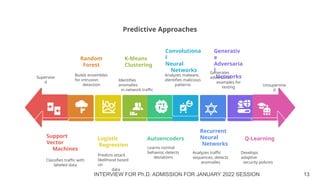
Predictive Approaches
Support
Vector
Machines
Analyzes traffic
sequences, detects
anomalies
Autoencoders Q-Learning
Recurrent
Neural
Networks
Classifies traffic with
labeled data
Learns normal
behavior, detects
deviations
Develops
adaptive
security policies
Predicts attack
likelihood based
on
data
Logistic
Regression
Scope of the Proposed Research
 The main scope of this research is to bring a need for proactive, adaptive, and
intelligent security solutions that can anticipate, detect, and respond to these
threats in real-time.
 The current cyber security paradigm is struggling to keep pace with the
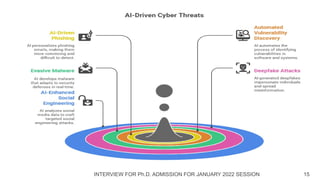
sophistication of AI-driven cyber threats. These threats include:
 AI-powered malware: Malware that can learn and adapt to evade detection.
 Deepfake-enabled social engineering: Attacks that use AI-generated fake
content to manipulate individuals.
 Automated vulnerability discovery: AI systems that can automatically identify
and exploit vulnerabilities in software and systems.
 AI-driven phishing campaigns: Highly personalized and convincing phishing
attacks generated by AI.
 Evasion of traditional security systems: AI techniques used to bypass
firewalls, intrusion detection systems, and antivirus software.
INTERVIEW FOR Ph.D. ADMISSION FOR JAN 2026 SESSION 14
INTERVIEW FOR Ph.D. ADMISSION FOR JANUARY 2022 SESSION 15
Methodology
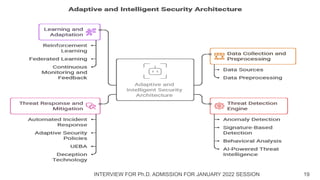
 To effectively counter AI-powered cyber threats, a robust and
adaptive security architecture is required. The proposed architecture consists of
the following key components:
 Data Collection and Preprocessing:
 Data Sources: Collect data from various sources, including network traffic,
system logs, endpoint activity, and threat intelligence feeds.
 Data Preprocessing: Clean, normalize, and transform the data to prepare it for
analysis. This includes removing noise, handling missing values, and converting
data into a suitable format for machine learning algorithms.
 Threat Detection Engine
 Anomaly Detection: Use machine learning algorithms to identify anomalous
behavior that deviates from the established baseline. Algorithms such as
Isolation Forest, One-Class SVM, and Autoencoders can be used for anomaly
detection.
 Signature-Based Detection: Maintain a database of known threat signatures
and use pattern matching techniques to identify malicious activity.
INTERVIEW FOR Ph.D. ADMISSION FOR JAN 2026 SESSION 16
INTERVIEW FOR Ph.D. ADMISSION FOR JANUARY 2022 SESSION 17
Methodology
 Behavioral Analysis: Analyze the behavior of users, applications, and systems to detect suspicious activities.
This involves tracking actions, resource usage, and communication patterns.
 AI-Powered Threat Intelligence: Integrate threat intelligence feeds and use AI to correlate and analyze threat
data to identify emerging threats and vulnerabilities.
 Threat Response and Mitigation
 Automated Incident Response: Automate incident response procedures to quickly contain and mitigate
threats. This includes isolating infected systems, blocking malicious traffic, and patching vulnerabilities.
 Adaptive Security Policies: Dynamically adjust security policies based on the current threat landscape and the
organization's risk profile.
 User and Entity Behavior Analytics (UEBA): Use machine learning to analyze user and entity behavior to
detect insider threats and compromised accounts.
 Deception Technology: Deploy decoys and traps to lure attackers and gather intelligence about their tactics
and techniques.
INTERVIEW FOR Ph.D. ADMISSION FOR JANUARY 2022 SESSION 18
Methodology
Learning and Adaptation
• Reinforcement Learning: Use reinforcement learning to train security systems to make optimal decisions in
response to threats.
• Federated Learning: Train machine learning models on decentralized data sources without sharing sensitive
information.
• Continuous Monitoring and Feedback: Continuously monitor the performance of the security system and
use feedback to improve its effectiveness.
4. Methodologies and Algorithms
The following methodologies and algorithms can be used in the proposed security architecture:
• Machine Learning Algorithms:
• Supervised Learning: Support Vector Machines (SVM), Random Forest, Gradient Boosting, Neural
Networks.
• Unsupervised Learning: K-Means Clustering, DBSCAN, Isolation Forest, Autoencoders.
• Reinforcement Learning: Q-Learning, Deep Q-Networks (DQN).
INTERVIEW FOR Ph.D. ADMISSION FOR JANUARY 2022 SESSION 19
Expected Outcome
INTERVIEW FOR Ph.D. ADMISSION FOR JANUARY 2022 SESSION 20
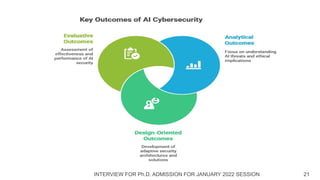
The research evaluate the limitations of traditional security system in addressing AI
powered threads.
The paper provide the detail analysis of current and emerging AI – Powered cyber
threats.
The paper will address the ethical considerations in use of AI in cyber security
The paper will evaluate the performance of AI-based security mechanisms in terms
of accuracy, speed, and resource consumption.
The paper will evaluate the effectiveness of the proposed adaptive security
architectures and intelligent security solutions through simulations, experiments, or
real-world deployments.
INTERVIEW FOR Ph.D. ADMISSION FOR JANUARY 2022 SESSION 21
Novelty
 The paper moves beyond traditional reactive security approaches by
proposing proactive and adaptive security solutions that can anticipate
and respond to evolving AI-powered threats in real-time.
 The paper proposes a holistic security architecture that integrates
multiple AI-powered security solutions to provide comprehensive
protection against AI-driven cyber threats.
 The paper explores the use of AI to automate incident response,
enabling organizations to quickly and effectively contain and
remediate cyber attacks.
 The research addresses the emerging threat of adversarial AI, where
attackers use AI to manipulate or evade AI-based security systems.
INTERVIEW FOR Ph.D. ADMISSION FOR JAN 2026 SESSION 22
INTERVIEW FOR Ph.D. ADMISSION FOR JANUARY 2022 SESSION 23
INTERVIEW FOR Ph.D. ADMISSION FOR JAN 2026 SESSION 24
THANK
YOU

Finaljan26.pptx centre for research

  • 1.
    CENTRE FOR RESEARCH ANNAUNIVERSITY,CHENNAI. INTERVIEW FOR Ph.D. ADMISSION FOR JAN 2026 SESSION 1 Format for Preparation of PPT for Interview
  • 2.
    INTERVIEW FOR Ph.D.ADMISSION FOR JAN 2026 SESSION 2 Name of the Candidate : Mrs. MERLIN ROSIA J Reference No. : 261941534 Affiliation (of Scholars) : Anna University Name of the Proposed Supervisor : Dr. AROCKIA XAVIER ANNIE R Affiliation : ANNA UNIVERSITY Addressing the Rise of AI-Powered Cyber Threats Through Adaptive and Intelligent Security Solutions
  • 3.
    Educational Qualifications INTERVIEW FORPh.D. ADMISSION FOR JAN 2026 SESSION 3 Sl.No. Degree Specialisatio n University/ Institute Year of Passing Marks (%/CGPA) 1 B.E COMPUTER SCIENCE AND ENGINEERING ANNA UNIVERSITY 2012 75 2 M.E. COMPUTER SCIENCE AND ENGINEERING ST.PETER’S UNIVERSITY 2014 75
  • 4.
    Experience (As on21.11.2025) INTERVIEW FOR Ph.D. ADMISSION FOR JAN 2026 SESSION 4 Sl. No. Designation Organisation From To Years of Experience 1 ASSISTANT PROFESSOR SRI RAMANUJAR ENGINEERING COLLEGE 25/9/24 7/5/25 5 MONTHS 2 ASSISTANT PROFESSOR VELAMMAL INSTITUTE OF TECHNOLOGY 2/4/25 TILL NOW 7 MONTHS Total Years of Experience 9 YEARS
  • 5.
    Publication (Journals orConferences) INTERVIEW FOR Ph.D. ADMISSION FOR JAN 2026 SESSION 5 Sl. No. Title of the Paper Authors Name of the Journal/ Conferenc e Year, Volume, Issue Impact Factor 1 Carbon Emission Reduction methodologies Ms. Merlin Rosia J Internatio nal Journal of innovative Science 2025, 10, 9
  • 6.
    INTRODUCTION  Cybercrime isa constantly evolving field, with attackers continually seeking new and innovative ways to exploit vulnerabilities and compromise systems.  This research explores the growing danger of cybercriminals using Artificial Intelligence (AI) to launch more sophisticated and effective attacks  The use of AI in cybercrime is constantly evolving, making it difficult for security professionals to keep up with the latest threats.  Behavioral analytics is used to monitor user and system behavior to identify deviations from normal patterns that may indicate a security INTERVIEW FOR Ph.D. ADMISSION FOR JANUARY 2022 SESSION 6
  • 7.
    INTRODUCTION  AI canbe used to detect and prevent intrusions by analyzing network traffic and system logs for malicious activity.  AI can be used to detect and analyze malware by identifying suspicious code patterns and behaviors.  AI can be used to detect phishing emails by analyzing the content and structure of emails for suspicious characteristics  AI can be used to identify and prioritize vulnerabilities by analyzing system configurations and software versions. INTERVIEW FOR Ph.D. ADMISSION FOR JANUARY 2022 SESSION 7
  • 8.
    Summary of Literature INTERVIEWFOR Ph.D. ADMISSION FOR JAN 2026 SESSION 8 Sl. No. Title of the Paper Authors Year Important Findings 1 AI-Powered Cyber Threats: A Systematic Review Mafaz Alanezi1, , Ruah Mouad Alyas AL- Azzawi 2, 06 Dec 2024 Limited Understanding of Novel AI Attack Vectors Insufficient Data for Training and Evaluation 2 Cyber security: State of the art, challenges and future directions Wasyihun Sema Admass a,∗ , Yirga Yayeh Munaye b , Abebe Abeshu Diroc 1 Oct 2023 Cloud Security Challenges
  • 9.
    Sl. No. Title of thePaper Authors Year Important Findings 3. Enhanced Adaptive Security Algorithm (EASA) for optimized performance in smart city networks M. Sethu Ram, R. Anandan* 7 April 2024 Resilience to Advanced Attacks Computational Complexity and Resource Requirements 4. The recent trends in cyber security: A review Jagpreet Kaur, K .R. Ramkumar ⇑ 9 February 2021 Quantum Computing and Cryptography Security of 5G Networks INTERVIEW FOR Ph.D. ADMISSION FOR JANUARY 2022 SESSION 9 Summary of Literature
  • 10.
    Research Gap  LimitedUnderstanding of Novel AI Attack Vectors: The rapid advancement of AI techniques means that new attack vectors are constantly emerging. There's a need for continuous research to identify and understand these novel threats, including adversarial attacks on AI systems themselves.  Insufficient Data for Training and Evaluation : The effectiveness of AI-based security solutions depends on the availability of large, high-quality datasets for training and evaluation. There's a need for more comprehensive and diverse datasets that accurately reflect the real- world threat landscape.  Cloud Security Challenges: Cloud computing introduces new security challenges, such as data breaches, mis configurations, and insider threats. Research is needed to address these challenges and develop effective cloud security solutions. . INTERVIEW FOR Ph.D. ADMISSION FOR JAN 2026 SESSION 10
  • 11.
     Resilience toAdvanced Attacks: The EASA algorithm may be vulnerable to advanced attacks that are not considered in its design. Research is needed to evaluate the algorithm's resilience to these attacks and to develop countermeasures to mitigate them.  Computational Complexity and Resource Requirements: The EASA algorithm may have high computational complexity and resource requirements, which could limit its applicability in resource-constrained smart city devices. Research is needed to optimize the algorithm's performance and reduce its resource requirements.  Quantum Computing and Cryptography: The advent of quantum computing poses a significant threat to current cryptographic algorithms. Research is needed to develop quantum- resistant cryptographic algorithms and security protocols.  Security of 5G Networks : 5G networks offer increased bandwidth and connectivity, but also introduce new security risks. Research is needed to address the security vulnerabilities of 5G networks and to develop secure 5G applications. INTERVIEW FOR Ph.D. ADMISSION FOR JANUARY 2022 SESSION 11 Research Gap
  • 12.
    Objectives  The mainobjective is to deploy AI-based anomaly detection systems that can identify deviations from normal network behavior, user activity, and system processes.  Utilize the AI to accelerate forensic analysis by automating the process of analyzing logs, network traffic, and system images.  Create platforms for sharing threat intelligence and best practices among organizations, government agencies, and security vendors.  Adopt zero trust security models that assume no user or device is trusted by default and require continuous verification before granting access to resources. INTERVIEW FOR Ph.D. ADMISSION FOR JAN 2026 SESSION 12
  • 13.
    INTERVIEW FOR Ph.D.ADMISSION FOR JANUARY 2022 SESSION 13 Unsupervise d Generates adversarial examples for testing Identifies anomalies in network traffic Supervise d Analyzes malware, identifies malicious patterns Builds ensembles for intrusion detection K-Means Clustering Random Forest Generativ e Adversaria l Networks Convolutiona l Neural Networks Predictive Approaches Support Vector Machines Analyzes traffic sequences, detects anomalies Autoencoders Q-Learning Recurrent Neural Networks Classifies traffic with labeled data Learns normal behavior, detects deviations Develops adaptive security policies Predicts attack likelihood based on data Logistic Regression
  • 14.
    Scope of theProposed Research  The main scope of this research is to bring a need for proactive, adaptive, and intelligent security solutions that can anticipate, detect, and respond to these threats in real-time.  The current cyber security paradigm is struggling to keep pace with the sophistication of AI-driven cyber threats. These threats include:  AI-powered malware: Malware that can learn and adapt to evade detection.  Deepfake-enabled social engineering: Attacks that use AI-generated fake content to manipulate individuals.  Automated vulnerability discovery: AI systems that can automatically identify and exploit vulnerabilities in software and systems.  AI-driven phishing campaigns: Highly personalized and convincing phishing attacks generated by AI.  Evasion of traditional security systems: AI techniques used to bypass firewalls, intrusion detection systems, and antivirus software. INTERVIEW FOR Ph.D. ADMISSION FOR JAN 2026 SESSION 14
  • 15.
    INTERVIEW FOR Ph.D.ADMISSION FOR JANUARY 2022 SESSION 15
  • 16.
    Methodology  To effectivelycounter AI-powered cyber threats, a robust and adaptive security architecture is required. The proposed architecture consists of the following key components:  Data Collection and Preprocessing:  Data Sources: Collect data from various sources, including network traffic, system logs, endpoint activity, and threat intelligence feeds.  Data Preprocessing: Clean, normalize, and transform the data to prepare it for analysis. This includes removing noise, handling missing values, and converting data into a suitable format for machine learning algorithms.  Threat Detection Engine  Anomaly Detection: Use machine learning algorithms to identify anomalous behavior that deviates from the established baseline. Algorithms such as Isolation Forest, One-Class SVM, and Autoencoders can be used for anomaly detection.  Signature-Based Detection: Maintain a database of known threat signatures and use pattern matching techniques to identify malicious activity. INTERVIEW FOR Ph.D. ADMISSION FOR JAN 2026 SESSION 16
  • 17.
    INTERVIEW FOR Ph.D.ADMISSION FOR JANUARY 2022 SESSION 17 Methodology  Behavioral Analysis: Analyze the behavior of users, applications, and systems to detect suspicious activities. This involves tracking actions, resource usage, and communication patterns.  AI-Powered Threat Intelligence: Integrate threat intelligence feeds and use AI to correlate and analyze threat data to identify emerging threats and vulnerabilities.  Threat Response and Mitigation  Automated Incident Response: Automate incident response procedures to quickly contain and mitigate threats. This includes isolating infected systems, blocking malicious traffic, and patching vulnerabilities.  Adaptive Security Policies: Dynamically adjust security policies based on the current threat landscape and the organization's risk profile.  User and Entity Behavior Analytics (UEBA): Use machine learning to analyze user and entity behavior to detect insider threats and compromised accounts.  Deception Technology: Deploy decoys and traps to lure attackers and gather intelligence about their tactics and techniques.
  • 18.
    INTERVIEW FOR Ph.D.ADMISSION FOR JANUARY 2022 SESSION 18 Methodology Learning and Adaptation • Reinforcement Learning: Use reinforcement learning to train security systems to make optimal decisions in response to threats. • Federated Learning: Train machine learning models on decentralized data sources without sharing sensitive information. • Continuous Monitoring and Feedback: Continuously monitor the performance of the security system and use feedback to improve its effectiveness. 4. Methodologies and Algorithms The following methodologies and algorithms can be used in the proposed security architecture: • Machine Learning Algorithms: • Supervised Learning: Support Vector Machines (SVM), Random Forest, Gradient Boosting, Neural Networks. • Unsupervised Learning: K-Means Clustering, DBSCAN, Isolation Forest, Autoencoders. • Reinforcement Learning: Q-Learning, Deep Q-Networks (DQN).
  • 19.
    INTERVIEW FOR Ph.D.ADMISSION FOR JANUARY 2022 SESSION 19
  • 20.
    Expected Outcome INTERVIEW FORPh.D. ADMISSION FOR JANUARY 2022 SESSION 20 The research evaluate the limitations of traditional security system in addressing AI powered threads. The paper provide the detail analysis of current and emerging AI – Powered cyber threats. The paper will address the ethical considerations in use of AI in cyber security The paper will evaluate the performance of AI-based security mechanisms in terms of accuracy, speed, and resource consumption. The paper will evaluate the effectiveness of the proposed adaptive security architectures and intelligent security solutions through simulations, experiments, or real-world deployments.
  • 21.
    INTERVIEW FOR Ph.D.ADMISSION FOR JANUARY 2022 SESSION 21
  • 22.
    Novelty  The papermoves beyond traditional reactive security approaches by proposing proactive and adaptive security solutions that can anticipate and respond to evolving AI-powered threats in real-time.  The paper proposes a holistic security architecture that integrates multiple AI-powered security solutions to provide comprehensive protection against AI-driven cyber threats.  The paper explores the use of AI to automate incident response, enabling organizations to quickly and effectively contain and remediate cyber attacks.  The research addresses the emerging threat of adversarial AI, where attackers use AI to manipulate or evade AI-based security systems. INTERVIEW FOR Ph.D. ADMISSION FOR JAN 2026 SESSION 22

  • 23.
    INTERVIEW FOR Ph.D.ADMISSION FOR JANUARY 2022 SESSION 23
  • 24.
    INTERVIEW FOR Ph.D.ADMISSION FOR JAN 2026 SESSION 24 THANK YOU