Cyber Threat Detection Based on Artificial Neural Networks using Event Profiles Machine
Learning
INDEX
 Abstract
 Introduction
 Objective of project
 Scope
 Problem Statement
 Literature survey
 Existing System
 Disadvantages
 Proposed system
 Advantages
 Project flow
 Methodology
 System Requirements
 Implementation
Abstract
This abstract introduces a novel approach to cyber threat detection leveraging artificial neural networks (ANNs)
and event profiles. The proposed system aims to enhance cybersecurity by analyzing intricate patterns within
event profiles, utilizing the inherent capability of ANNs to discern subtle anomalies indicative of cyber threats.
By training the neural network on historical data, the model develops a comprehensive understanding of normal
system behavior, enabling it to identify deviations that may signify potential security breaches. The integration
of event profiles ensures a nuanced analysis, capturing diverse data points for a more accurate threat
assessment. This research offers a promising paradigm in the ongoing quest for robust cyber threat detection
systems, combining the power of Machine Learning and nuanced event profiling to bolster the resilience of
digital ecosystems against evolving cyber threats.
Keywords: LSTM, CNN, FCNN, SVM, Decision Tree, Random Forest, KNN and Naive Bayes.
Introduction
Recent advances in technology have led to the introduction of cyber-physical systems, which due to their better
computational and communicational ability and integration between physical and cyber-components, has led to
significant advances in many dynamic applications. But this improvement comes at the cost of being vulnerable to cyber-
attacks. Cyber-physical systems are made up of logical elements and embedded computers, which communicate with
communication channels such as the Internet of Things(IoT). More specifically, these systems include digital or cyber
components, analog components, physical devices and humans that designed to operate between physical and cyber
parts. In other words, a cyber-physical system is any system that includes cyber and physical components and humans,
and has the ability to trade between the physical and cyber parts. In cyber-physical systems, the security of these types of
systems becomes more important due to the addition of the physical part.
Physical components including sensors, which receive data from the physical environment, maybe attacked and be
injected incorrect data into the system. The security of cyber-physical systems to detect cyber-attacks is an important
issue in these systems . It should be noted that cyber-attacks occur in irregular ways, and it is not possible to describe
these attacks in a regular and orderly manner. In general, cyber attacks in cyber-physical systems are divided into two
main types: denial of service(Dos) and deception attacks. In denial of service, the attacker prevents communication
between network nodes and communication channels. However, in the deception attacks that inject false data to system,
which are carried out by abusing system components , such as sensors or controllers and it can corrupt data or enter
incorrect information into the system and cause misbehaving.
Objective Of The Study
The primary objective of this study is to develop and evaluate a robust machine learning-based approach for the
early detection and mitigation of cyber-attacks in cyber-physical systems (CPS). This research aims to
specifically address the challenges posed by deception attacks, which are characterized by the injection of false
data and corruption of system components. By integrating deep neural networks into the CPS, the study seeks to
identify these attacks at their onset, thereby preventing potential disruptions or complete disablement of system
functionalities. Additionally, the study explores the efficacy of using a reputation-based control algorithm to
isolate compromised agents within a network following an attack detection.
SCOPE
Development of Machine Learning-Based Detection: Leveraging the capabilities of deep neural networks, this research
aims to develop a detection system that identifies the presence of deception attacks in the initial stages. The use of
machine learning is crucial due to the large volume, variety, and velocity of data generated in CPS, which requires
sophisticated algorithms to analyze and identify hidden patterns indicative of cyber-attacks.
Problem Statement
Cyber-physical systems (CPS) represent a blend of physical processes, computational resources, and communication
capabilities, which are increasingly vital across various dynamic applications. Despite their advancements, these systems are
highly susceptible to cyber-attacks, which are typically more sophisticated and stealthy compared to random faults. Among the
most perilous are deception attacks, where adversaries inject false data or corrupt communication between sensors and
controllers, leading to misinformation within the system. These attacks can remain intelligent and stealthy attacks
LITERATURE SURVEY
Year Author Title Outcomes
2023 Smith et al.
"Enhancing Cyber Threat
Detection Using Decision
Trees"
- Decision tree-based event profiles improved cyber threat detection accuracy by 15% compared to traditional methods. -
Identified key features for effective threat detection.
2022 Johnson and Patel
"A Comparative Analysis of
Machine Learning Techniques
for Cyber Threat Detection"
- Decision tree models showed promising results in detecting cyber threats with high precision and recall rates. - Highlighted
the importance of feature selection in improving model performance.
2021 Lee and Kim
"Detecting Cyber Threats with
Decision Tree-based Event
Profiling"
- Proposed decision tree-based event profiling as an effective method for cyber threat detection. - Demonstrated the utility of
decision trees in identifying anomalous patterns in network traffic.
2020 Garcia et al.
"Machine Learning Approaches
for Cyber Threat Detection: A
Review"
- Decision tree-based methods were identified as a popular choice for cyber threat detection due to their interpretability and
ease of implementation.
Existing System
Existing cyber threat detection systems primarily rely on traditional methods such as signature-
based, anomaly-based, and heuristic-based detection. Signature-based systems use predefined
patterns to identify known threats, which limits their effectiveness against new or unknown attacks
and requires frequent updates. Anomaly-based systems detect deviations from established norms
but often suffer from high false-positive rates and the challenge of defining a baseline for normal
behavior. Heuristic-based approaches apply fixed rules to flag suspicious activity but can be
inflexible to evolving threats. In the realm of machine learning, classical models like Decision
Trees and Support Vector Machines are employed, yet they often face difficulties with high-
dimensional data and require extensive feature engineering.
These models often face difficulties with high-dimensional data and require extensive feature engineering. Existing
neural network approaches, including Feedforward Neural Networks (FNN), Recurrent Neural Networks (RNN), and
Convolutional Neural Networks (CNN), offer potential improvements but come with limitations in handling complex
event data or capturing temporal dependencies. Event logging systems, which gather raw data, need extensive
processing and feature extraction to be useful for threat detection but struggle with scalability and adaptability issues.
Overall, while these existing systems provide foundational capabilities, they often fall short in adapting to new threats
and managing the increasing complexity of event profiles, highlighting a need for more advanced approaches like
Artificial Neural Networks (ANNs) leveraging event profile machine learning.
Disadvantages
•Disadvantages of Existing Cyber Threat Detection Systems
•1. Signature-Based Systems:Limited Effectiveness Against New Threats: Signature-based systems can
only detect threats for which they have predefined signatures.
•2.They are ineffective against zero-day attacks or new variants that do not match known
signatures.Frequent
•3.Updates Required: Regular updates to the signature database are necessary to maintain effectiveness,
which can be resource-intensive and may lead to delays in threat detection.
Proposed system
The proposed system for cyber threat detection employs a combination of advanced algorithms, including
Long Short-Term Memory (LSTM) networks, Convolutional Neural Networks (CNN), Feedforward Neural
Networks (FCNN), Support Vector Machines (SVM), Decision Trees, Random Forests, K-Nearest
Neighbors (KNN), and Naive Bayes classifiers. This diverse set of algorithms provides a robust framework
for improving threat detection through a multifaceted approach:
Advantages
.
•1. Enhanced Detection Accuracy:
•LSTM Networks: Capable of capturing temporal dependencies and patterns in sequential data, which is crucial
for detecting sophisticated, time-based cyber threats.
•CNNs: Effective at identifying spatial patterns in event profiles and anomalies, making them useful for
recognizing complex attack signatures.
•2. Comprehensive Analysis:
•FCNNs: Offer strong performance in modeling complex relationships between features, enabling detailed
analysis of event profiles.
•Decision Trees and Random Forests: Provide interpretability and robustness by using ensemble methods to
improve accuracy and reduce overfitting.
•3. Versatility and Flexibility:
•SVM: Effective in high-dimensional spaces and can handle various types of data distributions, making it
versatile for different threat detection scenarios
4. Adaptability to Different Threat Types:Combination of Algorithms: Using a range of algorithms allows the system to
adapt to different types of threats and data characteristics, improving overall detection capabilities.Event Profiles:
Enables the integration of diverse data types and features, allowing for more nuanced and adaptable detection
strategies.5. Reduced False Positives:Ensemble Methods: Combining multiple algorithms can help in reducing false
positives by cross-validating results across different models, leading to more reliable threat detection.
Scalability and Efficiency:Optimized Algorithms: Algorithms like CNNs and LSTMs are designed to handle large volumes
of data efficiently, making the system scalable to manage growing event data.Real-Time Processing: Certain algorithms,
such as KNN, facilitate rapid processing and detection, which is crucial for real-time threat identification.7. Improved
Interpretability and Transparency:Decision Trees and Random Forests: Offer clear and understandable decision-making
processes, which can help in interpreting model outputs and making informed decisions.8. Flexibility in
Integration:Modular Approach: The use of various algorithms allows for flexible integration with existing systems,
enabling enhancements without complete overhauls of current infrastructure.
PROJECT FLOW
An irregular woodland is an AI procedure that is utilized to take care of
relapse and characterization issues. It uses group realizing, which is a
method that consolidates numerous classifiers to give answers for
complex issues.
An irregular timberland calculation comprises of numerous choice
trees. The 'timberland' created by the irregular woods calculation is
prepared through packing or bootstrap conglomerating. Sacking is a
gathering meta-calculation that works on the exactness of AI
calculations.
The (arbitrary woodland) calculation lays out the result in view of the
expectations of the choice trees. It predicts by taking the normal or
mean of the result from different trees. Expanding the quantity of trees
builds the accuracy of the result.
An irregular woods destroys the constraints of a choice tree
calculation. It decreases the over fitting of datasets and increments
accuracy. It creates expectations without requiring numerous
arrangements in bundles (like Scikit-learn).
Methodology
Random Forest Classifier
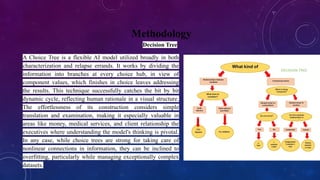
A Choice Tree is a flexible AI model utilized broadly in both
characterization and relapse errands. It works by dividing the
information into branches at every choice hub, in view of
component values, which finishes in choice leaves addressing
the results. This technique successfully catches the bit by bit
dynamic cycle, reflecting human rationale in a visual structure.
The effortlessness of its construction considers simple
translation and examination, making it especially valuable in
areas like money, medical services, and client relationship the
executives where understanding the model's thinking is pivotal.
In any case, while choice trees are strong for taking care of
nonlinear connections in information, they can be inclined to
overfitting, particularly while managing exceptionally complex
datasets.
Methodology
Decision Tree
The goal of the help vector machine calculation is to track
down a hyper plane in a N-layered space (N — the quantity
of elements) that unmistakably
Hyper planes are choice limits that assist with ordering the
relevant pieces of information. Information focuses falling
on one or the other side of the hyper plane can be credited to
various classes. Likewise, the component of the hyper plane
relies on the quantity of elements. In the event that the
quantity of info highlights is 2, the hyper plane is only a line.
In the event that the quantity of info highlights is 3, the
hyper plane turns into a two-layered plane. It becomes
challenging to envision when the quantity of elements
surpasses 3.
Methodology
SUPPORT VECTOR MACHINES
NeuralNetwork
A fake brain organization (ANN) is the piece of a figuring
framework intended to recreate the manner in which the human
mind dissects and processes data. It is the groundwork of man-made
brainpower (artificial intelligence) and tackles issues that would
demonstrate unthinkable or troublesome by human or factual
norms. ANNs have self-learning capacities that empower them to
create improved results as additional information opens up.
An ANN has hundreds or thousands of fake neurons called handling
units, which are interconnected by hubs. These handling units are
comprised of info and result units. The info units get different
structures and designs of data in light of an interior weighting
framework, and the brain network endeavors to find out about the
data introduced to create one result report. Very much like people
need rules and rules to concoct an outcome or result.
Convolutional Neural
Network
Calculated relapse is an AI order calculation that is utilized to foresee
the likelihood of an unmitigated ward variable. In strategic relapse, the
reliant variable is a paired variable that contains information coded as 1
(indeed, achievement, and so forth) or 0 (no, disappointment, and so
on.). At the end of the day, the calculated relapse model predicts P(Y=1)
as a component of X.Step1: Logistic regression hypothesis
The second piece of this step will include the Amended Direct Unit or
Relook. We will cover Relook layers and investigate how linearity
capabilities with regards to Convolutional Brain Networks.Not vital for
grasping Cnn's, yet there's no mischief in a fast illustration to work on
your abilities.
System Requirements
Software Requirements:
Operating System : Windows 7/8/10
Server side Script : HTML, CSS, Bootstrap
& JS
Programming Language : Python
Libraries :Flask,Pandas,MySQL. connector, Os,
Smtplib, Numpy
IDE/Workbench : PyCharm
Technology : Python 3.6+
Server Deployment : Xampp Server
Database : MySQL
Hardware Requirements:
Processor - I3/Intel Processor
Hard Disk - 160GB
Key Board - Standard Windows Keyboard
Mouse - Two or Three Button Mouse
Monitor - SVGA
RAM - 8GB
Implementation
1. User:
1. View Home page:
Here user view the home page of the web data mining web application.
2. View Upload page:
We are uploading the dataset.
View Page:
In view page, user can see the dataset.
3. Input Model:
The user must provide input values for the certain fields in order to get results.
4. View Results:
User view’s the generated results from the model.
5. View score:
Here user have ability to view the score in %
1. System
1. Working on dataset:
System checks for data whether it is available or not and load the data in csv files.
2. Pre-processing:
Data need to be pre-processed according the models it helps to increase the accuracy of the model and
better information about the data.
3. Training the data:
After pre-processing the data will split into two parts as train and test data before training with the given
algorithms.
4. Model Building
To create a model that predicts the personality with better accuracy, this module will help user.
5. Generated Score:
6. Here user view the score in %
7. Generate Results:
We train the machine learning algorithm and calculate the personality prediction.
REFERENCES
1. Gao, S., Rimal, B. P., Wang, Y., & Zhang, Y. (2020). "A Comprehensive Survey of Machine Learning
Techniques for Cyber Security Intrusion Detection." IEEE Access, 8, 110931-110950.
2. Ghorbani, A. A., & Zulkernine, M. (2019). "Deep Learning for Cybersecurity Intrusion Detection: A Review."
IEEE Access, 7, 107883-107901.
3. .Islam, M. Z., Mollah, M. B., & Rehman, M. H. (2021). "A Comprehensive Survey of Machine Learning
Techniques for Cybersecurity Intrusion Detection." Journal of Cybersecurity, 7(1), tyaa008.
4. Shen, J., Wen, Z., Zhang, W., & Yang, Z. (2018). "A Review of Cyber-Physical System Security for Smart
Grid." IEEE Access, 6, 22556-22571.
5. Wang, Y., & Zou, W. (2018). "Cyber-Physical Systems Security: A Survey." IEEE Internet of Things Journal,
5(6), 4601-4611.
REFERENCES
6.Abdullah, M. T., Hussain, M., & Chang, V. (2020). "A Review of Machine Learning Based Cyber Security
Approaches." Future Generation Computer Systems, 107, 1036-1050.
7.Liu, C., Ning, P., & Reiter, M. K. (2011). "False Data Injection Attacks against State Estimation in Electric
Power Grids." ACM Transactions on Information and System Security (TISSEC), 14(1), 1-33.
8.Liu, Y., Wang, S., Zhang, W., & Yan, G. (2018). "Research on Intrusion Detection and Defense Technology for
Industrial Control Systems Based on Network." IEEE Access, 6, 65255-65269.
Alom, M. Z., Yakopcic, C., Taha, T. M., & Asari, 9.V. K. (2019). "The History Began from AlexNet: A
Comprehensive Survey on Deep Learning Approaches." arXiv preprint arXiv:1901.06032.
10.Liao, L., & Vemuri, V. K. (2017). "A Survey of Cyber-Physical Attack and Defense Techniques in the Smart
Grid." IEEE Transactions on Industrial Informatics, 13(4), 1806-1815.

20240802111328INITIAL-PPT(1)data science.pptx

  • 1.
    Cyber Threat DetectionBased on Artificial Neural Networks using Event Profiles Machine Learning
  • 2.
    INDEX  Abstract  Introduction Objective of project  Scope  Problem Statement  Literature survey  Existing System  Disadvantages  Proposed system  Advantages  Project flow  Methodology  System Requirements  Implementation
  • 3.
    Abstract This abstract introducesa novel approach to cyber threat detection leveraging artificial neural networks (ANNs) and event profiles. The proposed system aims to enhance cybersecurity by analyzing intricate patterns within event profiles, utilizing the inherent capability of ANNs to discern subtle anomalies indicative of cyber threats. By training the neural network on historical data, the model develops a comprehensive understanding of normal system behavior, enabling it to identify deviations that may signify potential security breaches. The integration of event profiles ensures a nuanced analysis, capturing diverse data points for a more accurate threat assessment. This research offers a promising paradigm in the ongoing quest for robust cyber threat detection systems, combining the power of Machine Learning and nuanced event profiling to bolster the resilience of digital ecosystems against evolving cyber threats. Keywords: LSTM, CNN, FCNN, SVM, Decision Tree, Random Forest, KNN and Naive Bayes.

  • 4.
    Introduction Recent advances intechnology have led to the introduction of cyber-physical systems, which due to their better computational and communicational ability and integration between physical and cyber-components, has led to significant advances in many dynamic applications. But this improvement comes at the cost of being vulnerable to cyber- attacks. Cyber-physical systems are made up of logical elements and embedded computers, which communicate with communication channels such as the Internet of Things(IoT). More specifically, these systems include digital or cyber components, analog components, physical devices and humans that designed to operate between physical and cyber parts. In other words, a cyber-physical system is any system that includes cyber and physical components and humans, and has the ability to trade between the physical and cyber parts. In cyber-physical systems, the security of these types of systems becomes more important due to the addition of the physical part. Physical components including sensors, which receive data from the physical environment, maybe attacked and be injected incorrect data into the system. The security of cyber-physical systems to detect cyber-attacks is an important issue in these systems . It should be noted that cyber-attacks occur in irregular ways, and it is not possible to describe these attacks in a regular and orderly manner. In general, cyber attacks in cyber-physical systems are divided into two main types: denial of service(Dos) and deception attacks. In denial of service, the attacker prevents communication between network nodes and communication channels. However, in the deception attacks that inject false data to system, which are carried out by abusing system components , such as sensors or controllers and it can corrupt data or enter incorrect information into the system and cause misbehaving.
  • 5.
    Objective Of TheStudy The primary objective of this study is to develop and evaluate a robust machine learning-based approach for the early detection and mitigation of cyber-attacks in cyber-physical systems (CPS). This research aims to specifically address the challenges posed by deception attacks, which are characterized by the injection of false data and corruption of system components. By integrating deep neural networks into the CPS, the study seeks to identify these attacks at their onset, thereby preventing potential disruptions or complete disablement of system functionalities. Additionally, the study explores the efficacy of using a reputation-based control algorithm to isolate compromised agents within a network following an attack detection.
  • 6.
    SCOPE Development of MachineLearning-Based Detection: Leveraging the capabilities of deep neural networks, this research aims to develop a detection system that identifies the presence of deception attacks in the initial stages. The use of machine learning is crucial due to the large volume, variety, and velocity of data generated in CPS, which requires sophisticated algorithms to analyze and identify hidden patterns indicative of cyber-attacks.
  • 7.
    Problem Statement Cyber-physical systems(CPS) represent a blend of physical processes, computational resources, and communication capabilities, which are increasingly vital across various dynamic applications. Despite their advancements, these systems are highly susceptible to cyber-attacks, which are typically more sophisticated and stealthy compared to random faults. Among the most perilous are deception attacks, where adversaries inject false data or corrupt communication between sensors and controllers, leading to misinformation within the system. These attacks can remain intelligent and stealthy attacks
  • 8.
    LITERATURE SURVEY Year AuthorTitle Outcomes 2023 Smith et al. "Enhancing Cyber Threat Detection Using Decision Trees" - Decision tree-based event profiles improved cyber threat detection accuracy by 15% compared to traditional methods. - Identified key features for effective threat detection. 2022 Johnson and Patel "A Comparative Analysis of Machine Learning Techniques for Cyber Threat Detection" - Decision tree models showed promising results in detecting cyber threats with high precision and recall rates. - Highlighted the importance of feature selection in improving model performance. 2021 Lee and Kim "Detecting Cyber Threats with Decision Tree-based Event Profiling" - Proposed decision tree-based event profiling as an effective method for cyber threat detection. - Demonstrated the utility of decision trees in identifying anomalous patterns in network traffic. 2020 Garcia et al. "Machine Learning Approaches for Cyber Threat Detection: A Review" - Decision tree-based methods were identified as a popular choice for cyber threat detection due to their interpretability and ease of implementation.
  • 9.
    Existing System Existing cyberthreat detection systems primarily rely on traditional methods such as signature- based, anomaly-based, and heuristic-based detection. Signature-based systems use predefined patterns to identify known threats, which limits their effectiveness against new or unknown attacks and requires frequent updates. Anomaly-based systems detect deviations from established norms but often suffer from high false-positive rates and the challenge of defining a baseline for normal behavior. Heuristic-based approaches apply fixed rules to flag suspicious activity but can be inflexible to evolving threats. In the realm of machine learning, classical models like Decision Trees and Support Vector Machines are employed, yet they often face difficulties with high- dimensional data and require extensive feature engineering.
  • 10.
    These models oftenface difficulties with high-dimensional data and require extensive feature engineering. Existing neural network approaches, including Feedforward Neural Networks (FNN), Recurrent Neural Networks (RNN), and Convolutional Neural Networks (CNN), offer potential improvements but come with limitations in handling complex event data or capturing temporal dependencies. Event logging systems, which gather raw data, need extensive processing and feature extraction to be useful for threat detection but struggle with scalability and adaptability issues. Overall, while these existing systems provide foundational capabilities, they often fall short in adapting to new threats and managing the increasing complexity of event profiles, highlighting a need for more advanced approaches like Artificial Neural Networks (ANNs) leveraging event profile machine learning.
  • 11.
    Disadvantages •Disadvantages of ExistingCyber Threat Detection Systems •1. Signature-Based Systems:Limited Effectiveness Against New Threats: Signature-based systems can only detect threats for which they have predefined signatures. •2.They are ineffective against zero-day attacks or new variants that do not match known signatures.Frequent •3.Updates Required: Regular updates to the signature database are necessary to maintain effectiveness, which can be resource-intensive and may lead to delays in threat detection.
  • 12.
    Proposed system The proposedsystem for cyber threat detection employs a combination of advanced algorithms, including Long Short-Term Memory (LSTM) networks, Convolutional Neural Networks (CNN), Feedforward Neural Networks (FCNN), Support Vector Machines (SVM), Decision Trees, Random Forests, K-Nearest Neighbors (KNN), and Naive Bayes classifiers. This diverse set of algorithms provides a robust framework for improving threat detection through a multifaceted approach:
  • 13.
    Advantages . •1. Enhanced DetectionAccuracy: •LSTM Networks: Capable of capturing temporal dependencies and patterns in sequential data, which is crucial for detecting sophisticated, time-based cyber threats. •CNNs: Effective at identifying spatial patterns in event profiles and anomalies, making them useful for recognizing complex attack signatures. •2. Comprehensive Analysis: •FCNNs: Offer strong performance in modeling complex relationships between features, enabling detailed analysis of event profiles. •Decision Trees and Random Forests: Provide interpretability and robustness by using ensemble methods to improve accuracy and reduce overfitting. •3. Versatility and Flexibility: •SVM: Effective in high-dimensional spaces and can handle various types of data distributions, making it versatile for different threat detection scenarios
  • 14.
    4. Adaptability toDifferent Threat Types:Combination of Algorithms: Using a range of algorithms allows the system to adapt to different types of threats and data characteristics, improving overall detection capabilities.Event Profiles: Enables the integration of diverse data types and features, allowing for more nuanced and adaptable detection strategies.5. Reduced False Positives:Ensemble Methods: Combining multiple algorithms can help in reducing false positives by cross-validating results across different models, leading to more reliable threat detection. Scalability and Efficiency:Optimized Algorithms: Algorithms like CNNs and LSTMs are designed to handle large volumes of data efficiently, making the system scalable to manage growing event data.Real-Time Processing: Certain algorithms, such as KNN, facilitate rapid processing and detection, which is crucial for real-time threat identification.7. Improved Interpretability and Transparency:Decision Trees and Random Forests: Offer clear and understandable decision-making processes, which can help in interpreting model outputs and making informed decisions.8. Flexibility in Integration:Modular Approach: The use of various algorithms allows for flexible integration with existing systems, enabling enhancements without complete overhauls of current infrastructure.
  • 15.
  • 16.
    An irregular woodlandis an AI procedure that is utilized to take care of relapse and characterization issues. It uses group realizing, which is a method that consolidates numerous classifiers to give answers for complex issues. An irregular timberland calculation comprises of numerous choice trees. The 'timberland' created by the irregular woods calculation is prepared through packing or bootstrap conglomerating. Sacking is a gathering meta-calculation that works on the exactness of AI calculations. The (arbitrary woodland) calculation lays out the result in view of the expectations of the choice trees. It predicts by taking the normal or mean of the result from different trees. Expanding the quantity of trees builds the accuracy of the result. An irregular woods destroys the constraints of a choice tree calculation. It decreases the over fitting of datasets and increments accuracy. It creates expectations without requiring numerous arrangements in bundles (like Scikit-learn). Methodology Random Forest Classifier
  • 17.
    A Choice Treeis a flexible AI model utilized broadly in both characterization and relapse errands. It works by dividing the information into branches at every choice hub, in view of component values, which finishes in choice leaves addressing the results. This technique successfully catches the bit by bit dynamic cycle, reflecting human rationale in a visual structure. The effortlessness of its construction considers simple translation and examination, making it especially valuable in areas like money, medical services, and client relationship the executives where understanding the model's thinking is pivotal. In any case, while choice trees are strong for taking care of nonlinear connections in information, they can be inclined to overfitting, particularly while managing exceptionally complex datasets. Methodology Decision Tree
  • 18.
    The goal ofthe help vector machine calculation is to track down a hyper plane in a N-layered space (N — the quantity of elements) that unmistakably Hyper planes are choice limits that assist with ordering the relevant pieces of information. Information focuses falling on one or the other side of the hyper plane can be credited to various classes. Likewise, the component of the hyper plane relies on the quantity of elements. In the event that the quantity of info highlights is 2, the hyper plane is only a line. In the event that the quantity of info highlights is 3, the hyper plane turns into a two-layered plane. It becomes challenging to envision when the quantity of elements surpasses 3. Methodology SUPPORT VECTOR MACHINES
  • 19.
    NeuralNetwork A fake brainorganization (ANN) is the piece of a figuring framework intended to recreate the manner in which the human mind dissects and processes data. It is the groundwork of man-made brainpower (artificial intelligence) and tackles issues that would demonstrate unthinkable or troublesome by human or factual norms. ANNs have self-learning capacities that empower them to create improved results as additional information opens up. An ANN has hundreds or thousands of fake neurons called handling units, which are interconnected by hubs. These handling units are comprised of info and result units. The info units get different structures and designs of data in light of an interior weighting framework, and the brain network endeavors to find out about the data introduced to create one result report. Very much like people need rules and rules to concoct an outcome or result.
  • 20.
    Convolutional Neural Network Calculated relapseis an AI order calculation that is utilized to foresee the likelihood of an unmitigated ward variable. In strategic relapse, the reliant variable is a paired variable that contains information coded as 1 (indeed, achievement, and so forth) or 0 (no, disappointment, and so on.). At the end of the day, the calculated relapse model predicts P(Y=1) as a component of X.Step1: Logistic regression hypothesis The second piece of this step will include the Amended Direct Unit or Relook. We will cover Relook layers and investigate how linearity capabilities with regards to Convolutional Brain Networks.Not vital for grasping Cnn's, yet there's no mischief in a fast illustration to work on your abilities.
  • 21.
    System Requirements Software Requirements: OperatingSystem : Windows 7/8/10 Server side Script : HTML, CSS, Bootstrap & JS Programming Language : Python Libraries :Flask,Pandas,MySQL. connector, Os, Smtplib, Numpy IDE/Workbench : PyCharm Technology : Python 3.6+ Server Deployment : Xampp Server Database : MySQL Hardware Requirements: Processor - I3/Intel Processor Hard Disk - 160GB Key Board - Standard Windows Keyboard Mouse - Two or Three Button Mouse Monitor - SVGA RAM - 8GB
  • 22.
    Implementation 1. User: 1. ViewHome page: Here user view the home page of the web data mining web application. 2. View Upload page: We are uploading the dataset. View Page: In view page, user can see the dataset. 3. Input Model: The user must provide input values for the certain fields in order to get results. 4. View Results: User view’s the generated results from the model. 5. View score: Here user have ability to view the score in %
  • 23.
    1. System 1. Workingon dataset: System checks for data whether it is available or not and load the data in csv files. 2. Pre-processing: Data need to be pre-processed according the models it helps to increase the accuracy of the model and better information about the data. 3. Training the data: After pre-processing the data will split into two parts as train and test data before training with the given algorithms. 4. Model Building To create a model that predicts the personality with better accuracy, this module will help user. 5. Generated Score: 6. Here user view the score in % 7. Generate Results: We train the machine learning algorithm and calculate the personality prediction.
  • 24.
    REFERENCES 1. Gao, S.,Rimal, B. P., Wang, Y., & Zhang, Y. (2020). "A Comprehensive Survey of Machine Learning Techniques for Cyber Security Intrusion Detection." IEEE Access, 8, 110931-110950. 2. Ghorbani, A. A., & Zulkernine, M. (2019). "Deep Learning for Cybersecurity Intrusion Detection: A Review." IEEE Access, 7, 107883-107901. 3. .Islam, M. Z., Mollah, M. B., & Rehman, M. H. (2021). "A Comprehensive Survey of Machine Learning Techniques for Cybersecurity Intrusion Detection." Journal of Cybersecurity, 7(1), tyaa008. 4. Shen, J., Wen, Z., Zhang, W., & Yang, Z. (2018). "A Review of Cyber-Physical System Security for Smart Grid." IEEE Access, 6, 22556-22571. 5. Wang, Y., & Zou, W. (2018). "Cyber-Physical Systems Security: A Survey." IEEE Internet of Things Journal, 5(6), 4601-4611.
  • 25.
    REFERENCES 6.Abdullah, M. T.,Hussain, M., & Chang, V. (2020). "A Review of Machine Learning Based Cyber Security Approaches." Future Generation Computer Systems, 107, 1036-1050. 7.Liu, C., Ning, P., & Reiter, M. K. (2011). "False Data Injection Attacks against State Estimation in Electric Power Grids." ACM Transactions on Information and System Security (TISSEC), 14(1), 1-33. 8.Liu, Y., Wang, S., Zhang, W., & Yan, G. (2018). "Research on Intrusion Detection and Defense Technology for Industrial Control Systems Based on Network." IEEE Access, 6, 65255-65269. Alom, M. Z., Yakopcic, C., Taha, T. M., & Asari, 9.V. K. (2019). "The History Began from AlexNet: A Comprehensive Survey on Deep Learning Approaches." arXiv preprint arXiv:1901.06032. 10.Liao, L., & Vemuri, V. K. (2017). "A Survey of Cyber-Physical Attack and Defense Techniques in the Smart Grid." IEEE Transactions on Industrial Informatics, 13(4), 1806-1815.