

CV and Cover Letter 
Louise Bach-Nielsen
Purpose of seminar 
• Targeting your CV and cover letter to the Danish labour market 
• Tips for unsolicited applications 
• How to approach the enterprises
CV
Remember - A good CV promotes and sells! 
• Your marketing tool 
• Should leave a good impression of you just by scanning it 
• Short and precise: Max two pages 
• Simplicity 
• Be truthful 
• Targeted to the specific job 
• English or Danish?
List a couple of your most important competences
Starting to write your CV 
Make a profile of competences: 
• Provides an overview of all your work and educational qualifications and 
personal characteristics. Professionel, social and personal 
• Make a long list of duties and resposibilities you had in your 
former jobs 
Helps you target your CV and delete less significant competences
Two Types of CV 
Skills based: 
• Focuses on competences and tasks 
• Interesting when you: 
• have been working in few enterprises 
• have limited work experience 
• have very different experience 
• want to change your field of work 
Chronological: 
• Focuses on your work history 
• Provides a good overview over time 
• Always reverse chronological order
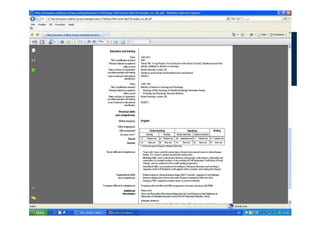
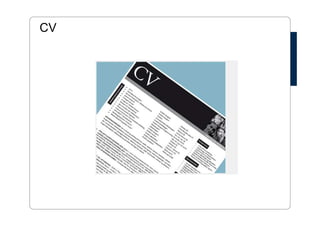
CURRICULUM VITAE 
NN 
501 G Street, N. W. 
Washington, DC 20006 
(202) 676-0000 
SUMMARY OF QUALIFICATIONS 
Extensive and diverse health care experience in both acute care and research hospital settings. Knowledgeable of 
current regulatory standards, biomedical technology, and medico-legal considerations. Strong background in 
designing, implementing, and directing patient care programs. Experience with hospital information systems. 
ADMINISTRATION 
Administered all operations for in-patient and ambulatory patient care units. 
Managed unusual incidents related to personnel functions and medical care. 
Acted as liaison between medical and nursing staffs. 
Supervised two to four para-professionals. 
Participated in auditing medical records for compliance with accreditation standards. 
Administered in-service educational programs. 
RESEARCH 
Collected data for research studies and protocols. 
Incorporated findings into clinical applications. 
Collaborated in development of clinical investigations. 
HEALTH CARE 
Assessed, planned, implemented, and evaluated holistic care for diverse patient populations. 
Designed, administered and directed teaching programs. 
Worked extensively with biomedical technology. 
EDUCATION 
Master of Health Services Administration, The George Washington University, Washington, DC, January 1987. 
BS in Nursing, Hampton Institute, Hampton, VA, May 1976. 
EMPLOYMENT 
The National Institutes of Health, Warren Grant Magnuson Clinical Center, Bethesda, MD, Clinical Nurse (May 1980 
present). ). 
Michael Reeves Medical Center, Chicago, IL, Staff Nurse (May 1979-April 1980). 
University of Chicago Medical Center, Chicago, IL, Staff Nurse (September 1976-May 1979
How to Structure your Chronological CV 
1. Personal details 
2. Personal profile 
3. Work experience 
4. Education 
5. Skills 
6. Interests 
7. References
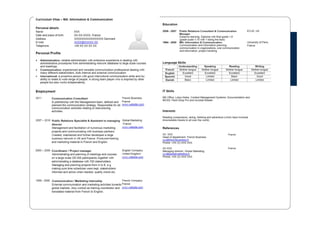
1. Personal details 
Make sure this section clearly states your: 
 Name 
NOTE: if your name does not obviously show if you are male or female, 
include this as well 
 Nationality 
 Residential address 
 Phone number 
 Email address - work 
 Date of birth (optional, but helpful) 
 Photo?
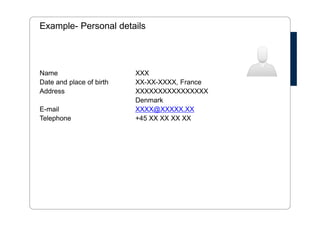
Example- Personal details 
Name XXX 
Date and place of birth XX-XX-XXXX, France 
Address XXXXXXXXXXXXXXXX 
Denmark 
E-mail XXXX@XXXXX.XX 
Telephone +45 XX XX XX XX
2. Personal profile 
• Short and targeted summary about 
yourself 
• What are your main professional skills/ 
personal & social qualities? 
• Think in keywords 
• Be specific 
• Target the content 
• Keep it short and to the point
Example- Personal Profile 
A determined and proactive communication manager with international 
experience and good administrative skills. An intercultural communicator with 
excellent French and English skills. A strong team player who is inspired by 
other people but also works independently. 
• Administration: reliable administrator with extensive experience in dealing 
with administrative procedures from administrating network database to 
large scale courses and meetings. 
• Communication: experienced and versatile communication professional 
dealing with many different stakeholders, both internal and external 
communication. 
• International: a proactive person with good intercultural communication 
skills and the ability to relate to wide range of people. A strong team player 
who is inspired by other people but also works independently.
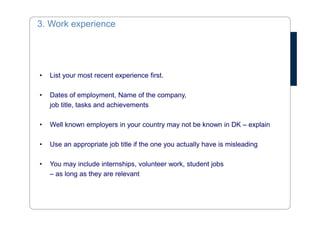
3. Work experience 
• List your most recent experience first. 
• Dates of employment, Name of the company, 
job title, tasks and achievements 
• Well known employers in your country may not be known in DK – explain 
• Use an appropriate job title if the one you actually have is misleading 
• You may include internships, volunteer work, student jobs 
– as long as they are relevant
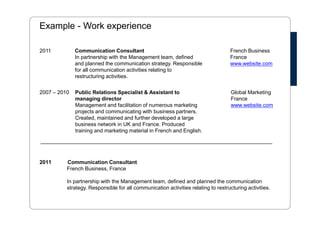
Example - Work experience 
2011 Communication Consultant 
In partnership with the Management team, defined 
and planned the communication strategy. Responsible 
for all communication activities relating to 
restructuring activities. 
French Business 
France 
www.website.com 
2007 – 2010 Public Relations Specialist & Assistant to 
managing director 
Management and facilitation of numerous marketing 
projects and communicating with business partners. 
Created, maintained and further developed a large 
business network in UK and France. Produced 
training and marketing material in French and English. 
Global Marketing 
France 
www.website.com 
2011 Communication Consultant 
French Business, France 
In partnership with the Management team, defined and planned the communication 
strategy. Responsible for all communication activities relating to restructuring activities.
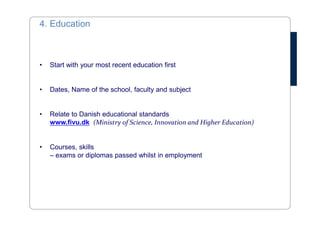
4. Education 
• Start with your most recent education first 
• Dates, Name of the school, faculty and subject 
• Relate to Danish educational standards 
www.fivu.dk (Ministry of Science, Innovation and Higher Education) 
• Courses, skills 
– exams or diplomas passed whilst in employment
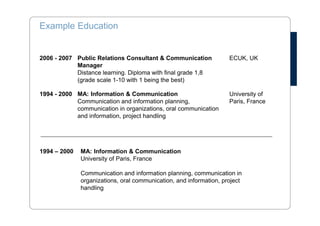
Example Education 
2006 - 2007 Public Relations Consultant & Communication 
Manager 
Distance learning. Diploma with final grade 1,8 
(grade scale 1-10 with 1 being the best) 
ECUK, UK 
1994 - 2000 MA: Information & Communication 
Communication and information planning, 
communication in organizations, oral communication 
and information, project handling 
University of 
Paris, France 
1994 – 2000 MA: Information & Communication 
University of Paris, France 
Communication and information planning, communication in 
organizations, oral communication, and information, project 
handling
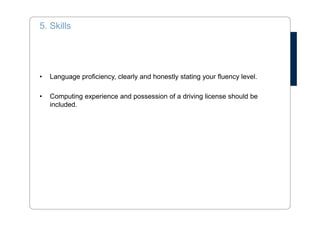
5. Skills 
• Language proficiency, clearly and honestly stating your fluency level. 
• Computing experience and possession of a driving license should be 
included.
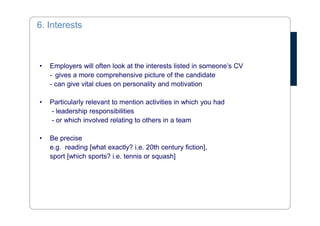
6. Interests 
• Employers will often look at the interests listed in someone’s CV 
- gives a more comprehensive picture of the candidate 
- can give vital clues on personality and motivation 
• Particularly relevant to mention activities in which you had 
- leadership responsibilities 
- or which involved relating to others in a team 
• Be precise 
e.g. reading [what exactly? i.e. 20th century fiction], 
sport [which sports? i.e. tennis or squash]
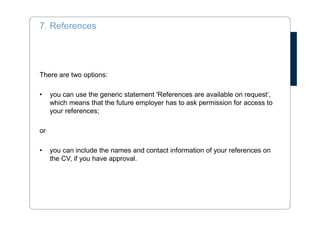
7. References 
There are two options: 
• you can use the generic statement 'References are available on request’, 
which means that the future employer has to ask permission for access to 
your references; 
or 
• you can include the names and contact information of your references on 
the CV, if you have approval.
Points to Remember 
• Max 2 pages 
• Use simple language 
• Documentation: do not send documentation unless mentioned in the job ad 
• Have someone read over your CV 
• Do a spell check! (“I speak fluent Englesh, Inglish, Eniglish” does not really 
instill confidence) 
• CV in Pdf. 
• Print out your CV
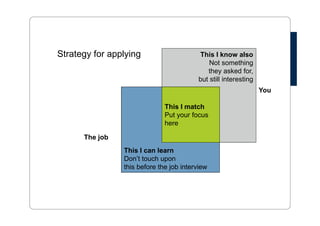
This I know also 
Not something 
they asked for, 
but still interesting 
You 
This I match 
Put your 
focus here 
focus 
here 
Strategy for applying 
This I can learn 
Don’t touch upon 
this before the job interview 
The job
Cover Letter
Preparing your Cover Letter 
Start by; 
• Researching the company well 
• Reading over the job description thoroughly 
• Preparing your letter by thinking about the following points; 
Why do you think you are specifically suitable for the role? 
What are the competences you possess that match the role? 
Why would you want to work for that particular company?
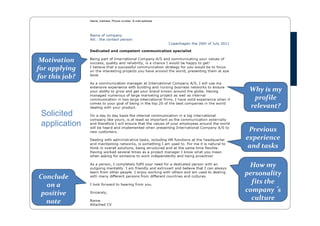
The Structure - solicited 
• Header: address and contact information 
• Catchy headline 
• Introductory paragraph 
• Motivation for applying 
• Professional background 
• Personal background 
• Closing 
• Enclosure, ex. CV
Motivation 
• Why are you applying for this specific job? 
• Show appreciation for the organisation 
• Do you know their strategy/ mission? 
• How do you see yourself fitting in the organisation?
Professional competences 
• What can you offer? 
Explain your professional competences 
– how will they match the tasks 
• What advantages will they gain from hiring you? 
• Relate to the task and how you can use your competences to solve them
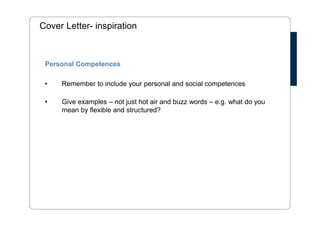
Cover Letter- inspiration 
Personal Competences 
• Remember to include your personal and social competences 
• Give examples – not just hot air and buzz words – e.g. what do you 
mean by flexible and structured?
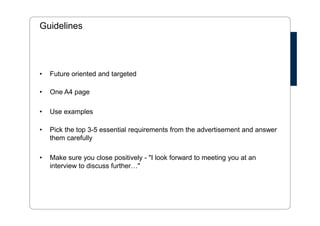
Guidelines 
• Future oriented and targeted 
• One A4 page 
• Use examples 
• Pick the top 3-5 essential requirements from the advertisement and answer 
them carefully 
• Make sure you close positively - "I look forward to meeting you at an 
interview to discuss further…"
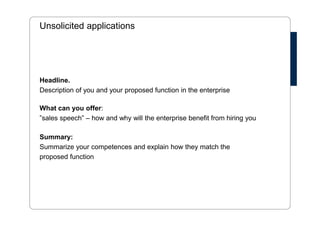
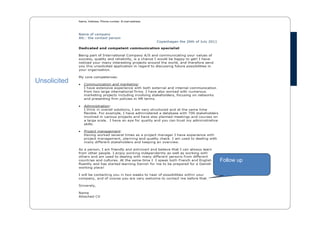
Unsolicited applications 
Headline. 
Description of you and your proposed function in the enterprise 
What can you offer: 
”sales speech” – how and why will the enterprise benefit from hiring you 
Summary: 
Summarize your competences and explain how they match the 
proposed function
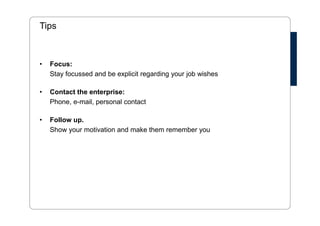
Tips 
• Focus: 
Stay focussed and be explicit regarding your job wishes 
• Contact the enterprise: 
Phone, e-mail, personal contact 
• Follow up. 
Show your motivation and make them remember you
Contacting an Enterprise
Contacting an Enterprise 
To phone or not to phone? 
• Yes, only if you have relevant 
questions. 
• You could be remembered as the 
person who wasted time. 
• Prepare the questions beforehand.
Examples of Questions 
• Do they recruit people with your educational background? 
 if yes, for which positions? 
• What kind of responsibilities do those employees have? 
• Which personal competences are important to have in the job? 
• How long will they keep an application
Job interview
Job interview in Denmark 
• Preparation is everything 
• More than one interview 
• More than one person present 
• Tests could be involved (personal, practical etc.) 
• You should be active and ask questions 
• Informal atmosphere
Unwritten rules 
• Firm hand shake – hello and good bye 
• Eye contact with all present 
• Body language 
• Accept coffee if offered, it is part of the cosy atmosphere / hygge 
• Prepare questions 
• Remember – the interview begins at the reception desk 
• Punctuality
Questions often Asked 
• How would your friends and family describe you. Exemplify 
• Describe a situation of conflict your have experienced. How did you solve it? 
• Which role do you have in groups? 
• How do you feel when critizised 
• How can your colleagues see and feel that you are under pressure? 
• Describe a good colleague and manager 
• How do you work under pressure? 
• Why this company? 
• Mention 3 of your weak points / strong points
Salary? 
• Not something you should mention – wait until asked 
• Research - what will you expect/accept
CV & Cover Letter Semina 16.09.2014

CV & Cover Letter Semina 16.09.2014

  • 2.
    CV and CoverLetter Louise Bach-Nielsen
  • 3.
    Purpose of seminar • Targeting your CV and cover letter to the Danish labour market • Tips for unsolicited applications • How to approach the enterprises
  • 4.
  • 5.
    Remember - Agood CV promotes and sells! • Your marketing tool • Should leave a good impression of you just by scanning it • Short and precise: Max two pages • Simplicity • Be truthful • Targeted to the specific job • English or Danish?
  • 6.
    List a coupleof your most important competences
  • 7.
    Starting to writeyour CV Make a profile of competences: • Provides an overview of all your work and educational qualifications and personal characteristics. Professionel, social and personal • Make a long list of duties and resposibilities you had in your former jobs Helps you target your CV and delete less significant competences
  • 8.
    Two Types ofCV Skills based: • Focuses on competences and tasks • Interesting when you: • have been working in few enterprises • have limited work experience • have very different experience • want to change your field of work Chronological: • Focuses on your work history • Provides a good overview over time • Always reverse chronological order
  • 9.
    CURRICULUM VITAE NN 501 G Street, N. W. Washington, DC 20006 (202) 676-0000 SUMMARY OF QUALIFICATIONS Extensive and diverse health care experience in both acute care and research hospital settings. Knowledgeable of current regulatory standards, biomedical technology, and medico-legal considerations. Strong background in designing, implementing, and directing patient care programs. Experience with hospital information systems. ADMINISTRATION Administered all operations for in-patient and ambulatory patient care units. Managed unusual incidents related to personnel functions and medical care. Acted as liaison between medical and nursing staffs. Supervised two to four para-professionals. Participated in auditing medical records for compliance with accreditation standards. Administered in-service educational programs. RESEARCH Collected data for research studies and protocols. Incorporated findings into clinical applications. Collaborated in development of clinical investigations. HEALTH CARE Assessed, planned, implemented, and evaluated holistic care for diverse patient populations. Designed, administered and directed teaching programs. Worked extensively with biomedical technology. EDUCATION Master of Health Services Administration, The George Washington University, Washington, DC, January 1987. BS in Nursing, Hampton Institute, Hampton, VA, May 1976. EMPLOYMENT The National Institutes of Health, Warren Grant Magnuson Clinical Center, Bethesda, MD, Clinical Nurse (May 1980 present). ). Michael Reeves Medical Center, Chicago, IL, Staff Nurse (May 1979-April 1980). University of Chicago Medical Center, Chicago, IL, Staff Nurse (September 1976-May 1979
  • 11.
    How to Structureyour Chronological CV 1. Personal details 2. Personal profile 3. Work experience 4. Education 5. Skills 6. Interests 7. References
  • 12.
    1. Personal details Make sure this section clearly states your:  Name NOTE: if your name does not obviously show if you are male or female, include this as well  Nationality  Residential address  Phone number  Email address - work  Date of birth (optional, but helpful)  Photo?
  • 13.
    Example- Personal details Name XXX Date and place of birth XX-XX-XXXX, France Address XXXXXXXXXXXXXXXX Denmark E-mail XXXX@XXXXX.XX Telephone +45 XX XX XX XX
  • 14.
    2. Personal profile • Short and targeted summary about yourself • What are your main professional skills/ personal & social qualities? • Think in keywords • Be specific • Target the content • Keep it short and to the point
  • 15.
    Example- Personal Profile A determined and proactive communication manager with international experience and good administrative skills. An intercultural communicator with excellent French and English skills. A strong team player who is inspired by other people but also works independently. • Administration: reliable administrator with extensive experience in dealing with administrative procedures from administrating network database to large scale courses and meetings. • Communication: experienced and versatile communication professional dealing with many different stakeholders, both internal and external communication. • International: a proactive person with good intercultural communication skills and the ability to relate to wide range of people. A strong team player who is inspired by other people but also works independently.
  • 16.
    3. Work experience • List your most recent experience first. • Dates of employment, Name of the company, job title, tasks and achievements • Well known employers in your country may not be known in DK – explain • Use an appropriate job title if the one you actually have is misleading • You may include internships, volunteer work, student jobs – as long as they are relevant
  • 17.
    Example - Workexperience 2011 Communication Consultant In partnership with the Management team, defined and planned the communication strategy. Responsible for all communication activities relating to restructuring activities. French Business France www.website.com 2007 – 2010 Public Relations Specialist & Assistant to managing director Management and facilitation of numerous marketing projects and communicating with business partners. Created, maintained and further developed a large business network in UK and France. Produced training and marketing material in French and English. Global Marketing France www.website.com 2011 Communication Consultant French Business, France In partnership with the Management team, defined and planned the communication strategy. Responsible for all communication activities relating to restructuring activities.
  • 18.
    4. Education •Start with your most recent education first • Dates, Name of the school, faculty and subject • Relate to Danish educational standards www.fivu.dk (Ministry of Science, Innovation and Higher Education) • Courses, skills – exams or diplomas passed whilst in employment
  • 19.
    Example Education 2006- 2007 Public Relations Consultant & Communication Manager Distance learning. Diploma with final grade 1,8 (grade scale 1-10 with 1 being the best) ECUK, UK 1994 - 2000 MA: Information & Communication Communication and information planning, communication in organizations, oral communication and information, project handling University of Paris, France 1994 – 2000 MA: Information & Communication University of Paris, France Communication and information planning, communication in organizations, oral communication, and information, project handling
  • 20.
    5. Skills •Language proficiency, clearly and honestly stating your fluency level. • Computing experience and possession of a driving license should be included.
  • 21.
    6. Interests •Employers will often look at the interests listed in someone’s CV - gives a more comprehensive picture of the candidate - can give vital clues on personality and motivation • Particularly relevant to mention activities in which you had - leadership responsibilities - or which involved relating to others in a team • Be precise e.g. reading [what exactly? i.e. 20th century fiction], sport [which sports? i.e. tennis or squash]
  • 22.
    7. References Thereare two options: • you can use the generic statement 'References are available on request’, which means that the future employer has to ask permission for access to your references; or • you can include the names and contact information of your references on the CV, if you have approval.
  • 26.
    Points to Remember • Max 2 pages • Use simple language • Documentation: do not send documentation unless mentioned in the job ad • Have someone read over your CV • Do a spell check! (“I speak fluent Englesh, Inglish, Eniglish” does not really instill confidence) • CV in Pdf. • Print out your CV
  • 27.
    This I knowalso Not something they asked for, but still interesting You This I match Put your focus here focus here Strategy for applying This I can learn Don’t touch upon this before the job interview The job
  • 28.
  • 29.
    Preparing your CoverLetter Start by; • Researching the company well • Reading over the job description thoroughly • Preparing your letter by thinking about the following points; Why do you think you are specifically suitable for the role? What are the competences you possess that match the role? Why would you want to work for that particular company?
  • 30.
    The Structure -solicited • Header: address and contact information • Catchy headline • Introductory paragraph • Motivation for applying • Professional background • Personal background • Closing • Enclosure, ex. CV
  • 31.
    Motivation • Whyare you applying for this specific job? • Show appreciation for the organisation • Do you know their strategy/ mission? • How do you see yourself fitting in the organisation?
  • 32.
    Professional competences •What can you offer? Explain your professional competences – how will they match the tasks • What advantages will they gain from hiring you? • Relate to the task and how you can use your competences to solve them
  • 33.
    Cover Letter- inspiration Personal Competences • Remember to include your personal and social competences • Give examples – not just hot air and buzz words – e.g. what do you mean by flexible and structured?
  • 34.
    Guidelines • Futureoriented and targeted • One A4 page • Use examples • Pick the top 3-5 essential requirements from the advertisement and answer them carefully • Make sure you close positively - "I look forward to meeting you at an interview to discuss further…"
  • 35.
    Unsolicited applications Headline. Description of you and your proposed function in the enterprise What can you offer: ”sales speech” – how and why will the enterprise benefit from hiring you Summary: Summarize your competences and explain how they match the proposed function
  • 36.
    Tips • Focus: Stay focussed and be explicit regarding your job wishes • Contact the enterprise: Phone, e-mail, personal contact • Follow up. Show your motivation and make them remember you
  • 37.
  • 38.
    Contacting an Enterprise To phone or not to phone? • Yes, only if you have relevant questions. • You could be remembered as the person who wasted time. • Prepare the questions beforehand.
  • 39.
    Examples of Questions • Do they recruit people with your educational background?  if yes, for which positions? • What kind of responsibilities do those employees have? • Which personal competences are important to have in the job? • How long will they keep an application
  • 40.
  • 41.
    Job interview inDenmark • Preparation is everything • More than one interview • More than one person present • Tests could be involved (personal, practical etc.) • You should be active and ask questions • Informal atmosphere
  • 42.
    Unwritten rules •Firm hand shake – hello and good bye • Eye contact with all present • Body language • Accept coffee if offered, it is part of the cosy atmosphere / hygge • Prepare questions • Remember – the interview begins at the reception desk • Punctuality
  • 43.
    Questions often Asked • How would your friends and family describe you. Exemplify • Describe a situation of conflict your have experienced. How did you solve it? • Which role do you have in groups? • How do you feel when critizised • How can your colleagues see and feel that you are under pressure? • Describe a good colleague and manager • How do you work under pressure? • Why this company? • Mention 3 of your weak points / strong points
  • 44.
    Salary? • Notsomething you should mention – wait until asked • Research - what will you expect/accept

Editor's Notes

  • #4 Da kurserne er af forskellig længde skal denne slide rettes til efter indhold
  • #6 A CV: Should show factual information about you Should leave a good impression of you just by scanning it Your CV is your marketing tool! Simplicity (is better) – the layout should make it easy to find information
  • #15 Be specific - remember that everyone writes that they are communicative, team player- exemplify!
  • #32 Future oriented
  • #34 Be specific. Bind dine statement op på konkrete eksempler
  • #35 Show that you have understood the competences required and and you meet hed requested competences
  • #44 Body languagge – ”own the table”. When you enter the interview room and have greeted all present, sit at the table, make room for you (place your paper and pen), sit straight up.
  • #46 Do not mention this first. At most interviews, you will be asked what you expect to receive. Therefore, it is important to contact your union to get advice. You can also look at pay statistics on the internet (eg. Jobindex) to find out approx. Salary. It is ok to say that you are not familiar with the Danish system and that you have researched the internet and found that this and that which will be your starting point.