201 Alvarez College Union ♦ careers@davidson.edu
davidson.edu/careers ♦ 704-894-2132
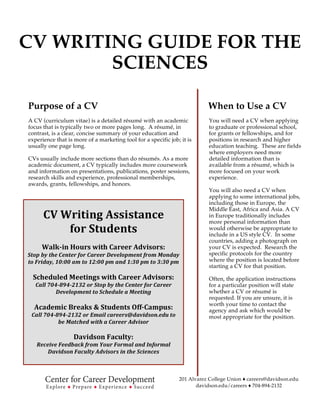
CV WRITING GUIDE FOR THE
SCIENCES
Purpose of a CV
A CV (curriculum vitae) is a detailed résumé with an academic
focus that is typically two or more pages long. A résumé, in
contrast, is a clear, concise summary of your education and
experience that is more of a marketing tool for a specific job; it is
usually one page long.
CVs usually include more sections than do résumés. As a more
academic document, a CV typically includes more coursework
and information on presentations, publications, poster sessions,
research skills and experience, professional memberships,
awards, grants, fellowships, and honors.
When to Use a CV
You will need a CV when applying
to graduate or professional school,
for grants or fellowships, and for
positions in research and higher
education teaching. These are fields
where employers need more
detailed information than is
available from a résumé, which is
more focused on your work
experience.
You will also need a CV when
applying to some international jobs,
including those in Europe, the
Middle East, Africa and Asia. A CV
in Europe traditionally includes
more personal information than
would otherwise be appropriate to
include in a US style CV. In some
countries, adding a photograph on
your CV is expected. Research the
specific protocols for the country
where the position is located before
starting a CV for that position.
Often, the application instructions
for a particular position will state
whether a CV or résumé is
requested. If you are unsure, it is
worth your time to contact the
agency and ask which would be
most appropriate for the position.
	
  
CV	
  Writing	
  Assistance	
  	
  
for	
  Students	


Walk-­‐in	
  Hours	
  with	
  Career	
  Advisors:	
  
Stop	
  by	
  the	
  Center	
  for	
  Career	
  Development	
  from	
  Monday	
  
to	
  Friday,	
  10:00	
  am	
  to	
  12:00	
  pm	
  and	
  1:30	
  pm	
  to	
  3:30	
  pm	


Scheduled	
  Meetings	
  with	
  Career	
  Advisors:	
  
Call	
  704-­‐894-­‐2132	
  or	
  Stop	
  by	
  the	
  Center	
  for	
  Career	
  
Development	
  to	
  Schedule	
  a	
  Meeting	


Academic	
  Breaks	
  &	
  Students	
  Off-­‐Campus:	
  
Call	
  704-­‐894-­‐2132	
  or	
  Email	
  careers@davidson.edu	
  to	
  
be	
  Matched	
  with	
  a	
  Career	
  Advisor	


Davidson	
  Faculty:	
  
Receive	
  Feedback	
  from	
  Your	
  Formal	
  and	
  Informal	
  
Davidson	
  Faculty	
  Advisors	
  in	
  the	
  Sciences	


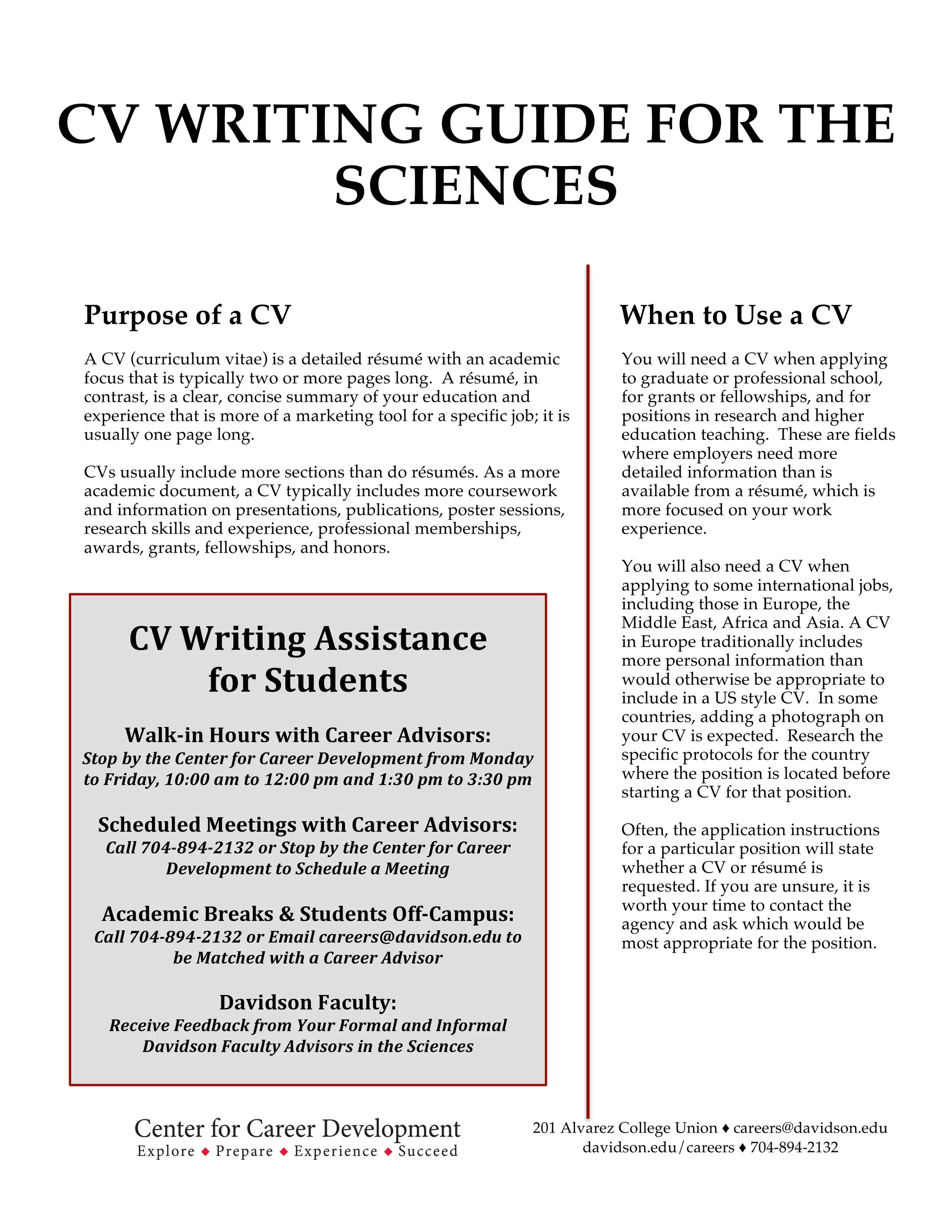
Preparing to Write
Before writing a CV, become familiar with the requirements of your academic field and review various
CV examples. Here are some tips:
• Visit your advisor and other trusted faculty members in your department for advice on vocabulary or
CV preferences specific to your field
• Visit your academic department's web site and view faculty CVs
• Visit websites of professional organizations related to your interests; they often contain CV advice
• The Chronicle of Higher Education includes career advice for writing a CV in various disciplines—see
The CV Doctor and use the search term “undergraduate CV” to get started
• Look at the information on the Purdue OWL (Online Writing Lab) website page Writing a Curriculum
Vitae
Organizing and Formatting Your CV
Order the sections according to relevance to the position you are seeking. An initial scan of a CV is usually
just 20-30 seconds by the employer, so strategically highlight information about your most relevant skills
and experience. The sections you choose will differ depending on your background and the opportunity
you are targeting. Science CVs often focus more on research, while CVs for the humanities and social
sciences may focus equally on teaching and presentations.
You will tailor your CV to different graduate programs or positions by emphasizing content more
appropriate to the areas you wish to study or work in at each particular institute or organization. This will
make you a more competitive candidate.
Descriptions within each section of your CV should be specific and concrete. Relevance is critical; refrain
from including unnecessary details or experience within any section. If you cannot explain something in
terms of the position that you are applying for, do not include it.
Readability is very important to a CV.
Information should be concise and
presented in a consistent style throughout
the document. Keep each section uniform.
For example, if you put the name of one
organization in italics, every organization
name should be in italics.
The preferred style, format, and content of
a CV varies by discipline. Each CV will
reflect an applicant’s unique experience.
You may use all or only a few of the
categories suggested below.
Sample CV Section Headings
Education Research Experience
Community Service Honors/Awards
Laboratory Experience Honors Thesis
Relevant Coursework Fieldwork
Software Skills Internship Experience
Presentations Study Abroad/Travel
Fellowships/Grants Conferences
Summer Education Poster Sessions
Publications Shadowing Experience
Teaching Experience Professional Affiliations
Work Experience Relevant Experience
Languages Leadership Experience
Special Training Certifications/Licensure
References
 
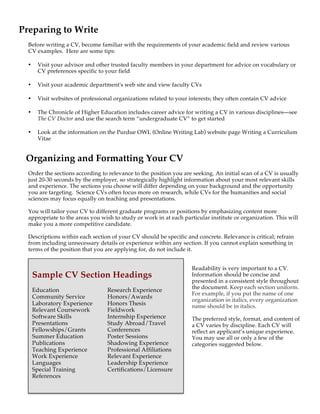
Tips for CV Sections
Header
• At the Top: Center your name
(larger font size ~18-20 point),
address, cell phone number, and
email address; do not include a
photo
• Address: Use your Davidson city
and state unless you are looking
for a job close to home
• Cell Phone Number: Make sure
you have a formal greeting on
your voicemail
• Email: Use your Davidson email
address unless you are
graduating in two to
three months
Education Section
• Key Points To Include: school
name, location, graduation date,
degree, major(s), concentration(s),
minor(s)
• GPA: Include if 3.00 or above;
can also list major GPA if it is
better than your overall GPA;
format correctly out to two
decimal places (i.e., 3.36)
• High School: Only include if you
are a first or second year student
or if you graduated from a
specialized (science/mathematics, arts) focused high school
• Study Abroad & Summer Education Experiences: Include as separate education entities
• Relevant Coursework: Include relevant, upper-level courses. Add the course titles. For the sciences,
indicate which included labs
• Academic Honors, Honor Societies, & Scholarships: Can be listed here if you have one or two. You
can also include any prestigious awards from high school. Students with many honors may want to
create a separate Honors and Awards section
• Senior Thesis Title: Include title in this section, a brief descriptive sentence or two, and the name of
your advisor. Use the format appropriate for your academic discipline (MLA, Chicago style, or APA)
Honors and Awards Section
• Include departmental awards, scholarships, and memberships in any honors associations
• Include a brief description and the date awarded
Laboratory and Software Skills Section
• Laboratory: Skills are relevant, even if you’ve only practiced them in your classes and labs. Skills with
which you have particular familiarity should also be highlighted in the research experience section
• Software: List knowledge of software programs and computer languages. For students in technical
fields and the arts, list all programs that are known well
General Formatting Tips
• Margins: 0.5” to 1”
• Font Type: Arial, Calibri	
  or	
  Helvetica
• Font Size: 10 to 12 point
• Bold: Use it to emphasize school names and
employer/organization names
• Italics: Consider using italics to emphasize
position titles
• Length: A CV does not need to be confined to a
single page, but should still be concise and easy to
find information quickly
• Bullets: Use bullet points when describing your
experiences (Bullet points do not need to be
complete sentences and therefore do not need
periods at the end)
• Follow a Consistent Format: Make sure titles,
locations, employers, and dates are listed in the
same format with each entry. Commas, spaces,
sizes, abbreviations, etc. should also be internally
consistent
• Absolutely No Grammatical or Spelling Errors:
Employers are interested in your accuracy and
attention to detail
• Spacing in each section should be appropriate so
that information is organized and easy to read
 
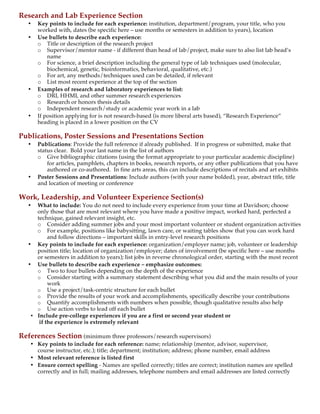
Research and Lab Experience Section
• Key points to include for each experience: institution, department/program, your title, who you
worked with, dates (be specific here – use months or semesters in addition to years), location
• Use bullets to describe each experience:
o Title or description of the research project
o Supervisor/mentor name - if different than head of lab/project, make sure to also list lab head’s
name
o For science, a brief description including the general type of lab techniques used (molecular,
biochemical, genetic, bioinformatics, behavioral, qualitative, etc.)
o For art, any methods/techniques used can be detailed, if relevant
o List most recent experience at the top of the section
• Examples of research and laboratory experiences to list:
o DRI, HHMI, and other summer research experiences
o Research or honors thesis details
o Independent research/study or academic year work in a lab
• If position applying for is not research-based (is more liberal arts based), “Research Experience”
heading is placed in a lower position on the CV
Publications, Poster Sessions and Presentations Section
• Publications: Provide the full reference if already published. If in progress or submitted, make that
status clear. Bold your last name in the list of authors
o Give bibliographic citations (using the format appropriate to your particular academic discipline)
for articles, pamphlets, chapters in books, research reports, or any other publications that you have
authored or co-authored. In fine arts areas, this can include descriptions of recitals and art exhibits
• Poster Sessions and Presentations: Include authors (with your name bolded), year, abstract title, title
and location of meeting or conference
Work, Leadership, and Volunteer Experience Section(s)
• What to include: You do not need to include every experience from your time at Davidson; choose
only those that are most relevant where you have made a positive impact, worked hard, perfected a
technique, gained relevant insight, etc.
o Consider adding summer jobs and your most important volunteer or student organization activities
o For example, positions like babysitting, lawn care, or waiting tables show that you can work hard
and follow directions – important skills in entry-level research positions
• Key points to include for each experience: organization/employer name; job, volunteer or leadership
position title; location of organization/employer; dates of involvement (be specific here – use months
or semesters in addition to years); list jobs in reverse chronological order, starting with the most recent
• Use bullets to describe each experience – emphasize outcomes:
o Two to four bullets depending on the depth of the experience
o Consider starting with a summary statement describing what you did and the main results of your
work
o Use a project/task-centric structure for each bullet
o Provide the results of your work and accomplishments, specifically describe your contributions
o Quantify accomplishments with numbers when possible, though qualitative results also help
o Use action verbs to lead off each bullet
• Include pre-college experiences if you are a first or second year student or
if the experience is extremely relevant
References Section (minimum three professors/research supervisors)
• Key points to include for each reference: name; relationship (mentor, advisor, supervisor,
course instructor, etc.); title; department; institution; address; phone number, email address
• Most relevant reference is listed first
• Ensure correct spelling - Names are spelled correctly; titles are correct; institution names are spelled
correctly and in full; mailing addresses, telephone numbers and email addresses are listed correctly
 
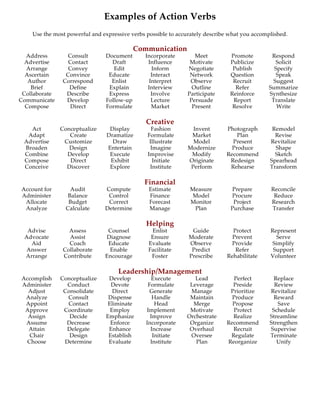
Examples of Action Verbs
Use the most powerful and expressive verbs possible to accurately describe what you accomplished.
	
  
Communication
Address Consult Document Incorporate Meet Promote Respond
Advertise Contact Draft Influence Motivate Publicize Solicit
Arrange Convey Edit Inform Negotiate Publish Specify
Ascertain Convince Educate Interact Network Question Speak
Author Correspond Enlist Interpret Observe Recruit Suggest
Brief Define Explain Interview Outline Refer Summarize
Collaborate Describe Express Involve Participate Reinforce Synthesize
Communicate Develop Follow-up Lecture Persuade Report Translate
Compose Direct Formulate Market Present Resolve Write
Creative
Act Conceptualize Display Fashion Invent Photograph Remodel
Adapt Create Dramatize Formulate Market Plan Revise
Advertise Customize Draw Illustrate Model Present Revitalize
Broaden Design Entertain Imagine Modernize Produce Shape
Combine Develop Execute Improvise Modify Recommend Sketch
Compose Direct Exhibit Initiate Originate Redesign Spearhead
Conceive Discover Explore Institute Perform Rehearse Transform
Financial
Account for Audit Compute Estimate Measure Prepare Reconcile
Administer Balance Control Finance Model Procure Reduce
Allocate Budget Correct Forecast Monitor Project Research
Analyze Calculate Determine Manage Plan Purchase Transfer
Helping
Advise Assess Counsel Enlist Guide Protect Represent
Advocate Assist Diagnose Ensure Moderate Prevent Serve
Aid Coach Educate Evaluate Observe Provide Simplify
Answer Collaborate Enable Facilitate Predict Refer Support
Arrange Contribute Encourage Foster Prescribe Rehabilitate Volunteer
Leadership/Management
Accomplish Conceptualize Develop Execute Lead Perfect Replace
Administer Conduct Devote Formulate Leverage Preside Review
Adjust Consolidate Direct Generate Manage Prioritize Revitalize
Analyze Consult Dispense Handle Maintain Produce Reward
Appoint Contact Eliminate Head Merge Propose Save
Approve Coordinate Employ Implement Motivate Protect Schedule
Assign Decide Emphasize Improve Orchestrate Realize Streamline
Assume Decrease Enforce Incorporate Organize Recommend Strengthen
Attain Delegate Enhance Increase Overhaul Recruit Supervise
Chair Design Establish Initiate Oversee Regulate Terminate
Choose Determine Evaluate Institute Plan Reorganize Unify
 
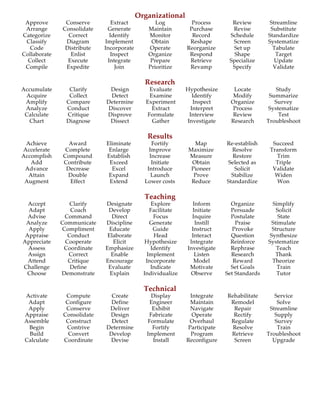
Organizational
Approve Conserve Extract Log Process Review Streamline
Arrange Consolidate Generate Maintain Purchase Revise Substitute
Categorize Correct Identify Monitor Record Schedule Standardize
Classify Diagram Implement Obtain Reshape Screen Systematize
Code Distribute Incorporate Operate Reorganize Set up Tabulate
Collaborate Enlist Inspect Organize Respond Shape Target
Collect Execute Integrate Prepare Retrieve Specialize Update
Compile Expedite Join Prioritize Revamp Specify Validate
Research
Accumulate Clarify Design Evaluate Hypothesize Locate Study
Acquire Collect Detect Examine Identify Modify Summarize
Amplify Compare Determine Experiment Inspect Organize Survey
Analyze Conduct Discover Extract Interpret Process Systematize
Calculate Critique Disprove Formulate Interview Review Test
Chart Diagnose Dissect Gather Investigate Research Troubleshoot
Results
Achieve Award Eliminate Fortify Map Re-establish Succeed
Accelerate Complete Enlarge Improve Maximize Resolve Transform
Accomplish Compound Establish Increase Measure Restore Trim
Add Contribute Exceed Initiate Obtain Selected as Triple
Advance Decrease Excel Introduce Pioneer Solicit Validate
Attain Double Expand Launch Prove Stabilize Widen
Augment Effect Extend Lower costs Reduce Standardize Won
Teaching
Accept Clarify Designate Explore Inform Organize Simplify
Adapt Coach Develop Facilitate Initiate Persuade Solicit
Advise Command Direct Focus Inquire Postulate State
Analyze Communicate Discipline Generate Instill Praise Stimulate
Apply Compliment Educate Guide Instruct Provoke Structure
Appraise Conduct Elaborate Head Interact Question Synthesize
Appreciate Cooperate Elicit Hypothesize Integrate Reinforce Systematize
Assess Coordinate Emphasize Identify Investigate Rephrase Teach
Assign Correct Enable Implement Listen Research Thank
Attend Critique Encourage Incorporate Model Reward Theorize
Challenge Define Evaluate Indicate Motivate Set Goals Train
Choose Demonstrate Explain Individualize Observe Set Standards Tutor
Technical
Activate Compute Create Display Integrate Rehabilitate Service
Adapt Configure Define Engineer Maintain Remodel Solve
Apply Conserve Deliver Exhibit Navigate Repair Streamline
Appraise Consolidate Design Fabricate Operate Rectify Supply
Assemble Construct Detect Formulate Overhaul Regulate Survey
Begin Contrive Determine Fortify Participate Resolve Train
Build Convert Develop Implement Program Retrieve Troubleshoot
Calculate Coordinate Devise Install Reconfigure Screen Upgrade
 
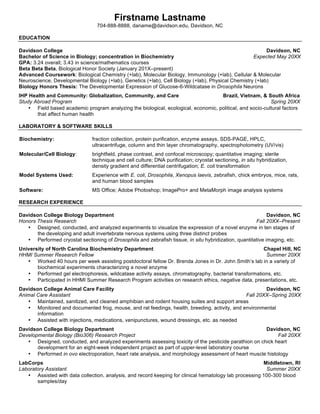
Firstname Lastname
704-888-8888, daname@davidson.edu, Davidson, NC
EDUCATION
Davidson College Davidson, NC
Bachelor of Science in Biology; concentration in Biochemistry Expected May 20XX
GPA: 3.24 overall; 3.43 in science/mathematics courses
Beta Beta Beta, Biological Honor Society (January 201X–present)
Advanced Coursework: Biological Chemistry (+lab), Molecular Biology, Immunology (+lab), Cellular & Molecular
Neuroscience, Developmental Biology (+lab), Genetics (+lab), Cell Biology (+lab), Physical Chemistry (+lab)
Biology Honors Thesis: The Developmental Expression of Glucose-6-Wildcatase in Drosophila Neurons
IHP Health and Community: Globalization, Community, and Care Brazil, Vietnam, & South Africa
Study Abroad Program Spring 20XX
• Field based academic program analyzing the biological, ecological, economic, political, and socio-cultural factors
that affect human health
LABORATORY & SOFTWARE SKILLS
Biochemistry: fraction collection, protein purification, enzyme assays, SDS-PAGE, HPLC,
ultracentrifuge, column and thin layer chromatography, spectrophotometry (UV/vis)
Molecular/Cell Biology: brightfield, phase contrast, and confocal microscopy; quantitative imaging; sterile
technique and cell culture; DNA purification; cryostat sectioning, in situ hybridization,
density gradient and differential centrifugation; E. coli transformation
Model Systems Used: Experience with E. coli, Drosophila, Xenopus laevis, zebrafish, chick embryos, mice, rats,
and human blood samples
Software: MS Office; Adobe Photoshop; ImagePro+ and MetaMorph image analysis systems
RESEARCH EXPERIENCE
Davidson College Biology Department Davidson, NC
Honors Thesis Research Fall 20XX–Present
• Designed, conducted, and analyzed experiments to visualize the expression of a novel enzyme in ten stages of
the developing and adult invertebrate nervous systems using three distinct probes
• Performed cryostat sectioning of Drosophila and zebrafish tissue, in situ hybridization, quantitative imaging, etc.
University of North Carolina Biochemistry Department Chapel Hill, NC
HHMI Summer Research Fellow Summer 20XX
• Worked 40 hours per week assisting postdoctoral fellow Dr. Brenda Jones in Dr. John Smith’s lab in a variety of
biochemical experiments characterizing a novel enzyme
• Performed gel electrophoresis, wildcatase activity assays, chromatography, bacterial transformations, etc.
• Participated in HHMI Summer Research Program activities on research ethics, negative data, presentations, etc.
Davidson College Animal Care Facility Davidson, NC
Animal Care Assistant Fall 20XX–Spring 20XX
• Maintained, sanitized, and cleaned amphibian and rodent housing suites and support areas
• Monitored and documented frog, mouse, and rat feedings, health, breeding, activity, and environmental
information
• Assisted with injections, medications, venipunctures, wound dressings, etc. as needed
Davidson College Biology Department Davidson, NC
Developmental Biology (Bio306) Research Project Fall 20XX
• Designed, conducted, and analyzed experiments assessing toxicity of the pesticide parathion on chick heart
development for an eight-week independent project as part of upper-level laboratory course
• Performed in ovo electroporation, heart rate analysis, and morphology assessment of heart muscle histology
LabCorps Middletown, RI
Laboratory Assistant Summer 20XX
• Assisted with data collection, analysis, and record keeping for clinical hematology lab processing 100-300 blood
samples/day
 
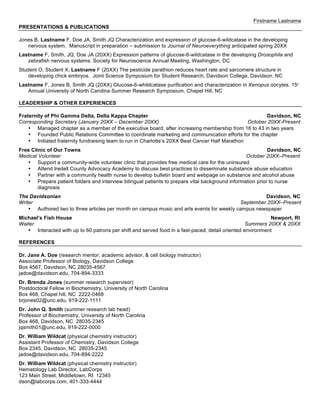
Firstname Lastname
PRESENTATIONS & PUBLICATIONS
Jones B, Lastname F, Doe JA, Smith JQ Characterization and expression of glucose-6-wildcatase in the developing
nervous system. Manuscript in preparation – submission to Journal of Neuroeverything anticipated spring 20XX
Lastname F, Smith, JQ, Doe JA (20XX) Expression patterns of glucose-6-wildcatase in the developing Drosophila and
zebrafish nervous systems. Society for Neuroscience Annual Meeting, Washington, DC
Student O, Student X, Lastname F (20XX) The pesticide parathion reduces heart rate and sarcomere structure in
developing chick embryos. Joint Science Symposium for Student Research, Davidson College, Davidson, NC
Lastname F, Jones B, Smith JQ (20XX) Glucose-6-whildcatase purification and characterization in Xenopus oocytes. 15th
Annual University of North Carolina Summer Research Symposium, Chapel Hill, NC
LEADERSHIP & OTHER EXPERIENCES
Fraternity of Phi Gamma Delta, Delta Kappa Chapter Davidson, NC
Corresponding Secretary (January 20XX – December 20XX) October 20XX-Present
• Managed chapter as a member of the executive board, after increasing membership from 16 to 43 in two years
• Founded Public Relations Committee to coordinate marketing and communication efforts for the chapter
• Initiated fraternity fundraising team to run in Charlotte’s 20XX Beat Cancer Half Marathon
Free Clinic of Our Towns Davidson, NC
Medical Volunteer October 20XX–Present
• Support a community-wide volunteer clinic that provides free medical care for the uninsured
• Attend Iredell County Advocacy Academy to discuss best practices to disseminate substance abuse education
• Partner with a community health nurse to develop bulletin board and webpage on substance and alcohol abuse
• Prepare patient folders and interview bilingual patients to prepare vital background information prior to nurse
diagnosis
The Davidsonian Davidson, NC
Writer September 20XX–Present
• Authored two to three articles per month on campus music and arts events for weekly campus newspaper
Michael’s Fish House Newport, RI
Waiter Summers 20XX & 20XX
• Interacted with up to 60 patrons per shift and served food in a fast-paced, detail oriented environment
REFERENCES
Dr. Jane A. Doe (research mentor, academic advisor, & cell biology instructor)
Associate Professor of Biology, Davidson College
Box 4567, Davidson, NC 28035-4567
jadoe@davidson.edu, 704-894-3333
Dr. Brenda Jones (summer research supervisor)
Postdoctoral Fellow in Biochemistry, University of North Carolina
Box 468, Chapel hill, NC 2222-0468
brjones02@unc.edu, 919-222-1111
Dr. John Q. Smith (summer research lab head)
Professor of Biochemistry, University of North Carolina
Box 468, Davidson, NC 28035-2345
jqsmith01@unc.edu, 919-222-0000
Dr. William Wildcat (physical chemistry instructor)
Assistant Professor of Chemistry, Davidson College
Box 2345, Davidson, NC 28035-2345
jadoe@davidson.edu, 704-894-2222
Dr. William Wildcat (physical chemistry instructor)
Hematology Lab Director, LabCorps
123 Main Street, Middletown, RI 12345
dson@labcorps.com, 401-333-4444

Davidson College CV Writing Guide

  • 1.
            201 Alvarez College Union ♦ careers@davidson.edu davidson.edu/careers ♦ 704-894-2132 CV WRITING GUIDE FOR THE SCIENCES Purpose of a CV A CV (curriculum vitae) is a detailed résumé with an academic focus that is typically two or more pages long. A résumé, in contrast, is a clear, concise summary of your education and experience that is more of a marketing tool for a specific job; it is usually one page long. CVs usually include more sections than do résumés. As a more academic document, a CV typically includes more coursework and information on presentations, publications, poster sessions, research skills and experience, professional memberships, awards, grants, fellowships, and honors. When to Use a CV You will need a CV when applying to graduate or professional school, for grants or fellowships, and for positions in research and higher education teaching. These are fields where employers need more detailed information than is available from a résumé, which is more focused on your work experience. You will also need a CV when applying to some international jobs, including those in Europe, the Middle East, Africa and Asia. A CV in Europe traditionally includes more personal information than would otherwise be appropriate to include in a US style CV. In some countries, adding a photograph on your CV is expected. Research the specific protocols for the country where the position is located before starting a CV for that position. Often, the application instructions for a particular position will state whether a CV or résumé is requested. If you are unsure, it is worth your time to contact the agency and ask which would be most appropriate for the position.   CV  Writing  Assistance     for  Students     Walk-­‐in  Hours  with  Career  Advisors:   Stop  by  the  Center  for  Career  Development  from  Monday   to  Friday,  10:00  am  to  12:00  pm  and  1:30  pm  to  3:30  pm     Scheduled  Meetings  with  Career  Advisors:   Call  704-­‐894-­‐2132  or  Stop  by  the  Center  for  Career   Development  to  Schedule  a  Meeting     Academic  Breaks  &  Students  Off-­‐Campus:   Call  704-­‐894-­‐2132  or  Email  careers@davidson.edu  to   be  Matched  with  a  Career  Advisor     Davidson  Faculty:   Receive  Feedback  from  Your  Formal  and  Informal   Davidson  Faculty  Advisors  in  the  Sciences      
  • 2.
      Preparing to Write Beforewriting a CV, become familiar with the requirements of your academic field and review various CV examples. Here are some tips: • Visit your advisor and other trusted faculty members in your department for advice on vocabulary or CV preferences specific to your field • Visit your academic department's web site and view faculty CVs • Visit websites of professional organizations related to your interests; they often contain CV advice • The Chronicle of Higher Education includes career advice for writing a CV in various disciplines—see The CV Doctor and use the search term “undergraduate CV” to get started • Look at the information on the Purdue OWL (Online Writing Lab) website page Writing a Curriculum Vitae Organizing and Formatting Your CV Order the sections according to relevance to the position you are seeking. An initial scan of a CV is usually just 20-30 seconds by the employer, so strategically highlight information about your most relevant skills and experience. The sections you choose will differ depending on your background and the opportunity you are targeting. Science CVs often focus more on research, while CVs for the humanities and social sciences may focus equally on teaching and presentations. You will tailor your CV to different graduate programs or positions by emphasizing content more appropriate to the areas you wish to study or work in at each particular institute or organization. This will make you a more competitive candidate. Descriptions within each section of your CV should be specific and concrete. Relevance is critical; refrain from including unnecessary details or experience within any section. If you cannot explain something in terms of the position that you are applying for, do not include it. Readability is very important to a CV. Information should be concise and presented in a consistent style throughout the document. Keep each section uniform. For example, if you put the name of one organization in italics, every organization name should be in italics. The preferred style, format, and content of a CV varies by discipline. Each CV will reflect an applicant’s unique experience. You may use all or only a few of the categories suggested below. Sample CV Section Headings Education Research Experience Community Service Honors/Awards Laboratory Experience Honors Thesis Relevant Coursework Fieldwork Software Skills Internship Experience Presentations Study Abroad/Travel Fellowships/Grants Conferences Summer Education Poster Sessions Publications Shadowing Experience Teaching Experience Professional Affiliations Work Experience Relevant Experience Languages Leadership Experience Special Training Certifications/Licensure References
  • 3.
      Tips for CVSections Header • At the Top: Center your name (larger font size ~18-20 point), address, cell phone number, and email address; do not include a photo • Address: Use your Davidson city and state unless you are looking for a job close to home • Cell Phone Number: Make sure you have a formal greeting on your voicemail • Email: Use your Davidson email address unless you are graduating in two to three months Education Section • Key Points To Include: school name, location, graduation date, degree, major(s), concentration(s), minor(s) • GPA: Include if 3.00 or above; can also list major GPA if it is better than your overall GPA; format correctly out to two decimal places (i.e., 3.36) • High School: Only include if you are a first or second year student or if you graduated from a specialized (science/mathematics, arts) focused high school • Study Abroad & Summer Education Experiences: Include as separate education entities • Relevant Coursework: Include relevant, upper-level courses. Add the course titles. For the sciences, indicate which included labs • Academic Honors, Honor Societies, & Scholarships: Can be listed here if you have one or two. You can also include any prestigious awards from high school. Students with many honors may want to create a separate Honors and Awards section • Senior Thesis Title: Include title in this section, a brief descriptive sentence or two, and the name of your advisor. Use the format appropriate for your academic discipline (MLA, Chicago style, or APA) Honors and Awards Section • Include departmental awards, scholarships, and memberships in any honors associations • Include a brief description and the date awarded Laboratory and Software Skills Section • Laboratory: Skills are relevant, even if you’ve only practiced them in your classes and labs. Skills with which you have particular familiarity should also be highlighted in the research experience section • Software: List knowledge of software programs and computer languages. For students in technical fields and the arts, list all programs that are known well General Formatting Tips • Margins: 0.5” to 1” • Font Type: Arial, Calibri  or  Helvetica • Font Size: 10 to 12 point • Bold: Use it to emphasize school names and employer/organization names • Italics: Consider using italics to emphasize position titles • Length: A CV does not need to be confined to a single page, but should still be concise and easy to find information quickly • Bullets: Use bullet points when describing your experiences (Bullet points do not need to be complete sentences and therefore do not need periods at the end) • Follow a Consistent Format: Make sure titles, locations, employers, and dates are listed in the same format with each entry. Commas, spaces, sizes, abbreviations, etc. should also be internally consistent • Absolutely No Grammatical or Spelling Errors: Employers are interested in your accuracy and attention to detail • Spacing in each section should be appropriate so that information is organized and easy to read
  • 4.
      Research and LabExperience Section • Key points to include for each experience: institution, department/program, your title, who you worked with, dates (be specific here – use months or semesters in addition to years), location • Use bullets to describe each experience: o Title or description of the research project o Supervisor/mentor name - if different than head of lab/project, make sure to also list lab head’s name o For science, a brief description including the general type of lab techniques used (molecular, biochemical, genetic, bioinformatics, behavioral, qualitative, etc.) o For art, any methods/techniques used can be detailed, if relevant o List most recent experience at the top of the section • Examples of research and laboratory experiences to list: o DRI, HHMI, and other summer research experiences o Research or honors thesis details o Independent research/study or academic year work in a lab • If position applying for is not research-based (is more liberal arts based), “Research Experience” heading is placed in a lower position on the CV Publications, Poster Sessions and Presentations Section • Publications: Provide the full reference if already published. If in progress or submitted, make that status clear. Bold your last name in the list of authors o Give bibliographic citations (using the format appropriate to your particular academic discipline) for articles, pamphlets, chapters in books, research reports, or any other publications that you have authored or co-authored. In fine arts areas, this can include descriptions of recitals and art exhibits • Poster Sessions and Presentations: Include authors (with your name bolded), year, abstract title, title and location of meeting or conference Work, Leadership, and Volunteer Experience Section(s) • What to include: You do not need to include every experience from your time at Davidson; choose only those that are most relevant where you have made a positive impact, worked hard, perfected a technique, gained relevant insight, etc. o Consider adding summer jobs and your most important volunteer or student organization activities o For example, positions like babysitting, lawn care, or waiting tables show that you can work hard and follow directions – important skills in entry-level research positions • Key points to include for each experience: organization/employer name; job, volunteer or leadership position title; location of organization/employer; dates of involvement (be specific here – use months or semesters in addition to years); list jobs in reverse chronological order, starting with the most recent • Use bullets to describe each experience – emphasize outcomes: o Two to four bullets depending on the depth of the experience o Consider starting with a summary statement describing what you did and the main results of your work o Use a project/task-centric structure for each bullet o Provide the results of your work and accomplishments, specifically describe your contributions o Quantify accomplishments with numbers when possible, though qualitative results also help o Use action verbs to lead off each bullet • Include pre-college experiences if you are a first or second year student or if the experience is extremely relevant References Section (minimum three professors/research supervisors) • Key points to include for each reference: name; relationship (mentor, advisor, supervisor, course instructor, etc.); title; department; institution; address; phone number, email address • Most relevant reference is listed first • Ensure correct spelling - Names are spelled correctly; titles are correct; institution names are spelled correctly and in full; mailing addresses, telephone numbers and email addresses are listed correctly
  • 5.
      Examples of ActionVerbs Use the most powerful and expressive verbs possible to accurately describe what you accomplished.   Communication Address Consult Document Incorporate Meet Promote Respond Advertise Contact Draft Influence Motivate Publicize Solicit Arrange Convey Edit Inform Negotiate Publish Specify Ascertain Convince Educate Interact Network Question Speak Author Correspond Enlist Interpret Observe Recruit Suggest Brief Define Explain Interview Outline Refer Summarize Collaborate Describe Express Involve Participate Reinforce Synthesize Communicate Develop Follow-up Lecture Persuade Report Translate Compose Direct Formulate Market Present Resolve Write Creative Act Conceptualize Display Fashion Invent Photograph Remodel Adapt Create Dramatize Formulate Market Plan Revise Advertise Customize Draw Illustrate Model Present Revitalize Broaden Design Entertain Imagine Modernize Produce Shape Combine Develop Execute Improvise Modify Recommend Sketch Compose Direct Exhibit Initiate Originate Redesign Spearhead Conceive Discover Explore Institute Perform Rehearse Transform Financial Account for Audit Compute Estimate Measure Prepare Reconcile Administer Balance Control Finance Model Procure Reduce Allocate Budget Correct Forecast Monitor Project Research Analyze Calculate Determine Manage Plan Purchase Transfer Helping Advise Assess Counsel Enlist Guide Protect Represent Advocate Assist Diagnose Ensure Moderate Prevent Serve Aid Coach Educate Evaluate Observe Provide Simplify Answer Collaborate Enable Facilitate Predict Refer Support Arrange Contribute Encourage Foster Prescribe Rehabilitate Volunteer Leadership/Management Accomplish Conceptualize Develop Execute Lead Perfect Replace Administer Conduct Devote Formulate Leverage Preside Review Adjust Consolidate Direct Generate Manage Prioritize Revitalize Analyze Consult Dispense Handle Maintain Produce Reward Appoint Contact Eliminate Head Merge Propose Save Approve Coordinate Employ Implement Motivate Protect Schedule Assign Decide Emphasize Improve Orchestrate Realize Streamline Assume Decrease Enforce Incorporate Organize Recommend Strengthen Attain Delegate Enhance Increase Overhaul Recruit Supervise Chair Design Establish Initiate Oversee Regulate Terminate Choose Determine Evaluate Institute Plan Reorganize Unify
  • 6.
      Organizational Approve Conserve ExtractLog Process Review Streamline Arrange Consolidate Generate Maintain Purchase Revise Substitute Categorize Correct Identify Monitor Record Schedule Standardize Classify Diagram Implement Obtain Reshape Screen Systematize Code Distribute Incorporate Operate Reorganize Set up Tabulate Collaborate Enlist Inspect Organize Respond Shape Target Collect Execute Integrate Prepare Retrieve Specialize Update Compile Expedite Join Prioritize Revamp Specify Validate Research Accumulate Clarify Design Evaluate Hypothesize Locate Study Acquire Collect Detect Examine Identify Modify Summarize Amplify Compare Determine Experiment Inspect Organize Survey Analyze Conduct Discover Extract Interpret Process Systematize Calculate Critique Disprove Formulate Interview Review Test Chart Diagnose Dissect Gather Investigate Research Troubleshoot Results Achieve Award Eliminate Fortify Map Re-establish Succeed Accelerate Complete Enlarge Improve Maximize Resolve Transform Accomplish Compound Establish Increase Measure Restore Trim Add Contribute Exceed Initiate Obtain Selected as Triple Advance Decrease Excel Introduce Pioneer Solicit Validate Attain Double Expand Launch Prove Stabilize Widen Augment Effect Extend Lower costs Reduce Standardize Won Teaching Accept Clarify Designate Explore Inform Organize Simplify Adapt Coach Develop Facilitate Initiate Persuade Solicit Advise Command Direct Focus Inquire Postulate State Analyze Communicate Discipline Generate Instill Praise Stimulate Apply Compliment Educate Guide Instruct Provoke Structure Appraise Conduct Elaborate Head Interact Question Synthesize Appreciate Cooperate Elicit Hypothesize Integrate Reinforce Systematize Assess Coordinate Emphasize Identify Investigate Rephrase Teach Assign Correct Enable Implement Listen Research Thank Attend Critique Encourage Incorporate Model Reward Theorize Challenge Define Evaluate Indicate Motivate Set Goals Train Choose Demonstrate Explain Individualize Observe Set Standards Tutor Technical Activate Compute Create Display Integrate Rehabilitate Service Adapt Configure Define Engineer Maintain Remodel Solve Apply Conserve Deliver Exhibit Navigate Repair Streamline Appraise Consolidate Design Fabricate Operate Rectify Supply Assemble Construct Detect Formulate Overhaul Regulate Survey Begin Contrive Determine Fortify Participate Resolve Train Build Convert Develop Implement Program Retrieve Troubleshoot Calculate Coordinate Devise Install Reconfigure Screen Upgrade
  • 7.
      Firstname Lastname 704-888-8888, daname@davidson.edu,Davidson, NC EDUCATION Davidson College Davidson, NC Bachelor of Science in Biology; concentration in Biochemistry Expected May 20XX GPA: 3.24 overall; 3.43 in science/mathematics courses Beta Beta Beta, Biological Honor Society (January 201X–present) Advanced Coursework: Biological Chemistry (+lab), Molecular Biology, Immunology (+lab), Cellular & Molecular Neuroscience, Developmental Biology (+lab), Genetics (+lab), Cell Biology (+lab), Physical Chemistry (+lab) Biology Honors Thesis: The Developmental Expression of Glucose-6-Wildcatase in Drosophila Neurons IHP Health and Community: Globalization, Community, and Care Brazil, Vietnam, & South Africa Study Abroad Program Spring 20XX • Field based academic program analyzing the biological, ecological, economic, political, and socio-cultural factors that affect human health LABORATORY & SOFTWARE SKILLS Biochemistry: fraction collection, protein purification, enzyme assays, SDS-PAGE, HPLC, ultracentrifuge, column and thin layer chromatography, spectrophotometry (UV/vis) Molecular/Cell Biology: brightfield, phase contrast, and confocal microscopy; quantitative imaging; sterile technique and cell culture; DNA purification; cryostat sectioning, in situ hybridization, density gradient and differential centrifugation; E. coli transformation Model Systems Used: Experience with E. coli, Drosophila, Xenopus laevis, zebrafish, chick embryos, mice, rats, and human blood samples Software: MS Office; Adobe Photoshop; ImagePro+ and MetaMorph image analysis systems RESEARCH EXPERIENCE Davidson College Biology Department Davidson, NC Honors Thesis Research Fall 20XX–Present • Designed, conducted, and analyzed experiments to visualize the expression of a novel enzyme in ten stages of the developing and adult invertebrate nervous systems using three distinct probes • Performed cryostat sectioning of Drosophila and zebrafish tissue, in situ hybridization, quantitative imaging, etc. University of North Carolina Biochemistry Department Chapel Hill, NC HHMI Summer Research Fellow Summer 20XX • Worked 40 hours per week assisting postdoctoral fellow Dr. Brenda Jones in Dr. John Smith’s lab in a variety of biochemical experiments characterizing a novel enzyme • Performed gel electrophoresis, wildcatase activity assays, chromatography, bacterial transformations, etc. • Participated in HHMI Summer Research Program activities on research ethics, negative data, presentations, etc. Davidson College Animal Care Facility Davidson, NC Animal Care Assistant Fall 20XX–Spring 20XX • Maintained, sanitized, and cleaned amphibian and rodent housing suites and support areas • Monitored and documented frog, mouse, and rat feedings, health, breeding, activity, and environmental information • Assisted with injections, medications, venipunctures, wound dressings, etc. as needed Davidson College Biology Department Davidson, NC Developmental Biology (Bio306) Research Project Fall 20XX • Designed, conducted, and analyzed experiments assessing toxicity of the pesticide parathion on chick heart development for an eight-week independent project as part of upper-level laboratory course • Performed in ovo electroporation, heart rate analysis, and morphology assessment of heart muscle histology LabCorps Middletown, RI Laboratory Assistant Summer 20XX • Assisted with data collection, analysis, and record keeping for clinical hematology lab processing 100-300 blood samples/day
  • 8.
      Firstname Lastname PRESENTATIONS &PUBLICATIONS Jones B, Lastname F, Doe JA, Smith JQ Characterization and expression of glucose-6-wildcatase in the developing nervous system. Manuscript in preparation – submission to Journal of Neuroeverything anticipated spring 20XX Lastname F, Smith, JQ, Doe JA (20XX) Expression patterns of glucose-6-wildcatase in the developing Drosophila and zebrafish nervous systems. Society for Neuroscience Annual Meeting, Washington, DC Student O, Student X, Lastname F (20XX) The pesticide parathion reduces heart rate and sarcomere structure in developing chick embryos. Joint Science Symposium for Student Research, Davidson College, Davidson, NC Lastname F, Jones B, Smith JQ (20XX) Glucose-6-whildcatase purification and characterization in Xenopus oocytes. 15th Annual University of North Carolina Summer Research Symposium, Chapel Hill, NC LEADERSHIP & OTHER EXPERIENCES Fraternity of Phi Gamma Delta, Delta Kappa Chapter Davidson, NC Corresponding Secretary (January 20XX – December 20XX) October 20XX-Present • Managed chapter as a member of the executive board, after increasing membership from 16 to 43 in two years • Founded Public Relations Committee to coordinate marketing and communication efforts for the chapter • Initiated fraternity fundraising team to run in Charlotte’s 20XX Beat Cancer Half Marathon Free Clinic of Our Towns Davidson, NC Medical Volunteer October 20XX–Present • Support a community-wide volunteer clinic that provides free medical care for the uninsured • Attend Iredell County Advocacy Academy to discuss best practices to disseminate substance abuse education • Partner with a community health nurse to develop bulletin board and webpage on substance and alcohol abuse • Prepare patient folders and interview bilingual patients to prepare vital background information prior to nurse diagnosis The Davidsonian Davidson, NC Writer September 20XX–Present • Authored two to three articles per month on campus music and arts events for weekly campus newspaper Michael’s Fish House Newport, RI Waiter Summers 20XX & 20XX • Interacted with up to 60 patrons per shift and served food in a fast-paced, detail oriented environment REFERENCES Dr. Jane A. Doe (research mentor, academic advisor, & cell biology instructor) Associate Professor of Biology, Davidson College Box 4567, Davidson, NC 28035-4567 jadoe@davidson.edu, 704-894-3333 Dr. Brenda Jones (summer research supervisor) Postdoctoral Fellow in Biochemistry, University of North Carolina Box 468, Chapel hill, NC 2222-0468 brjones02@unc.edu, 919-222-1111 Dr. John Q. Smith (summer research lab head) Professor of Biochemistry, University of North Carolina Box 468, Davidson, NC 28035-2345 jqsmith01@unc.edu, 919-222-0000 Dr. William Wildcat (physical chemistry instructor) Assistant Professor of Chemistry, Davidson College Box 2345, Davidson, NC 28035-2345 jadoe@davidson.edu, 704-894-2222 Dr. William Wildcat (physical chemistry instructor) Hematology Lab Director, LabCorps 123 Main Street, Middletown, RI 12345 dson@labcorps.com, 401-333-4444