What is resume?
A resume is a short, concise document that states
relevant information regarding your education, skills,
experiences, accomplishments, and job-related
interests.
 It is a quick advertisement of who you are.
What is the Purpose of a
Resume?
 is to attract the attention of the employer and impress
them so much that they want to have either a face-to-face or telephone interview
with you so that they can learn more about your qualifications for the job.
 is to provide a summary of your skills, abilities and
accomplishments.
 is a marketing piece that presents you in the best
possible light.
• Before you write, take time to do a self-
assessment on paper. Outline your skills and
abilities as well as your work experience and
extracurricular activities. This will make it
easier to prepare a thorough resume.
Resume Essentials
What Information Should
Be In A Resume?
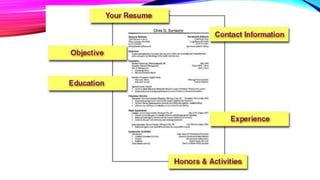
 Identify Yourself
 Education
 Continuing Education
 Work or Professional Experience
 Volunteer Experience
 Activities
 Computer Skills
 Professional Associations
 Optional Sections
Objective
Special Skills and Abilities
Reference Statement
Characteristics Of A
Successful Resume
• Focuses on skills. Uses action words to define the
responsibilities of your job-related experience.
• Easy to read and understand.
• Visually powerful and free of gimmicks.
• One page, or at most 2 pages long.
• Language is grammatically correct.
• Spelling has been checked.
• Formal Style
• Must always be 100% truth.
Summary of sections
• Name
• Address, telephone number, e-mail address
• Objective
• Education
• Experience
• Achievements and awards
• Skills
• Professional affiliations
• Publications or projects
Optional
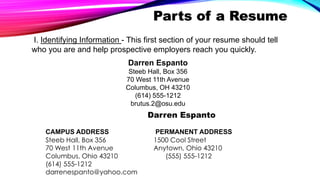
Parts of a Resume
I. Identifying Information - This first section of your resume should tell
who you are and help prospective employers reach you quickly.
Darren Espanto
Steeb Hall, Box 356
70 West 11th Avenue
Columbus, OH 43210
(614) 555-1212
brutus.2@osu.edu
Darren Espanto
CAMPUS ADDRESS PERMANENT ADDRESS
Steeb Hall, Box 356 1500 Cool Street
70 West 11th Avenue Anytown, Ohio 43210
Columbus, Ohio 43210 (555) 555-1212
(614) 555-1212
darrenespanto@yahoo.com
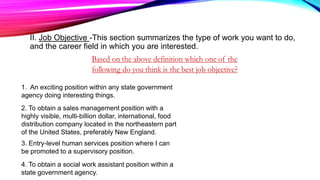
II. Job Objective -This section summarizes the type of work you want to do,
and the career field in which you are interested.
1. An exciting position within any state government
agency doing interesting things.
2. To obtain a sales management position with a
highly visible, multi-billion dollar, international, food
distribution company located in the northeastern part
of the United States, preferably New England.
3. Entry-level human services position where I can
be promoted to a supervisory position.
4. To obtain a social work assistant position within a
state government agency.
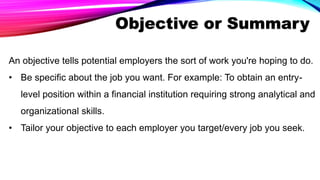
Objective or Summary
An objective tells potential employers the sort of work you're hoping to do.
• Be specific about the job you want. For example: To obtain an entry-
level position within a financial institution requiring strong analytical and
organizational skills.
• Tailor your objective to each employer you target/every job you seek.
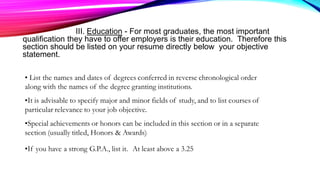
III. Education - For most graduates, the most important
qualification they have to offer employers is their education. Therefore this
section should be listed on your resume directly below your objective
statement.
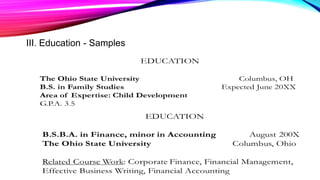
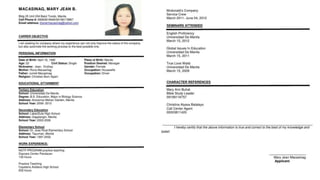
III. Education - Samples
Education
New graduates without a lot of work experience should list their
educational information first. Alumni can list it after the work experience
section.
 Your most recent educational information is listed first.
 Include your degree (A.S., B.S., B.A., etc.), major, institution
attended, minor/concentration.
 Add your grade point average (GPA) if it is higher than 3.0.
 Mention academic honors.
IV. Experience - For each work experience, list your position title,
the name of the organization your worked for, and the dates you worked.
Then follow with a description of the work performed.
Winning Formula: action + object + outcomes
• The more that a past experiences is related to the work you are seeking the
more space you should allot to its description.
• When possible, note any achievements or key lessons learned from your
experiences.
• Highlight what you have done in a concise, powerful, action-oriented way.
• Since position titles usually do not do justice to the work performed, it is
advisable to highlight the functions for which you were responsible.
Work Experience
Briefly give the employer an overview of work that has taught you
skills. Use action words to describe your job duties. Include your
work experience in reverse chronological order—that is, put your
last job first and work backward to your first, relevant job. Include:
• Title of position,
• Name of organization
• Location of work (town, state)
• Dates of employment
• Describe your work responsibilities with emphasis on specific
skills and achievements.
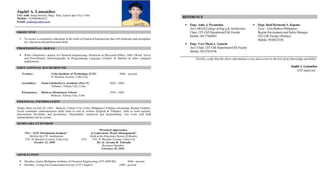
IV. Experience -Samples
Social Service Work Experience
Franklin County Children Services Columbus, OH
Social Service Assistant Summer 200X
o Assessed families’ needs establishing their eligibility for benefits and services such
as food stamps, Medicaid, Welfare and transportation.
o Monitored and kept case records on clients from different ethnic backgrounds,
reporting progress to supervisor and case manager.
o Visited clients’ homes providing emotional support and making sure their services
were being received.
o Assisted children ages 5-8 in need of counseling or crisis intervention, making
successful referrals.
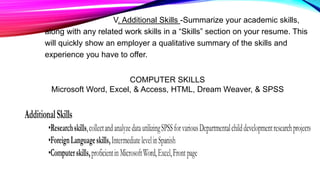
V. Additional Skills -Summarize your academic skills,
along with any related work skills in a “Skills” section on your resume. This
will quickly show an employer a qualitative summary of the skills and
experience you have to offer.
COMPUTER SKILLS
Microsoft Word, Excel, & Access, HTML, Dream Weaver, & SPSS
Use the skills section
Software programs and proficiency (Word, PowerPoint, Excel, FrontPage,
AutoCad …)
Programming languages (include Visual Basic, HTML, PHP, …)
Abilities (based on experience)
Languages and language ability
Achievements and awards
 Dean’s list
 Scholarships
 Grants
 Prizes
 Nominations
 Professional societies
 Significant accomplishments
 Committees and leadership roles
 References are individuals who can attest to your
qualifications for a particular position, people who can
discuss your skills and attributes.
 Create a separate page to use for listing your references.
 You should select 3 to 5 people to serve as your
references and list them in the order you want them to be
contacted.
Presentation:Create an
effective layout
• Try to interest your reader visually
• A clean, professional format with a little style
• Extra white space makes it easy to read – set margins
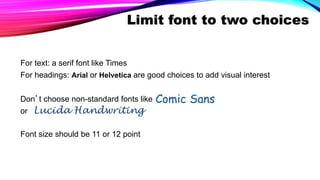
Limit font to two choices
For text: a serif font like Times
For headings: Arial or Helvetica are good choices to add visual interest
Don’t choose non-standard fonts like
or
Font size should be 11 or 12 point
Write concisely and vigorously
• A focused, targeted resume is best:
Avoid the temptation to go more than one page
Delete obvious information in order to highlight your unique
qualities
• Find specific, dynamic verbs:
Use present (or past) imperatives
Include each verb only once
Consult online lists of “resume action words”
Final thoughts …
Choose the correct tense and use it consistently
Do not ask for a particular salary
Be accurate and honest
Print it out! Do not attempt to proofread on screen
WHAT IS A COVER LETTER?
• A cover letter is a letter sent alongside your resume
to introduce yourself, explain why you are sending in
your resume, and provide more information about
yourself.
COVER LETTERS
• The purpose of a cover letter is to tell a prospective employer
what you can do and why you feel you are qualified.
• It is an opportunity to demonstrate your writing skills and it
opens a window to your personality.
• A good-well planned cover letter is just as important as an
impressive resume, and together they form an important
resource in your job campaign.
LETTER OF APPLICATION “LOA”
(COVER LETTER INFORMATION)
• 3-4 paragraphs in length
(MAX) stating your interest
in the position and just a bit
of an overview of why you
are qualified for the position.
• Average view is 4.2 seconds
for a committee to look at a
cover letter – be brief (but
efficient)
• Use “power words” in your
letter – same as your resume
WHAT’S THE POINT OF
A COVER LETTER?
• Introduce yourself
• Cover letters should carry a message about you
• Get you noticed
• Project the desired image of you or your business
• Convey special information
• Highlight accomplishments
• Get employers, award judges and scholarship committees to read your resume
LETTER OF APPLICATION “LOA”
(COVER LETTER INFORMATION)
• Dear…“Mr., Dr., Mrs., Ms.,
Professor, Committee
Chair, Human Resources
Rep, etc… (what and to
whom you address?) –
DO YOUR RESEARCH on
the organization – don’t
settle for anything less
than a name!
KEYS TO EFFECTIVE COVER LETTERS
• Tell the employers what you can do for the company,
instead of what the company can do for you.
• Find out about the employer’s needs, then emphasize what
you can do to meet their needs.
• Consider how your work experience, education, and/or
personal qualities would be helpful to the employer.
STYLISH COVER LETTERS
• Block Style
• All lines start on the left side of the margin
• No indentations
• Modified Block Style
• Uses indentations
• Each paragraph is indented, as well as the
beginning information and the close
YOU SHOULD INCLUDE…
• Your address and the date the letter
was written
• The name and address of the person to
whom the letter is being sent
• A salutation (Dear ____:)
• The body of the letter
• A complimentary close and signature
• A title of respect, such as Dr., Mr., or
Ms.
• A return address and zip code
• Can also include reference initials,
enclosure notifications (such as your
resume), copy and postscript
WRITING STYLE- COVER LETTER
• It’s addressed to a specific individual.
• It’s grabs the reader’s attention in the
first paragraph.
• It sounds confident without being
arrogant.
• It’s no longer than one page.
• It answers the question: “Why should
we hire you?”
• It’s action oriented.
• It uses the first person (“I”) sparingly.
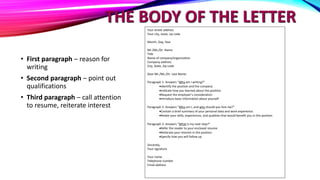
THE BODY OF THE LETTER
• First paragraph – reason for
writing
• Second paragraph – point out
qualifications
• Third paragraph – call attention
to resume, reiterate interest
Your street address
Your city, state, zip code
Month, Day, Year
Mr./Ms./Dr. Name
Title
Name of company/organization
Company address
City, State, Zip code
Dear Mr./Ms./Dr. Last Name:
Paragraph 1: Answers “Why am I writing?”
Identify the position and the company
Indicate how you learned about the position
Request the employer’s consideration
Introduce basic information about yourself
Paragraph 2: Answers “Who am I, and why should you hire me?”
Contain a brief summary of your personal data and work experience.
Relate your skills, experiences, and qualities that would benefit you in this position
Paragraph 3: Answers “What is my next step?”
Refer the reader to your enclosed resume
Reiterate your interest in the position
Specify how you will follow up
Sincerely,
Your signature
Your name
Telephone number
Email address
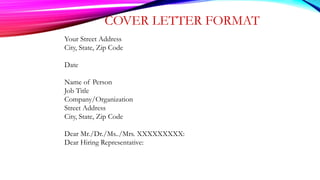
COVER LETTER FORMAT
Your Street Address
City, State, Zip Code
Date
Name of Person
Job Title
Company/Organization
Street Address
City, State, Zip Code
Dear Mr./Dr./Ms../Mrs. XXXXXXXXX:
Dear Hiring Representative:
7007 Chestnut Street
Columbus, OH 43210
February 4, 200X
Dr. Rose Smith
Villa Rosa
56 Northeast Avenue
Dublin, OH 43444
Dear Dr. Smith:
writing an effective resume and application letter

writing an effective resume and application letter

  • 2.
    What is resume? Aresume is a short, concise document that states relevant information regarding your education, skills, experiences, accomplishments, and job-related interests.  It is a quick advertisement of who you are.
  • 3.
    What is thePurpose of a Resume?  is to attract the attention of the employer and impress them so much that they want to have either a face-to-face or telephone interview with you so that they can learn more about your qualifications for the job.  is to provide a summary of your skills, abilities and accomplishments.  is a marketing piece that presents you in the best possible light.
  • 4.
    • Before youwrite, take time to do a self- assessment on paper. Outline your skills and abilities as well as your work experience and extracurricular activities. This will make it easier to prepare a thorough resume. Resume Essentials
  • 5.
    What Information Should BeIn A Resume?  Identify Yourself  Education  Continuing Education  Work or Professional Experience  Volunteer Experience  Activities  Computer Skills  Professional Associations  Optional Sections Objective Special Skills and Abilities Reference Statement
  • 6.
    Characteristics Of A SuccessfulResume • Focuses on skills. Uses action words to define the responsibilities of your job-related experience. • Easy to read and understand. • Visually powerful and free of gimmicks. • One page, or at most 2 pages long. • Language is grammatically correct. • Spelling has been checked. • Formal Style • Must always be 100% truth.
  • 7.
    Summary of sections •Name • Address, telephone number, e-mail address • Objective • Education • Experience • Achievements and awards • Skills • Professional affiliations • Publications or projects Optional
  • 8.
    Parts of aResume I. Identifying Information - This first section of your resume should tell who you are and help prospective employers reach you quickly. Darren Espanto Steeb Hall, Box 356 70 West 11th Avenue Columbus, OH 43210 (614) 555-1212 brutus.2@osu.edu Darren Espanto CAMPUS ADDRESS PERMANENT ADDRESS Steeb Hall, Box 356 1500 Cool Street 70 West 11th Avenue Anytown, Ohio 43210 Columbus, Ohio 43210 (555) 555-1212 (614) 555-1212 darrenespanto@yahoo.com
  • 9.
    II. Job Objective-This section summarizes the type of work you want to do, and the career field in which you are interested. 1. An exciting position within any state government agency doing interesting things. 2. To obtain a sales management position with a highly visible, multi-billion dollar, international, food distribution company located in the northeastern part of the United States, preferably New England. 3. Entry-level human services position where I can be promoted to a supervisory position. 4. To obtain a social work assistant position within a state government agency.
  • 10.
    Objective or Summary Anobjective tells potential employers the sort of work you're hoping to do. • Be specific about the job you want. For example: To obtain an entry- level position within a financial institution requiring strong analytical and organizational skills. • Tailor your objective to each employer you target/every job you seek.
  • 11.
    III. Education -For most graduates, the most important qualification they have to offer employers is their education. Therefore this section should be listed on your resume directly below your objective statement.
  • 12.
  • 13.
    Education New graduates withouta lot of work experience should list their educational information first. Alumni can list it after the work experience section.  Your most recent educational information is listed first.  Include your degree (A.S., B.S., B.A., etc.), major, institution attended, minor/concentration.  Add your grade point average (GPA) if it is higher than 3.0.  Mention academic honors.
  • 14.
    IV. Experience -For each work experience, list your position title, the name of the organization your worked for, and the dates you worked. Then follow with a description of the work performed. Winning Formula: action + object + outcomes • The more that a past experiences is related to the work you are seeking the more space you should allot to its description. • When possible, note any achievements or key lessons learned from your experiences. • Highlight what you have done in a concise, powerful, action-oriented way. • Since position titles usually do not do justice to the work performed, it is advisable to highlight the functions for which you were responsible.
  • 15.
    Work Experience Briefly givethe employer an overview of work that has taught you skills. Use action words to describe your job duties. Include your work experience in reverse chronological order—that is, put your last job first and work backward to your first, relevant job. Include: • Title of position, • Name of organization • Location of work (town, state) • Dates of employment • Describe your work responsibilities with emphasis on specific skills and achievements.
  • 16.
    IV. Experience -Samples SocialService Work Experience Franklin County Children Services Columbus, OH Social Service Assistant Summer 200X o Assessed families’ needs establishing their eligibility for benefits and services such as food stamps, Medicaid, Welfare and transportation. o Monitored and kept case records on clients from different ethnic backgrounds, reporting progress to supervisor and case manager. o Visited clients’ homes providing emotional support and making sure their services were being received. o Assisted children ages 5-8 in need of counseling or crisis intervention, making successful referrals.
  • 17.
    V. Additional Skills-Summarize your academic skills, along with any related work skills in a “Skills” section on your resume. This will quickly show an employer a qualitative summary of the skills and experience you have to offer. COMPUTER SKILLS Microsoft Word, Excel, & Access, HTML, Dream Weaver, & SPSS
  • 18.
    Use the skillssection Software programs and proficiency (Word, PowerPoint, Excel, FrontPage, AutoCad …) Programming languages (include Visual Basic, HTML, PHP, …) Abilities (based on experience) Languages and language ability
  • 20.
    Achievements and awards Dean’s list  Scholarships  Grants  Prizes  Nominations  Professional societies  Significant accomplishments  Committees and leadership roles
  • 21.
     References areindividuals who can attest to your qualifications for a particular position, people who can discuss your skills and attributes.  Create a separate page to use for listing your references.  You should select 3 to 5 people to serve as your references and list them in the order you want them to be contacted.
  • 22.
    Presentation:Create an effective layout •Try to interest your reader visually • A clean, professional format with a little style • Extra white space makes it easy to read – set margins
  • 23.
    Limit font totwo choices For text: a serif font like Times For headings: Arial or Helvetica are good choices to add visual interest Don’t choose non-standard fonts like or Font size should be 11 or 12 point
  • 24.
    Write concisely andvigorously • A focused, targeted resume is best: Avoid the temptation to go more than one page Delete obvious information in order to highlight your unique qualities • Find specific, dynamic verbs: Use present (or past) imperatives Include each verb only once Consult online lists of “resume action words”
  • 25.
    Final thoughts … Choosethe correct tense and use it consistently Do not ask for a particular salary Be accurate and honest Print it out! Do not attempt to proofread on screen
  • 31.
    WHAT IS ACOVER LETTER? • A cover letter is a letter sent alongside your resume to introduce yourself, explain why you are sending in your resume, and provide more information about yourself.
  • 32.
    COVER LETTERS • Thepurpose of a cover letter is to tell a prospective employer what you can do and why you feel you are qualified. • It is an opportunity to demonstrate your writing skills and it opens a window to your personality. • A good-well planned cover letter is just as important as an impressive resume, and together they form an important resource in your job campaign.
  • 33.
    LETTER OF APPLICATION“LOA” (COVER LETTER INFORMATION) • 3-4 paragraphs in length (MAX) stating your interest in the position and just a bit of an overview of why you are qualified for the position. • Average view is 4.2 seconds for a committee to look at a cover letter – be brief (but efficient) • Use “power words” in your letter – same as your resume
  • 34.
    WHAT’S THE POINTOF A COVER LETTER? • Introduce yourself • Cover letters should carry a message about you • Get you noticed • Project the desired image of you or your business • Convey special information • Highlight accomplishments • Get employers, award judges and scholarship committees to read your resume
  • 35.
    LETTER OF APPLICATION“LOA” (COVER LETTER INFORMATION) • Dear…“Mr., Dr., Mrs., Ms., Professor, Committee Chair, Human Resources Rep, etc… (what and to whom you address?) – DO YOUR RESEARCH on the organization – don’t settle for anything less than a name!
  • 36.
    KEYS TO EFFECTIVECOVER LETTERS • Tell the employers what you can do for the company, instead of what the company can do for you. • Find out about the employer’s needs, then emphasize what you can do to meet their needs. • Consider how your work experience, education, and/or personal qualities would be helpful to the employer.
  • 37.
    STYLISH COVER LETTERS •Block Style • All lines start on the left side of the margin • No indentations • Modified Block Style • Uses indentations • Each paragraph is indented, as well as the beginning information and the close
  • 38.
    YOU SHOULD INCLUDE… •Your address and the date the letter was written • The name and address of the person to whom the letter is being sent • A salutation (Dear ____:) • The body of the letter • A complimentary close and signature • A title of respect, such as Dr., Mr., or Ms. • A return address and zip code • Can also include reference initials, enclosure notifications (such as your resume), copy and postscript
  • 39.
    WRITING STYLE- COVERLETTER • It’s addressed to a specific individual. • It’s grabs the reader’s attention in the first paragraph. • It sounds confident without being arrogant. • It’s no longer than one page. • It answers the question: “Why should we hire you?” • It’s action oriented. • It uses the first person (“I”) sparingly.
  • 40.
    THE BODY OFTHE LETTER • First paragraph – reason for writing • Second paragraph – point out qualifications • Third paragraph – call attention to resume, reiterate interest Your street address Your city, state, zip code Month, Day, Year Mr./Ms./Dr. Name Title Name of company/organization Company address City, State, Zip code Dear Mr./Ms./Dr. Last Name: Paragraph 1: Answers “Why am I writing?” Identify the position and the company Indicate how you learned about the position Request the employer’s consideration Introduce basic information about yourself Paragraph 2: Answers “Who am I, and why should you hire me?” Contain a brief summary of your personal data and work experience. Relate your skills, experiences, and qualities that would benefit you in this position Paragraph 3: Answers “What is my next step?” Refer the reader to your enclosed resume Reiterate your interest in the position Specify how you will follow up Sincerely, Your signature Your name Telephone number Email address
  • 41.
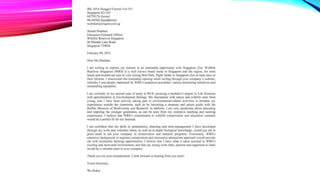
    COVER LETTER FORMAT YourStreet Address City, State, Zip Code Date Name of Person Job Title Company/Organization Street Address City, State, Zip Code Dear Mr./Dr./Ms../Mrs. XXXXXXXXX: Dear Hiring Representative:
  • 42.
    7007 Chestnut Street Columbus,OH 43210 February 4, 200X Dr. Rose Smith Villa Rosa 56 Northeast Avenue Dublin, OH 43444 Dear Dr. Smith: