



Competence AssessmentWorkshop Ulrik Romme Akademikernes
AGENDA 
The Labourmarket for academics just now 
How to get the first job 
Competence – a model 
Exercises x 4 
Tips and tricks 
Questions 
AKADEMIKERE SKABER VÆKST
25 ORD OM ULRIK ROMME 
1996 - 2002: Konsulent og sekretariatschef hos Magistrenes Jobservice 
2002 - 2003: Projektmedarbejder i dimittendundersøgelse på RUC og AAU 
2003 - 2006: Chefkonsulent og udviklingschef hos Civiløkonomnerne A-kasse (CA) 
2006 – 2013: Chefkonsulent og afdelingsleder i jobafdelingen hos Akademikernes A-kasse 
Sept. 2013: Key Account Manager i Akademikernes. Med ansvar for kontakt til universiteter og fokus op dimittendledighed
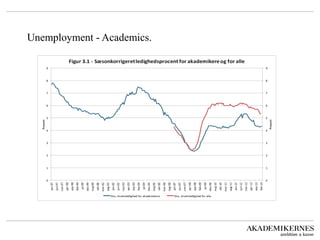
Unemployment - Academics. 
90 
95 
100 
105 
110 
115 
120 
125 
2005 
2006 
2007 
2008 
2009 
2010 
2011 
2012 
2005 = 100 
Akademikernes-medlemmer 
A-kasse-medlemmer i alt i Danmark
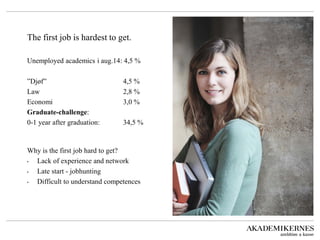
The first job is hardest to get. 
Unemployed academics i aug.14: 4,5 % 
”Djøf” 4,5 % 
Law 2,8 % 
Economi 3,0 % 
Graduate-challenge: 
0-1 year after graduation: 34,5 % 
Why is the first job hard to get? 
•Lack of experience and network 
•Late start - jobhunting 
•Difficult to understand competences
Trends 
•Lower unemployment, but increasing graduate- unemployment 
•No growth in public sector, but big potential in SME 
•”Djøfisering” – more jobs demand high education 
•Communication and ”understanding business” are important skills. 
•Esbjerg is hot
Shortcuts to your first job 
•Relevant study-jobs 
•Internship or cooperation with a company on thesis or project 
•Voluntary work. E.g. experience in communication, organisation or fundraising 
•Fundrais your own job 
•Start your own company – sell your knowhow on consulant basis.
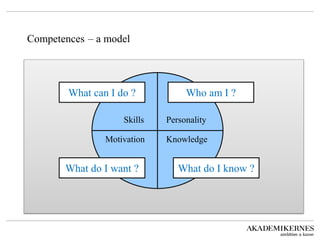
Competences – a model 
Personality 
Knowledge 
Skills 
Motivation 
What can I do ? 
What do I want ? 
Who am I ? 
What do I know ?
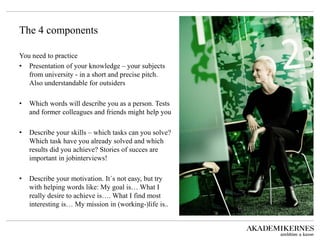
The 4 components 
You need to practice 
• 
Presentation of your knowledge – your subjects from university - in a short and precise pitch. Also understandable for outsiders 
• 
Which words will describe you as a person. Tests and former colleagues and friends might help you 
• 
Describe your skills – which tasks can you solve? Which task have you already solved and which results did you achieve? Stories of succes are important in jobinterviews! 
• 
Describe your motivation. It´s not easy, but try with helping words like: My goal is… What I really desire to achieve is…. What I find most interesting is… My mission in (working-)life is..
Knowledge Find a person that does not know the subjects your are studying. Explain what you learnt in your studies so far. Try to be short and precise. Now ask the other person to retell what he or she heard.
Personality Groups of 3 persons. Tell a true ”case of succes” from work, study or spare time Two persons listen (appreciative inquiry) When ever you hear a compence – write in on a post-it
Personality 
•Difficult to describe 
•Expect to give examples during interview 
•Tests 
•Referencer 
•Ask friends and colleagues 
•Cases where you had succes. They make you cedible and easier to remember.
Skills Form a group with students from your own subject You are now a small consultant-company Which task will you sell and to which costumer?
MOTIVATION Gør følgende sætninger færdige: Jeg trives med…… Jeg brænder for …… Missionen med mit arbejde er ……..
Important tips… 
• Find the right words for your profile 
• Find different cv´s on the web and be inspired 
• Application is ”future” cv is ”past” 
• Remember to analyse and research on job-add´s 
• Prepare stories of succes for your interview 
• Unsolicited application – look for information rather than just sell yourself 
AKADEMIKERE SKABER VÆKST

Competence Assessment Workshop Slides (27.10.14)

  • 1.
  • 2.
    AGENDA The Labourmarketfor academics just now How to get the first job Competence – a model Exercises x 4 Tips and tricks Questions AKADEMIKERE SKABER VÆKST
  • 3.
    25 ORD OMULRIK ROMME 1996 - 2002: Konsulent og sekretariatschef hos Magistrenes Jobservice 2002 - 2003: Projektmedarbejder i dimittendundersøgelse på RUC og AAU 2003 - 2006: Chefkonsulent og udviklingschef hos Civiløkonomnerne A-kasse (CA) 2006 – 2013: Chefkonsulent og afdelingsleder i jobafdelingen hos Akademikernes A-kasse Sept. 2013: Key Account Manager i Akademikernes. Med ansvar for kontakt til universiteter og fokus op dimittendledighed
  • 4.
    Unemployment - Academics. 90 95 100 105 110 115 120 125 2005 2006 2007 2008 2009 2010 2011 2012 2005 = 100 Akademikernes-medlemmer A-kasse-medlemmer i alt i Danmark
  • 5.
    The first jobis hardest to get. Unemployed academics i aug.14: 4,5 % ”Djøf” 4,5 % Law 2,8 % Economi 3,0 % Graduate-challenge: 0-1 year after graduation: 34,5 % Why is the first job hard to get? •Lack of experience and network •Late start - jobhunting •Difficult to understand competences
  • 6.
    Trends •Lower unemployment,but increasing graduate- unemployment •No growth in public sector, but big potential in SME •”Djøfisering” – more jobs demand high education •Communication and ”understanding business” are important skills. •Esbjerg is hot
  • 7.
    Shortcuts to yourfirst job •Relevant study-jobs •Internship or cooperation with a company on thesis or project •Voluntary work. E.g. experience in communication, organisation or fundraising •Fundrais your own job •Start your own company – sell your knowhow on consulant basis.
  • 8.
    Competences – amodel Personality Knowledge Skills Motivation What can I do ? What do I want ? Who am I ? What do I know ?
  • 9.
    The 4 components You need to practice • Presentation of your knowledge – your subjects from university - in a short and precise pitch. Also understandable for outsiders • Which words will describe you as a person. Tests and former colleagues and friends might help you • Describe your skills – which tasks can you solve? Which task have you already solved and which results did you achieve? Stories of succes are important in jobinterviews! • Describe your motivation. It´s not easy, but try with helping words like: My goal is… What I really desire to achieve is…. What I find most interesting is… My mission in (working-)life is..
  • 10.
    Knowledge Find aperson that does not know the subjects your are studying. Explain what you learnt in your studies so far. Try to be short and precise. Now ask the other person to retell what he or she heard.
  • 11.
    Personality Groups of3 persons. Tell a true ”case of succes” from work, study or spare time Two persons listen (appreciative inquiry) When ever you hear a compence – write in on a post-it
  • 12.
    Personality •Difficult todescribe •Expect to give examples during interview •Tests •Referencer •Ask friends and colleagues •Cases where you had succes. They make you cedible and easier to remember.
  • 13.
    Skills Form agroup with students from your own subject You are now a small consultant-company Which task will you sell and to which costumer?
  • 14.
    MOTIVATION Gør følgendesætninger færdige: Jeg trives med…… Jeg brænder for …… Missionen med mit arbejde er ……..
  • 15.
    Important tips… •Find the right words for your profile • Find different cv´s on the web and be inspired • Application is ”future” cv is ”past” • Remember to analyse and research on job-add´s • Prepare stories of succes for your interview • Unsolicited application – look for information rather than just sell yourself AKADEMIKERE SKABER VÆKST